 MuleSoft
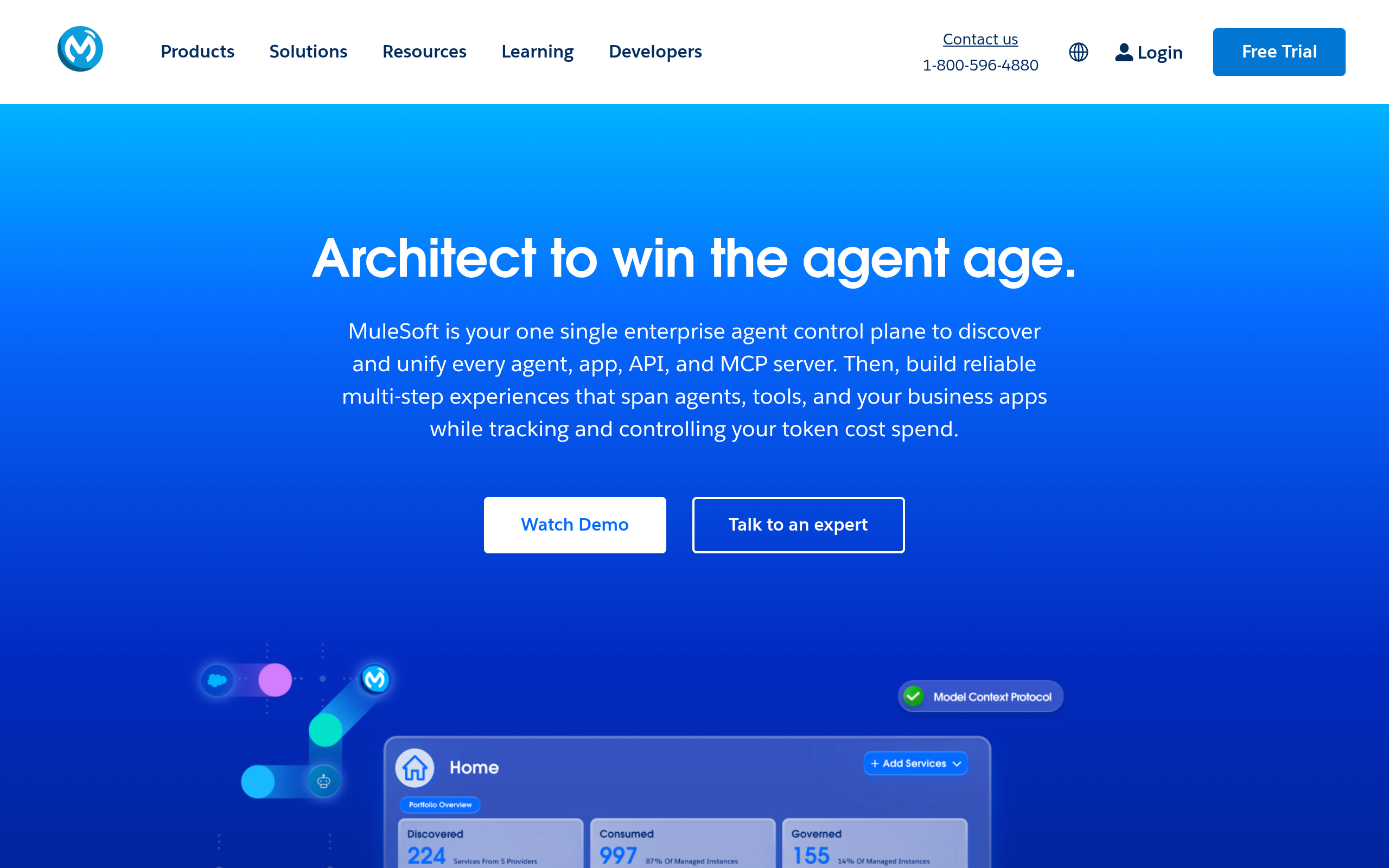
MuleSoft is an enterprise-level integration platform under Salesforce, providing Anypoint Platform for API design, integration and AI workflow orchestration.
MuleSoft
Core parameters and statistics
| Projects | Data |
|---|---|
| Product positioning | Enterprise-level integration and API full life cycle management platform |
| Group | Salesforce |
| Core Platform | Anypoint Platform |
| Key components | Runtime, Exchange, Design Center, API Manager, Flex Gateway |
| Corporate Customers | Thousands of large global companies (including 60%+ of the Fortune 500) |
| Compliance Certification | SOC 2 Type II, HIPAA, PCI DSS, GDPR, FedRAMP |
| Supported languages | English is the main language, and the management interface supports multiple languages |
| Deployment models | Cloud SaaS, private deployment, hybrid deployment |
| Number of connectors | 200+ pre-built connectors |
| Global Data Centers | AWS/Azure/GCP Multi-Region |
| Typical vCore size | 1-32 vCore (elastic expansion on demand) |
MuleSoft is known for its "API-led integration" methodology, which emphasizes building an integrated asset network through reusable APIs and connectors rather than point-to-point monolithic processes. It ranks among the three leading platforms in the global integration market with Workato and Boomi, and is in the Leader quadrant in the Gartner 2025 iPaaS Magic Quadrant.
The architectural design of Anypoint Platform is different from the "hub and spoke" model of the traditional ESB (Enterprise Service Bus), adopting a decentralized API asset network - each API is both a consumer and a provider, and assets can be reused across departments and projects in Exchange. The runtime component supports deployment and operation on any infrastructure (physical machine VM, Kubernetes, Cloud Foundry), and cooperates with Flex Gateway to execute security policies on the edge side, forming an architectural pattern of "unified control plane + decentralized data plane".
In terms of performance indicators, MuleSoft's Runtime Engine can support thousands of transactions per second (TPS) in regular enterprise scenarios. The specific throughput depends on vCore allocation, network topology and transformation complexity. For high-throughput scenarios (such as real-time payment IoT event streams), Flex Gateway needs to be used for traffic shaping and current limiting protection. Anypoint Monitoring provides end-to-end transaction tracking capabilities, which can locate the time-consuming distribution of a single API call in mapping conversion, connector calling, and system response.
User and market recognition
Market position
MuleSoft is a leader in the enterprise integration market. In Gartner's 2025 Magic Quadrant for Enterprise Integration Platforms as a Service (iPaaS), MuleSoft is in the Leader quadrant in both dimensions of ability to execute and completeness of vision, alongside its main competitors Workato and Boomi. In the Forrester Wave's evaluation of API management solutions, MuleSoft also received the highest score for its comprehensive API lifecycle management capabilities.
As of 2026, MuleSoft has more than 3,000 paying enterprise customers worldwide, covering key industries such as financial services, healthcare, retail, manufacturing, and government. Typical customers include: Coca-Cola, Unilever, General Electric, Siemens, HSBC, Pfizer and other world-renowned companies. The number of customers within the Salesforce ecosystem is even larger - because it belongs to the same group as Salesforce, MuleSoft's penetration rate in the Salesforce customer base continues to grow.
Large-scale implementation practice
- Coca-Cola: Used MuleSoft to integrate the ERP systems of 200+ bottling partners around the world to achieve unified visualization of supply chain data and shorten the integration development cycle from 6 months to 6 weeks.
- Unilever: Connected Salesforce instances in 14 different regions and 30+ local systems through Anypoint Platform to achieve a global unified view of customer data, with an API reuse rate of 60%+.
- Siemens: Based on the MindSphere industrial IoT platform, MuleSoft is used to connect OT and IT systems, connect device data and enterprise back-end ERP, and average daily API calls exceed 20 million times.
Comparison of competitive advantages
| Dimensions | MuleSoft | Workato | Boomi |
|---|---|---|---|
| Core methodology | API-led integration (three-tier API architecture) | Automation first for business users | Unified platform + Atom architecture |
| AI Depth | AI Mapping Suggestions + API Recommendations | AI Recipe Generation + Copilot | AI Boomi Suggest + Bots |
| Connector richness | 200+ pre-built connectors | 1,500+ community connectors | 300+ connectors |
| Open Ecosystem | Strong (API Exchange Market) | Medium (Community Recipe Library) | Medium (Boomi Boomiverse) |
| Salesforce Integration | Native Deep Integration (Same Group) | Standard Connectors | Standard Connectors |
| Private deployment | Supported (Anypoint Runtime can be hosted) | Not supported (Pure SaaS) | Supported (Atom local deployment) |
| Typical annual fee range | US$50,000-500,000 | US$10,000-300,000 | US$30,000-400,000 |
| Learning Curve | Steeper (requires DataWeave and API-led architecture training) | Flat (low-code recipe) | Moderate (Process Designer drag and drop) |
| Applicable enterprise size | Medium and large enterprises (500+ people) | Small and medium-sized enterprises to large enterprises | Mainly medium-sized enterprises |
Cost advantage
MuleSoft's total cost of ownership (TCO) needs to be comprehensively evaluated from four dimensions: infrastructure, licensing, manpower, and deferred delivery. Compared with self-built integration solutions, MuleSoft can reduce integration development and operation and maintenance costs by 40%-60% in large-scale integration scenarios.
Enterprise Level Licensing Cost
MuleSoft adopts a dual-dimensional billing model based on vCore (virtual computing core) and API call volume:
- Professional Edition (Gold): The annual fee is about US$50,000-200,000, suitable for department-level integration projects, including 1-4 vCore licenses, and a limited number of connectors.
- Enterprise Edition (Platinum): Customized quotation, the annual fee is usually between US$200,000 and US$500,000, including Flex Gateway, advanced SLA, unlimited connectors, and unlimited API calls.
- AI add-on module: AI mapping recommendation and API recommendation functions require additional payment based on usage and are sold as independent add-on modules.
Hidden Cost Tip: The cost of team training brought about by MuleSoft’s learning curve cannot be ignored. A typical MuleSoft development engineer requires 4-8 weeks of system training to independently complete integrated development, and enterprises need to set aside a training budget for this. In addition, the infrastructure hosting fees for Runtime (if you manage the Kubernetes cluster yourself) will add additional operational costs. API calls that exceed the license are billed at overage rates. Professional version users especially need to pay attention to the call volume limit.
API/Developer Cost
For API developers, Anypoint Platform's Design Center provides API design tools based on RAML or OAS specifications to reduce cross-team coordination costs in the design phase. DataWeave’s AI mapping recommendations can reduce a single data mapping task from 2-3 hours to 15-30 minutes. As an internal API asset market, Anypoint Exchange helps developers reuse existing integration patterns and connector configurations to avoid reinventing the wheel.
Cost optimization suggestions
- Utilize Exchange asset reuse: Establish an internal API asset library, reduce repeated development through the reuse capability of Exchange, and increase integrated development efficiency by 2-3 times.
- Flex Gateway reduces gateway costs: Use Flex Gateway to replace traditional hardware API gateways, move security policy execution from the central proxy to the edge, and reduce the license fees and operation and maintenance complexity of the central gateway.
- vCore planned auto-scaling: Adjust vCore allocation by observing actual API call peaks and average load. MuleSoft supports dynamic expansion and contraction of vCore (enterprise edition authorization required) to avoid resource waste caused by peak configuration.
- Long-Term Subscription Discount: For long-term commitments of 3+ years, MuleSoft offers significant discounts (usually 15%-25% off), which can significantly reduce the average annual cost.
Main functions
MuleSoft's core capabilities revolve around the Anypoint Platform, but the synergy between functions is its real value.
Function 1: Anypoint Platform unified control plane
This is the central system for all operations of MuleSoft, integrating the full life cycle management capabilities of API design, development, testing, deployment, management, and monitoring. Anypoint Platform integrates API Manager, Design Center, Exchange, Monitoring and other subsystems into a single sign-on and unified permission control system.
Expert view: The unification of the control plane itself is not a selling point. The real value lies in the data connectivity between functions - after the API specification design is completed in the Design Center, Exchange automatically generates a reusable API asset catalog, API Manager deploys security policies simultaneously, and Monitoring automatically configures corresponding transaction tracking, achieving one-time configuration and full-link effectiveness. This synergy of "design as assets and assets as management" enables Anypoint Platform to have natural organizational memory capabilities in enterprise-level API management scenarios.
Function 2: Three-layer asset model of API-led architecture
Deconstruct the integration into system API (connecting underlying systems such as SAP and Oracle), process API (arranging business logic such as order processing process) and experience API (terminal-oriented such as mobile data interface).
Expert View: The real advantage of the three-tier architecture is revealed in the change storm scenario - when an underlying system (such as ERP upgraded from SAP ECC to S/4HANA) changes, only the corresponding mapping of the system API layer needs to be modified, and the 10 experience APIs on the upper layer are not affected at all. In traditional point-to-point integration, a system upgrade often requires rewriting 15-20 integration processes. With API-led architecture, the scope of integrations affected by system changes shrinks from 18 to 2-3 on average.
Function 3: AI-driven intelligent mapping and recommendation (AI Integration)
This is MuleSoft’s core investment in product intelligence. Features include:
- DataWeave AI Mapping Recommendations: In the data conversion editor, AI automatically recommends mapping rules and conversion functions based on source field names, data samples and target structures, with an accuracy of 75%-90% in standard business scenarios (customers, orders, product data).
- AI API Recommendation: Automatically recommend appropriate APIs, connectors, and integration templates based on developers' descriptions of integration requirements (natural language), reducing the discovery cost of starting from scratch.
- Intelligent Error Analysis: Runtime operation logs are connected to AI analysis, automatically classify exception types (data format mismatch/insufficient permissions/connection timeout/service unavailable), and provide repair suggestions.
Expert View: The accuracy of AI mapping is greatly affected by the standardization of field naming - if the field naming style of the source system and the target system is consistent (such as customerName → Customer_Name), the AI recommendation accuracy can reach 90%+; but if it encounters abbreviated naming (such as cstNm → CUSTNAME), the accuracy will quickly drop below 50%. This means that the implementation effect of AI mapping is highly dependent on the existing level of data standardization governance of the enterprise.
Feature 4: 200+ pre-built connector ecosystem
MuleSoft offers 200+ certified connectors covering major enterprise systems: Salesforce, SAP, Oracle EBS, Workday, ServiceNow, NetSuite, MarketForce, AWS S3, and more. Each connector encapsulates the authentication method API frequency control strategy, error handling and retry logic of the corresponding system.
Expert View: The real value of a connector is not only "plug and play", but that it has built-in best practices for connecting enterprise systems - for example, the Salesforce connector automatically handles OAuth 2.0 token refresh and API throttling backoff, and the SAP connector handles the binary encoding issue of the RFC/BAPI protocol. Developers do not need to deeply understand the underlying protocol details of each target system, and can complete the connection only through the configuration interface. For custom or legacy systems (such as AS/400 green screen, mainframe COBOL interface), MuleSoft provides Anypoint Connector DevKit for custom connector development.
Function 5: Anypoint Flex Gateway
The lightweight API gateway is deployed in sidecar or independent proxy mode at the edge of any infrastructure (Kubernetes, virtual machines, bare metal), and implements unified security policies such as API authentication, flow-limiting IP whitelisting, JWT verification, and SSL termination.
Expert View: The real strategic significance of Flex Gateway is to migrate API governance from the "centralized gateway" model to the "grid edge execution" model. When the API gateway becomes the single bottleneck for all traffic, the failure radius of a centralized gateway is very large. Flex Gateway allows each API instance to independently execute security policies. The control plane (API Manager) is only responsible for policy distribution and status collection, and does not participate in data plane forwarding, thereby eliminating single points of failure and performance bottlenecks.
Model and version evolution
MuleSoft's product iteration cadence is measured in years, with each major release introducing important integration and AI capability enhancements.
Version evolution milestones
- 2017-2018: Anypoint Platform v1-v3 establishes API-led integration basic framework and launches Exchange and Design Center.
- 2019-2020: v4 introduces DataWeave 2.0 and Runtime Fabric to support Kubernetes deployment.
- 2021-2022: v5 launches enhanced versions of Anypoint Flex Gateway and API Manager, and begins to introduce machine learning-assisted traffic analysis.
- 2023-2024: The v2024 series officially commercializes AI functions. AI-assisted mapping suggestions are added to the DataWeave editor, and AI capabilities are available from the laboratory to production.
- 2025+: The v2025 series deepens AI Integration capabilities, adding AI API recommendations, intelligent error analysis, and natural language-driven integrated template search.
Version evolution details of AI functions
| Version | New AI capabilities | Maturity |
|---|---|---|
| 2024.1 | DataWeave AI-assisted mapping (field level recommended) | Beta → GA |
| 2024.2 | AI-driven anomaly root cause analysis (log pattern recognition) | Beta |
| 2025.1 | AI API Recommendation (Natural Language Description Search API/Connector) | GA |
| 2025.2 | Multi-step mapping AI optimization (end-to-end recommendation for compound transformation) | Beta |
At present, AI functions are still in the rapid iteration stage, and some advanced capabilities (such as multi-step mapping optimization, automatic generation of AI-driven integration processes) are still in the beta stage, and it is recommended to use them in conjunction with the manual review process for production-bound deployment. The collaborative integration of AI capabilities (Einstein AI) within the Salesforce ecosystem with MuleSoft AI Integration is still in progress, and future versions are expected to achieve unified orchestration of AI data pipelines across Salesforce products.
Technical advantages
MuleSoft's technical depth is reflected in its scalable runtime architecture, data conversion engine and API governance mechanism. These technical components together constitute its architectural concept of "centralized control plane and decentralized data plane".
Anypoint Runtime Engine Architecture
Runtime Engine is an execution engine for integrated processes, built on Java, and supports running on any infrastructure. At its core is a message-oriented process engine - integrated processes compiled into event-driven processing pipelines, each pipeline containing a message source (HTTP listener Scheduler, JMS consumer, etc.), a processor chain (converters, routes, connector calls) and a message target.
Architecture causal chain: Message-based asynchronous processing architecture → Naturally supports non-blocking I/O → A single vCore can process hundreds of concurrent messages at the same time → In standard enterprise scenarios, 1 vCore can support approximately 500-2,000 TPS (depending on transformation complexity and network latency). When higher throughput is required, processing capabilities can be linearly increased by horizontally scaling runtime instances (increasing the number of vCores).
DataWeave Transformation Engine
DataWeave is a dedicated language (DSL) developed by MuleSoft in the field of data conversion. It supports the mutual conversion of 20+ data formats such as JSON, XML, CSV, YAML, Avro, and Parquet. The core advantages of DataWeave compared to traditional XSLT (XML transformation) or manual coding transformations are:
- Declarative transformation logic: Developers define "what they want" rather than "how to do it", and the engine automatically derives the transformation path.
- Functional programming model: immutable data + pure functions, avoiding side effects, and the conversion results are highly deterministic.
- Type Awareness: Automatically infer data types at runtime, and provide clear error information instead of silent failure when encountering type conflicts.
- AI Enhancement: In the v2024+ version, the DataWeave editor integrates AI mapping suggestions, increasing the field-level mapping accuracy to 85%+ in standard scenarios.
Causal chain: Declarative + functional + type-aware → The conversion results are deterministic and testable → The debugging time in integrated development is shortened from 3-5 hours/day of traditional coding to 1-2 hours/day → Developer efficiency is increased by 2-3 times. But for complex multi-table related transformations (such as multi-level nested transformations of order header + line item + tax + freight), the learning curve of DataWeave will increase significantly.
Anypoint Exchange Asset Market
Exchange is MuleSoft's API and integration asset hub, allowing teams to publish, discover, and reuse APIs, connectors, templates, and integration examples across their organization. Exchange's built-in version management and dependency tracking capabilities ensure that users always reference the latest version of assets.
Collaboration with API Management: Each asset in Exchange can set the life cycle state (development → test → release → deprecation), which is automatically synchronized to the security policy configuration of API Manager. When an API asset is marked as "deprecated", API Manager automatically reminds all consumers to migrate, reducing production accidents caused by API changes.
Data governance and compliance structure
MuleSoft's compliance architecture adheres to the "no data transit" principle - when processing sensitive data (such as PII, PHI, financial transactions), private deployment of Runtime and edge execution of Flex Gateway ensure that the data is processed within the customer's own infrastructure without the need for backhauling to the MuleSoft control plane. The control plane only receives metadata and operational metrics (such as API call count, error rate, latency quantile) and does not participate in data plane forwarding.
Safety Mechanism:
- Encryption at Rest: All stored data is encrypted using AES-256.
- Transport Encryption: TLS 1.2/1.3 connections, API requests force HTTPS.
- Key Management: Support BYOK (Bring Your Own Key) and HSM integration.
- Audit Log: All administrator operations and API call changes are recorded in an untamperable audit log.
How to use
The use of MuleSoft can be divided into three main stages: platform deployment and initialization, integration process development, API management and monitoring.
Phase 1: Platform deployment and initialization
SaaS version (recommended for most scenarios):
- Visit
anypoint.mulesoft.comto register a Salesforce or MuleSoft account. - Create contexts (Development/Test/Production) in the organization, and bind different vCore resource pools to each.
- Set RBAC permissions (API administrator, integration developer, business consumer, etc. roles) in Access Management.
- Configure Runtime context: Support self-management (Runtime Fabric on K8s), CloudHub (MuleSoft hosting), and hybrid mode.
- Install Anypoint Studio (an Eclipse-based IDE) or use Web-based Design Center for clientless development.
Private deployment:
- Download the Runtime Fabric installation package and deploy it to your own Kubernetes cluster (supports OpenShift, Rancher, and self-built K8s).
- Use Helm Chart or Operator for Runtime Fabric installation and life cycle management.
- Register the vCore license and associate it with the Anypoint Platform control plane.
- Deploy Flex Gateway as the edge node of the API gateway.
Phase 2: Integrated process development
A typical workflow is as follows:
- API Design: Use RAML or OpenAPI 3.0 specifications to create API specification definitions in Design Center, which supports visual drag-and-drop modeling or code editor.
- Asset Release: After the API specification is completed, it is released to Exchange for discovery and reference by other teams.
- Connector Configuration: Select the target system connector from Exchange (e.g. Salesforce, SAP) and configure the connection parameters (endpoint URL, authentication credentials, timeout settings).
- Conversion logic: Use the DataWeave editor to define data transformation rules, and AI mapping suggestions automatically recommend field mappings. Click the "AI Suggestion" button to accept or adjust the AI recommendation results.
- Process Orchestration: Drag and drop to combine message sources, processing logic and target endpoints in Anypoint Studio to form a complete integration process.
- Test: Use the built-in Mock service to simulate the target system response and verify the correctness and boundary conditions of the process.
- Deployment: Package the process into .jar or .zip and deploy it to the Runtime environment, and API Manager will automatically register the new API endpoint simultaneously.
Phase 3: API Management and Monitoring
- API Manager: Configure current limiting policy (call limit per second/minute/day), authentication method (OAuth 2.0, JWT, Basic Auth, Client Credentials), IP whitelist and blacklist.
- Anypoint Monitoring: View the API call topology map to locate latency bottlenecks - you can expand layer by layer to the time spent on each section of a single API call: authentication time, conversion time, connector call time, and target system response time.
- Alarm configuration: Set alarm thresholds for error rate, delay P99, and abnormal fluctuations in call volume. Alarms can be pushed through email Slack and PagerDuty channels.
- Version Management: When the API needs to be changed, create a new version in Design Center, run the two versions in parallel in Exchange, and gradually migrate traffic through API Manager to reduce the risk of one-time changes.
Enablement of AI functions
Enable AI functionality in Anypoint Platform's management console (requires separate purchase of AI add-on license):
- AI Suggestion in the DataWeave editor is enabled by default. Click the "AI Suggestion" button in the mapping interface to activate it.
- AI API recommendations automatically take effect in the Exchange search bar. Enter a natural language description (such as "API to find customer order data") to get the recommended results.
Product Pricing
MuleSoft's price system belongs to the high-end echelon in the iPaaS market, but its value lies in reducing the long-term maintenance costs of system integration for enterprises.
Pricing Tier Details
| Tier | Billing basis | vCore scope | Annual fee range (USD) | Included components | Applicable scenarios |
|---|---|---|---|---|---|
| Professional (Gold) | Annual fee per vCore | 1-4 vCore | ~$50,000-$200,000 | Design Center, API Manager, 200+ Connector Exchange | Department-level integration, 1-3 integration projects |
| Enterprise Edition (Platinum) | Customized Quotation | 4-32 vCore | ~$200,000-500,000+ | Professional Edition + Flex Gateway, Advanced SLA, Unlimited API Calls, Audit Log BYOK | Enterprise-level full platform integration, multi-department sharing |
| AI Add-on | Per Usage/Per vCore | Not Standalone | Pricing by Agreement | AI Mapping Recommendations AI API Recommendations, Intelligent Error Analysis | Organizations Already Using Enterprise Edition |
Additional Fee Description:
- API calls that exceed the license are billed at overage rates (Enterprise version usually includes unlimited calls, Professional version is billed based on call volume tiers).
- Premium technical support (24/7 support + 4-hour SLA response) is available for additional purchase.
- MuleSoft training and certification courses are additional, and the MCD (MuleSoft Certified Developer) certification exam is about $300/time.
- Third-party audit and compliance reports (such as SOC 2 Type II reports) are available upon request.
Pricing comparison with competing products
| Integrated Platform | Annual Fee Getting Started | Typical Enterprise Annual Fee | Free Trial | Hidden Costs |
|---|---|---|---|---|
| MuleSoft | $50,000+/year | $200,000-500,000/year | 30-day trial | Training Runtime hosting, excess calls |
| Workato | $10,000+/year | $50,000-300,000/year | 14-day trial | Varying quality of community connectors, excessive task count |
| Boomi | $30,000+/year | $80,000-400,000/year | 30-day trial | Atom local deployment maintenance cost |
| SnapLogic | $40,000+/year | $100,000-350,000/year | 30-day trial | Custom Snap development cost |
Purchase Recommendation: MuleSoft's price/performance ratio depends on integration complexity and team size. For organizations with 3+ integration projects, requiring deep API governance, or within the Salesforce ecosystem, MuleSoft's Enterprise Edition has significant TCO advantages. For single integration scenarios or SMBs with a limited budget, Workato or Boomi may be more flexible options.
Application scenarios
Scenario 1: API standardization governance for large enterprises
Background: Large enterprises usually have 100-500+ APIs scattered in different business lines. The lack of unified specifications leads to frequent security vulnerabilities, outdated interface documents, and chaotic version management.
MuleSoft's solution: Establish a unified API control plane through Anypoint Platform, forcing all APIs to be designed according to unified RAML/OAS specifications in the Design Center. API Manager uniformly executes security policies (authentication, current limiting, auditing). Exchange serves as the API directory center, and the discoverability and governance transparency of all API assets are greatly improved.
Cost reduction and efficiency increase deduction: For a large enterprise with 300 APIs, after introducing MuleSoft's API governance: the response time for API security issues is shortened from an average of 3 days to 2 hours (deduction); the API duplication development rate is reduced by 40%-60% (deduction); the maintenance workload of API documents is reduced by 70% (deduction).
Human-in-the-loop boundary: Changes to API security policies (especially those involving production-bound traffic switching, alarm threshold adjustments, and sensitive data exposure scope modifications) must be manually reviewed and confirmed and cannot be automatically executed by AI.
Scenario 2: Salesforce deep integration and data synchronization
Background: Salesforce is usually not the only CRM or business system of the enterprise and requires two-way data synchronization with systems such as SAP Order Oracle Finance Workday HR, ServiceNow IT and other systems.
MuleSoft's solution: Use MuleSoft as a member of the Salesforce group to provide the most native Salesforce connector - supporting all operations of the Salesforce SOAP/REST/Bulk API and automatically handling Salesforce's API frequency control limits and token refresh. Through the API-led architecture, data from different systems are uniformly encapsulated into standardized APIs. Business users in Salesforce can directly consume data from these APIs without understanding the complexity of the underlying system.
Cost reduction and efficiency improvement deduction: For a typical world-class Salesforce integration project (connecting to SAP + Oracle Finance + Workday HR), traditional point-to-point integration requires a development cycle of 4-6 months. Using MuleSoft's pre-built connectors and API-led architecture, development cycles can be reduced to 6-10 weeks (gameplay). The impact scope of subsequent system changes (such as SAP S/4HANA upgrade) is reduced from 15-20 integration points to 2-3 system API mappings (reduction).
Scenario 3: Open Banking and Financial Compliance
Background: Banks need to meet the open banking compliance requirements of PSD2, HKMA, CBIRC and other regulatory agencies, and encapsulate core banking services into standardized APIs to provide to third-party service providers.
MuleSoft's solution: Encapsulate core banking functions (account query, transaction record, payment initiation) into a standardized API that complies with the OpenAPI 3.0 specification through API-led architecture. Flex Gateway enforces security policies at the edge to ensure data privacy compliance, and private deployment of Runtime ensures core banking data does not leave the bank's own infrastructure.
Compliance value: API-led architecture naturally supports API granular permission control - each third-party service provider can only access APIs and data fields within the authorization scope. The audit log records the requester, time, operation type and return result of each API call, meeting the audit requirements of regulatory agencies.
Scenario 4: Real-time collaboration of supply chain
Background: Modern supply chains involve multiple systems such as ERP, WMS (Warehouse Management System), TMS (Transportation Management System), OMS (Order Management System), etc. Data inconsistencies lead to inventory blind spots and delivery delays.
MuleSoft’s solution: Synchronize order, inventory and logistics status in real time with MuleSoft. When ERP generates a sales order, the system API automatically pushes the order data to WMS for inventory allocation, and the allocation results are updated in OMS through the process API for customer query. When the logistics status changes, the TMS's Webhook triggers the Runtime process to update the ERP and customer portal.
Key capabilities: MuleSoft's asynchronous event-driven architecture adapts to the uncertainty of supply chain scenarios - when the WMS response times out, the Runtime supports the configuration of a retry strategy (up to 3 retries + exponential backoff) and a dead letter queue to ensure that data will not be lost in the transmission link.
Scenario 5: IT operation and maintenance automation and incident response
Background: The IT operation and maintenance team needs to link monitoring alarms (Datadog/PagerDuty/Splunk) with IT service management (ServiceNow/Jira) to reduce the MTTR of incident response.
MuleSoft's solution: Automatically receive REST API calls for IT events through the ServiceNow connector, combined with the PagerDuty connector to create a duty escalation process. Standardize alert formats from different monitoring tools into a unified ITSM event structure through DataWeave transformation.
Automation Boundary: Alarm classification and event creation can be 100% automated. However, manual confirmation points must be set up for changes and repairs related to production, traffic switching of key business systems, and data repair operations, which must be reviewed by operation and maintenance engineers before execution.
Applicable people
Integration Architect
Portrait: Responsible for enterprise integration strategy formulation and technology selection, focusing on API governance, architecture standardization and asset reuse.
MuleSoft's value: API-led architecture provides a clear integration governance framework, and Exchange's asset reuse mechanism supports architects to promote the standardization and reusability of integrated assets. Flex Gateway's edge execution mode provides architects with a decentralized API gateway deployment model to avoid the performance bottleneck of a single gateway.
Prerequisite: Requires understanding of RESTful API design principles, Enterprise Integration Pattern (EIP) and basic Service Oriented Architecture (SOA) knowledge. It is recommended to complete MuleSoft’s official Anypoint Architecture training.
Integrated Development Engineer
Portrait: Developers who actually write integration processes and data conversions, focusing on development efficiency, debugging tools, and AI assistance capabilities.
MuleSoft's value: Anypoint Studio provides a visual process designer, DataWeave's declarative transformation syntax reduces the amount of code, and AI mapping recommendations can increase field mapping efficiency by 3-5 times in standard scenarios. 200+ connectors reduce integration development time with third-party systems.
Prerequisites: Familiar with Java or similar back-end development languages, and understanding of XML/JSON data structures. It is recommended to obtain MCD (MuleSoft Certified Developer) certification.
Not suitable for boundaries: For junior developers who are not familiar with enterprise integration patterns, MuleSoft has a steep learning curve. If the team does not have an integration architect to provide technical guidance, it is not recommended to directly use MuleSoft as the first integration platform.
Enterprise Architect/CTO
Portrait: Responsible for corporate IT strategic planning, focusing on TCO, risk control and long-term technology evolution.
MuleSoft’s value: As an integral part of the Salesforce Group, MuleSoft’s long-term technology roadmap is deeply tied to the Salesforce ecosystem, and the risk of product delisting is low. Maintaining a long-term leadership position in Gartner and Forrester assessments results in less risky technology selection decisions. Compliance certification (SOC 2, HIPAA, FedRAMP) covers high-compliance industries such as finance, medical, and government.
Prerequisite: It is necessary to evaluate the compatibility between the enterprise's existing technology stack and MuleSoft, especially for enterprises that are already using Salesforce. MuleSoft is the natural integration layer choice.
Not Fitting the Boundary: If the business is not using Salesforce at all and the main systems are running on the .NET technology stack, MuleSoft (Java based) will have higher integration costs than Workato or Azure Logic Apps. It is recommended to give priority to Microsoft Azure's native integration solution in this scenario.
Salesforce Administrator/Business Analyst
Portrait: Business people who manage Salesforce configurations and business processes, non-technical background, need to connect Salesforce with other business systems.
The value of MuleSoft: Through API-led architecture, Salesforce administrators can complete basic system connections and data synchronization through the Connector configuration interface without writing code. However, complex data conversion and process orchestration still require the support of integrated development engineers.
Prerequisite: Knowledge of the Salesforce object model and basic data operations. MuleSoft's Anypoint Studio and DataWeave still have a high threshold for users with pure business backgrounds.
Not suitable for boundaries: Pure business users (non-technical background) are not suitable for direct operation of Anypoint Studio. For simple Salesforce data synchronization scenarios (such as Salesforce to Excel/Google Sheets), it is recommended to first evaluate low-code/no-code integration tools such as Workato, Zapier, etc. MuleSoft is more suitable for medium to large organizations with dedicated integration teams.
Summary and Outlook
MuleSoft is the evangelist and practitioner of the "API-first integration" concept, and its Anypoint Platform is ahead of Workato and Boomi in API governance and asset reuse capabilities. Salesforce’s ecological binding makes it almost irreplaceable among heavy Salesforce users.
Summary of core advantages
- API-led architecture: The three-tier API model has irreplaceable value in the integrated governance scenario of large enterprises, especially in complex environments where multiple systems coexist and change frequently.
- AI integration capabilities: DataWeave AI mapping and API recommendation functions significantly reduce the manual configuration workload in standard scenarios. Although it does not have the end-to-end process generation capabilities of Workato AI, the mapping accuracy is higher.
- Ecosystem Depth: 200+ pre-built connectors + Salesforce native integration + Flex Gateway edge gateway, forming a complete solution from design to runtime.
- Compliance and Security: SOC 2/HIPAA/FedRAMP certification + BYOK support + data plane independence, meeting the requirements of strictly regulated industries such as finance, medical, and government affairs.
Current limitations and challenges
- Steep learning curve: DataWeave language API-led architecture and Runtime operation and maintenance require special training and certification, and it takes 4-8 weeks from recruitment to acquisition. The scarcity of integration architects will directly affect project implementation progress and quality.
- AI capabilities are still in their early days: AI capabilities are currently focused on mapping suggestions, and the ability to automate process generation has not yet reached the depth of Workato AI Agent. The AI optimization of multi-step mapping is still in the beta stage, and production is recommended to cooperate with manual review.
- High pricing threshold: MuleSoft belongs to the highest pricing echelon in the iPaaS market, with annual fees usually ranging from US$50,000 to US$500,000, which is not suitable for small and medium-sized enterprises and single integration scenarios.
- Technology stack limitations: Java-based runtime requires additional operation and maintenance capabilities in enterprise technology stacks dominated by .NET. Although MuleSoft has rich connectors, for non-mainstream SaaS systems, custom connectors still need to be developed based on DevKit.
Competitive Landscape Outlook
In the next 3-5 years, competition in the iPaaS market will revolve around three core dimensions: depth of AI automation, low-code availability, and ecological binding capabilities. MuleSoft is catching up with Workato's automatic recipe generation capabilities in the AI dimension, but there is still a gap with Workato in terms of low-code usability. Salesforce uses MuleSoft as the core of its integration infrastructure - with the enhanced capabilities of the Salesforce Einstein AI platform, MuleSoft AI is expected to be seamlessly integrated into Salesforce's data cloud and automation capabilities, forming a "CRM + integration + AI" trinity of enterprise-level data pipelines. This is a differentiated advantage that Workato and Boomi will be difficult to replicate in the short term.
Procurement and Adoption Risk Assessment
MuleSoft is recommended as the preferred scenario:
- Medium to large enterprises (500+ employees) that have heavily used Salesforce
- Organizations with multi-system integration governance requirements and more than 50 APIs
- Financial institutions or healthcare organizations that need to meet SOC 2/HIPAA/PCI DSS compliance requirements at the integration level
- Enterprises planning to establish an internal API asset market to increase integration reuse
Scenarios where it is recommended to carefully evaluate or prioritize alternatives:
- For single integration scenarios (such as connecting only Salesforce and ERP), consider using Workato or Boomi to reduce TCO
- Enterprises whose technology stack is mainly .NET/Azure will give priority to evaluating the combination of Azure Logic Apps + API Management
- For organizations with an integration team of less than 3 people or where business users are the main developers, the learning threshold for low-code platforms (Workato/Zapier) is lower
- For budget-sensitive small and medium-sized enterprises, MuleSoft's annual fee threshold may exceed the reasonable ROI range
Verify key terms before purchasing:
- The actual elastic range of the vCore billing model - confirm whether the vCore included in the annual fee can be dynamically expanded and reduced, and the charging standards for excess vCore.
- Pricing method for AI add-on modules - Confirm whether billing is based on vCore or API calls to avoid unexpected costs after the AI function is activated.
- Data export restrictions – Confirm the type and frequency of metadata collected by the control plane to ensure that it does not violate enterprise data governance policies.
- Termination terms - Confirm data migration support, asset export formats and transition period arrangements after contract termination.
Related tools:  CrewAI,
  LangChain
Version Info
- MuleSoft AI Integration :Introducing AI-driven API recommendations and Anypoint smart mapping. There is no official precise date yet.
- Anypoint Platform v2024 :Introducing AI-assisted DataWeave data transformation recommendations. There is no official precise date yet.
User Reviews