 Nebius AI Studio
Nebius AI Studio is Nebius's model experimentation and production platform for AI developers; the current official entrance has been jumped and upgraded to Nebius Token Factory, which provides AI training model required playground, OpenAI-compatible API, open source model inference, fine-tuning, data management and dedicated endpoint capabilities.
Nebius AI Studio - In-depth tool analysis
Core parameters and statistics
The more accurate current public form of Nebius AI Studio is Nebius Token Factory: the original studio.nebius.com entrance will jump to tokenfactory.nebius.com, and the brand name in the official page configuration has also been written as Nebius Token Factory. It is not a simple chatbot, but a model workbench for developers and AI application teams: first compare models and parameters in the playground, then export the same set of settings as OpenAI compatible API calls, and finally enter fine-tuning, data management, or dedicated endpoint deployment.
| Dimensions | Public information |
|---|---|
| Current official entrance | https://tokenfactory.nebius.com/ |
| The user gives the entrance | https://studio.nebius.com/, currently jumps to Token Factory |
| Core positioning | Open source model inference playground, API, post-training and production endpoints |
| API form | OpenAI-compatible API, the base address is https://api.tokenfactory.nebius.com/v1/ |
| Model types | Text-to-text, Embedding, Vision, and API examples such as image generation and rerank |
| Product Modules | Explore, Inference, Post-training, Data Lab, Sandboxes, Dedicated endpoints |
| Publish the latest UI version | [email protected]+6400142d |
| Payment mode | A billing account must be set up. You can get a $1 trial credit upon first login, valid for 30 days |
Judgment in one sentence: The value of Nebius AI Studio is not "another web chat box", but putting model trial, code migration, cost observation, fine-tuning and exclusive reasoning resources into the same development link. It has lower migration friction for teams already familiar with the OpenAI SDK, and is closer to production infrastructure than a pure SaaS chat product for teams that need open source models and controllability of GPU resources.
User and market recognition
Nebius’ brand endorsement comes from AI cloud infrastructure, not consumer-grade AI assistant traffic. Token Factory’s official documentation emphasizes “from quick experimentation to production deployment”, which shows that it prioritizes serving developers, platform teams, and organizations that need to embed model capabilities into business systems.
From the public page, Nebius places Token Factory in the product narrative of "purpose-built AI cloud, engineered from silicon to API", which means that it is not an isolated API proxy, but connected to Nebius's GPU cloud, regional resources, dedicated endpoints, billing and team management. For enterprise teams that are increasingly sensitive to the model supply chain, this kind of integrated narrative of "cloud resources + model entrance + post-training" is more convincing than simply low price.
It should be noted that public recognition signals come more from developer documentation, product pages, and infrastructure capabilities rather than C-side user rankings. Therefore, it is more suitable to evaluate based on engineering selection logic: look at model coverage, latency, price, region, team permissions, API compatibility, and dedicated resource delivery, rather than measuring the social popularity of the chat product.
Cost advantage
Nebius Token Factory’s cost structure favors pay-as-you-go and infrastructure controllability. The official Billing document shows that you must create a billing account and bind a bank card when registering. The first registration provides a trial credit of 1 US dollar, which is valid for 30 days; the balance will be deducted in real time when using the bank card, and the payment will be automatically deducted when it reaches the threshold or has a negative balance at the beginning of the month. Enterprises can also process bills through bank transfers.
| Cost item | Official public caliber | Meaning of selection |
|---|---|---|
| Trial amount | First registration is US$1, valid for 30 days | Small-scale verification of API and Playground is available, not suitable as a long-term free tier |
| Inference billing | The model card shows the price per million tokens of input tokens and output tokens | Suitable for splitting costs by model and scenario, rather than a unified subscription system |
| Model flavor | Base and Fast, Fast optimizes latency with smaller batches, higher calculation allocation and speculative decoding | Can make engineering trade-offs between cost and response speed |
| Dedicated endpoint | For isolated GPU, predictable latency, area and performance control | Suitable for production business, but the cost will shift from pure token calls to resource configuration thinking |
| Bill monitoring | Usage can be viewed by projects, services, resources, regions and other dimensions | More suitable for multi-project teams to do budget attribution |
The key to the cost advantage is not "free forever", but linking the open source model Fast/Base flavor OpenAI SDK migration and dedicated endpoints, allowing the team to experiment at low cost first, and then upgrade according to latency, throughput and isolation requirements.
Main functions
- Playground: You can try out the available models without writing code, and adjust the system prompts few-shot examples and common generation parameters.
- Model Comparison: Playground supports Compare, running two model settings side by side and synchronizing parameters or system prompts.
- View code: The current model settings and chat context can be exported into code to facilitate application integration.
- OpenAI-compatible API: Supports calling methods such as Python, JavaScript, and cURL. Developers mainly replace
base_urland API key. - Model Inference: Covers request types such as prompt, chat, and image, and supports model categories such as text-to-text, embedding, and vision.
- Fine-tuning / Post-training: Supports LoRA or full-parameter fine-tuning on multiple types of open source weights to improve performance on specific tasks.
- Data Lab: Used to create, explore, and manage datasets and reuse them into batch inference and fine-tuning workflows.
- Dedicated endpoints: Provide isolated GPU deployment with an emphasis on predictable latency, cost, and data control.
- Team Management: Provides enterprise collaboration portals such as organizations, projects, user invitations, team access, and SSO.
- Observation and Billing: Supports usage monitoring, project/service dimension consumption viewing, and inference observation related documents.
Model and version evolution
Nebius does not make AI Studio a traditional desktop software version product, so version evolution is more suitable to be understood in terms of brand entrance and public function stages.
| Stage | Time | Focus of change |
|---|---|---|
| Nebius AI Studio entry stage | About 2024-2025 | Provide developers with model experiment and inference entrance under the name of AI Studio |
| Token Factory Documentation Phase | About 2025 | Documentation migrated to docs.tokenfactory.nebius.com, clarifying OpenAI-compatible API, Playground, reasoning, fine-tuning and integration capabilities |
| Current production UI stage | 2026-06 | The entrance jumps to tokenfactory.nebius.com, and the public configuration shows [email protected]+6400142d |
Open or open weight ecological models such as DeepSeek, Meta Llama, Qwen, Moonshot Kimi, OpenAI GPT-OSS / Unsloth can be seen in the current default examples and page configurations. The fine-tuning documentation lists model families such as Qwen3, Qwen2.5, DeepSeek V3, Llama 3.x, GPT-OSS, etc., and explains support boundaries by LoRA, full-parameter fine-tuning, and context length.
The version boundary needs special explanation: the directory is still included under the user-given name Nebius AI Studio, but for real users, it should currently be understood as the predecessor/entrance alias of Nebius Token Factory. Continue to use studio.nebius.com to reach the service, but the actual product brand, documentation and screenshots are subject to Token Factory.
Technical advantages
The first layer of advantage of Nebius Token Factory is API compatibility. The official Switch documentation clearly states that when migrating from OpenAI, you mainly change base_url to https://api.tokenfactory.nebius.com/v1/, use NEBIUS_API_KEY to provide the key, and specify the model supported by Token Factory. For existing OpenAI SDK projects, this can significantly lower the trial threshold.
The second level of benefit is Inference Optimization Options. The official Inference Overview mentions optimization technologies such as KV Cache, Paged Attention, Flash Attention, Quantization, Continuous Batching, Context Caching, Speculative decoding, etc., and provides Base/Fast model flavor. It exposes "model quality, latency, throughput, price" trade-offs to the engineering team instead of just giving a black box model name.
The third layer benefit is an upgrade path from shared APIs to private endpoints. When the business enters the production stage, Dedicated endpoints can provide isolated GPUs, determined areas, controllable performance and more stable latency. For scenarios such as finance, medical care, customer service, and code platforms that are more sensitive to stability and data control, this is easier to incorporate into architecture reviews than relying solely on a shared inference pool.
How to use
The typical path can be understood in four steps: first create an account at tokenfactory.nebius.com and set up billing; then select the model in Models / Playground, debug system prompts and parameters; then use View code to export Python, JavaScript or cURL code; finally put the call into the application, and enter the fine-tuning Data Lab or Dedicated endpoints if necessary.
| Entrance | Suitable objects | Key actions |
|---|---|---|
| Playground | Product managers, prompt engineers, developers | Quickly test models, adjust parameters, and compare two setups |
| API keys | Backend developer | Create API key and put it into NEBIUS_API_KEY contextual variable |
| OpenAI SDK | Existing LLM application team | Replace base URL and model name, reuse existing SDK code |
| Data Lab | Data/Model Team | Manage datasets, serve batch inference and fine-tuning |
| Post-training | Model Engineer | Do LoRA or full parameter fine-tuning of supported models |
| Dedicated endpoints | Platform/Infrastructure Team | Deploy isolated inference resources, control latency, region, cost and throughput |
It is recommended to use the same task set to compare Base/Fast and different models before entering fine-tuning. The real bottleneck for many teams is not that the models are "not smart enough", but that prompts, context, retrieval, tool calls and data quality have not been stabilized; Token Factory's Playground and View code are just right to reduce this layer of uncertainty first.
Product Pricing
The official does not write all model prices into a static summary list, but displays the prices in the model card and billing system: the model card contains key fields such as input tokens, output tokens, tokens per second, and quality. That said, pricing should be judged by specific model, flavor, call volume, region, and whether dedicated endpoints are used.
Public Billing rules show that both individuals and businesses need to set up billing accounts first; bank cards will be deducted based on real-time balances and thresholds, and businesses can apply for bank transfers through the sales team. The Usage page can view consumption by organization, project, service, resource and region, which is critical for multiple teams sharing a platform.
Selection suggestions: Prioritize the use of shared APIs and playgrounds during the prototype period, and pay attention to the unit price per million tokens and response speed; during the production period, compare the fixed/resource costs of Dedicated endpoints and the variable costs of the shared inference pool. When traffic is steady, latency requirements are stringent, or resource isolation is required, the total cost of dedicated endpoints may be more controllable than it seems.
Application scenarios
- AI application backend: Integrate chat, Q&A, summary, extraction, rewriting, classification and other capabilities into existing products.
- Internal Copilot: Access open source models in enterprise knowledge base, customer service, work orders, sales support, and R&D assistants.
- Model Evaluation and Replacement: Use Playground and Compare to compare different models, parameters and prompt schemes.
- OpenAI Compatible Migration: Existing OpenAI SDK code can be connected to the Nebius model endpoint with minor changes.
- Vertical fine-tuning: LoRA or full-parameter fine-tuning based on internal data to improve domain terminology, format and task stability.
- Image and Multimodal Tasks: Handle image understanding or generation tasks with Vision, Image generation, and related API examples.
- Highly Stable Production Inference: Use Dedicated endpoints to provide isolated resources and predictable performance for high SLA products.
- Team-level cost governance: Split usage by projects, regions, services and resources to avoid out-of-control model call costs.
Applicable people
Nebius AI Studio / Token Factory is most suitable for three types of people: the first type is development teams that already have LLM product prototypes and need more model options and more controllable inference costs; the second type is enterprise platform teams that need open source models, fine-tuning and dedicated endpoints; the third type is technical leaders who do AI infrastructure evaluation and hope to merge GPU cloud, model API, data and post-training into the same supplier system.
The situations where it is not suitable are also clear: if you only want a Chinese chat web page, writing assistant or low-threshold C-side tool, Nebius's engineering interface and bill front-end will appear to be too heavy; if the team does not have development capabilities and is not prepared to connect to the API, its core value will be difficult to fully unleash.
Summary and Outlook
Relevant information has not been made public, please refer to the official real-time page.
Related tools:  Hugging Face, replicate
Competing product comparison and source verification
| Products | Benefits | Nebius Differentiation |
|---|---|---|
| OpenAI API | Closed source flagship model, mature ecosystem, strong documentation and tool chain | Nebius puts more emphasis on open source/open weight models, inference infrastructure and dedicated endpoint selection |
| Together AI | The open source model API ecosystem is rich and developer-friendly | Nebius is more closely integrated with its own AI cloud infrastructure GPU and post-training links |
| Fireworks AI | Outstanding inference speed, model deployment and serverless experience | Nebius simultaneously puts Data Lab, post-training, billing and team governance into Token Factory |
| Replicate | The model market is wide and the threshold for using image/audio/video models is low | Nebius prefers enterprise-level LLM inference, fine-tuning and controllable infrastructure |
| RunPod | Flexible GPU rental and self-deployment | Nebius provides a higher-level OpenAI-compatible API, Playground and hosted model experience |
If the team's goal is to "quickly build a stable API", OpenAI, Together, and Fireworks are all worthy of comparison; if the goal is to "go from API verification to fine-tuning, data management and dedicated GPU endpoints", Nebius Token Factory's integrated path will be more attractive.
This entry is based on official public sources: studio.nebius.com currently jumps to tokenfactory.nebius.com; Token Factory home page HTML public configuration includes brandName: Nebius Token Factory, api.tokenfactory.nebius.com/v1/, [email protected]+6400142d and supported regional endpoints; official Quickstart, API Introduction, Inference Overview, Playground, Billing, Post-training Models, Switch documents are used to verify API compatibility Playground, model type, fine-tuning, billing and migration information.
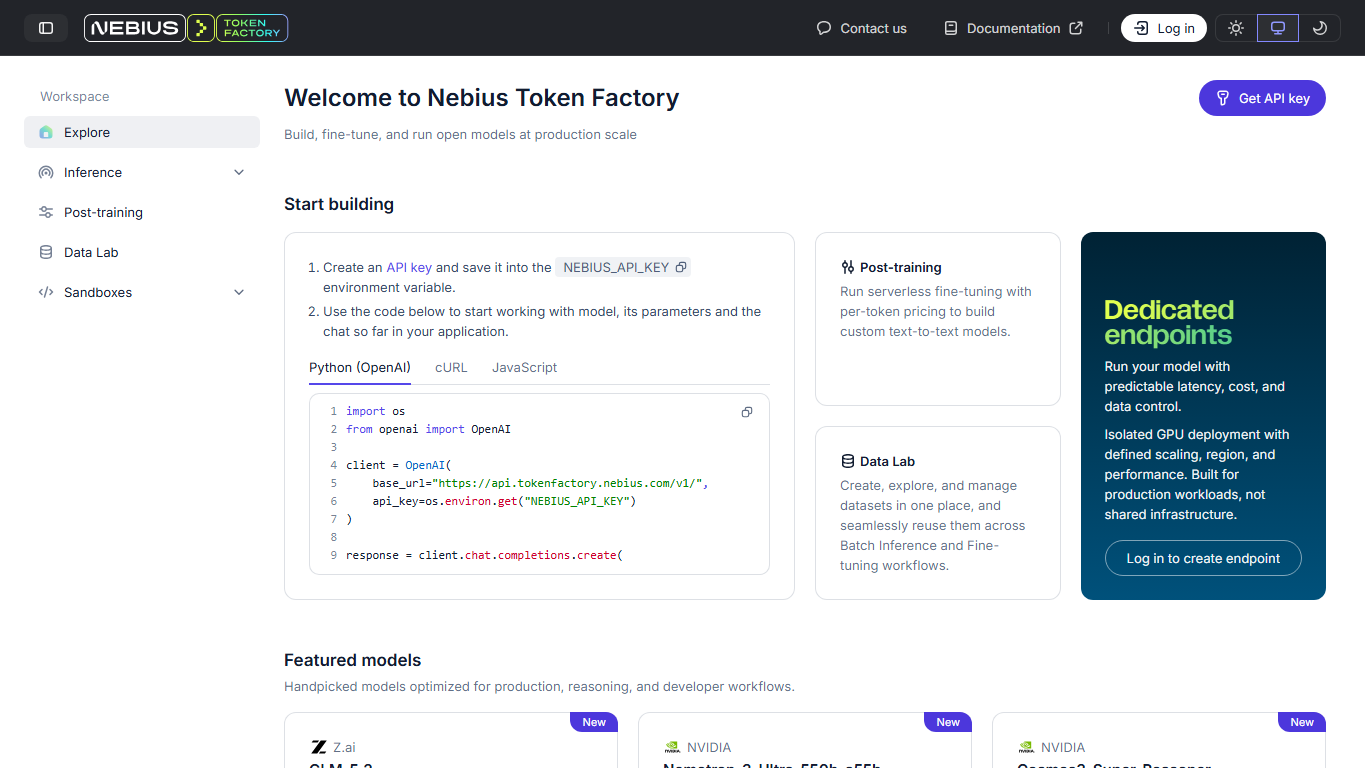
Material verification: The logo is taken from the official Nebius https://nebius.com/logo.svg and rendered into 200x200 PNG; the screenshot is taken from the official public web page of https://tokenfactory.nebius.com/, the size is greater than 1000x600, the screen contains Nebius Token Factory, API key, Post-training, Data Lab, Dedicated endpoints and Featured models Waiting for real product vision.
Version Info
- Nebius Token Factory production UI :The public configuration on the official website shows that the current web application version is [email protected]+6400142d, and the brandName is marked as Nebius Token Factory; studio.nebius.com has jumped to tokenfactory.nebius.com. The core capabilities include model playground, OpenAI compatible API, inference, fine-tuning Data Lab, dedicated endpoints and team access.
- Nebius Token Factory document system stage :Official documentation is centralized at docs.tokenfactory.nebius.com, clearly providing OpenAI-compatible API, Playground, inference fine-tuning, Data Lab, dedicated endpoints and API Reference.
- Nebius AI Studio public entrance stage :The model experiment and inference entrance is provided under the Nebius AI Studio brand, and the official entrance will be gradually migrated to the Token Factory brand and domain name system.
User Reviews