 Netus AI
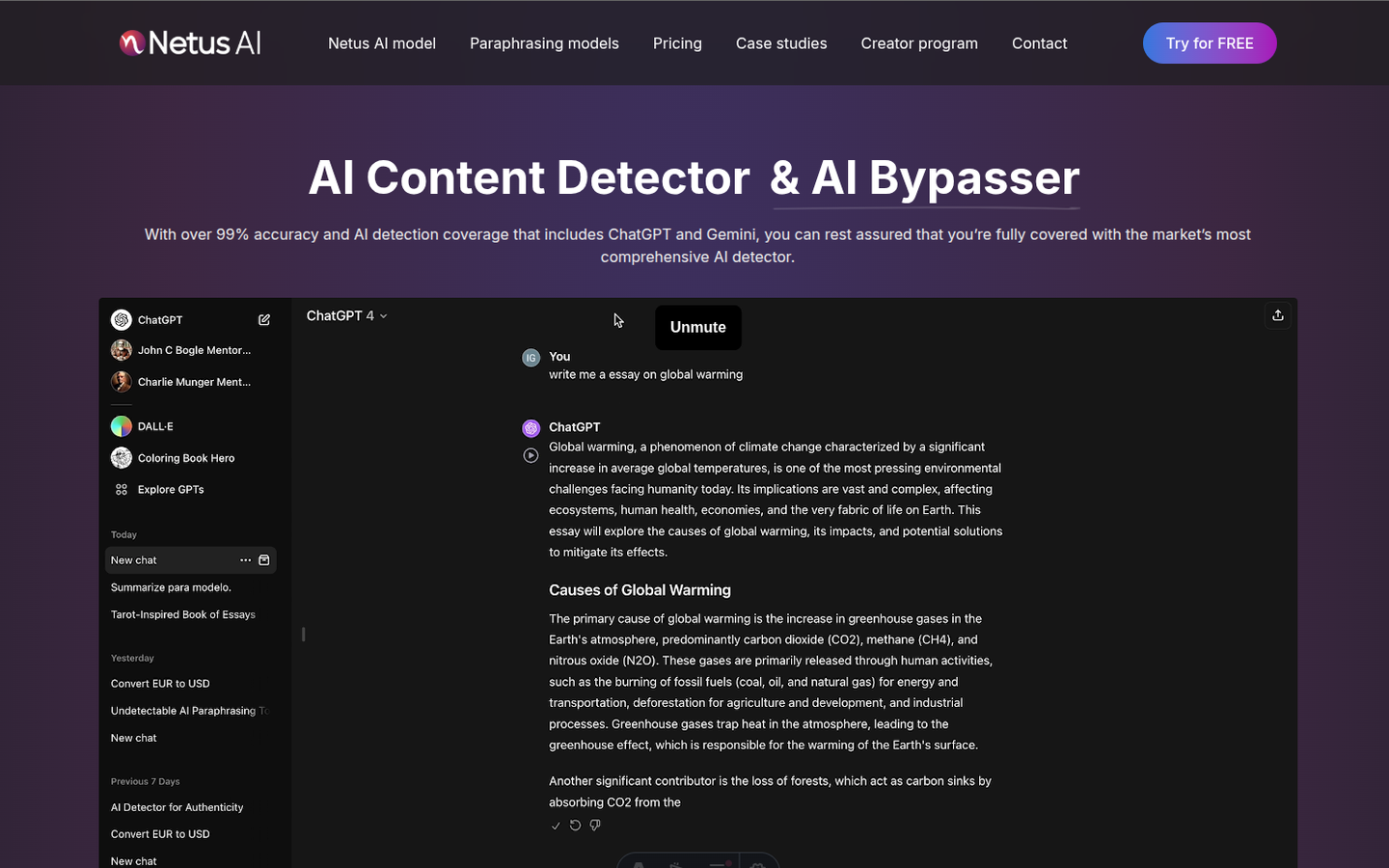
Netus AI is a multi-model AI text rewriting and detection avoidance platform that supports text rewriting through multiple AI models to bypass mainstream AI detectors, and also provides API interfaces.
NetusAI
Core parameters and statistics of Netus AI
| Parameter item | Description |
|---|---|
| Product positioning | AI humanized text rewriting and detection avoidance platform, with AI content detection capabilities |
| Billing unit | Credit, rewriting/paraphrasing consumes 1 credit / 10 words, readability analysis 1 credit / time |
| Maximum single processing length | Officially undisclosed specific upper limit, actual measurement supports long documents (10,000-word level) |
| Detection passed claim | Official claim that the rewritten text can pass mainstream detectors such as Turnitin / Originality.ai / GPTZero / Copyleaks |
| AI detection accuracy | Official claim is 99% probability of distinguishing AI text from artificial text |
| Anti-plagiarism success rate | Official claim: 99.97% no risk of plagiarism |
| Supported languages | 36 languages, including Chinese, English, Japanese, Korean, Arabic, and European languages |
| Platform coverage | Web App, Chrome extension Google Docs plug-in Android App, REST API |
| Trust Score | Trustpilot 4.8 / 5.0 (five-star rating) |
| Data training amount | Officially stated that the model is trained based on 200 million+ data points |
The differentiation strategy of Netus AI lies in full detector coverage + multiple bypass version selection: users can choose the most suitable rewriting strategy for the current detector from multiple bypasser versions, instead of relying only on a single rewriting model. There are differences in the performance of different bypasser versions on different detectors (for example, v1 focuses on avoiding GPTZero, v2 focuses on avoiding Originality.ai), and users need to experiment and match by themselves.
Users and market recognition of Netus AI
Trustpilot Rating: Netus AI received a comprehensive rating of 4.8 / 5.0 on Trustpilot, with users covering multiple groups such as content creators, students, digital marketers, and e-commerce operators. Many user reviews mentioned that its performance in "long document rewriting efficiency" and "detection and avoidance stability" is superior to similar tools.
Customer Case: The official website disclosed an e-commerce case - European fitness supplement e-commerce Supp***.com encountered a DMCA complaint from a competing product (accusing its product descriptions of plagiarism). The team used Netus AI to rewrite all 800 product descriptions within two weeks. The revamped site saw organic search traffic increase 38% and revenue grow 45% in the quarter. This case demonstrates the actual output capabilities of Netus AI in batch content reconstruction scenarios.
User Group: Typical users listed on the product page include digital marketers, content marketers, entrepreneurial SEO experts, copywriters, and bloggers, covering the entire chain from individual creators to corporate content teams.
Industry status: Netus AI is one of the leading players in the AI detection and avoidance track, directly competing with tools such as Undetectable AI, Stealth Writer, and Humanize AI. Its differentiation lies in the multi-version bypass strategy and a richer tool matrix (AI detector + paraphrase + summary + SEO article generation + readability check, etc. integrated).
Cost Advantages of Netus AI
Netus AI adopts the credit (Credit) billing model, and different functions consume credits at different rates:
- AI Bypasser / Paraphraser / Summarizer: consumes 1 credit / 10 words
- Readability Checker: consumes 1 credit/analysis
- AI Detector: Unlimited use (no credits consumed)
- SEO Article Generator / Keyword Extractor / Title Generator and other auxiliary tools: consume credits on a per-use basis
C client/individual user: The free file provides 50 credits/month (approximately 500 words can be rewritten), which is suitable for trying to verify the effect. The paid entry plan Basic ($14/month, 1,500 credits) can cover the daily rewriting needs of individual bloggers or students. Standard ($30/month, 10,000 credits) is the officially labeled "most popular" package and can meet the average monthly rewriting volume of 100,000 words.
Developers/API Users: The official website does not disclose API exclusive pricing. API access is obtained through the Elite package ($99/month, 100,000 credits) or Enterprise on-demand quotation. For content factories that process more than 30,000 words per day, the converted cost of the Elite package is about $0.10 per thousand words, which is lower than the cost of calling most AI text generation APIs. However, please note that credit points are reset at the beginning of each month, and unused credit will not be accumulated.
Enterprise/privatized customers: The Enterprise package is quoted on demand, and the official website does not disclose the specific price. The annual payment plan can save about 40% (i.e. monthly payment price × 12 × 0.6), which is more cost-effective for teams that use it stably for a long period of time. Enterprise customers should contact sales directly to confirm API concurrency cap SLA guarantee and data privatization deployment options.
Hidden Cost: The exchange ratio between credit points and word count is inconsistent across different functions, and the official does not provide a detailed credit consumption schedule. Users may underestimate the actual consumption when switching functions. In addition, multi-version bypassers require users to test the pass rates of each version on different detectors, and this trial and error time cost is easily overlooked. Although you can save 40% with an annual subscription, if usage drops midway, paid fees will not be refunded.
Main features of Netus AI
-
AI Bypasser: core functionality. The user selects the bypass version and submits the text. The system rewrites the text through sentence reconstruction, synonym replacement, grammatical adjustment, etc., so that it can pass mainstream AI detectors such as Turnitin, Originality.ai, GPTZero, ZeroGPT, Winston AI, Content at Scale, and Copyleaks. Officials claim that the fluency of the rewritten text is no different from manual writing.
-
AI Detector (AI Content Detection): Built-in AI detector, claiming to be 99% accurate in distinguishing AI and artificial text. The detection technology route is similar to Turnitin, evaluating text patterns, context, syntax and semantic features. This function can be used unlimitedly and does not consume credits. It can be used as a "pre-check" tool before rewriting - first use the detector to evaluate the AI probability, and then bypass it in a targeted manner.
-
Multi-version interpretation engine: Provides multiple bypasser versions to choose from, and different versions are optimized for different detectors. Users must manually switch according to the type of target detector (such as the Turnitin evasive version for academic papers, the Originality.ai evasive version for blogs). The synergistic effect of this strategy is that users can complete the "detection-select version-rewrite-redetection" in one workflow without switching multiple tools.
-
Tool Matrix Integration: In addition to the core bypass function, it also integrates more than ten auxiliary tools such as Paraphraser (paraphrasing), Summarizer (summarizer), Readability Checker (readability check), SEO Article Generator (SEO article generator), Keyword Extractor (keyword extraction), Title Generator (title generation), Slogan Generator (slogan generation), Email Writer (email writing), etc. These tools share a credit point system, and users can complete the entire process from content generation to rewriting avoidance within the same platform.
-
Fine-tuning: In response to the "fingerprinting" technology of tools such as Turnitin (which can compare students' historical assignments to detect differences in writing style), Netus AI provides a writing style fine-tuning option. After users upload their own writing samples, the rewriting engine can imitate their word frequency and sentence distribution, reducing the risk of being flagged due to sudden changes in writing style. This is a targeted solution to the "writing fingerprint" technology of a new generation of detectors.
-
Cross-platform integration: Chrome extension supports instant rewriting of selected text in web pages; Google Docs plug-in supports calling the rewriting function directly in the document editor; Android App supports mobile use. The three cover the three main content production scenarios of "backend management - content editing - mobile office".
Model and version evolution of Netus AI
Netus AI's version iteration track focuses on functional expansion, evolving from a single rewriting tool to a full-stack content platform:
Mainline release
| Version | Time | Core Changes |
|---|---|---|
| v2.0 | 2025-06 | Optimize the rewrite algorithm to improve detection and avoidance success rate; introduce multi-language support |
| v3.0 | 2026-01 | Launched REST API interface and Chrome extension; supports batch rewriting; launched AI Detector function |
| v3.5 | 2026-06 | Added multiple versions of bypass engine switching (different versions target different detectors); optimized API batch processing speed; launched writing style fine-tuning function |
Version feature analysis
- v2.0 stage: The product exists in the form of a single rewriting tool, and its core competitiveness lies in rewriting quality and detection evasion success rate. At this stage, a large amount of bilingual and multilingual training data has been accumulated.
- v3.0 stage: a key node in platform transformation. The opening of the API has upgraded Netus AI from a tool product to an integrable service, and the Chrome extension and Google Docs plug-in have significantly lowered the threshold for content creators to use it.
- v3.5 stage: The introduction of multi-version bypasser strategies and style fine-tuning, marking a proactive response to the detector "arms race" - no longer relying on a single rewriting algorithm, but allowing users to dynamically select countermeasures based on the target detector. Style fine-tuning directly targets Turnitin's "writing fingerprint" detection technology.
Known limitations
The officially disclosed version information is relatively limited, with only 3 version nodes traceable. The details of versions prior to v3.0 (such as v1.x), the specific technical improvement indicators of each version, and the version compatibility strategy of the API have not been made public. In addition, the specific version number of "multi-version bypasser" in v3.5 and the list of adaptation detectors for each version also lack official detailed documentation.
Technical advantages of Netus AI
The causal chain of Technical Mechanism → Effect → Applicable Scenario is as follows:
-
200 million+ data point training: The rewritten model is trained on more than 200 million data points, covering a variety of genres such as academic papers, blogs, marketing copywriting, and technical documents. Diversity and scale directly determine the upper limit of the ability to "rewrite while maintaining the original intention". Effect: The quality of rewriting in different styles is stable, and there will be no serious loss of semantics in specific styles. Applicable scenarios: SEO agencies, multi-category e-commerce detail pages that are rewritten in batches across genres.
-
Multi-version bypasser strategy: Maintain multiple rewrite models at the same time, and each performs reverse optimization for the detection logic of a specific detector. GPTZero focuses on perplexity and burst analysis, while Originality.ai focuses on sentence pattern recognition. Different versions are specifically adjusted in these dimensions. Effect: No need to change tools when switching target detectors, just switch versions. Applicable scenarios: Scenarios where multiple platforms are released and each platform uses different detectors.
-
Style Fine-tuning: Based on the "writing fingerprint" technology of detectors such as Turnitin (which analyzes word frequency distribution and sentence preference in users' historical writing to create personalized profiles), Netus AI allows users to upload writing samples for style migration. Effect: Reduce the probability of being marked as AI text due to sudden changes in writing style. Applicable scenarios: Academic papers, graduation thesis and other scenarios that require the same signature for a long time.
-
Full coverage of 36 languages: The rewriting engine supports 36 languages, including Chinese, Japanese, Korean and other non-Latin languages, and each language level is independently optimized. Effectiveness: The rewriting quality of non-English content is not significantly lower than that of English. Applicable scenarios: Multi-language content marketing, cross-border e-commerce multi-site description rewriting.
-
Detection + Overwriting: The same platform has built-in AI detector and Bypasser, and optimization can be completed in the "Detection→Select Version→Rewriting→Redetection" cycle without the need to switch between multiple tools. Effect: A single rewrite iteration was reduced from 3-5 minutes across tool switches to within 1 minute. Applicable scenarios: Key content that requires a high pass rate.
How to use Netus AI
Netus AI provides 4 main entrances, covering different workflows:
Web App (main entrance)
- Visit https://app.netus.ai/ to register an account (email registration is supported, and no credit card is required for free files).
- Select the function module: AI Bypasser / AI Detector / Paraphraser / Summarizer, etc.
- If using AI Bypasser: Paste the AI-generated text → Select a bypasser version (it is recommended to choose based on the target detector, such as using the Turnitin evasion version to deal with academic detection) → Click Submit.
- The system returns the rewriting result and displays the estimated AI detection probability after rewriting.
- If you are not satisfied with the result, you can change the version and try again, or adjust the text length and submit again.
Chrome extension
- Install the Netus AI extension from the Chrome Web Store.
- Select the text in any web editor, right-click and select "Rewrite with Netus AI".
- An expanded pop-up window displays the rewriting results, click Replace to complete. No need to leave the current page, suitable for quick rewriting in CMS background Google Docs, WordPress editor and other scenarios.
Google Docs Plugin
- Install the Netus AI Paraphrasing Tool plug-in from the Google Workspace Marketplace.
- Work in the Google Docs sidebar, select the text and click the Rewrite button in the plug-in.
- Insert the rewritten results directly into the document, retaining the original format. Suitable for long document scenarios that require frequent iterative modifications.
REST API
- API endpoints, authentication methods, and call limits must be obtained through the Enterprise package, and the official public API documentation has not been released.
- Interconnection method: Submit text and version parameters through HTTP POST, and return the rewritten results.
- Suitable for enterprise customers such as content factories, SEO agencies, etc. who require batch automated processing.
Usage suggestions
- Version Selection: Netus AI officially recommends "letting the content pass both v1 and v2 detectors to obtain the highest invisibility", which means that users can first rewrite it with one version, and then use another version for secondary processing to cover more detection dimensions of the detector.
- Pre-checking process: First use AI Detector to evaluate the AI probability of the original text and record the score; after rewriting, use the same detector to evaluate the pass rate. This "before rewriting - after rewriting" comparison can help users find the most suitable bypass version.
- Style fine-tuning: If tools such as Turnitin use "writing fingerprint" technology, it is recommended to fine-tune the rewriting engine with writing samples before uploading so that the word frequency distribution of the output text is consistent with historical assignments.
Product Pricing for Netus AI
Netus AI adopts a credit (Credit) system, and the consumption of all functions is measured uniformly. Credit points are reset monthly and unused credit will not be carried forward to the next month. Save approximately 40% on annual plans.
| Packages | Monthly fee (USD) | Credits/month | Bypasser/Paraphraser monthly processing volume (approx.) | AI Detector | Other tools |
|---|---|---|---|---|---|
| Free | $0 | 50 | 500 words | Unlimited | Limited |
| Basic | $14 | 1,500 | 15,000 words | Unlimited | 15,000 words/month |
| Standard | $30 | 10,000 | 100,000 words | Unlimited | 100,000 words/month |
| Premium | $59 | 40,000 | 400,000 words | Unlimited | 400,000 words/month |
| Elite | $99 | 100,000 | 1,000,000 words | Unlimited | 1 million words/month |
| Enterprise | Quote on Demand | Custom | Custom | Unlimited | Custom |
Key differences between levels:
- Free: 50 credits can rewrite about 500 words, which is only enough for functional verification, not enough to support content production.
- Basic ($14): 15,000 words/month, suitable for light personal use, but insufficient for multi-day production scenarios.
- Standard ($30): Marked "most popular", 100,000 words/month, covering the daily output of a team of 1-2 people.
- Premium ($59): 400,000 words/month, suitable for a team of 3-5 people or a marketing agency with a monthly output of 100+ articles.
- Elite ($99): 1 million words/month, combined with API access, suitable for content mills and SEO agencies.
Pricing comparison with competitive products:
| Tools | Entry-level monthly fee | Mid-range monthly fee | Billing method | API availability |
|---|---|---|---|---|
| Netus AI | $14 | $30 (100,000 words) | Credit points | Elite and above |
| Undetectable AI | $9.99 | $19.99 (monthly/quarterly) | Word count | Unpublished |
| Stealth Writer | $12 | $24 | Word count | Yes, price undisclosed |
| Humanize AI | Free | $15 (Pro) | Word count | Unpublished |
Netus AI's Standard file is at the middle level of the market with the same monthly processing volume (100,000 words), but the Elite file is more cost-effective for customers who require batch automated processing due to the added value of API access.
Application scenarios of Netus AI
-
SEO Content Factory Batch Rewriting: After the SEO agency uses AI to generate blog drafts, they are rewritten in batches through the Netus AI API and detected by Originality.ai. Process: AI generation → detector pre-check → select version batch rewriting → re-detect → publish. Quantitative deduction: Under the Premium package ($59/month), the rewriting cost of each 2,000-word article is about $0.30, and the cost of AI generation is about $0.01/article. The total cost of a single article is controlled within $0.35, which is more than 99% lower than purely manual writing ($50-100/article).
-
Multi-platform content detection-proof distribution: We-media rewrites an AI draft into multiple versions and publishes them to different platforms. Different platforms may use different detectors (for example, Zhihu uses GPTZero, and public accounts use internal systems). Netus AI's multi-version bypasser allows the selection of the corresponding version for each platform, reducing the risk of "an article being intercepted and the entire platform implicated."
-
Academic Writing Style Adaptation: Researchers use the style fine-tuning function to adapt personal writing styles and reduce the probability of AI tagging in tools such as Turnitin. Process: Upload 2-3 published works as samples → fine-tune the engine → rewrite paragraphs → pre-check. Note: Academic integrity policies vary from institution to institution, so you should confirm your institution's regulations before using them.
-
Cross-border e-commerce multilingual description: After using AI to generate an English description, rewrite it into a multilingual version and circumvent each language detector. Quantitative deduction: 800 descriptions were rewritten (the official website case was completed in 2 weeks). Compared with pure manual translation, which cost about $5-15 per translation, the total cost was reduced from $4,000-12,000 to $60-120, and the delivery cycle was shortened by more than 80%.
-
Startup Content Cold Start: Maintain a single blog output of 5-10 blogs per week. Human-machine collaboration boundary: The outline, arguments, and data are determined manually; AI is responsible for the expansion of the first draft; Netus AI is responsible for rewriting avoidance and style unification; humans are responsible for final proofreading. Generation and rewriting can be 100% automated, with manual verification points remaining for fact checking and compliance approval.
Applicable groups of Netus AI
-
SEO content agencies and content factories: Faced with the pressure of producing hundreds of pieces of content every day, a solution is needed that can be processed in batches and pass the dual review of Quality rater and AI detector. Netus AI's API and the high quota of the Elite package can support this type of large-scale rewriting needs. Prerequisites: Basic API integration capabilities are required, and API documentation needs to be obtained through the Enterprise package.
-
Individual Creators and Bloggers: Use AI-assisted writing on a daily basis, but are worried that if the content is detected as AI text, it will affect platform recommendations or search engine rankings. Netus AI’s Standard package ($30/month) can cover the rewriting needs of 50-80 blogs per month. Note: You need to test the effects of different bypass versions by yourself, and there will be learning costs in the initial stage.
-
Academic Researchers and Students: In AI-assisted essay writing scenarios, use Netus AI’s style fine-tuning capabilities to reduce the probability of AI tagging in tools like Turnitin. Important Boundary: Most academic institutions have clear disclosure requirements for AI-assisted writing, and using detection avoidance tools may itself violate academic integrity policies. This scenario only applies to relaxed policy contexts that allow AI assistance but require "human polish".
-
E-commerce Operation Team: Need to rewrite product description A+ pages and marketing copy in batches, especially for multi-site and multi-language e-commerce sellers. Netus AI’s multi-language support (36 languages) and batch processing capabilities are clearly valuable in this scenario.
-
Digital Marketing Agency: Responsible for producing a large amount of marketing content for clients, which is subject to AI detection and review by the client. Netus AI's detector pre-check + rewrite function can help agents self-check before submission and reduce rework rates.
Not suitable for the crowd:
- Scenarios that require in-depth original writing of long articles (such as serious literature, news investigations, academic monographs): rewriting tools can only optimize based on existing AI texts and cannot replace research and creation from scratch.
- Scenarios with the highest requirements for content copyright and compliance (such as legal documents, medical instructions): the rewriting tool is not responsible for fact verification and legal liability attribution, and the output content still needs to be manually reviewed verbatim.
- Users with a very low budget ($0-5/month): Netus AI’s free file of 50 credits/month is only enough to rewrite 500 words, and its practicality is limited. Free users are more suitable to use the free file of Undetectable AI or the free version of Humanize AI.
Summary and Outlook of Netus AI
The core competitiveness of Netus AI lies in multi-version bypass strategy + detection and rewriting closures + tool matrix integration. It is not a simple "AI-to-human" rewriter, but a content optimization platform covering the entire process of "detection-rewriting-evaluation-rewriting". For SEO content factories, cross-border e-commerce operations and multi-platform self-media practitioners, Netus AI's batch processing capabilities and multi-language support give it obvious engineering advantages in the same track.
Current Limitations and Uncertainties:
- Insufficient transparency of the credit point system: The rate at which different functions consume credit points is quite different (rewriting 1 credit/10 words vs readability check 1 credit/time). The official does not provide a complete credit consumption reference table, and users may find that the actual consumption exceeds expectations during actual use.
- User learning cost of multi-version bypasser: Which detectors each version is suitable for and which styles perform best. There is a lack of official documentation on systematic adaptation. Users need to accumulate experience through trial and error, which is not friendly enough to new users.
- Incomplete version information: The officially disclosed version history only has 3 nodes. It lacks early version details and API version compatibility strategies, making it difficult for enterprise customers to evaluate the stability of the product when making technology selections.
- API documentation is limited: The API is only open to Enterprise customers, and developers cannot evaluate the integration complexity before purchasing, increasing selection risks.
- Risk of Detector Arms Race: AI detection technology continues to evolve (such as Turnitin's "writing fingerprint" technology GPTZero's perplexity analysis), and the bypass version of Netus AI needs to be continuously updated to maintain effectiveness. If the bypasser is not adapted in time after the detector is upgraded, users may experience a "sudden failure" window period.
Procurement and Adoption Risk Assessment:
For teams planning to purchase Netus AI, it is recommended to evaluate along the following path:
- Pilot phase (1 month): Starting from the Standard package, select 1-2 typical content process access, focusing on testing the actual pass rate and rewriting quality of the bypasser on the target detector.
- Extended Conditions: During the pilot period, the pass rate should be stable above 85%, the manual review modification rate after rewriting should be less than 20%, and the deviation between credit consumption and estimate should be within 15%.
- Enterprise pre-purchase verification: For the Elite or Enterprise plan, the SLA indicators (API availability 99.9%+, maximum delay of a single rewrite, version update frequency), the promise that the data will not be used for secondary training of the model, and the adaptation timeliness promise after the detector is upgraded need to be clearly stated in the contract. If the official cannot provide the above commitment, it is recommended to keep a backup tool (such as Undetectable AI or Stealth Writer) for 2-3 months as a risk hedge.
Related tools:  originality.AI,
  GPTZero
Version Info
- Netus AI v3.5 :Added a new multi-model rewriting engine to support GPT-4o/Claude 3.5 switching; optimized API batch processing speed.
- Netus AI v3 :Launched API interface and Chrome extension to support batch rewriting.
- Netus AI v2 :Optimize and rewrite the algorithm to improve detection and avoidance success rate.
User Reviews