 Notion
Free
Notion
Free
Notion is a collaboration platform that integrates documents, database wikis, project management and AI capabilities. It is officially positioned as "Where teams and agents think together". Its AI layer includes Notion Agent (agent that performs tasks autonomously), Enterprise Search (cross-application enterprise search), AI Meeting Notes (meeting transcription and summary), Research Mode (in-depth research mode), as well as inline writing assistance, database automatic filling and other functions. Covering all scenario needs from individuals, small and medium-sized teams to Fortune 100 level enterprises.
Notion
Core parameters and statistics
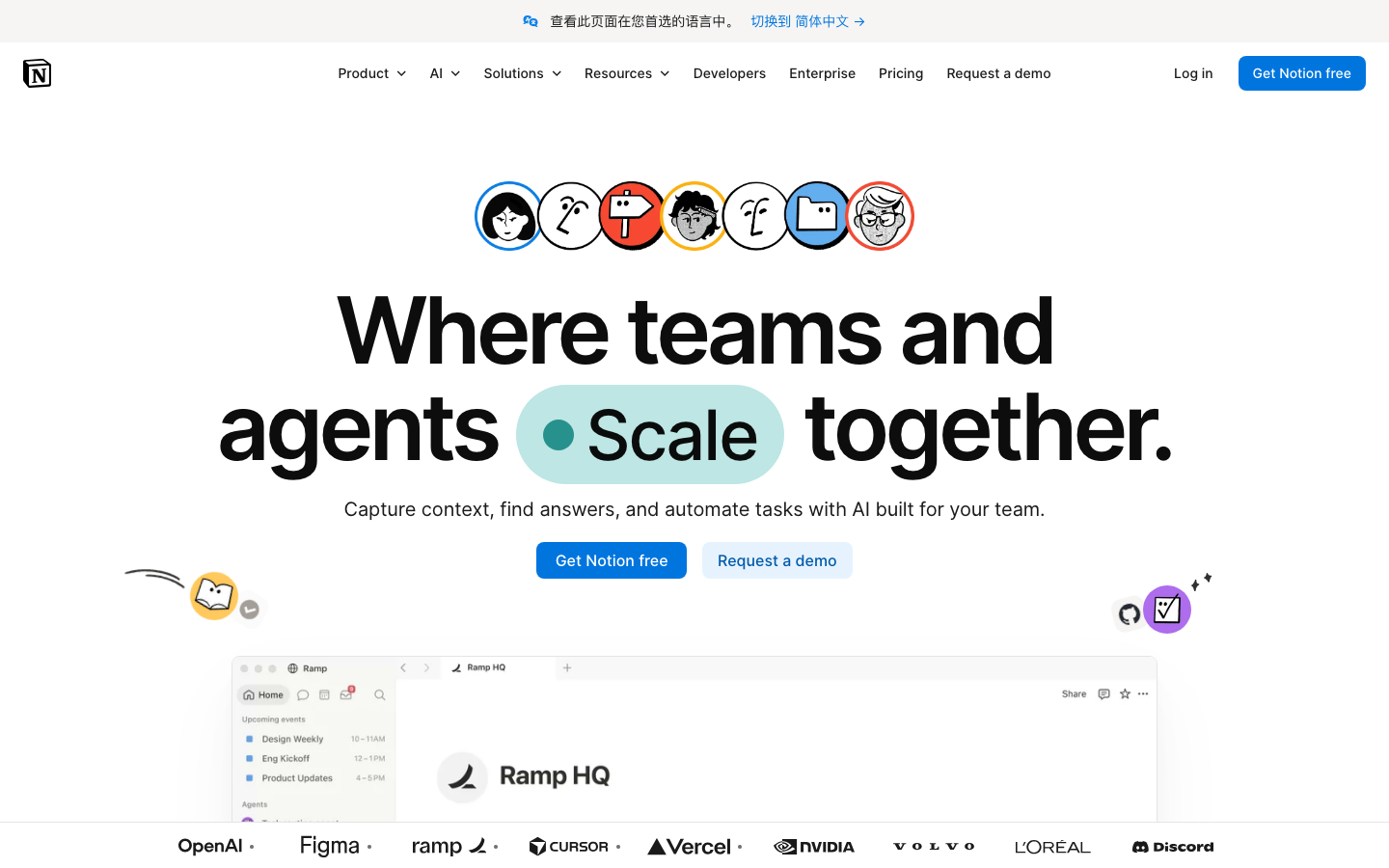
Notion's positioning has evolved from an "all-in-one workspace" to an AI-native collaboration platform. The official 2026 slogan "Where teams and agents think together" clearly conveys its core transformation: AI agents are no longer additional functions, but "first-class citizens" of the workspace.
| Projects | Public Information |
|---|---|
| Official positioning | Where teams and agents think together |
| Product form | Document + database + Wiki + project management + AI agent |
| Deployment method | Cloud SaaS (Web/Desktop/Mobile) |
| AI model layer | Multi-model support (including Claude Agents integration), user-switchable |
| User scale | Officially said there are over 100 million users, covering 50+ countries |
| Enterprise Penetration | Used by 62% of Fortune 100 Enterprises |
| Community size | 1,400,000+ community members |
| Latest platform iteration | 2026 Q2 (Agent GA + Workers Beta) |
| Supported platforms | Web, macOS, Windows, iOS, Android, API |
Evolutionary meaning of positioning: From "note-taking tool" to "operating system" to "AI collaboration platform", Notion's product boundaries have been expanding. In the current version, Notion Agent can directly perform operations such as creating pages, filling databases, and cross-application queries in the workspace, without requiring users to manually trigger them. This is the most essential difference from traditional note/document tools.
AI layer depth: Notion AI’s coverage includes six levels: inline assistance (writing, translation, summarization), database intelligence (automatic filling, formula generation), search (Enterprise Search across applications such as Slack/Google Drive), meetings (AI Meeting Notes transcription and summary), research (Research Mode in-depth report generation) and agents (Notion Agent/Custom Agents). It is currently one of the products with the most complete AI capability stack among SaaS collaboration tools.
User and market recognition
Notion's market influence spans individual C-side users, small and medium-sized teams, and large enterprises, and is supported by verifiable data at different levels.
C-side and community: Officially disclosed that there are over 100 million users in more than 50 countries. The Notion community has 1.4 million+ members. The template library, plug-in ecology and third-party tutorials form a powerful user growth flywheel. Notion's "Blocks" (block editor) design concept lowers the threshold for knowledge management, allowing it to naturally extend from personal note-taking scenarios to team collaboration.
B-side and enterprise penetration: 62% of Fortune 100 companies use Notion, and more than 50% of Y Combinator startups use it as a core collaboration tool. Typical enterprise customers include OpenAI, Cursor, Faire, Ramp, Remote.com, Lovable, 1Password, Affirm, Riot Games, and more. G2 has rated it the #1 knowledge base product three years in a row. This data means that Notion is not a "marginal tool" in the enterprise market, but is replacing the core position of traditional enterprise wikis such as Confluence and SharePoint.
Industry Recognition: Notion’s valuation reaches $10 billion in 2024. For comparison, Atlassian, the parent company of its direct competitor Confluence (owned by Atlassian), has a market value of about $50 billion, but Notion’s growth rate and the completeness of its AI capability stack are closing this gap. It is worth noting that the adoption data of Notion AI has not been officially disclosed separately - the adoption rate of the Business and above plans, AI function daily activity and other indicators are still "undisclosed".
Cost advantage
- C-side/Individual: Usually a free version is provided to experience the core functions, and high-frequency use requires a paid package subscription.
- API/Developer: Billed by call volume, suitable for development teams that can be flexibly integrated into their own systems.
- Enterprise/Privatization: Contact the business owner to obtain customized quotation and deployment plan. The specific price is subject to the official real-time pricing page.
Main functions
Notion’s functional architecture can be broken down into six layers, with AI capabilities running through them rather than being attached to the surface:
- AI Agent Layer (Notion Agent): The core AI capability. Agent can understand the user's natural language instructions and independently perform operations such as creating pages, editing databases, generating charts, and cross-application queries. Supports custom "Instructions & Skills" to constrain behaviors, and provides a "Review & Approve" approval mechanism before performing key operations. Agent can also expand external tool calling capabilities through Claude Agents integration (Beta).
- Enterprise Search: An AI-based cross-workspace search engine that simultaneously indexes Notion internal content and connected third-party applications (Slack, Google Drive, etc.) and returns results in the form of references. This is the key selling point that distinguishes Notion from traditional knowledge bases - users can query information on all related systems without leaving Notion.
- AI Meeting Notes (Beta): Compatible with any meeting client, automatically transcribes meeting content, generates summaries and action items, and saves all notes in Notion and can be retrieved by Enterprise Search. For distributed teams, this eliminates the hidden role of "meeting note taker."
- Research Mode: Exclusive to the Business/Enterprise plan, handles complex or open-ended queries and can synthesize information from workspaces and web pages to generate in-depth reports. Essentially a built-in "deep research agent" that mirrors Perplexity's Pro mode, but the data source contains private workspace content.
- Inline AI assistance: AI writing, translation (cross-language), summarization, tone rewriting, brainstorming generation in document editing. Dynamic AI content blocks can be embedded through
/AI Block, and the specified context source can be configured. - Database Intelligence: AI-driven database creation Autofill automatically fills attributes, formula assistant, automatic summary and keyword extraction of database pages. This is a manifestation of Notion's AI capabilities being extended to "structured data management" scenarios, rather than just staying at the document level.
Hidden linkage: Notion Agent can directly use the results of Enterprise Search to answer user questions. At the same time, it can use the transcription content of Meeting Notes as context to generate project reports, and then write the results back to the project tracking table through AI database automatic filling. This connection connects the four isolated islands of "Meeting -> Search -> Document -> Database" into an automated link, solving the manual pain point of cross-module switching.
Model and version evolution
As a SaaS product, Notion's version evolution is based on quarterly feature releases, rather than the version number system of traditional software. The following is organized according to publicly verifiable milestones:
2023: AI takes off
- 2023 Q4: Notion AI Early Access is online, introducing generative AI into the workspace for the first time, with an initial focus on inline writing assistance and document summarization.
2024: AI fully available
- 2024 Q1: Notion AI General Availability, core AI functions are open to all Business and above plans, including AI Autofill, translation, and formula generation.
- Full Year 2024: Continuously iterating AI database capabilities and inline AI blocks, no major new AI forms have been released.
2025: Agent and enterprise-level capabilities explode
- 2025 Q2: The release of Notion Agent Beta marks the transition of AI from "passive assistance" to the "active execution" stage.
- 2025 Q3: AI image generation is online (Business/Enterprise plan), 10 times/24h, 30 times/30d limit.
- 2025 Q4: Enterprise Search Beta + AI Meeting Notes Beta, extending AI search from within Notion to external connected apps.
2026: Agent scaling
- 2026 Q1: Custom Agents (billed by Credits) + AI Connectors (Slack/Google Drive) + Research Mode, the Agent ecosystem has begun to take shape.
- 2026 Q2: Notion Agent GA (Generally Available) + Workers Beta (Custom Code Extension) + Claude Agents Integration Beta + Cursor Connection Beta.
- 2026 Q3 (Outlook): Official pricing of Workers (billing starts from 2026-08-11), more third-party Agent integrations.
Version rhythm summary: Notion maintains a rhythm of major AI feature updates every 2-3 months, with a clear evolutionary path from "assisted writing" to "automatic doing" to "external system connection". However, judging from the version information, some release dates are speculation dates (marked ~), and the official accurate Release Notes are subject to notion.so/releases.
Technical advantages
The technical advantage of Notion AI lies not in the performance of the underlying model (it relies on third-party LLM, including Claude, GPT, etc.), but in its "deep integration of AI and structured data" capabilities.
Context awareness and connector architecture: The core technical barrier of Notion AI is "understanding the workspace context". Enterprise Search connects to external systems such as Slack and Google Drive through Notion AI Connectors. The AI Agent can incorporate the internal database structure, page hierarchy, permission information and external data into reasoning when making decisions. This is fundamentally different from standalone AI chat tools such as ChatGPT - where the context is manually provided by the user, whereas Notion AI's context is automatically extracted from the workspace and its connected systems.
Multiple models switchable: Notion AI is not bound to a single model, and users can switch the underlying AI models (including Claude, GPT, etc.) in the settings. What this means for enterprise users is that they can choose the most suitable model for different task scenarios (such as using Claude for long document analysis and GPT for creative writing), reducing the risk of lock-in to a single model supplier.
Approval and Security Architecture: Notion Agent requires "Review & Approve" manual confirmation before performing key operations (creating users, modifying permissions, deleting data). This is a mechanism that cannot be omitted in the implementation of Agent products at the enterprise level. The Enterprise plan's "zero data retention" provision ensures that no training data is stored when using an LLM provider - a requirement for compliance industries such as finance and healthcare.
Technical Limitations: Notion AI's search quality is highly dependent on how structured the content is - for information scattered among unstructured pages, Enterprise Search's recall rate may be lower than for retrieval of structured content in a database. In addition, the depth of cross-app connectors (such as fine-grained paragraph-level references to documents in Google Drive) may not be fully covered during the beta phase. Currently, there is no official disclosure of the maximum number of consecutive steps or the upper limit of the Token budget of the AI Agent, which poses uncertainty for complex multi-step tasks.
How to use
Notion provides multiple usage paths for different roles:
Getting Started for Individual Users:
- Visit
notion.soto register a free account and choose a starting point from the template library (officially providing 1000+ templates), such as personal homepage, project board, reading notes, etc. - AI function activates inline AI through
shift + cmd/ctrl + Jshortcut keys, or enter/AIon the page to select AI Block.
Team/Enterprise activate AI:
- Upgrade to the Business plan ($20/person/month), enable the AI function in Settings -> Notion AI, configure AI Connectors (connect to Slack, Google Drive, etc.), set the AI Web Search switch, and personalize the Notion Agent name and instructions.
- Create Agent: Click Notion AI in the sidebar -> Select Agent mode -> Describe the task in natural language. The Agent will generate an execution plan, which the user can review before approving the execution.
Developer Integration:
- Implement data reading and writing and event triggering through Notion Public API (RESTful) and Webhooks.
- Workers (Beta) allow writing custom extensions in JavaScript/TypeScript, building Agent tools, synchronizing external data or triggering workflows. Free trial until August 11, 2026.
- Integrated Claude Agents (Beta): Use Claude agents directly in Notion to manipulate workspace content.
- Connect Cursor (Beta): Use Notion as a knowledge base context for the Cursor AI coding assistant.
Enterprise Deployment:
- Enterprise customers can complete user provisioning, configure SAML SSO, enable Audit Log, set zero data retention policy, and connect to security tools such as DLP/SIEM through SCIM.
Product Pricing
The pricing model is subject to the official real-time page. Usually a freemium or subscription system is used, and basic functions can be used for free. Advanced functions or high-frequency use require paid subscriptions, and users are advised to evaluate the optimal solution based on actual usage.
Application scenarios
Notion’s AI capabilities produce quantifiable efficiency differences in the following scenarios (the following is a deduction based on product capabilities, unofficial commitment):
- Project management and progress synchronization: AI Meeting Notes automatically transcribes the stand meeting and generates action items, and Notion Agent automatically writes the action items into the project database and assigns the person in charge. Estimated Benefits: The time spent by project managers manually sorting out meeting minutes each week is reduced from approximately 2-3 hours to 10-15 minutes of review after automatic processing by AI. Prerequisites for adaptation: All team members use the Business plan and the meeting client is compatible with AI Meeting Notes.
- Enterprise knowledge base construction and retrieval: Enterprise Search cross-application search Slack discussion records Google Drive documents and Notion internal wiki. Estimated benefits: The time it takes to find historical decisions when new employees join is reduced from hours (looking through Slack history + searching documents) to one search. Adaptation prerequisite: The IT department needs to complete the configuration of AI Connectors, and the connected third-party application content has reasonably structured tags.
- Support team work order processing: Notion Agent connects to Slack, automatically extracts key information from the work order message into the database, generates a summary and assigns it to the corresponding person in charge. Estimated Benefits: Frontline support staff’s manual entry time for each ticket is reduced from 5-8 minutes to 1-2 minutes of review after Agent auto-populates. Adaptation prerequisite: The work order process has been modeled in the Notion database, and the Agent permissions are configured accurately.
- R&D team weekly report automation: Agent automatically summarizes the tasks completed this week, code review records (by connecting to Git tools) and meeting points, and generates a structured weekly report draft. Estimated Benefits: The technical leader’s weekly report writing time is reduced from 30-60 minutes to 5-10 minutes for editing.
- Marketing content planning: Research Mode combines network data and historical content libraries to generate competitive product analysis reports; AI assists in writing the first draft and automatically translates it into multi-language versions; database Autofill fills in content calendar attributes.
Not suitable for scenarios: Notion AI is not suitable for scenarios that require purely offline context (the core of Notion is cloud SaaS); it is not suitable for real-time full-text search of very large-scale document libraries (millions of pages) - the performance ceiling of Enterprise Search is not disclosed, and POC verification is required before large-scale deployment; it is not suitable for scenarios that require highly customized AI model training (Notion does not provide model fine-tuning capabilities).
Applicable people
The value of Notion AI increases step by step with the size of the team and the depth of use of AI functions:
- Personal Knowledge Workers and Creators: The limited AI trial of the Free/Plus plan is sufficient for daily writing assistance, translation, and summarization needs. But for users who need Agent automation, the Business plan is the de facto entry barrier.
- Small to medium teams (5-50 people): The $20/person/month Business plan is the first choice to balance cost and AI capabilities. The three-piece set of AI Meeting Notes + Notion Agent + Enterprise Search basically covers the core needs of meeting efficiency, information retrieval and task automation. Prerequisite: The team needs to have certain technical literacy to configure AI Connectors and Agent commands, otherwise the AI function may be used as an advanced search instead of realizing its automation potential.
- Large Enterprises and Compliance Sensitive Organizations: The Enterprise plan is the only option, with zero data retention terms that are non-negotiable for the financial, medical, and legal industries. SCIM user provisioning and Audit Log are essential for compliance auditing. Not suitable for boundaries: If the enterprise already has a mature Confluence + Jira + Salesforce ecosystem and the replacement cost is too high, the full migration of Notion may be higher than expected.
- Developers and Platform Extenders: Public API and Workers (Beta) provide technical teams with the possibility to use Notion as a "collaborative data base". However, Workers’ formal billing model will not be implemented until August 2026, and there is currently pricing uncertainty for building production-level processes based on it.
- Not recommended for use: Pure personal note-taking users who do not need collaboration (free Apple Notes/Obsidian may be more lightweight); teams that require strict offline or local storage (Notion has no self-hosting option); small teams that have no need for AI functions and are budget-sensitive (the value of the Plus plan at $10/person/month is mainly reflected in collaboration rather than AI).
Summary and Outlook
Notion's core competency lies in its product architecture of "embedding AI agents onto structured collaborative data." Unlike general-purpose AI tools like ChatGPT, the advantage of Notion AI is that context comes from the user’s real work data and connected systems, rather than manual input. Notion Agent's "Review & Approve" mechanism and Enterprise's zero data retention clause demonstrate that its investment in Agent security caters to enterprise-level needs. 100 million users + 62% Fortune 100 penetration figures illustrate that it has moved beyond the early adopter stage and into the mainstream market.
Current limitations and uncertainties: The actual cost of Custom Agents' Credits billing model has not been fully verified by the market - the Credits consumption of a complex Agent task may far exceed user expectations; the depth of Enterprise Search's cross-application search (such as whether it can retrieve specific paragraphs of documents in Google Drive instead of just the file name) is not clear enough in public information; after the official billing model of Workers (August 2026), the original free-built automated process may face cost reconstruction; AI Meeting Meeting Notes is still in beta, and transcription accuracy and the extent of multi-language support are undisclosed.
Purchase/Adoption Risk Assessment: It is recommended that small and medium-sized teams first conduct a 1-2 month POC of the AI function on a monthly subscription basis (rather than annual payment) from the Business plan, focusing on verifying the actual completion rate of Notion Agent in its own workflow and the Credits consumption rate of Custom Agents, and then converting to an annual payment lock-in discount after confirmation. Before purchasing at the enterprise level, the following terms need to be clarified to Notion Sales: Enterprise Search's index coverage cap, zero data retention LLM provider list SCIM compatibility with existing IdPs, and service level commitments (SLA) in the Enterprise annual contract. For organizations that already have a mature Confluence/Jira ecosystem, it is recommended to introduce Notion through a "parallel pilot" rather than a "one-size-fits-all replacement" approach, and then develop a full migration plan after verification in a single department.
Related tools:  Notion AI, google-workspace
Version Info
- Notion AI 2026 Q2 Release (Agent + Workers Beta) :Released Notion Agent universally available Workers custom code extension beta, Claude Agents integration beta, AI Meeting Notes continuous iteration Enterprise Search officially launched. The specific date is subject to the official Release Notes.
- Notion AI 2026 Q1 (Custom Agents + Connectors) :Launched Custom Agents (billed by Notion Credits), Notion AI Connectors to connect Slack/Google Drive and other third-party applications Research Mode and in-depth research mode. There is no official precise date yet.
- Notion AI 2025 Q4 (Enterprise Search Beta) :Enterprise Search Beta released, supporting enterprise-wide full-text search across workspaces and connected apps; AI Meeting Notes enters Beta. There is no official precise date yet.
- Notion AI 2025 Q2 (Notion Agent Beta) :Notion Agent has entered the beta stage and can independently perform tasks such as creating pages and editing databases; the AI image generation function is online. There is no official precise date yet.
- Notion AI General Availability :Notion AI has moved from closed testing to full availability, providing inline writing-assisted AI database automatic filling, translation, summarization and other core functions. There is no official precise date yet.
- Notion AI Early Access :Early access to Notion AI is launched for the first time, and inline AI writing and summarizing functions are online. There is no official precise date yet.
User Reviews