 Ocoya
Free
Ocoya
Free
Ocoya is an AI-driven social media management platform. Its core features are AI Agent (social media posting agent DM chatbot, comment → DM conversion) and automated workflow engine (time trigger/RSS trigger/product release trigger), helping brands and agencies achieve automatic generation and release of social media content.
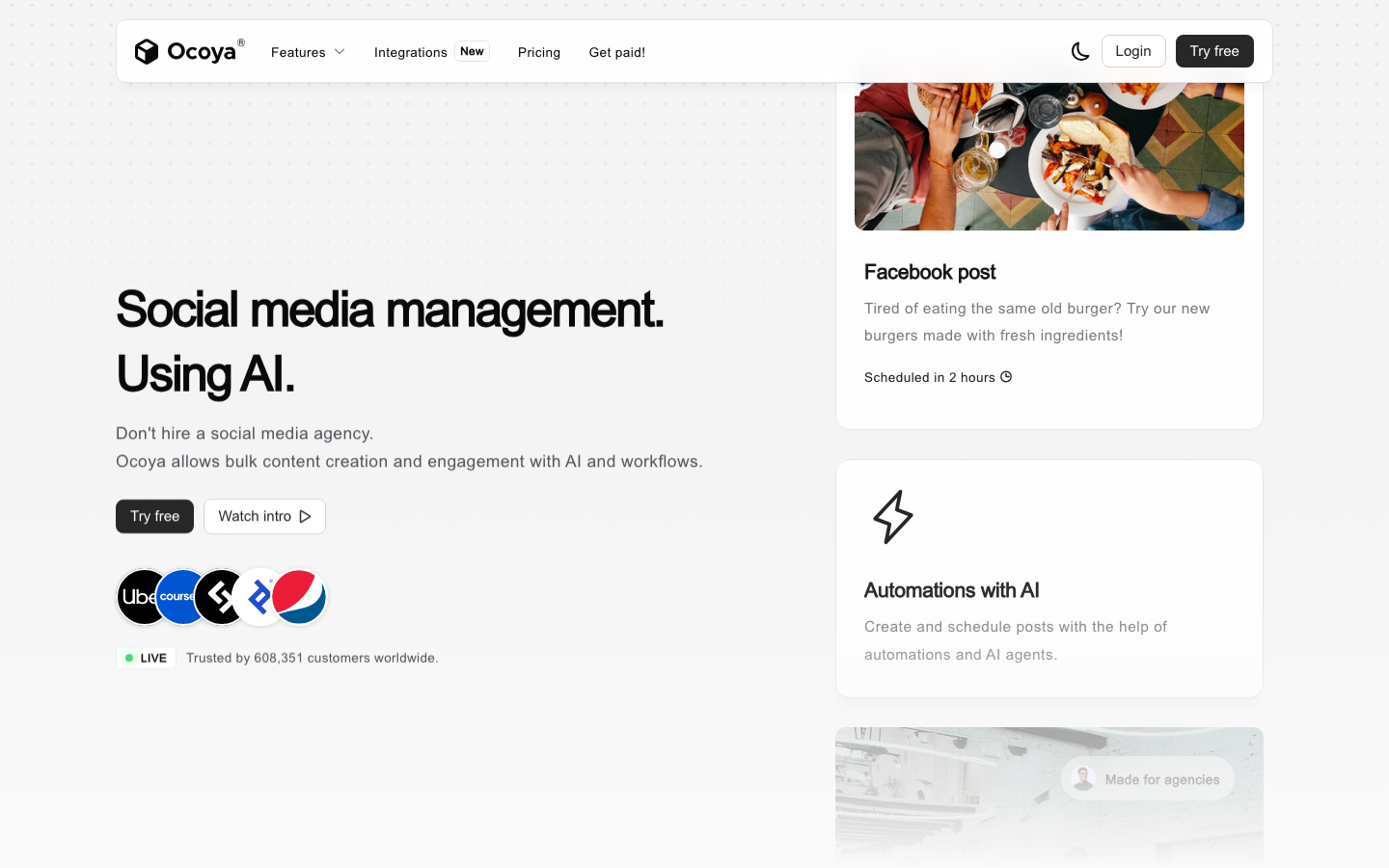
Full introduction to #Ocoya
Core parameters and statistics
| Parameter items | Specifications |
|---|---|
| Product positioning | AI agent-driven social media management and content automation platform |
| Core form | Web SaaS |
| User scale | Thousands of brands and agencies (2,000+ posts generated daily) |
| Covered platforms | 30+ social media/design/e-commerce integration |
| Core Features | AI Agent, automated workflow, multi-level approval, brand package |
| Pricing Model | Credits-Based SaaS Subscription |
| Price range | $15–$159/month |
| Free trial | 7-day free trial |
| Billing unit | Credits (covering AI text generation, image generation, automated operation, etc.) |
Interpretation: Ocoya's differentiated positioning lies in "AI replacing social media agents" - it is not another scheduling tool, but attempts to automate all the "repetitive execution" parts of social media management through AI Agents and automated workflows, leaving the brand team responsible only for strategy and approval.
User and market recognition
- Enterprise Clients: Used by marketers of well-known brands such as Uber Eats (case user is an Uber Eats executive).
- Community reputation: There is a certain user base among agencies and social media marketing teams, and the Facebook community is active.
- Daily processing volume: The platform generates 2,000+ social media posts every day.
- Industry Recognition: It is included in many AI tool catalogs and has a certain reputation in the field of social media automation.
Cost advantage
Ocoya adopts Credits billing model, and all AI functions (text generation, image generation, automated operation, etc.) consume Credits uniformly:
- C-side/Freelance ($15–$39/month):
- Bronze ($15/month): 1 workspace, 1 user, 5 social media accounts, 100 Credits/month. Suitable for individual creators.
- Silver ($39/month): 5 workspaces, 5 users, 20 social media accounts, 500 Credits/month. Suitable for small teams.
- B-side/brand and agency ($79–$159/month):
- Gold ($79/month): 20 workspaces, 20 users, 50 social media accounts, 1,500 Credits/month. Suitable for mid-sized brands.
- Diamond ($159/month): 50 users, 150 social media accounts, unlimited Credits estimate. Suitable for large agencies.
- Annual Payment Discount: Save approximately 20% by paying annually.
- Hidden Costs:
- Credits consumption: AI text generation, image generation, and automated operation each consume Credits. High-output users may need to pay attention to the consumption speed.
- After exceeding the Credits limit, you need to purchase additional packages or upgrade packages.
- No separate API pricing - API integrations use the same Credits system.
Rule: For a small agency managing 5 brand accounts, the Silver plan ($39/month) can cover the basic needs. Comparing the cost of hiring social media content writers (average monthly $500-1000/person), even if you upgrade to Gold ($79/month), the cost is only one-tenth of the labor cost.
Main functions
- AI Agent System: Three pre-configured AI Agents—Social Poster (automatically generates and publishes multi-platform content), DM Chatbot (automatically replies to private messages), and Comment-to-DM (keywords trigger automatic private messages). Synergy: AI generates content→automatic scheduling→automatically responds to comments→converts private messages, forming a complete automation process from content generation to customer interaction.
- Automated workflow engine: Supports three triggers - scheduled trigger (automatic publishing every
- AI content generation: Built-in AI copywriting and image generation, and access to media libraries such as Canva, Unsplash, and Giphy.
- Multi-level approval workflow: Supports internal approval, customer approval and public link sharing, with comments and status tracking.
- Analysis Panel: Track the release performance of each platform and recommend the best release time.
- Link Shortening and UTM Management: Built-in link shortening and UTM tracking parameter management.
- Hashtag Presets: Create reusable Hashtag collections and quickly apply them to posts.
Model and version evolution
Mainline release
- 2024 — First release: The core functions of AI content generation + social media scheduling are online.
- 2025 — Multi-Platform Expansion: Integrate 30+ platforms, add multi-level approvals and brand suite capabilities.
- 2026 — AI Agent + Workflow Engine: Launch of AI Agent system (Social Poster, DM Chatbot, Comment-to-DM) and three automated workflow triggers. Ocoya has been upgraded from a "scheduling tool" to an "automated social media operation platform."
Technical advantages
Ocoya's core technical architecture is an organic combination of "AI orchestration layer + automation engine + platform API integration":
- AI Orchestration Layer: Coordinates multiple underlying AI models (text generation, image generation, translation) to output unified branded content. Users only need to set the brand tone and content strategy, and the AI layer automatically completes the execution.
- Automation Engine (Workflow Engine): event-driven architecture, supports three types of triggers: time RSS and e-commerce products. When the trigger conditions are met, the engine automatically calls the AI orchestration layer to generate content and publish it directly through the platform API.
- Platform API integration: Publishing APIs of 30+ social media platforms to ensure content format, size, and safe zone compliance.
Causal chain: Trigger (timing/RSS/product event) → AI content generation (text + image) → automatic scheduling → platform API release. The entire link changes from "manual execution" to "automatic operation".
How to use
Getting Started:
- Register an Ocoya account and start a 7-day free trial.
- Connect social media accounts (Instagram, Facebook, TikTok, LinkedIn, etc.).
- Set up the brand package - brand color, font, logo, etc.
- Select a workflow:
- Quick publishing: AI generates a single post and publishes it immediately or at a scheduled time.
- Automated workflow: Configure triggers and AI agents to run automatically.
- Review the AI-generated content in the calendar panel and publish it after approval.
Core Configuration:
- AI Agent Configuration: Select Social Poster in the Agent panel and set posting frequency, theme and platform.
- Workflow configuration: Select trigger type (timing/RSS/product), set AI generation parameters and publishing rules.
- Approval Process: Enable multi-level approval and invite team members or customers to review content.
Product Pricing
| Package | Monthly payment | Annual payment (average monthly) | Number of users | Social media account | Credits/month |
|---|---|---|---|---|---|
| Bronze | $15 | ~$12 | 1 | 5 | 100 |
| Silver | $39 | ~$31 | 5 | 20 | 500 |
| Gold | $79 | ~$63 | 20 | 50 | 1,500 |
| Diamond | $159 | ~$127 | 50 | 150 | Undisclosed |
- All plans include a 7-day free trial.
- Save approximately 20% on annual payment.
- Additional packs will need to be purchased after exceeding Credits.
- Credits consumption: AI text generation (small amount), image generation (medium amount), automated operation (micro amount).
Application scenarios
- E-commerce Social Media Automation: Shopify/WooCommerce stores set up product release trigger workflows - after new products are put on the shelves, AI automatically generates social media posts and schedules them for release. Deduction: New product release → The delay in social media promotion is shortened from "1-2 hours to manually create posts" to "5 minutes to be automatically generated by AI".
- Content-based blog social media promotion: Blog updates trigger RSS workflow, and AI automatically extracts the key points of new articles to generate social media posts. Deduction: Each blog post automatically generates 3-5 social media promotion posts. The promotion coverage rate is increased but the operation hours are close to 0.
- Agency Multi-Client Management: Create workspaces for each client, configure their own branding suites and approval processes. Manual confirmation point: AI-generated content must be manually reviewed and approved before publishing, and is not suitable for 100% unattended publishing.
- DM automatic customer service conversion: Brands set up Comment-to-DM Agent on Instagram/TikTok, and users automatically receive private message replies after triggering keywords in comments. Deduction: The response time from comment interaction to private message conversion is shortened from hours to seconds.
Applicable people
- Social Media Agency: To manage multiple brand customers, brand parameters and approval processes need to be configured independently for each customer. Adaptation of multi-player collaboration function for Gold/Diamond package.
- E-commerce Brand: Shopify/WooCommerce store owners need to automate the product listing process and social media promotion.
- Content Creators and Bloggers: Publish blogs/videos regularly and need automated social media promotion to reduce duplication of work.
- Not suitable for the crowd:
- For brands that require in-depth social media data analysis (competitive analysis, audience insights), Ocoya’s analysis functions are relatively basic.
- For brands that have extremely high quality requirements for AI-generated content (such as luxury goods, art), the AI-generated content may require a lot of manual modification.
- The Credits billing model is not suitable for heavy users of AI functions. You need to pay attention to the consumption speed to avoid exceeding the budget.
Summary and Outlook
Ocoya's core differentiation lies in "AI Agent + automated workflow" - it is not another scheduling tool, but an attempt to use AI to replace repetitive execution problems in social media management. For e-commerce brands and agencies, this ability to "run automatically" may bring significant operational efficiency improvements.
Current Limitations:
- The quality and consistency of AI-generated content depends on setting accuracy, and early configuration requires time.
- Credits billing model can result in unpredictable costs.
- Brand awareness is lower than mature competitors such as Hootsuite and Buffer.
- In-depth analysis ability is relatively weak.
Procurement/Adoption Risk Assessment:
- It is recommended to start with the 7-day trial of the Bronze or Silver package and configure a brand account to test the content quality and workflow reliability of the AI Agent.
- Before purchasing, agencies should focus on verifying the efficiency of multi-client management and the compliance of the approval process.
- Enterprise users need to confirm the security certification status such as SOC2 of the data storage location - this information is subject to Ocoya's official real-time page or business communication.
Related tools:  Notion AI, google-workspace
Business process integration and ROI analysis
As a productivity tool for enterprises or professional positions, Ocoya's true value depends on the depth of integration with existing workflows and the quantifiable efficiency improvement effect. The following is a systematic analysis from three core dimensions.
System integration and data interoperability The ability to interoperate with existing business systems is a key prerequisite for productivity tools to be integrated into workflows. It is recommended to focus on evaluating the following integration dimensions: the openness and documentation quality of the RESTful/GraphQL API (whether a complete API reference and SDK examples are provided), the support scope of Webhook event notifications (which business event types are supported for automatic push), the number and depth of pre-built integrations with common collaboration SaaS tools (WeChat Enterprise, DingTalk, Feishu, Slack, Notion, Jira, etc.), and enterprise-level identity authentication support (SSO/SAML/OAuth and LDAP/AD directory integration). Products that lack integration capabilities are easily isolated into information islands, which in turn increases the cognitive cost and operational friction for teams to switch between different tools.
Efficiency Quantification and ROI Estimation Methodology Before purchasing decisions, it is recommended to quantify the input-output ratio through a structured method: Step 1, choose 3-5 Standardized tasks that are frequently repeated and time-consuming in each team are used as test samples; in the second step, the average time consumption of a single task before and after tool intervention, first-time pass rate or error rate, and the number of links requiring manual intervention are recorded under controlled conditions; in the third step, the saved manpower time is converted according to the comprehensive cost of the position (salary, benefits, management sharing), and soft benefits (increased employee satisfaction, standardization of work quality, and improvement in response speed to core business) are superimposed to obtain a comprehensive ROI estimate. It is recommended to continue tracking ROI trends on a monthly basis, as the value of a tool usually increases over time as team proficiency increases and workflows are optimized.
Phase-based implementation strategy and risk control It is recommended to adopt a three-stage implementation path of "pilot verification-gradual promotion-continuous optimization". In the pilot stage (1-2 weeks), a single team or a single business scenario is selected for small-scale verification. The core goal is to verify technical feasibility and user acceptance, and establish preliminary usage specifications and success standards; in the promotion stage (2-4 weeks), after the pilot verification is passed, the coverage is gradually expanded, and standardized activation processes and training materials are developed; in the optimization stage (continuous), the workflow configuration is continuously adjusted based on actual usage data and user feedback, and more high-value application scenarios are explored. Clear quantitative key result indicators should be set at each stage to avoid blindly expanding the scope of use without data support.
Version Info
- AI Agents + Workflows :Launched AI Agent system (Social Poster, DM Chatbot, Comment-to-DM), and added automated workflow engine (Scheduled/RSS/Product Release trigger). There is no official precise date yet.
- Multi-Platform Scheduling :Expand social media platform integration to 30+, support multi-level approval workflow and brand package management. There is no official precise date yet.
- Ocoya Launch :Released for the first time, it is positioned as an AI-driven social media management tool, providing content generation, scheduled release and basic analysis functions. There is no official precise date yet.
User Reviews