 Omnilingual ASR
Free
Omnilingual ASR
Free
Omnilingual ASR is an open source automatic speech recognition system launched by Meta FAIR. It covers 1600+ languages and focuses on solving the speech transcription problem of low resources and languages not covered by mainstream ASR.
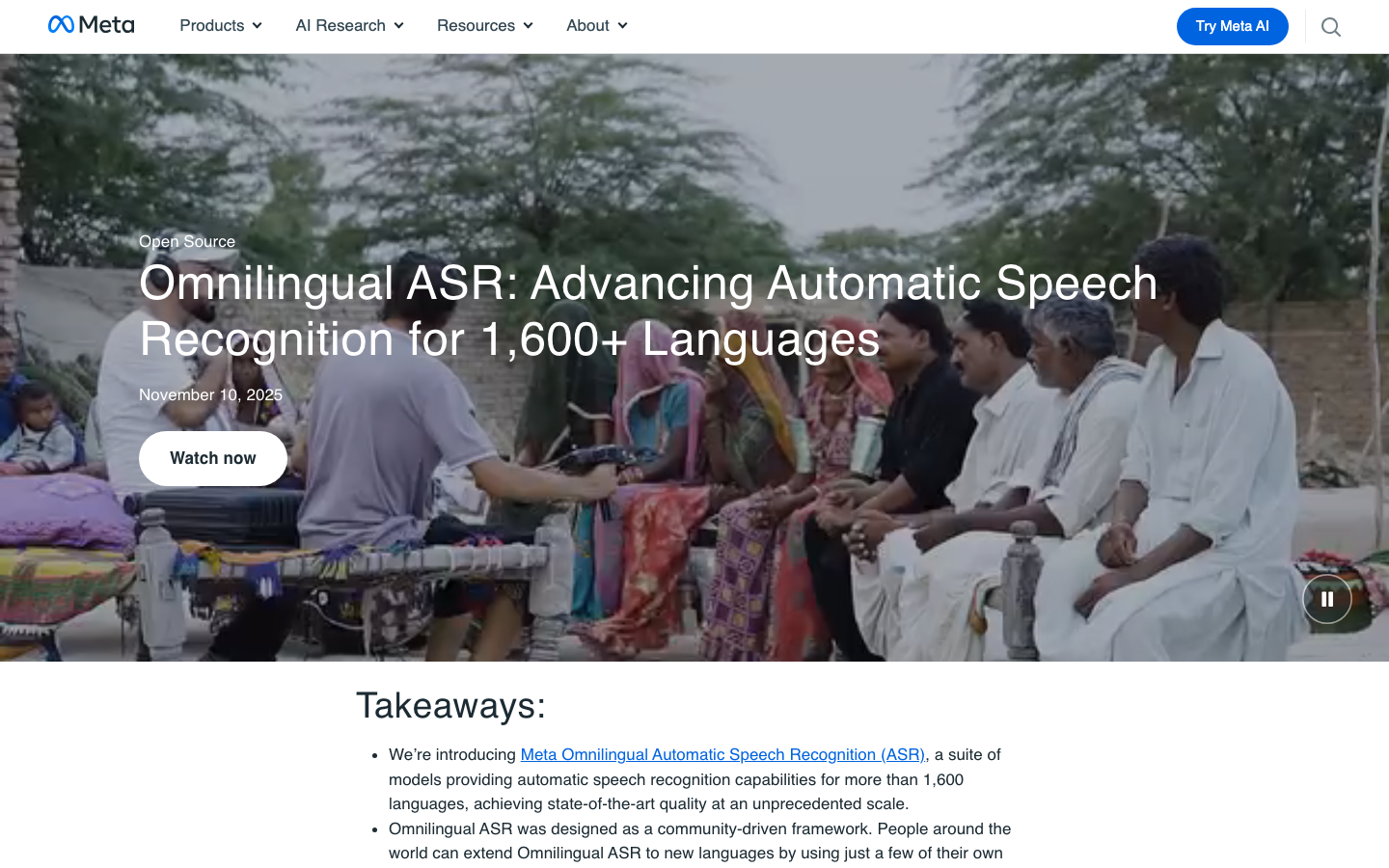
Full review of #Omnilingual ASR
Core parameters and statistics
| Project | Specifications |
|---|---|
| Product Positioning | Large-scale multi-language open source speech recognition system |
| Developer | Meta FAIR |
| Languages Covered | 1600+ |
| Low resource languages | Approximately 500 languages without AI transliteration support before |
| Model size | 300M / 7B and other sizes |
| Dual Decoder | CTC + Transformer/LLM style |
| Open Source License | Apache 2.0 (model) / CC-BY 4.0 (data) |
| Low Resource CER | 78% of languages have a character error rate below 10% |
Omnilingual ASR does not seek to surpass Whisper in English, but does a more difficult thing - making more than 1,600 languages in the world recognized by AI, including about 500 languages that have had almost no AI transliteration support before. It may not be the best ASR for English users, but for speakers of a niche language, it's the only option.
Promotion verification: "78% of languages have a character error rate below 10%" - this statistic includes the contribution of high-resource languages (such as English, Spanish), and performance in low-resource languages will be significantly lower than this average. For truly niche languages (those with the smallest corpus), the CER may be higher than 30%.
The Free Truth: Apache 2.0 is open source and model weights are free to download. However, fine-tuning low-resource languages requires collecting and annotating audio data by yourself, and the cost of this data preparation process may be much higher than the model itself. For a niche language, "collecting dozens of hours of annotated audio" itself is a big project.
User and market recognition
Gradually build user awareness in the field, and product capabilities are used by content creators and teams to improve work efficiency. Some industry users have incorporated it into their daily workflow. It is recommended to refer to the latest official disclosures for specific user scale and industry adoption rate data.
Cost advantage
| Dimensions | Description |
|---|---|
| Model Weights | Apache 2.0 Open Source and Free |
| Dataset | CC-BY 4.0 Free |
| API Service | No official paid API |
| Self-deployed inference | 300M version can run on a single card, 7B requires GPU |
Free Truth: The code and models are fully open source, but self-deploying the ASR service requires audio processing pipelines and GPU inference resources. For low-resource languages, fine-tuning also requires collecting and annotating audio data in the target language—these hidden costs are much higher than the zero cost of model downloads.
Main functions
- 1600+ Language Speech Transcription: Covering most of the world's major languages and a large number of minor languages. Even if your language isn’t supported in mainstream ASR products, Omnilingual ASR will most likely cover it—approximately 500 languages have never had AI transliteration capabilities before.
- Multi-size model family: Provides multi-scale models in the parameter range from 300M to 7B. The 300M version is suitable for resource-constrained devices and real-time inference, and the 7B version pursues the highest accuracy.
- Dual decoder architecture: Provides two routes: CTC decoding (lightweight and fast) and Transformer/LLM style decoding (higher accuracy). Developers can choose between speed and quality.
- Extensible to new languages: The system can be extended to new languages with a small number of audio-text samples without the need to retrain the entire model. For new niche languages, the adaptation can be completed by collecting dozens of hours of annotated audio.
Model and version evolution
Mainline release
- ~2026-06: Meta FAIR releases Omnilingual ASR, a speech recognition system covering 1600+ languages.
Technical advantages
- Algorithm Optimization: Special optimization at the model or algorithm level has been carried out for the corresponding scenario to achieve a balance between response speed and result quality.
- Low-latency architecture: Adopts streaming or asynchronous processing architecture to reduce user waiting time and is suitable for high-frequency interaction scenarios.
How to use
- Download model weights from Meta AI official channels
- Use PyTorch to load the model for inference
- Support 300M/7B multiple size selections
- For low-resource languages, prepare a small amount of annotated audio for fine-tuning.
Product Pricing
| Dimensions | Description |
|---|---|
| Model Weights | Apache 2.0 Open Source |
| Dataset | CC-BY 4.0 |
| API Service | No third-party official API |
| Self-deployment | GPU required (300M single card can run) |
Application scenarios
- Multi-language subtitles and podcast transcription: Media platforms that need to handle audio content in multiple languages can use Omnilingual ASR to replace the maintenance costs of multiple sets of ASR. Suitable for podcast platforms, video websites and media monitoring services.
- Low resource language digitization: Endangered language protection projects, minority language education platforms and other scenarios. The open source attribute of Omnilingual ASR allows these non-commercial projects to also use advanced ASR technology.
- Voice Assistant Internationalization: When expanding the voice assistant to new language markets, use Omnilingual ASR as the speech recognition layer and cooperate with the machine translation system to achieve cross-language interaction.
Dissuade scenario: If your application only serves English users, Whisper or DeepSpeech has higher accuracy and a more mature ecosystem in English. The advantage of Omnilingual ASR is coverage, not precision in a single language.
Applicable people
- Multi-language ASR researchers: A research team doing multi-language speech recognition and low-resource language modeling.
- International Product Engineer: A development team that needs to expand product voice capabilities to multilingual markets.
- Language Digitization Project Team: Researchers engaged in non-commercial projects such as endangered language protection and multilingual corpus construction.
Persuasion Scenario: If your application scenario is real-time speech transcription in a single language (such as English meeting records), Whisper is better than Omnilingual ASR in terms of latency and accuracy. The value of Omnilingual ASR lies in multi-language coverage, not extreme precision in a single language.
Current limitations: 7B model deployment requires higher GPU resources; the CER of low-resource languages is significantly higher than that of high-resource languages; no official managed API service is provided, and self-deployment requires building an inference pipeline by yourself.
Summary and Outlook
It provides competitive solutions in its field, and its core value lies in lowering the threshold for AI use in this field.
Current limitations: Some advanced features require paid subscription, and the free version has function or usage restrictions; specific technical details and performance benchmarks have not yet been fully disclosed.
Related tools:  ElevenLabs, udio
Version Info
- Omnilingual ASR :Meta FAIR is released, covering 1600+ languages and providing 300M/7B multi-size models.
- Omnilingual ASR :First release, no official precise date yet.
User Reviews