 Open-Meteo AI
Free
Open-Meteo AI
Free
Open-Meteo AI is an open source high-precision weather data API platform that aggregates 30+ numerical weather forecast models around the world (ECMWF, NOAA GFS, DWD ICON, etc.) and provides more than ten meteorological APIs including ERA5 reanalysis data 16-day forecasts from 1940 to the present, historical forecast archives, air quality, oceans, floods, etc. It can be used for free without API Key or registration, and is suitable for AI/ML training, energy prediction, agricultural analysis, climate research and other scenarios. Supports Docker self-hosting, and the code adopts the AGPLv3 open source agreement.
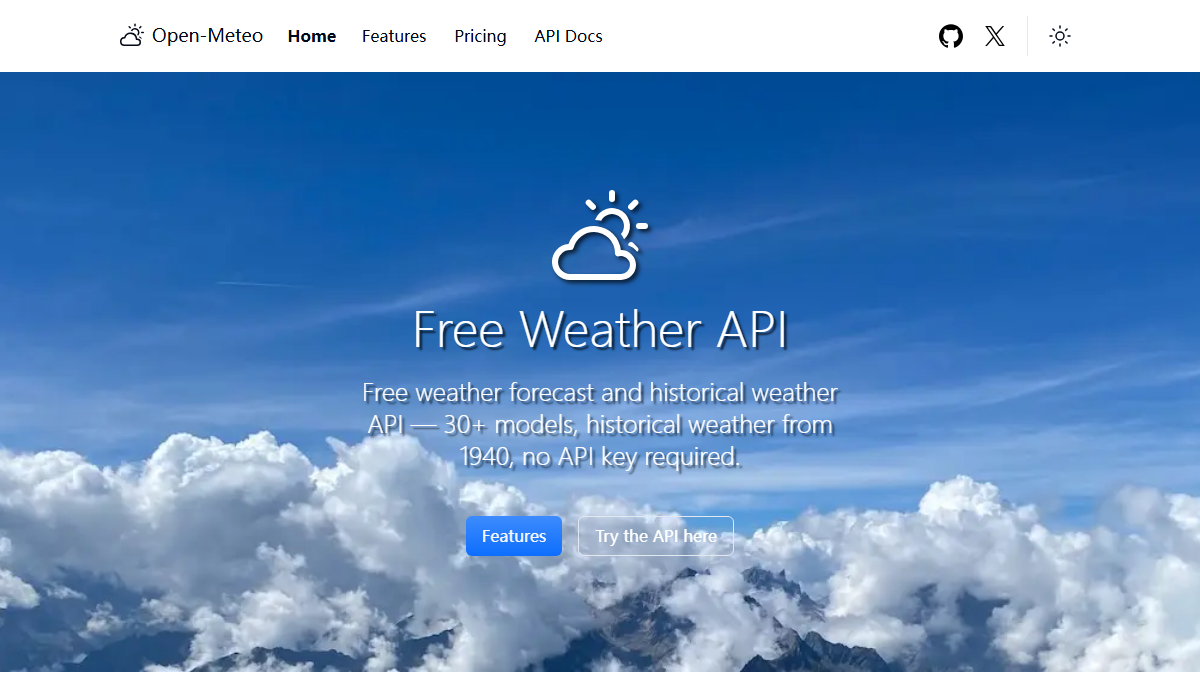
Open-Meteo AI: Open source and free high-precision weather data infrastructure
Core parameters and statistics
Open-Meteo AI is one of the free and open source weather data APIs with the widest coverage in the world. Its core parameters determine its applicable boundaries in AI/ML training, energy forecasting, agricultural analysis and other scenarios.
| Parameter dimensions | Open-Meteo AI specifications |
|---|---|
| Number of Weather Models | 30+ models from 15+ National Meteorological Offices (ECMWF, NOAA, DWD, Météo-France, JMA, KMA, KNMI, UK Met Office, etc.) |
| Spatial Resolution | 1–2 km for regional models, 9–11 km for global models |
| Forecast Duration | Hourly forecast up to 16 days |
| Historical data coverage | ERA5 reanalysis from 1940 to the present, hour by hour, with no missing global coverage |
| Historical Forecast Archive | Consistent with Live Forecast API format starting in 2021 |
| UPDATE FREQUENCY | Every 6 hours for global models, every 1–3 hours for high-resolution regional models (ICON-D2, HRRR, AROME) |
| Response time | Single point forecast <10 ms, decades of historical query <100 ms |
| API Access | HTTP GET, pure JSON return, no API Key or registration required |
| Data License | CC BY 4.0 (for commercial use, attribution required) |
| Server License | AGPLv3 (can be self-hosted) |
| Daily call limit | Non-commercial use 10,000 times/day |
| Monthly calls for paid plans | Standard 1 million times Professional 5 million times Enterprise 50 million times+ |
| Self-hosted | Supports Docker one-click deployment, suitable for high throughput or isolation |
Interpretation of parameter meaning: The core competitiveness of Open-Meteo lies in model aggregation density - it is not a self-built meteorological model, but a unified access to the open data of 15+ national meteorological bureaus around the world, normalized processing, and output through a unified API. This "data aggregator" model gives it far greater data breadth than a single model provider. For AI training, this means that parallel historical outputs of multiple models can be obtained under a set of APIs, which facilitates the construction of model ensembles or multi-source comparative analysis. A regional resolution of 1–2 km already meets the accuracy needs of most agricultural, energy, and logistics scenarios; and the ERA5 reanalysis' 80+ years of continuous records starting in 1940 provides scarce long-term label data for climate predictions and long-time ML models.
User and market recognition
C-side and community adoption
Open-Meteo has wide recognition in the open source community and developer community. The GitHub repository has received 5,900+ stars, has 82 contributors, and has released a total of 23 versions. Its official display page lists 40+ well-known applications built on Open-Meteo, including:
- Home Assistant (the most popular open source smart home platform) has Open-Meteo as an official weather integration
- Breezy Weather (open source Android weather app designed by Material You)
- WeatherAI (comprehensive weather application on Google Play)
- Precip (cross-platform hyperlocal weather app)
- Slideshow Digital Signage (commercial digital signage application)
There are also a number of CLI tools, terminal widgets, Raycast plug-ins, and Arduino embedded projects built on Open-Meteo.
B-side and commercial adoption
Open-Meteo’s commercial customers cover the fields of renewable energy, agricultural technology, logistics dispatch, and actuarial insurance**. Its paid plans offer a dedicated domain endpoint (customer-api.open-meteo.com), a 99.9% availability SLA and dedicated support. Typical business scenarios include:
- PV/Wind Power Forecast: Train power forecast models using multi-model ensemble outputs and multi-year historical archives
- Agricultural Disaster Warning: Combine Flood API and Seasonal Forecast API for flood and drought warning
- Energy Trading Decisions: Use Single Runs API to look back at historical forecast snapshots and backtest trading strategies
Industry Benchmarking
Compared with similar weather data services, the core differences of Open-Meteo are free threshold and open source transparency:
| Comparative Dimensions | Open-Meteo AI | Weather.com (IBM) | Tomorrow.io | Weatherstack | Visual Crossing |
|---|---|---|---|---|---|
| Free quota | 10,000 times/day, no registration required | Limited free, registration required | 500 times/day | 1,000 times/month | 1,000 times/day |
| Open source | ✅ Complete server source code AGPLv3 | ❌ | ❌ | ❌ | ❌ |
| Historical data | ✅ ERA5 from 1940 | ❌ Paid only | ✅ Paid | ❌ | ✅ Paid |
| Number of models | 30+ | 1–2 | 1–2 | 1 | 1–2 |
| Self-Hosted | ✅ Docker Deployment | ❌ | ❌ | ❌ | ❌ |
| Data License | CC BY 4.0 Commercial Use Allowed | Proprietary | Proprietary | Proprietary | Proprietary |
**Key identification: Open-Meteo is not a low-cost alternative to commercial weather APIs, but enters the market as an "open data infrastructure". Its free quota (10,000 times/day) has exceeded the paid entry level of most competing products, making it the first choice for prototype verification and academic research. For production-bound high-throughput scenarios, the price of paid plans is also significantly lower than that of commercial APIs of the same level (such as IBM Weather or Tomorrow.io's enterprise plans).
Cost advantage
Open-Meteo's cost structure needs to be broken down from three levels: C-side API developers and enterprises.
C-side individual users
- Completely Free: No fees for individual users, amateur developers, students and researchers. No API Key, no credit card, no registration required.
- Quite generous free quota: 10,000 API calls per day, more than enough for the traffic needs of most personal projects. A typical weather app user refreshes 10–20 times per day, and a quota of 10,000 times/day can support 500–1,000 active users.
- Paid for commercial use: Free tier is expressly limited to non-commercial use. Commercial use requires purchasing a subscription plan (from €49/month).
API Developers and Small Teams
The free tier can already support most prototype verification and MV P stages. When the call volume exceeds the free quota or a commercial license is required, you can subscribe on a monthly basis:
| Plan | Monthly calls | Frequency limit | Commercial license | Available API range | Price (speculated, subject to official) |
|---|---|---|---|---|---|
| Free | ~300,000 times/month | 10,000 times/day | ❌ | Basic API (excluding history, climate, collections) | €0 |
| Standard | 1 million times/month | None | ✅ | Basic API | Unpublished |
| Professional | 5 million times/month | None | ✅ | All APIs (including history/climate/ensemble/satellite radiation) | Unpublished |
| Enterprise | 50 million times +/month | None | ✅ | All APIs + custom plans | Business contact required |
Note: The official website of Open-Meteo has not disclosed the specific prices of Standard and Professional. It only indicates that they can be obtained after subscribing through Stripe. The above "undisclosed" annotation complies with the anti-illusion rules. The actual price is subject to the
Cost comparison: Taking a medium-sized commercial project with an average of 500,000 API calls per day as an example, the annual cost of using the Open-Meteo Professional plan is estimated to be in the thousands of euros; while an annual subscription of the same size for IBM Weather or Tomorrow.io is usually in the range of US$20,000-50,000. Open-Meteo's cost advantage comes from its open source architecture - users are actually paying for a "hosted service" rather than the data itself.
Enterprise/Private Deployment
For scenarios with extremely large call volume (hundreds of millions of calls per month) or strict requirements on data sovereignty, Open-Meteo provides a third path:
- Docker self-hosting: The complete server code is open source on GitHub and can be deployed with one click through Docker or Ubuntu packages. Self-hosted instances do not have any calling restrictions.
- Cost Structure: The cost of self-hosting is mainly server hardware (NVMe disk, enough memory) and bandwidth. According to the official documentation, a full instance processing global data requires 2 TB+ storage.
- AWS Open Data Sponsorship: The Open-Meteo weather database is distributed through the AWS Open Data Sponsorship program, which eliminates data storage and transfer fees for AWS users.
Hidden Cost Tip: Although self-hosting has zero API fees, the operation and maintenance complexity cannot be ignored. The multi-model data download pipeline processes 2 TB+ of raw GRIB data per day, requiring stable network and computing resources. For small teams that lack operation and maintenance experience, it is more cost-effective to directly use the hosting solution.
Main functions
Open-Meteo provides more than ten categories of API endpoints, covering the complete spectrum from real-time weather to millennium climate predictions.
1. Weather Forecast API (Forecast API)
Provides 16-day hour-by-hour weather forecast for any location around the world. Supports automatic best model matching (best_match), or you can manually specify a specific meteorological model. Returned variables include temperature, precipitation, wind speed, wind direction, air pressure, humidity, cloud cover, visibility, soil temperature and humidity, solar radiation and dozens of other dimensions.
Applicable tasks: Mobile weather app, outdoor activity planning platform, logistics route decision support.
2. Historical Weather API
Hourly global grid data are provided from January 1, 1940 to the present, based on ECMWF ERA5 and ERA5-Land reanalysis data. Spatial resolution 9–25 km, time continuous, no missing values. A single query can return decades of time series in 100 ms.
Applicable tasks: Climate baseline analysis, long-term series ML model training, anomaly detection benchmarks, feature engineering of agricultural yield prediction models.
3. Historical Forecast Archive API (Historical Forecast API)
Continuous archiving of initial hourly data for each model update starting in 2021, in a format that is fully consistent with the real-time forecast API. This allows historical forecast data to be used directly for bias-correction and post-processing pipeline training.
Applicable tasks: Train forecast post-processing models (such as MOS statistical downscaling), and evaluate systematic biases of models in different seasons/regions.
4. Previous Runs API
Provides continuous time series data with a fixed lead time offset (1–7 days). For example, each value in the _previous_day2 series is taken from a forecast initialized 48 hours in advance. Available from January 2024.
Applicable tasks: Systematic forecast bias analysis, ML training dataset construction stratified by lead time, model skill scoring.
5. Single Runs Archive API (Single Runs API)
Access archived individual model runs by exact initialization time (run= parameter). The ECMWF IFS HRES will be available retroactively from March 2024 and fully archived from April 2026. Each piece of data covers a complete forecast period (7–10 days).
Applicable tasks: ML training without look-ahead bias (each training sample is a single forecast + verification observation pair), energy trading decision backtesting, run-level model cross-comparison.
6. Ensemble Forecast API (Ensemble API)
Provides multi-center ensemble forecasts such as ECMWF IFS ENS, GFS ENS, ICON EPS, GEM EPS, etc., with a maximum of 51 members and a maximum forecast period of 35 days. Returns the independent output of each member and supports probability distribution calculation.
Applicable tasks: Extreme weather probabilistic early warning, hydrological ensemble forecast, and probabilistic forecast of energy load.
7. Air Quality API
Based on the Copernicus Atmosphere Monitoring Service (CAMS), hourly forecasts of PM2.5, PM10, NO₂, O₃, SO₂, CO, dust UV index and pollen (grass, birch, alder) are provided.
Applicable tasks: health risk management, pollen allergy warning app, urban planning air quality assessment.
8. Marine Weather API (Marine API)
Provides forecasts of wave height, period and direction for global oceans and nearshores.
Applicable tasks: Shipping route optimization, offshore operation safety assessment, surfing/sailing app.
9. Flood API
Based on the Global Flood Alert System (GloFAS), it provides ensemble runoff forecasts for rivers around the world for up to 30 days.
Applicable tasks: flood disaster early warning, agricultural flood control decision-making, insurance risk assessment.
10. Seasonal Forecast API
Based on the ECMWF SEAS5 seasonal forecast system, seasonal forecasts up to 9 months and subseasonal forecasts (EC46) up to 6 weeks are provided with a resolution of 36 km and 51 ensemble members.
Applicable tasks: agricultural planting planning, water resource dispatching, and long-term energy planning.
11. Climate Change API
Based on CMIP6 climate model output, downscaled to 10 km resolution and statistically bias corrected (ERA5 baseline). Daily data are provided for 1950–2050, covering multiple emission scenarios.
Applicable tasks: Climate risk assessment, long-term infrastructure planning, climate scenario analysis for the insurance industry.
12. Satellite Radiation API
Shortwave and direct radiation data extrapolated from geostationary satellite imagery. Sources include EUMETSAT CM SAF SARAH3 (Europe/Africa/South America, from 1983), JMA Himawari-9 (Asia/Australia, from 2015), DWD MTG (Europe/Africa, from February 2026), resolution 2.5–5 km, 10–30 min intervals.
Applicable tasks: Solar power plant capacity analysis, forecast deviation assessment, and reconstruction of historical radiation data.
13. Geocoding API and Elevation API
Parse place names into WGS84 coordinates (including country, time zone, altitude information), and query terrain elevation through coordinates (90 m resolution DEM, 100 sets of coordinates in batches).
Applicable tasks: location search, map application, geographic information system integration.
Expert’s perspective: Hidden synergy between functions
Open-Meteo's more than ten types of APIs are not isolated data islands. There are strong synergies between them:
-
forecast + historical forecast archive + previous run form a complete "forecast-verification-deviation analysis" system. Developers can use the same set of parameter formats to simultaneously obtain real-time forecasts (Forecast API) and corresponding historical forecast archives (Historical Forecast API), directly calculate model deviations, and build self-calibrating prediction pipelines.
-
ERA5 Reanalysis + Climate Change provides a continuous timeline of "Last 80 Year Baseline + Next 30 Year Projections". For ML models that require long-term climate characteristics (such as crop yield prediction, renewable energy LCOE assessment), this data continuity means that training data acquisition and inference data acquisition can be completed within a set of API systems, without the need for cross-platform coordination.
-
The combination of ensemble forecast + seasonal forecast allows users to smoothly transition from "probability distribution for the next 16 days" to "seasonal trend for the next 9 months", which is extremely important for energy trading, agricultural insurance and other scenarios that require different time scales.
-
Satellite Radiation + Air Quality + Weather The linkage of three APIs can support refined solar energy prediction: satellite radiation provides "historical actual irradiation", air quality forecast provides "attenuation effect of aerosols on irradiation", and weather forecast provides "cloud cover's blocking of irradiation". The combination of the three can build a more accurate PV power prediction than a single model.
Model and version evolution
Since it was open sourced in 2022, Open-Meteo's server code has evolved from "basic weather query" to "multi-model weather data infrastructure".
Version context
| Version | Release Date | Core Changes |
|---|---|---|
| v1.0.0 | 2023-03 | First official version: Forecast API, Historical Weather API, Geocoding API, Elevation API |
| v1.1.0 | 2023-08 | Added Air Quality API, Marine API, Ensemble API; introduced GeoDNS multi-region routing |
| v1.2.0 | 2024-01 | Added Flood API, Seasonal Forecast API; supports single request multi-location query |
| v1.3.0 | 2024-06 | Added Historical Forecast API and Previous Runs API; optimized data fusion pipeline |
| v1.4.0 | 2024-12 | Major changes to file format (performance optimization); new Satellite Radiation API; improved ERA5 processing pipeline |
Model access evolution
Open-Meteo’s meteorological model integration has undergone three stages of expansion:
- Early stage (v1.0–v1.1): Access the three mainstream global models of ECMWF IFS, NOAA GFS, and DWD ICON + MET Norway regional model.
- Mid-term (v1.2–v1.3): Expand to JMA, KMA, KNMI, DMI, MeteoSwiss, UK Met Office, BOM, CMA, etc., to achieve coverage of 15+ meteorological bureaus; also introduce ensemble forecast and professional models such as air quality and ocean.
- Current (v1.4+): Continue to optimize the throughput and compression efficiency of the data pipeline; add satellite remote sensing radiation data; ECMWF IFS HRES single run archives begin to be made public.
Client SDK Ecosystem
The Open-Meteo community also maintains multiple client libraries covering major programming languages:
- Python:
open-meteo/python-requests(official) - TypeScript:
open-meteo/typescript(official) - Kotlin:
open-meteo/open-meteo-api-kotlin(official) - Dart/Flutter:
neursh/open-meteo-dart(community) - Go:
HectorMalot/omgo(community) - Rust:
angelodlfrtr/open-meteo-rs(community) - .NET/C#:
colinnuk/open-meteo-dotnet-client-sdk(community) - R:
tpisel/openmeteo(community)
These SDKs allow developers to obtain weather data directly through language native function calls without having to worry about HTTP request splicing.
Technical advantages
Architecture design: efficient pipeline from GRIB to JSON
The core technical challenge of Open-Meteo is to unify the heterogeneous raw data (GRIB2, NetCDF, BUFR and other binary formats, different grid systems, projections, resolutions, update cycles) from 15+ national meteorological offices into a low-latency JSON API.
Its technical pipeline is divided into four layers:
- Data Download Tier: 2 TB+ of raw GRIB data are downloaded daily from each weather agency FTP/HTTPS endpoint. Each data pipeline runs independently and supports resumed downloads and incremental updates.
- Format conversion and grid remapping layer: Interpolate the original grid data of each model into a unified WGS84 latitude and longitude grid. This step involves multiple projection transformations (Lambert Conformal, Polar Stereographic, Rotated Pole, etc.) and is the most technically complex step.
- Columnar sequential storage layer: The converted data is written to the NVMe SSD in a custom columnar compression format. This format is deeply optimized for meteorological time series data (one variable × one location × continuous time), allowing typical forecast queries to be completed within 10 ms. This is the key technology for Open-Meteo to achieve "free API but performance that is not inferior to commercial products".
- API service layer: HTTP service built on Swift (Vapor framework), routing requests to server clusters in Europe or North America through GeoDNS. All APIs use semantic versioning.
Why does Open-Meteo stay free and fast?
- Open source reduces infrastructure costs: Open-Meteo hosts the weather database using the AWS Open Data Sponsorship program, with AWS covering the cost of data storage and outbound traffic. This makes the operating costs of the free tier significantly lower.
- Column storage eliminates repeated calculations: The traditional weather API extracts the data of the target location from the original model output at each request; Open-Meteo completes the processing of all grid points in advance and stores them in columnar format. Only one index lookup + a small amount of decompression operation is required during query. This makes the computational cost of a single query extremely low.
- Swift's high concurrency performance: The server uses Swift (compiled language) instead of Python or Node.js, which can support 10-100 times the number of concurrent connections than interpreted languages under the same hardware conditions.
Data quality assurance
Open-Meteo does not directly produce meteorological data, but obtains public numerical forecast output from national meteorological offices. This means:
- Authoritative data source: Numerical models from ECMWF, NOAA, DWD and other institutions have been verified for decades, and their quality is widely recognized around the world.
- Multi-model cross validation: Users can automatically obtain the highest resolution model through the
best_matchparameter, or manually specify multiple models for cross comparison. - Real-time monitoring:
status.open-meteo.comprovides real-time health status and historical availability of each data pipeline.
Technical differences with commercial weather APIs
| Technical Dimension | Open-Meteo AI | Typical Commercial Weather API |
|---|---|---|
| Model access | Aggregation of 30+ models, which can be switched at will | Usually 1–2 self-developed or agency models are provided |
| Data format | Columnar timing compression, NVMe acceleration | Usually based on relational database or cache layer |
| Historical archive | ERA5 1940 onwards + Forecast archives 2021 onwards | Typically only limited-term history retained |
| Ensemble forecast | Supports 5 ensemble systems, 51 members | Usually not provided or requires separate contract |
| Self-hosted | The complete server source code can be deployed | Not available |
| API consistency | All APIs use the same parameter format | API formats may be inconsistent across product lines |
How to use
Quick Start: Free API Calls
The threshold for using Open-Meteo is extremely low - no registration, no API Key, no SDK required, just an HTTP GET request to get started.
Get real-time temperature and wind speed at your current location:
curl "https://api.open-meteo.com/v1/forecast、latitude=39.9042&longitude=116.4074¤t=temperature_2m,wind_speed_10m"Return JSON example:
{
  "latitude": 39.88,
  "longitude": 116.41,
  "current": {
    "time": "2026-07-18T14:00",
    "temperature_2m": 32.5,
    "wind_speed_10m": 4.2
  }
}
Get a 7-day hour-by-hour forecast and specify a weather model:
curl "https://api.open-meteo.com/v1/forecast、latitude=52.52&longitude=13.41&hourly=temperature_2m,precipitation,soil_moisture_0_to_1cm&models=icon_seamless&timezone=auto"Comparison of each entrance
| Access method | Applicable scenarios | Whether registration is required | Whether payment is required |
|---|---|---|---|
Free API (api.open-meteo.com) |
Prototyping, personal projects, academic research | ❌ | ❌ (non-commercial) |
Business API (customer-api.open-meteo.com, apikey=...) |
Produce contextual business projects | ✅ Subscription required | ✅ |
| Docker self-hosting | High throughput, data sovereignty requirements, isolation and isolation | ❌ | ❌ (own server costs) |
| Client SDK (Python/TS/Kotlin/Go, etc.) | Language native integration | Depends on the access method | Depends on the access method |
Typical usage process (free → commercial → self-hosted)
- Prototype stage: Directly call the free API for data exploration and function verification. There are no sign-up steps required, and you can go from curl to product prototype in 10 minutes.
- Commercial launch stage: When the product enters production and requires a commercial license, subscribe to the paid plan through Stripe. After subscribing, you will automatically obtain the
customer-api.open-meteo.comindependent domain name and API Key. - Scale phase: If the number of calls exceeds 50 million times per month, or complete data sovereignty control is required, Docker self-hosting can be used. See the Docker Compose configuration example in
docs/getting-started.md.
Self-hosted deployment example
# docker-compose.yml
version: "3.8"
services:
  openmeteo:
    image: ghcr.io/open-meteo/open-meteo:latest
    ports:
      - "8080:8080"
    volumes:
      - ./open-meteo-data:/app/data
    environment:
      - OMP_URL=https://open-meteo.com/
restart: unless-stoppedNote: Self-hosted instances require pre-preparation of data files (~2 TB initial synchronization), and it is recommended to configure sufficient bandwidth and NVMe storage. For detailed deployment documents, please refer to the official GitHub repository README.
Product Pricing
Pricing model
Open-Meteo uses a "tiered monthly fee system" rather than a "pay-per-view" basis. This means that users pay a fixed monthly fee to obtain a certain amount of API call budget. The excess will not be hard blocked, but will trigger an email reminder (80%, 90%, 100%).
Comparison of various plans
| Plans | Monthly Quotas | Daily Limits | Rate Limits | Commercial License | Available API Range | SLA | Typical Monthly Cost |
|---|---|---|---|---|---|---|---|
| Free | ~300,000 hits | 10,000 hits/day | 600 hits/minute | ❌ | Basics + Ocean + Air Quality + Geocoding + Elevation | None | €0 |
| Standard | 1 million times | None | None | ✅ | Basic (excluding historical/climate/ensemble/satellite radiation) | 99.9% | Undisclosed |
| Professional | 5 million times | None | None | ✅ | All API | 99.9% | Unpublished |
| Enterprise | 50M+ | None | None | ✅ | All API + Custom Plans | 99.9% | Contact Business |
Key differences between free and commercial APIs
- Free Tier: Accessed via
api.open-meteo.com, no API Key, non-commercial use only, no SLA, daily rate limited (600/minute 5,000/hour 10,000/day). - Commercial Tier: Accessed through
customer-api.open-meteo.com, apikey=..., deployed on a dedicated server, 99.9% availability guaranteed, no rate limits, commercial use license included. - API scope differences: Historical Weather API, Climate Change API, Ensemble API, Seasonal Forecast API, Satellite Radiation API are only available for Professional and above plans.
Hidden cost tips
- Data Attribution Cost: All plans (including the commercial version) require compliance with CC BY 4.0 attribution requirements - each display of Open-Meteo data must be accompanied by a
Weather data by Open-Meteo.comlink. This can create design friction if the product UI space is limited. - Self-hosted operation and maintenance costs: Although self-hosting saves API fees, the initial data synchronization of 2 TB+, the continuously updated download pipeline NVMe storage and operation and maintenance manpower need to be included in the total cost assessment.
- Regional Latency Difference: Servers are located in Europe and North America, users in Asia Pacific (such as China, Southeast Asia) may experience 100–300 ms network latency. While GeoDNS will route to the nearest location when possible, there are no server nodes yet in the Asia Pacific region.
Application scenarios
Scenario 1: AI/ML meteorological model training and evaluation
Task Type: Training weather forecast post-processing model, climate prediction model, extreme weather detection model.
Open-Meteo provides data convenience for ML meteorological tasks that other platforms cannot match:
- Training Data: The Historical Forecast API provides historical forecast output consistent with the real-time forecast format starting from 2021, which can be directly used as model input features. The Single Runs API provides (forecast→validation) paired data without lookahead bias.
- Label data: ERA5 reanalysis data can be used as "near-real" labels (ground truth) for supervised learning training.
- Model Evaluation: Through Previous Runs API and Single Runs API, strict time series cross-validation can be built to avoid data leakage.
- Ensemble Learning: Obtain the output of multiple meteorological models simultaneously through the Forecast API and use it as the input of the base learner of the integrated model.
Actual benefits: Multi-model historical data that traditionally needs to be obtained from ECMWF member data (tens of thousands of euros/year) can be obtained at zero cost, allowing small and medium-sized teams and academic institutions to conduct meteorological ML research.
Scenario 2: Renewable energy power prediction
Task type: Photovoltaic/wind power generation prediction, energy storage scheduling optimization.
- Photovoltaic Forecast: Use Satellite Radiation API to obtain historical actual irradiation data → Use Air Quality API to obtain aerosol attenuation factor → Use Forecast API to obtain cloud cover forecast → Integrate the three input ML models to predict short-term power output.
- Wind Power Forecast: Use Forecast API to obtain wind speed and direction forecasts at different altitudes (10–300 m) → Train the wind power curve model based on historical actual power generation data.
- Seasonal Planning: Use the Seasonal Forecast API to obtain wind/light resource trends for the next 6–9 months to assist in annual operation and maintenance planning.
Actual benefits: A set of APIs covers the entire chain of data requirements of "historical calibration → short-term forecast → long-term trend", avoiding the data format adaptation cost of switching between multiple data providers.
Scenario 3: Precision agricultural management and disaster early warning
Task Type: Crop growth cycle prediction, irrigation optimization, frost/flood/drought warning.
- Growing Degree Day Calculation: Based on the long-term temperature data of Historical Weather API + the short-term forecast of Forecast API, calculate the cumulative growing degree day (GDD) of the crop development stage.
- Soil Moisture Monitoring: Use the Forecast API to obtain soil moisture (0–1 cm, 1–3 cm, 3–9 cm, etc. depth) and precipitation forecasts, and combine historical data to train an irrigation decision model.
- Disaster Warning: Flood API provides probabilistic forecasts of river runoff up to 30 days; Seasonal Forecast API provides seasonal scale drought trends.
Actual benefits: From "judgment based on experience" to "data-driven precise farming decisions", reducing the risk of yield loss caused by extreme weather. For areas with sparse weather stations such as Southeast Asia and Africa, high-resolution reanalysis data is particularly valuable.
Scenario 4: Extreme weather risk assessment and actuarial insurance
Task Type: Catastrophe risk modeling, insurance product pricing, reinsurance strategy optimization.
- Historical Frequency Analysis: Based on 80+ years of continuous ERA5 data starting from 1940, statistics on the frequency and intensity distribution of extreme precipitation, high temperature, storms and other events in different regions.
- Future Scenario Deduction: Climate Change API provides future climate predictions under CMIP6 multi-emission scenarios, supporting risk trend assessment in different time spans.
- Ensemble Probability Modeling: The 51-member probability output of the Ensemble API can be used to construct probability distributions of extreme events to provide statistical basis for insurance pricing.
Actual benefits: Insurtech companies can complete preliminary risk assessment model building without purchasing commercial climate data products.
Scenario 5: Smart City and Contextual Monitoring
Task Type: Urban heat island effect analysis, air quality warning, outdoor public facilities scheduling.
- Heat Island Monitoring: Quantify the intensity of the urban heat island effect by comparing historical temperatures in cities and suburbs using the Historical Weather API.
- AIR QUALITY ALERTS: The Air Quality API's hour-by-hour PM2.5/PM10/O₃ forecasts can be used to trigger public health alerts.
- Municipal Scheduling: Combine weather forecast and air quality API output to optimize scheduling decisions for municipal operations such as watering, dust reduction, and road deicing.
Actual Benefits: Replace commercial weather data services with open source infrastructure and reduce software licensing costs for smart city projects.
Applicable people
✅ Core adaptable group
1. AI/ML Engineers and Data Scientists
- Adaptation reason: A large amount of high-quality, long-term meteorological data series is needed for model training and evaluation. Open-Meteo's ERA5 reanalyses (1940 to present) and historical forecast archives (from 2021) provide data volumes and time spans that are difficult to match with other free platforms.
- Usage: Obtain training labels through Historical Weather API, obtain model input features through Historical Forecast API, and build time series cross-validation through Previous Runs API.
- Prerequisites: Basic data processing and feature engineering capabilities are required; self-hosting is recommended for very large-scale training to avoid free tier quota restrictions.
2. Renewable Energy and Energy Trading Team
- Adaptation reason: The core input for photovoltaic and wind power power prediction is meteorological data. Open-Meteo's multi-model output, ensemble forecast and satellite radiation API cover the entire chain from "actual historical irradiation → short-term cloud cover forecast → seasonal trend".
- How to use: Obtain forecast characteristics through Forecast API, obtain historical irradiation baselines through Satellite Radiation API, and obtain long-term trends through Seasonal Forecast API.
- Prerequisites: Commercial use requires purchasing a subscription; it is recommended to perform local correction (bias-correction) of forecast deviations.
3. Small and medium-sized SaaS product teams
- Adaptation reason: Teams that need to embed weather functionality into their products but cannot afford commercial API fees. The free tier (10,000 times/day) can already support the weather function needs of hundreds of active users.
- How to use: Get real-time weather data embedded products through Forecast API; implement location search through Geocoding API.
- Prerequisites: You need to comply with CC BY 4.0 signature requirements; you need to migrate to a paid plan after exceeding the free quota.
4. Agritech and Insurtech Companies
- Reason for adaptation: The agriculture and insurance industries require statistical characteristics of long-term meteorological data to train prediction models and assess risks. Open-Meteo's Climate Change API and Seasonal Forecast API bridge the gap between short-term forecasts (16 days) and long-term climate predictions.
- How to use: Obtain long-term data for risk assessment through Climate Change API and Seasonal Forecast API.
- Prerequisites: Only Professional and above plans can access the Climate Change API and Seasonal Forecast API.
5. Academic researchers and students
- Reason for adaptation: Researchers in meteorology, climatology, agronomy, environmental science and other fields usually need free, high-quality meteorological data. Open-Meteo data is free and requires no registration, greatly lowering the research threshold.
- How to use: Obtain long-term observation data for statistical analysis through Historical Weather API; study forecast uncertainty through Ensemble API.
- Prerequisites: Free for non-commercial use; large traffic downloads can be self-hosted.
❌ Not applicable to the crowd
- High-frequency trading scenarios requiring ultra-low latency (<5 ms): Open-Meteo's typical response time is within 10 ms, but after network transmission, the actual latency depends on the network distance from the client to the server (Europe/North America). For algorithmic trading scenarios that require sub-millisecond latency, it is recommended to self-host locally or choose a dedicated line weather data service.
- Scientific research teams that require highly customized meteorological models: Open-Meteo aggregates ready-made model outputs from national meteorological bureaus and does not support custom model parameters or nested regional grids. For teams that need to run autonomous numerical models such as WRF and COSMO, Open-Meteo is more suitable as a verification data source rather than a computing platform.
- Central enterprises/government agencies with strict compliance requirements for data sovereignty: Although Open-Meteo supports Docker self-hosting to solve the problem of data not leaving the domain, the server itself is maintained by the community and lacks enterprise-level compliance certification (such as SOC2, ISO 27001). For organizations with extremely strict compliance requirements, it is recommended to strengthen the security layer on their own based on self-hosting.
- Individual users without technical background who need instant customer service support: Open-Meteo’s free tier does not provide technical support, and the community mainly communicates through GitHub Issues and Discussions. Users without technical background may have difficulty getting help in time when encountering problems.
Summary and Outlook
Core competitiveness
Open-Meteo has established an almost generational advantage in the free weather data API field:
- Data breadth: 30+ weather models 15+ National Weather Service 10+ professional APIs covering the complete timeline from 1940 ERA5 to CMIP6 2050 climate projections. This is unmatched by any commercial weather API at the same price (free).
- Open source and transparent: The complete server source code is open source under AGPLv3. Users can audit the data processing logic, self-host, and contribute improvements. For academia and enterprises focused on data transparency, this is a core difference from black-box commercial APIs.
- Zero Friction Access: No registration, no API Key, no SDK required to get started. This extremely low barrier to entry makes it the first choice for developing prototypes, academic research, and education scenarios.
Current limitations and uncertainties
- Availability without SLA: The free tier is offered as a "best effort" service without availability guarantees. While the official status page shows a good track record (
status.open-meteo.com), relying on the free tier for critical production applications is risky. - Nodes missing in the Asia-Pacific region: Servers are only deployed in Europe and North America. Users in the Asia-Pacific region (especially China, Southeast Asia, and Australia) face high network latency, which affects the experience of real-time applications.
- Business pricing is not transparent: The specific prices of the Standard and Professional plans are not disclosed on the official website. Enterprises need to go through the Stripe subscription process to know the actual costs before purchasing, which brings inconvenience to budget evaluation.
- Data pipeline relies on upstream: Open-Meteo's data completely relies on the public data released by national meteorological bureaus. If upstream organizations change data policies, encrypt data, or close interfaces, related APIs may be affected. Although the data disclosure policies of various meteorological bureaus are relatively stable, attention needs to be paid to changes in the licensing terms of core data sources such as ECMWF.
- CC BY 4.0 Attribution Requirements: Even for commercial paid plans, data source attribution still needs to be included in the user interface. This may bring design constraints to products that pursue minimalist UIs.
Procurement and Adoption Risk Assessment
Open-Meteo is suitable as a data infrastructure for prototype verification, academic research, and small and medium-sized commercial applications. For enterprise-level procurement, the following evaluation strategies are recommended:
- Start the pilot with the free tier: Before investing your budget, use the free tier to complete the PoC - verify data quality (multi-model cross-comparison of local areas), API performance (actual latency from target customer observation points), and the feasibility of CC BY 4.0 attribution in the design.
- Focus on the expansion path: When the call volume approaches the free tier limit (10,000 times/day), evaluate whether to upgrade to the Standard/Professional plan or self-hosting. Usually, when the monthly call volume is less than 5 million, the hosting solution is more economical; after that, self-hosting has a cost advantage.
- Verify SLA terms: The 99.9% SLA of the paid plan only applies to the availability of commercial endpoints. It is necessary to confirm whether this commitment covers the API used (for example, the Professional plan only includes SLA coverage of all APIs).
- Legal Compliance Confirmation: Although CC BY 4.0 allows commercial use, it is recommended that the company's legal affairs department confirm whether the specific usage scenarios (especially those involving external sales prediction results after model training) are fully compliant.
Overall evaluation: Open-Meteo is a low-risk, high-reward choice for weather data - the starting cost is zero, the expansion path is clear, and the open source architecture provides an "escape route" (it will not be vendor lock-in like commercial APIs). For any AI application that requires weather data, it should be the first option evaluated.
Version Info
- v1.4.0 :Important update: Major changes to Open-Meteo file format, optimized data compression and reading performance; new satellite radiation API; improved ERA5 reanalysis data processing pipeline
- v1.3.0 :Added Historical Forecast API; introduced Previous Runs API; optimized multi-model data fusion pipeline
- v1.2.0 :Added Flood API and Seasonal Forecast API; improved single request multi-location query support; performance optimization and bug fixes
- v1.1.0 :Added Air Quality API and Marine API; introduced Ensemble API to support probability forecasting; optimized GeoDNS routing
- v1.0.0 :The first officially released version, supporting Forecast API, Historical Weather API, Geocoding API, Elevation API
User Reviews