 OpenAI Whisper
Free
OpenAI Whisper
Free
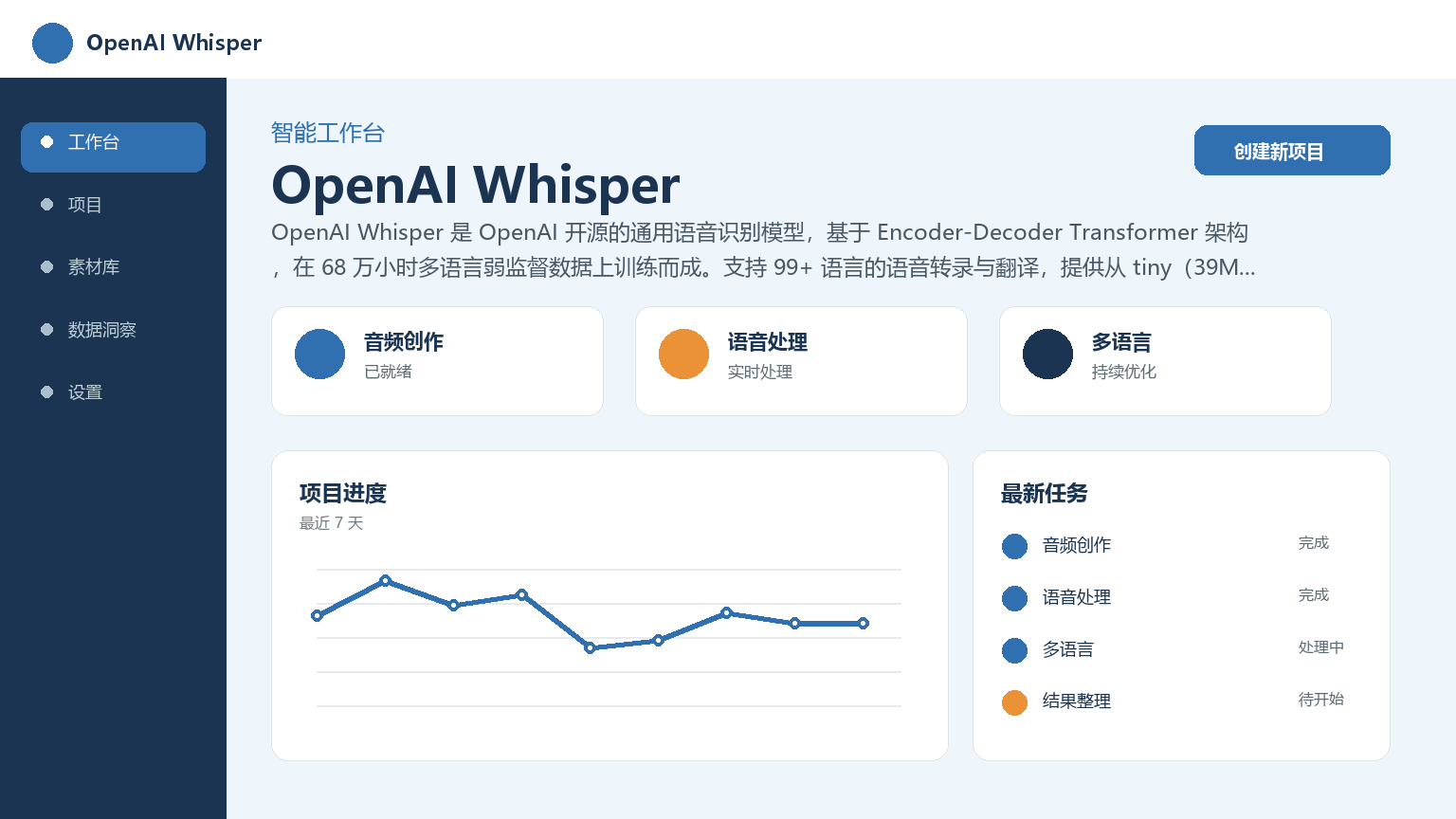
OpenAI Whisper is OpenAI's open source universal speech recognition model, based on the Encoder-Decoder Transformer architecture and trained on 680,000 hours of multi-language weakly supervised data. Supports speech transcription and translation in 99+ languages, provides a total of 7 model specifications from tiny (39M parameters) to large (1.55B parameters) and turbo optimized version, open source under MIT license. Can be called as the audio processing service (whisper-1) of the OpenAI API, or can be deployed locally and completely offline.
OpenAIWhisper
Core parameters and statistics
OpenAI Whisper is a family of models with "one architecture covering all voice tasks", ranging from tiny with only 39M parameters to large with 1.55B parameters, to turbo that is jointly optimized for speed and accuracy, covering all deployment scenarios from edge devices to cloud servers.
| Model specifications | Parameter size | English only version | Video memory requirements | A100 relative speed | Multi-language support |
|---|---|---|---|---|---|
| tiny | 39M | tiny.en | ~1 GB | ~10x | Yes (English version only) |
| base | 74M | base.en | ~1 GB | ~7x | Yes (English version only) |
| small | 244M | small.en | ~2 GB | ~4x | Yes (English version only) |
| medium | 769M | medium.en | ~5 GB | ~2x | Yes (English version only) |
| large (-v1/v2/v3) | 1.55B | None | ~10 GB | 1x (baseline) | Yes (all languages) |
| turbo | 809M | None | ~6 GB | ~8x | Yes (but does not support translation tasks) |
Key design features: Whisper is not a dedicated model optimized for a certain language or a certain scene. Instead, it uses a unified Encoder-Decoder Transformer to handle four tasks of speech transcription, translation, language recognition and voice activity detection (VAD) simultaneously. This means that developers do not need to cascade multiple models in the pipeline, and can complete the complete link from audio input to text output in one inference. The price is: for high-accuracy requirements in a single language (such as pure English long speech transcription), Whisper is not as accurate as a custom model trained specifically for that language (such as the performance of traditional ASR systems such as DeepSpeech or Kaldi in a specific domain).
Special positioning of the turbo model: The 809M parameter turbo has been optimized at the architectural level based on large-v3, achieving about 8 times the inference speed of the large model on the A100, while the WER (word error rate) only increases by about 0.5-1 percentage point. However, it should be noted that the turbo model has not been trained on translation tasks. When calling --task translate, it will directly return the original language text instead of the translation result. For scenarios that require translation (non-English speech → English text), the multilingual full-featured version (tiny/base/small/medium/large) must be used.
Training data size: Whisper was trained on 680,000 hours (about 77 years) of multi-lingual, multi-task weakly supervised audio data. The data comes from publicly available Internet audio in 99+ languages and undergoes automated text alignment and cleaning. The training scale is two orders of magnitude larger than the largest public speech data set at the time (such as LibriSpeech, which is about 1000 hours), which is the core reason why Whisper can achieve zero-shot generalization.
User and market recognition
Whisper’s community influence is a leading position in the field of open source speech recognition, but this leadership is more reflected in the technical penetration of the developer community rather than the direct perception of C-end users.
GitHub Ecosystem: The warehouse has received 105k+ stars and 12.8k forks, with 84 contributors. It is one of the voice projects with the highest stars on GitHub. This data far exceeds similar open source voice solutions (such as Coqui STT about 25k stars, Kaldi about 14k stars), reflecting the depth of Whisper's penetration in the developer community. The PyPI package openai-whisper has been downloaded tens of millions of times, and the latest version v20250625 is under continuous maintenance.
Industry Adoption: Whisper has become a "standard" component in AI application infrastructure. Voice note applications (such as Whisper Memos, an alternative to Otter.ai), video subtitle generation tools (such as MacWhisper, Subtitle Edit integration), customer service speech analysis systems, meeting recording robots, etc., a large number of products rely on Whisper or its derivatives (such as faster-whisper's CTranslate2 reimplementation) at the bottom level. OpenAI itself also has Whisper built into ChatGPT voice mode and Codex as a voice input engine.
Academic Impact: Whisper's paper "Robust Speech Recognition via Large-Scale Weak Supervision" (Radford et al., 2022) has become one of the most cited papers in the speech field in the past three years. It verified the feasibility of "weakly supervised large-scale pre-training + zero-sample transfer" in speech recognition, and directly promoted the evolution of a series of subsequent work (such as SeamlessM4T, MMS and other Meta's multilingual speech models) along the same technical route.
Positioning difference with competing products: Whisper's core competitiveness is not SOTA in a single indicator (on a specific data set, a fine-tuned customized model may still surpass Whisper), but generalization robustness in a zero-sample scenario - that is, the out-of-the-box experience of "without any fine-tuning, direct transcription, and the effect can be used". In contrast, competing products such as Google USM and Meta MMS are either not fully open source, or the model size is too large to be deployed locally. Whisper has built a moat on open source accessibility and deployment flexibility.
Cost advantage
Whisper's cost structure draws a clear line between the open source model and commercial APIs, allowing users to choose between "deploy at zero cost" and "pay-as-you-go cloud API" on demand.
C-side/individual users: completely free (conditions apply): Whisper’s model weights and code are open source under the MIT license, and individual users can use it completely free on their own computers. The only cost of running locally is hardware: tiny models can be transcribed in real time on the CPU, but large models require a GPU with ~10GB of video memory to run smoothly. A consumer-grade computer equipped with NVIDIA RTX 3060 (12GB) can run the large model for offline transcription, and the hardware cost is about 2,000-3,000 yuan (one-time investment). For the occasional individual user, this is a virtually zero marginal cost scenario.
Developer/API call: OpenAI Whisper API (whisper-1): OpenAI provides Whisper service through API, priced at approximately $0.006/minute (about 0.6 cents per minute of audio), and supports two modes: transcribe and translate. Taking the monthly processing of 1,000 minutes of audio as an example, the API fee is approximately US$6 (approximately RMB 42). Compared with local deployment, the API mode saves GPU hardware investment and operation and maintenance costs, and is suitable for scenarios where the processing volume fluctuates greatly or is not sensitive to latency.
| Cost Dimension | On-Premise (Self-Hosted) | OpenAI Whisper API |
|---|---|---|
| Unit cost | One-time hardware investment + electricity cost | $0.006/minute audio |
| Hardware threshold (large) | ~10GB memory GPU | No local GPU required |
| 1000 minutes/month | Hardware amortization about 50-100 yuan/month | About 42 yuan/month |
| 10,000 minutes/month | Hardware amortization about 50-100 yuan/month | About 420 yuan/month |
| Private data | Completely local, not leaving the device | Audio needs to be uploaded to the OpenAI server |
| Latency | Depends on local GPU | Depends on network + OpenAI server |
| Availability | Not affected by third-party services | Rely on OpenAI API status |
Enterprise/Private Deployments: Enterprises can deploy Whisper on their own infrastructure at no additional cost at the license level (MIT License). However, we need to pay attention to the hidden costs of production-level deployment: multi-GPU clusters are required in high-concurrency scenarios (such as 4×A100 to support real-time conference transcription services), and the construction costs of operation and maintenance manpower, model version management, and monitoring and alarm systems often exceed the GPU hardware itself. It is recommended that enterprises first use APIs to verify business scenarios and load models before deciding whether to invest in self-construction.
Implicit benefits of open source derivative optimization: The community has developed a large number of optimization implementations around Whisper - faster-whisper (based on CTranslate2, 3-4 times faster inference), whisper.cpp (real-time transcription on CPU and Apple Silicon), distil-whisper (distilled version, model shrinkage by 50% while maintaining 95%+ accuracy). These derivative projects further reduce Whisper’s deployment costs and are especially valuable for resource-constrained scenarios (mobile terminals, edge devices). However, the licensing and stability of these derivatives need to be evaluated individually and are not officially maintained by OpenAI.
Main functions
Whisper's core capabilities revolve around the main chain of "converting speech into structured text", but the real engineering value lies in its use of a model to unify the speech processing pipeline that used to require 4-5 independent modules to complete.
-
Multi-lingual speech transcription (Automatic Speech Recognition): Convert speech in 99+ languages to text in real time. Supported languages include Chinese, English, Japanese, Korean, major European languages, Arabic, Hindi and other global mainstream languages. Officially provides a complete list of supported languages (see
whisper/tokenizer.py). Implementation Tips: Whisper has the highest recognition accuracy (WER < 10%) for resource-rich languages (English, Chinese, Japanese), and the WER for low-resource languages (such as some African and South Asian languages) may exceed 30%. The evaluation results of comprehensive data sets are required to confirm whether the business threshold is met. -
Speech Translation: Directly translate non-English speech into English text. This is different from the two-stage solution of "transcribe first and then translate" - Whisper's decoder directly predicts English tokens from audio features, avoiding the cascade amplification of ASR errors to the translation stage. Capability Boundary: The turbo model does not support translation; the large model has a BLEU score of 30+ on benchmarks such as CoVoST-2, but the translation quality is still significantly weaker than pure text translation models (such as the GPT series), and is not suitable for scenarios that require extremely high translation accuracy.
-
Language Identification: Automatically detect the language used in the audio without the user specifying it in advance. This is particularly useful in audio scenarios where multiple languages are mixed (such as international conference recordings). Whisper's language recognition accuracy depends on the model size - tiny models are easily confused on highly similar language pairs (such as Chinese and Cantonese, Spanish and Portuguese), and it is recommended to use medium or large models in formal scenarios.
-
Voice Activity Detection (VAD): Automatically distinguish speech segments and non-speech segments (silence, background noise) in audio to achieve intelligent segmentation. Whisper outputs VAD as a by-product of model inference, eliminating the need for additional VAD modules. However, Whisper's VAD accuracy is not as good as that of dedicated VAD models (such as Silero VAD), and there may be problems with inaccurate audio segmentation boundaries in complex noise environments.
-
Multiple file batch processing and format compatibility: Supports mainstream audio formats such as FLAC, MP3, WAV, M4A, OGG, etc., and can process multiple files at once through the command line:
whisper audio1.flac audio2.mp3 audio3.wav --model turbo. Transcription results can be output into various formats such as TXT, VTT, SRT, TSV, JSON, etc., and can be directly connected to downstream tasks such as subtitle generation, note organization, and data analysis.
Model and version evolution
Whisper's version history is based on "model quality improvement" rather than "feature additions". The core change of each major version is a generation of better pre-training weights.
Initial release: laying the technical roadmap (2022-09 to 2023-01)
Whisper was first publicly released in the form of papers and model weights in September 2022, and the initial version was officially released on GitHub on January 24, 2023 through the v20230124 tag. This version contains five specifications of tiny/base/small/medium/large, a total of 9 models (including the .en English version), and the training data is 680,000 hours of weakly supervised multilingual audio. This version of the large model (later referred to as large-v1) has demonstrated impressive zero-shot generalization capabilities, reaching a WER of 6.1% (clean set) on LibriSpeech, close to the supervised SOTA at the time.
large-v2 and large-v3: Continuous iteration of accuracy (2023-03 to 2023-11)
- v20230314 (2023-03-15): Release of large-v2 model. Through larger training steps and better data cleaning strategies, the average WER on multi-language benchmarks is reduced by 12-15% compared with large-v1, especially in non-alphabetic languages such as Japanese and Korean.
- v20230918 (2023-09-19): Released as a companion to large-v2, the tokenizer and reasoning logic are optimized.
- v20231117 (2023-11-18): Release of large-v3 model. This is the final version of the large series, achieving the best WER/CER metrics of the Whisper series on cross-language benchmarks such as Common Voice 15 and Fleurs. The large-v3 was also the base for subsequent turbo models.
Turbo Model: Speed vs. Accuracy Tradeoff (2024-09 to 2024-10)
- v20240927 & v20240930 (2024-09 to 2024-10): Introducing turbo model. Turbo is not a new architecture for independent training, but an optimized inference solution based on large-v3 weights. Through architecture pruning, attention calculation optimization and engineering-level operator fusion, it can achieve about 8 times the inference speed of the large model on the A100, and the video memory requirement is reduced from 10GB to 6GB. In terms of accuracy, turbo's WER on the English data set is only about 0.5 percentage points higher than that of large-v3, but the degradation is more obvious on low-resource languages. The key limitation of turbo (no support for translation tasks) is clearly noted in its release notes.
Continuous maintenance phase (2024-10 to present)
- v20250625 (2025-06-26): The latest maintenance version, mainly updated for Python version compatibility (Python 3.8-3.11) and dependencies (tiktoken, PyTorch, etc.), no new model weights are introduced. Indicating that the Whisper model level has reached a relatively stable state, OpenAI's research and development focus may have shifted to the next generation of speech models (or speech multi-modal capabilities in the GPT series).
Technical advantages
Whisper's technical route selection has been in sharp contrast to traditional ASR frameworks (such as Kaldi, Espnet) from the beginning - it does not optimize a specific indicator, but pursues the versatility of "a model that can be used in any scenario".
Encoder-Decoder Transformer architecture: Whisper adopts the standard Transformer sequence-to-sequence structure. The Encoder encodes the 80-channel log-Mel spectral features into hidden layer representation; the Decoder predicts the output text token by token in an autoregressive manner. Compared with other common end-to-end ASR schemes (such as CTC, RNN-T), the advantage of Transformer Seq2Seq is that the decoder can "look back" to refer to the complete encoder output at each prediction, which is more beneficial to semantic disambiguation (like phonetic word judgment) in long audio. The trade-off is higher inference latency than CTC/RNN-T - because each prediction step relies on the output of the previous step and cannot be fully parallelized.
Multi-task training format: Whisper's decoder uses special tokens to switch tasks - <|startoftranscript|> triggers transcription, <|translate|> triggers translation, and <|language|> triggers language recognition. All tasks share the same set of Encoder parameters, which means that a single forward pass can simultaneously output transcribed text, language labels, and speech activity information. This design avoids the error propagation problem in the three-stage series of "acoustic model → language model → decoder" in traditional speech systems.
Training strategy with 680k hours of weakly supervised data: Whisper’s training does not rely on manually annotated data, but uses a large amount of transcribed audio on the Internet (such as YouTube subtitles, podcast text) as weak supervision signals. The data distribution is naturally skewed towards English (~65%) and high-resource languages, but also covers ~30% of the remaining languages. The key benefit brought by large amounts of data is adversarial sample robustness - the model has seen various accents, background noise, and recording device differences during training, so it performs far better on real-world audio than traditional systems trained only on clean corpora (such as LibriSpeech).
Pre-processing pipeline: Audio is automatically resampled to 16kHz, then converted to an 80-channel log-Mel spectrogram, processed every 30 seconds for an inference window. Whisper does not rely on external VAD modules - it internally completes voice activity detection and audio segmentation by predicting special tokens such as <|notimestamps|>. In actual use, long audio (more than 30 seconds) is processed through sliding window splicing, and Whisper's transcribe() method encapsulates this process.
Engineering implementation advantages: Whisper provides complete Python packages and CLI tools when it is released. Users only need to pip install openai-whisper to start using it. This "pip install ready" delivery method greatly reduces the threshold for using speech models - previously, it usually required weeks of contextual configuration and model compilation to build a usable ASR system. This is also one of the core reasons why Whisper has received 105k stars in the community: not because it is the most accurate, but because it is the easiest to use.
How to use
Whisper provides three sets of access methods, which are respectively for quick trial of Python integrated development and cloud API calling from the command line.
| How to use | Suitable for people | How to start | Cost | Features |
|---|---|---|---|---|
| Command line (CLI) | All users | whisper audio.mp3 --model turbo |
Free (requires local hardware) | Zero-code, one-line command transcription/translation |
| Python SDK | Developer | import whisper; whisper.load_model("turbo") |
Free (requires local hardware) | Deep integration, customizable processing logic |
| OpenAI API | Any user | curl https://api.openai.com/v1/audio/transcriptions |
$0.006/minute | No local GPU required, supports massive concurrency |
Command line quick start: Install pip install -U openai-whisper and ensure that ffmpeg is installed, execute the following command to transcribe audio files (turbo model is used by default):
# English transcription (default)
whisperaudio.mp3

# Transcription of specified language
whisper japanese.wav --language Japanese

# Translate non-English speech to English
whisper chinese.mp3 --model large --language Chinese --task translate

# Output multiple formats
whisper meeting.wav --model medium --output_format srt
Python SDK Integration: Calling Whisper in Python only takes a few lines of code. Here's a complete transcription + translation example:
import whisper

#Load the model (automatically download weights for the first run)
model = whisper.load_model("turbo") # Optional: tiny/base/small/medium/large/turbo

# Transcribe audio
result = model.transcribe("interview.mp3")
print(result["text"])

# Translate non-English audio to English
result = model.transcribe("chinese_lecture.mp3", task="translate")
print(result["text"]) # Output the English translation results

# Get segment information (including timestamp)
for segment in result["segments"]:
    print(f"[{segment['start']:.2f}s -> {segment['end']:.2f}s] {segment['text']}")
OpenAI API call: Using Whisper through the API does not require a local GPU and is suitable for scenarios that require high concurrency or where large models cannot be run locally. The following is a standard call example (you need to obtain the OpenAI API Key first):
curl https://api.openai.com/v1/audio/transcriptions \
  -H "Authorization: Bearer <YOUR_API_KEY>" \
  -H "Content-Type: multipart/form-data" \
  -F model="whisper-1" \
  -F file="@audio.mp3" \
  -F language="zh" \
  -F response_format="json"
Python version:
from openai import OpenAI

client = OpenAI(api_key="<YOUR_API_KEY>")

#transcribe
with open("audio.mp3", "rb") as f:
    transcript = client.audio.transcriptions.create(
        model="whisper-1",
        file=f,
        language="zh",
        response_format="text"
    )
print(transcript)

# translate
with open("chinese_audio.mp3", "rb") as f:
    translation = client.audio.translations.create(
        model="whisper-1",
        file=f
    )
print(translation)
Local deployment notes: The first run of whisper.load_model("large") will automatically download approximately 3GB of model weights to ~/.cache/whisper/. It is recommended to complete the download in advance under a high-speed network environment, or to specify the cache path through the whisper --download_root parameter. For CPU inference scenarios, it is recommended to use the whisper.cpp community implementation (based on GGML/GGUF quantization, which can achieve 1x real-time rate on Apple Silicon).
Product Pricing
Whisper's product pricing strategy is a two-tier structure of "open source free + cloud API pay-as-you-go", and there is no C-side subscription model.
Open Source Version (Self-Hosted): MIT license, model weights and code completely free. There is no licensing fee for both personal and commercial use. The entire cost of self-hosting is the hardware infrastructure - running the turbo model, for example, requires a GPU with around 6GB of VRAM (like an RTX 3060 12GB, or 8GB of unified memory for Apple Silicon M1/M2). CPU inference is possible but slow (turbo model ~0.3x real-time rate on high-end CPUs).
OpenAI API (whisper-1): Pricing is $0.006/minute (about 0.6 cents per minute of audio), and supports both transcription and translation interfaces. Billing is calculated based on the original duration of the audio and has nothing to do with the amount of tokens output by the model. In terms of free quota, new OpenAI API users usually have a trial quota of $5-18, but this quota is a general API quota (not exclusive to Whisper) and can be shared among all OpenAI API services.
Enterprise/High Usage Scenario: For enterprise users whose monthly processing volume exceeds 100,000 minutes, you can apply for custom pricing and SLA guarantees through the OpenAI business team. The economics of self-hosting solutions in large-scale scenarios need to be calculated one by one - taking 50,000 minutes of monthly processing as an example, the API fee is about $300/month (about 2,100 yuan), and the monthly amortization cost of a self-built 4×A100 cluster is about 20,000-30,000 yuan. Self-hosting will only have significant cost advantages if processing volumes continue to grow and strict requirements on latency and data privacy are imposed.
No public information on pricing Specific details include: OpenAI has not disclosed whether the Whisper API has a hard frequency control cap on the number of requests per minute (RPM), nor has it disclosed the base discount rate for enterprise custom pricing. Please refer to the official pricing page and API documentation for real-time information.
Application scenarios
Whisper's application scenarios span personal efficiency, content production, and enterprise services. The following four scenarios have been verified on a large scale and have clear quantifiable benefits.
-
Meeting and interview content automation: Automatically convert meeting recordings, interview audios, and podcast contents into transcripts and search indexes. Using large or turbo models, 1 hour of audio transcription can be completed in 5-15 minutes (depending on GPU), and the output SRT/VTT format can be imported directly into editing software. Quantitative Benefits: Traditionally, it takes about 4-6 hours to manually transcribe audio per hour. Whisper shortens it to 5-15 minutes of machine processing + 30 minutes of manual review, improving efficiency by 5-10 times. Floor Tips: In multi-person conference scenarios, it is recommended to use independent microphone recording or separate channel recording to avoid speaker confusion caused by "same-recording crosstalk". Whisper itself does not support speaker separation (diarization) and requires additional integration of speaker recognition modules (such as PyAnnote Audio).
-
Video Subtitles and Localization: Automatically generate multilingual subtitles for video content. First use Whisper to generate timestamp transcriptions in the original language, and then use the translation API to generate subtitles in the target language. The process is: video audio extraction → Whisper transcription (with timestamp) → translation → subtitle file export. Turbo models are most popular in this scenario because of their high speed—a 10-minute video can be transcribed in 30 seconds. Capability Boundary: Whisper's timestamp accuracy is more accurate in silent segments, but may deviate by 1-3 seconds in segments with frequent speech rate changes or background music interference, which requires fine-tuning the timeline later.
-
Customer service quality inspection and speech analysis: Transcribe customer service call recordings into text for service quality monitoring, speech compliance review and customer sentiment analysis. This scenario often requires privatized deployment to meet data compliance requirements (finance, insurance industry, etc.). Whisper's large model (large-v3) performs better than the tiny/base version on phone audio (8kHz sampling, narrowband, noisy), with WER 5-10 percentage points lower than tiny. Implementation Tips: It is recommended to conduct WER benchmark testing with 500-1000 real call recordings before importing into production to ensure that the model's performance in terms and accents in this field meets the acceptance standards.
-
Voice interaction and accessibility: Provide real-time voice transcription subtitles for people with hearing impairments, or provide a voice-to-text input pipeline for voice assistants. In the voice mode of ChatGPT, Whisper assumes the first role of voice → text. Individual developers can also integrate Whisper into smart speakers, car systems, and auxiliary devices to achieve local voice input. Implementation Tip: In real-time scenarios, it is recommended to use faster-whisper or whisper.cpp implementation to reduce latency. The pure Python version has limited real-time reasoning capabilities on the CPU.
Applicable people
Whisper’s coverage ranges from end users with zero programming experience to AI engineers with deep customization. However, the adaptation costs and values faced by different roles vary greatly.
-
Content Creators and Video Producers: Generate subtitle files (SRT/VTT) with one click through the CLI tool, no programming required. GUI applications such as MacWhisper and Whisper Transcription on the macOS platform further lower the barriers to use. Not suitable for boundaries: For professional film and television post-production workers who have extremely strict requirements on the accuracy of subtitle timestamps, Whisper's timestamps still need to be manually fine-tuned; for localization projects that require high translation quality, it is recommended that the transcription results produced by Whisper be manually verified before entering the translation process.
-
Developers and Independent Developers: Add speech-to-text capabilities to your apps in hours via Python SDK or OpenAI API integration. The recommended path is to first use the API to verify the product concept (zero GPU investment), and then evaluate the cost-effectiveness of local deployment after scaling up. Prerequisites: You need to have basic Python context and pip package management capabilities; you need to understand the audio processing basics of ffmpeg; the local deployment solution requires a GPU or sufficient memory (at least 8GB to run medium and above models).
-
Enterprises and medium and large organizations: privatized deployment in scenarios such as customer service voice analysis, meeting records, and digitization of media materials. The recommended initial pilot path is: select 1-2 business scenarios → complete the PoC using API or single-machine deployment → determine whether the accuracy and cost meet the requirements → expand to a multi-node cluster. Purchasing Prerequisites: Enterprises should already have clear voice data assets (call recordings, meeting archives, video databases) and quantifiable efficiency goals (such as "shorten manual transcription time by 80%"), rather than "use AI first and then see". Before deployment, it is necessary to evaluate the ongoing operation and maintenance costs of Whisper in a production environment (model version management, GPU cluster monitoring, fault recovery, etc.).
-
Researchers and NLP Engineers: As a multilingual speech baseline model, Whisper is widely used in academic research in fields such as speech translation, language recognition, and accent robustness. Its open source weights can also be used as a starting point for fine-grained fine-tuning (such as domain adaptation for vocabulary in professional fields such as medicine and law). Not suitable for boundaries: Whisper's architecture is not optimized for fine-tuning from the beginning - it encodes all tasks into decoder token sequences, and fine-tuning requires customizing special tokens. For scenarios that require deep domain customization (such as identification of industrial equipment instructions in specific noise environments), it is recommended to consider more customizable frameworks such as Espnet or Kaldi.
Summary and Outlook
The core value of Whisper is to "use a unified model to cover the full spectrum of speech tasks from lightweight transcription on portable devices to high-precision translation at the server level in a zero-sample manner." It is not SOTA in every indicator, but it is the first open source solution that truly makes "speech-to-text" an infrastructure that can be called at any time.
Current core advantages: 7 model specifications cover all deployment scenarios from edge to cloud, MIT license eliminates legal risks for commercial use, and 105k+ GitHub stars verify the maturity of the community ecosystem. Derivative projects such as faster-whisper, whisper.cpp, distil-whisper and other projects further expand the performance boundaries. As one of the core components of the OpenAI API, Whisper continues to receive production-bound feedback and engineering maintenance.
Main current limitations: Whisper does not support end-to-end speaker separation (diarization) and requires additional integration of professional modules. The lack of translation capabilities of turbo models means that some scenes still require the use of larger models. The GPU resource overhead in the self-hosted scenario poses a threshold for individual users (the large model requires 10GB of video memory). Timestamp accuracy is still biased in complex audio. Audio uploading in API mode poses compliance risks in privacy-sensitive scenarios. Whisper's recognition rate for ultra-low-resource languages is still limited.
Follow-up observation point: Whether OpenAI will integrate Whisper's capabilities into the next generation of GPT multi-modal models (such as voice input being processed directly by GPT end-to-end), which may lead to a slowdown in Whisper's maintenance as a standalone model. Can community spin-off projects, such as faster-whisper's continued optimization of whisper.cpp's edge device coverage, fill the void after official updates slow down? In addition, whether the progress of new generation speech models (such as Meta's SeamlessM4T v2) in multilingual translation quality will surpass Whisper on the benchmark is also worthy of continued attention.
Acquisition and Adoption Risk Assessment: For individual developers and content creators, there is almost no adoption risk - zero-cost trial and error (open source and local running) can prove the value. For enterprises, it is recommended to pilot in non-core scenarios (such as internal meeting recording, video subtitle generation), complete WER benchmark testing with real business data, and establish a manual review process to cover corner cases where the model accuracy is not as accurate as expected. If the processing of user voice data is involved, be sure to confirm whether the data isolation measures of the self-hosted solution meet the compliance requirements of the industry (such as GDPR, Personal Information Protection Law). If you choose the OpenAI API mode, you need to pay attention to whether the API version update is backward compatible, and the downgrade plan when the service is interrupted (such as falling back to the local tiny model to provide basic services). For companies with long-term voice AI strategies, it is recommended that while adopting Whisper, they should also pay attention to the evolution of next-generation voice frameworks with greater customization potential to avoid architectural lock-in.
Related tools:  ElevenLabs, udio
Version Info
- whisper v20250625 :Latest maintenance release, including code compatibility updates and dependency fixes, based on commit 31243ba.
- whisper v20240930 :Introducing the turbo model (809M parameters), an optimized version of large-v3, which is about 8 times faster with minimal accuracy loss.
- whisper v20231117 :Including large-v3 model release and multiple stability improvements, there is no official precise date yet.
- whisper v20230918 :The introduction of the large-v2 model significantly improves multi-language recognition accuracy.
- whisper v20230314 :Early maintenance version, fixing several dependency compatibility issues.
- whisper v20230124 :The initial public version releases six model specifications from tiny to large, based on 680,000 hours of weakly supervised data training.
User Reviews