 or poor.love
Free
or poor.love
Free
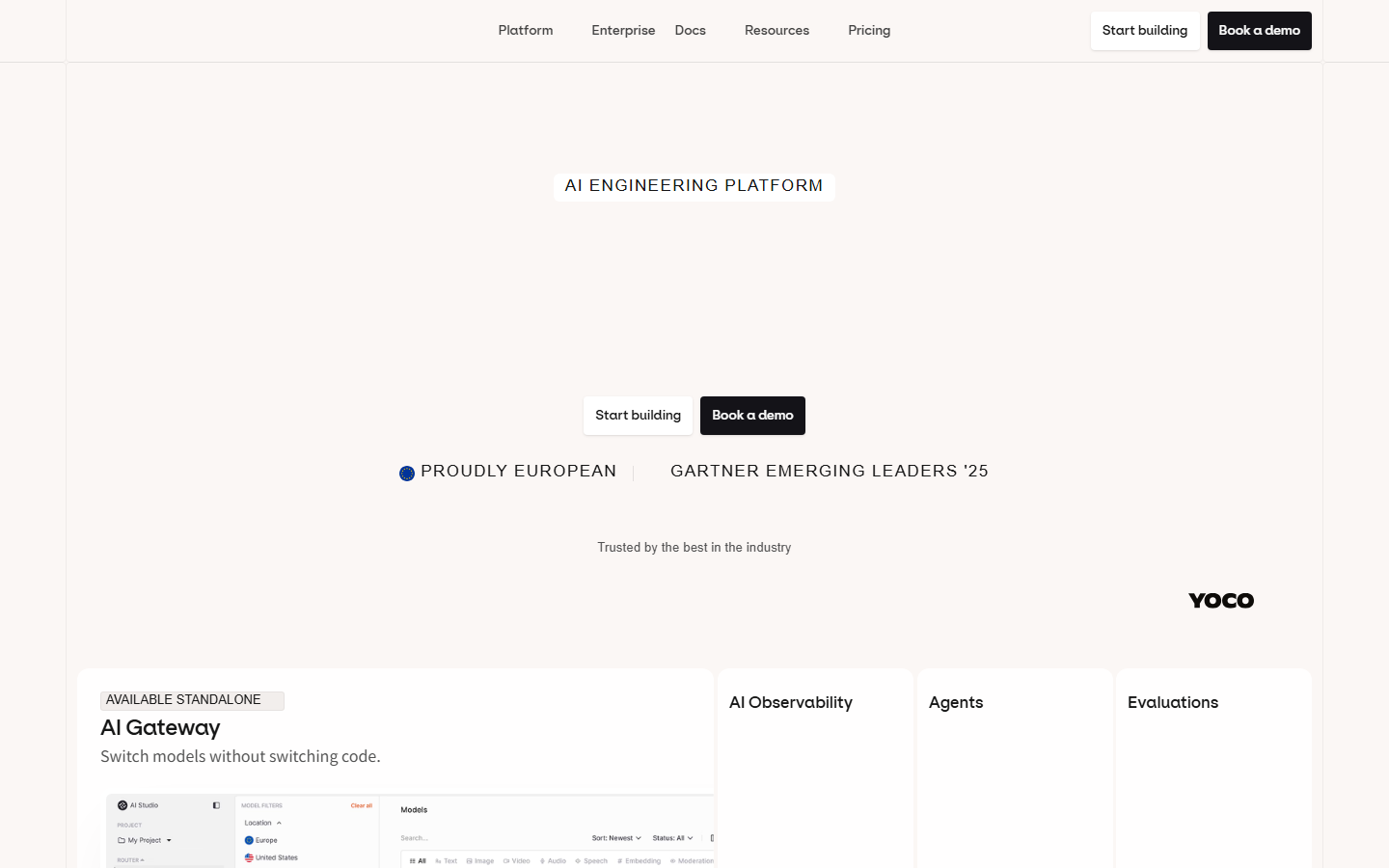
Orq.ai is an AI engineering platform for enterprises and development teams. Its official positioning covers the orchestration, evals, observability and governance of AI agent lifecycle, and provides modules such as AI Gateway, Agent Runtime, Evaluation, Knowledge Base, Monitoring & Observability, etc.
Orq.ai
Core parameters and statistics
Orq.ai’s official homepage defines the product as “Build & operate quality AI” and further explains that it covers orchestration, evals, observability and governance in the AI agent lifecycle. It is closer to an AI engineering platform than a single chatbot or a single model supplier: the core value lies in putting the model routing agent running prompts and knowledge base, online/offline evaluation, production tracking and enterprise governance into the same workbench.
| Projects | Public Information |
|---|---|
| Official entrance | https://orq.ai/ |
| Official positioning | AI Engineering Platform; Sovereign AI platform for the full AI agent lifecycle |
| Core Module | AI Gateway, Agent Runtime, Evaluation, Knowledge Base, Monitoring & Observability |
| Model coverage | The home page of the official website states that AI Gateway can route 400+ models from 28+ providers; the Pricing FAQ states that AI Router supports 300+ models from 20+ providers |
| Free tier quota | 1 user, 50k spans/month, 1GB processed data, 3 agents, 50 agent runs/month, 3 deployments, 14 day retention, 50 API calls/day |
| Current public version clues | Official Changelog Release 4.10 |
| Corporate Signal | Official website homepage displays Proudly European, Gartner Emerging Leaders '25 and multiple customer logos |
| Attribution | Official structured data address is Amsterdam, NL |
Product Boundary: Orq.ai is not responsible for training the underlying model, nor is it a pure RAG database or traditional monitoring tool. It is suitable for teams that are already building LLM application agents or multi-model workflows, linking "build, go online, observe, evaluate, improve, and manage" together; if it is just personal chat or occasional API calls, the platform capabilities will be overemphasized.
User and market recognition
Orq.ai's market signals mainly come from three types of officially visible materials: the customer logo and Gartner Emerging Leaders '25 logo displayed on the homepage of the official website, the free and enterprise package structure given on the pricing page, and the Changelog that is continuously updated on the documentation site. Names such as Capgemini, Brand New Day, Vattenfall, AFAS Software, hear.com, bunq, Moneybird, YOCO, etc. can be seen in the customer area of the homepage, indicating that its external narrative has been oriented towards enterprise AI engineering and production systems, not just developer experimental tools.
Enterprise adoption signals: The official website labels itself as Proudly European and emphasizes sovereign AI, governance, cost visibility, compliance and risk in the product copy. For European enterprises, fintech, customer service, knowledge management and teams that require EU data residency narratives, this type of positioning is closer to the procurement context than a simple "model access tool".
Undisclosed items: Orq.ai does not provide verifiable total number of registered users ARR, total number of paying customers, retention rate or industry share on the public page. Customer logos and Gartner logos can only indicate market endorsement and industry attention, but cannot be inferred to determine business scale.
Cost advantage
Orq.ai's cost advantage is not "the lowest model unit price", but putting AI Gateway, Agent Runtime, Observability, Evaluations, Knowledge Bases and platform APIs into a unified billing and governance framework. For multi-model, multi-team, and multi-Agent organizations, the value mainly comes from reducing duplicate access, duplicate log buried points, duplicate evaluation systems, and duplicate permission management.
C-side/Personal: Orq.ai is not an ordinary consumer chat tool. The free Developer tier is suitable for individual developers or small teams to verify the first AI function. The official pricing page discloses 1 user, 50k spans/month, 3 agents, 50 agent runs/month, 3 deployments and 50 API calls/day, which is enough for prototypes, but not suitable for high-concurrency production systems.
Developer/API: The Growth tier adopts the expansion method based on seats and usage. The public price is 35 euros per seat per month, and lists dimensions such as 100k spans/month, overage 7 euros/100k spans, 1GB processed data, overage 3 euros/GB, 500 agent runs/month, overage 0.01 euros/run, etc. This structure is suitable for first incorporating a small amount of production traffic into observations and evaluations, and then expanding based on spans, data processing volume, and Agent run.
Enterprise/Private: Enterprise is a custom quote covering custom seats, custom spans, custom processed data, unlimited agent runs/deployments/webhooks, SSO/SCIM, Audit logs, SOC 2 report, HIPAA BAA, AWS/Azure Marketplace, on-prem or private cloud. The actual purchase cost depends on seats, traffic, retention period, deployment form, compliance terms and support level, and is subject to the official real-time page and contract.
Main functions
- AI Gateway: Use a unified API to operate multiple models. The official website states that it can route requests across 400+ models from 28+ providers, and supports fallbacks, retries and cost visibility. It is suitable to separate model selection from business code and reduce supplier switching costs.
- Agent Runtime: supports building, running and managing agents. The official documentation includes entrances to Agent Studio visual builder, API building Agent, memory, tools, knowledge integration and streaming. Suitable for upgrading multi-step tasks from Prompt calls to traceable execution chains.
- AI Observability: Track logs, traces, threads, latency, token spend and failure modes. For production systems, the key is not "whether there are logs", but whether each tool call, retrieval step and model response can be played back in a trace.
- Evaluation and Experiments: Supports online and offline evaluation of LLM-as-judge, code and manual review. Release 4.10 introduces a unified Review screen and Evaluator Studio, indicating that Orq.ai places quality acceptance in a continuous iteration process instead of a one-time test before going online.
- Knowledge Base / Memory Stores: Pricing page lists knowledge base and memory storage, and supports RAG-as-a-Service, chunk explorer, embedding, reranking, RAG evaluators and document processing add-on. Suitable for teams that need to connect private data to Agent.
- Governance and Enterprise Security: Enterprise layer covers RBAC, SSO/SCIM, Audit logs, SOC 2 report, HIPAA BAA, custom DPA, custom rate limits and private cloud/on-prem. It is useful for incorporating organizational-level permissions and auditing into AI calls, rather than having each line of business maintain its own model keys and logs.
Model and version evolution
Orq.ai is a continuously iterative cloud platform, and the official Changelog has formed a 4.x version. The current public thread focuses on AI Gateway independence, Model Garden Skills, Traces, evaluation MCP and corporate governance capabilities.
| Version Node | Public Release Notes | Major Changes |
|---|---|---|
| Release 4.10 | Official Changelog latest visible node | Unified API key management, AI Gateway is separated into special areas, rebuilt Model Garden, added unified Review screen Evaluator Studio, Agent Schedules |
| Release 4.9 | Official Changelog history node | Introducing native Skills, Traces’ Errors view, LangGraph trace visualization, and Azure Foundry model access optimization |
| Release 4.8 | Official Changelog History Node | Added Router Policies, Guardrail Rules, categorical evaluators, redesigned homescreen and predefined MCP servers |
| Release 4.4 | Official Changelog history node | Orq MCP Server provides 23 tools for managing objects such as agents, datasets, experiments, etc. |
| Release 4.2 / 4.3 | Official Changelog historical node | Sovereign AI Router, EU data residency, 300+ models unified billing and other capabilities enter the main line |
Version Judgment: The version number of Orq.ai is not the local software package version, but the cloud platform function release node. During the online evaluation, you should pay attention to whether the corresponding API, SDK, Gateway, Observability, and evaluation capabilities are available in the target workspace, and confirm whether the retention period, model coverage, and enterprise security terms match the actual environment.
Technical advantages
Mechanism: Unified model gateway -> Effect: Reduce supplier coupling -> Scenario: Multi-model production routing. AI Gateway puts the model provider, retry fallback, cost and current limit into a unified entrance, so the business code does not need to maintain separate access logic for each provider. Teams can schedule models by cost, latency, quality, or regional requirements.
Mechanism: Trace-first observable -> Effect: Shorten positioning link -> Scenario: Agent production troubleshooting. Orq.ai's Observability puts Agent, LLM call, tool execution, retrieval step, latency and token spend into trace. For multi-step agents, this is more valuable than just recording the final answer, since failures often occur during tool calls, retrievals, or intermediate decisions.
Mechanism: Evaluation and Review embedded -> Effect: Move quality access control forward and continuous -> Scenario: Prompt/Agent version release. The unified Review screen and Evaluator Studio in Release 4.10 make it easier to reuse feedback from the experimental Annotation Queue and production Trace, reducing the problem of "online failed samples cannot be returned to the test set".
Mechanism: Platformization of governance objects -> Effect: Authority, cost and compliance can be audited in a unified manner -> Scenario: Enterprise AI platform. Enterprise capabilities include RBAC, SSO/SCIM, Audit logs, SOC 2 reports, HIPAA BAA, and private cloud/on-prem options, enabling security teams to incorporate AI calls into existing compliance processes.
How to use
| Usage | Typical steps | Adaptation objects |
|---|---|---|
| Web Studio | Create an account or workspace -> Configure projects, model agents, prompts and knowledge bases -> Run experiments and evaluations -> View traces and dashboards | Product and Engineering AI Platform Team |
| AI Gateway / API | Obtain API Key -> Connect to unified Gateway -> Configure model and routing strategy -> Enable observability, guardrails and cost tracking | Back-end engineering LLMOps, platform engineering |
| Enterprise / Private Cloud | Confirm with official SSO, SCIM, audit, data residency Marketplace or privatized deployment -> Pilot business line -> Expand to organizational level governance | Medium to large enterprises, security and compliance teams |
The typical implementation path is to first select a high-frequency but low-risk AI call link, connect to Gateway and Observability, observe spans, latency, token spend, failure rate and trace completeness; then precipitate online failure samples into datasets and evaluators; and finally introduce Agent schedules, Skills, Router Policies, SSO, auditing and cost attribution.
Product Pricing
Orq.ai uses a tiered structure of Free Developer, Pay as you go Growth, and Custom Enterprise. The public price and quota may be adjusted according to the official website, and the actual official real-time Pricing page and contract shall prevail.
| Package | Official public price | Key quota and capabilities | Applicable objects |
|---|---|---|---|
| Free Developer | Free | 1 user, 50k spans/month, 1GB processed data, 10 MB memory storage, 3 agents, 50 agent runs/month, 3 deployments, 14 day retention, 50 API calls/day | Prototype PoC, small team verification |
| Growth | 35€/seat/month | 100k spans/month, overage 7€/100k spans; 1GB processed data, overage 3€/GB; 500 agent runs/month, overage 0.01€/run; unlimited users/agents/deployments | Pre-production and growth team |
| KB / Memory Stores Add-on | 500€/month | Unlimited retrievals, ingestion, parsing, chunking, 2.5GB document processing, overage 0.10€/MB | RAG and knowledge base intensive scenarios |
| Teams Add-on | €300/month | Enterprise SSO, SAML/OIDC, SSO enforcement, fine-grained RBAC, dedicated Slack channel | Multi-team collaboration and permissions governance |
| Enterprise | Custom | Custom seats/spans/data/storage, unlimited agent runs, SSO/SCIM, Audit logs, SOC 2 report, HIPAA BAA, on-prem/private cloud | Large organizations, heavy compliance and high traffic scenarios |
Price Boundary: Orq.ai's fees do not replace the underlying model vendor bill. Teams still need to account for calls to OpenAI, Anthropic, Google, Azure, private models, or other providers at the same time. The value of Orq.ai lies in making the routing, observability, measurement and governance costs of these calls transparent.
Application scenarios
- Multi-model AI Gateway: Route models by cost, quality, latency, or compliance requirements in the same application. The acceptance focus is fallback hit rate P95/P99 latency, model billing attribution and business availability in the event of supplier failure.
- Agent production observability: record complete traces of customer service, sales assistants, internal knowledge assistants or automated operation agents. The key points for acceptance are tool call replayability, error classification token spend, failed sample recovery and trace retrieval efficiency.
- LLM Evaluation and Release: Incorporate prompt, agent, model and tool changes into offline/online evals. The key points for acceptance are evaluation set coverage, manual review speed, online indicator drift alarms and version rollback paths.
- RAG and Enterprise Knowledge Access: Manage private data Q&A with Knowledge Base, Memory Stores, chunking, reranking and RAG evaluators. The acceptance focus is on retrieval hit rate, hallucination rate, data update latency and permission boundaries.
- Enterprise AI Governance: Unify SSO, RBAC, audit PII filtering, rate limits and cost attribution to the AI platform layer. The acceptance focus is on audit log completeness, team permission isolation, budget attribution and compliance documentation.
Applicable people
- AI Platform Engineering Team: Requires unified management of model gateway Agent Runtime, observables, evaluations, keys, budgets, and team permissions. The premise is that the organization already has multiple AI calling links or is ready to officially launch the AI function.
- Product and Application Engineering Team: Need to quickly build AI Agent, Prompt, knowledge base and evaluation process, while retaining two collaboration entrances, API and Web Studio. It’s suitable for product managers, engineers, and domain experts to work together to iterate on AI features.
- LLMOps/Quality Team: Online traces, failed samples, evaluation set reviews and experiments need to be connected in series to reduce implicit regressions caused by prompts or model changes.
- Security, Compliance & Procurement Team: Focus on SSO/SCIM, Audit logs, SOC 2, HIPAA, data residency private cloud/on-prem and Marketplace procurement paths. This group needs clarity on data boundaries and contract terms before PoC.
Not suitable for the boundary: Scenarios that only involve personal chatting, low-frequency single model calls, no production launch plan, and no log management or evaluation requirements do not necessarily require a complete platform like Orq.ai; if the main problem of the team is basic model training or data annotation, a more vertical model training, annotation or data platform should also be selected.
Summary and Outlook
Orq.ai's core competitiveness lies in splitting the AI Agent's production link into manageable objects: Gateway manages model entry, Runtime manages Agent execution, Observability manages real behavior, Evaluation manages quality feedback, and Governance manages permissions, costs, and compliance. This makes it more suitable for enterprise-level AI projects rather than one-off demos.
The current limitations are also clear: the public page does not disclose company revenue, total number of active customers, complete industry distribution, or contract details for each enterprise function; different pages have 300+ and 400+ representation differences in model coverage, which should be subject to the specific workspace and official real-time documents; terms such as Enterprise, privatization, data residency SLA, and HIPAA BAA require business confirmation.
Implementation suggestions focus on progressive verification: first connect to a real AI call link, quantify spans, trace completeness, failure rate, delayed token spend, evaluation pass rate and manual review cost; after the indicators are stable, expand to multi-model routing Agent Runtime, Knowledge Base, Router Policies and organizational-level SSO/RBAC. Enterprises should review data residency, log retention, audit export, private deployment Marketplace settlement and underlying model bill allocation before purchasing.
Related tools:  CrewAI,
  LangChain
Version Info
- Orq.ai Release 4.10 :Release 4.10 of the official Changelog unifies API key management, separates the AI Gateway into a dedicated area, rebuilds the Model Garden, and adds a unified Review screen Evaluator Studio and Agent Schedules; the official does not disclose the precise date on this page.
- Orq.ai Release 4.9 :Release 4.9 of the official Changelog introduces native Skills, Errors view in Traces, LangGraph trace visualization and Azure Foundry model access optimization; the official does not disclose the precise date on this page.
- Orq.ai Release 4.8 :The official Changelog for Release 4.8 covers Router Policies, Guardrail Rules, categorical evaluators, redesigned homescreen, and predefined MCP servers; the exact date is not disclosed on this page.
User Reviews