 A2A
Free
A2A
Free
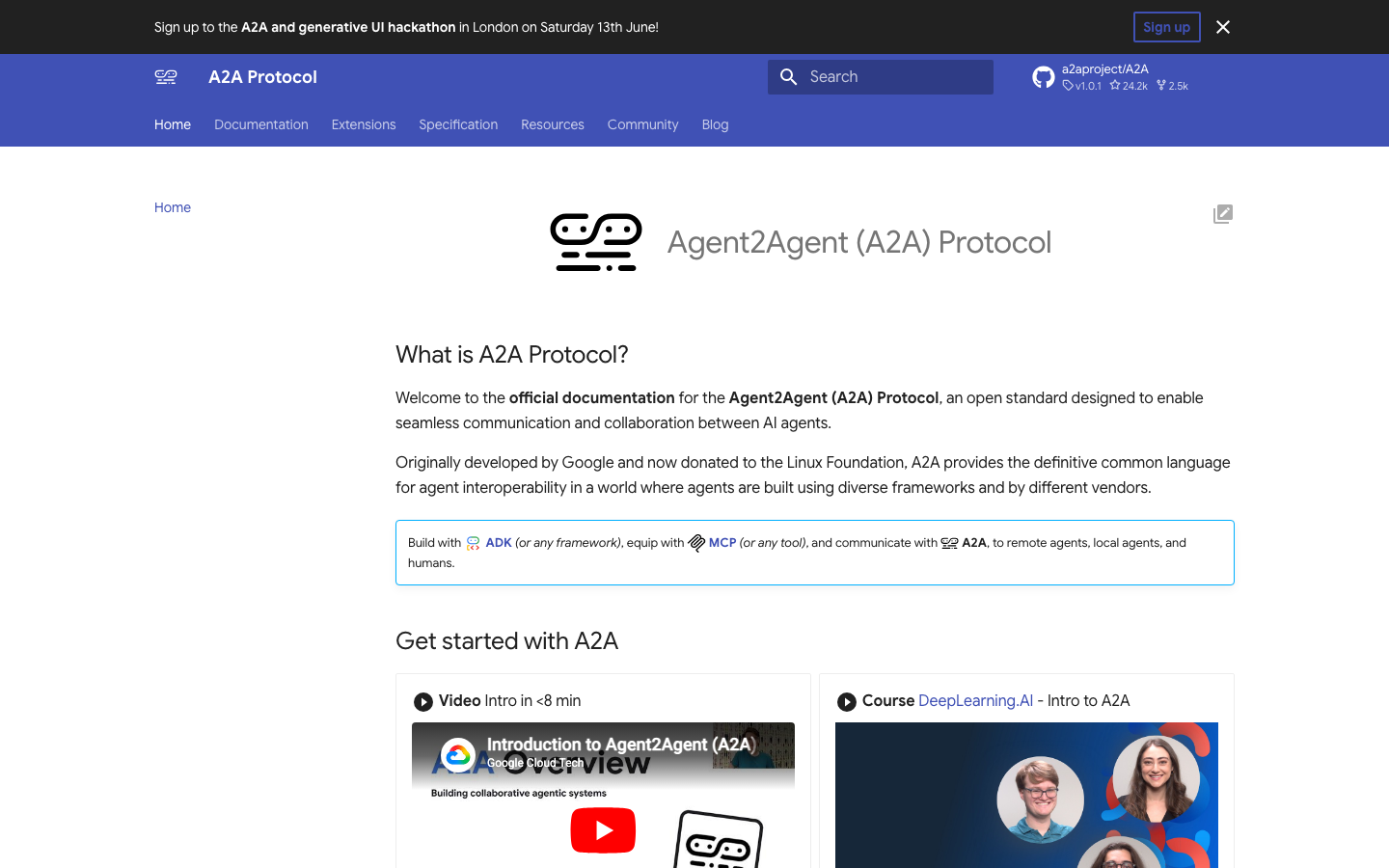
A2A is an open protocol for AI agents collaboration. It builds an interoperability layer around the Agent Card, JSON-RPC, SSE and SDK ecosystem, with the goal of allowing agents built by different frameworks and vendors to collaborate safely.
Tool text (please fill in completely)
Core parameters and statistics
A2A is not SaaS in the traditional sense, but a set of open protocols for multi-agent interoperability. Its value is not in "replacing a chat interface", but in providing a common communication and collaboration layer for agents in different frameworks, different vendors, and different deployment locations.
| Projects | Public Information |
|---|---|
| Protocol name | Agent2Agent (A2A) Protocol |
| Protocol form | Open protocol, reference implementation SDK ecology |
| Governance and provenance | Open source project under the Linux Foundation system, contributed by Google |
| Official site | a2a-protocol.org |
| GitHub repository | a2aproject/A2A |
| Latest version | v1.0.1 (2026-05-26) |
| Historical Milestones | v1.0.0 (2026-03-12), v0.3.0 (2025-07-30) |
| Community size | About 24.2k stars, 2.5k forks, 158 contributors |
| Partners | 50+ technology partners and service providers |
| Core Communications | JSON-RPC 2.0 over HTTP(S), SSE, push notifications |
| Support data | text, files, structured JSON data |
| Main SDKs | Python, Go, JavaScript, Java, .NET, Rust |
| License | Apache-2.0 |
Protocol positioning: The core of A2A is not to "make a stronger agent", but to standardize how agents discover, negotiate, transfer tasks, and feedback status. For enterprises, this means that interface management can be front-loaded when integrating across frameworks, instead of reinventing connectors in each project.
Community signal: The GitHub page shows about 24.2k stars, 2.5k forks, and 158 contributors, indicating that it has entered a more mature engineering collaboration stage from a concept initiative, and at least has an observable developer attention and contribution base.
Version Rhythm: From the official release announcement on 2025-04-09, to 0.3.0 on 2025-07-30, to 1.0.0 on 2026-03-12 and 1.0.1 on 2026-05-26, A2A’s mainline has completed the transition from protocol draft to stable maintenance.
User and market recognition
Breadth of partners: Google’s official announcement on 2025-04-09 gave a cooperation array of 50+ technology partners and service providers, covering Atlassian, Box, Cohere, Intuit, LangChain, MongoDB, PayPal, Salesforce, ServiceNow and other enterprises, indicating that A2A has not been owned by a single manufacturer from the beginning, but is a standardized direction for ecological interconnection.
Open source acceptance: 24.2k stars and 2.5k forks is enough for a protocol-based project, especially when the warehouse continues to generate releases, issues, and contributor activities. This kind of popularity usually means that developers are treating it as an integration standard that can be implemented, rather than just watching the excitement.
Organizational Endorsement: A2A has both Google's engineering drive and the open collaboration approach in the context of the Linux Foundation. This combination is often easier to be adopted by third parties than protocols independently promoted by a single company, because it reduces the worry of being locked into a single product route.
Disclosure boundary: The number of users, revenue, corporate purchase amount and commercialization conversion rate are not disclosed. This is not unexpected for the agreement. What really depends on it is not the sales funnel, but the density of subsequent SDKs, samples, and access to each agent platform.
Cost advantage
The protocol itself does not charge a seat fee: A2A’s public warehouse uses Apache-2.0, and both the protocol and reference implementation can be used directly. For developers and architecture teams, the entry cost is mainly to learn the specifications, access the SDK, and complete tests, rather than paying a protocol licensing fee up front.
Developer Tier: Costs focus on integration rather than licensing: When using A2A, the real overhead usually comes from agent service orchestration, authentication, message flow, observability and regression testing, rather than the protocol itself. In other words, it reduces the cost of "buying standards" and leaves the cost of "doing docking" to engineering implementation.
Enterprise layer: Cost transfer to system governance: If an enterprise wants to use A2A for cross-department or cross-cloud agent collaboration, the budget focus will usually fall on the gateway, auditing, authentication SLA, runtime and governance platform. A2A makes interoperability easier but does not automatically eliminate the complexity of enterprise-level governance.
Current pricing status: There is no official public subscription price, volume price or privatization price. What is more meaningful for purchasing judgment is to confirm whether it has entered the default standard position of the target ecology, rather than looking for a non-existent price list.
Main functions
- Agent Card Discovery Mechanism: The agent exposes skills, endpoints and certification requirements through a JSON-formatted capability card. The client can select the most appropriate remote agent based on this, reducing manual maintenance of the docking list.
- Task-Oriented Collaboration: A2A manages communication with task as the center, which is suitable for long-term tasks, asynchronous tasks and complex processes that require continuous feedback, rather than just one-time request-response.
- Multi-modal interaction: The protocol supports text, files and structured data, and also allows interaction methods to be negotiated around the UI form. It is suitable for advancing the agent from "plain text question and answer" to "task execution interface".
- Streaming and push notifications: SSE and push notifications allow the remote agent to continuously return status, which is suitable for processes that require waiting, verification, and staged returns.
- Enterprise-level authentication ideas: The official document clearly lists authentication and authorization as design principles, which means that it is not just designed for demo demonstrations, but puts the security boundary in front of the protocol layer.
The effect of combining these abilities is to unify the four things of "finding an agent, connecting with an agent, seeing progress, and getting results". For teams that need cross-platform orchestration, this is closer to delivering real value than simply improving model capabilities.
Model and version evolution
A2A is not a model product, but a protocol standard; the version evolution here refers to how the specification and warehouse mainline move from draft to stable maintenance.
Public Milestones
| Time | Node | Key points of change |
|---|---|---|
| 2025-04-09 | Official announcement | A2A is released for the first time as an open protocol, with more than 50 partners |
| 2025-07-30 | v0.3.0 | Complete mTLS, Agent Card extensions and protocol binding adjustments |
| 2026-03-12 | v1.0.0 | Entering the 1.0 trunk, the specification structure and task/message model are further stabilized |
| 2026-05-26 | v1.0.1 | Continue to correct binding, TaskStatus and transcoding issues on the 1.0 trunk |
Main judgment
- 0.x stage: more like the protocol forming stage, focusing on finalizing the Agent Card, task life cycle, message structure and transmission binding.
- Phase 1.0: It means that the protocol already has stable API semantics, and the follow-up will be more about maintenance, patching and ecological adaptation, rather than large-scale overthrow.
Version meaning
For the implementation team, a small version like v1.0.1 usually means that the specification is ready for pilot or pre-production verification, but you still need to check whether the SDK, sample code and target platform you rely on are synchronized to the same trunk.
Technical advantages
Mechanism 1: Standardization discovery and negotiation. After Agent Card structures capabilities, endpoints and authorization information, the client agent can find the target agent without relying on manual configuration tables. The effect is to reduce cross-system discovery costs and is suitable for multi-team and multi-vendor scenarios within the enterprise.
Mechanism 2: Task life cycle management. A2A does not regard one interaction as the end point, but breaks the task into stages such as submission, execution, feedback, and completion. The effect is that it is more suitable for long-term tasks and processes that require staged confirmation, such as recruitment screening, supply chain coordination, or step-by-step approval.
Mechanism 3: SSE and push notifications. Long tasks do not need to be supported by polling. The system can continuously push progress. The effect is to reduce status inconsistencies during the waiting period. It is suitable for work orders, analysis, orchestration and background batch processing.
Mechanism 4: Incorporate UI negotiation into the agreement. The message part (parts) allows different presentation forms to coexist. The effect is that the agent can no longer only "speak", but can incorporate forms, files, audio and video and other interactive forms into the same collaboration framework.
The common result of these technology choices is that A2A is more like a "universal transportation layer between agents" and a "task collaboration layer" rather than a front-end shell of a certain model. It solves interoperability problems, so its value will amplify as the ecological scale grows.
How to use
A2A's official entrance mainly has three levels: documentation station, specification station and GitHub warehouse.
| Entrance | Purpose | Suitable for action |
|---|---|---|
| A2A Documentation Site | Read the protocol, tutorials and site navigation | Establish concept and terminology boundaries first |
| A2A specification repository | View protocol definitions, changes and examples | Lock the version and confirm implementation details |
| A2A GitHub Releases | View version evolution and revisions | Confirm current trunk and compatibility |
| A2A samples | Reference sample implementation | Quickly verify end-to-end Unicom |
Getting Started: First read the documentation site to understand the terminology, then read the specification warehouse to confirm the task model and Agent Card, then choose an SDK run-through sample, and finally expose your agent as an A2A server or connect to an A2A client.
Acceptance focus: When it comes to implementation, you should not just ask "can you connect?", but also confirm whether the authentication method, task status return, long task interruption recovery and message structure meet your production requirements.
Product Pricing
Pricing Status: A2A has not officially disclosed the SaaS subscription price, seat price or volume price. Both the protocol and repository are publicly accessible, and commercial costs come primarily from your own agent runtime, infrastructure, monitoring, auditing, and integration workload.
- Personal/Learning: There is almost no protocol threshold cost, the main cost is learning and debugging time.
- Developer/API: SDK and specifications can be used directly, and the cost is concentrated on access authentication, message processing and testing regression.
- Enterprise/Private: If A2A is adopted as a cross-department standard, the cost will be shifted to gateway, governance, compliance and organizational collaboration, and the specific budget will depend on the platform scope and SLA.
At present, it is more suitable to understand it as an "open standard" rather than a "single product that can be ordered directly."
Application scenarios
- Enterprise Process Automation: Connect procurement, approval, work order, knowledge base, ERP and other systems to allow different agents to collaborate according to task division and reduce manual transfers.
- Recruitment and Candidate Screening: Let one agent be responsible for retrieval, and another agent be responsible for interview arrangement or background information compilation, suitable for multi-step, long-term tasks.
- Customer service and support collaboration: The front-end customer service agent collaborates with the back-end knowledge, work order and refund agent to improve the efficiency of problem distribution and status return.
- Supply Chain and Operations Coordination: Establish a unified task layer between inventory, logistics, procurement and forecasting, suitable for processes that require continuous progress synchronization.
- Multi-framework agent orchestration: When teams use different frameworks or different cloud environments at the same time, A2A provides a more unified interoperability boundary and reduces the problem of "each platform speaks its own language".
Applicable people
- Platform Architect: Need to define enterprise-level agent interoperability standards, hoping to incorporate different frameworks and vendors into the same set of governance models.
- agent framework developers: need to expose their own agents to external system calls, or access third-party agent collaboration.
- Enterprise Integration Team: Already have multiple business systems and AI projects and want to reduce repeated integration across projects.
- Protocol Research and Standards Promotion Team: Focus on open standards, message models, security binding and ecological collaboration.
Not suitable for boundaries: If the team just wants to make a stand-alone chat application, a one-time automation script, or does not have any cross-system interoperability requirements, A2A's protocol abstraction will appear to be too heavy; such scenarios are more suitable for directly using a single application layer tool instead of introducing a standard layer first.
Summary and Outlook
A2A's core competitiveness lies in advancing agent interoperability from the stage of "each company defines its own interface" to the stage of "establishing common standards around tasks, discovery, negotiation and status return". Its most valuable part is not a single point of functionality, but that agents in different frameworks, different suppliers, and different operating environments finally have a collaborative language that they can all follow.
Its current limitations are also very clear: the official commercial pricing has not been disclosed, and the ecological maturity still relies on the synchronization progress of various SDKs, platforms, and examples. Enterprises also need to verify authentication, auditing, long-term task stability, and compatibility item by item when launching. If you want to do a pilot, it is recommended to first select a cross-system, high-frequency, rollback task link for small-scale verification, and then decide whether to upgrade A2A to an enterprise-level interoperability standard; before formal procurement or expansion, you should still focus on confirming the compatibility boundaries of the protocol backbone, target SDK version, and existing agent platform.
Related tools:  CrewAI,
  LangChain
Version Info
- A2A 1.0.1 :The revised version on the 1.0 trunk continues to correct issues related to HTTP binding, TaskStatus and transcoding, indicating that the protocol has entered a stable maintenance stage.
- A2A 1.0.0 :The first 1.0 milestone is to complete the backbone organization around task notifications, security solutions, message binding and protocol structures.
- A2A 0.3.0 :Early critical versions complement mTLS, Agent Card extensions and protocol binding adjustments to push the specification closer to official release.
User Reviews