 CrewAI
Free
CrewAI
Free
CrewAI is a AI agents orchestration framework for developers. By assigning roles, tasks, and tools to multiple Agents, it can collaborate to complete complex workflows of retrieval, analysis, and execution.
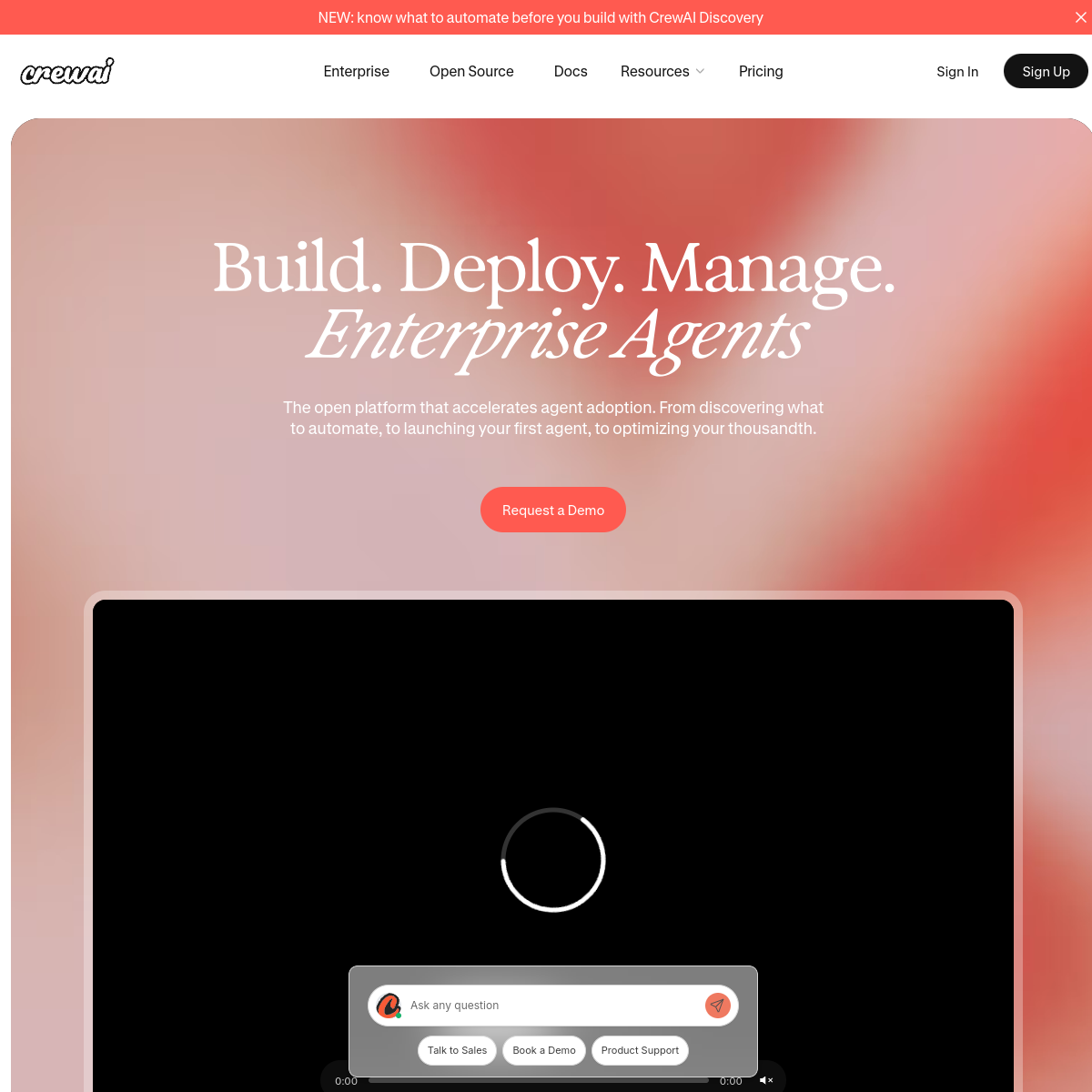
CrewAI
Core parameters and statistics of CrewAI
CrewAI is one of the most representative open source frameworks in the field of AI Agent orchestration. It is not just a development library, but a complete set of "Flow (workflow) → Crew (team) → Agent (intelligent) → Tool (tool)" layered architecture. Officially positioned as an "open platform that accelerates agent adoption", it covers the entire path from prototype verification to enterprise-level deployment.
| Projects | Public Information |
|---|---|
| Official positioning | Multi-agent orchestration framework and enterprise platform |
| Core abstraction | Flow (status and orchestration), Crew (team collaboration), Agent (role intelligence), Task (task), Tool (tool) |
| Deployment form | Open source framework (self-hosted) + enterprise platform (cloud hosting) |
| Process mode | Sequential (sequential), Hierarchical (layered), Hybrid (mixed) |
| Open Source License | MIT (Main Repository Public) |
| Community scale | GitHub Stars / Forks are subject to real-time data from the official warehouse |
| Corporate Clients | Officially disclosed that 63% of Fortune 500 companies have adopted |
| Supported Platforms | Python API, Web Console CLI |
Engineering meaning of layered architecture: Flow layer manages status and execution sequence, Crew layer carries multi-Agent collaboration logic, and Agent layer encapsulates roles and tool bindings. This layered design allows developers to iterate a certain layer of logic independently without affecting the overall situation - for example, replacing Agent's LLM backend does not require rewriting Flow's state machine.
Execution Budget: The platform layer provides a monitoring panel for execution times, token usage, and performance indicators. Together with automatic scaling and Cron scheduling, it is suitable for production scenarios with hard indicators on execution stability.
Users and market recognition of CrewAI
The market's recognition of CrewAI is reflected in three levels: open source community popularity, Fortune 500 enterprise adoption rate, and the depth of integration in the Agent ecosystem.
Community and Developers: CrewAI is one of the most active multi-agent orchestration frameworks on GitHub. Officially, more than 100,000 developers have been certified through community courses. Its GitHub repository continues to iterate frequently, and the response speed of Issues and PRs is an important indicator of the maturity of the framework - based on the real-time data of the official repository.
Enterprise-level penetration: The official website clearly lists DocuSign, Experian, PepsiCo, IBM, Johnson & Johnson, ABInBev and other Fortune 500 customers, and claims that 63% of Fortune 500 companies are already using it. This penetration rate is extremely rare in multi-agent frameworks, indicating that CrewAI has entered the enterprise procurement list from the developer experimental stage.
Third Party Ecosystem: CrewAI’s “Export as MCP Server” capability allows its Agent to be exposed as a standard MCP tool and called by other AI platforms. This means that CrewAI is not only an independent framework, but also an Agent output module for the broader AI ecosystem.
Prerequisites for implementation: The real value of enterprise-level Agent orchestration depends on whether the organization has a clear intention to dismantle the process. For teams without standardized business processes, it will be difficult to measure ROI even if they are connected to CrewAI.
Cost advantage of CrewAI: open source and free + enterprise on-demand
CrewAI's cost structure is a typical two-tier model of "open source base + commercial value-added". The core advantage is that developers can verify the framework's capabilities without any upfront investment.
C-side and developers (open source and self-hosted): The core framework is completely open source (MIT license) and can be used locally through pip install crewai or uv tool install crewai. The explicit cost of the self-hosted path is zero, but you need to bear the cost of LLM API calling fees, infrastructure operation and maintenance, and monitoring setup.
Cloud Platform (Free Plan): The official Free tier is provided, including visual editor AI Copilot, GitHub integration and 50 workflow executions per month. Suitable for individual developers and teams for PoC verification.
Enterprise Edition (Custom): The enterprise plan is priced on demand and includes all the capabilities of the Free tier plus: Dedicated VPC, NAT, SAM certification, FedRamp High compliance SSO (MS Entra, Okta), RBAC, 50 hours/month dedicated development support, on-site training and deployment. The specific price needs to be confirmed by the business.
The real hidden cost: The total cost of ownership of the Agent orchestration framework is not just the subscription fee. The LLM Token consumption for each Agent call, the surge in Tokens brought about by multi-Agent collaboration, and the regression testing after process changes are the largest expenditures in long-term operation and maintenance. The Tracing, Token usage monitoring and Hallucination Scores functions provided by CrewAI Enterprise Edition are designed to make these hidden costs explicit.
Main features of CrewAI
The functional system of CrewAI is designed around the four stages of "Orchestration -> Execution -> Observation -> Governance":
- Flow workflow engine: Based on event-driven state machine, supports
@start,@listen,@routerdecorators to define execution links. State is managed through the Pydantic model, supports persistence and breakpoint recovery, and is suitable for long-running production processes. - Multi-Agent role collaboration: Each Agent has independent
role,goal,backstoryand toolset. Agents in Crew can autonomously allocate subtasks and call each other's results, simulating the division of labor model of a human team. - Flexible task and process control: Supports three processes: Sequential (linear precursor and successor), Hierarchical (dynamic allocation by Manager Agent) and Hybrid. Each Task can set
output_file,human_input(human confirmation point),guardrails(output guardrails) andcallback. - Tools and MCP integration: Built-in official toolkits such as SerperDevTool, DALL·E Tool, Firecrawl, etc., and also supports the expansion of custom tools through
crewai[tools]. Supports exporting the entire Crew as MCP Server, which can be called by external LLM platforms. - Enterprise governance capabilities: including Usage Dashboard, Token Count, Performance Metrics, Hallucination Scores, LLM Management, Automatic Scaling, SSO, RBAC, Cron Scheduling, OpenTelemetry Tracing and Guardrails.
Hidden linkage: Flow's @router decorator can dynamically route to different Crews based on the output of the previous step, realizing the combination of "conditional branching + multi-Agent collaboration" - this usually requires nesting multiple conditional judgment nodes in traditional RPA or low-code platforms, but CrewAI uses a decorator to complete it in one line.
Version evolution of CrewAI
CrewAI’s development path is clear: starting from an open source framework and gradually expanding into a complete Agent life cycle platform.
Open source framework stage
- CrewAI Open Source Framework (2023-12): First publicly released as a Python multi-agent orchestration library. The core provides four abstractions: Agent, Task, Crew, and Process, and quickly gained attention in the AI developer community.
- Tool Ecosystem Expansion: The
crewai[tools]toolkit will be released one after another, integrating third-party capabilities such as SerperDev, Firecrawl, and DALL·E, so that Agent is no longer limited to text generation.
Enterprise platform stage
- CrewAI Enterprise (2024-10): Launch an enterprise-level platform based on an open source framework, adding capabilities such as a visual editor, monitoring panel SSO/RBAC, and audit log Dedicated VPC. The target customer base has expanded from independent developers to Fortune 500 organizations.
- MCP and Flow deepening: Introducing Flow abstraction (state management + event-driven), MCP Server export Human-in-the-Loop trigger, and Export as UI Component capabilities to evolve CrewAI from an orchestration library to an Agent application platform.
The current version is subject to official GitHub Releases and official documents. The public page shows that the project is still in high-frequency iteration.
CrewAI’s technical advantages
The technical advantage of CrewAI is not in the performance of a single model, but in the "engineered abstraction of Agent collaboration" and "native integration of production-level governance."
Flow-Crew two-layer architecture: The Flow layer is responsible for state persistence, event routing and execution sequence, and the Crew layer is responsible for the intelligent collaboration of multiple Agents. This separation makes state management independent of the Agent's LLM context window—even if an Agent's conversation history is truncated, Flow's State remains intact. Mechanically, Flow uses the Pydantic model to constrain the state structure and naturally supports type checking and serialization.
Event-driven execution model: Define the execution graph through @start, @listen, @router decorators instead of the traditional DAG configuration file. This makes the execution logic isomorphic to the business code, reducing the learning curve. @router can dynamically select the next hop Crew based on the output of the previous step and implement conditional branching without introducing an external state machine.
Agent tool calling protocol: CrewAI's Tool abstraction layer unifies tool interfaces from different sources - whether it is LangChain tools, custom Python functions, or MCP Server, they are all exposed to Agent through the same _run method. The advantage of this unified abstraction is that the Agent does not need to be aware of the implementation differences of the underlying tools and only needs to pay attention to tool_name and arguments.
Enterprise-grade observability: Built-in OpenTelemetry Tracing, Token Count, Performance Metrics and Hallucination Scores. The governance team can monitor the regular Token consumption and output quality of each execution without modifying the Agent code - this is the essential difference between a pure open source framework and a commercial platform.
CrewAI’s Agent tool open list and architecture link
This section is expanded by Agent tool type standards to describe the specific Tool behaviors that CrewAI Agent exposes to LLM.
Tool open list
CrewAI Agent exposes the following typical tool behaviors to LLM through the Tool abstraction layer (specifically, please refer to the crewai-tools official package):
SerperDevTool: Web search based on Serper.dev, returning title, abstract and URL.FirecrawlSearchTool: Deep web crawling and structured extraction based on Firecrawl.DALLETool: Image generation based on DALL·E model.PDFSearchTool: Semantic search and content extraction of local PDF documents.MySQLTool/PostgresTool: Database query and result set return.CodeDocsSearchTool: Semantic search of technical documentation libraries.ScrapeWebsiteTool: scrape the HTML content of the specified URL.FileReadTool/FileWriteTool: Read and write operations on the local file system.MCP Tool Adapter: Connect to any external tool server through MCP protocol.
Architecture link (text icon)
LLM (Agent Brain)
   ↓ tool_name + arguments
Agent Layer (role, goal, backstory, tools)
   ↓ _run()
Tool Abstraction Layer
   ├── Built-in Tools (SerperDev, Firecrawl, DALL·E...)
   ├── Custom Tools (Python function wrapped with @tool)
   └── MCP Server Adapter (external tool over stdio/HTTP)
        ↓
External Systems (Web, Database, File System, API, MCP Server)
   ↓ result
Agent Layer → returns response to Crew → Flow updates State
Data backflow direction: Agent calls Tool to obtain structured results → results are injected into the context of Agent → Agent produces final reply → Crew summary → Flow updates State → triggers the next step.
Engineering Pitfall Guide
-
Dead-end loop and Token inflation control: In multi-Agent collaboration, the Agent may retry repeatedly due to unsatisfactory results returned by the tool, resulting in an exponential increase in Token consumption. Solution: Set the
max_retryandtimeoutparameters at the Task level; limitmax_iterationsat the Agent level; use Flow's State persistence to avoid repeating completed steps when restarting. For long-running Crews, it is recommended to enabletask_output_limitto control the context length. -
Tool call exception and context pollution: When a Tool returns a timeout, empty result or error message, the Agent may misunderstand the exception message as valid data and continue reasoning. Solution: Return structured error codes instead of natural language descriptions in the Tool implementation; set
guardrailsin the Task definition to perform secondary verification of the output; usehuman_input=Trueto insert human confirmation points at high-value task nodes to prevent error cascading propagation. -
Security and unauthorized management: After the Agent is given FileWriteTool or Database Tool, LLM may perform unexpected write operations or delete operations. Solution: Use the
@tooldecorator to embed confirmation logic when wrapping irreversible operations (DELETE, DROP, payment interface calls, etc.); enable RBAC in the enterprise platform to limit the Tool access scope by role; use Dedicated VPC to isolate the execution context of the Agent in production context.
Get started quickly in 3 minutes
# Install CrewAI CLI (requires Python >=3.10, <3.14)
pip install crewai
# Or use uv (recommended)
uv tool install crewai

#Create project
crewai create flow my-ai-flow
cd my-ai-flow

# Install dependencies
crewai install

# Configure LLM API Key in .env
echo "OPENAI_API_KEY=sk-..." >> .env

# run
crewai run
For more detailed configuration, please refer to the official documentation: https://docs.crewai.com/en/installation
How to use CrewAI
CrewAI provides multiple landing paths, suitable for teams at different stages:
| How to use | Suitable for the crowd | Features | Cost |
|---|---|---|---|
| Open source framework (self-hosted) | Developers and DevOps teams | Local installation, fully controllable, deeply customizable | Free (MIT), LLM calling fee is at your own expense |
| Cloud Free Plan | PoC Verifier | Visual Editor + AI Copilot, 50 executions per month | Free |
| Enterprise Edition | Compliance and scaling requirements | Dedicated VPC, SSO, RBAC, dedicated development support | Business confirmation required |
Typical implementation path: First use the Free solution to do PoC on 1-2 high-frequency and low-risk processes (such as lead classification, preliminary screening of work orders) to verify the accuracy of multi-agent collaboration and token cost; then migrate the verified processes to the production environment through self-hosting or enterprise version; gradually add Human-in-the-Loop nodes and high-value tasks (such as contract review, customer quotation).
Product Pricing for CrewAI
CrewAI’s pricing adopts a three-tier structure of “free open source + free cloud + enterprise customization”:
- Open Source Framework: MIT License, completely free. The cost depends on self-hosted LLM API calls (billed by token), server infrastructure, and operation and maintenance manpower.
- Free Cloud Plan: 50 workflow executions per month, including visual editor GitHub integration, standard tools and triggers. Suitable for individual developers and small team pilots.
- Enterprise Edition (Custom): Includes all the capabilities of the Free tier, and additionally provides Dedicated VPC, NAT, SAM/FedRamp High compliance certification SSO (MS Entra/Okta), RBAC, 50 hours/month dedicated development support, on-site deployment and training. The specific price needs to be confirmed by contacting the sales team.
Procurement evaluation points: Enterprise customers need to confirm three terms before signing a contract - the billing rules after the execution volume is exceeded (Overage), the specific implementation of physical isolation of the data plane (VPC or dedicated cluster), and whether the audit link between Guardrails and Human-in-the-Loop meets compliance requirements.
CrewAI application scenarios
CrewAI’s implementation scenarios cover a wide range from automation research to enterprise-level business processes:
- Sales lead enrichment and prioritization: Multiple Agents are responsible for company information retrieval, size estimation, technology stack identification, and finally aggregate lead scoring. Gelato’s case shows processing 3,000+ lead enrichments per month and reducing development time by 90%.
- Intelligent processing of customer service tickets: The Agent team divides labor to perform classification, knowledge base retrieval, answer generation and manual upgrade judgment. After Piracanjuba replaced the original RPA, the customer service response accuracy rate reached 95%.
- Content production and course design: Multiple Agents are responsible for outline writing, chapter content generation, picture suggestions and format verification. General Assembly uses CrewAI to scale its course design process.
- Voice Agent Quality Test: Automated test Agent simulates user interaction and performs regression verification on the response of the Voice Agent. The QA time of a leading catering platform dropped from 74 hours to 3 hours, a drop of 96%.
- Internal enterprise process automation: Combined with Gmail/Slack/Salesforce triggers to achieve approval routing, knowledge base synchronization, and cross-system data flow. Suitable for medium and large organizations that have standardized processes.
Applicable groups of CrewAI
- AI application developer: Use Python API to build multi-Agent applications and manage complex logic hierarchically through Flow-Crew. Python development experience and basic knowledge of LLM API usage are required. Not suitable for scenarios that only require a single round of Chat functionality.
- AI Product and Platform Team: Need to embed Agent capabilities into existing products, or build an internal Agent orchestration platform. CrewAI's MCP Export capability allows it to be called by front-end applications as an Agent backend.
- Enterprise Architecture and IT Governance Team: Focus on compliance, auditing and cost control of Agent processes. The enterprise version's SSO, RBAC, Tracing and Token monitoring can meet the requirements of highly regulated industries such as finance, medical, and government affairs.
- Business Operations and Automation Leader: Build cross-department automation processes through visual editors and ready-made connectors to reduce dependence on the R&D team. But only if the business process has been standardized and can be broken down into orchestrated steps.
Not suitable for boundaries: CrewAI is not suitable for Chat scenarios that require minimalist interaction with a single Agent (AI Chat tools should be used), single-step tool calls that do not require orchestration (directly using the LLM API is more lightweight), and organizations that do not have a basis for process standardization (the abstraction layer brought by the orchestration framework will increase the maintenance burden).
Summary and Outlook
The core value of CrewAI is to provide a complete engineering path from prototype to production for multi-Agent collaboration. Its Flow-Crew-Agent-Tool hierarchical abstraction is currently the closest practice to an "Agent operating system" in the open source community. With a Fortune 500 penetration rate of 63%, abundant enterprise compliance certifications (SAM, FedRamp High), and the depth of integration in the MCP ecosystem, it has established a clear first-mover advantage in the field of enterprise-level Agent orchestration.
Current limitations include: the open source version lacks enterprise-level observability capabilities (tracing, token monitoring, etc. are limited to enterprise platforms); the token cost model in multi-agent collaboration scenarios is still complex, requiring users to accumulate actual consumption data during the pilot phase; and the high-frequency iteration rhythm poses challenges to the needs of enterprises for fixed versions.
Procurement and Adoption Suggestions: It is recommended to use the Free solution to pilot 1-2 high-value processes first, focusing on verifying three indicators - the accuracy of multi-Agent collaboration (recommended ≥90%), single-process Token cost (compared with pure manual or traditional RPA), and the misjudgment rate of Human-in-the-Loop nodes. If the pilot results are in line with expectations, then enter the enterprise version business negotiation as needed, focusing on confirming the Overage billing rules, data isolation methods, and audit compliance coverage.
Related tools: CrewAI,  LangChain
CrewAI’s model and version evolution
Continuous iterative updates, the latest version introduces performance optimization and new features. Historical version information can be viewed through the official release page. There is currently no complete public version evolution timeline.
How to use CrewAI
- Web client: You can use it by visiting the official website and registering an account. Most functions do not require installation.
- API access: Provides RESTful API, developers can obtain the API Key and integrate it into their own applications.
Version Info
- CrewAI Enterprise :It provides enterprise-level orchestration, monitoring and deployment capabilities based on the open source framework; the specific version and availability are subject to the latest official page.
- CrewAI open source framework :Released as open source as a Python multi-agent orchestration framework, it quickly gained developer attention.
User Reviews