 ActiveCampaign
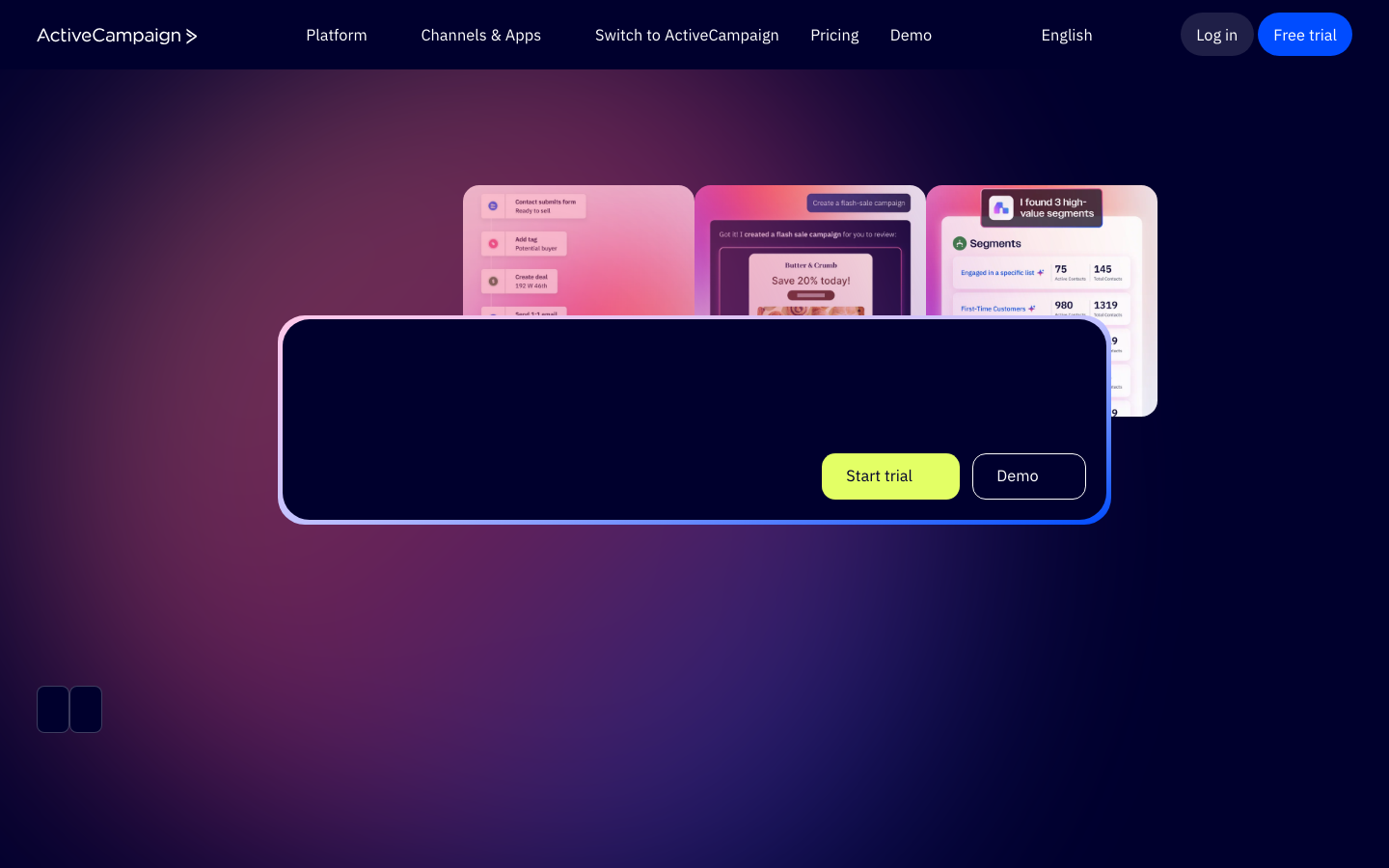
ActiveCampaign is a customer experience automation platform (CXA) that integrates email marketing, marketing automation, and sales CRM. With a powerful automated editor as the core, it supports website behavior tracking, conditional branching and sales pipeline management.
ActiveCampaign
Core parameters and statistics of ActiveCampaign
ActiveCampaign's official positioning has been upgraded from "Customer Experience Automation Platform (CXA)" to "Autonomous Marketing Platform". The core difference lies in its AI layer Active Intelligence 2.8 - instead of making AI an independent module, it is used as a strategy engine to embed email SMS, WhatsApp, CRM, data analysis and other product aspects. Officials claim that the platform is powered by billions of data points and runs more than 150 million automated marketing processes every month.
| Projects | Public Information |
|---|---|
| Product Positioning | Autonomous Marketing Platform |
| AI Engine | Active Intelligence 2.8 |
| Core form | SaaS Web + Mobile App + API + MCP |
| Customer scale | 180,000+ corporate customers |
| Channels covered | Email SMS, WhatsApp, website, social advertising |
| Integration Ecosystem | 1000+ third-party application integrations (including Zapier, Salesforce, Shopify, etc.) |
| Latest version iteration | 2026.07 (AI prediction sending and automated process optimization) |
| Pricing model | Per contact, 4 packages + add-ons |
| Free trial | 14-day fully functional trial (no credit card required) |
| User reputation | G2 4.5 stars / 14,000+ reviews |
AI Density: Active Intelligence 2.8 introduces four major contextual mechanisms: Memory, Custom Instructions, Brand Kit, and Campaign Reference. Each round of AI generation is based on brand historical data and user preferences, rather than starting from scratch every time. This is fundamentally different from most marketing tools on the market that only connect to general LLM in copywriting generation - ActiveCampaign attempts to push AI from "assisted generation" to "autonomous strategy."
Integration depth: 1000+ integrations not only include common connectors such as Zapier and Make, but also support MCP (Model Context Protocol) direct connection of Claude and ChatGPT. This means marketers can directly manipulate ActiveCampaign’s data and processes within the LLM conversational interface without having to switch interfaces frequently.
User and market recognition
ActiveCampaign's market recognition comes from three verifiable dimensions: customer scale, industry reviews and user reputation. The three cross-validate its industry status as a "leading marketing automation player".
Customer Size: The official pricing page shows over 180,000 businesses using it. Referring to the G2 platform's 14,000+ reviews with a combined 4.5-star rating, it is one of the marketing automation platforms with the largest number of reviews and the highest overall rating on G2. Customers include small and medium-sized enterprises in retail, education, medical, technology and other industries, as well as some medium and large institutions (such as non-profit organizations such as the YMCA).
Industry Recognition: Officially named a leader in marketing automation by Gartner and Forrester. ActiveCampaign is generally ranked well in Gartner Magic Quadrant and Forrester Wave reports for ability to execute and completeness of vision. The specific year and quadrant position are subject to the official real-time page and the latest report.
Real user feedback: Quantitative results appearing in official customer cases include:
- Spark Joy New York (retail): With the help of AI content generation, email sending volume increased by 3 times, and marketing shifted from "fear" to proactive.
- YMCA of Alexandria (non-profit): Save 10+ hours of design time per week with AI Brand Kit, allowing employees without a design background to produce professional-grade emails.
- UBITS (Educational Technology): Email click-through rate increased from 2.92% to 10.8% after using AI suggested segmentation.
- Frank and Sherri (ecommerce): AI Campaign Builder reduced email creation time from hours to minutes, with $76,000 in revenue directly attributed to the automated process.
- Parrish Law (Legal Services): AI reporting capabilities save 2.5+ hours per week.
Hidden Cost Tip: The ROI data in customer cases are mostly selectively disclosed by the authorities and do not mean that they can be reproduced in all sizes/industries. It is recommended that new users use a 14-day trial period to actually measure the open rate, click-through rate and conversion improvement of their own scenes, rather than directly benchmarking case numbers.
Cost advantage
- C-side/Individual: Usually a free version is provided to experience the core functions, and high-frequency use requires a paid package subscription.
- API/Developer: Billed by call volume, suitable for development teams that can be flexibly integrated into their own systems.
- Enterprise/Privatized: Contact the business owner for customized quotation and deployment plan. The specific price is subject to the official real-time pricing page.
Main features of ActiveCampaign
ActiveCampaign's functional design revolves around the core concept of "autonomous marketing", unifying AI orchestration, multi-channel CRM and data analysis into one platform. The following five functional groups are the core differences:
-
Active Intelligence AI Engine: This is a core capability upgrade in 2026. The AI layer is not limited to copywriting generation, but covers the complete link from strategy to execution – automatically generating complete campaigns based on Business Goals, creating new templates based on the best historical campaigns, and predicting the optimal sending window and channel preferences for each contact. Key components include: AI Campaign Builder (generates a complete email in one sentence), AI Brand Kit (automatically imports brand colors/fonts/logos), AI Suggestion Segmentation (automatically divides audience groups based on behavioral patterns), Business Goals (goal-driven AI Agent, automatically arranges strategies after users enter goals).
-
AI Agent and Autonomous Workflow: Officially introduces the concept of AI Agent - each Agent specializes in specific marketing tasks (content creation, sending time optimization, effect analysis) and works together under the coordination of Active Intelligence. Users do not need to manually configure complex conditional branches and directly describe the goal in natural language (such as "increase the click-through rate of promotional emails sent this Thursday by 20%"). The AI Agent automatically completes segmentation adjustment, copywriting optimization, sending time rearrangement and execution. Expert View: The key to this Agent architecture is the "Memory" mechanism - AI remembers the brand preferences, copywriting style and audience characteristics of each round of interaction, avoiding the need to explain it from scratch every time. In actual use, the initial configuration of Custom Instructions takes 20-30 minutes, but the time for each subsequent activity creation can be compressed from hours to 15-30 minutes.
-
Multi-channel automation orchestration (email + SMS + WhatsApp): Visual drag-and-drop automation editor that supports multi-branch conditions, rating triggers, behavior tracking and cross-channel jumps. The core difference from competing products is "inter-channel linkage" - for example, when a visitor opens an email but does not click on it, it is automatically sent to SMS to send a reminder; after the WhatsApp session ends, it automatically triggers email follow-up and CRM lead scoring updates. This kind of cross-channel “relay” automation is something that traditional email automation (Mailchimp) and single-channel tools (such as SMS-only platforms) cannot do.
-
Sales CRM and Lead Management: The built-in CRM module supports lead management Deal Pipeline, task assignment, automatic email tracking and sales automation. CRM is deeply integrated with marketing automation behavioral data - automatically assigning leads to corresponding sales when they reach specific scoring thresholds, automatically generating follow-up tasks based on email interaction records, and automatically updating the deal stage when customer behavior changes. Expert View: ActiveCampaign’s CRM lacks feature depth compared to Salesforce and HubSpot—it lacks advanced reporting, predictive analytics, and complex permissions management. Its core value lies in "the data from marketing to sales is not implemented", and it is suitable for small and medium-sized enterprises without a dedicated CRM team.
-
AI Prediction and Optimization Layer: Predictive Sending analyzes the open time pattern of each contact in the past 30-90 days, selects the optimal sending window for each person, and officially claims to increase the click-through rate by 17%. BotSense automatically identifies and filters robot opening behavior to prevent spam complaint rates from increasing due to misjudgment. Business Goals tracks 200 (Pro/Enterprise package) indicator targets in real time and triggers optimization recommendations when campaign performance deviates from the target.
Model and version evolution
As a continuous SaaS service, ActiveCampaign has no semantic version number, but its functional milestones in recent years clearly outline the evolution path from "rule automation" to "AI independent marketing".
2024: Emerging AI capabilities
- 2024 Q1 (~2024-02): Introducing AI-driven outbound scoring and lead prioritization, applying machine learning to lead quality judgment for the first time, replacing manual scoring.
- 2024 Q3-Q4: The predictive sending function is launched, and the personalized sending time is optimized based on the user's historical behavior. At the same time, the Conditional Content function was launched to dynamically display different email content modules based on contact attributes.
2025: First release of Active Intelligence
- Spring 2025 (~2025-03): Official release of Active Intelligence - the debut of a unified AI layer that integrates the three capabilities of AI copywriting, AI suggestion segmentation and AI automation building.
- Autumn 2025 (~2025-09): The new sales CRM reconstruction is launched, adding visual Deal Pipeline orchestration and more fine-grained permission management. That month, the G2 rating exceeded 4.5 and the number of reviews exceeded 11,000.
- End of 2025 (~2025-11): Start MCP integration development to establish connectivity capabilities with Claude and ChatGPT.
2026: Independent marketing platform finalized
- 2026 Q1 (~2026-03): The Active Intelligence 2.0 update introduces AI Brand Kit (brand kit) and Memory mechanism, and the AI output style and brand consistency are significantly improved.
- 2026 Q2 (~2026-05): 800+ integrations expanded to 1000+; MCP integrations officially open to the public, supporting direct manipulation of ActiveCampaign data in Claude/ChatGPT conversations.
- July 2026 (~2026-07): Active Intelligence 2.8, the latest version currently available for verification. Enhanced AI Campaign Builder (generating complete campaigns in one sentence), Business Goals Agent (goal-driven autonomous marketing), and AI image generation and editing capabilities.
Version Note: The above dates are subject to the official blog help center update log and product page markings. Some earlier versions do not have precise release dates and are marked with "~YYYY-MM". Please see the official Changelog page for the latest feature updates.
Technical advantages
The technical barrier of ActiveCampaign is not the parameter scale of a single AI model, but the engineering integration of the trinity of "marketing data + AI orchestration + multi-channel execution".
AI layer is deeply embedded instead of plug-in: The way most marketing tools on the market integrate AI is to embed a ChatGPT pop-up window in the editor - after generating the copy, you still need to manually copy and paste it into the active editor. The difference of ActiveCampaign's Active Intelligence 2.8 is that AI directly operates the platform's internal data structure (contact list, segmentation conditions, automation rules, sending queues), and does not require manual transfer by the user from "copy generation" to "policy execution". AI Campaign Builder, for example, generates not just an email body, but a complete campaign package including send time, audience segmentation, automation triggers, and A/B testing scenarios.
Context continuity mechanism of Memory and Brand Kit: This mechanism solves the core pain point of marketing AI - the need to repeatedly explain the brand background for each generation. Memory stores the brand preferences of previous interactions, rejected copywriting directions, and user feedback. Brand Kit automatically identifies and stores brand colors, fonts, logos, and commonly used picture styles. When a user creates a new campaign, the AI automatically references the brand’s historical best practices and visual norms. The cost of technical implementation of this mechanism is: the "cold start" stage of new users' first use (the first 3-5 activity creations) requires manual correction of deviations in AI output. As the number of interactions increases, the output quality gradually converges.
Integrated innovation of MCP protocol: ActiveCampaign is an early marketing platform that supports Model Context Protocol. MCP allows LLMs such as Claude and ChatGPT to directly read and write ActiveCampaign's contact, activity, and report data through standardized protocols. There is no API Key generation and OAuth process required for deployment. You only need to open the corresponding MCP server in the LLM client. The practical value of this to the marketing team is that daily data queries (such as "Which email template had the highest open rate last week") can be completed directly in the chat interface, without the need to log in to the backend to run reports.
Connector governance behind thousands of integrations: The focus of 1000+ integrations is not the quantity, but the life cycle management of connectors - when a SaaS updates the API version, ActiveCampaign's connector governance mechanism needs to ensure the continuous operation of existing activities. This is the hidden difference between enterprise-grade platforms and lightweight tools like Zapier’s single-tier integration. When it comes to payment CRM, e-commerce and other key systems, connector stability directly affects the ROI of marketing activities.
Engineering Challenge: "Timing consistency" of cross-channel automation is a technical difficulty. When the same contact triggers three automated branches of email + SMS + WhatsApp within a short period of time (<1 second), the platform needs to ensure that the sending order, frequency and content of the three messages do not conflict. ActiveCampaign's processing method is unified scheduling through "action queue + frequency control rules", but execution timing problems may still occur in the orchestration of ultra-complex automation (>50 branch nodes).
How to use
ActiveCampaign provides multiple usage paths, covering teams with different technical backgrounds and business needs.
| How to use | Suitable for the crowd | Core features | Cost |
|---|---|---|---|
| Web backend | All users | Visit activecampaign.com and use it directly after registration. All functions can be accessed through the web page | 14-day free trial, and then pay according to the package |
| Mobile App | Field/operation staff | iOS/Android app store search ActiveCampaign, supports mobile data viewing and basic operations | Free (included in package) |
| REST API | Developer/Integrator | RESTful API supports contact management, activity reach, data export, automated start and stop | Included in package quota |
| MCP integration | Claude/ChatGPT users | Operate ActiveCampaign directly in the Claude/ChatGPT conversation interface | Free (platform feature) |
Quick Start Suggestions: New users are advised to follow the order of "Import Contacts → Set up Brand Kit → Create the first AI Campaign". When using Active Intelligence for the first time, spend 20-30 minutes filling out the Custom Instructions (brand tone, target audience, communication style). This one-time investment will significantly improve the quality of subsequent AI output. For users migrating from other platforms, the official provides free migration services (including contact import, template conversion and historical data migration), but the automated process logic needs to be manually rebuilt.
Typical usage link: Take a simple "welcome sequence" as an example - automatically triggered after the user fills out the form on the official website: ① Send a welcome email (automatically generated by AI based on Brand Kit); ② If the email is not opened for 24 hours → automatically transfer to SMS to send a short summary; ③ Click the email link within 72 hours → trigger lead scoring + sales task assignment; ④ After completing the above process, AI automatically analyzes the open rate/click rate and gives optimization suggestions for the next round of activities. The entire set of links takes engineers 3-5 hours to configure in traditional tools, but can be set up in about 30 minutes in ActiveCampaign.
MCP Integration Example: After connecting ActiveCampaign in Claude, actions can be performed via natural language instructions. The following is a typical interaction mode (no code required, completed in the Claude dialogue interface):
User: Help me query the list of all contacts who did not open the welcome email in the last month and create a reactivation sequence for them.
Claude (via MCP): Queried 1,247 contacts who did not open the welcome email, creating reactivation sequence:
- Frequency of sending: 1 email per week, 3 emails in total
- The second email contains a limited time discount code
- After the sequence ends, non-interacted contacts are automatically moved to the "Cooling Down" tab

Please confirm whether to execute.
Implementation method: For enterprises with high standardization requirements, it is recommended to proceed in the three stages of "pilot → comparison → expansion". In the pilot phase, a high-frequency but low-risk process (such as a form triggering a welcome email) was selected, and it took 2 weeks to verify the AI output quality and team acceptance; the control phase was run in parallel with the old process, and the three indicators of open rate/click rate/conversion rate were quantified and compared; after the improvement was confirmed, it was expanded to more complex scenarios. At the end of the first phase, it is recommended to accept three key indicators: the performance difference between the AI-generated version and the manual version in A/B testing, the abnormality rate of the automated process (such as non-triggering/repeated triggering), and the change in the team's time allocation from "manual operation" to "review-based work".
Product Pricing
The pricing model is subject to the official real-time page. Usually a freemium or subscription system is adopted. Basic functions can be used for free, while advanced functions or high-frequency use require paid subscriptions. It is recommended that users evaluate the optimal solution based on actual usage.
Application scenarios
ActiveCampaign's "independent marketing" positioning determines that its highly adaptable scenarios are concentrated at the intersection of two types of needs: "the need for automation but lack of full-time engineers" and "the need for cross-channels but the lack of a unified platform."
-
B2B Lead Nurturing and Marketing-Sales Collaboration: This is ActiveCampaign’s strongest scenario. Automatically calculate lead scores through website behavior tracking (page visits, content downloads, meeting appointments) and email interactions (opens, clicks, replies), and automatically assign to corresponding sales and create follow-up tasks after reaching the threshold. Quantified expectations: Referring to the UBITS case, AI suggestion segmentation can increase the email click-through rate from 2.92% to 10.8%. Implementation Tips: Ensure two-way synchronization of data between CRM and marketing automation - after sales updates the Deal stage in CRM, marketing automation should automatically adjust the content and frequency of the lead's emails to avoid the embarrassment of "customers who have already made a deal still receive promotional emails."
-
E-commerce abandoned order recovery and full life cycle management: Track shopping cart abandonment behavior → Automatically send a personalized recovery sequence (email + SMS + WhatsApp multi-layer coverage) → Transfer to the repurchase cultivation process after successful conversion. The Frank and Sherri case shows $76,000 in revenue directly attributable through the ActiveCampaign automation process. Unsuitable boundary: ActiveCampaign’s in-depth e-commerce analysis (SKU-level product recommendation, collaborative filtering based on purchase history) is weaker than Klaviyo. If the core appeal is “AI-driven product recommendation engine”, Klaviyo may be more suitable.
-
Customer journey orchestration for service-oriented enterprises: Automatically trigger confirmation, reminder, evaluation invitation and repurchase reminder based on status changes of reservation events (course registration, service reservation, event registration). Cross-channel support means customers can receive notifications via their preferred channel (email SMS, WhatsApp). Implementation Tips: The service reservation scenario has high timeliness requirements. It is recommended to set up a back-up branch in the automation of "if there is no reply N hours before the deadline, transfer to manual processing" to avoid missing key reservations caused by complete automation.
-
Nonprofit/membership organization communication automation: The YMCA of Alexandria case shows that operations staff with non-design background can independently complete professional member communication emails through AI Brand Kit, saving 10+ hours per week. Suitable for membership renewal reminders, event notifications, volunteer management and other scenarios.
Applicable people
ActiveCampaign's target audience is mainly small and medium-sized enterprises that "need automation but do not have an engineering team" and teams that "want to unify marketing-sales data flows".
-
Marketers (non-technical background): Through AI Campaign Builder and Active Intelligence, marketers can describe needs in natural language, and AI automatically completes email generation, segment selection, and sending time optimization. Prerequisite: The team needs to have clear brand visual specifications (Logo, color value, font) and audience stratification logic - AI-assisted optimization cannot replace early marketing strategy planning.
-
Sales Team (SMB CRM users): The built-in CRM provides lead management Deal Pipeline and automatic task allocation. The core value is that marketing behavior data is automatically synchronized to the sales side, eliminating manual entry time. Not a good fit: When teams exceed 20 people and require multi-level permission management and complex predictive analytics, the depth of functionality of Salesforce or HubSpot CRM is a better match. ActiveCampaign CRM is suitable for early-stage teams who are building a sales process from 0 to 1.
-
E-commerce and retail operations personnel: Support abandoned order recovery, automatic serial SKU-level tag management after purchase, and cross-channel promotion push. Note: For e-commerce companies that have many customized categories (SKU > 1000) and rely on personalized product recommendations, they need to be used with specialized e-commerce tools such as Klaviyo. ActiveCampaign alone cannot meet the needs for in-depth recommendations.
-
All-round operator for small and medium-sized enterprises: The "one person with multiple jobs" role that is responsible for both marketing, sales and customer service can benefit the most from ActiveCampaign's unified platform - there is no need to switch between email tools CRM and analysis tools. Price: Unification means that each module is not as deep as the specialization tools. If a team is already using a mature standalone CRM (like Salesforce) and BI system, ActiveCampaign's integration layer may become redundant.
-
Not recommended for use:
- Pure email sending needs (such as newsletters): Mailchimp’s free plan and lighter Newsletters editing experience are better suited.
- Large Enterprise Full Stack Marketing: Enterprises that need PPM (Project Portfolio Management), advanced BI, and omnichannel attribution analytics, HubSpot Enterprise or Adobe Experience Cloud are more suitable.
- Only WhatsApp or SMS single-channel marketing: ActiveCampaign’s WhatsApp and SMS require an email package to be used together and cannot be purchased separately; in a pure single-channel scenario, Twilio or MessageBird are cheaper.
Summary and Outlook
Through the comprehensive upgrade of Active Intelligence 2.8, ActiveCampaign is the first among traditional marketing automation platforms to complete the product paradigm shift from "rule-driven" to "AI-driven". Its core competitive barrier is that the AI layer is not a plug-in module, but is deeply embedded in the entire link of email SMS, WhatsApp, CRM and data analysis. With the three contextual mechanisms of Memory, Brand Kit and Custom Instructions, it achieves "brand consistent AI output" that is rare in the industry.
Current Core Advantages: 180,000+ customers and G2 4.5-star rating verify the market acceptance of the product; 1,000+ integrations and MCP protocol support make it less difficult to implement in enterprises with existing tool stacks; AI Campaign Builder and Business Goals Agent compress single campaign creation time from hours to tens of minutes.
Major current limitations and uncertainties:
- Insufficient pricing transparency: The official does not stably display the precise monthly fee on the pricing page. The cost jump after the number of contacts increases requires users to contact sales for confirmation, which is not conducive to budget planning.
- AI cold start cost: When you first use Active Intelligence, you need to invest 20-30 minutes to configure Custom Instructions and Brand Kit, and the first 3-5 campaign creations may require manual correction of AI output bias.
- Insufficient e-commerce depth: The AI capabilities of SKU-level recommendation and multi-category cross-selling are weaker than Klaviyo. Cross comparison is recommended for the main e-commerce scenarios.
- CRM functional boundaries: The built-in CRM may not be sufficient for sales teams of more than 20 people, lacking advanced reporting, predictive analysis, and multi-level permission management.
- API frequency control and SLA: The details of API call frequency control and SLA guarantee have not been officially disclosed. There may be hidden costs for teams that deeply integrate APIs into their own systems.
Procurement and Adoption Risk Assessment:
- For SMBs and 1-10 person marketing teams: Lower risk. The 14-day free trial is enough to verify the applicability of core scenarios, and starting from Plus or Pro can cover more than 80% of marketing automation needs. It is recommended to focus on testing whether the quality of AI-generated content meets brand requirements.
- For e-commerce teams: Medium risk. It is recommended to focus on comparing Klaviyo’s SKU recommendation and RFM analysis capabilities during the trial period to choose the platform that best suits your category. If the core appeal is just abandoned order recovery and basic automation, ActiveCampaign is completely sufficient.
- For medium and large enterprises: relatively high risk. Before purchasing, you must confirm whether the coverage API frequency control limits of SSO and user rights management meet the data volume expectations, the response time and compensation terms of the enterprise version SLA, and whether the CRM enhancement components meet the needs of the sales team. It is recommended to pilot Plus or Pro in a small business line first, and then decide whether to expand to Enterprise after verification.
- Cross-scenario strategy: For companies that have both B2B lead cultivation and e-commerce retail business, you can consider the combined strategy of ActiveCampaign + Klaviyo - ActiveCampaign is responsible for B2B leads and marketing-sales collaboration, and Klaviyo is responsible for in-depth analysis and recommendations of e-commerce scenarios. In this case, the cost of data synchronization between the two systems needs to be evaluated.
Follow-up observation points: Whether Active Intelligence will further support the automated orchestration of AI Agents (not just suggestion mode); whether the MCP ecosystem will expand to more LLMs (such as DeepSeek, Gemini); whether pricing transparency will improve as product maturity increases; whether the functional depth of e-commerce scenarios will be completed through acquisitions or self-construction.
Related tools:  Notion AI, google-workspace
Version Info
- ActiveCampaign July 2026 :Enhanced AI predictive sending and automated process optimization recommendations
- ActiveCampaign 2025 Fall :Introducing new sales CRM and visual orchestration of pipelines
- ActiveCampaign 2024 Q1 :Introducing AI-driven outbound scoring and lead prioritization
User Reviews