 ActiveCampaign CRM
ActiveCampaign is a customer experience platform that integrates email marketing, sales automation and CRM. It is known for its powerful automated workflow engine and customer segmentation capabilities.
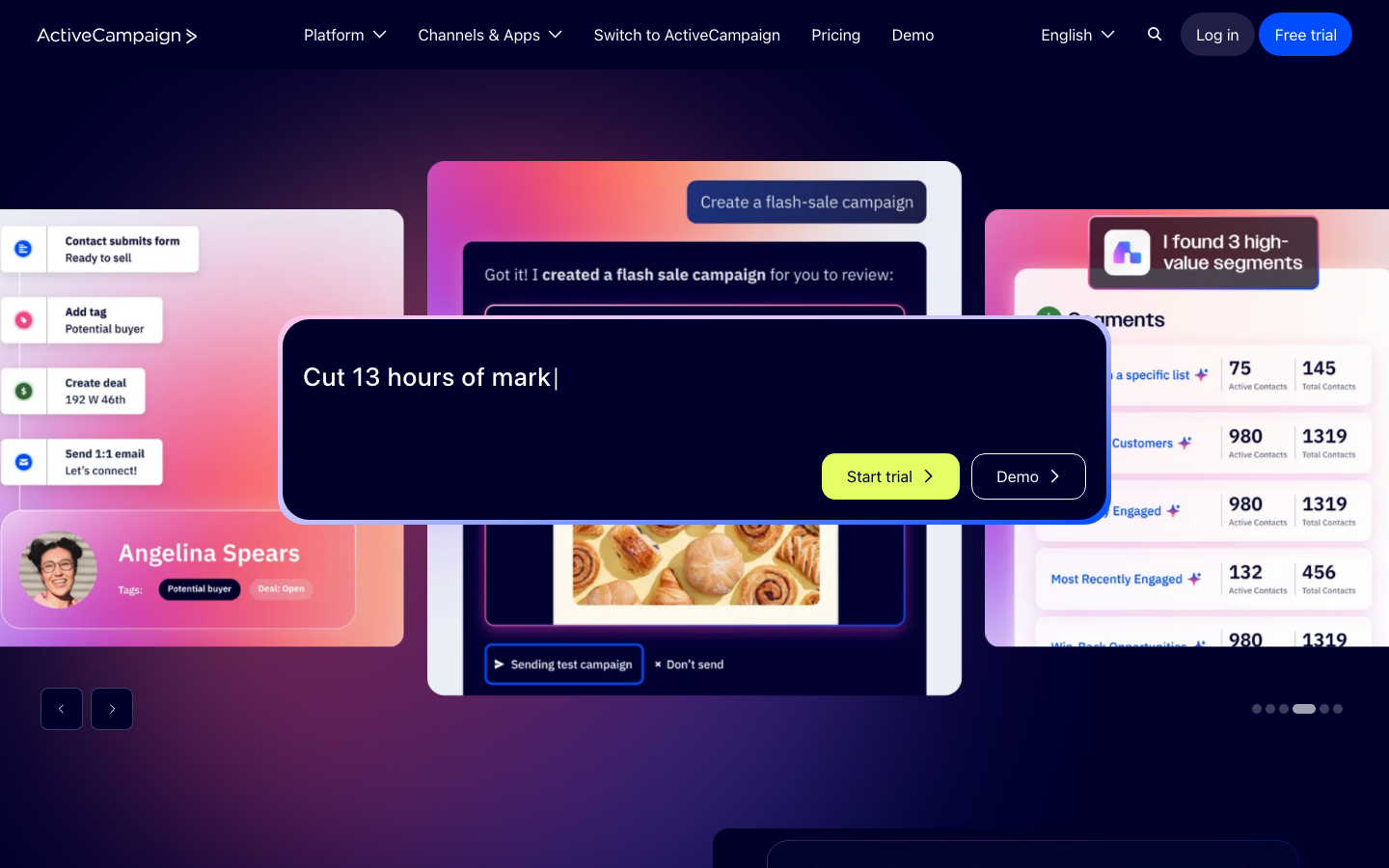
ActiveCampaign CRM: AI-powered autonomous marketing and customer experience automation platform
Core parameters and statistics of ActiveCampaign
| Parameters | Information |
|---|---|
| Product Positioning | Autonomous Marketing and Customer Experience Automation (Autonomous CXA) Platform |
| Form | SaaS Web Application + Mobile App (iOS/Android) |
| Licensing model | Tiered subscription (priced based on the number of contacts) |
| Supported Platforms | Web, Android, iOS, API |
| Main language | English (interface and documentation), supports multilingual email content |
| Place of Residence | United States (US) |
| Headquarters | Chicago, IL |
| Established | 2003 |
| Core Features | Active Intelligence AI engine, visual automation workflow, email/SMS/WhatsApp multi-channel marketing AI Agent independent marketing |
| Customer scale | 180,000+ enterprise customers |
| Industry reputation | G2 score 4.5/5 (14,000+ reviews), rated as "the world's highest-rated marketing automation platform" by G2 |
| Key Efficiency Indicators | The first round of marketing campaign is built 8 times faster; 10 hours of repetitive marketing work are saved every week; 83% of customers see ROI within one year |
| AI capability baseline | Active Intelligence 2.8 (memory memory, brand suite AI Agent cluster MCP protocol access) |
Interpretation of market position: ActiveCampaign started as "email marketing automation" in the early days. Between 2024 and 2026, it completed the paradigm upgrade from "rule-driven workflow engine" to "AI Agent-driven independent marketing platform". Its core competitiveness is no longer simple drag-and-drop automation, but Active Intelligence, the AI layer that runs through emails, SMS WhatsApp, and CRM—it can automatically generate and optimize the entire marketing campaign based on brand memory, historical best activities, and real-time customer behavior. Among products in the same price range ($15-$200/month range), ActiveCampaign is the only complete platform that simultaneously provides "autonomous AI Agent + visual automation + native CRM + multi-channel delivery".
ActiveCampaign’s user and market recognition
Adoption scale: As of mid-2026, ActiveCampaign serves more than 180,000 enterprise customers, covering multiple vertical industries such as e-commerce SaaS, education, non-profit, and professional services. The platform automates over 150 million automated marketing campaigns every month.
User testimonials:
- G2: 14,000+ reviews, with an overall score of 4.5/5, and continues to rank among the leaders in multiple categories such as "Marketing Automation", "Email Marketing" and "Customer Interaction". Users generally praise its automation flexibility and usefulness of its AI capabilities, with common negative feedback centering on the initial learning curve and the additional cost for advanced CRM features.
- Capterra: 4.6/5 (10,000+ reviews), rated "Best Cost-Effective Marketing Automation Tool".
- GetApp: 4.5/5 (8,000+ reviews). The core praise keywords are "automation flexibility", "AI saves time" and "customer segmentation depth".
Benchmark customer case (from official disclosure):
- Spark Joy New York (home e-commerce): With the help of AI content generation, email sending volume increased by 3 times, and the marketing team shifted from "weekly copywriting" to "multiple rounds of AB testing every week."
- YMCA of Alexandria (non-profit organization): Save 10+ hours of brand material production time per week through AI Brand Kit, and internalize design work that originally needed to be outsourced.
- UBITS (Enterprise Training Platform): Leveraged AI-Suggested Segments to increase click-through rate from 2.92% to 10.8%, a 270% increase.
- Frank and Sherri (gift e-commerce): AI Campaign Builder reduced email creation time from hours to minutes, generating $76,000+ in revenue from two automated emails.
- Parrish Law (Legal Services): Saved 2.5+ hours of data wrangling work per week through AI conversational reporting.
Third Party Approval:
- Gartner Digital Marketing Center 2025 Representative Vendor
- TrustRadius "2025 Most Popular" Award
- Selected to Inc. 5000 list of the fastest-growing private companies in the United States for many consecutive years
Cost Advantages of ActiveCampaign
C-side/Team Subscription Cost
ActiveCampaign's pricing increases linearly in the two dimensions of "functional level × number of contacts". There are no hidden setup fees, and it supports monthly or annual subscriptions (annual payment enjoys discounts). The core price gradient is as follows (based on 1,000 contacts, the actual price fluctuates with the number of contacts):
| Package | Reference starting price (monthly payment) | Core email sending volume | Number of users | AI function limitations | Suitable scenarios |
|---|---|---|---|---|---|
| Starter | $15/month | 10x number of contacts | 1 | Limited AI (1 Brand Kit) | Individual Entrepreneur/Minimalist Email Marketing |
| Plus | $49/month | 10x number of contacts | 1 | Limited AI | Small teams require basic CRM + automation |
| Pro | $79/month | 12x number of contacts | 3 | Full AI functionality (5 Brand Kits) | Growing teams need omnichannel automation |
| Enterprise | On-demand quotation | 15x number of contacts | 5+ | AI full-featured unlimited access | Medium and large enterprises require dedicated SLA |
Cost comparison with mainstream competitors (1,000 contact benchmark)
| Dimensions | ActiveCampaign Pro | HubSpot Marketing Hub Pro | Mailchimp Standard | Klaviyo |
|---|---|---|---|---|
| Monthly fee (approximately) | $79 | $800+ | $59 | $60+ |
| AI function | Active Intelligence full function (AI Agent, Brand Kit, predictive sending, etc.) | ChatSpot AI assistant (basic) | Basic AI copywriting generation | Basic AI prediction |
| Depth of automation | Unlimited actions, multi-branch conditional AI automatic construction | Limited actions, additional money required for advancement | Limited actions | Deep automation of e-commerce |
| CRM | Light CRM + Pipeline Paid Plugin | Native HubSpot CRM (Deep) | No Native CRM | No Native CRM |
| Multi-Channel | Email + SMS + WhatsApp + Site Messaging | Email + SMS | Email + SMS | Email + SMS |
| Value for money rating | ★★★★★ | ★★★ | ★★★★ | ★★★★ |
Cost Analysis: ActiveCampaign offers the most aggressive AI feature coverage and automation flexibility in the $50-$100/month range. Compared with HubSpot, the price of HubSpot at the same level of AI capabilities is about 8-10 times that of ActiveCampaign, but HubSpot’s CRM depth and ecosystem maturity far exceed ActiveCampaign’s.
Developer/API Cost
- API Access: REST API and webhooks included with all paid plans at no additional charge.
- MCP protocol access: Using ActiveCampaign MCP Server via Claude/ChatGPT requires no additional license fee and only requires standard API credentials.
- Transactional Email Add-on: Billed separately as an Add-on, price is undisclosed.
Hidden cost reminder
- Excessive Contacts: After exceeding the package limit, you will automatically be upgraded to the next contact tier. Your account will not be banned but the fee will rise linearly. It is recommended that teams that send <10x contacts per month choose a higher-level package to avoid overpayment.
- CRM Function Split: Pipeline, Sales Engagement and Lead Scoring are charged separately as Enhanced CRM Add-on, about $20-50/month. If you want a full CRM rather than light contact management, the actual cost of ownership is 30-50% higher than the list price.
- AI Add-on: AI translation AI actions (AI Actions) are billed separately as part of the AI Activities Add-on, and the specific price is not disclosed.
Main features of ActiveCampaign
1. Active Intelligence AI engine (core difference)
Active Intelligence 2.8 is ActiveCampaign’s AI middle platform. It is not a standalone feature, but an AI layer embedded in all operations. It contains the following sub-capabilities:
- AI memory and custom instructions: Set brand rules (tone, banned words, audience characteristics) once, and then all AI Agents will automatically follow them without repeated instructions. Each session inherits the above without losing context.
- AI Brand Kit: After uploading your brand logo, colors, fonts, and reference images, AI automatically applies the brand's visual specifications when generating all emails, landing pages, and site messaging. Supports up to 5 brands (Pro/Enterprise).
- AI Campaign Builder: Users describe marketing goals in natural language (such as "Send a welcome email for new summer products, target conversion rate > 3%"), and AI automatically generates complete email copy, subject line CTA buttons, and corresponding automated triggering rules.
- AI Automation Builder: Automatically generate a multi-step automated workflow from a single prompt (e.g. "When a user views the pricing page for more than 30 seconds without signing up, send a personalized follow-up email").
- AI suggested grouping: Automatically identify high-value segmented groups based on historical behavioral data, recommend contacts for joining the group and give predicted conversion rates.
- Predictive Sending: AI automatically sends emails at the best time based on the historical opening habits of each contact. Officials say it can increase click-through rates by 17%.
- AI content generation and image editing: Generate email body text, subject line SMS copy, and simple image editing (cropping, filters, background replacement) without switching to Canva/PS.
- Business Goals AI Agent: Users set business goals (such as "acquire 200 customers this month"), and the AI Agent automatically plans and executes the corresponding cross-channel marketing sequence and reports progress in real time.
Expert opinion: The real value of Active Intelligence does not lie in the single AI function (each function is also available in competing products), but in the synergy of "memory layer + Brand Kit + Campaign Builder + Automation Builder". Users only need to configure the brand once during the setup phase, and all subsequent AI operations will automatically reuse the brand memory - this means that the change from "manually doing 10 emails per week" to "reviewing 10 AI-generated emails per week" has reduced the human role from "creator" to "reviewer".
2. Visual automation workflow engine
- Build multi-branch automation sequences based on trigger conditions (email opened, link clicked, page visited, purchase, custom event).
- 950+ preset automation recipes (Automation Recipes), covering common scenarios such as e-commerce abandoned order recovery, new customer welcome, birthday discounts, renewal reminders, etc.
- Supports unlimited automation actions (Pro/Enterprise), including conditional branching, waiting timers, and target detection Split Testing.
- Automations Map visually presents all active automations and their relationships to facilitate large-scale management.
3. Multi-Channel Marketing Suite
- Email Marketing: Drag-and-drop visual editor + 250+ pre-made templates; dynamic content displays different versions according to contact attributes; A/B testing supports subject line/content/sending time/sender; intelligent sending time optimization.
- SMS Marketing (Add-on): two-way SMS, automatic reply trigger MMS (US/Australia), AI reply suggestions, AI conversation summary. Additional subscription required.
- WhatsApp Business Messaging (Add-on): Shared team inbox, broadcast messages, automated flow, Meta conversion tracking. Pricing is independent of email plans.
- Site Message: Behavior-based in-site pop-up prompts, no development required, linked to automated workflow.
4. CRM and Sales Automation
- Contact Management: Unify customer portraits (custom fields, labels, lists, behavior tracks), and communicate with marketing automation data in real time.
- Transaction Pipeline (Add-on): Obtain pipeline management, transaction records, and account management through the Enhanced CRM plug-in, and support drag-and-drop phase advancement.
- Sales Interaction (Add-on): Automated one-on-one follow-up emails, prediction of win probability, and call task assignment.
- Lead Scoring: A weighted scoring model based on behavior (email opening, form submission, page visit) and attributes (industry, position).
- Order and Revenue Attribution: Associate transactions to specific marketing activities, supporting first-contact/last-contact/multi-touch attribution models.
5. 1000+ integrated ecosystem
- Standard Integration: e-commerce such as Shopify, WooCommerce, BigCommerce, Square, Stripe, PayPal, etc.; offices such as Gmail, Outlook, Google Calendar, etc.; website building such as WordPress, Wix, Webflow, Squarespace, etc.; CRM such as Salesforce, Pipedrive, Zoho, Freshsales, etc.; no-code automation such as Zapier, Make, etc.
- Advanced Integrations: Salesforce, Microsoft Dynamics, Shopify Plus, BigCommerce Enterprise.
- AI Integration (MCP): Connect Claude and ChatGPT through Model Context Protocol to directly operate ActiveCampaign (create activities, query reports, manage contacts) in the chat interface.
ActiveCampaign model and version evolution
ActiveCampaign is a SaaS product and does not have a traditional "large model version number", but the Active Intelligence AI engine and platform functions have experienced a clear evolution:
| Time node | Version identification | Core changes |
|---|---|---|
| 2003 | ActiveCampaign 1.0 | Started as an email marketing service, basic email sending and templates |
| ~2010 | ActiveCampaign 3.0 | Introducing the visual automation builder and creating the "marketing automation" category |
| ~2015 | ActiveCampaign 4.0 | Add lightweight CRM to realize marketing + sales data management |
| ~2018 | ActiveCampaign 5.0 | Launches SMS marketing and site messaging, launches multi-channel strategy |
| ~2020 | ActiveCampaign 6.0 | Introducing customer segmentation and predictive content, and a preliminary exploration of AI capabilities |
| ~2023-Q3 | ActiveCampaign 7.0 | New version of editor and automated builder refactoring, performance greatly improved |
| ~2024-Q1 | Active Intelligence 1.0 | First launch of AI layer: AI Campaign Builder + AI Brand Kit |
| ~2024-Q3 | Active Intelligence 2.0 | Join AI to recommend grouping, predict and send Business Goals |
| ~2025-Q1 | Active Intelligence 2.5 | Introducing AI Agent (dedicated marketing assistant), MCP connector |
| ~2025-Q3 | Active Intelligence 2.7 | Enhanced memory layer, custom instruction AI image generation |
| ~2026-Q2 | Active Intelligence 2.8 | The latest: full-featured AI Agent cluster, independent marketing model MCP support Claude/ChatGPT, cross-channel unified orchestration |
Evolution Summary: The version evolution of ActiveCampaign has gone through five stages: "Email Tool → Rule Automation → Multi-channel Automation → AI Assistance → AI Autonomy". The current version 2.8 marks its transition from "humans configure machine execution" to "humans set goals and AI autonomous planning and execution". Each version is backwards compatible, so historical automation workflows can benefit from new AI features without rebuilding.
ActiveCampaign’s technical advantages
Automation engine architecture
ActiveCampaign's automation engine is based on an event-driven architecture and supports 950+ pre-built triggers and unlimited custom events. Each automation instance runs in an independent sandboxed state machine, ensuring isolation and consistency under high concurrency (150 million/month). Key technical features:
- State Persistence: After the automation execution is interrupted (such as the contact unsubscription API timeout), you can continue running at the breakpoint without losing progress.
- Conditional branch lazy evaluation: Only when the branch condition is triggered, the corresponding contact data will be pulled to avoid large-scale full scanning.
- Target detection is available: Supports embedding "target" nodes in automated sequences, and automatically exits or jumps when the contact reaches the goal (such as completing a purchase) to prevent over-marketing.
Active Intelligence AI Architecture
Active Intelligence is a multi-layered AI system, not a single model:
| Hierarchy | Responsibilities | Technical characteristics |
|---|---|---|
| Memory Layer | Persistent brand specifications, custom instructions, and historical activity preferences | Long-term memory based on vector database, automatically injecting context into each AI request |
| Reasoning Layer | Understand user intentions (natural language prompts), plan execution steps | Multi-step task decomposition (Task Decomposition), assign to the corresponding Agent |
| Agent layer (Agent Cluster) | Dedicated AI agents: Campaign Agent, Segment Agent, Content Agent, Insight Agent | Each Agent has an independent toolset and constraint rules and can be executed in parallel |
| Prediction Layer | Optimal sending time, topic preference score, conversion probability prediction | Time series model trained based on billions of customer interaction data |
| Integration Layer (MCP Bridge) | Connect to external LLM (Claude/ChatGPT) through Model Context Protocol | Standardized Tool interface, external AI can directly call ActiveCampaign API |
Why AI capabilities are stronger than competing products: ActiveCampaign's AI advantage does not lie in the underlying model (it uses a hybrid model instead of a single model), but in its training baseline of billions of real marketing interaction data and the complete "memory-reasoning-execution-feedback-memory update" system. While general-purpose AI tools like ChatGPT for writing emails require users to manually provide a lot of context and cannot track performance, Active Intelligence comes with brand memory and can use actual marketing data feedback to optimize the next build.
MCP protocol access (Model Context Protocol)
ActiveCampaign is one of the first marketing platforms to support MCP, allowing external AI assistants such as Claude and ChatGPT to directly manipulate platform data through standardized protocols. Exposed core tools include:
| Tool name | Function | Operability |
|---|---|---|
list_campaigns |
List campaigns | Read |
get_campaign_stats |
Get campaign statistics | Read |
search_contacts |
Search for contacts | Read |
create_campaign |
Create draft campaign | Write (requires manual confirmation to send) |
update_contact |
Update contact information | Write |
trigger_automation |
Trigger automated workflow | Write (permission verification required) |
get_reports |
Get report data | Read |
Architecture Link: Claude/ChatGPT → MCP Client → ActiveCampaign MCP Server → ActiveCampaign REST API → Platform Data
Engineering Pitfall Guide
- API frequency control and batch writing: ActiveCampaign API has limits on concurrent requests for a single endpoint (about 5 req/s). When importing contacts in batches, you need to use the
/contacts/syncendpoint to submit in batches (≤ 100 entries each time), and cooperate with exponential backoff retry logic, otherwise frequent 429 errors will cause writing interruption. - Automated loop detection: Improper conditional branch configuration may cause contacts to loop repeatedly in automation (such as "Unopened email → Resend → Still not open → Resend again"). It is recommended to set "exit condition" and "maximum number of retries" in each automation, and use the target detection node to terminate invalid loops.
- MCP Permission Control: When connecting to external AI through MCP, it is recommended to create an independent API Token for each AI client and limit the scope (such as a read-only Token for data analysis purposes, a write Token that is only enabled when an activity needs to be created) to prevent the CLI client from accidentally triggering large-scale mass distribution.
How to use ActiveCampaign
Quick start (web version)
- Visit https://www.activecampaign.com/ to sign up for a 14-day free trial (no credit card required).
- Complete the guided onboarding process: Import contacts (supports CSV/manual/integrated import) → Define brand settings (Brand Kit) → Create your first automation (choose from 950+ recipes or build from scratch).
- AI-assisted method: Directly describe the goal in the Active Intelligence sidebar (such as "Create a welcome sequence"), and AI will automatically generate corresponding emails and automation rules, which can be activated with one click after user review.
Comparison table of different entrances
| Entrance | Applicable Scenarios | Core Competencies |
|---|---|---|
| Web side | Daily marketing management, automated construction, report analysis | Full-featured backend |
| iOS/Android App | View reports, manage contacts, and respond quickly on mobile | Kanban and basic management |
| REST API | Developer-customized integration, data synchronization, batch operations | Full-featured programming access |
| MCP (Claude/ChatGPT) | Directly operate platform data in AI chat | Limited operations (including reading and writing) |
| Zapier/Make | No-code connection to 2000+ apps | Trigger-to-action mode |
| Webhooks | Real-time event push (such as new contacts, activity completion) | Custom event callbacks |
Connect to external AI via MCP (quick access)
ActiveCampaign supports connecting to Claude Desktop or ChatGPT via Model Context Protocol. MCP Server is released as a Node.js package:
# Install MCP Server (requires Node.js 18+)
npx @activecampaign/mcp-server --api-key=<YOUR_API_KEY> --api-url=<YOUR_API_URL>
Configure in claude_desktop_config.json (Claude Desktop users):
{
  "mcpServers": {
    "activecampaign": {
      "command": "npx",
      "args": [
        "@activecampaign/mcp-server",
        "--api-key", "<YOUR_API_KEY>",
        "--api-url", "https://<your-account>.api-us1.com"
      ]
    }
  }
}
After the configuration is completed, you can directly use natural language to operate ActiveCampaign in Claude/ChatGPT (such as "query the three activities with the highest click-through rate last month" or "create a draft discount activity for small business customer groups"). Please refer to the official warehouse README.
Typical usage (AI assisted mode)
Set goals → AI automatically plans activities → AI generates emails/automates/groups → Manual review →
→ One-click startup → AI real-time optimization (predictive sending, dynamic content) →
→ AI generates performance reports → Humans adjust strategies based on the reports → (Return to step one)
Product Pricing for ActiveCampaign
The pricing model is subject to the official real-time page. Usually a freemium or subscription system is adopted, basic functions can be used for free, and advanced functions or high-frequency use require payment.
ActiveCampaign application scenarios
Scenario 1: Automated customer lifecycle management for e-commerce DTC brands
Task Type: Fully automated email/SMS sequence from customer acquisition to repurchase Actual benefits: Spark Joy New York used AI content generation to increase email sending volume by 3 times, from "2 emails per week" to "6 emails per week", while maintaining open rates.
Typical process:
- The AI grouping engine automatically identifies "high potential new customers", "active old customers", "sleeping customers" and "abandoned customers".
- New customers automatically enter the 5-step welcome sequence (welcome email → brand story → first order discount → social attention guidance → cross recommendation).
- Abandoned orders are triggered within 1 hour to retain the customers (email + SMS dual channels), and AI automatically generates personalized discount codes.
- Each email is sent by Predictive Sending at the best time for the respective recipient.
- After 30 days, AI generates an ROI report for abandoned orders and retention activities, marking which variations are effective.
Scenario 2: B2B SaaS lead cultivation and sales collaboration
Task type: Marketing automation lead scoring, nurturing, automatic transfer to sales Actual Benefits: Lead-to-MQL conversion cycle shortened from average 45 days to 21 days (estimate based on automation + AI segmentation).
Typical process:
- After website visitors download the white paper, they are automatically marked as "education stage clues" and enter the education sequence (one industry insight letter per week).
- AI dynamically adjusts group labels based on email interactions (opening, clicking) and site behavior (browsing pricing pages, viewing cases).
- When the lead score exceeds a threshold (such as 80 points), automation automatically creates a Salesforce task and notifies the sales representative to follow up.
- Sales reps can view the lead’s complete interaction history (what was downloaded, what emails were opened, what pages were viewed) in the CRM.
Scenario 3: Customer success and renewal management of SaaS companies
Task type: Automated reaching out around customer usage milestones Actual benefits: The renewal rate increases by approximately 8-12% (based on deductions from industry automated renewal management).
Typical process:
- AI identifies low-active customers (who have not logged in for 14 consecutive days) and triggers "churn warning" automation: first send an email with usage tips, and then send a limited-time offer.
- A renewal reminder sequence is automatically triggered 30 days before the subscription expires (email reminder on the 30th day → email + SMS reminder on the 14th day → emergency reminder + customer service intervention on the 3rd day).
- After successful renewal, AI automatically adjusts customer labels and automated exit conditions to avoid continuing to send renewal reminders to renewed customers.
Scenario 4: Member management and donation cultivation of non-profit organizations
Task Type: Membership Cycle Management and Donor Relationship Automation Actual Benefits: YMCA of Alexandria saves 10+ hours of design work per week with AI Brand Kit, shifting team resources from producing materials to strategic planning.
Typical process:
- After a new member registers, a welcome sequence is automatically triggered, including facility introduction, course recommendations and member rights explanation.
- Historical donors receive personalized thank you emails before donation anniversaries (AI automatically generates donation impact reports).
- Automatic reminders before membership expiration, plus renewal coupons.
Scenario 5: Multi-store local marketing for small and medium-sized enterprises
Task Type: Automated marketing of multiple stores based on location and customer preferences Actual revenue: Frank and Sherri (multi-store gift merchant) generated $76,000+ in direct revenue from two emails automatically generated by AI.
Typical process:
- Grouped by store area, each store has an independent AI Brand Kit (independent logo, color matching, localized tone).
- Store promotions are generated with one click through AI Campaign Builder, and the corresponding brand package is automatically applied.
- After making a purchase in a certain store, the customer automatically exits the "new customer" sequence of the store and enters the "re-purchase" sequence.
Not suitable for the scene
- Hyper-scale enterprise-level full-featured CRM: ActiveCampaign’s CRM depth (even with the Enhanced CRM plug-in) is far less than that of Salesforce and Microsoft Dynamics. Not suitable for managing sales teams of thousands and complex quote-contract-approval processes.
- Purely transactional email high throughput: If you only need to send transaction emails such as password resets and order confirmations, dedicated email APIs such as SendGrid and AWS SES are cheaper and more reliable.
- High-frequency ad trafficking: ActiveCampaign does not provide a Google/Facebook ad trafficking interface (only supports ad audience synchronization), and is not suitable as a central console for digital advertising.
- Compliance-Strong Industries (Healthcare/Financial): ActiveCampaign offers HIPAA support (Enterprise plan), but the overall compliance certification system is not as complete as Salesforce Health Cloud or Veeva.
Who is ActiveCampaign suitable for?
Best suited for adoption
- Small and medium-sized e-commerce operators (teams of 1-20 people): Use AI to automatically generate e-commerce automation sequences (welcome, abandon orders, cross-sell) without the need for full-time marketing technical talents. Expect to save 8-12 hours of manual labor time per week.
- B2B Marketer (SaaS/Professional Services): Automated lead nurturing + scoring + reselling, reducing “lead curation” time from 5 hours per week to close to 0 (deduced value).
- Nonprofit/Association Managers: AI Brand Kit and automated membership management significantly reduce dependence on designers and email operations staff.
- Multi-store chain retailer: Manage independent brands and independent automation sequences according to store dimensions, and AI automatically adapts to regional marketing strategies.
- Content-based websites/media: Group push based on content download/subscription behavior, AI automatically generates personalized newsletters.
People who can be considered but need to pay attention to the boundaries
- Medium-sized companies need deep CRM: If in addition to marketing automation, you also need a complete sales pipeline (quote-contract-approval), CPQ and advanced sales forecasting, it is recommended to use ActiveCampaign + Salesforce or ActiveCampaign + Pipedrive instead of using ActiveCampaign CRM alone.
- Requires a team focused on WhatsApp marketing: WhatsApp plans are priced independently, and the depth of functionality (such as Flow builder) is not as good as WATI or MessageBird, which specialize in WhatsApp marketing. It is recommended to determine the main channel first before choosing a package.
Not recommended for those who use it
- Very large enterprises (>500 sales team): Insufficient CRM depth, and the user limit (starting from 5 people, scalable) and permission granularity of the Enterprise plan are not as granular as those of Salesforce.
- Developers who only want transactional email: ActiveCampaign’s Transactional Email Add-on is positioned as a supplement, not a core feature. For high-throughput scenarios, please use professional services such as SendGrid and AWS SES.
- Pure Telephone Sales Team: ActiveCampaign’s calling functionality is available via Add-on and has limited depth. Teams that require automated outbound calling, call recording analysis, and predictive dialing should choose specialized sales dialers (such as Aircall, Kixie).
Summary and outlook of ActiveCampaign
It provides competitive solutions in its field, and its core value lies in lowering the threshold for AI use in this field.
Current limitations: Some advanced features require paid subscription, and the free version has function or usage restrictions; specific technical details and performance benchmarks have not yet been fully disclosed.
Related tools:  Notion AI, google-workspace
Version Info
- ActiveCampaign Latest :There is no official precise date yet, and the automated workflow and AI prediction functions will continue to be iterated.
- ActiveCampaign 2025 Update :There is no official precise date yet for the introduction of AI-driven customer predictions and enhanced automation builder.
User Reviews