 Activepieces
Free
Activepieces
Free
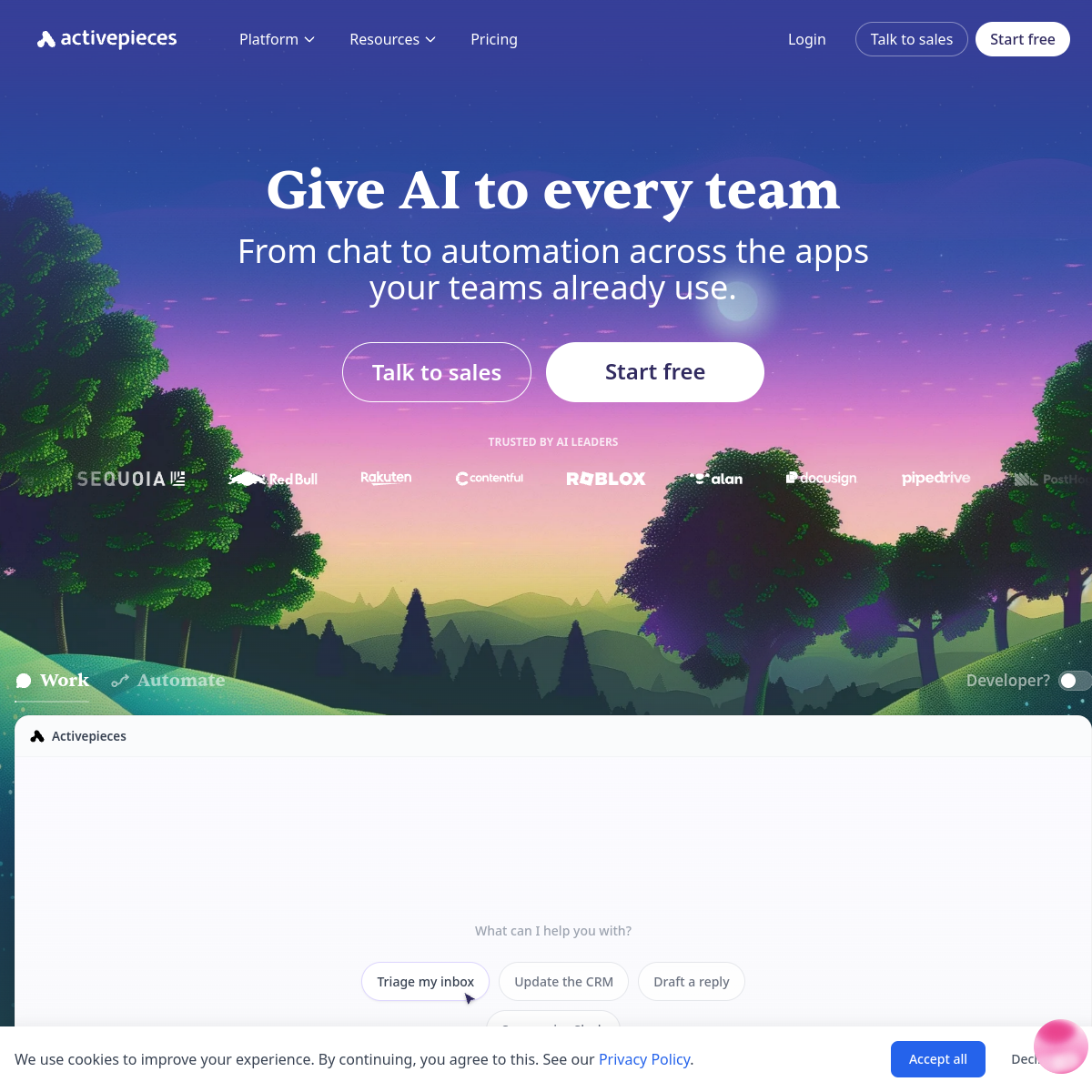
Activepieces is an AI agent and workflow automation platform for business teams and IT teams. It is officially positioned as "AI-first automation for every team" and also provides a cloud version, open source self-hosting path and MCP connection capabilities.
Activepieces
Core parameters and statistics
Activepieces is an AI-first automation platform for every team, officially positioned as "AI-first automation for every team". It integrates four capability lines of visual workflow, AI Agent orchestration, MCP connection and self-hosted deployment in the same product. The target customer group directly covers HR, finance, marketing, sales and IT.
| Projects | Public Information |
|---|---|
| Official positioning | AI-first automation for every team |
| Automation forms | AI workflows, AI agents, MCP servers |
| Deployment path | Cloud hosting Self-host, open source self-hosting |
| Connect Ecosystem | Official Warehouse Description “~400 MCP servers for AI agents” |
| Open source license | GitHub public repository, open source can be self-hosted |
| Community size | About 22,605 stars, 3,755 forks |
| Latest version | 0.85.0 (2026-06-04, GitHub Releases) |
| Support Platform | Web, API |
Deployment forms: Activepieces provides both cloud hosting and open source self-hosting. Teams with high data compliance requirements can first use the cloud to verify the experience, and then migrate to self-hosting according to data sovereignty requirements.
Ecological Density: The official warehouse description discloses "~400 MCP servers", indicating that its value is not only in process orchestration, but also in quickly encapsulating external systems and internal capabilities into reusable interfaces.
Iteration rhythm: GitHub Releases shows that the 0.85.0 official version and multiple 0.82.1 candidate versions were released on the same day on 2026-06-04, indicating that the project is still in the high-frequency iteration stage.
User and market recognition
The market's recognition of Activepieces comes mainly from the open source community and cross-department positioning, rather than public revenue or customer numbers (the latter is not officially disclosed).
Community Popularity: GitHub API shows about 22,605 stars and 3,755 forks at the current time, indicating that it has passed the early experimental stage and formed a stable connector and template contribution ecosystem, and problem feedback and repairs have certain external verification.
Target customer group: The official list of HR, finance, marketing, sales and IT is directly listed as the target team, which shows that its design goal is to automate the middle platform across departments, rather than a single developer tool.
Prerequisites: For platform-based automation to truly realize its value, it usually requires the team to have accumulated reusable process assets (approval, lead distribution, content production, work order synchronization), and the IT team is willing to centralize permissions, auditing and connector management on one platform.
Cost advantage
The cost advantage of Activepieces is not the absolute low price, but the fact that it puts open source self-hosting and commercial cloud into the same product path, leaving room for the team to "first verify for free, and then upgrade on demand".
Free and Open Source: The Free plan appears publicly on the pricing page, and the warehouse provides Open Source and Self-host paths. For teams with existing operation and maintenance capabilities, self-hosting is usually the lowest explicit subscription cost solution, but it will translate into infrastructure and maintenance costs.
Business and Enterprise: Pro, Enterprise, Contact sales, Book a demo and other entrances appear publicly on the pricing page, covering the complete path from paid subscription to enterprise sales.
True cost structure: For automation platforms, subscription fees are often not the biggest factor. What really affects the total cost is the connector management LLM call fee and the cost of internal process changes. Therefore, when evaluating benefits, you should also measure the time it takes to build a single process, the rate of manual intervention after going online, and the human investment required to integrate with existing systems.
Main functions
Activepieces’ capabilities are designed around “unifying cross-department automated AI and connection governance into one platform”, and its public capabilities can be summarized into five categories:
- Visual workflow orchestration: Decompose business actions into triggers, conditions, execution and notification links, suitable for maintenance by non-R&D roles.
- AI Agent and AI Workflow: Embed LLM inference into existing processes instead of isolating AI into a chat box.
- MCP Server Connection: Turn external systems and internal capabilities into reusable interfaces to reduce repeated integration.
- Self-hosting and open source deployment: Easy to implement in data security and network isolation scenarios.
- Cross-team adaptation: Officially covering HR, finance, marketing, sales and IT, suitable for unified platform management.
The actual effect of platform capabilities depends on three key points: whether key systems have mature connectors, whether exception handling can fall into the audit link, and whether AI nodes can be understood and maintained by non-R&D roles.
Model and version evolution
Continuous iterative updates, the latest version introduces performance optimization and new features. Historical version information can be viewed on the official release page. There is no complete public version evolution timeline yet. It is recommended to pay attention to the official announcement to understand the rhythm of feature updates.
Technical advantages
The technical advantage of Activepieces comes from "platform unity" rather than the performance of a single model. The core can be broken down into three points:
Unified architecture: Put the workflow engine AI node MCP server and deployment path on the same product side. The business side does not need to switch between multiple sets of tools, and the IT side does not need to manage script agents and connectors separately.
Connector reuse: When connected in series across systems, MCP and connectors can reduce repeated integration, and the new system integration cycle is more controllable.
Self-hosted data plane: In scenarios with high compliance requirements, the self-hosted path allows enterprises to control the data plane internally first, and then gradually decide which capabilities should be moved to the cloud.
The price of this architecture is: the more complete the platform, the higher the requirements for governance, monitoring and execution stability. Therefore, it is more suitable for teams with platform requirements, rather than scenarios that only want to make one-time scripts.
How to use
Activepieces provides two entrances, cloud and self-hosted, suitable for teams with different needs:
| How to use | Suitable for the crowd | Features | Cost |
|---|---|---|---|
| Cloud version | Teams who want quick verification | No installation required, priority checking of permissions, quotas and execution statistics | Free plan included |
| Self-hosted/open source | Teams with high data boundary requirements | Deploy internal environment first, and then connect to high-value processes | Infrastructure + operation and maintenance manpower |
| Enterprise solutions | Scale and compliance implementation | Business confirmation required SSO, auditing and private deployment | Business confirmation required |
The actual implementation is usually promoted by "pilot → comparison → expansion": first select 1 or 2 highly repetitive, low-risk processes (such as lead synchronization, work order routing) and run them through, then compare them with the old processes in parallel, and finally gradually integrate MCP, AI nodes and more departmental processes. In the first week, connector availability and failure retry strategies must be clearly tested, otherwise subsequent expansion will be slowed down by basic management.
Product Pricing
The pricing model is subject to the official real-time page. Usually a freemium or subscription system is used, and basic functions can be used for free. Advanced functions or high-frequency use require paid subscriptions, and users are advised to evaluate the optimal solution based on actual usage.
Application scenarios
Activepieces’ implementation scenarios focus on cross-system, standardizable digital processes:
- Sales and Marketing Automation: Lead distribution, form storage, and email-triggered CRM synchronization. The benefits are reflected in the reduction of manual transcription and shortened response time.
- Operation and customer service process: Work order diversion, knowledge base retrieval AI preliminary screening, need to pay attention to AI node misjudgment rate and manual rollback audit.
- Internal IT Automation: Cross-SaaS synchronization, alert routing, approval orchestration, suitable for leveraging the advantages of MCP and self-hosted paths.
Applicable people
Activepieces’ polymorphic strategy serves three types of roles:
- IT and platform team: It is necessary to unify the automation capabilities of multiple departments and pay attention to permission governance, auditing and access reuse.
- Business Operations Team: A low-code approach is needed to standardize daily repetitive processes.
- Head of Product and Automation: Hope to embed AI nodes into existing business processes instead of building a new system.
Scenarios that are less suitable are: the team only needs individual-level script automation, has no unified governance requirements, or even process standardization has not yet been completed. In these scenarios, platform capabilities will bring additional learning and governance costs.
Summary and Outlook
The core value of Activepieces is to unify AI automation Agent, MCP and self-hosted governance into one platform. It is not the “lightest” automation tool, but it is more practical for organizations that already have cross-departmental process needs and want to incorporate AI into formal operations. Its high-frequency iterations and active MCP connection ecosystem give it the potential for continuous evolution in its positioning as an automated middle platform.
If you want to implement it, it is recommended to use the cloud Free solution to conduct a small-scale pilot on 1 to 2 high-value processes to verify the construction efficiency and the reduction in manual intervention, and then decide whether to expand to enterprise-level deployment; before enterprise procurement, you still need to focus on confirming the execution volume billing SSO and auditing, self-hosted business terms, and the stability of the latest version on the enterprise connector.
Related tools:  CrewAI,
  LangChain
Version evolution of Activepieces
Activepieces is still in the high-frequency iteration stage. GitHub Releases publicly shows that the 0.85.0 official version and multiple 0.82.1 candidate versions appeared on the same day on 2026-06-04, indicating that the team maintains intensive delivery between mainline release and candidate verification.
Mainline release
- 0.85.0 (2026-06-04): The latest officially verifiable release, which is the baseline version for deployment evaluation.
Candidate Verification
- 0.82.1-rc.3 (2026-06-04): Candidate version, reflecting the pace of regressions and fixes before release.
- 0.82.1-rc.1 (2026-06-04): Early node of the candidate version, reflecting its version stability verification process.
Since the mainline and candidate versions are frequently parallel, it is more suitable for production to first fix an official version for closure evaluation, and then verify the connector compatibility and AI node output stability in staging, rather than directly following each update.
Version Info
- Activepieces 0.85.0 :The latest version disclosed on the GitHub release page continues to iterate along the main lines of AI Agent, MCP server and automated workflow platform.
- Activepieces 0.82.1 RC 3 :The release candidate version shows that the official continues to promote mainline release verification and regression correction on the same day.
- Activepieces 0.82.1 RC 1 :An early version of the release candidate is used to complete the repair and acceptance of key issues before the official version.
User Reviews