 Add To Cart AI
Free
Add To Cart AI
Free
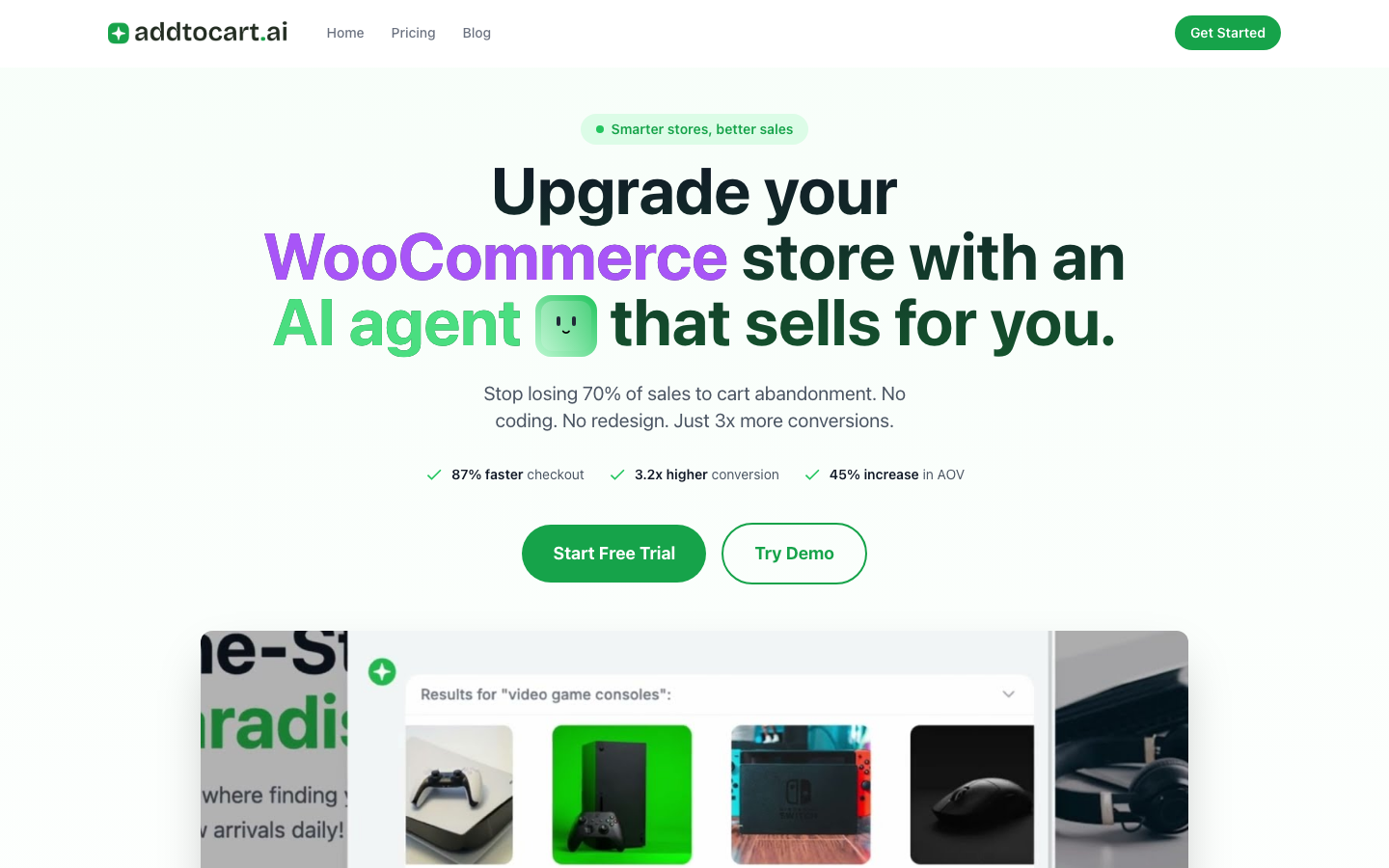
Add To Cart AI is an AI shopping assistant for WooCommerce merchants that supports text, voice, and image multi-modal input to understand shopping intentions and fill the shopping cart with one click. Merchants deploy the WooCommerce plugin in 15 minutes, and consumers don’t need to register to use it. Four levels of pricing are available: Starter/Growth/Professional/Enterprise, with a 14-day free trial.
Add To Cart AI
Core parameters and statistics of Add To Cart AI
| Parameters | Official verifiable information |
|---|---|
| Product positioning | AI-powered shopping assistant for WooCommerce merchants (AI-powered shopping assistant for WooCommerce) |
| Delivery form | WooCommerce plug-in + embedded Widget (no installation required on the consumer side) |
| Input method | Text, voice, image |
| Core Technology | Generative AI, Semantic Search (Semantic Search) |
| Supported platforms | WooCommerce (current); Shopify, Magento (planned); BigCommerce, Salesforce Commerce Cloud (2025 roadmap) |
| Merchant integration | WooCommerce plug-in installation → Synchronize product catalog → Available online |
| Deployment time | Official claim that "most merchants will be online within 15 minutes" |
| Compliance standards | GDPR, CCPA (encrypted transmission and storage RBAC permission control, no payment data storage) |
| Widget customization | Supports page switching, display language switching, color scheme adjustment, position and appearance configuration |
| Pricing model | Monthly subscription, Starter $49/month → Growth $149/month → Professional $499/month → Enterprise customization |
| Trial Policy | 14-day free trial, no credit card required |
| Developer Portal | No public API documentation yet; integration method is WooCommerce plug-in |
| Live demonstration | demo.addtocart.ai provides online experience |
Brief review in one sentence: Add To Cart AI is not a general-purpose chat robot, but solidifies the experience of "adding purchases by taking a photo/voice/pasting a list" into a WooCommerce native plug-in, allowing small and medium-sized e-commerce companies to develop zero-development access to AI shopping guide capabilities.
Users and market recognition of Add To Cart AI
B2B2C delivery model: The product has merchants as direct customers and consumers as indirect users. After the merchant installs the WooCommerce plug-in, consumers can use the AI assistant directly on the product page without additional registration or downloading.
Market stage: Judging from the information on the official website, the product is in the early commercialization stage. The website copyright is marked as 2025, and the brand's own blog, help center, and community forum are all marked "coming soon." The official has not disclosed specific customer cases, user volume or financing information, and market awareness is still accumulating.
Verifiable entrance: The product provides an online demonstration site demo.addtocart.ai, where potential customers can directly experience the AI shopping cart construction effect. In addition, a technical white paper ("Introducing Add To Cart AI: E-Commerce Shopping AI Agent") is provided for an in-depth understanding of the product architecture.
Social Media: The product is operated as @addtocartai on
Cost Advantages of Add To Cart AI
Hiered Pricing Structure: Parsed from the structured data on the product page and the pricing page, Add To Cart AI provides four clear subscription tiers, progressively based on message volume and functional scope.
| Tiers | Monthly Fees | Core Quotas | Key Feature Differences |
|---|---|---|---|
| Starter | $49/month | 1,000 conversations/month | Text + image input, basic AI shopping cart construction |
| Growth | $149/month | 10,000 conversations/month | Add semantic search, priority customer service, dedicated customer success manager |
| Professional | $499/month | Undisclosed (flexible) | Adds advanced analytics, additional integrations, higher quotas |
| Enterprise | Customized quotation | On-demand | Additional 24/7 phone support, quarterly optimization review, branded CSS override |
C-side/Consumer: Free. Consumers do not need to pay or create an account to use the AI shopping function on the e-commerce website where the assistant is embedded. This lowers the threshold for consumers to try and eliminates merchants' concerns about "charging users".
B-side/Merchant: Monthly subscription system, billed according to the volume of store messages. Starter costs $49 per month, for small WooCommerce stores with low monthly order volume; Growth costs $149 per month, for medium-sized merchants who require semantic search and prioritized customer service; Professional costs $499 per month, for high-traffic stores that require advanced analytics and additional integration capabilities; Enterprise offers customized quotes for large brands or complex needs. All tiers include core AI shopping cart functionality, with differences mainly reflected in quotas, search depth, analytical capabilities and service levels.
Hidden cost considerations:
- Platform locked: Currently only WooCommerce is supported. Migrating to other platforms requires waiting for the Shopify/Magento integration to be launched (in the roadmap, the specific time is not disclosed).
- Data dependence: The quality of AI recommendations is highly dependent on the completeness and annotation level of the product catalog - a product collection with confusing categories and missing specifications will directly affect the recall accuracy.
- Quota Management: Starter only has 1,000 monthly conversations. Stores whose monthly order volume exceeds this threshold need to upgrade their packages, otherwise the AI functions will be limited.
Main functions of Add To Cart AI
- Core Processing Capabilities: Provides core AI capabilities in relevant scenarios to support users to quickly complete tasks.
- Multi-modal interaction: supports text input and result output, and some scenes support image or file upload.
- Workflow Integration: Can be embedded into existing workflows or linked with other tools through APIs to reduce context switching.
Add To Cart AI model and version evolution
The product will be officially launched in early 2025 (copyright marked 2025), starting with the WooCommerce native AI shopping assistant. The current version is the 2025-07 iteration, and the main evolution is as follows:
Mainline release
- 2025-01 (online version): The product is publicly launched for the first time. The core capabilities are multi-modal input (text + voice + image) and basic AI shopping cart construction, and supports basic WooCommerce integration.
- 2025-07 (current version): Add semantic search, advanced analysis panel Widget appearance customization function (display language/color/location/page switch) on top of the basic capabilities. The pricing system is officially established as a four-tier monthly subscription system.
Candidate Verification
Clearly listed in the product roadmap:
- Shopify and Magento Integration – Hot on the heels of WooCommerce and currently in “Open for Pre-order Notification” status.
- BigCommerce and Salesforce Commerce Cloud - included in the 2025 roadmap, specific time will be subject to official announcement.
Version Note: The version evolution of Add To Cart AI reflects a clear "functional depth" path - first build a platform (WooCommerce basic version), then expand the input mode and search capabilities, then complete the analysis and customization capabilities, and finally expand horizontally to multiple e-commerce platforms. This rhythm is suitable for small and medium-sized merchants to verify the effect at a single point before deciding whether to roll it out across the entire platform.
Technical advantages of Add To Cart AI
Main type determination: Productivity/business-side application (Type D — AI e-commerce shopping assistant). The product is delivered in the form of a SaaS plug-in. The merchant side is configured with WooCommerce backend, and the consumer side is a front-end embedded widget. It is an end-to-end business application.
Semantic search instead of keyword matching: Traditional e-commerce search relies on word segmentation and inverted indexing. Consumers must enter accurate keywords to find the target product. Add To Cart AI uses Semantic Search to encode product descriptions and user queries into vectors respectively, and performs semantic-level matching in high-dimensional space. This means that the query "Find me a 32-inch 4K monitor with USB-C" can still match the correct SKU even if it does not contain the precise format of the word "monitor". Mechanically, this combines the three steps of "query understanding → product matching → result sorting" into one vector retrieval, which reduces the cost of rule maintenance.
Generative AI-driven recommendation explanation: AI not only returns the product list, but also explains "why this is recommended" in natural language. This explainability directly affects purchasing decisions in e-commerce scenarios - consumers are more inclined to buy products with "reasons" rather than black box recommendations. Generative AI also handles product Q&A, extracting snippets of information relevant to consumer questions from unstructured product descriptions and reviews and combining them into answers.
WooCommerce native plug-in architecture: Products are installed as WordPress WooCommerce plug-ins, using WooCommerce’s existing product data model (SKU, category, specifications, inventory status), without the need for additional database creation or data migration. The AI model runs in the cloud. The merchant only needs to install the plug-in and synchronize the product catalog. The front-end widget is embedded in the product page through JavaScript. This architecture has the lowest technical requirements for merchants - no AI or front-end development capabilities are required, and the installation process is three steps: install the plug-in → synchronize directories and rules → test the first AI shopping cart.
Quantification of cost reduction and efficiency improvement (deduction):
- Consumer side: In the weekly food purchasing scenario, traditional manual search and comparison takes about 20-30 minutes to complete the shopping cart, and AI inputs the list and generates it in seconds. The reference data of "saving more than 20 minutes per purchase" is given in the official FAQ.
- Merchant side: After accessing the AI shopping assistant, the time spent by the customer service team on answering repetitive inquiries such as "Is this product suitable for me?" "Which model is more suitable?" can be greatly reduced, and the released manpower can be diverted to high-value customer services.
- Operation side: The product recommendation logic is driven by AI semantic understanding. Merchants do not need to manually configure rules such as "buy again" and "similar recommendations", reducing operation and maintenance costs.
Human-machine collaboration boundary:
- 100% automated and organized: regular product query response, specification parameter Q&A, inventory matching, shopping cart filling. The accuracy of these measures is highly dependent on the completeness of the product catalog and the understanding accuracy of the AI model. Merchants should complete sufficient test dialogue verification before going online.
- It is recommended to set up manual confirmation points in a reasonable manner: recommendations for high-priced products (such as luxury goods, medical equipment), consultations involving after-sales policies, cross-store price comparisons, and scenarios where consumers clearly request "switch to manual". In the official support system, Growth and above packages provide a dedicated customer success manager, which can be used as a manual entry point. Merchants should ensure that the AI assistant's recommendation results are marked "AI generated suggestions are for reference only" and clearly distinguish between AI recommendations and manual recommendations before placing an order.
How to use Add To Cart AI
Deployment Quick Start (Merchant):
- Sign up for an Add To Cart AI account and start your 14-day free trial.
- Log in to the backend dashboard and follow the guided wizard to complete the three steps:
- Install the WooCommerce plugin (automatically installed in the WordPress backend or uploaded manually).
- Synchronize product catalog and matching rules (AI automatically learns product categories and specifications).
- Test the first AI shopping cart (verify recognition and matching quality on demo page).
- Configure the Widget appearance (display language, color, position, page switch).
- Go online. Official data states that most merchants complete the entire process within 15 minutes.
Consumer usage path:
When consumers browse products in a WooCommerce store embedded with Add To Cart AI, the page will automatically display the AI shopping assistant widget. Consumers can directly in the conversation window:
- Enter text: Paste your shopping list or describe your needs in natural language.
- Upload pictures: Take a photo or upload a photo of the product, and AI will identify and match similar inventory products.
- Voice input: Speak the type or specification of the product you want to buy.
AI gradually narrows down the recommendation scope during the conversation, and the final consumer adds it to the shopping cart with one click after confirmation.
Existing Integration Platform:
| Entrance | Description |
|---|---|
| WooCommerce | Currently the only supported e-commerce platform, providing native plug-ins |
| Shopify | In the roadmap, online appointment notification is currently available |
| Magento | In the roadmap, online appointment notification is currently available |
| BigCommerce / Salesforce Commerce Cloud | Official Roadmap 2025 Goals |
Online experience: demo.addtocart.ai provides an AI shopping experience in a simulated store, and you can try it out without registration.
Product Pricing for Add To Cart AI
Add To Cart AI adopts a monthly subscription system, with tiered pricing based on the volume of conversation messages. All plans include core AI shopping cart building capabilities, and differ primarily in quotas, search depth, analytical capabilities, and service levels.
| Package | Monthly fee | Monthly message volume | Core capabilities | Technical support |
|---|---|---|---|---|
| Starter | $49 | 1,000 items | AI shopping cart construction, text + image input | Knowledge base + email support |
| Growth | $149 | 10,000 items | Starter + semantic search, priority support | Live chat + dedicated success manager |
| Professional | $499 | Flexible quota | Growth + advanced analytics, additional integrations | Live chat + dedicated success manager |
| Enterprise | Customized quote | On demand | Professional All + 24/7 phone support, quarterly optimization review, branded CSS override | 24/7 phone support |
Free Trial: All packages offer a 14-day free trial, no credit card required. After the trial period ends, you need to choose a paid package to continue using it.
Payment and Contract: Starter and Growth support monthly payment; Professional and Enterprise recommend annual contract (specifically, please refer to the official quotation). Enterprise packages require contacting the sales team for custom quotes and capacity configuration.
Hidden Fees: After the Starter package exceeds 1,000 items/month, the AI function may be limited (the handling of quota exceeding shall be subject to the official real-time policy). Currently, only the WooCommerce platform is supported. If you need cross-platform access, you need to wait for subsequent integration to be launched.
Add To Cart AI application scenarios
- Fashion Clothing E-commerce: Consumers upload a reference outfit photo, and AI recognizes the clothing style, color and style in the picture, matches similar items in the store inventory and combines them into a shopping cart. For fashion stores with many SKUs and frequent style updates, AI can assume the role of "virtual matchmaker" and reduce the time consumers spend on jumping between single product pages.
- Food and Fresh Procurement: Consumers directly paste a weekly purchase list (such as "a dozen eggs, 2L fresh milk, 1kg tomatoes, a bag of sliced bread"), and AI automatically matches the specific SKU and adds it to the shopping cart in batches. The official FAQ figures say it saves more than 20 minutes each time. This scenario requires high matching accuracy - the AI needs to understand "a dozen" vs "12", the replacement logic of different brand specifications, etc.
- Electronic products and digital accessories: Consumers describe product specifications (such as "32-inch 4K monitor, with USB-C interface, budget within 3,000"), AI performs multi-condition semantic matching in the product catalog, and returns options that meet the specifications with recommendation reasons. This scenario tests the AI’s structured understanding of specification parameters.
- Cross-border and multi-language e-commerce: Currently supports English interface, and will cover more language scenarios after subsequent platform expansion. Consumers can express their needs in their own language (or mixed input), and AI automatically matches the product inventory in the target market.
- Official brand website: The brand integrates AI assistants in its self-operated WooCommerce stores to provide a "one-on-one virtual shopping guide" experience, reducing bounce rates and increasing unit prices. Brands can customize the Widget's appearance and reply tone to keep the brand's tone consistent.
Scenario Suitability Tip: The premise for the above scenario to be established is that the product catalog has sufficiently structured specification data. For handmade artworks, non-standard customized products, or a large number of SKU collections without specification descriptions, the matching accuracy of AI will drop significantly. At this time, manual shopping guides are more needed than pure AI solutions.
Applicable groups of Add To Cart AI
- WooCommerce Merchant: Use groups directly. After installing the plug-in, you can add AI shopping guide capabilities to your store. It is suitable for small and medium-sized e-commerce stores with monthly orders ranging from hundreds to thousands, especially clothing/home/digital categories with a large number of product SKUs that require intelligent matching recommendations. Merchants do not need to have an AI technology background, and deployment can be completed in 15 minutes.
- E-commerce Operations and Growth Team: Operations staff responsible for optimizing shopping experience and conversion rate. The AI assistant can undertake repetitive product questions and answers, personalized recommendations and shopping cart guidance, reducing customer service pressure. At the same time, it can obtain consumer demand hotspot data through the background analysis panel to assist product selection and marketing decisions.
- Brand e-commerce manager: A manager who pays attention to the conversion efficiency of brand independent stations. The AI assistant's brand customization capabilities (customized tone/color/CSS) allow it to be deeply integrated with the brand image, making it suitable for medium and large brands that use the brand's official website as their core sales channel.
- E-commerce platform development and integrator: After the integration of Shopify/Magento and other platforms in the future, e-commerce system integrators can recommend Add To Cart AI to customers as a value-added component to expand the scope of services.
- Independent website building service provider: Provides AI enhanced services to merchants who use WooCommerce to build websites, which can be packaged in website building plans as an added-value selling point.
Not applicable to the crowd:
- Merchant on non-WooCommerce platform (Shopify/Magento integration is not officially live yet).
- For stores with unstructured product catalogs and lack of specification parameters (handmade products, non-standard customization categories), the AI matching effect is difficult to guarantee.
- For industries that have strict compliance review requirements for AI recommendation results (such as medical devices, prescription drugs, financial products), it is recommended to consider adopting it after the manual review mechanism is improved.
- Enterprises that require complete offline deployment or localized data storage (the product is cloud SaaS, no private deployment plan is disclosed).
Summary and Outlook of Add To Cart AI
Core Competency: Add To Cart AI encapsulates the link "multimodal input → semantic understanding → automatic purchase" as a WooCommerce native plug-in, allowing small and medium-sized e-commerce companies to access AI shopping guide capabilities at zero development cost. Compared with building a recommendation system from scratch or accessing a general large model API, its core value lies in "scenario solidification" - it does not require merchants to understand vector retrieval prompt engineering or model tuning, and it can be online after installing a plug-in.
Current Limitations and Uncertainties:
- Single platform: Currently only WooCommerce is supported, and wider e-commerce ecosystem integration such as Shopify/Magento is still on the roadmap and will not be covered until 2025 at the earliest. The specific time is subject to the official announcement.
- Product maturity and market verification: The official website blog, help center, and case library are all in "coming online" status, and lack verifiable large-scale customer cases and buyer feedback. For enterprise buyers who pursue stability and reliability, it is recommended to fully verify through the 14-day free trial and demo station.
- Uncertainty in the quality of AI recommendations: product identification and matching accuracy are highly dependent on the degree of structuring of the product catalog. No benchmark data has been published on performance in categories that lack specification parameters or complex visual scenes (multiple products in the same frame, low light).
- Incomplete documentation and developer ecosystem: Currently there is no public API documentation SDK or developer guide, the embedding method is limited to WooCommerce plug-in, and the space for customization is limited.
Procurement/Adoption Risk Assessment:
- For small and medium-sized WooCommerce merchants with a strong willingness to try, the recommended strategy is: use the 14-day free trial to open the Starter package, first verify the AI matching quality on non-core categories or limited products (it is recommended to prepare 50-100 test product SKUs, covering the main categories), and observe the AI recommendation accuracy and the actual purchase conversion rate of consumers. Once you are satisfied, upgrade to the Growth package and expand to the full category.
- For medium and large brands or merchants with high requirements for platform stability, it is recommended to consider adopting it after the following conditions are met: Shopify/Magento integration is officially launched, the product's enterprise security certification (such as SOC 2) information is disclosed, and there are publicly available customer cases of brands of the same size that can be checked.
- In terms of data compliance, the product clearly states that it complies with GDPR and CCPA standards, data transmission and storage are encrypted, and consumer payment data is not stored. Merchants still need to review the privacy policy and data processing agreement of the product themselves to ensure that they are consistent with regulatory requirements in their region.
Related tools:  CrewAI,
  LangChain
How to use Add To Cart AI
- Web client: You can use it by visiting the official website and registering an account. Most functions do not require installation.
- API Access: Provides RESTful API, developers can obtain the API Key and integrate it into their own applications.
Version Info
- Add To Cart AI current :The current version supports text/voice/image multi-modal input, AI shopping cart construction, semantic search, intelligent Q&A, WooCommerce plug-in integration, Widget appearance customization (display language, color scheme, page switch), and merchant backend analysis dashboard. Four levels of pricing are available: Starter/Growth/Professional/Enterprise, with a 14-day free trial.
- Add To Cart AI launch :The product is online. Its core functions are AI e-commerce shopping assistant and multi-modal interaction, and supports basic WooCommerce integration.
User Reviews