 AdStage
AdStage focuses on cross-platform advertising data aggregation and analysis, supports more than ten advertising channels such as Google Ads, LinkedIn Ads, Facebook Ads, etc., and provides unified reports and AI-driven performance insights.
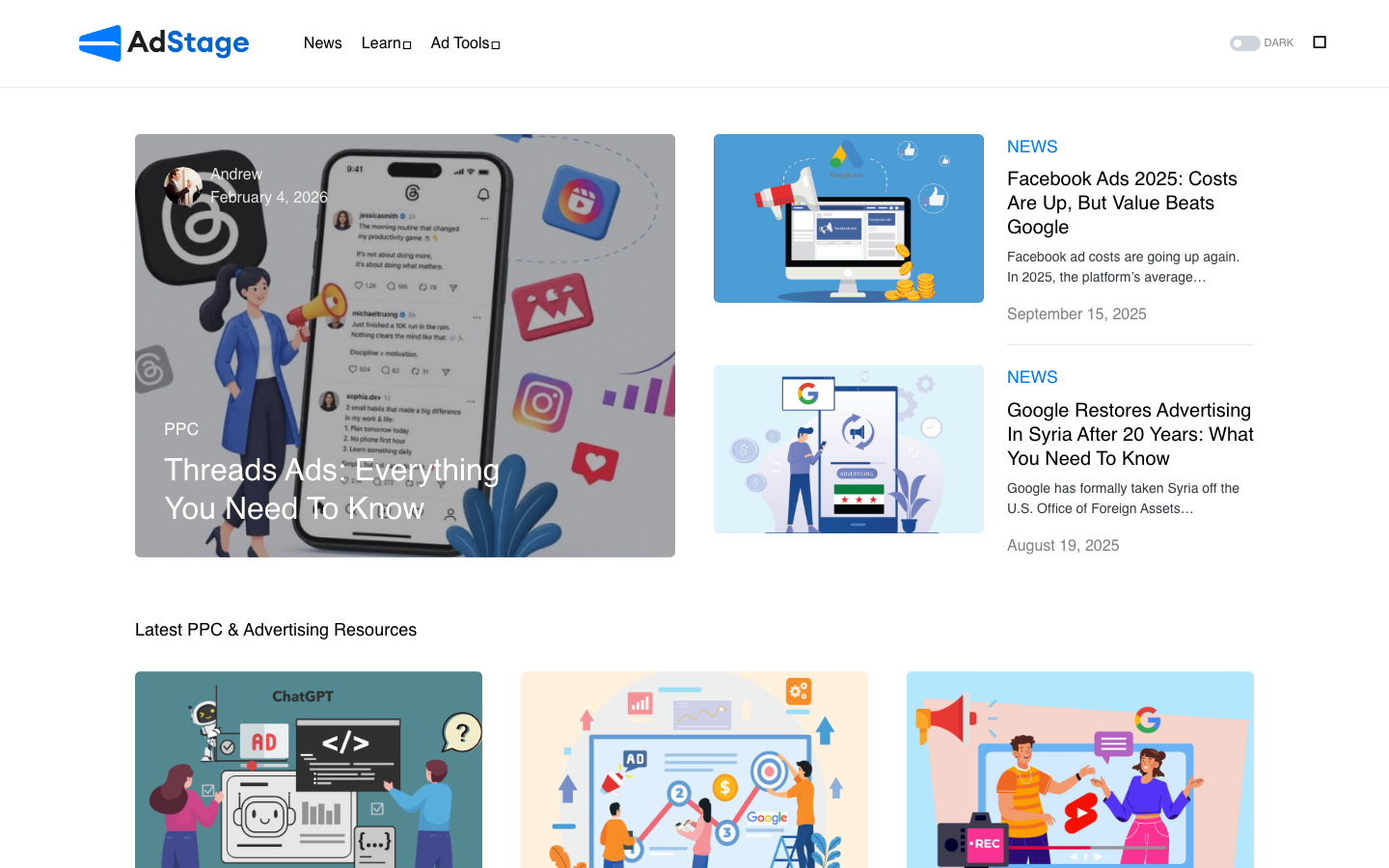
AdStage
Core parameters and statistics of AdStage
AdStage is positioned as a cross-platform advertising reporting and analysis platform. Its core value lies in aggregating delivery data scattered across multiple advertising backgrounds into a unified view, eliminating the duplication of labor and caliber differences in manual aggregation. It is not an advertising optimization execution tool (no bid adjustments, no creative management), but a mid-level data product for marketing analysis teams.
| Parameters | Public information |
|---|---|
| Product positioning | Cross-platform advertising reporting and analysis platform |
| Target users | Marketing analysis team, advertising operations, agencies |
| Support advertising channels | Google Ads, Facebook Ads, LinkedIn Ads, Twitter Ads, etc. more than ten |
| Core delivery form | SaaS web client |
| Home | US |
| Official pricing model | Paid subscription (tiered by number of data sources) |
| Data refresh method | API automatic pull, regular synchronization |
| AI capabilities | Anomaly detection, natural language insight output |
| Report delivery method | Web billboard, scheduled email sending, Slack integration |
Positioning boundaries: AdStage does not solve the execution layer problem of "how to deliver ads more effectively", but solves the aggregation layer problem of "how to uniformly view and analyze delivery effect data". Data aggregation capabilities are its core barrier and the key difference from general analysis tools such as Google Analytics and Tableau.
The value of channel coverage: Supports more than ten mainstream platforms such as Google Ads, Facebook Ads, and LinkedIn Ads. Each time a channel connector is added, one manual login and export operation is reduced. The time savings for a team managing 5+ channels is exponential.
Positioning of AI capabilities: AI insights focus on anomaly detection and natural language interpretation, non-generative advertising creativity or automatic bidding, and are more suitable for "post-facto analysis" scenarios.
User and market recognition of AdStage
AdStage's market data (number of users, revenue, financing rounds) is not fully disclosed on the public page. The following information is synthesized from the product page, industry channels and public reports.
Target customer group portrait: Product pages and content strategies clearly point to digital advertising operators. The official website blog continues to track the policy updates of each platform, and the core audience is PPC advertising operation practitioners. Typical pain points: Switching and exporting reports between 3-6 advertising backgrounds every day, and then manually merging them using Excel, which takes 1-2 hours/day. AdStage directly corresponds to this scenario.
Industry competition landscape: There are multiple competing products in the field of cross-platform advertising reporting:
| Comparative Dimensions | AdStage | Supermetrics | Funnel.io | Improvado |
|---|---|---|---|---|
| Core form | Independent SaaS reporting platform | Data connector (Google Sheets/Data Studio plug-in) | Data pipeline + visualization | Enterprise-level marketing data middle platform |
| Channel coverage | 10+ advertising platforms | 70+ data sources | 50+ data sources | 200+ data sources |
| AI capabilities | Anomaly detection + natural language insights | No native AI | Built-in AI insights | Custom ML models |
| Target customers | Small and medium-sized marketing teams | Individuals to medium-sized teams | Medium-sized to large teams | Large enterprises |
| Deployment Method | SaaS | SaaS/Plugins | SaaS | SaaS/Private |
| Public pricing | Tiered subscription (undisclosed price) | Monthly payment based on the number of data sources | Billing based on usage | Annual contract quotation |
Market Recognition Signal: AdStage has certain brand recognition in the PPC practitioner community, but its market coverage is not as good as Supermetrics and Funnel.io, and it is more suitable for medium-sized marketing teams.
Side verification of content strategy: The official website takes blog/news content as its core operation direction, implying that the product may have entered a maintenance period rather than a radical growth period.
Cost Advantages of AdStage
AdStage's cost structure needs to be dismantled from the three levels of C-end individuals, teams/agencies, and enterprises, and at the same time, a horizontal comparison with its competing products can make decision-making meaningful.
C-side/individual users: AdStage does not publicly provide free plans or independent subscriptions for individuals. Individual advertising operators (such as freelance PPC specialists) are more suitable to use the reporting functions provided by each advertising platform, or pull data into Google Sheets through Supermetrics for light analysis. The value of AdStage only starts to show when you manage more than 3 ad accounts.
Team/Agency (Core Audience):
| Cost Items | AdStage | Alternatives (Manual Aggregation) |
|---|---|---|
| Monthly subscription fee | Undisclosed (stratified by number of data sources) | $0 (labor cost only) |
| Manpower investment | Automatically run after a single report configuration | 1-2 hours a day for manual export + merge |
| Average monthly hidden expenses | API quotas, integration maintenance | Cross-team communication costs, data caliber proofreading |
| Error rate | Low (machine aggregation) | Medium-high (manual copy errors) |
Cost Reduction and Efficiency Increase Deduction: Taking a 3-person marketing team that manages 5 advertising channels as an example, each person spends about 1.5 hours a day on report summary in manual mode, and the average monthly total time is about 90 hours. After the introduction of AdStage, daily reporting time approaches zero after the configuration period (approximately 2-3 days) is invested, and only 15 minutes per week are needed to check data integrity. The average monthly reporting hours can be reduced from 90 hours to about 1 hour, but a subscription fee is required - The core decision is the trade-off between "spending labor or spending money".
Enterprise/Agency: The enterprise version provides exclusive data integration API direct connection and customized signboards, but the price needs to be confirmed by contacting sales. Considering competing products (for example, the annual fee for Funnel.io Enterprise Edition is usually in the $15,000-$50,000 range), AdStage's pricing is likely to be in the same range or slightly lower. Enterprises need to confirm the following before purchasing:
- Whether to support SSO/SAML unified login
- Data storage area and compliance commitment (SOC2, GDPR)
- API call frequency and data refresh SLA
- Does White-label support agency brand exposure?
Hidden cost considerations: The hidden cost of AdStage is not in the software itself, but in "data connector maintenance" and "channel coverage limitations". When an advertising platform updates its API and causes connection interruption, the repair time depends on the technical response speed of AdStage; if you need to access advertising channels that are not covered by it, you must either wait for official support or build a new data pipeline - this additional cost needs to be included in the evaluation when selecting.
Main features of AdStage
The functional system is designed around the three-layer link of "data aggregation → visualization → insight".
Cross-platform data aggregation (data layer)
- API Automatic Pull: Automatically obtain core indicators such as impressions, clicks, costs, conversions CPA, ROAS, etc. through the official API of each advertising platform, eliminating the duplication of manual login to the backend to export one by one.
- Unified Data Model: There are differences in indicator names and data calibers between different platforms (such as Facebook's "reach" and Google Ads' "impressions"). AdStage maps them to a unified semantic layer to ensure consistent calibers when comparing across channels.
- Scheduled incremental synchronization: Supports setting the data refresh frequency by hour/day/week to ensure that the dashboard data is always close to real-time.
[Expert View] Internal and external collaboration of the data layer: Data aggregation itself is not a core competitiveness. The real difference is in the accuracy of data mapping and responsiveness of connector maintenance. These two dimensions should be confirmed through trials when selecting.
Custom reports and dashboards (visualization layer)
- Drag-and-drop report editor: Generate customized analysis views by channel, time range, and dimension combinations (device type, region, campaign) without SQL or coding skills.
- Multi-dimensional cross-analysis: Supports overlaying data slices of multiple dimensions in the same report, such as viewing CPA change trends "by channel × time × device type".
- Automatically send at scheduled times: Reports can be set to be automatically generated daily/weekly/monthly and pushed to designated recipients via email or Slack, replacing the fixed process of manual PPT production.
[Expert View] The real benefits of report automation: Scheduled automatic sending is one of the most valuable modules in actual work. It compresses analysis report production from "several hours of manual editing" to "zero operations after one configuration", and managers "can grasp the full effect without looking at the background."
AI effect insight (intelligent layer)
- Automatic anomaly detection: Based on the historical data baseline model, automatically identify changes such as sudden increases in spending, sudden drops in conversion rates, and abnormal increases in CPA, and present them in the form of highlights or marks in the dashboard.
- Natural language analysis conclusion: Generate readable analysis text for detected anomalies, such as "The CPA of the Google Ads search series has increased by 23% in the past 7 days, mainly affected by the increase in brand word bidding costs" to help operators with non-data backgrounds quickly understand the problem.
- Focus Recommendation: AI recommends campaigns or channels that need priority based on data distribution, assisting operators in deciding the optimization priority for the day.
[Expert View] The Boundary of AI Capabilities: AI is currently stuck in the "detection + description" stage and has not yet entered "diagnosis + action recommendations". AI flags anomalies → humans diagnose the cause → manually perform optimization instead of AI replacing humans.
Advertising Attribution Assistance (Analysis Layer)
- Multi-channel conversion path analysis: Track the user's complete path from the first contact with the ad to the final conversion, and identify the reach contribution of each channel in the conversion funnel (first click, assist click, and last click).
- Budget allocation data support: Attribution analysis results can be used to determine the true ROI of each channel and assist in budget reallocation decisions among different channels.
Limitations of Attribution: Attribution analysis is limited by each platform’s own attribution model (Last Click, Linear, etc.). The "last mile" of cross-device attribution cannot be solved through APIs alone, and attribution reports are more suitable for trend reference.
AdStage version evolution
AdStage is not a typical iterative product with large version numbers (such as v1.0 → v2.0). Instead, it operates in a SaaS continuous delivery model, and feature updates are gradually pushed to all users. The following version information is based on publicly available information. The precise version date is subject to the official real-time page.
Public version context
| Version identification | Approximate date | Major changes |
|---|---|---|
| 2026.07 | ~2026-07 | Continuously updating data connectors and AI analysis capabilities, the latest verifiable release node |
| 2026.01 | ~2026-01 | Optimize cross-platform reporting engine and data integration capabilities |
| 2025 Series | ~2025 | Multiple data connector updates to expand support for emerging channels such as TikTok Ads |
| 2024 Series | ~2024 | Introducing AI anomaly detection and natural language insight functions, upgrading from a pure reporting tool to an intelligent analysis platform |
| 2023 and earlier | ~2023 ago | Early version, focusing on cross-platform data aggregation and basic reporting capability building |
Evolution logic: AdStage presents the characteristics of "first do connector breadth, then do analysis depth". Early (before 2023) core investment in data connector coverage; the introduction of AI capabilities from 2024 marks the transformation from "data aggregation tools" to "intelligent analysis platforms" - when data aggregation becomes standard, differentiation turns to "whether actionable insights can be extracted from data."
Iterative status quo judgment: The official website focuses on blog/news content as its main operation direction, and the product may have entered a maintenance period with stable functions. Existing features are highly mature, but new features may be introduced at a slower pace. The selection should be based on the current functional version and should not rely on the "coming soon" functional roadmap.
AdStage’s technical advantages
AdStage's technical advantage lies not in "what cutting-edge algorithms are used", but in "how to solve engineering problems in cross-platform data aggregation". The following dismantles its technical mechanism from three levels: data pipeline, indicator standardization, and anomaly detection.
Data Pipelines: Engineering Challenges of API Aggregation
The primary technical problem faced by cross-platform data aggregation is that the APIs of each advertising platform are very different - different authentication methods (OAuth 2.0 vs API Key vs Token), different data models (Google Ads uses a three-tier structure of Campaign/AdGroup/Ad, Facebook Ads uses a three-tier structure of Campaign/Ad Set/Ad but completely different field names), and different frequency control limits (number of requests per minute, daily data volume limit).
Mechanism: AdStage has built an adapter architecture. Each advertising platform corresponds to an independent connector module to handle authentication, request scheduling, data pulling and error retry. The upper layer maps heterogeneous data with a standardized data model.
Effect: Users see that all channels present data with consistent field names and time granularity, without having to care about underlying API differences. Single-platform API changes only require updating the corresponding connector module.
Applicable scenarios: The advantages are most obvious in scenarios with a large number of channels and frequent changes. AdStage's centralized processing model significantly reduces integration complexity when managing more than 5 channels.
Indicator standardization: eliminate the error of "same words with different synonyms"
The calculation logic of the same indicator on different advertising platforms may be completely different. For example, the Click-Through Rate of Google Ads is the number of clicks/the number of impressions, while the denominator of Facebook's CTR may be "number of exposures" rather than "number of impressions". Direct splicing will lead to distortion of analytical conclusions.
Mechanism: AdStage maintains a set of indicator mapping rule libraries, clearly records the calculation caliber of each platform's original indicators, and makes necessary calibrations during the standardization process. For example, Facebook's "impressions" (calculated by the number of impressions) are adjusted to a comparable level with Google Ads' "impressions" (calculated by the number of impressions) through a coefficient.
Effectiveness: Cross-channel comparison reports have more reference value and reduce "wrong conclusions caused by different calibers". However, it should be noted that this calibration itself is based on empirical estimates and cannot be 100% accurate. When selecting, you should confirm whether AdStage has publicly disclosed the specific rules for indicator mapping and whether it supports user-defined mapping (to adapt to the special caliber needs of specific industries).
Anomaly detection: from "data aggregation" to "intelligent early warning"
Mechanism: The AI anomaly detection module establishes a baseline model for each channel/campaign based on historical data, and identifies data points that deviate from the baseline through time series analysis (such as moving average, seasonal decomposition). After anomalies are detected, readable analytical text is output through pre-trained natural language generation templates.
Effect: Advance the time of "data anomaly discovery" from "accidental discovery during manual inspection" to "automatic discovery within the first data refresh cycle after the abnormality occurs". For large accounts (thousands of campaigns), manual inspection cannot cover all campaigns every day, and AI detection makes up for this blind spot.
Applicable scenarios: Most suitable for accounts with large budgets and large number of advertising campaigns - the amount of data is sufficient to establish a baseline, and a single abnormality will cause large financial losses. Fluctuations in small-budget accounts are prone to false alarms, and the value of AI detection is relatively low.
How to use AdStage
The AdStage usage process is divided into four stages: account registration, data source connection, report configuration and insight viewing, all completed through the web interface without the need for local installation or code deployment.
Usage steps
-
Register AdStage account: Visit the official website, choose a payment plan and create an account. There is currently no public free trial entrance, please refer to the official page for specific business procedures.
-
Authorized Advertising Platform Connection: Select the advertising channels to be connected (Google Ads, Facebook Ads, LinkedIn Ads, etc.) in the AdStage backend, and authorize AdStage to read advertising data through the OAuth process. Only one authorization is required for each channel, and subsequent data will be automatically synchronized.
-
Configure data view: Select the advertising account, time range and core indicators (spending, impressions, clicks, conversion CPA, ROAS, etc.) that need to be included in the dashboard to establish a unified data view. Different accounts on multiple platforms can be included at the same time.
-
Create custom reports: Use the drag-and-drop editor to generate analysis reports as needed, and configure scheduled sending rules (send to email or Slack daily/weekly).
-
View AI Insights: Check the abnormal changes automatically marked by AI in the dashboard, read the natural language analysis conclusions, and decide whether to perform manual intervention.
Usage comparison
| How to use | Suitable for the crowd | Prerequisites | Features |
|---|---|---|---|
| SaaS web client | Marketing team, agency | Subscription payment + advertising platform API authorization | Ready-to-use, centralized management of all channels |
| Enterprise version exclusive integration | Large advertisers, agency groups | Business confirmation + API direct connection requirements | Customized billboards, white label reports SSO |
Implementation Tips: It is recommended to select 1-2 core advertising channels to complete the connection configuration, verify the completeness of the data pull and the accuracy of the indicator mapping, and then gradually expand other channels after confirmation. The first week focuses on: ① Whether the data refresh frequency meets the requirements; ② Whether the indicators of each platform can be compared after mapping; ③ Whether the false positive rate of AI anomaly detection is within the acceptable range.
Product Pricing for AdStage
AdStage adopts a tiered subscription system and differentiates plans based on the number of data sources and functional levels. Specific price figures have not been fully disclosed on the public page. The following information is based on the description on the product page and is subject to the official real-time pricing page.
Pricing Tiers
| Plan | Target users | Core benefits | Price range (deduction) |
|---|---|---|---|
| Basic version | Single channel or small budget team | Limited number of advertising platform connections, basic reports and dashboards | Undisclosed, estimated $50-150/month |
| Professional version | Multi-channel operation team | Unlock data source restrictions AI insights, automatic reporting, team collaboration | Undisclosed, estimated $200-500/month |
| Enterprise Edition | Large advertisers, agency groups | Exclusive data integration API direct connection, customized dashboard, white label report | Need to contact sales, estimated $500+/month |
Price deductions are based on range estimates based on public pricing of competing products (Supermetrics, Funnel.io) and AdStage’s functional ladder, and are not used as actual purchasing basis.
Three-tier cost structure
C-side/Personal: AdStage does not provide personal-level plans. For individual operators who manage 1-2 channels, free built-in reports or Supermetrics plug-ins for each platform are more cost-effective.
Team/Agency: The professional version is the core solution. The key to cost control lies in the matching of "number of data sources" and "actual number of channels that need to be managed". If your team only needs 3 channels, choose a lower-tier package; if you need 8 channels, you need to confirm whether the package is billed based on the number of connectors. Hidden costs also include: employee learning curve (about 1-3 days), data verification man-hours (the first week requires manual cross-verification of the consistency of AdStage data and the backend data of each platform).
Enterprise/Group: The enterprise version requires business confirmation, and the main terms involved include: data storage location (whether it meets GDPR/CCPA compliance requirements), API call frequency and data SLA, SSO integration and audit logs, annual contract payment and termination terms. It is recommended to complete at least 2 weeks of data connection verification before signing a contract, and confirm data integrity before signing a long-term contract.
AdStage application scenarios
The following three types of scenarios are the most typical high-value implementation scenarios of AdStage.
Scenario 1: Unified data view for multi-platform advertising operations
Scenario description: The marketing team manages multiple advertising accounts such as Google Ads, Facebook Ads, LinkedIn Ads, TikTok Ads, etc. Every day, they need to log in to each backend to view data or export reports, and then manually merge them into Excel for comparison.
AdStage's solution: gather the data of all authorized accounts into a unified dashboard in real time, slice it freely by channels, time, campaigns and other dimensions, and compare core indicators such as CPA, ROAS, CTR of each channel with one click.
Quantitative revenue deduction: Taking a 2-person team that manages 5 advertising channels at the same time as an example, each person spends an average of 1.5 hours per day on data export and merger in manual mode, and the monthly average is about 60 hours. After the introduction of AdStage, daily data viewing is completed instantly on the dashboard, and the report merging time approaches zero. Based on an hourly salary of $30 for operating personnel, the average monthly labor cost savings is approximately $1,800.
Acceptance focus: ① Whether the data pull from each platform is complete (especially fine-grained data by day/by device/by region); ② Whether the data refresh delay is within an acceptable range (recommended to be no more than 4 hours); ③ Whether the historical data pull range meets the requirements for retrospective analysis (at least 12 months).
Scenario 2: Automation of regular advertising performance reports
Scenario Description: The operations team needs to submit advertising performance reports to management every week/month, including key indicators of each channel, comparative changes, and descriptions of exceptions. The traditional process requires manually exporting data from various backends, making charts in PPT/Excel, and writing analysis text.
AdStage's solution: Configure the report template once and set up scheduled sending rules. The system will automatically generate a report containing charts and analysis conclusions, and push it to designated personnel via email or Slack.
Quantitative revenue deduction: A weekly report across 5 channels, which takes about 3-4 hours to manually produce (including 1h for data export + 1.5h for charting + 1h for analysis and writing). After automation, the production time approaches zero, freeing up 3-4 hours per week to invest in the formulation of advertising optimization strategies. The average monthly saving is 12-16 hours, equivalent to $360-$480 in labor costs.
Concerns for acceptance: ① Whether the customizability of the report template meets the information needs of management; ② Whether the analysis text generated by AI requires a lot of manual modification before it can be used; ③ The stability and time controllability of email/Slack delivery.
Scenario 3: Rapid problem location based on anomaly detection
Scenario description: In a large advertising account (dozens to hundreds of campaigns), the CPA of a certain campaign suddenly rises or the conversion rate plummets, but the operations staff may only discover after a few days during daily inspections that a large amount of invalid spending has occurred.
AdStage's solution: AI continuously monitors the key indicators of all advertising campaigns. Once it detects anomalies that deviate from the historical baseline, it will automatically mark it in the dashboard and output analysis instructions after the next data refresh.
Quantitative Benefit Deduction: Assuming that the average discovery delay for each anomaly is 3 days, the average daily invalidation cost is $200, and 20 such anomalies occur per year, the annual loss is approximately $12,000. AI detection reduces discovery time from 3 days to 2-4 hours, avoiding approximately 90% of ineffective spend and saving $10,800 annually.
Acceptance focus: ① Whether the sensitivity of anomaly detection is adjustable (to avoid excessive alarms for low-value fluctuations); ② The accuracy and usefulness of AI analysis conclusions (whether false alarms are often reported or meaningless conclusions are given); ③ Whether custom alarm rules and notification channels are supported.
Not suitable for the scene
- Single channel operation: If the team only manages 1 advertising account, the value of AdStage is very limited, and the reporting tools provided by each platform are sufficient.
- Scenarios that require automatic optimization of ads: AdStage is an analysis tool rather than an execution tool, and does not support optimization operations such as automatic bid adjustment, creative rotation, and budget allocation.
- Deeply customized data modeling: If you need to conduct complex correlation analysis between advertising data and internal CRM, ERP and other systems, AdStage's fixed data model may not be flexible enough, and it is more suitable to use enterprise BI tools such as Looker and Tableau.
- Omni-channel data middle for very large enterprises: For large multinational enterprises that manage 50+ data sources, AdStage's connector coverage is not as broad as Funnel.io (50+) or Improvado (200+), and a more specialized data pipeline solution may be required.
Who is AdStage suitable for?
Marketing analysis team (core group)
Professionals responsible for the integration and analysis of advertising performance data usually use Excel/Sheets to process multi-platform data. AdStage provides them with automated data aggregation and visualization capabilities, shifting their energy from "data handling" to "data interpretation". Prerequisite: The team has at least 3 advertising accounts to manage and has basic methodology for data analysis.
Advertising agency (sub-core group)
Agency teams that manage multiple client ad accounts simultaneously need to generate regular reports for each client. AdStage's automated reporting and (presumably) white-labeling capabilities can significantly reduce the cost of producing multi-client reports. Prerequisites: The white label support and multi-account management capabilities of the enterprise version are required, and the advertising platform used by the customer is within the coverage of AdStage's connector.
Marketing Manager/Director
Decision makers who do not need to operate the backend on a daily basis, but need to understand the performance of each channel on a regular basis. AdStage's scheduled reports and AI insight summaries allow managers to gain a complete picture of advertising performance without logging into the system. Prerequisite: There needs to be a dedicated person in the team to complete the early data connection and report configuration.
Not suitable for the crowd
- Individual Freelance PPC Specialist: Manage 1-2 accounts. The paid subscription of AdStage is low in cost performance, and the free reporting tools of each platform can meet the needs.
- Operators who need automatic advertising optimization functions: If the core requirement is execution-level functions such as "automatic bidding" and "intelligent budget allocation", which AdStage cannot meet, you should choose platform-native optimization tools such as Google Ads Smart Bidding and Facebook Automated Rules.
- Data Engineer/Data Scientist: For scenarios that require access to raw data for custom modeling, AdStage's standardized data model and visual output may not be flexible enough, and are more suitable for direct connection through API or data warehouse solutions.
Summary and Outlook of AdStage
AdStage has a clear positioning and solid basic capabilities in the field of cross-platform advertising reporting. Its core value proposition - "unifying data from multiple advertising platforms into one report" - still has clear practical significance at a time when marketing data is increasingly fragmented.
Current Core Advantages:
- Connector Maturity: Supports more than ten mainstream advertising platforms, covering the core channel needs of most teams.
- Practical value of AI anomaly detection: Upgrading "post-event discovery" to "quasi-real-time warning" has a significant cost saving effect on large accounts.
- Efficiency improvement of report automation: Automatically sending periodic reports can eliminate the manual process of periodic reports, allowing analysis time to return to strategy optimization.
Main Current Limitations:
- Analysis only, not execution: AdStage is a "data layer" and "analysis layer" tool that does not involve the "execution layer" (bidding, creativity, budget allocation). Users still need to complete optimization operations in the background of each advertising platform. This means that issues discovered by AdStage cannot be resolved on the same platform.
- Limited channel coverage depth: The coverage of more than a dozen advertising platforms is sufficient in medium-sized team scenarios, but compared with Funnel.io (50+) and Improvado (200+), there is a gap in super long-tail channel coverage.
- Insufficient transparency of public information: Product pricing, detailed technical documentation, API documentation, historical version milestones and other information are less publicly disclosed, which increases the cost of obtaining information in the early stage of selection.
- The pace of product iteration is questionable: The official website has transformed from a product site to a content site (mainly blog/news), which may indicate that product functions have entered a maintenance period rather than an expansion period. The pace of launching new functions needs attention.
Evolutionary directions worthy of attention:
- Whether to expand more data source connectors, especially emerging advertising platforms such as TikTok Ads, Pinterest Ads, Reddit Ads, etc.
- Can AI insights evolve from "passive detection" (telling what happened) to "active suggestions" (combining industry benchmarks and account historical data to give specific optimization directions).
- Whether to launch native integration with enterprise BI tools (Looker, Tableau, Power BI) or provide more flexible data export capabilities.
- Whether to open more fine-grained API or Webhook capabilities so that users can integrate AdStage data into their own systems.
Procurement and Adoption Risk Assessment:
AdStage is suitable for evaluation as a "mid-sized solution for cross-platform advertising reporting". It is recommended to complete before purchasing: ① Confirm that the connector covers all advertising channels currently used and possible expansion channels in the next 6-12 months; ② Conduct a trial to verify the completeness of data pull and accuracy of indicator mapping; ③ Confirm the data storage area and security compliance certification; ④ Pilot 1-2 high-value channels for 2-4 weeks to verify the ROI before expanding. For teams that only need basic data aggregation capabilities, Supermetrics + Google Sheets/Looker Studio is a lower initial cost alternative, but requires more DIY capabilities and maintenance effort.
Related tools:  Notion AI, google-workspace
AdStage’s model and version evolution
Continuous iterative updates, the latest version introduces performance optimization and new features. Historical version information can be viewed through the official release page. There is currently no complete public version evolution timeline.
How to use AdStage
- Web client: You can use it by visiting the official website and registering an account. Most functions do not require installation.
- API access: Provides RESTful API, developers can obtain the API Key and integrate it into their own applications.
Version Info
- AdStage 2026.07 :There is no official precise date yet, but data connectors and AI analysis capabilities will continue to be updated.
- AdStage 2026.01 :There is no official precise date yet, and we will continue to optimize the cross-platform reporting engine and data integration.
User Reviews