 AgentScope
Free
AgentScope
Free
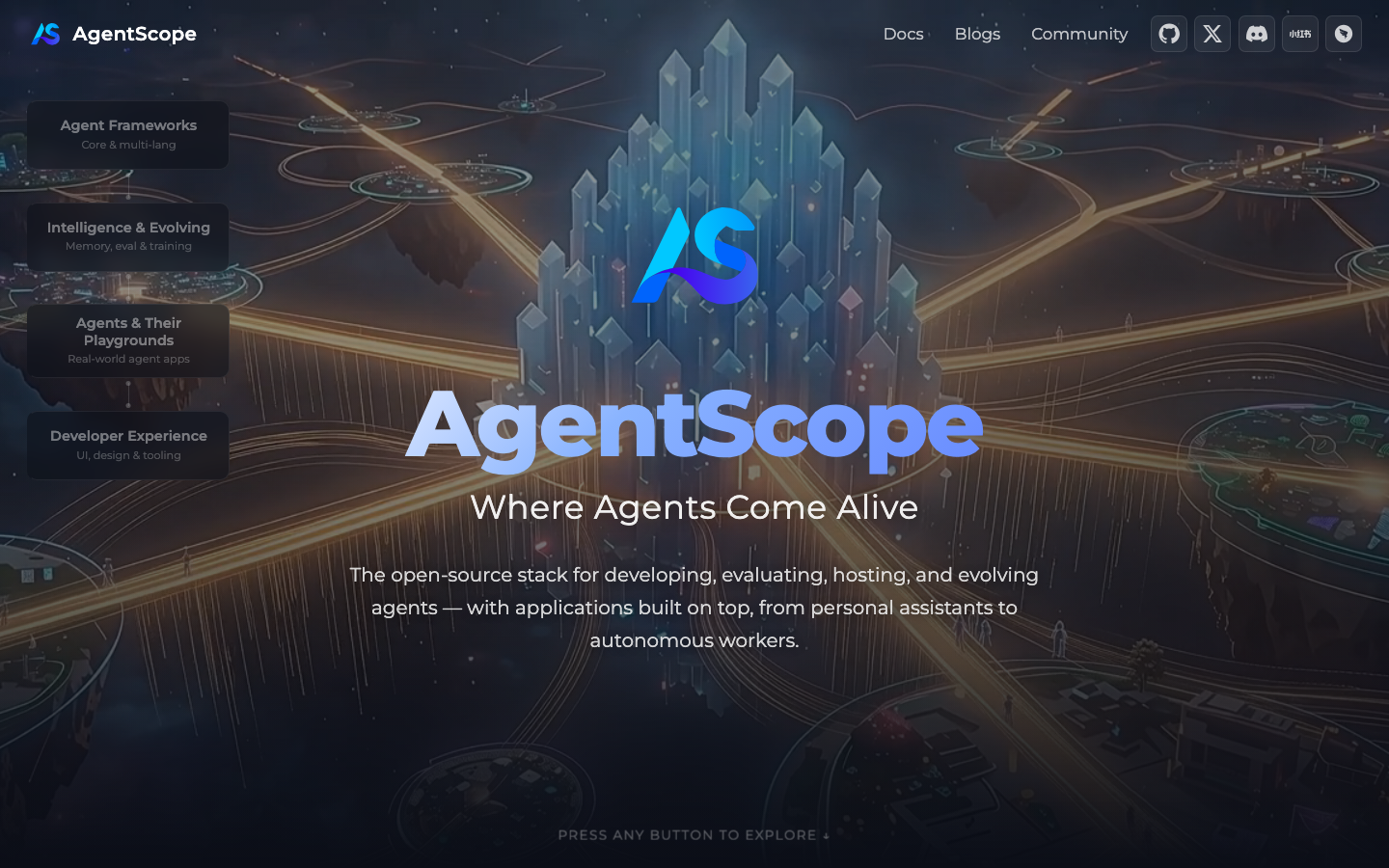
AgentScope is an open source multi-agent development framework originated from Alibaba Tongyi Team. It uses message driver (message exchange) as the core abstraction to help developers build single and multi-agent applications. It has built-in fault tolerance and retry mechanisms, visual AgentScope Studio, distributed execution and tool calling capabilities. Version 2.0 is further oriented towards production-level agent orchestration, with the goal of making multi-agent systems easier to develop, debug and deploy.
AgentScope
Core parameters and statistics
AgentScope is an open source development framework for multi-agent applications. It is officially positioned as a platform that makes it easier to build multi-agent applications. It was initiated by Alibaba Tongyi Team. It uses "message exchange" as the core abstraction, models the collaboration between agents as the transmission and processing of messages, and has built-in fault tolerance, tool calling and visual debugging capabilities.
| Projects | Public Information |
|---|---|
| Official positioning | Development framework for multi-agent applications |
| Core abstraction | Agent collaboration driven by message exchange |
| Key capabilities | Fault tolerance and retry, tool invocation, distributed execution |
| Visualization | AgentScope Studio (visual development and debugging) |
| Language implementation | Python (and ecological extensions such as Java) |
| Sponsor | Alibaba Tongyi Team |
| Open Source License | Apache 2.0 |
| Community size | GitHub about 26,600 stars, 2,900 forks |
| Latest version | v2.0.1 (2026-06-05, GitHub Releases) |
| Applicable level | From single agent to production-level multi-agent orchestration |
Abstract Value: The complexity of multi-agent systems mainly comes from the collaboration and state management between agents. AgentScope uses a unified "message exchange" abstraction to make collaboration explicit. The effect is that developers can more clearly organize the dialogue and division of labor between agents, and reduce the mental burden of multi-agent orchestration.
Fault Tolerance Value: Real agent applications often break due to model timeouts, tool failures, or parsing errors. AgentScope has a built-in fault tolerance and retry mechanism, with the goal of allowing the system to recover gracefully even when a single point fails. This is particularly critical for long-link, multi-step agent tasks.
Debugging value: AgentScope Studio provides a visual development and debugging interface, which visually presents the message flow, tool calling and execution process between agents, helping developers locate difficult-to-track problems in multi-agent systems.
User and market recognition
AgentScope's recognition mainly comes from the endorsement of the open source community and Alibaba Tongyi Ecosystem. The framework itself is free and has no revenue caliber.
Community scale: The GitHub repository agentscope-ai/agentscope publicly displays about 26,600 stars and 2,900 forks. It is a highly watched project in the multi-agent framework track. Backed by the Alibaba Tongyi team, it has a strong foundation for dissemination and adoption in the Chinese developer community.
Ecological positioning: In the field of multi-agent frameworks, AgentScope is often discussed alongside other Agent frameworks. The difference lies in its combination of "message-driven + fault tolerance + visual studio" and its focus on production deployment. Version 2.0 further focuses on observability and deployability.
Prerequisites for implementation: AgentScope is a developer framework, and its use requires Python engineering capabilities; the final effect of the multi-agent system also depends on the connected large model, tool design and orchestration logic. The framework provides structure and reliability guarantee rather than ready-made business capabilities.
Cost advantage
The cost advantage of AgentScope is that it provides production-level multi-agent capabilities in an open source manner, eliminating the repeated investment in self-built orchestration, fault tolerance, and visualization facilities.
Software free and open source: Under the Apache 2.0 license, the framework and AgentScope Studio are free to use, can be used commercially, and allow auditing and customization.
API/Developer Cost: There is no charge for the framework itself. The real cost comes from the large model API and tool calls it is connected to. Although fault-tolerant retry improves stability, it may also increase the token overhead caused by repeated calls, which needs to be weighed between reliability and cost.
Enterprise/Privatization Cost: When self-hosting a multi-agent system within an enterprise, the cost is concentrated on model invocation, computing power and operation and maintenance of distributed execution. Whether to deploy with Alibaba Cloud and other hosting capabilities is decided by the team based on its own infrastructure. The relevant cloud resource fees are based on the real-time page of the corresponding platform.
Cost Combination Suggestion: Use a framework to quickly verify the orchestration logic during the development phase, and then optimize the retry strategy and model selection for high-frequency paths during the production phase to avoid unnecessary amplification of call costs by the fault-tolerant mechanism.
Main functions
AgentScope's capabilities are organized around "building, debugging, and deploying multi-agent systems":
- Message-driven orchestration: Organizes agent collaboration with message exchange as the core, supporting single and multi-agent applications.
- Fault Tolerance and Retry: Built-in fault tolerance and retry mechanism for exceptions such as model timeout and tool failure to improve the stability of long-link tasks.
- Tool Call: Supports intelligent agents to call external tools and functions to expand execution capabilities.
- AgentScope Studio: Provides a visual development and debugging interface, presenting the message flow and execution process.
- Distributed Execution: Supports distributed deployment of agents, oriented to large-scale and production-level scenarios.
Model and version evolution
AgentScope has undergone an important evolution from 1.0 to 2.0, and the mainline continues to be iterated at a high frequency.
Mainline release
The latest version v2.0.1 (2026-06-05) is a revised release after the 2.0 major version; v2.0.0 (2026-05-25) is a key node, which reconstructs the framework capabilities for production-level agent applications and enhances the orchestration, observability and deployment experience.
Version context
Before entering 2.0, the 1.0 series (such as v1.0.21, 2026-05-25) maintains a stable iteration rhythm. The leap from 1.0 to 2.0 reflects the evolution direction of AgentScope from "usable multi-agent framework" to "production-oriented agent platform". For existing users, when upgrading across major versions, they need to pay attention to changes in interfaces and abstractions. It is recommended to complete migration verification in a testing environment.
Technical advantages
The technical advantages of AgentScope can be explained by the chain of "mechanism-effect-scenario".
Mechanism: Unified message exchange abstraction. Model agent collaboration as message passing. The effect is that the division of labor and dialogue between multiple agents are expressed in a structured manner, reducing the complexity of orchestration. The applicable scenario is complex tasks that require multiple roles to complete collaboratively.
Mechanism: Built-in fault tolerance and retry. Handle exceptions and failures at the framework level. The effect is that long-link tasks can still be recovered when a single point fails, improving system robustness and suitable for production scenarios with many steps and external dependencies.
Mechanism: Visualization Studio. Visualize the message flow and execution process. The effect is to expose difficult-to-track problems in multi-agent systems, shorten the debugging cycle, and is suitable for development teams that need continuous iteration and troubleshooting.
How to use
AgentScope is for developers, and the main entrance is as follows:
- Python Framework: Install AgentScope through pip and define agents, tools and collaboration logic in a message-driven manner.
- AgentScope Studio: Start the visual interface, develop, run and debug agent applications, and observe message flows and tool calls.
- Basic process: Define agents and tools → Organize collaboration using message exchange → Run and debug in Studio → Configure fault tolerance and deploy after distributed execution.
When implementing, attention needs to be paid to the division of agent roles and the design of message protocols, which determine the maintainability of the system; at the same time, reasonable retry and timeout strategies must be configured for the critical path to avoid fault-tolerance mechanisms from amplifying costs or masking real problems.
Product Pricing
AgentScope is a completely free and open source framework.
- Open Source Use: The framework and AgentScope Studio are free, licensed under Apache 2.0, and available for commercial use.
- Model and Computing Power Cost: The computing power required for accessed large model APIs, tool calls, and distributed execution is billed by the corresponding supplier or its own infrastructure.
- Associated Cloud Service: If deployed in conjunction with a cloud platform, the related resource costs are based on the real-time page of the corresponding platform.
Application scenarios
- Multi-role collaboration tasks: Use multiple agents with clear division of labor to collaboratively complete research, writing or data processing. The focus of verification is the clarity of message protocols and collaboration logic.
- Production-grade agent service: Build an agent backend that requires stable operation. The focus of verification is the performance of fault-tolerant retries and distributed execution under real loads.
- Agent Research and Prototyping: The research team uses the framework to quickly build and visually debug multi-agent systems. The focus of the verification is to compare the effects of different orchestration strategies.
Applicable people
- Multi-agent application developers: A structured framework is needed to organize the collaboration and status of multiple agents.
- Platform and back-end engineer: Focus on fault tolerance, observability and distributed deployment of agent systems, oriented to production context.
- AI Research and Prototyping Team: Hope to use visual tools to quickly build and debug multi-agent experiments.
Not suitable for the boundary: AgentScope is a development framework and is not suitable for non-technical users who do not have engineering capabilities and want ready-made agent products; if only a single simple agent is needed, a complete multi-agent framework may be too heavy, and a lightweight solution is more suitable.
Summary and Outlook
AgentScope uses a combination of "message-driven + fault-tolerant retry + visual studio" to highlight development experience and production reliability in a multi-agent framework. Version 2.0 further shifts the focus to observability and deployability. Backed by the Alibaba Tongyi team and approximately 26,600 GitHub stars, it has a solid adoption foundation among the Chinese developer community.
For teams planning to implement it, it is recommended to first use the framework and Studio to verify the orchestration logic and fault-tolerance strategy on a small scale, and then optimize model selection and retry parameters for the production path; before expanding to production, the stability of distributed execution, call costs, and compatibility across major version upgrades need to be verified. The current uncertainties that need attention are: the abstraction from 1.0 to 2.0 has changed significantly, the upgrade requires migration verification, the final business effect still depends on the connected model and tool design, and end-to-end evaluation should be completed before formal production.
Related tools:  CrewAI,
  LangChain
Comparison of competing products
| Comparison dimensions | AgentScope | Competitor A | Competitor B |
|---|---|---|---|
| Core Differences | — | — | — |
| Price | — | — | — |
| Target Users | — | — | — |
Note: The above comparison is based on product public information, and actual differences are based on user experience.
Version Info
- AgentScope v2.0.1 :The latest version released by GitHub Releases is a revised release after the 2.0 major version. It continues the main line of production-level multi-agent orchestration and improves message drive, tool calling and stability.
- AgentScope v2.0.0 :The 2.0 major version node is designed to reconstruct the framework capabilities for production-level agent applications and enhance the orchestration, observability and deployment experience.
- AgentScope v1.0.21 :The later iterative version of the 1.0 series reflects the release rhythm of the project's continuous maintenance before entering 2.0.
User Reviews