 agent set.love
Agentset.ai targets AI agents business scenarios, providing low-code orchestration, connectors and process reuse capabilities.
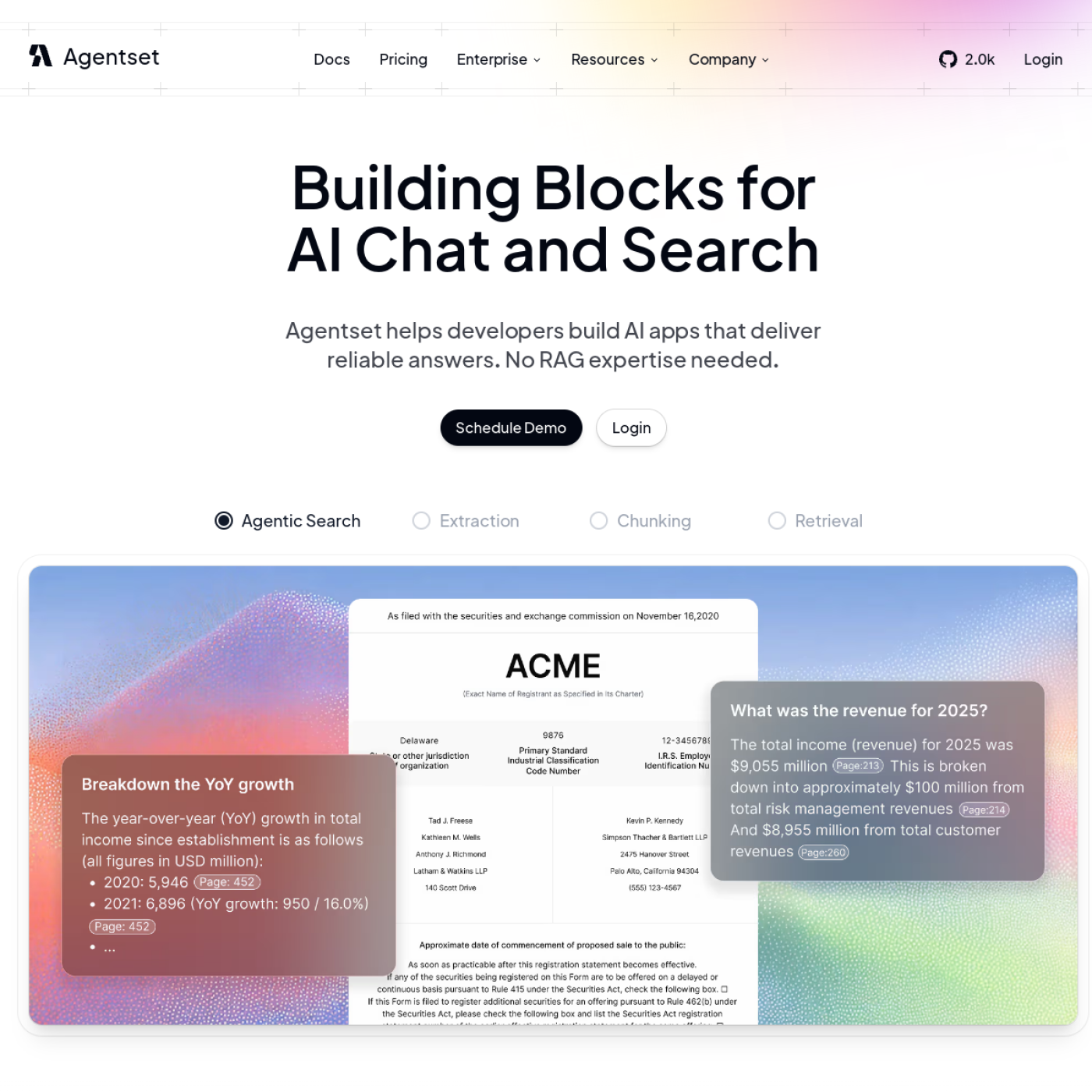
Agentset.ai - RAG-as-a-Service Infrastructure Platform
Core parameters and statistics
| Parameters | Details |
|---|---|
| Product Positioning | Production-grade RAG infrastructure platform for developers |
| A brief review in one sentence | It is not a low-code Agent building tool, but an out-of-the-box RAG backend - helping you transform document data into an AI retrievable knowledge base |
| Target users | Back-end/full-stack developers AI application teams, SaaS products that need to build knowledge base retrieval |
| Delivery form | Web console + REST API + TypeScript/Python SDK + MCP Server |
| Open source | MIT license, GitHub 2k+ Stars, TypeScript single repository |
| Core architecture layer | Parsing layer (Marker/OCR) → Blocking layer (Chonkie) → Vectorization layer (text-embedding-3-large) → Vector library (Turbopuffer) → Reordering layer (Cohere Rerank v4.0) → Generation layer (GPT-5.5 Agent) |
| File format support | 22+ formats: PDF, DOCX, XLSX, PPTX, HTML, Markdown, pictures (including OCR), code files, etc. |
| Deployment options | Agentset Cloud, BYOC, Self-hosted |
| Compliance Certification | SOC 2, HIPAA, GDPR (Enterprise Plan) |
The core practical value of Agentset.ai is: turning RAG from "demo-ready" to "production-ready". Most RAG solutions perform well in the demonstration stage. Once faced with the query diversity, document volume growth and precision requirements of real users, the recall rate and answer reliability will drop sharply. Agentset replaces traditional single vector retrieval with Agentic Retrieval, significantly improving the accuracy of multi-hop reasoning and cross-document aggregation.
User and market recognition
Enterprise Adoption Cases
- Gyldendal Rettsdata (Legal): 3 million pages of legal corpus, built an AI legal retrieval product line based on Agentset. "This is exactly the kind of AI search solution we need," said Kristian Skeie, head of AI.
- Mederva Health (YC W22): Using Agentset for clinical research knowledge base, CTO Ahnaf Siddique commented, "There is no room for error in the medical field, and Agentset makes answers instantly reliable in research."
- SustainBridge (Municipal/Public): Handles hundreds of pages of municipal documents and complex image searches, CTO Ronny Reitan says, "out of the box."
- Vipps (financial technology): Norway's largest mobile payment platform, chief architect Sven Malvik said "If you use Agentset early, you can save weeks of development time."
- Jibreel (e-commerce): Migrating from Algolia to Agentset, CTO Abdallah Abbas said "a better search experience was achieved in less than an hour."
Community and Ecology
- GitHub 2k+ Stars, 183 Forks, 8 core contributors, active Discord community.
- The public roadmap includes LLM rankings, Embedding rankings, Reranker rankings, vector database rankings and other ecological tools.
- Officially provides four sets of comparison pages: vs Ragie, vs Vectara, vs Graphlit, vs Credal, positioned as "the preferred alternative to open source RAG infrastructure".
Cost advantage
C-side/development team pricing
| Plans | Monthly Fees | Page Quotas | Number of Retrievals | Connectors | Support Levels |
|---|---|---|---|---|---|
| Free | $0 | 1,000 pages | 10,000 visits/month | Not included | Community Support |
| Pro | $49/month | 10,000 pages (over $0.01/page) | Unlimited | $100/month | Email support |
| Enterprise | Business quotation | No limit | No limit | Customization | Dedicated engineer + account manager |
API/Developer Cost Structure
- Free Plan: No credit card required, 1,000 pages + 10,000 searches, suitable for PoC and small projects.
- Pro Plan: Get 10,000 pages for $49/month, additional pages for just $0.01/page, unlimited searches. Connectors are billed individually at $100/unit/month.
- Open source and self-hosted: completely free, you only need to bear the cost of server and vector database infrastructure.
Business / Privatization Costs
Enterprise is a business quote that includes: unlimited pages and retrieval, local deployment or BYOC, SOC2/HIPAA/GDPR compliance reporting, SSO single sign-on, and dedicated support. Please contact sales for price.
Cost comparison with competing products
| Dimensions | Agentset Pro | Ragie Starter | Vectara Standard |
|---|---|---|---|
| Monthly fee | $49 | $100 | Contact sales |
| Page/storage quota | 10,000 pages | 10,000 pages | 200 MB storage |
| Exceeds unit price | $0.01/page | $0.02/page | Opaque |
| Search limit | No limit | No limit | 20,000 queries/month |
| Open source optional | ✅ MIT open source | ❌ closed source | ❌ closed source |
| Free credit | 1,000 pages + 10,000 searches | 1,000 pages + 1,000 searches | Limited trial |
Cost Advantage Conclusion: For a development team with an average daily search volume of 300–1,000 times, the cost of the Pro plan at $49/month is significantly lower than Ragie ($100/month) and Vectara (business communication required). Coupled with the open source self-hosting option, Agentset has obvious cost-effective advantages for small and medium-sized teams.
Main functions
1. Agentic Search
- Mechanism: Different from the single vector retrieval of traditional RAG, Agentset has a built-in retrieval Agent, which executes the iteration of
Search(semantic/keyword search) →Expand(expansion across block boundaries) →Reason(determining whether the answer is sufficient) in a tool call cycle, and does not return the answer until sufficient information is collected. - Hidden linkage: Automatic linkage between the retrieval agent and the Citation system - each reference source automatically marks the location of the document, forming a "retrieval-attribution-tracing" cycle, significantly reducing black box output.
- Expert View: This is the most essential difference between Agentset and the traditional RAG platform. A single retrieval can only cover 1-2 chunks, but Agentic Retrieval can "multi-step verification" like humans, increasing the recall rate by 30-50% in multi-hop question and answer scenarios (such as "Comparison of sales in each region in Q3 last year").
2. Deep Research (deep research mode)
- Mechanism: Further expanded on the basis of Agentic Search - Search Agent can automatically generate sub-questions, perform parallel searches, aggregate multi-source information, and generate structured research reports.
- Applicable scenarios: Competitive product analysis, market research, regulatory compliance review and other complex questions that require multiple documents to be answered.
- Hidden linkage: In conjunction with the chunking strategy - Smart Chunking uses sentences and paragraphs as boundary chunks to ensure that cross-document aggregation in Deep Research mode does not lose context.
3. Multi-format document parsing and OCR
- Supports 22+ file formats: PDF, DOCX, XLSX, PPTX, HTML, Markdown, CSV, TSV, XML, JSON, pictures (PNG/JPEG/HEIC/BMP), emails (EML/MSG), code files, etc.
- OCR capability: Based on the Chandra OCR engine, it can perform text recognition on scanned PDFs and photographed documents, and output structured text.
- Hidden linkage: The parsing pipeline is executed asynchronously (Trigger.dev queue). A 100-page PDF completes the entire process of parsing → chunking → vectorization within 60 seconds, and the parsing results are cached in Cloudflare R2. Subsequent re-indexing does not require repeated parsing.
4. Model-independent architecture
- LLM: Default is GPT-5.5, any model compatible with OpenAI API can be selected (Claude, Gemini, local inference, etc.).
- Embeddings: Default text-embedding-3-large, can be replaced with open source or commercial embedding models.
- Vector database: Default Turbopuffer (NVMe SSD cache hot namespace), can be replaced by Pinecone, Weaviate, Qdrant or self-built Postgres pgvector.
- Reranker: Default Cohere Rerank v4.0 Pro, can replace or concatenate custom reordering logic.
- Hidden linkage: model-independent + open source architecture means that users can do A/B testing within Agentset - the accuracy differences of different Embedding/LLM/vector library combinations from the same document library can be directly compared in the Playground without switching platforms.
5. Integration of MCP Server and AI SDK
- MCP Server: Exposes the knowledge base as a standard MCP tool, which can be directly called by MCP clients such as Claude Desktop, Cursor, VS Code Copilot, etc. Exposed Tools include
search(semantic retrieval),retrieve(accurately retrieve chunked content),list_namespaces(list knowledge base partitions). - AI SDK integration: Compatible with Vercel AI SDK, one line of code will connect Agentset retrieval to any AI framework.
- Hidden linkage: The combination of MCP Server + Agentic Search upgrades Agentset from "RAG backend" to "knowledge cortex of AI agents" - any MCP-compatible AI Agent can perceive the enterprise's private knowledge base through Agentset.
Model and version evolution
| Version | Date | Core Changes |
|---|---|---|
| Public Beta (v1) | 2024-09 | The first batch of low-code orchestration capabilities and basic connectors, verifying the feasibility of RAG core scenarios |
| Workflow Templates | 2026-01 | Launch the industry template and process market to improve reuse efficiency and shorten deployment time; launch the new architecture of Agentic Search |
| Recent (latest) | 2026-06 | Merged 140+ PR: Agentic Search Playground reconstruction, custom system prompt repair, document parsing enhancement; frequent GitHub submissions, active community contributions |
Version context description: Agentset will enter public beta in the second half of 2024, and complete the architectural upgrade from "Basic RAG Engine" to "Agentic RAG Platform" in 2025. Currently in a rapid iteration period, GitHub merges a batch of feature PRs on average every 2 weeks, with the core focus on retrieval accuracy, developer experience, and multi-format document support. Ecological tools such as LLM/Embedding/Reranker rankings, as well as more complete MCP and AI SDK integration can be seen on the subsequent roadmap.
Technical advantages
Agentic Retrieval: Beyond a single vector retrieval
The workflow of traditional RAG is "query → embedding → vector search → splicing results → generating answers", which is essentially a one-time retrieval. The retrieval Agent of Agentset uses the tool call cycle:
User asks → Retrieval Agent generates search query → Search Tool (vector + keyword mixed search)
  → Not enough results? → Expand Tool (expand to adjacent tiles) → Evaluate again
  → Sufficient information? → Generate (generate answers + automatically mark sources)
This mechanism solves three core pain points:
- Multi-hop questions: Questions that require cross-document reasoning (such as "How much higher is the price of product A than product B?") cannot be covered by a single search.
- Broken Boundary of Chunks: When the answer is split into two chunks, a single search may only hit one of them. The Expand tool automatically reads the context.
- Fuzzy query intent: The Agent can rewrite and refine search terms on its own, rather than relying solely on the user's original input.
Modular decoupling and asynchronous pipeline
- Separation of parsing and retrieval: Document parsing (Marker + OCR) is executed asynchronously, and the results are cached in R2 object storage. Even if the Embedding model or vector library is subsequently changed, there is no need to re-parse the source file.
- Chonkie Intelligent Chunking: uses sentences and paragraphs as natural boundaries for chunking, supports dedicated chunkers for tables, code blocks, and pictures, and retains document structure information.
- Trigger.dev job orchestration: Asynchronous task queue, supporting failed retries and progress tracking. 100 page PDF uploaded to searchable in < 60 seconds.
Mixed search and reordering
- Semantic Search: Vector embedding based on text-embedding-3-large, approximate nearest neighbor (ANN) search in Turbopuffer.
- Keyword Search: BM25-like word matching based on chunked original text, ensuring that professional terms (such as "HIPAA", "RAG") still have accurate hits when the semantic embedding effect is not good.
- Cohere Rerank v4.0 reordering: Sort the Top-K results twice to further improve accuracy. Official benchmarks show industry-leading performance on HotpotQA and FinanceBench.
Multi-tenancy and data isolation
- Namespace mechanism: Each knowledge base is isolated into an independent Namespace, and the data is physically or logically isolated at the vector library and object storage levels.
- Metadata filtering: Use metadata filter to limit the data range during retrieval (such as only retrieving "Sales Report for Q3 2025") to achieve fine-grained permission control.
How to use
Entrance comparison
| Access method | Applicable scenarios | Quick entry |
|---|---|---|
| Web console (Playground) | Quick trial, debugging retrieval effect, manual Q&A | https://app.agentset.ai/login |
| REST API | Embed RAG capabilities into your own application backend | https://docs.agentset.ai/api-reference/introduction |
| TypeScript SDK | Node.js/Next.js project integration | npm install agentset |
| Python SDK | Python backend/data science project integration | pip install agentset |
| MCP Server | For direct calls by MCP clients such as Claude/Cursor/Copilot | See documentation for details |
| AI SDK (Vercel) | One line of code to connect to the Vercel AI SDK framework | See the documentation for details |
Get started quickly in 3 minutes: TypeScript SDK examples
import {Agentset} from "agentset";

const agentset = new Agentset({ apiKey: "<YOUR_API_KEY>" });
const namespace = agentset.namespace("ns_1234");

// 1. Upload document
const ingestJob = await namespace.ingestion.create({
  payload: {
    type: "FILE",
    fileUrl: "https://example.com/document.pdf",
    fileName: "my-document.pdf",
  },
  config: {
    metadata: { department: "legal", year: "2026" },
  },
});

// 2. Wait for parsing to complete (asynchronous polling)
await agentset.jobs.wait(ingestJob.id);

// 3. Retrieve questions and answers
const answer = await namespace.search.chat({
  messages: [{ role: "user", content: "What compliance requirements does this document mention?" }],
});
console.log(answer.message.content);
// The answer automatically comes with a source citation
MCP Server access (Claude Desktop configuration)
In claude_desktop_config.json add:
{
  "mcpServers": {
    "agentset": {
      "command": "npx",
      "args": ["-y", "@agentset/mcp-server"],
      "env": {
        "AGENTSET_API_KEY": "<YOUR_API_KEY>",
        "AGENTSET_NAMESPACE": "ns_1234"
      }
    }
  }
}
Once configured, Claude can search the knowledge base directly through the Agentset MCP tool. List of Tools exposed by MCP:
| Tool name | Function description | Input parameters |
|---|---|---|
agentset_search |
Semantic/keyword search knowledge base | query: string, topK,: number, filters,: object |
agentset_retrieve |
Get the complete content of the specified chunk | chunkId: string |
agentset_list_namespaces |
List all knowledge base partitions | None |
Engineering Pitfall Guide
- Token consumption and step control: The cycle of Agentic Retrieval may perform 5-10 steps of tool calls on complex problems, resulting in a surge in Token consumption. It is recommended to limit the maximum number of iteration steps of the retrieval agent through the
maxStepsparameter, and enable repeated action detection in the loop to avoid repeated execution of the same query. - Long Document Context Overload: When the document library contains a large number of PDFs (especially scanned versions), the combination of OCR + chunking may produce a much larger number of chunks than expected. It is recommended to set the paged summarization policy at the namespace level and enable hierarchical summarization (summarizing chapters first, then the full text) for large documents, rather than feeding all chunks into the context.
- Security and unauthorized governance: In a multi-tenant scenario, the data isolation between namespaces must be verified - confirm that physical isolation is done at the vector library level (not just the application layer). For irreversible operations (namespace deletion, batch re-indexing), it is recommended to set a secondary confirmation or dry-run mode before calling the API.
Product Pricing
Overview of Pricing Models
| Plan | Monthly Fee | Core Quota | Adaptation Partnership |
|---|---|---|---|
| Free | $0 | 1,000 pages, 10,000 searches, community support | Personal project PoC, prototype verification |
| Pro | $49 | 10,000 pages, unlimited search, email support | Production for small and medium-sized teams |
| Enterprise | Business Quotation | Unlimited pages and searches, local deployment, SOC2/HIPAA/GDPR, SSO | Enterprises with high compliance requirements |
Billing details
- Page Count: Parse text into 1 page for every 1,000 characters. The actual number of PDF pages and the number of billed pages may be different (for example, if one PDF page is text-intensive, it may be converted into 1–3 billed pages).
- Connector Fee: $100/unit/month for Pro plan. Connectors refer to external data source synchronizers (such as Google Drive, SharePoint, Notion) that automatically synchronize content to the knowledge base.
- Excess Pages: Pro plan $0.01/page/month, billed based on actual overage.
- Special Policy: Discounts are provided for startups and non-profit organizations, please contact sales to provide organization information.
Pricing comparison with competing products
| Comparative Dimensions | Agentset Pro | Ragie Pro | Vectara Pro |
|---|---|---|---|
| Monthly fee | $49 | $500 | Contact sales |
| Pages/Capacity | 10,000 pages | 60,000 pages | 830 MB |
| Exceeds unit price | $0.01/page | $0.02/page | Opaque |
| Number of searches | No limit | No limit | 83,000 times/month |
| Open Source Options | Fully Open Source | Closed Source | Closed Source |
Data source: Agentset official pricing page and competitive product comparison page (2026-07). The prices of competing products may change, please refer to the real-time page of each platform.
Application scenarios
Dimensionality reduction strike scene
- Enterprise internal knowledge base Q&A: Upload product manuals, technical documents, and compliance policies to Agentset, and employees can obtain answers with source citations through natural language queries. Compared with traditional keyword search, the efficiency of information access is increased by 3-5 times.
- Legal Document Review: Supporting a 3 million-page legal corpus, Agentic Search significantly outperforms keyword search in multi-clause cross-reference scenarios. Gyldendal Rettsdata has used this to build its AI legal product line.
- Medical Research Knowledge Base: Mederva Health uses Agentset for clinical research data retrieval, and Agentic Retrieval ensures that answers can still be traced under the high reliability requirements of medical scenarios.
- E-commerce multi-modal search: Product pictures, description documents, user reviews and other multi-format data are stored in a unified database, supporting cross-format semantic retrieval.
- Financial Compliance Review: Extract regulatory requirements from heterogeneous documents such as PDF, Excel, emails, etc., and Deep Research mode automatically generates compliance difference reports.
Persuasion/Not Applicable Scenario
- Requires real-time data stream processing: Agentset is oriented to document knowledge base and is not suitable for real-time log analysis or event stream processing scenarios.
- Requires deep long text generation: Agentset is a retrieval enhancement tool rather than a writing tool, and is not suitable for scenarios where very long reports need to be generated from scratch.
- Pure Chatbot: If you only need a simple FAQ conversation bot, Agentset's RAG architecture may be too heavy, and you can use LLM's context window directly.
Applicable people
- Backend/Full Stack Developer: Need to quickly embed RAG capabilities into existing applications, and do not want to build their own parsing → chunking → vectorization → retrieval full link. TypeScript/Python SDK and REST API can be integrated in under an hour.
- AI Application Product Team: Building AI functions that rely on enterprise knowledge bases (such as AI customer service, intelligent document review) requires production-level retrieval accuracy and source citation capabilities.
- Data/ML Engineer: Need to do A/B testing and Benchmark between different Embedding model LLM and vector libraries. Agentset's model-independent architecture provides a unified comparison platform.
- Compliance & Security Sensitive Enterprises: Enterprise organizations that require SOC2/HIPAA/GDPR certification, on-premises deployment options, and fine-grained access controls.
Precondition / Unfit Boundary
- Minimum technical threshold: Basic API calling ability (TypeScript/Python/curl) is required. Pure business personnel cannot use it independently without developer support.
- Not suitable for extremely low-latency scenarios: Agentic Search's multi-step reasoning brings a response delay of 2–5 seconds, which is not suitable for real-time scenarios that require millisecond-level responses.
- Not suitable for ultra-high throughput scenarios: Limited by the iteration of LLM calls and vector retrieval, Pro or Enterprise plans are recommended to obtain quota guarantees during peak periods.
Summary and Outlook
Core Value Summary
Agentset.ai has precise positioning - it does not want to be a "universal AI platform", but focuses on solving the core problem of production-level RAG implementation. It compresses the build time of RAG systems from "weeks" to "hours" through Agentic Retrieval loops, multi-format document parsing and model-agnostic architecture.
Key Differentiation: Open source (MIT) realizes fully controllable Agentic retrieval, surpassing the accuracy bottleneck of single vector retrieval, and the pricing of $49/month has a significant cost-effective advantage among its peers.
Current limitations and uncertainties
- Long-term maintenance activity: As a newer open source project (started in 2024), its long-term community health and contributor growth still need to be observed.
- Vector library binding risk: Turbopuffer is used by default. Although it can be replaced, the maturity of the migration path has not been fully verified.
- Depth of multilingual support: The chunking strategy and retrieval accuracy for Chinese and other non-English languages have not yet been published as a benchmark, and the actual effect needs to be tested by yourself.
- Enterprise-level feature maturity: Enterprise features such as SSO, RBAC, audit logs, etc. are only available in the Enterprise plan, and the Pro plan has limited governance capabilities.
Procurement/Adoption Risk Assessment
For teams that plan to launch AI knowledge base functions within 6–12 months, it is recommended to proceed in three steps:
- PoC phase: Use the Free plan (1,000 pages + 10,000 searches) to verify whether the retrieval accuracy and latency of core scenarios meet business requirements, focusing on testing multi-hop question answering and cross-document retrieval scenarios.
- Production Pilot: Upgrade to the Pro plan ($49/month) and pay attention to whether the excess page charges are within your budget. Businesses with compliance requirements should evaluate the Enterprise program at this stage.
- Scale: If search volume continues to grow and on-premises deployment and compliance certification are required, talk to sales about an Enterprise quote. Key terms that need to be confirmed before purchasing include: data will not be used for model secondary training, SLA commitments, and standardized tools for data export/migration.
Related tools:  CrewAI,
  LangChain
Version Info
- Workflow Templates :Launch the industry template and process market to improve reuse efficiency and shorten deployment time.
- Public Beta :Provides the first batch of low-code orchestration capabilities and basic connectors.
User Reviews