 Amazon Nova 2
Amazon Nova 2 is the second-generation basic model family launched by Amazon within the Bedrock and nova.amazon.com systems, covering Nova 2 Lite, Nova 2 Sonic, Nova 2 Omni and multi-modal embedding. The core selling points are extended thinking, built-in tools, enterprise-level Agent construction and multi-modal context processing.
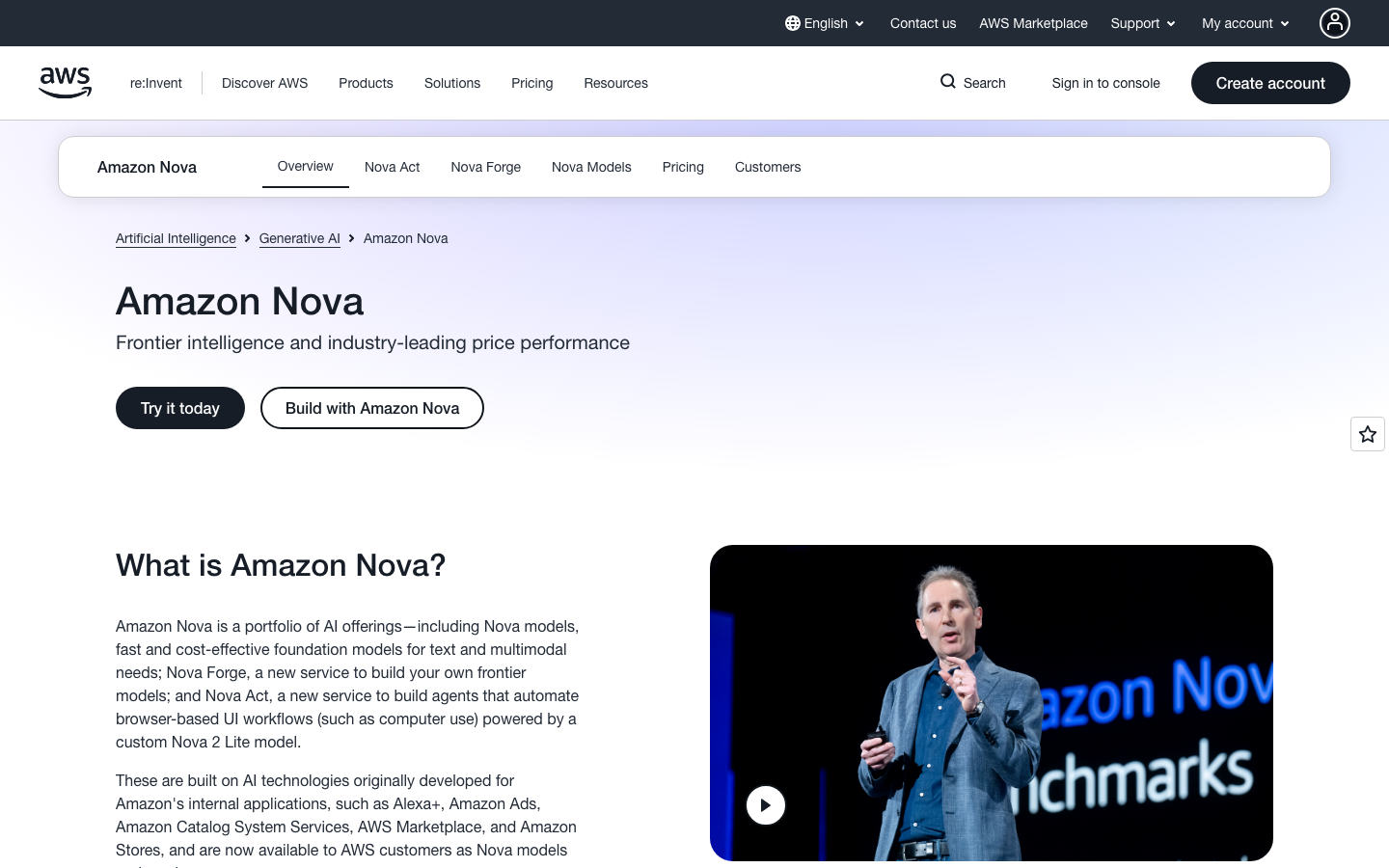
AmazonNova2
Core parameters and statistics
[A brief comment in one sentence]: It is not a single model, but a second-generation basic model package that Amazon has broken down according to enterprise workflow.
[Publicity Verification]: The official main narrative of Nova 2 is very clear. The key words are multimodal reasoning, extended thinking, tool use, and agent building. This publicity is basically true, because the official not only divides the model families, but also puts the built-in Web grounding, code interpreter, document understanding and speech model into the same generation architecture. The real pain point it hits is that companies don’t want to assemble multiple models to create a complex Agent chain.
| Projects | Public Information |
|---|---|
| Family composition | Nova 2 Lite, Nova 2 Pro, Nova 2 Omni, Nova 2 Sonic, Nova Multimodal Embeddings |
| Official main line release date | 2025-12-02 |
| Maximum context | Up to 1M token |
| Key new capabilities | Extended thinking, built-in tools, improved document understanding, video understanding agent construction |
| Main entrance | Amazon Bedrock, nova.amazon.com, nova.amazon.com/dev |
| API selection | Converse API, Invoke API |
| Inference timeout requirements | Official alert requests may take up to 60 minutes |
Expert’s perspective: Nova 2 does not pursue “one of the strongest items on the list,” but rather reconstructs its capability lines based on the most realistic bottlenecks for enterprise implementation: long context, document processing, built-in tools, voice conversations, and multi-modal retrieval.
User and market recognition
Nova 2's market recognition is reflected more through its AWS ecological position rather than its reputation in a separate app store. Its natural advantage is that once you are already inside Bedrock or AWS, Nova 2 has much lower access friction than external models.
User and market recognition: The official document directly writes use cases to enterprise workflow-level scenarios such as RAG, agentic applications, video analysis, UI workflow automation, conversational speech, etc., indicating that it is not oriented to a single chat product, but to platform construction.
Publicity verification: To say that it is "automatically suitable for all enterprises" is of course an exaggeration; but if it is said that it is a model family that AWS wants enterprises to change less models, less interfaces, and less governance layers, this judgment is very accurate.
Hidden benefits: For heavy AWS users, model migration, permission management, compliance and billing can save a few layers of bridges. This is the most realistic market value.
Cost advantage
The Free Truth: The Nova 2 is not a free model. The AWS documentation does not provide a unified price list on these description pages. The actual pricing needs to be considered based on the Bedrock region, model, input and output modes, and calling methods. Its value proposition is not lowest price, but lower enterprise integration friction.
| Cost layer | Disclosure | What it actually means |
|---|---|---|
| C-side/Personal | Can be experienced at nova.amazon.com | More like a trial entrance than a long-term low-price consumption service |
| Developer/API | Accessible by Bedrock and Nova Dev | Focus on model family differences, long context and tool chain call costs |
| Enterprise | Works with AWS Governance and Agent Platform | The real cost advantage often comes in governance, permissions, and platform uniformity |
Hidden costs: First, long context does not mean cheap, and the ability of 1M token is a double-edged sword for the budget; second, enterprises often underestimate the compound cost of tool invocation, vector retrieval, document processing, and voice links; third, Nova 2 has rich capabilities, which also means that model selection and prompt engineering are more complex.
Hidden benefits: If the organization is already building RAG, Agent and multi-modal applications on AWS, Nova 2 can tie the "model layer + permission layer + call layer" more closely together, and this unity itself can save money.
Main functions
- Multi-model family coverage: Lite, Pro, Omni, Sonic and Multimodal Embeddings have clear division of labor.
- Extended thinking: Nova 2 Lite supports multi-level reasoning intensity control.
- Built-in Tools: Web grounding and code interpreter can directly expand model boundaries.
- Improved document and video understanding: suitable for Agent, RAG and complex knowledge tasks.
- Real-time Speech Capabilities: Nova 2 Sonic handles natural conversational voice interactions.
- Enterprise-level Agent construction optimization: The official clearly regards Agent as one of the core adaptation directions.
Expert View: The hidden linkage of these functions is the "Shaopin System". In the past, enterprises had to do their own web search, code execution, vector retrieval, document understanding and speech. Now AWS is trying its best to package these pieces into a unified model family and inference portal.
Model and version evolution
Previous generation main line
Nova Version 1: AWS documentation still retains an independent V1 user guide, indicating that the Nova 1 family is still a comparable historical mainline.
Second generation main line
Nova 2 Family: Amazon Science technical report officially defined the Nova 2 family on 2025-12-02, emphasizing multi-modality, long context, inference control, and real-time voice.
Subsequent expansion
AWS “What’s new in Amazon Nova 2” continues to add content such as Lite, Sonic, Multimodal Embeddings, Nova Forge, etc., indicating that Nova 2 is not a single release, but a continuous evolution of the platform.
Current Limitations: The regions, modes, and abilities of different models vary greatly. Don’t misunderstand “Nova 2” as a single model with the same specifications.
Technical advantages
Amazon Nova 2 belongs to the [Basic Large Model/API Infrastructure] type.
Performance and Throughput: AWS documentation does not disclose specific numbers for TTFT, RPM, and TPM. What can be directly confirmed is: Nova inference requests may last up to 60 minutes, Nova 2 Sonic has a maximum connection duration of 8 minutes and a maximum of 20 concurrent connections per customer. The model supports two sets of calling methods, Converse API and Invoke API.
Mechanics -> Effects -> Scenes:
Family model division of labor: Lite/Pro/Omni/Sonic/Embeddings each perform their own duties. The effect is that enterprises can dismantle models according to tasks instead of a shuttle, which is suitable for mass production systems.
Built-in tools: Web grounding and code interpreter mean that some Agent workflows do not need to require more external tools, reducing the complexity of system assembly.
Long context + document understanding: More friendly to long documents, code libraries and video analysis scenarios, suitable for enterprise knowledge processing and workflow automation.
Adaptation Boundary: The best at platform construction within the AWS ecosystem; the worst at teams that only need a lightweight chat box and don’t want to be exposed to complex cloud governance.
How to use
It is officially recommended to call through Amazon Bedrock’s Converse API or Invoke API.
from botocore.config import Config
import boto3

bedrock = boto3.client(
    'bedrock-runtime',
    region_name='us-east-1',
    config=Config(read_timeout=3600)
)Note: This is an example of a timeout configuration clearly given by the AWS documentation in Core inference. The official also clearly stated that please set modelId to the corresponding Nova 2 Lite, Sonic or Multimodal Embeddings model ID, and give priority to using the Converse API as a unified interface for most scenarios.
Using path:
- Complete Bedrock permissions and area preparation first.
- Choose a specific model like Nova 2 Lite, Sonic, etc.
- Decide whether to use Converse API or Invoke API according to the task.
- If you need tool capabilities, then connect to the Web grounding, code interpreter or Agent platform.
Product Pricing
There is currently no fixed price list for these public document pages, and the specific fees are subject to AWS Bedrock and related real-time pages.
C client/individual: You can try it through nova.amazon.com or nova.amazon.com/dev, but it is not suitable to equate the experience entrance with the long-term purchase cost.
Developer/API: True cost accounting requires breaking down models, modalities, context length, tool usage and inference time.
Enterprise: Permission governance, regional compliance, long connections, logs, and downstream system calls must be included in the total cost of ownership.
The free truth: The cost-effectiveness of Nova 2 is not largely due to the "low unit price of the model", but to "if it is already on AWS, the overall platform will be more trouble-free".
Application scenarios
- Enterprise Agent Platform: multi-step reasoning, tool usage and complex context retention.
- Long Document and Knowledge Base Processing: 1M context and document understanding suitable for enterprise knowledge tasks.
- Multimodal retrieval and semantic search: Multimodal Embeddings supports cross-modal semantic space.
- Real-time Voice Conversation System: Nova 2 Sonic is suitable for customer service and voice assistants.
Dimensionality reduction attack scenario: When enterprises hope to complete multi-modal models, tool invocation, permission management and agent orchestration in the same cloud, its integration advantages are very obvious.
Current Limitations: For teams that are not within the AWS ecosystem and only want to quickly try out single-point models, its system complexity will be too heavy.
Applicable people
- Platform team within the AWS ecosystem: It is easiest to reap the benefits of its unified governance and interfaces.
- Enterprise Knowledge and Agent Team: Requires document understanding, long context and tool collaboration.
- Developers of voice and multi-modal applications: You can split tasks according to family members.
Persuasion Scenario:
- Those who just want a lightweight chat model: They may feel that the system is too heavy.
- Budget and Cloud Dependency Very Sensitive Teams: Carefully calculate long context and tool call costs.
- People who want to go online with minimal cloud governance: The advantages and complexity of the AWS system are two sides of the same coin.
Summary and Outlook
The core competitiveness of Amazon Nova 2 is not the absolute leadership of a single model, but "the ability to put together the most common needs of enterprises into the same family and the same call surface." For AWS ecosystem users, this unity is far more valuable than a single benchmark.
[Procurement/Adoption Risk Assessment]: If the team has already used AWS deeply, Nova 2 deserves to be included in the assessment first; if the team is just doing a lightweight prototype, it may be slowed down by its cloud governance and system complexity. Before going online, you need to focus on verifying regional availability, specific model family differences, long context budgets, tool call audits, and concurrency and timeout limits of voice links.
Related tools:  DeepSeek,
  ChatGPT
Version Info
- Amazon Nova 2 Family :Amazon Science technical report officially unveiled the Nova 2 family, including Nova 2 Lite, Nova 2 Pro, Nova 2 Omni and Nova 2 Sonic, emphasizing 1M context, multi-modal input and enterprise-level reasoning capabilities.
- Amazon Nova Version 1 :AWS documentation has clarified that Nova Version 1 is the previous generation family before Nova 2 and retains independent documentation; there is no official precise date yet.
User Reviews