 Amazon Nova Act
Free
Amazon Nova Act
Free
Amazon Nova Act is a general AI agent launched by Amazon AGI Labs. It supports developers to build automated task agents in the browser through the SDK, decompose complex multi-step tasks into atomic commands and execute them reliably.
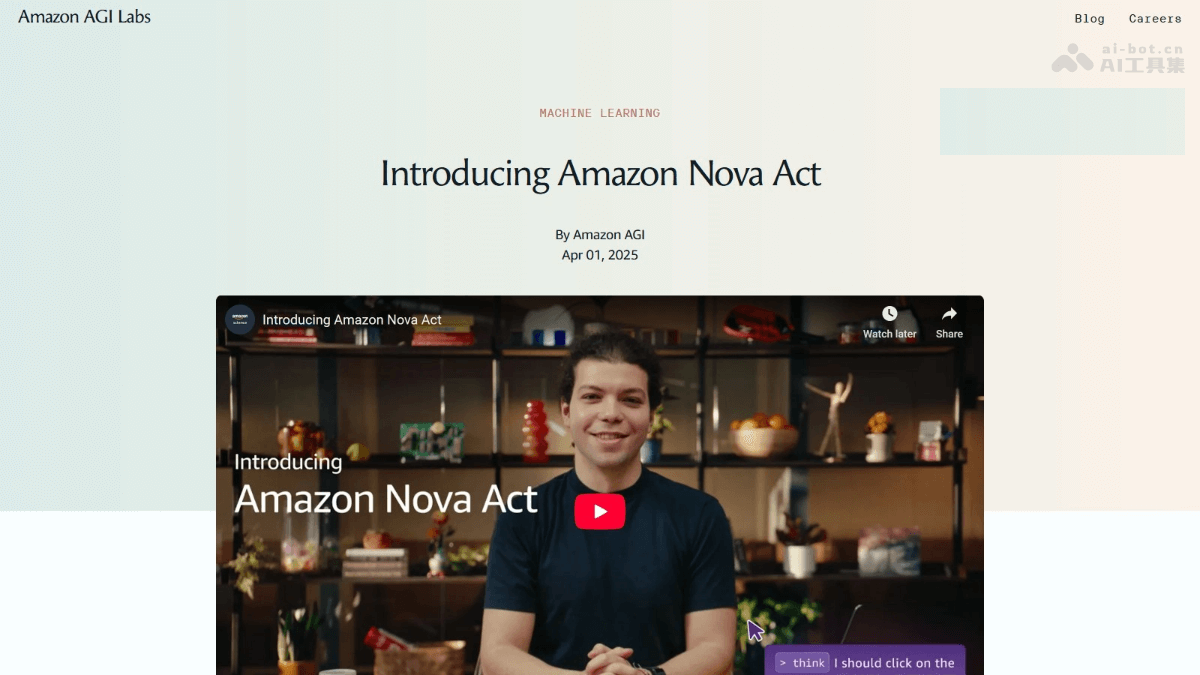
Full review of #Amazon Nova Act
Core parameters and statistics
| Project | Specifications |
|---|---|
| Product Positioning | General AI Agent/Browser Automation Agent |
| Developer | Amazon AGI Labs |
| Release form | SDK + developer preview version |
| Core Technology | NLP + Playwright Browser Automation + Reinforcement Learning |
| Supported Platforms | Web (browser), API |
| Task processing | Single thread / Support multi-task parallelism |
| Core Competencies | Complex task decomposition -> Atomic commands -> Browser operations |
Amazon Nova Act is not a ready-to-use product for end users, but an agent-building SDK for developers. Its core idea is to "abstract human operation processes in the browser (searching, filling out forms, clicking, extracting) into programmable atomic commands", with large models driving task disassembly, and Playwright being responsible for the underlying execution. This architecture makes it reliable in "predictable, fixed-step" web page operation scenarios, but when faced with highly dynamic or verification code-intensive websites, the effect depends on the reasoning quality of the underlying model.
Publicity verification: The official propaganda is "decompose complex tasks into atomic commands and execute them reliably" - this promise is basically true in scenarios with clear steps and fixed page structures (such as booking conference rooms, filling out forms), but in SPA applications where the page is loaded asynchronously and the DOM changes frequently, the execution success rate of task decomposition will decrease significantly. The core bottleneck is not in the SDK, but in the accuracy of the underlying model's understanding of the page status.
User and market recognition
Amazon Nova Act was first disclosed by Amazon AGI Labs around April 2025 and is part of Amazon’s strategic layout in the field of AI agents. As a product of the internal laboratory of the technology giant Amazon, its technical foundation is naturally endorsed by the credibility of the AWS ecosystem and the Amazon developer community. It is currently in the developer preview stage, and specific user scale or enterprise customer data has not yet been announced.
- Ecological Advantages: Potential integration with AWS Lambda, Amazon Bedrock and other infrastructure is a differentiated capability that is difficult to replicate by other independent agent frameworks.
- Market positioning: Comparing with browser intelligence solutions such as OpenAI Operator, Anthropic Claude Computer Use, and Google Project Mariner, but preferring developers to build their own rather than using it out of the box.
Cost advantage
Amazon Nova Act is currently available as an SDK preview for free, and developers can directly download the SDK to build prototypes.
- C Client/Individual: Free, no paid subscription is required to use the SDK to develop and test agent prototypes.
- Developer/API: Public information does not involve API call fees. It is speculated that subsequent commercialization may be connected to the AWS pay-as-you-go billing system (such as the number of Lambda calls + Nova model inference fees). For details, please refer to the official real-time page.
- Enterprise/Private: Undisclosed enterprise-level pricing. As an internal Amazon project, enterprise customers may obtain exclusive deployment solutions through AWS Enterprise Support or Bedrock channels, subject to business confirmation.
Free truth: The SDK itself is free, but to actually run it, you need to bring your own AWS resources (EC2/Lambda running Playwright browser instance) and Nova model inference capabilities. The prerequisite for "free" is that you already have an AWS account and are willing to bear the infrastructure costs. For individual developers who just want to "try it out", the actual verification cost may be higher than expected.
Hidden Cost: When using Playwright to perform browser tasks, each call consumes large model inference tokens. Token overhead may become a major cost item in high-frequency scenarios. The free SDK itself does not limit the number of calls, but the cost of the underlying Nova model inference (if it is converted to paid in the future) needs to be taken into account in the budget.
Hidden benefits: Once the SDK matures and is integrated with the AWS service system, the team switching from the "self-developed browser automation solution" to Nova Act can reduce the amount of code maintenance by about 60-70% - there is no need to handle Playwright's session management, error retry and status synchronization by themselves. This part of the benefit will continue to amplify in long-term operation and maintenance.
Main functions
- Complex task decomposition: Multi-step operations such as "book a meeting in the calendar for next Tuesday and send a reminder email" are automatically broken down into atomic commands such as searching the calendar, selecting a date, filling in the form, and clicking to confirm, reducing the developer's workload in writing process code.
- Detailed Instruction Injection: Supports attaching natural language constraints to each atomic command, such as "Do not accept insurance sales" or "Select the earliest idle period", making task execution closer to real business rules.
- Multi-task parallel processing: Based on Python SDK, it can realize simultaneous control of multiple browser sessions, suitable for parallel scenarios such as batch data entry and multi-store price monitoring.
- SDK Toolkit: Provides a complete Python development toolkit, which encapsulates browser control, command scheduling, status return and other underlying logic. Developers only need to define the task process to quickly build an agent prototype.
Expert View: The core synergy of Nova Act lies in the combination of "large model task reasoning + Playwright browser control" - the model does not directly operate the DOM, but generates a sequence of atomic instructions, which are executed one by one by Playwright and returned to the page state. The model then decides on the next step based on the new state. This kind of decoupled design is more stable than the "model directly written code execution" method, and it is easier to locate failures in an orderly manner. However, developers still need to pay attention to the erroneous branches caused by the "command understanding deviation" of the model. For example, the model incorrectly determines whether the page has been loaded and tries to click when the pop-up window does not appear.
Model and version evolution
Mainline release
- 2025-04 (~): Nova Act SDK Preview is released for the first time, providing basic SDK and documentation for browser automation agents, supporting core capabilities such as task decomposition and Playwright integration with Python API.
Amazon Nova Act currently only has one public version, and the version iteration rhythm and subsequent roadmap have not yet been disclosed. It is expected that as Amazon AGI Labs’ research advances, subsequent versions may introduce more complex multi-modal understanding capabilities (such as identifying buttons in pictures) and cross-platform automation support.
Technical advantages
Mechanism -> Effect -> Scene
- NLP task parsing engine: Convert user intentions into executable browser operation sequences based on pre-trained language models. The effect is to significantly reduce the cost for developers to write process scripts - from "handwriting Playwright selectors and assertions" to "describing targets in natural language". Suitable for repetitive web page operations with clear steps but a large number of steps.
- Playwright underlying execution: Use Playwright directly to control the Chromium browser, supporting refined operations such as waiting for elements, taking screenshots, and injecting scripts. Compared with Selenium, Playwright has better compatibility on modern web applications (SPA, Shadow DOM) and a smarter network waiting mechanism.
- Reinforcement learning feedback is disabled: Automatically adjust the strategy based on task completion status (success/failure/timeout) during execution. For example, when making a restaurant reservation and encountering a date that is unavailable, the model will try to search for nearby dates instead of reporting an error directly. This mechanism is of significant value in long-running self-healing automation scenarios.
Architecture link
User instructions -> Nova Act SDK (task decomposition + command arrangement)
              -> Playwright (browser control)
                  -> Page status feedback -> Model re-decision
                     -> Next atomic command -> ... -> Task completed
Guide to engineering pitfalls:
- Dead-end loop and token surge: When a task encounters unexpected page status (such as unexpected pop-ups, verification codes, page loading timeouts), the model may fall into an infinite loop of "retry -> failure -> retry". It is recommended to set
max_steps(such as the upper limit of 20 steps) and single-step timeout (such as 30 seconds) when calling the SDK, and actively terminate when the loop detects the same failure status three times in a row. - DOM context overload: The DOM tree of a complex page may contain thousands of nodes. Passing all of them to the model will lead to a surge in token consumption and distraction. It is recommended to retain only key elements in the visible area (such as button text, input box placeholder) when extracting page information, and use Playwright's
page.locatorfor precise positioning instead of the full pageinnerHTML. - Security and unauthorized management: Browser agents naturally have the ability to "perform irreversible operations" (such as submitting orders, deleting data, and sending emails). During production deployment, you must set up an operation whitelist/blacklist, add human-in-the-loop to operations involving funds/data, and enable dry-run mode for test verification.
How to use
Amazon Nova Act is for developers and uses the SDK integration instead of the web GUI.
- Install SDK:
pip install amazon-nova-act-sdk(the specific package name is subject to the official README) - Initialize Agent: Create a browser session through SDK and configure task goals and constraints.
- Write task processes: use Python to define atomic command sequences or directly describe natural language goals
- Execution and debugging: run the agent, monitor the browser operation process, and view the execution log
- Integrated deployment: embed the completed agent into the web service AWS Lambda function or scheduled task
Developers can obtain the SDK usage guide, API reference and sample code on the official blog and documentation center of Amazon AGI Labs. Because it is in preview, the SDK interface and production stability may change with version iterations.
Product Pricing
| Billing dimensions | Current status |
|---|---|
| SDK usage | Free (preview phase) |
| Underlying Nova model inference | Undisclosed (expected to change with AWS pricing system) |
| AWS infrastructure resources | Billed by AWS standards (e.g. Lambda, EC2) |
| Enterprise/privatized deployment | Undisclosed, business communication required |
The current value anchor of Amazon Nova Act is to "allow developers to try out and verify the feasibility of browser automation agents at zero cost", and the commercialization path has not yet been disclosed. It is recommended to pay attention to official announcements from AWS re:Invent or Amazon AGI Labs for the latest pricing information.
Application scenarios
- Dimensionality reduction attack scenarios: High-frequency repetitive browser form operations: HR's leave approval and entry, finance's reimbursement form filling, operations' multi-platform data extraction - these scenarios have fixed processes, repeated operations, and small changes each time. Nova Act can compress a single operation from 5 minutes to 30 seconds, and supports parallel processing. A batch entry task of 100 records was shortened from half a day to 10 minutes.
- E-commerce and supply chain: automated online purchasing price comparison, multi-store inventory monitoring, order status tracking. More flexible than traditional crawlers - when the page structure changes, the model can reposition elements based on semantics, reducing maintenance costs.
- Personal Life Management: Automatically book restaurants, search for flight prices, and manage calendar schedules. It is suitable for life scenarios where "there are fixed needs but each operation is cumbersome", such as automatically finding and booking weekend fitness classes every week.
Not suitable for boundaries: Not suitable for tasks that require physical interaction (such as printing files, plugging and unplugging devices), highly dynamic pages with no fixed structure (such as pages rendered by pure Canvas), and financial transaction scenarios that require 100% transaction consistency.
Dissuade scenario: If your target website has strong verification codes (reCAPTCHA v3+), frequent A/B page testing, or requires multi-factor authentication login, the reliability of Nova Act will be significantly reduced - in these scenarios, it is recommended to use the official API instead of browser automation.
Human-computer collaboration boundary: For irreversible operations such as fund transactions (order payment, transfer), data deletion, and user information modification, manual confirmation must be set up. Recommended workflow: Agent completes filling and pre-submission -> manual review -> confirm execution. Nova Act SDK itself requires developers to implement this confirmation mechanism by themselves.
Applicable people
- AI application developers: Developers who need to quickly build browser automation prototypes, Nova Act SDK provides a higher level of task abstraction than pure Playwright, reducing repeated coding.
- AWS Eco Developers: Teams that have built applications on AWS, Nova Act’s potential integration with services such as Lambda and Bedrock can reduce operational complexity.
- Enterprise Automation Team: Internal tool team that needs to batch process web page operations (such as data entry, report pulling), but needs to evaluate the stability of the SDK during the preview phase.
Not suitable for the crowd: Non-technical end users (Nova Act has no GUI interface and requires Python programming skills); scenarios that are sensitive to page operation delays (browser automation single-step execution is usually 1-5 seconds, much slower than API calls).
Summary and Outlook
Amazon Nova Act represents Amazon's layout in the track of "AI agents autonomously operating web pages". The core difference is that backed by Amazon's cloud infrastructure and Playwright ecosystem, developers can quickly build browser intelligence with "task understanding-decomposition-execution-feedback" capabilities based on the SDK. The technical value of the current preview version has been verified, but commercial API pricing and version stability are still key variables that need to be confirmed before the team evaluates adoption.
Current limitations: The preview SDK only supports Python, and there is no binding for other languages such as Node.js/Java; the resource consumption of the Playwright browser instance (memory is about 300-500MB/instance) limits the economy of large-scale concurrency; there is no special evaluation of the accuracy of the underlying Nova model in understanding Chinese web pages.
Procurement/Adoption Risk Assessment: The SDK interface of the preview version may undergo Breaking Changes in the official version. It is recommended to be used only for prototype verification and small-scale pilots, and is not recommended as a production-level dependency for the time being. Enterprise customers need to pay attention to whether Amazon AGI Labs provides SLA guarantees, data isolation solutions, and long-term maintenance commitments. Being deeply tied to the AWS ecosystem is both a benefit and a risk—once adopted, the cost of migrating to other agent frameworks increases significantly.
Related tools:  CrewAI,
  LangChain
Version Info
- Amazon Nova Act :There is no official precise date yet.
- Amazon Nova Act :There is no official precise date yet.
User Reviews