 Anyword
Anyword takes marketing copywriting scenarios as its core, emphasizing the integration of generation, scoring, and iteration, and is suitable for continuous delivery and content growth teams.
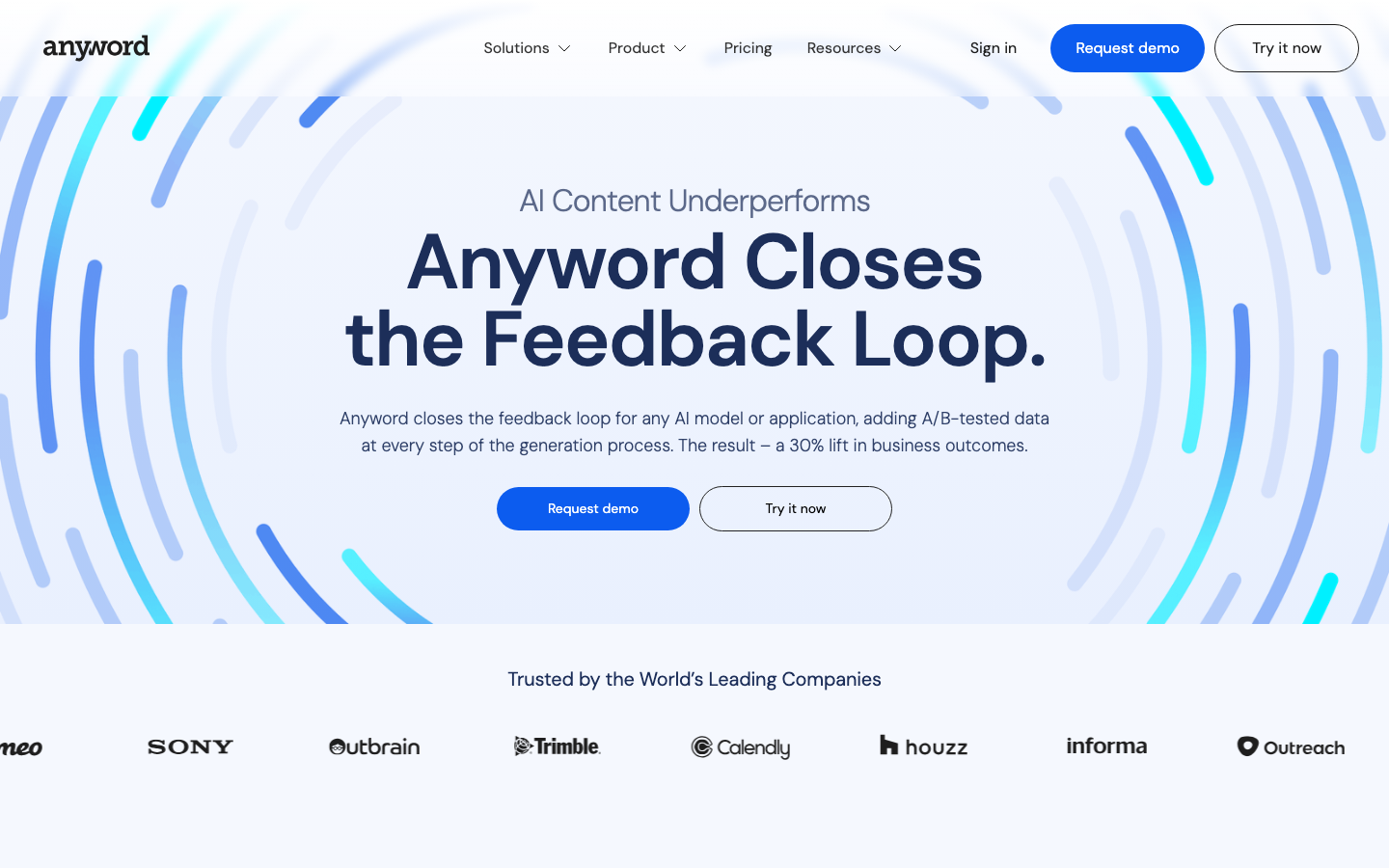
Anyword
Anyword tool introduction
Anyword is a data-driven AI copywriting and content optimization platform for businesses and marketing teams. Different from general-purpose AI writing tools, the core differentiation of Anyword lies in the integration of copywriting generation, effect prediction, and historical performance data training in the same workflow. It not only helps users "write", but also tells users "which version can bring better clicks/conversions" before publishing. The platform supports multi-channel copywriting scenarios such as advertising, landing pages, emails, social media, product descriptions, etc., and provides APIs for companies to embed predictive capabilities into their own AI agents or applications.
Anyword is operated by Keywee Inc. (New York, USA) and has obtained multiple compliance certifications such as SOC 2, ISO 27001, GDPR, HIPAA, etc., and is positioned as the "AI content infrastructure for the GTM (Go-to-Market) team". It officially claims that the effect of AI content using Anyword is increased by 76% on average, and the conversion rate is increased by 30% (source: anyword.com official website public data, 2025-2026).
Tool Type Classification: It belongs to "Productivity/Business Application" (Rule D). The main delivery form is a SaaS subscription platform, and APIs are provided for developers to integrate.
Anyword’s core features
1. AI copywriting generation (multi-channel coverage)
Anyword provides short text editors (advertising, social media, pop-up windows) and long text editors (blogs, landing pages, emails), with 100+ built-in marketing-specific templates and prompts. Support:
- Advertising copy: Google Ads, Meta Ads, LinkedIn Ads, X Ads, etc.
- Email Marketing: Development letter, cultivation sequence, cold start, retention email
- Website Content: Home Page, Product Page, Landing Page, Blog, Help Center
- Social Media Posting: LinkedIn, Facebook, Instagram, X (Twitter), TikTok, YouTube Description
- Product Description: E-commerce catalog SaaS function description
Blog Wizard has a built-in plagiarism checker, suitable for SEO content teams.
2. Copywriting performance prediction score (Performance Prediction)
This is the core function that distinguishes Anyword from general AI writing tools. After users generate multiple copywriting variations, the system will predict and score each variation based on target indicators (click-through rate, conversion rate, interaction rate, etc.), audience portraits, and delivery channels based on tens of millions of A/B test data sets.
Officials claim that its prediction accuracy reaches 82%, while general large models (such as GPT-5) are only 52% without the support of Anyword data (source: anyword.com official website public data). This means that Anyword can screen out high-potential versions before the content goes online, significantly reducing the cost of trial and error.
3. Historical performance data training (Performance Data Training / RLPF)
Anyword's original RLPF (Reinforcement Learning from Performance) mechanism - connects the company's existing advertising account CRM, CMS and other data sources, imports historical delivery performance data, and trains exclusive copywriting generation models. The system will identify "which words/selling points/titles have brought high conversions in the past" and prioritize the reuse of these high-performance elements in subsequent generation.
This is essentially a continuous reinforcement learning process based on real business feedback: delivery -> data return -> model fine-tuning -> better generation.
4. Brand Voice Compliance
Users can preset brand tone rules (formal/relaxed/professional/humorous, etc.) in Anyword, and all generated content will automatically align with the brand style. The platform provides a brand tone detection function to ensure that the content output by all team members is consistent in tone and avoids fragmentation of brand expression during multi-position collaboration.
5. Content Intelligence & Image Scoring
Anyword's Content Intelligence module provides a cross-channel content performance analysis dashboard to track which copywriting topics and keyword CTAs generate conversions at high frequencies. The Image Scoring feature predicts the performance of AI-generated images to ensure that visual materials also have high conversion potential.
6. AI Agents and Chrome Extensions
- Anyword Agent for Microsoft Copilot: Embed Anyword’s predictive and branding capabilities into the Microsoft 365 ecosystem
- Chrome Extension: Call Anyword’s generation and prediction capabilities in any web page input box
- ChatGPT / Gemini Copilot Integration: Get Anyword’s performance predictions and brand tone enhancements directly in third-party AI conversational tools
7. Gen-AI Content Performance API
Provides complete API capabilities for enterprise developers, including:
- Performance Context RAG: Inject high-performance words and audience data into any LLM prompt
- Predictive Analytics: Instant performance predictions for multiple AI-generated variations
- Data Import: Return performance data from CRM and advertising platforms
- Content Export: push optimized content back to CMS and advertising platform
Anyword’s pricing strategy
Anyword uses a SaaS subscription system, tiered by seats and forecast quota. Data source: anyword.com/pricing page (2025-2026 public information, actual prices).
| Package | Price | Seats | Number of performance predictions | Number of data rows | Key differentiators |
|---|---|---|---|---|---|
| Starter | $49/month | 1 | 50 times/month | 50 lines | Unlimited copywriting to generate 1 brand tone Blog Wizard, Chrome extension |
| Data-Driven | $99/month | 3 | 100 times/month | 50 lines | Starter included; real-time manual editing of forecasts |
| Business | Customized quotation | 3 | 250 times/month | 5,000 rows | Custom AI model, historical data training, website A/B testing, permission management |
| Enterprise | Customized quotes | On demand | 500+ times/month | 10,000+ lines | Private LLM, SSO, full API access, dedicated customer success manager, security review |
Free Trial: Each package provides a free trial path (the specific duration is subject to the official website registration process).
API Pricing: Complete billing details are not disclosed on the public page, enterprise customers need to contact sales to obtain a quote.
Hidden Cost Tip:
- The forecast quota limits the monthly usage of high-frequency iteration teams. If it exceeds the amount, the package needs to be upgraded.
- The number of data rows (performance data rows) is the record upper limit for imported historical delivery data, which directly affects the RLPF training effect
- Enterprise-level private LLMs with custom integrations typically require annual contracts
Analysis of the advantages and disadvantages of Anyword
Advantages
- Industry-leading performance prediction capabilities: 82% prediction accuracy (compared to 52% of the general model) is Anyword’s hardest barrier, allowing the marketing team to make data-driven decisions before going online.
- Historical data continues to feed the model: The RLPF mechanism allows the model to "understand" the brand more and more the more it is used, instead of generating it from scratch every time.
- Complete compliance certification: SOC 2, ISO 27001, GDPR, HIPAA quadruple certification, suitable for regulated industries (medical, financial, etc.).
- Rich integration ecosystem: Deeply connected with mainstream marketing stacks such as Salesforce, HubSpot, Marketo, Google Ads, Meta Ads, etc., covering 30+ platforms.
- Strong brand tone control: Ensure content consistency across teams and channels, which is something that general AI tools cannot do.
Disadvantages
- High pricing threshold: starting from $49/month, and the core prediction function has a limit. Small and micro teams or individual users may feel that the price/performance ratio is not as good as that of general tools (ChatGPT, Claude).
- Limited Chinese support: The platform is currently mainly in English. The functions and model optimization for Chinese marketing scenarios are weak, and domestic users need to evaluate it.
- Forecast accuracy depends on the amount of data: When a new account has no historical delivery data, the initial effects of the RLPF and prediction model may be compromised, requiring a "cold start" period.
- Learning curve exists: Compared with using ChatGPT to write copy directly, Anyword needs to understand concepts such as predictive scoring, data rows, and brand tone, and the team needs a certain amount of time to get started.
- Low transparency in version iterations: The official has not published standardized version logs, making it difficult for users to track the pace of feature evolution.
Applicable scenarios for Anyword
Dimensionality reduction strike scene
- Multi-ad account batch delivery team: Dozens or hundreds of ad copy need to be generated every day and the optimal version needs to be screened. Anyword's predictive scoring can directly replace the initial round of manual A/B testing, compressing the screening efficiency from "online testing 1-2 weeks" to "instant scoring".
- Enterprises with high requirements for brand content consistency: When multiple markets produce content at the same time, the brand tone compliance function ensures that the output style of the global team is consistent.
- High compliance industries (medical/financial/legal): HIPAA compliance + SSO + RBAC to meet strict auditing and authority management requirements.
- High-frequency output of e-commerce promotions/marketing nodes: Blog Wizard + multi-channel copywriting generation + historical data training, which can quickly reuse high-conversion words from past promotions.
Discourage/Inapplicable people
- Individual Creator/Freelancer: The entry price of $49/month is too high for individual combat. You can first use general AI tools + manual A/B testing.
- Chinese team focusing on the Chinese market: Anyword’s Chinese capabilities have not been verified on a large scale, and it is recommended to give priority to local tools in domestic marketing scenarios.
- One-off projects that do not require continuous iteration: If you just write a brand slogan or a single blog, there is no need for prediction and iteration pipeline.
Summary of Anyword
Anyword has a clear positioning and significant differentiation in the AI copywriting tool track - it is not a "writing assistant", but a conversion effect-oriented marketing content operating system. Its core value lies in standardizing the "Generation -> Prediction -> Learning -> Optimization" process, allowing marketing teams to make content decisions using data rather than intuition.
For professional marketing teams with continuous advertising needs, emphasis on conversion rates, and budget permitting, Anyword's ROI is quite clear: 33% faster ad creation speed, 23% more clicks, and 30% higher conversion rate (source: anyword.com public customer case data). However, individual users and small teams need to carefully evaluate the matching between the forecast amount and pricing.
Procurement/Adoption Risk Assessment: Enterprise customers need to focus on verifying the following three aspects before purchasing - (1) Whether the seats and predicted quota match the team's actual content output to avoid monthly budget overruns; (2) Additional billing rules for API calls to ensure that the total cost of the integration solution is controllable; (3) The statement about "anonymization training" in the data privacy terms confirms that the enterprise IP is completely isolated. It is recommended to apply for a trial first and run a cold start for 2-4 weeks using real historical data to verify the actual accuracy of the prediction model in your own business scenario before making an annual contract.
Anyword efficiency improvement comparison
Based on anyword.com's officially disclosed customer case data and industry benchmark deductions, the following is the change in working hours and effects of typical marketing positions before and after using Anyword (the places marked "deduction" are reasonable extrapolations based on public data, unofficial commitments):
| Job role | Typical tasks | Before use (traditional method) | After using Anyword | Improvement rate | Data source |
|---|---|---|---|---|---|
| Advertising Manager | Produce 20 pieces of advertising copy every week and A/B test | Manual writing + online testing, 1-2 weeks to draw conclusions, about 6-8 hours/week | Generation + real-time screening of predictive scores, about 3-4 hours/week | Time savings of 50%+ | Deduction; customer cases mention "33% faster ad creation" |
| Email Marketing Specialist | Design 5 versions of email subject and text and measure the open rate | Write + batch letters, receive data in 3-5 days, about 4-5 hours/round | Predictive scoring directly selects the high-opening version, about 2 hours/round | Time saving 55%+ | Deduction; based on the predictive scoring mechanism |
| Content Marketing Manager | 8 blogs per month + SEO optimization | Writing + manual duplication checking + optimization takes about 24 hours/month | Blog Wizard assisted writing + duplication checking takes about 14 hours/month | Time saving 40%+ | Deduction; based on Blog Wizard function |
| Brand/Creative Leader | Ensure consistent brand tone across channels | Manual review and modification after each output takes about 2-3 hours/round | Brand tone preset automatic compliance takes about 0.5 hours/round | Reduce rework by 75%+ | Deduction; based on Brand Voice Compliance function |
| Growth Manager | Extract high-conversion words from historical data | Manually pull and deliver report analysis, about 8-10 hours/month | RLPF automatically learns historical performance and applies it in about 2 hours/month | Time saving 75%+ | Deduction; based on Performance Data Training function |
| Performance Metrics | Ad CTR | Baseline | Improved 23% More Clicks | +23% | Client Story Christopher Ingrao (Senior Manager, Growth Marketing) |
| Performance indicators | Conversion rate | Baseline level | Average improvement 30% | +30% | anyword.com official website public data |
| Performance indicators | AI content performance | General AI (GPT-5) | Anyword optimized | +76% | anyword.com official website public data |
Automation boundaries for Anyword
Anyword's positioning is to "enhance human decision-making, rather than completely replace humans." The following is a breakdown of different levels of automation:
Can be 100% automated and organized
- Generate first draft of copywriting: After inputting product selling points, audience, and channels, Anyword can automatically generate multiple versions of copywriting.
- Performance prediction scoring: Automatic scoring and sorting of generated or handwritten copywriting variants.
- Brand tone compliance check: Automatically detect whether the copy complies with the preset brand tone rules.
- Historical data import and training: After connecting to the advertising platform/CRM, the delivery data will be automatically returned to update the model.
- Content Export: Push the selected copy to Google Ads, Meta Ads, HubSpot and other target platforms with one click.
Human-in-the-loop requires human intervention
| Reasons for requiring manual intervention | Typical intervention methods | |
|---|---|---|
| Brand strategic content (official website homepage, brand manifesto, etc.) | High-value, irreversible external image output, requiring final confirmation by senior executives/creative directors | Release after manual review and revision |
| High compliance industry content (medical claims, financial product descriptions) | Regulations require compliance/legal team review | Legal review -> Manual issuance |
| Irreversible operations (advertising account deductions, batch email sending) | Involves real budget expenditures, which need to be confirmed | Manual confirmation online button |
| Prediction model cold start phase | New accounts lack historical data, and the initial prediction may not be accurate enough | Manual sampling is required to verify the prediction accuracy before trusting |
| Customer communication/complaint response | Involves customer relations and brand reputation, needs humanized treatment | Manual writing + Anyword assisted optimization |
| Pricing and promotion strategy copywriting | Involving business decisions such as gross profit margin, discount range, etc. | After confirmation by the strategy team, Anyword will expand multiple versions |
Suggested automated processes
Manual input of strategic intent -> Anyword generates multiple versions -> Prediction score sorting ->
Manual review Top 3 -> One-click placement/sending -> Data return -> RL retraining ->
The next round of generation effect will be automatically improved.
Security and Compliance for Anyword
Anyword has invested significantly in security and compliance and is one of the few AI copywriting platforms on the market that holds quadruple certification.
Certification and Standards
| Certification/Standards | Status | Scope of application |
|---|---|---|
| SOC 2 Type II | Passed | Security, Availability, Confidentiality |
| ISO 27001 | Passed | Information Security Management System |
| GDPR | Compliance | EU User Data Protection |
| HIPAA | Passed (new in 2025) | U.S. Healthcare Information Protection |
| SSO / SAML | Enterprise plan support | Single sign-on |
| MFA (Multi-factor Authentication) | Supported | Account security enhancement |
| RBAC (Role-Based Access Control) | Business/Enterprise package support | Permission level management |
Data Privacy Principles
- Data is not used for third-party model training: Anyword’s proprietary generation engine is LLM-agnostic (model agnostic) architecture, ensuring complete isolation of customer data and full control of IP.
- Private LLM Option: Enterprise customers can deploy private language models without data leaving the enterprise boundary.
- DPA (Data Processing Agreement): A DPA agreement template is available on the official website (source: anyword.com/anyword-dpa-agreement).
Infrastructure Reliability
- 99.9% Uptime: Guaranteed SLA
- Global availability and failover: multi-region deployment, automatic failover
- Enterprise-level security review: Enterprise package includes security and legal review
Anyword’s integrated ecosystem
Anyword provides 5 types of core integration capabilities: Performance Context RAG, Performance Prediction, Data Import, Performance Data Training, and Content Export. As of mid-2026, it has supported docking with 30+ mainstream platforms.
Main integration list
| Category | Platform | Integration capabilities |
|---|---|---|
| Advertising | Google Ads, Meta Ads, LinkedIn Ads, X Ads | Content Export, Performance Prediction, Performance Context RAG, Performance Data Training |
| CRM | Salesforce, HubSpot, Microsoft Dynamics 365, Oktopost | Data Import, Performance Context RAG, Content Export, Performance Prediction |
| Marketing Automation | Marketo, Eloqua, Braze, Iterable | Data Import, Performance Context RAG, Content Export, Performance Prediction |
| CMS | Sitecore, Drupal | Content Export, Data Import, Performance Context RAG |
| Social Media Platforms | Facebook Page, LinkedIn Page, Instagram, X (Twitter) | Content Export, Performance Prediction, Performance Context RAG |
| Sales Enablement | Outreach, Gong | Data Import, Performance Context RAG, Performance Prediction |
| Product Information Management | inRiver, Salsify | Data Import, Performance Data Training, Content Export |
| AI Collaboration | ChatGPT, Gemini, Microsoft Copilot | Performance Prediction, Performance Context RAG |
| Office Collaboration | Google Drive, Microsoft Word | Content Export, Performance Context RAG |
| Project Management | Wrike | Content Export |
| Customer Experience | Sprinklr | Content Export, Data Import, Performance Data Training |
| Browser Extension | Chrome Extension | Call Anyword prediction and generation in any web page input box |
Ecological architecture diagram
[Marketing Data Source] -> Data Import -> [Anyword Engine]
                                  |
[LLM] <- Performance Context RAG <- [Anyword Engine]
  | |
[AI generated content] -> Performance Prediction -> [Rating results]
                                  |
                          Manual review Top 3
                                  |
                    Content Export -> [Distribution Platform / CMS / CRM]
                                  |
                    Performance Data Training <- [Delivery Data Postback]
                                  |
                        Continuous model optimization (RLPF disabled)
Implementation suggestions for Anyword
Deployment roadmap (recommended 4 weeks incremental)
Week 1: Trial and Evaluation
- Sign up for a Starter or Data-Driven package trial
- Run 3-5 rounds of generation -> prediction -> delivery verification in a single channel (such as Google Ads)
- Record the consistency between Anyword's predicted score and actual delivery performance
- Evaluation indicators: Whether the prediction accuracy reaches 70%+, and whether the brand tone is in line with expectations
Week 2: Data Access and Cold Start
- Connect the advertising account (Google Ads / Meta Ads) to return 3-6 months of historical delivery data
- Import customer segmentation information in CRM (Salesforce / HubSpot)
- Set up 1-2 brand tone templates to cover core channels
- Key Action: Confirm whether Performance Data Training successfully reads historical data
Week 3: Team Training and Process Establishment
- Marketing Copywriter Position (2-4 hours of training):
- Anyword editor operations (short text/long text)
- Predictive scoring understanding and screening criteria (Top 3 strategies)
- Guidelines for using brand tone templates
- Content operation position (1-2 hours of training):
- Blog Wizard and SEO process
- Chrome extension usage
- Management (1 hour):
- Content Intelligence Kanban Interpretation
- ROI assessment framework
Week 4: Scale and Optimize
- Expand to 3+ channels (Ads + Email + Landing Page)
- Start RLPF automatic learning loop
- Establish a weekly content performance review mechanism and iterate the brand tone rules
- Evaluate whether you need to upgrade to the Business/Enterprise plan
Team configuration suggestions
| Team size | Recommended packages | Expected monthly cost | Typical configuration |
|---|---|---|---|
| 1-2 people (individual/freelancing) | Starter | $49 | 1 Brand Tone 1 Seat |
| 3-5 people (small to medium marketing team) | Data-Driven | $99 | 3 seats, 100 predictions |
| 5-15 people (growth team) | Business | Customization (estimated at about $500-1500/month) | Custom models, historical data training, permission management |
| 15+ people (Enterprise Marketing Department) | Enterprise | Customization | Private LLM, SSO, full API access, exclusive CSM |
Best Practices
- Don’t rely entirely on prediction scores during the cold start period: It is recommended to use manual + prediction dual-track parallelism in the first 2-4 weeks, and then gradually increase the automation ratio after accumulating trust data.
- Use Performance Data Training to establish competitive barriers: The longer it continues to be launched, the deeper the RLPF model will understand the brand's rhetoric, making it difficult for late-comer competitors to copy.
- Leave a margin in the forecast quota: A 20-30% margin should be reserved for the number of monthly forecasts to deal with unexpected marketing events (big promotions, hot spots).
- Brand tone templates are set differently by channel: LinkedIn’s tone can be more formal than TikTok, and the same brand can maintain 2-3 channel variant templates.
- Regularly check the data row quota: The number of data rows (performance data rows) is the "fuel" for RLPF training. Low-quality records should be cleared in advance or the package should be upgraded before it is used up.
Common mistakes to avoid
- Import dirty data: Invalid ad groups or test records are mixed in historical delivery data, which will pollute the RLPF training effect. Data cleaning needs to be done before importing.
- All-in Switch: Migrate all channels to Anyword at once, lacking a baseline. It is recommended to leave one channel as a control group to continuously compare the effects.
- Ignoring copyright risks: Copyright ownership of AI-generated content varies in different jurisdictions, and policy-sensitive companies should consult their legal teams before using AI-generated content for commercial purposes.
The main functions of Anyword
- Core Processing Capabilities: Provides core AI capabilities in relevant scenarios to support users to quickly complete tasks.
- Multi-modal interaction: supports text input and result output, and some scenes support image or file upload.
- Workflow Integration: Can be embedded into existing workflows or linked with other tools through APIs to reduce context switching.
Application scenarios of Anyword
- Personal Creation: Quickly generate or process content to improve daily work efficiency.
- Team collaboration: Unify workflow and reduce repetitive manpower investment.
- Enterprise-grade deployment: Embed capabilities into on-premises systems via API or private deployment.
Anyword’s applicable groups
- Individual Users: Content creators and knowledge workers who need AI assistance to improve their daily work efficiency.
- Developers: Technical teams who need to integrate AI capabilities into their own products or services through APIs.
- Enterprise: Organizations seeking to deploy AI at scale in their field.
Anyword’s technical advantages
- Algorithm Optimization: Special optimization at the model or algorithm level has been carried out for the corresponding scenario to achieve a balance between response speed and result quality.
- Low-latency architecture: Adopts streaming or asynchronous processing architecture to reduce user waiting time and is suitable for high-frequency interaction scenarios.
Anyword’s core parameters and statistics
Specific technical parameters (such as model size, context length, supported file formats, input and output restrictions, etc.) are subject to the official product page. It is recommended that users verify the latest technical specifications and system requirements before choosing to ensure that they match their own usage scenarios.
Anyword’s user and market recognition
Gradually build user awareness in the field, and product capabilities are used by content creators and teams to improve work efficiency. Some industry users have incorporated it into their daily workflow. It is recommended to refer to the latest official disclosures for specific user scale and industry adoption rate data.
Anyword’s cost advantage
- C-side/Individual: Usually a free version is provided to experience the core functions, and high-frequency use requires a paid package subscription.
- API/Developer: Billed by call volume, suitable for development teams that can be flexibly integrated into their own systems.
- Enterprise/Privatized: Contact the business owner for customized quotation and deployment plan. The specific price is subject to the official real-time pricing page.
Summary and Outlook of Anyword
It provides competitive solutions in its field, and its core value lies in lowering the threshold for AI use in this field. With technology iteration, products are expected to continue to improve in functional coverage and performance.
Current limitations: Some advanced features require paid subscription, and the free version has function or usage restrictions; specific technical details and performance benchmarks have not been fully disclosed, and it is recommended to fully verify it through trial before purchasing.
Related tools:  Notion AI,
  Jasper
Anyword’s model and version evolution
Continuous iterative updates, the latest version introduces performance optimization and new features. Historical version information can be viewed on the official release page. There is no complete public version evolution timeline yet. It is recommended to pay attention to the official announcement to understand the rhythm of feature updates.
How to use Anyword
- Web client: You can use it by visiting the official website and registering an account. Most functions do not require installation.
- API access: Provides RESTful API, developers can obtain the API Key and integrate it into their own applications.
Anyword’s Product Pricing
The pricing model is subject to the official real-time page. Usually a freemium or subscription system is used, and basic functions can be used for free. Advanced functions or high-frequency use require paid subscriptions, and users are advised to evaluate the optimal solution based on actual usage.
Version Info
- Anyword Web Latest :The official website is continuously updated, and there is no official precise version number and release date yet.
- Anyword Web Previous Milestone :There is no official precise date yet, and the historical capability evolution is subject to the official real-time page.
User Reviews