 AutoGen
Free
AutoGen
Free
AutoGen is an open source multi-AI Agent framework from Microsoft Research that allows developers to build systems where multiple AI Agents can talk to each other and collaborate to complete complex tasks. It supports mainstream models such as GPT-4, Claude, and Gemini, and has built-in code execution, tool calling, and human-computer interaction capabilities. With over 30,000 GitHub stars, it is one of the most popular AI multi-agent programming frameworks.
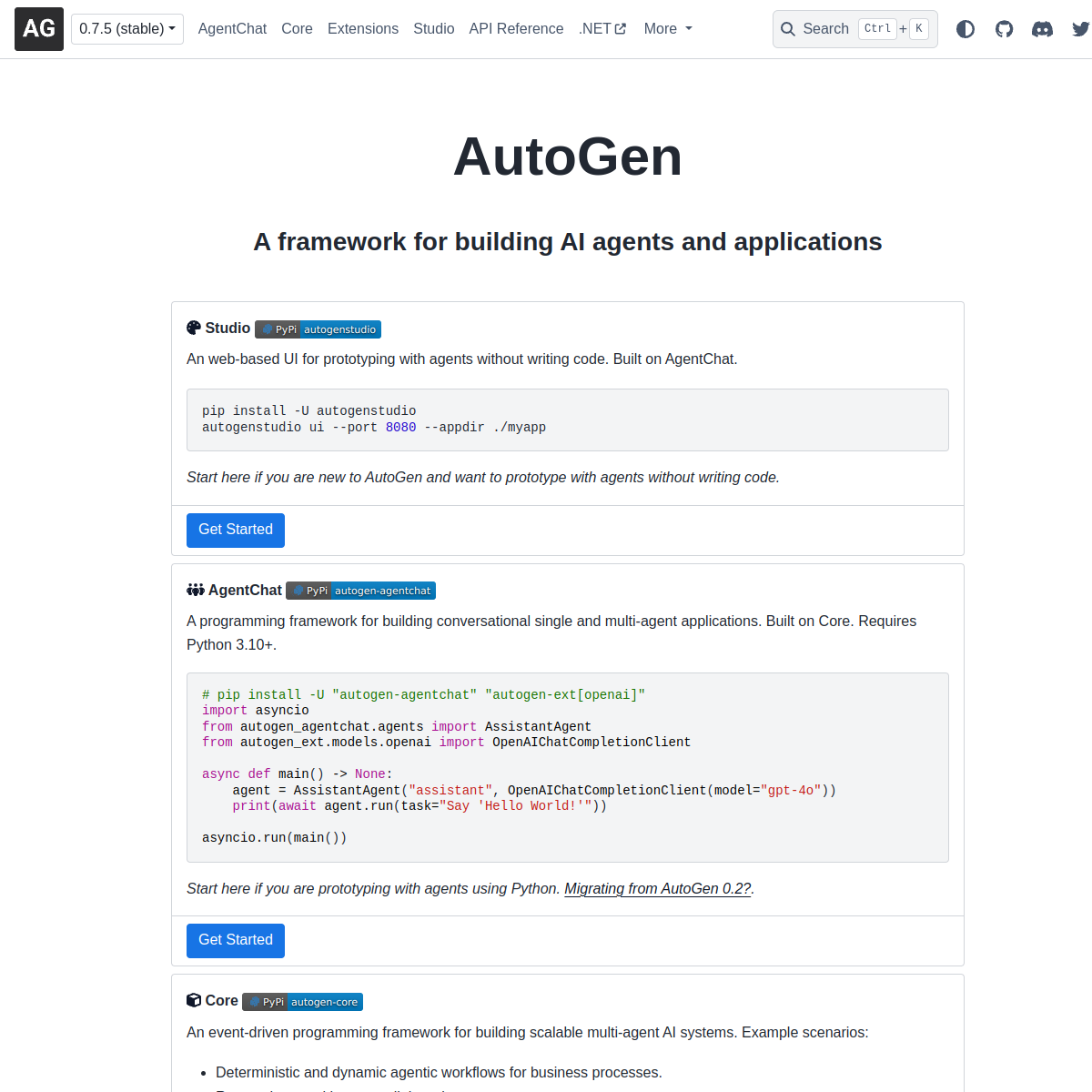
AutoGen — Microsoft’s open source multi-agent dialogue framework
Core parameters and statistics
| Parameters | Details |
|---|---|
| Published | September 2023 |
| Development organization | Microsoft Research (Microsoft Research) |
| Lead author | Chi Wang, Qingyun Wu and the Microsoft Research team |
| Open Source License | MIT License |
| GitHub stars | 35,000+ (as of 2025) |
| Programming Languages | Python (main), experimental .NET version |
| Supported models | OpenAI, Azure OpenAI, Anthropic, Google, Mistral, Ollama, etc. |
| Installation method | pip install autogen |
| Core features | Multi-Agent dialogue, automatic code execution, tool invocation, human-computer interaction |
| Application fields | Automated task execution, data analysis, software development Agent, research automation |
The core innovation of AutoGen is to use "multiple AI Agents talking to each other" as the basic paradigm for solving complex problems - different Agents play different roles (such as planners, executors, reviewers), and iteratively complete complex tasks beyond the capabilities of a single LLM through structured dialogue, while retaining the ability of humans to intervene and provide feedback at any time.
User and market recognition
AutoGen is one of the most cited multi-agent AI frameworks in academia and industry. Its paper "AutoGen: Enabling Next-Gen LLM Applications via Multi-Agent Conversation" has been cited more than a thousand times within a few months after its release, becoming a basic reference for multi-agent system research. 35,000+ stars and hundreds of forks on GitHub validate its broad influence in the developer community.
At the industrial application level, AutoGen is used by a large number of startups and enterprise AI teams as the basic framework for building AI automation workflows, especially in scenarios such as data analysis automation, code generation and testing, and document processing. Microsoft itself has also integrated the concept of AutoGen into the multi-agent functions of Azure AI Studio and Microsoft Copilot Studio, which is an important technical pillar of Microsoft's AI strategy.
Cost advantage
| Plan | Price | Main Benefits | Target Users |
|---|---|---|---|
| Open source framework | Completely free | All AutoGen framework features | Developers, researchers |
| AutoGen Studio | Completely free | Visual Agent building interface | Low-code users |
| Azure AI integration | Billing by LLM call | Enterprise-level support for Azure ecosystem integration | Enterprise users |
The AutoGen framework itself is completely free and open source, and users only need to bear the cost of API calls to the LLM of their choice. AutoGen offers the highest flexibility and customizability at zero framework cost compared to Salesforce Einstein Agents or other commercial multi-agent platforms, making it the first choice for researchers and development teams with limited budgets.
Main functions
- ConversableAgent Framework: core abstraction, each Agent is a conversational entity with its own system prompts, toolset and response strategy, and can conduct multiple rounds of structured dialogue with other Agents or humans.
- GroupChat Multi-Agent Collaboration: Multiple Agents form a group, and the next speaking Agent is determined through rotation or intelligent selection mechanism to achieve automatic decomposition and collaborative execution of complex multi-step tasks.
- Code Execution Sandbox: With built-in code execution capabilities, the Python/Shell code generated by the Agent can be automatically executed in a secure Docker container or local environment, and the results are verified and fed back to the Agent for iterative improvements.
- Tool Use: Supports configuring custom tool functions (such as web search, database query, file operation) for the Agent. The Agent can independently decide when to call which tool to expand its scope of action.
- Human-in-the-Loop: Flexibly configure the timing of human intervention through UserProxyAgent - from completely autonomous execution (NEVER) to confirmation of each step (ALWAYS) to meet task requirements of different trust levels.
- Model-independent design: Supports almost all mainstream models such as OpenAI, Azure OpenAI, Anthropic Claude, Google Gemini, Mistral, Ollama, etc. through a unified LLM configuration interface to facilitate model switching and cost optimization.
- AutoGen Studio visual interface: A web-based visual Agent design tool that allows graphical configuration of Agent roles, tools and workflows, and supports online debugging and execution.
- Asynchronous execution (AsyncIO): Version 0.4 adopts async-first architecture, supports concurrent execution of multiple agents, and significantly improves the execution efficiency of complex workflows.
Model and version evolution
| Version | Time | Major Changes |
|---|---|---|
| Papers and pre-release | 2023-08 | AutoGen academic paper published, multi-Agent dialogue paradigm proposed for the first time |
| v0.2 public release | 2023-09 | PyPI officially released, ConversableAgent framework, code execution sandbox |
| AutoGen Studio | 2024-02 | Visual Agent construction interface released |
| v0.3 | 2024-06 | More model support, improved GroupChat management |
| v0.4 Architecture Reconstruction | 2025-03 | AgentChat/Core/Extensions three-tier architecture, asynchronous first design |
Technical advantages
Design philosophy of dialogue as a primitive: AutoGen elevates "multi-agent dialogue" to a core computing primitive for solving complex problems. Each Agent is both a message sender and a receiver, and the problem-solving process is modeled as a dialogue evolution process between Agents. This paradigm enables the decomposition, execution and verification of complex tasks to be expressed using a unified dialogue model, reducing the design complexity of multi-agent systems.
Code Executor Agent: A key technical advantage of AutoGen is the seamless combination of LLM code generation and actual code execution - AssistantAgent generates code, UserProxyAgent (or a specialized CodeExecutorAgent) executes the code and feeds back the results, forming an automatic cycle of "generate-execute-observe-improve" until the task is completed. This feature makes AutoGen particularly suitable for data analysis, algorithm implementation and other programming tasks that require verification.
Flexible human-computer interaction design: Unlike many Agent frameworks that pursue "full automation", AutoGen has considered human intervention as a core function from the beginning of the design, allowing developers to finely control which steps of the Agent require human confirmation, taking into account the safety requirements of automation efficiency and human supervision, and is more in line with the actual deployment requirements of current AI systems.
Active research-engineering dual-track community: AutoGen serves both academic researchers (rapid prototype verification of new Agent architecture) and engineering developers (construction of production-level Agent systems), forming a unique ecosystem where academic innovation and engineering practice promote each other. New research results (such as new models of Agent collaboration) can be quickly implemented and verified in the framework.
How to use
| Entrance | Description |
|---|---|
| PyPI installation | pip install autogen or pip install pyautogen |
| Official documentation | https://microsoft.github.io/autogen/ |
| GitHub repository | https://github.com/microsoft/autogen |
| AutoGen Studio | pip install autogenstudio && autogenstudio ui |
Typical usage steps (Python API):
- Install:
pip install autogen, set OpenAI or Anthropic API Key as a context variable. - Configure LLM: Create a
config_listto specify the model provider and API Key. - Create Agent: Define
AssistantAgent(AI assistant) andUserProxyAgent(executor/human agent). - Configure tools for the Agent: Register the Python function as a tool, and the Agent can call it independently.
- Start the conversation: call
user_proxy.initiate_chat(assistant, message="Complete task description"). - Observe the Agent dialogue process: multiple Agents collaborate automatically, code executes automatically, and tasks are gradually completed.
Product Pricing
AutoGen is completely free open source software (MIT License) without any paid plans:
- Framework: completely free and open source, with unlimited use of all functions.
- AutoGen Studio: completely free, no need to pay for the visual interface and debugging tools.
- LLM API fee: The user is responsible for it. They can choose commercial APIs such as OpenAI, Anthropic, and Google (billed by token), or use the local Ollama model (zero cost).
- Azure Integration (Enterprise Option): When used through Azure OpenAI, the cost is included in your Azure bill, but there is no additional charge at the AutoGen framework level.
Overall, AutoGen is currently the free and open source multi-agent framework with the most complete functions and the most active community. Enterprises can build production-level Agent systems based on it without paying any framework license fees.
Application scenarios
1. Data Analysis Automation The data science team configures "Data Analyst Agent" and "Code Execution Agent" to form a workflow and uses natural language to describe analysis requirements. The Agent automatically generates Python data processing code, executes it, analyzes the results, and generates reports, compressing manual analysis that originally took hours to minutes.
2. Software Development Agent System Build a multi-Agent development pipeline including "Requirements Analysis Agent", "Code Generation Agent", "Testing Agent" and "Code Review Agent" to automatically complete the complete development cycle from requirements to runnable code, which is especially suitable for standardized functional module development tasks.
3. Research Automation AI researchers use AutoGen to build a multi-agent system of "Paper Retrieval Agent", "Data Extraction Agent" and "Analysis and Synthesis Agent" to automatically complete research auxiliary tasks such as systematic literature review and experimental data summary, greatly improving research efficiency.
4. Enterprise Knowledge Base Q&A Combined with RAG (Retrieval Augmented Generation), a multi-Agent enterprise knowledge question and answer system is built. One Agent is responsible for understanding user questions, another is responsible for retrieving the knowledge base, and the third is responsible for comprehensive answers. The quality of answers to complex questions is improved through multi-Agent collaboration.
5. Workflow Automation Integrate AutoGen with external tool APIs to build an Agent workflow that can autonomously call enterprise systems such as CRM, ERP, and databases to achieve end-to-end automation of business processes, such as contract processing, data entry, report generation and other repetitive tasks.
Applicable people
- AI researchers and algorithm engineers: For researchers who want to quickly verify their multi-agent architecture ideas, AutoGen provides the most flexible experimental platform that can quickly configure various Agent roles and communication modes.
- Python Developer: Engineers who have a Python foundation and want to build AI automated workflows. AutoGen's API design is simple and intuitive, with a low learning curve.
- Enterprise AI Platform Team: For teams looking to build an internal AI Agent infrastructure within the enterprise, AutoGen's flexibility and scalability are its main advantages over commercial platforms.
- Unsuitable scenarios: Enterprise-critical businesses that require mature production-level reliability guarantees (AutoGen is still a research-oriented framework, and production stability is not as good as commercial platforms); non-technical users (AutoGen Studio provides certain low-code capabilities, but it is still a developer tool overall); simple tasks that require a fixed and stable workflow rather than adaptive dialogue (a single Agent + tool calling solution is more suitable).
Summary and Outlook
AutoGen has established an important position in the field of AI Agent frameworks with its systematic implementation of the multi-agent dialogue paradigm. The endorsement of Microsoft Research brings continuous academic research input, and the active open source community ensures rapid engineering iteration. The architectural reconstruction of version 0.4 shows the team’s determination to upgrade AutoGen from a research tool to a production-level platform. Asynchronous-first design and modular architecture have laid a more solid technical foundation for large-scale Agent system deployment.
Current limitations: The abstraction layer of the framework is complex, and the learning curve is still challenging for beginners; reliability in ultra-long running tasks (Agent may fall into loops or produce unexpected behaviors) is still a challenge; integration with production context (monitoring, logging, error recovery) requires additional engineering investment; document quality and framework iteration speed are sometimes out of sync.
Directions of future focus: Improvement of Agent memory and persistence state, deep integration with Model Context Protocol (MCP), construction of the Observability tool chain, and commercial integration of AutoGen in Microsoft Copilot Studio and Azure AI products.
Related tools:  CrewAI,
  LangChain
Version Info
- AutoGen 0.3 Preview :Released AutoGen 0.3, introducing a more flexible Agent communication protocol and supporting custom message routing; adding support for more model providers (including Mistral, Cohere, and local Ollama models); improving the GroupChat management mechanism and adding SelectorGroupChat (intelligent selection of the next speaking Agent).
- AutoGen Studio released :Released AutoGen Studio - a web-based visual Agent building interface that allows developers to configure Agent roles, tools and workflows through a graphical interface, lowering the threshold for using AutoGen and building basic Agent applications without writing Python code.
- AutoGen 0.2 released :AutoGen was released to the public for the first time, proposing the core abstraction of ConversableAgent, supporting multiple Agents to form a conversation group (Group Chat) for automatic collaboration; built-in two basic Agent types: UserProxyAgent (representing humans) and AssistantAgent (LLM driver); supporting code execution sandbox (Docker or local); attracting widespread attention in Hacker News and academia.
- AutoGen 0.4 stable version :AutoGen 0.4 has completed a major architectural reconstruction, introducing a three-layer architecture of AgentChat, Core, and Extensions, and adopting an async-first design to improve concurrency performance; a new AutoGen Studio visual interface is added, allowing codeless construction and debugging of Agent workflows; and enhanced support for enterprise-level LLM services such as Azure OpenAI and Amazon Bedrock.
User Reviews