 Baidu Wenku AI Assistant
Free
Baidu Wenku AI Assistant
Free
Baidu Wenku AI Assistant is an AI tool built into Baidu Wenku. It integrates document generation, summary, question and answer and other capabilities into the library scene. It is a document-oriented AI Office assistant.
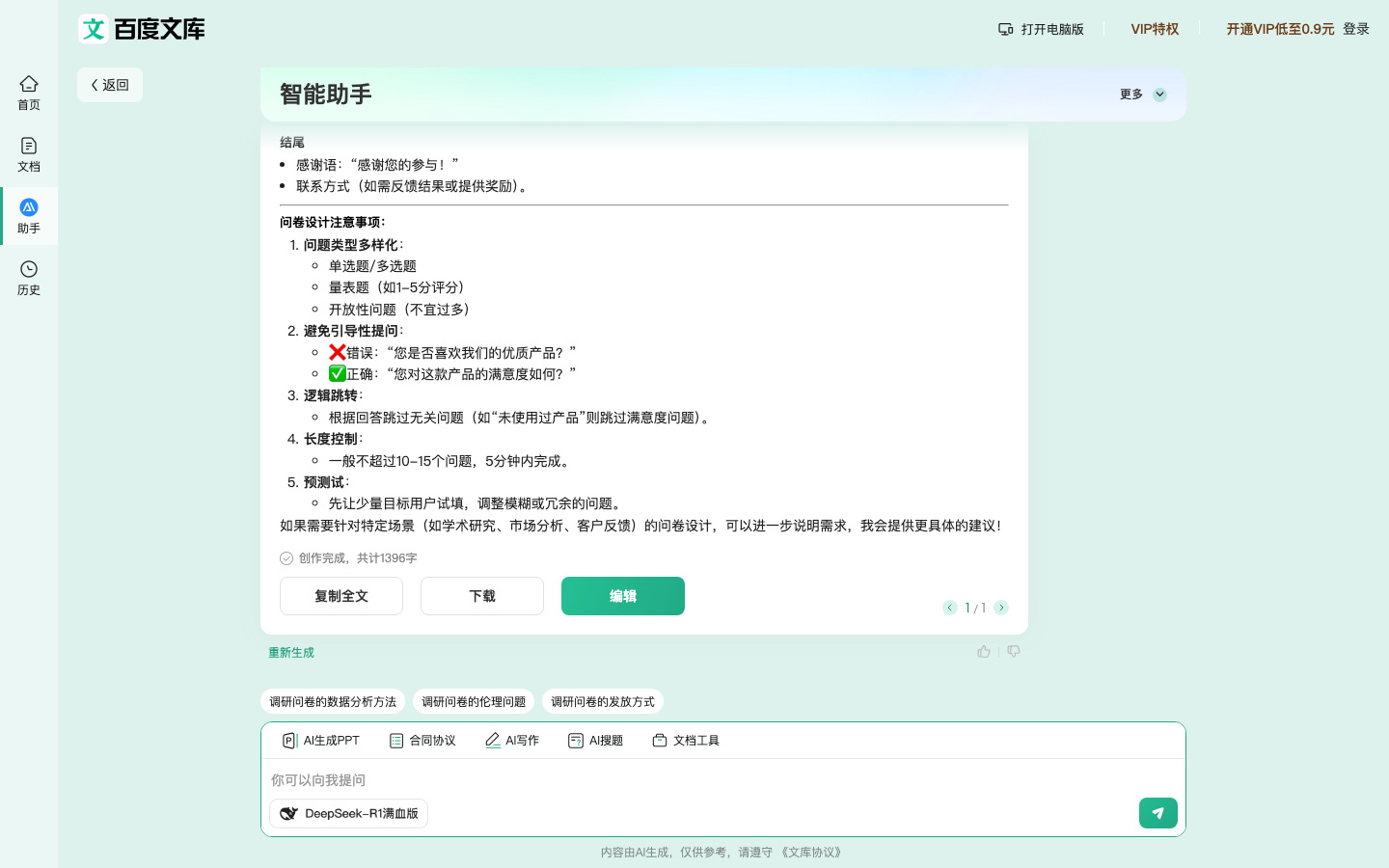
Baidu Wenku AI Assistant
Core parameters and statistics
Baidu Wenku AI Assistant is an AI tool built into Baidu Wenku. Understand it in one sentence - it is not an independent chat software, but a "document enhancement module" embedded in the library scene: when you read documents, find information, and write materials, it can help you generate content, summarize key points, and answer questions on the spot. The core pain point it solves is "it's troublesome to switch AI tools back and forth in the document scene."
| Projects | Public Information |
|---|---|
| Official positioning | Built-in AI document assistant in the library |
| Producer | Baidu Library |
| Underlying capabilities | Wenxin large model |
| Core Competencies | Document Generation/Summary/Q&A |
| Product form | Web, embedded library |
| Content ecology | Massive library document resources |
| Support Platform | Web |
| Place of Belonging | China |
| Is it free | Provides free capabilities |
Product Boundary: It is strong in "one-stop in the document scene", combining generation, summary, question and answer with library resources; it is not a general programming or complex multi-modal tool.
Capability source: Relying on Baidu Wenku's massive document resources and Wenxin large model, content understanding and generation capabilities are implemented in document usage scenarios.
User and market recognition
Gradually build user awareness in the field, and product capabilities are used by content creators and teams to improve work efficiency. Some industry users have incorporated it into their daily workflow. It is recommended to refer to the latest official disclosures for specific user scale and industry adoption rate data.
Cost advantage
- C-side/Individual: Usually a free version is provided to experience the core functions, and high-frequency use requires a paid package subscription.
- API/Developer: Billed by call volume, suitable for development teams that can be flexibly integrated into their own systems.
- Enterprise/Privatized: Contact the business owner for customized quotation and deployment plan. The specific price is subject to the official real-time pricing page.
Main functions
- Document generation: Generate documents and first draft of materials according to needs.
- Content Summary: Quickly summarize the main points of long documents.
- Document Q&A: Ask questions around the document content.
- Combination of Templates and Resources: Combining massive resources from the library to assist creation.
- Rewrite and Polish: Optimize existing content.
Hidden linkage: Its value lies in the synergy of "AI capabilities + library resources" - when generating materials, you can use the library's massive documents and templates, and when summarizing and answering questions, you can combine specific document content. The combination of the two allows document work to be integrated in one scene, eliminating the need to switch between tools.
Model and version evolution
Continuous iterative updates, the latest version introduces performance optimization and new features. Historical version information can be viewed on the official release page. There is no complete public version evolution timeline yet. It is recommended to pay attention to the official announcement to understand the rhythm of feature updates.
Technical advantages
Mechanism: Embed the content understanding and generation capabilities of the Wenxin large model into the library document scene, and combine the library's document and template resources.
Effectiveness: Users can complete generation, summary, and Q&A without leaving the library, reducing cross-tool switching; combining library resources makes creation more evidence-based.
Applicable scenarios: Students and professionals who often search for information, write materials, and process long documents in libraries can best benefit from the one-stop design in the scenario.
How to use
- Enter the Baidu Wenku AI Assistant page or invoke the assistant in the Wenku document.
- Describe requirements, such as generating materials, summarizing documents, or asking questions.
- Let AI combine library resources to give results.
- Verify and edit the generated content.
- Continue to improve the document in the library scene.
The entrance is in the library, and free capabilities can be experienced directly.
Product Pricing
The pricing model is subject to the official real-time page. Usually a freemium or subscription system is used, and basic functions can be used for free. Advanced functions or high-frequency use require paid subscriptions, and users are advised to evaluate the optimal solution based on actual usage.
Application scenarios
- Material Writing: Quickly generate first drafts of reports, plans, etc.
- Long document summary: Refining the key points of the information.
- Document Q&A: Quickly obtain information around documents.
- Content polish: Optimize the expression of existing documents.
Applicable people
- Student: Write a paper, find information, and summarize literature.
- Workplace Person: Write reports, plans, and materials.
- Content Worker: Need assistance with document generation and organization.
Not suitable for the boundary: For documents that require serious and original long articles or highly professional and strong compliance requirements, the AI first draft is only a starting point and must be subject to manual in-depth verification; users who require general programming and complex multi-modal creation should choose corresponding professional tools.
Summary and Outlook
Baidu Wenku AI Assistant embeds the document capabilities of Wenxin Large Model into the library scene, using a one-stop design of "generation + summary + question and answer + resource combination" to solve the pain point of frequent tool switching in document work, and uses the library's massive content ecology as the basis for differentiation. Its boundary is that AI-generated content still requires manual control.
Implementation suggestions: Students and professionals can use it for free as a "handy assistant" in document scenarios to quickly produce a first draft, make a summary, and then manually verify the final draft; for formal materials with high accuracy and compliance requirements, the AI results are only used as a starting point, and key content must be reviewed manually.
Related tools:  Notion AI, google-workspace
Version evolution of Baidu Wenku AI Assistant
As an online function, the ability continues to iterate with the upgrade of Wenxin large models and library products, and there is no traditional discrete version number.
Main line context
- Launch period (~2024): Baidu Library introduces AI assistant to provide generation, summary, and question and answer capabilities.
- Continuous iteration period: With the upgrade of the Wenxin large model, the document processing quality and scene coverage are enhanced.
The official unified version number and precise date have not been disclosed, and the text is marked with the online version at the time of collection.
Business process integration and ROI analysis
As a productivity tool for enterprises or professional positions, the real value of Baidu Wenku AI Assistant depends on the depth of integration with existing workflows and the quantifiable efficiency improvement effect. The following is a systematic analysis from three core dimensions.
System integration and data interoperability The ability to interoperate with existing business systems is a key prerequisite for productivity tools to be integrated into workflows. It is recommended to focus on evaluating the following integration dimensions: the openness and documentation quality of the RESTful/GraphQL API (whether a complete API reference and SDK examples are provided), the support scope of Webhook event notifications (which business event types are supported for automatic push), the number and depth of pre-built integrations with common collaboration SaaS tools (WeChat Enterprise, DingTalk, Feishu, Slack, Notion, Jira, etc.), and enterprise-level identity authentication support (SSO/SAML/OAuth and LDAP/AD directory integration). Products that lack integration capabilities are easily isolated into information islands, which in turn increases the cognitive cost and operational friction for teams to switch between different tools.
Efficiency Quantification and ROI Estimation Methodology Before purchasing decisions, it is recommended to quantify the input-output ratio through a structured method: Step 1, choose 3-5 Standardized tasks that are frequently repeated and time-consuming in each team are used as test samples; in the second step, the average time consumption of a single task before and after tool intervention, first-time pass rate or error rate, and the number of links requiring manual intervention are recorded under controlled conditions; in the third step, the saved manpower time is converted according to the comprehensive cost of the position (salary, benefits, management sharing), and soft benefits (increased employee satisfaction, standardization of work quality, and improvement in response speed to core business) are superimposed to obtain a comprehensive ROI estimate. It is recommended to continue tracking ROI trends on a monthly basis, as the value of a tool usually increases over time as team proficiency increases and workflows are optimized.
Phase-based implementation strategy and risk control It is recommended to adopt a three-stage implementation path of "pilot verification-gradual promotion-continuous optimization". In the pilot stage (1-2 weeks), a single team or a single business scenario is selected for small-scale verification. The core goal is to verify technical feasibility and user acceptance, and establish preliminary usage specifications and success standards; in the promotion stage (2-4 weeks), after the pilot verification is passed, the coverage is gradually expanded, and standardized activation processes and training materials are developed; in the optimization stage (continuous), the workflow configuration is continuously adjusted based on actual usage data and user feedback, and more high-value application scenarios are explored. Clear quantitative key result indicators should be set at each stage to avoid blindly expanding the scope of use without data support.
Version Info
- Baidu Wenku AI Assistant (online version) :The product continues to iterate, and the document intelligence capabilities are updated with the Wenxin large model; the official unified version number has not been disclosed, and the online version at the time of collection is marked here. There is no official precise date yet.
- Wenku AI Assistant released :Baidu Wenku launches AI assistant to provide document generation, summary and question and answer capabilities; there is no official precise date yet.
User Reviews