 Biqi AI
Free
Biqi AI
Free
Biqi AI focuses on essays and academic writing scenarios, providing full-link services from outline generation, text writing, reference recommendation to AIGC reduction and duplicate checking. Based on DeepSeek V4 academic enhanced version and Genius Writer 5.0 model, it supports multi-lingual academic writing and has built-in defense PPT generation and intelligent topic selection modules.
Complete review of Biqi AI
Core parameters and statistics
BiQi AI is currently one of the few academic writing aids in China that covers the entire link from topic selection to defense. Its core parameters reflect its degree of in-depth customization in the vertical scenario of essay writing - it is not a universal conversation model shell, but a complete tool chain package for academic writing.
| Project | Specifications |
|---|---|
| Product Positioning | AI full-link assistant for essays and academic writing |
| Developer | Guangzhou ZhiWu Technology Co., Ltd. |
| Underlying Model | DeepSeek V4 Academic Enhanced Edition / Genius Writer 5.0 |
| Covered paper types | 16 categories such as graduation thesis, journal paper, professional title paper, course paper, textbook, monograph, junior college-to-undergraduate thesis, literature review, proposal report, investigation report, scientific paper, defense draft, project paper, etc. |
| Supported Languages | Chinese, English, Japanese, Korean, Russian, Thai |
| References | 40 real references from CNKI/CAS, with citation annotations automatically inserted into the text |
| Outline Level | Second-level outline and third-level outline, supporting manual entry and AI generation |
| Word count range | 3,000 words to more than 100,000 words, supports long continuous writing |
| Education Adaptation | Associate, Undergraduate, Postgraduate, Doctoral MBA |
| AIGC reduction guaranteed | CNKI AIGC detection exceeds 25%, free re-reduction or refund |
| Weight Reduction Guarantee | Refundable if CNKI/VIP weighing rate exceeds 15% |
| Platform | Web |
| Average daily usage (announced) | Outline generation is about 4300+ times/day, text writing is about 860+ times/day, weight reduction/AIGC reduction is about 220+ times/day |
Parameter Interpretation: The average daily usage reflects the real paper writing cycle - the amount of outline generation is much higher than the amount of text writing, indicating that a large number of users are concentrated in the "framework building" stage. The single-day processing volume of AIGC for weight reduction/reduction is about 220 times, which is equivalent to one post-processing requirement for every 4-5 texts, which is in line with the output pattern of "more first drafts and more refined final drafts" in paper writing. The recommended amount of 40 references is a pragmatic medium size - enough to support the reference requirements of an undergraduate thesis, but for a doctoral thesis or monograph (which may require 80-150 references), users may need to generate it in multiple times or supplement it by themselves.
User and market recognition
Biqi AI is concerned with an extremely rigid demand in China's higher education system - essay writing. According to official website data, its cumulative users have exceeded 8 million, and the average daily processing time is about 4,300 outlines, about 860 main texts, and about 220 weight reduction/reduction AIGC times. These data come from real-time statistics of product pages and can be used as a reference indicator of activity.
Market positioning: Biqi AI does not do "general AI writing", but focuses on in-depth customization of academic paper scenarios. This is different from the large number of general-purpose AI writing tools on the market (such as Wen Xin Yi Yan, Tong Yi Qian Wen, etc.) - although the latter can also write papers, they lack targeted optimization in academic format specifications, citation annotation, weight reduction/AIGC reduction and other majors. Biqi AI's competitiveness does not lie in the model itself, but in the complete tool chain built around the paper scenario.
Publicity Verification:
- "40 CNKI/Chinese Academy of Sciences authentic references": The product page clearly indicates that the references come from CNKI and the Chinese Academy of Sciences, and provides an online preview function, so the authenticity of the documents can be verified. However, the relevance of recommendations is highly dependent on the specificity of the paper topic - broad topics may recommend marginally relevant documents, requiring users to manually filter and replace them.
- "AIGC reduction of CNKI is more than 25% refundable": This is a commitment with clear quantitative indicators, indicating that the product side has certain confidence in its AIGC reduction effect. However, the AIGC testing standards (CNKI, VIP, and school-built systems) of each school are quite different, and there is still uncertainty about the actual pass rate after AIGC is reduced.
- "Refundable if the CNKI/VIP check weight exceeds 15%": The promise of duplicate check rate comes with refund conditions, but the convenience and timeliness of the refund process are not disclosed and need to be verified by the user.
User Reputation Observation: Judging from the product page comment area and third-party discussions, typical positive reviews focus on the three dimensions of "free outline", "authentic references", and "good weight reduction effect"; typical negative reviews or complaints focus on issues such as "limited logical depth of text generation", "account credit consumption is faster after long-term use", and "customer service response speed". Due to the lack of independent third-party evaluation data, the above reputation is based on user feedback presented on the product page.
Cost advantage: Free outline to attract traffic, paid in-depth service
The cost structure of Biqi AI adopts the model of "free C-end outline drainage + pay-as-you-go for text/weight reduction", which is essentially different from the "subscription system" or "pay-by-token" of general AI writing tools.
C client/individual users:
- Outline Generation: Completely free and unlimited, covering second-level and third-level outlines. This is Biqi AI's core customer acquisition method - the first step in writing a paper is to build a framework, which reduces decision-making costs for free. At this stage, users can verify whether the tool is suitable for them at zero cost.
- Text Writing: Provides free trial quota (the specific number of words is not disclosed and needs to be checked after registration). After that, you will be charged per article or per word. The payment model is different from the general "monthly subscription card" and is more suitable for the temporary needs of "only writing 1-2 papers".
- AIGC Reduction and Weight Reduction: Pay-per-view paid service. Taking a single weight reduction/AIGC reduction as an example, the cost is not directly announced on the page and needs to be logged in to view. The page provides a "group purchase" entrance, implying the existence of a volume discount mechanism.
- Defense PPT generation: included in the text generation process, the specific billing model is not disclosed separately.
- Smart Topic Selection: Available for free.
| Service module | Billing method | Free quota | Remarks |
|---|---|---|---|
| Outline generation (Level 2/Level 3) | Free and unlimited | Completely free | Core customer acquisition methods |
| Text writing | By article/by number of words | There is a trial quota (requires registration to view) | Pay after exceeding |
| Reduce AIGC | Pay-per-view | No free quota | CNKI super 25% refundable |
| Duplication reduction | Pay-per-view | No free quota | CNKI/VIP Super 15% refundable |
| Defense PPT | Pay-per-view | Unpublished | Upload thesis to generate PPT |
| Intelligent topic selection | Free and unlimited | Completely free | Assisted topic selection decision-making |
The free truth: The free outline does lower the threshold for use, but you need to pay to complete a complete paper (text + weight reduction + AIGC reduction). For a scenario where a 10,000-20,000-word undergraduate thesis needs to be written, the total cost is roughly in the range of tens to more than a hundred yuan (specifically based on the real-time page). Compared with thesis tutoring services that cost several hundred yuan, Biqi AI has obvious cost advantages, but the hidden cost is that - over-reliance on AI generation may lead to unnatural language style of the paper, and the tutor's review stage will increase the hidden time cost of rework and revision.
Bulk/Enterprise Procurement: The page provides the entrance to "Bulk Procurement, Business Cooperation", but does not disclose enterprise pricing. For scenarios such as school bulk purchasing and institutional cooperation, you need to contact the business owner to confirm the pricing model, invoice support, and SLA terms.
Main functions of Biqi AI
The functional design of Biqi AI revolves around the complete life cycle of paper writing, covering 6 key steps from topic selection to defense. The core difference is not the strength of a single function, but the synergy between functions - the results generated by the outline can be directly entered into the text writing, the citation annotations in the text are automatically connected to the reference system, and after the writing is completed, the AIGC/weight reduction process can be transferred with one click.
-
Intelligent topic selection: Automatically generate topic selection suggestions based on the type of paper (graduate thesis, journal paper, professional title paper, etc.), with explanations of the basis for the topic selection. It solves the anxiety of "not knowing what to write" at the beginning of writing a paper. The topic selection result is the basic input for subsequent outline generation, and the two are linked - after the topic selection is determined, you can directly enter the outline generation section without re-entering the context.
-
Intelligent outline generation (free): Supports second-level and third-level outlines, which can be generated by AI or entered manually. The free and unlimited strategy reduces users’ trial and error costs. The outline is not an isolated output - each level of outline is connected to the subsequent text generation module. After the user adjusts the outline, the text can be regenerated, realizing the single definition and multiple reuse of "outline as framework".
-
Continuous text writing: Generate the text of the paper section by section based on the outline, supporting continuous writing of long articles. Key details include direct embedding of academic elements such as data tables, formulas, code, and images, a capability often missing from general-purpose writing tools. Each paragraph in the text is automatically marked with a citation source (corresponding to the specific documents in the 40 references), which solves the citation coherence problem of "quoting where to write".
-
"Feeding AI" Material Learning: Allows users to upload reference materials (papers, textbooks, research reports, etc.) and let the model learn the specified materials and then generate the text. The value of this function is that for users with highly specialized topics (such as medical and engineering papers), the text generated by naked AI often lacks field depth. By "feeding" field data, the relevance and accuracy of the generated content can be significantly improved. Please refer to the product page description for currently supported upload formats and file size limits.
-
40 real references system: Automatically recommend 40 real references from CNKI/Chinese Academy of Sciences, automatically insert citation annotations into the text, and provide online preview. The credibility of references is a core concern in academic writing - BiQi AI does not generate false citations that "look real but do not actually exist" (a common problem in general AI writing), but directly connects to the core Chinese academic database. However, it should be pointed out that the quality of reference recommendations is highly dependent on the clarity of the paper title, and vague titles may cause some documents to deviate from the topic.
-
AIGC trace reduction: Perform trace reduction processing on AI-generated content to make it closer to human writing style. The page promotes "the suspicion level is reduced by 60%" and matches the promise of "CNKI's 25% refundable service". Supports uploading original documents (doc/docx/txt, up to 100MB) or pasting text for processing and then downloading. The essence of this function is a rewriting engine - while keeping the semantics unchanged, it adjusts sentence structure, vocabulary selection, paragraph rhythm and other features so that it can pass the judgment of the AIGC detection model.
-
Duplicate reduction: Similar to AIGC reduction but with different emphasis - duplication reduction mainly solves the problem of text similarity with published documents, while AIGC reduction solves the problem of machine writing traces. Biqi AI provides the two as independent services, and users can use them individually or in combination as needed.
-
Defense PPT generation: Automatically generate defense PPT after uploading the thesis document, supporting four types of academic defense/proposal report/practice report/course report. This is a "value-added function" - after the thesis writing is completed, preparation for the defense is the next necessary step. Biqi AI has completed the connection between these two steps in the same product, preventing users from switching between different tools.
-
Essay Templates and Samples: Provides sample essays for various types of papers for users to refer to for writing format and structure. This is an accessibility feature and does not directly produce AI-generated content.
Biqi AI’s model and version evolution
Biqi AI's product iteration follows the dual-track path of "upgrading basic models + enriching application functions". The underlying model has gradually evolved from the early general language model to a combination of the DeepSeek V4 academic enhanced version and the self-developed Genius Writer 5.0. The application layer has gradually expanded from a single text generation to a full-link tool set covering topic selection, outline, writing, weight reduction, and defense.
Mainline version
-
~2024 (early version): Biqi AI takes general AI writing as the entry point and mainly provides basic text generation functions. The product form at this stage was not very different from the general writing tools on the market at that time, and it had not yet formed the differentiated capabilities of the vertical scenario of papers.
-
Version 3.0 (~2025-01): The product direction has clearly shifted to the academic paper vertical scenario. It has introduced three-level outline generation (free) and data feeding functions into the 40-article CNKI/CAS reference system, and established a three-stage product structure of "from outline to text to references". This version has established Biqi AI's differentiated positioning - it no longer competes head-on with general writing tools, but enters the rigid demand market for essay writing.
-
Version 4.0 (~2025-06): Upgraded the underlying model to the DeepSeek V4 academic enhanced version, which enhanced academic format specifications (data tables, formulas, code embedding) and multilingual writing capabilities (newly added Japanese, Korean, Russian, Thai). The AIGC reduction engine was first launched in version 4.0, marking the extension of the product from "writing assistance" to "post-processing".
-
Version 5.0 / Genius Writer (~2026-01): Current online version. The underlying model has been upgraded to Genius Writer 5.0 (further optimized based on the DeepSeek V4 academic enhanced version), which adds intelligent topic selection and defense PPT generation functions, and improves the guarantee mechanism for AIGC and weight reduction modules (clear commitment to "refundable for over 25%/over 15%"). The product form has evolved from "thesis writing tool" to "thesis full-link workstation".
Version comparison
| Dimensions | Version 3.0 | Version 4.0 | Version 5.0 (current) |
|---|---|---|---|
| Underlying Model | Unpublished | DeepSeek V4 Academic Enhanced Edition | Genius Writer 5.0 (based on DeepSeek V4 Academic Enhanced Edition) |
| Outline | Free Level 3 Outline | Free Level 3 Outline | Free Level 3 Outline |
| References | 40 CNKI articles/Chinese Academy of Sciences | 40 CNKI articles/Chinese Academy of Sciences | 40 CNKI articles/Chinese Academy of Sciences |
| Multi-language | Chinese, English | Added Japanese/Korean/Russian/Thailand | All 6 languages |
| AIGC reduction | — | First launch | CNKI super 25% money back guarantee |
| reduce detection | — | Basic version | CNKI/VIP Super 15% refund guarantee |
| Smart topic selection | — | — | ✅ |
| Defense PPT | — | — | ✅ |
| Information Feeding | ✅ | ✅ | ✅ |
Technical advantages of Biqi AI
BiQi AI's technical capabilities are not based on the performance of a single model, but on a three-layer architecture of "academic scene fine-tuning + tool chain integration + guarantee mechanism".
In-depth fine-tuning for academic scenarios: Biqi AI has made special fine-tuning for academic writing (academic enhanced version) based on DeepSeek V4, and upgraded it to the self-developed Genius Writer 5.0 model in version 5.0. The core directions of fine-tuning include: the paragraph structure of academic papers (IMRaD structure of abstract-introduction-methods-results-discussion), citation annotation format (annotation system connected to CNKI/CAS Document Database), and the formality and objectivity of academic expression. This means that the output quality of the model in essay scenarios is better than that of general conversation models of the same scale, but its performance may be limited in non-academic scenarios such as creative writing and daily conversations.
Reference authenticity guarantee mechanism: This is the key technical difference that distinguishes Biqi AI from general AI writing tools. General models are prone to "phantom citations" (documents that appear to be real but do not actually exist) when generating references. However, Biqi AI achieves the verifiability of citations by connecting to CNKI/Chinese Academy of Sciences Literature Database. When generating the main text, the system will automatically match relevant documents from the literature database and insert citation annotations. Users can preview the abstract information of each document online. The engineering cost of this mechanism is responsiveness - retrieving, matching, and sorting from the literature library requires additional time, and the overall latency of text generation will be slightly higher than pure model generation.
Rewriting strategy to reduce AIGC: Biqi AI's AIGC reduction engine adopts the combined strategy of "sentence restructuring + vocabulary replacement + rhythm adjustment". Its technical route is different from simple synonym replacement, but is based on the analysis of AIGC detection model features, and targeted modification of those text features that are easily judged as "machine writing" - including the uniformity of sentence length distribution, paragraph structure consistency, transition word usage patterns, etc. The page promotion of "60% reduction in suspicion" is a deduced value or an average test value, and the actual effect will fluctuate due to differences in the original text and detection models.
Data Security and Privacy: The product page states that Alibaba Cloud encryption technology is used to ensure the privacy of the paper, HTTPS encrypted transmission, no detection records are retained, and it complies with GDPR and academic ethics. For the materials uploaded by users and the content of the papers generated, the page promises "strict confidentiality, and the copyright of the output content belongs to you." However, the page does not provide detailed instructions on the specific terms of the privacy policy (such as whether the data will be used for secondary training of the model). Users are advised to read the complete privacy agreement carefully before submitting important papers.
How to use Biqi AI
BiQi AI currently only provides a web portal, and the usage path is simple and direct, without installation or configuration.
Typical steps:
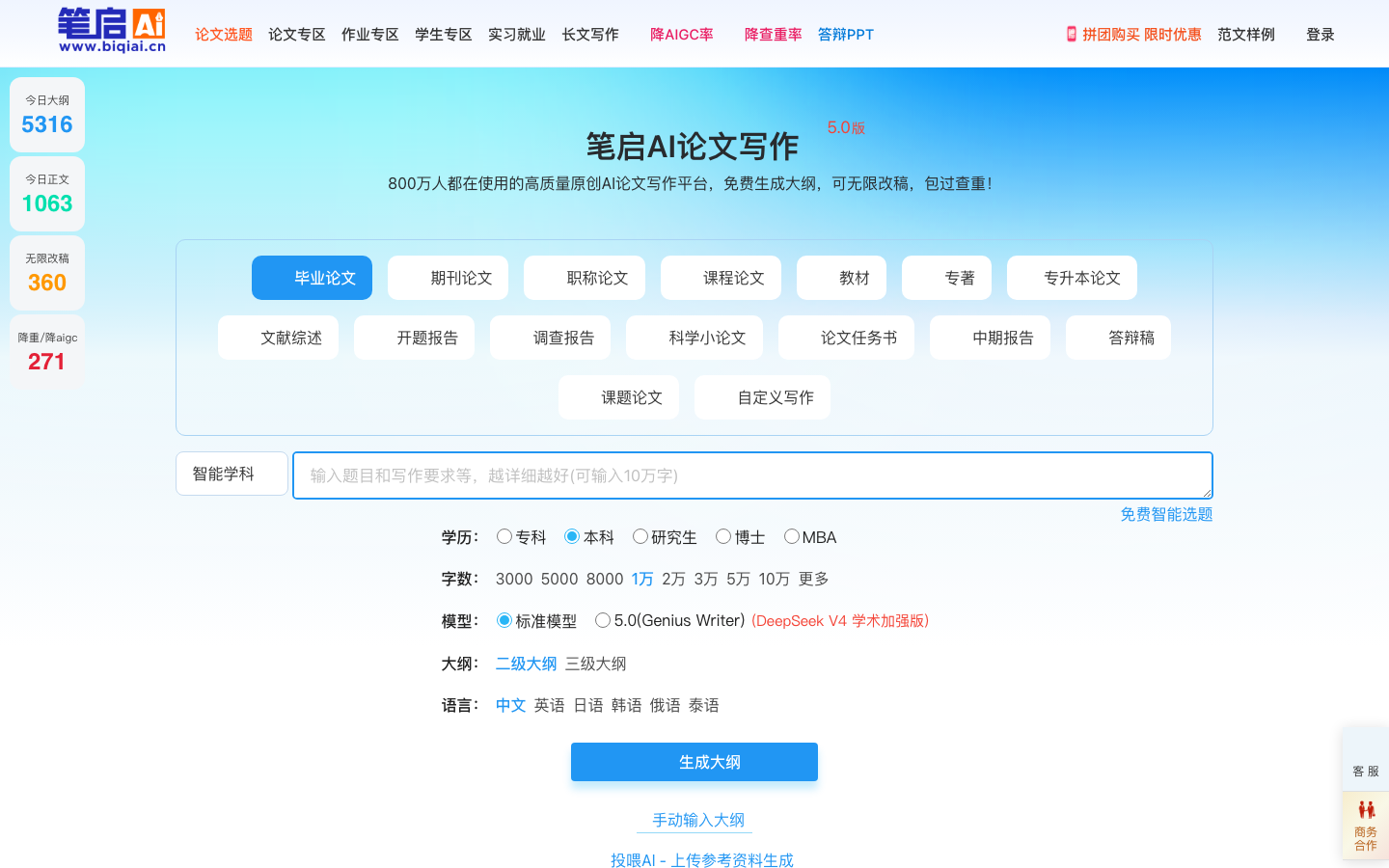
- Visit the official website to register: Open https://www.biqiai.cn/, and you can directly use some functions (such as topic selection, free outline) online. Full functions require registration and login.
- Select paper type: Select a matching type from 16 types of paper templates (graduate thesis, journal paper, professional title paper, course paper, etc.), or select "Customized writing" to set freely.
- Define writing parameters:
- Education level: associate degree, undergraduate, graduate, doctoral MBA
- Word count target: 3000 / 5000 / 8000 / 10,000 / 20,000 / 30,000 / 50,000 / 100,000 / more
- Model selection: Standard model / 5.0 (Genius Writer, DeepSeek V4 academic enhanced version)
- Outline level: Level 2 syllabus / Level 3 syllabus
- Language: Chinese / English / Japanese / Korean / Russian / Thai
- Generate Outline: Click "Generate Outline" to have AI automatically generate the paper framework, or select "Manually Enter Outline" to enter your own outline structure. The outline is free and unlimited, and can be adjusted repeatedly as needed.
- Data feeding (optional): Upload reference materials for AI to learn and then generate text. This is suitable for scenarios that require high professionalism in the content field.
- Generate text section by section: Generate the text of the paper section by section according to the outline, and support unlimited revisions. After each section is generated, the AI can be asked to rewrite, expand, or streamline it until it is satisfactory.
- Post-processing: After the text is completed, enter the AIGC or weight reduction module for processing. Support uploading complete documents or pasting text, and then downloading after processing.
- Defense PPT generation (optional): Upload thesis document, select the PPT type (academic defense/proposal report/practice report/course report), and generate defense PPT with one click.
Multi-entry function comparison:
| Function module | Entry path | Do you need to log in |
|---|---|---|
| Intelligent topic selection | Home → Intelligent topic selection for papers | No |
| Outline generation | Home page→Select paper type→Generate outline | No (free) |
| Text writing | Home → Select paper type → Generate outline → Generate text | Yes |
| Reduce AIGC | Home → Reduce AIGC rate or aigc.html | Yes (paid) |
| Reduce duplication check | Home page → Reduce duplication check rate or paper_pass.html | Yes (paid) |
| Defense PPT | Home → Defense PPT or ppt.html | Yes (paid) |
| Sample Essay | Home → Sample Essay or preview/ | No |
Note on "Model Selection": The home page provides two options: "Standard Model" and "5.0 (Genius Writer)". The standard model is suitable for scenarios that require high generation speed and average academic standardization requirements; the version 5.0 model has higher generation quality, but the response speed is relatively slow. The billing standards for different models under the same account may be different. The actual page after logging in shall prevail.
Product Pricing
Biqi AI's pricing strategy is designed around "free traffic + pay-as-you-go", forming differentiated competition with the subscription system of general AI writing tools. The following is a pricing framework based on public information on product pages:
FREE SERVICE:
- Outline generation (Level 2/Level 3): unlimited times
- Intelligent topic selection: unlimited times
- View sample essays: unlimited times
Paid Service (login required to view real-time prices):
- Text writing: There is a free trial limit, after which you will be charged per article or word count.
- AIGC reduction: pay-per-view, refundable if CNKI AIGC test exceeds 25%
- Reduce the weight of the inspection: Pay-per-view, refundable if the weight of the CNKI/Visual Census exceeds 15%
- Defense PPT generation: pay-per-view
Bulk volume and discount:
- Group purchase: The product page provides the entrance to "Group purchase, limited time offer", implying the existence of a bulk discount mechanism for group purchase by multiple people.
- Bulk purchasing/business cooperation: need to contact customer service for confirmation
Cost estimation and deduction: Taking a 15,000-word undergraduate thesis as an example, using the 5.0 model + complete AIGC reduction + duplication reduction service, the total cost is roughly in the range of 50-150 yuan (based on the market price range deduction of similar paper AI writing tools, unofficial data, subject to the real-time page after logging in). Compared with manual essay tutoring services (usually 500-2,000 yuan/paper), Biqi AI has a significant cost advantage. However, it should be noted that some institutions have begun to include AI-assisted writing in the review of academic regulations. The cost of using AI tools should not only be calculated in terms of money, but also possible academic compliance risks.
Enterprise/Bulk Purchase: Enterprise pricing is not disclosed on the page. For bulk purchases by universities or cooperation with education and training institutions, you need to contact the business to confirm the pricing model, invoice support, number of available users, and SLA terms.
Biqi AI application scenarios
The core application scenarios of Biqi AI focus on "academic writing that requires the production of structured long texts and requires standardized formats."
-
Graduation thesis writing (undergraduate/master/doctoral): This is the core application scenario of Biqi AI. According to the standard paper process of "topic selection → outline → proposal report → literature review → main text → weight reduction → defense PPT", each section has a corresponding functional module. Actual benefits: For undergraduate-level papers, the content generated by AI can usually be used directly in terms of structure and format specifications. The core content (experimental data, survey analysis, model design, etc.) needs to be supplemented by the students themselves. For master's and doctoral theses, AI is more suitable for structured content such as the first draft of literature review and methodological description. The core innovation points still need to be manually led. Cost reduction and efficiency improvement: Under the traditional model, an undergraduate thesis usually takes 4-8 weeks from proposal to finalization; with Biqi AI assistance, the framework construction and first draft of the content can be shortened to 3-7 days, but the time compression for later manual revisions and tutor communication is limited, and the overall cycle estimate can be shortened from 4-8 weeks to 2-4 weeks.
-
Course Papers and Final Assignments: Suitable for current students who need to produce multiple course papers in a short period of time. When multiple courses assign papers at the same time, BiQi AI can quickly generate multiple first drafts in different directions, and students can then make personalized revisions for each paper. Actual Benefits: Solve the urgent problem of "insufficient time to write", but you need to be wary of the risk of "multiple AI-generated content with the same style" being identified by teachers. Cost reduction and efficiency improvement: A course paper of 3000-5000 words, which takes about 6-12 hours to write traditionally, can be compressed to 2-4 hours (including manual revision time) using Biqi AI assistance.
-
Journal papers and professional title papers: Chinese and English academic paper writing assistance, supporting multi-lingual output and academic format specifications. For graduate students and scientific researchers who need to publish, Biqi AI's reference system and citation annotation mechanism can speed up the writing of the literature review section. Actual benefits: The recommendation and automatic annotation of 40 references reduced the time of manually organizing documents, but journal articles have high innovation requirements, and the AI-generated content is only suitable as the skeleton of the first draft. Cost reduction and efficiency improvement: The literature review part of a journal article takes about 2-3 days for traditional manual retrieval and sorting. Biqi AI assistance can compress this to 3-6 hours.
-
Monograph and textbook writing: This is a newer application direction of BiQi AI, supporting the writing of professional monographs of more than 200,000 words. There are already related tutorial articles such as "AI monograph writing tool, 200,000 words in 3 days" in the information area of the page. Actual benefits: Suitable for teachers who need to quickly produce teaching materials or engineers who need to write technical manuals. Cost reduction and efficiency improvement: For a 200,000-word monograph, the traditional writing cycle is usually 6-12 months. AI assistance can compress the first draft production time to a few weeks, but the professional accuracy of the content and the logical coherence of chapters require a lot of manual review, and the overall delivery cycle is shortened by about 50%-60%.
-
Defense PPT preparation: a natural extension of the thesis writing. After uploading the thesis document, BiQi AI automatically extracts key content to generate a PPT for defense, supporting four styles: academic defense, proposal report, practice report, and course report. Actual benefits: Saves time on manually making PPT, especially suitable for scenarios where time is tight before the defense. However, the AI-generated PPT may have deficiencies in visual design and layout refinement, and it is recommended to make manual adjustments before use.
Applicable groups of Biqi AI
Biqi AI's target user group is highly concentrated on "Chinese students and researchers with academic writing needs", which is in sharp contrast to the broad applicability of general writing tools.
-
Undergraduate students: Biqi AI’s largest user group. Among the approximately 10 million undergraduates in school every year across the country, graduation thesis is a rigid requirement. Biqi AI's free outline of 40 references and the AIGC/weight reduction function exactly correspond to the three major pain points of undergraduate thesis writing - "don't know how to start", "cannot find the references" and "worry about failing to check for plagiarism". Unsuitable Boundary: For top universities that have extremely high requirements for paper innovation (such as the Qingbei Resumption of Diplomatic Relations), teachers have a strong ability to recognize AI-assisted writing, so it is recommended to use it with caution. Some institutions have explicitly included AI-assisted tools in academic integrity regulations, and you should confirm the school's policies before using them.
-
Master's and PhD students: Graduate students who need to write high-quality journal articles, dissertations and literature reviews. BiQi AI's data feeding function and multi-lingual writing ability are of high practical value to graduate students - graduate students usually have more focused research directions, and feeding field data can significantly improve the professionalism of generated content. Unsuitable boundary: The originality requirements for doctoral dissertations are much higher than those at the undergraduate/master's level. AI-generated content is only suitable as an auxiliary reference. The core research content (theoretical innovation, experimental design, data analysis) must be completed independently by the researcher.
-
Scientific researchers and university teachers: Scientific researchers who need to quickly produce standardized academic documents such as teaching materials, lecture notes, project application forms, and academic reports. Biqi AI's long article writing capabilities and monograph writing functions are suitable for the batch content production needs of this group. Unfit Boundary: In formal publishing scenarios that require extremely high citation accuracy (such as submissions to core journals), the references recommended by AI still require manual verification of the original documents one by one.
-
Continuing Education and Vocational Qualification Candidates: Part-time academic writing needs such as junior college-to-undergraduate thesis, professional title thesis, etc. The characteristics of this type of scenario are "high requirements for format standardization and relatively low requirements for academic innovation." BiQi AI's templated writing capabilities are a perfect match. Inappropriate Boundary: There may be "AI checking" in the review of professional title papers (some institutions have introduced AIGC testing), and you should confirm the relevant policies of the review agency before using it.
Summary and Outlook
Biqi AI's positioning is precise - it does not do "general AI writing", but focuses on the vertical scenario of papers and academic writing, from topic selection, outline, text, references to AIGC reduction, weight reduction, and defense PPT, forming a rare full-link thesis tool chain in China. For the vast majority of the more than 8 million users, it solves the three most direct pain points of "difficulty in starting paper writing, unfamiliarity with format specifications, and anxiety about plagiarism checking."
Current Core Advantages:
- The function covers the whole life cycle of the paper, from topic selection to defense, one-stop completion, avoiding the need to switch between multiple tools
- 40 real references from CNKI/Chinese Academy of Sciences, effectively solving the problem of "phantom citations" in general AI writing
- The free outline strategy lowers the decision-making threshold for users. The average daily output of 4,300+ outlines verifies the effectiveness of this strategy.
- The promise of reducing AIGC/weight loss (refundable for over 25%/over 15%) is relatively rare among similar products.
Major Current Limitations:
- The underlying model relies on a third party (DeepSeek V4), and the accuracy and timeliness of the generated content are limited by the capabilities of the upstream model.
- The scale and financial transparency of the operating entity Guangzhou Zhiwrite Technology Co., Ltd. have not been disclosed, and long-term service stability requires continuous observation.
- Insufficient pricing transparency - the specific prices of core services such as text writing, AIGC/weight reduction, etc. need to be viewed after logging in, which is not conducive to price comparison before users make purchasing decisions.
- The user is solely responsible for the academic quality and innovation of the paper content, and the platform is not responsible for the academic results - this means that even if BiQi AI is used to complete the paper, if it is deemed to be excessive AI assistance, the user still needs to bear all academic risks
- The product only supports the web side and lacks offline document editing and mobile support. The experience is limited when there is no network connection or when fragmented writing is required.
Follow-up observation points:
- As universities increasingly tighten their review policies for AI-assisted writing (some universities have incorporated AI testing into their paper plagiarism checking process), whether BiQi AI’s AIGC reduction function will continue to be effective will become a key competitive variable.
- Whether to launch a more transparent pricing system and free trial mechanism to reduce users’ purchase decision-making costs
- Whether the underlying model will be switched from DeepSeek to a self-developed model or a domestic large model (such as Zhipu, Wenxin, Tongyi Qianwen, etc.) to reduce dependence on a single supplier
- Can the bulk purchase/enterprise cooperation model be expanded to the official procurement market of universities?
Procurement and Adoption Risk Assessment: For individual users (undergraduate/master students), BiQiAI’s free outline and trial quota are enough to help complete the construction of thesis framework, and there is no real risk in zero-cost trial and error. For users who need complete essay writing assistance, it is recommended that before officially purchasing paid services: 1) Use the free outline function to evaluate whether the recommended article structure and reference quality are consistent with the direction of your topic; 2) Confirm the policy boundaries of your school/department on AI-assisted writing - some institutions have made it clear that "AI-assisted frameworks and polishing are allowed, and AI ghostwriting is prohibited", which must be used within the scope permitted by school regulations; 3) Downgrade AIGC The final text is manually reviewed to ensure smooth logic, natural language, and accurate citations, and to avoid language style alienation caused by over-reliance on AI modifications. For universities or training institutions that purchase in bulk, it is recommended that the data privacy terms (the storage location of user paper data, whether it is used for model training, and the method of data disposal after service termination) and service availability SLA be specified in the contract.
Related tools:  Notion AI,
  Jasper
Version Info
- Biqi AI version 5.0 (Genius Writer) :Based on the DeepSeek V4 academic enhanced version and the self-developed Genius Writer 5.0 model, it provides full-link paper writing support, including intelligent topic selection, 40 real references for three-level outlines, AIGC/weight reduction, defense PPT generation and other complete functions.
- Biqi AI version 4.0 :Introducing the DeepSeek V4 academic enhanced version, upgrading the AIGC engine, and adding multilingual writing support. There is no official precise date yet.
- Biqi AI version 3.0 :It supports three-level outlines and data feeding and recommends 40 CNKI/Chinese Academy of Sciences reference documents, establishing a full-link product form for papers. There is no official precise date yet.
User Reviews