 Boost AI
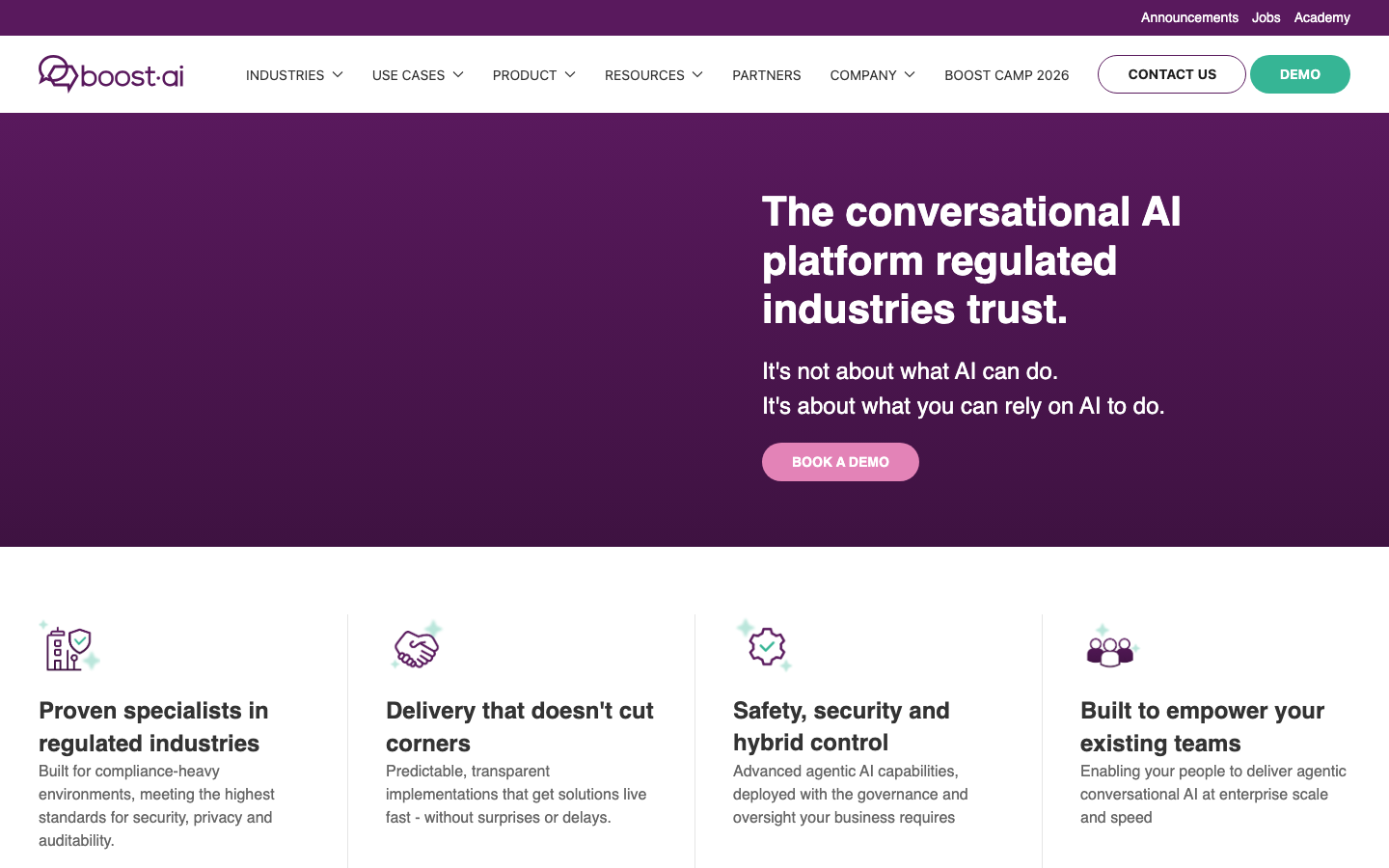
Boost AI is an enterprise-level conversational AI platform, with self-developed NLU engine + hybrid GenAI architecture as the core, providing customer service automation and AI agent solutions for regulated industries such as banking, insurance, and telecommunications.
BoostAI
Core parameters and statistics of Boost AI
Boost AI is not another chatbot-building platform - its core selling point is "conversational AI infrastructure for regulated industries." The platform is built around three layers of self-developed NLU engine, hybrid GenAI architecture and Agentic AI capabilities, targeting industries such as banking, insurance, telecommunications, and public sectors that "don't dare to make mistakes."
| Projects | Public Information |
|---|---|
| Official positioning | Enterprise-level conversational AI and AI agent platform for regulated industries |
| Core technology stack | Self-developed NLU, Hybrid GenAI (NLU + LLM + RAG), Agentic AI, Voice AI |
| Deployment Method | SaaS + Privatization (Hybrid Deployment) |
| Channel Support | Web Chat Voice, Facebook Messenger, WhatsApp, Mobile App, etc. |
| Language coverage | English, Norwegian, Swedish, Danish, Finnish (strength), German, etc. |
| Typical industries | Financial services, insurance, telecommunications, public sector, hotels |
| Certification and Compliance | ISO 27001, ISO 27701, GDPR, OWASP |
| Latest version | 2026 Q1 |
| Number of active AI Agents | 600+ live |
| Cumulative automated conversations | 150 million+ |
| Certified AI Trainers | 4,500+ |
| Industry Rating | Gartner Magic Quadrant 2025 Selected, Capterra/G2 4.8/5, 94% recommendation rate |
Core Difference: The essential difference between Boost AI and the general LLM customer service solution lies in the hybrid architecture of "first NLU identifies the intent, and then LLM generates a reply". The value of this architecture is irreplaceable in regulated scenarios - the NLU layer ensures that intent identification is auditable and traceable, and the LLM layer only generates content within the security boundaries delineated by NLU. This is in sharp contrast to the pure Prompt solution: in the latter, a single Prompt change may cause the entire dialogue chain to go out of control, while the impact of Boost AI's NLU rule changes can be accurate to a single intent node.
Users and market recognition of Boost AI
Boost AI has far greater penetration in regulated industries than comparable generic solutions. According to official disclosures, the platform has 600+ active AI Agents running online and has processed more than 150 million automated conversations. The channel automation rate has exceeded 50%, and the resolution rate for top customers has reached 85-90%+.
Iconic Client:
- Telenor (Norwegian telecom giant): Deployed virtual customer service Telmi and achieved the ROI target in the first year. Telenor's head of AI Trainer rates its CX Insights feature as a "game-level improvement."
- MSU Federal Credit Union: "Developing powerful virtual agents internally is made simple," according to chief digital strategy officer Benjamin Maxim.
- PLAY Airlines (Iceland low-cost airline): handles more than 100,000 conversations per year, with a resolution rate of 85%+.
- Sage (global accounting software vendor): Use Test Studio to verify GenAI conversation security boundaries.
- Acorn Insurance: Built an end-to-end claims and service AI engine.
Industry Analyst Recognition: Gartner's 2025 Magic Quadrant for Conversational AI Platforms lists Boost.ai in the report, rating its "platform availability + scalable and diverse deployment model as a top vendor in this study."
Community Rating: Capterra and G2 dual platforms 4.8/5 stars, 94% of users are willing to recommend. This score ranks among the top echelons in the conversational AI category—competing products are mostly concentrated in the 4.2-4.5 range.
Market coverage: Although the founding team and technology accumulation are in Northern Europe, its customers have covered the United States, the United Kingdom, and continental Europe, forming verifiable industry benchmark cases in the two vertical industries of financial services and insurance.
Cost Advantages of Boost AI
Boost AI adopts a pure enterprise subscription model and does not have a free version or public pricing page (official /pricing returns 404). This means that its cost structure needs to be determined by business negotiations.
Three-tier cost analysis:
- C-side/Individual: No free version. Individual users or small and micro teams cannot use it directly.
- Developer/API: No independent API solution is disclosed. The platform does not provide a pure API access model billed by token, and all usage must be bound to a full platform subscription.
- Enterprise/Private: Quoted on an annual basis, including platform authorization, number of channel accesses, number of concurrent AI Agents, and optional privatization deployment surcharges. Gartner Magic Quadrant positioning implies that its pricing is mid-to-high among similar enterprise-level platforms.
Comparative Perspective (Deduction Estimation): Compared with solutions such as Zendesk Answer Bot or Intercom Fin, which are billed on a resolved conversation basis, Boost AI’s annual contract model requires a higher upfront investment, but the marginal cost of a single conversation is lower—in a high-volume scenario (monthly activity of 100,000+ conversations), the overall cost can be 30-50% lower. For small batch scenarios (monthly activity <10,000 conversations), the fixed annual fee model may be more expensive than pay-as-you-go.
Hidden Costs:
- AI trainer manpower: Boost AI emphasizes the role of "certified AI trainers" (currently 4,500+ globally). Enterprises need internal training or hire dedicated personnel to continuously optimize NLU models and dialogue flows. This labor cost is often underestimated.
- Migration Cost: NLU training data and dialogue flow are highly bound to the platform. Once Boost AI is selected, subsequent migration to competing platforms requires re-labeling of a large amount of training corpus - this is a substantial risk of vendor lock-in.
Main features of Boost AI
Boost AI's functional system is built around "Hybrid AI (NLU + LLM + Agentic AI)". The synergy between functions is the key to distinguishing it from fragmented solutions.
- Self-developed NLU intent engine: Based on the proprietary NLU model for intent recognition and entity extraction, it does not rely on third-party LLM to complete intent understanding. This means that even if the LLM layer is completely offline, the NLU layer can still function independently. Synergy: The intent structure identified by NLU is passed to the LLM generation layer and conversation flow engine at the same time, ensuring that LLM will not "deviate" to unauthorized topics.
- Codeless Dialog Builder: Visual drag-and-drop dialogue flow editor that supports conditional branching, variable storage API Hook and back-end system integration. Synergy: Conversation flow nodes can be bound to "Guardrails" - each node independently configures compliance boundaries to prevent LLM from generating illegal content.
- Hybrid Generative AI (GenAction): Four pillars - Knowledge (RAG knowledge source), Guardrails (compliance fences), API Hooks (system actions), Action Hooks (custom actions). Synergy: After the Knowledge layer retrieves facts from the enterprise knowledge base, the Guardrails layer performs compliance filtering before returning, API Hooks trigger back-end transactions (such as transfers, billing), and Action Hooks execute subsequent workflows - four layers of serial auditability.
- Voice AI (Native Embedded): The voice channel is not a "plug-in", but shares the same NLU engine and conversation flow with the chat channel. Synergy: The same AI Agent shares intent models and training data in Chat and Voice channels, reducing the cost of maintaining two systems.
- AI Agent (Agent Capability): New Agentic capability in 2025-2026 - AI Agent can independently plan multi-step actions (query balance -> determine whether transfer conditions are met -> execute transfer -> notify user), instead of a single round of question and answer. Synergy: Agent behavior is constrained by NLU Guardrails to prevent autonomous decisions from crossing boundaries.
- Test Studio: Persona-based automated testing + Voice test studio. Synergy effect: The test results are directly fed back into the training data suggestions of the NLU model, forming a "test-discovery-correction-retest" closed loop.
have.
- CX Insights Analysis Engine: AI-driven conversation analysis, automatically annotating resolution rates, user sentiment, and compliance anomalies. Synergy effect: High-frequency failure scenarios identified by the analysis engine automatically trigger "Content Suggestion" - it is recommended that the AI Trainer supplement the corresponding skills or adjust the NLU model.
- Multi-channel integration and pre-built industry modules: Pre-configured knowledge packages and compliance fences for banking, insurance, telecommunications and other industries are built-in out of the box.
Boost AI model and version evolution
| Version | Time | Core Changes |
|---|---|---|
| 2025 Summer | ~2025-07 | Introducing conversation analysis dashboard and automatic intent suggestion function |
| 2026 Q1 (current) | ~2026-03 | Enhanced multi-language NLU capabilities, deep LLM integration (GPT-4, etc.), GenAction framework release |
| 2026 Q2-Q3 (speculative) | Expected in the second half of 2026 | Expected to further expand Agentic AI capabilities and deeply integrate Voice AI |
Version Rhythm: Boost AI adopts the rhythm of annual major versions + quarterly feature updates. Unlike traditional SaaS, the NLU model itself will continue to learn online through the annotated data of AI Trainer. Therefore, platform capability upgrades not only rely on version number updates, but also rely on the company's own training investment - with the same version number, the quality of fully trained enterprise AI Agents may differ by 2-3 times.
Technical advantages of Boost AI
- Hybrid architecture (NLU-first + LLM augmentation): This is the core technical decision of Boost AI. The NLU layer performs intent classification and entity extraction (deterministic and auditable), while the LLM layer only performs generation within the scope of NLU's determined intent (flexibility). This "differentiate first and then generate" architecture is an order of magnitude safer in regulated scenarios than pure LLM schemes (such as feeding prompts directly to GPT-4) - because the results of NLU can be explicitly tested and verified, while LLM's prompt behavior is probabilistic in nature.
- RAG + Guardrails two-layer protection: GenAction's Knowledge layer uses RAG to retrieve facts from the enterprise knowledge base; the Guardrails layer does another compliance check before returning them to the user. There are clear audit logs between the two layers, and any violation interceptions are recorded and traceable.
- Multi-channel unified NLU: Chat, Voice, and Messaging channels share the same set of NLU models and training data. Compared with the splicing solution of "Dialogflow for chat + Twilio for voice + Chatwoot for access", this saves the cost of data synchronization and repeated model training.
- Persona-based automated testing: Simulate different user portraits (such as "impatient customers" and "non-native English speakers") to conduct batch stress tests on the AI Agent. This would take a manual QA team several days to complete in a traditional customer service solution, but Test Studio can run thousands of scenarios in tens of minutes.
- Security compliance in depth: ISO 27001 (information security management), ISO 27701 (privacy information management), GDPR compliance OWASP protection. For financial and insurance clients, these certifications are often a prerequisite for purchase—lack of any certification will result in a one-shot rejection by the compliance department.
How to use Boost AI
The threshold for using Boost AI is focused on "pre-configuration" rather than development capabilities. The platform design philosophy is to replace coding with NLU training.
Typical access process:
- Pre-sales stage: Submit a Demo request on the official website, and the sales team leads the POC.
- Contextual deployment: Choose SaaS or private deployment. The SaaS version is hosted by Boost AI, and the private version is deployed on customer-owned infrastructure (hybrid cloud supported).
- NLU training: Import historical conversation data through the AI Trainer interface, and the platform automatically recognizes the intent and generates an initial NLU model. AI Trainer can manually label, merge, and split intentions.
- Conversation Flow Design: Use a codeless builder to build a conversation flow. Each node can be bound to Guardrails, API Hooks, or Knowledge sources.
- GenAI Configuration: Select the LLM backend (supports GPT-4, etc.), configure the Knowledge source (upload PDF/webpage/database), and set Guardrails rules.
- Test online: Use Test Studio to run Persona tests and boundary tests, and publish them to the production environment after passing the verification.
- Continuous Optimization: CX Insights automatically generates operational reports and NLU optimization recommendations, and AI Trainer regularly iterates the model.
Note: The most underestimated aspect of the entire process is "NLU training data preparation" - if the company does not have experience in cleaning and annotating historical conversation data, it is recommended to arrange for a dedicated person (AI Trainer) to devote full time in the first 3 months, otherwise the accuracy of intent recognition after going online may be far lower than expected.
Product Pricing for Boost AI
Boost AI does not have a public pricing page, and all plans require business confirmation. The following is based on official information fragments and industry benchmarking reasoning:
Enterprise subscription system (annual contract model):
| Dimensions | Description |
|---|---|
| Billing basis | Annual platform authorization + number of active AI Agents + number of channels |
| Typical annual fee range (deduction) | $50,000 - $500,000+/year, depending on deployment size and industry complexity |
| SaaS vs Privatization | SaaS annual subscription; Privatization one-time license fee + annual maintenance fee |
| Whether NLU training support is included | Basic includes limited training hours, in-depth training requires the purchase of additional service packages |
| Free trial | No public free version; can be experienced by selling POC |
Comparison reference (deduction rather than official data): Compared with Amelia ($100K+/year) and Kore.ai ($80K+/year), which are both positioned in regulated industries, Boost AI has stronger price competitiveness in the Nordic language advantage area, but has limited room for premium in the English market.
Purchasing Suggestion: Enterprises with monthly active conversations exceeding 50,000 are more suitable for the annual contract model; enterprises with conversation volume below this threshold are recommended to give priority to pay-as-you-go solutions (such as Zendesk, Intercom) to avoid waste caused by fixed annual fees.
Boost AI application scenarios
The core scenarios of Boost AI focus on "high-frequency, repetitive, but extremely low error-tolerance customer interactions." The following four types of scenarios are the areas where it can best exert its value:
- Omni-channel customer service for financial institutions: Bank customers can inquire about account balances, transaction details, foreign exchange rates, credit card bills, etc. Boost AI’s NLU engine supports mixing numbers, dates, and currency units in conversations, and intent recognition is not affected by accents or spelling errors. Typical benefits: Frontline customer service calls reduced by 40-60%, Telenor achieved ROI in the first year.
- Insurance claims self-service declaration: Customers describe the accident process through natural language, and NLU automatically extracts key entities (time, location, involved parties, loss type), creates a claim work order and pushes it to the back-end system. Acorn Insurance implements an "end-to-end claims engine" in this scenario. Typical benefits: Claims filing time is shortened from 15 minutes of manual form filling to 3 minutes of AI guidance.
- Telecom operator customer service: call charge inquiry, package change, network failure report, international roaming activation, etc. Telenor's Telmi virtual customer service covers all types of inquiries from Telenor. Typical benefits: ROI target achieved in the first year, human agents focus on complex complaints.
- Public Sector Citizen Help Desk: Tax filing guidelines, social welfare eligibility inquiries, passport/driving license application procedures. NLU covers both dialects and official languages of Nordic languages, meeting public sector accessibility requirements.
| Quantitative deduction of cost reduction and efficiency improvement (for a typical 200-seat customer service center): | Position | Original time spent | After AI assistance | Savings |
|---|---|---|---|---|
| Front-line customer service (simple inquiry) | 4 hours a day to deal with repeated problems | 0.5 hours a day to provide answers to exceptions | 87.5% | |
| Claims Specialist (Information Entry) | 15min per order | 3min per order AI preprocessing | 80% | |
| QA quality inspector | 2h random inspection recording every day | 30min AI full analysis | 75% | |
| AI Trainer (Platform Maintenance) | Does not exist | Add 1-2 full-time people | New model |
Unsuitable Scenarios: Emotionally intensive scenarios (psychological counseling, customer complaint escalation and appeasement), ultra-complex multi-round negotiations (bulk purchase negotiations), crisis communication that requires human empathic judgment - these scenarios still require full manual intervention.
Applicable groups of Boost AI
- Corporate Customer Service/IT Leaders in Regulated Industries: The most immediate target group. You need a conversational AI solution that can pass compliance audits, have industry cases, and can be deployed privately. Boost AI's comprehensive maturity is among the best in its category.
- CXO/Digital Transformation Director of Banking, Insurance, and Telecommunications: If your KPIs include "self-service rate", "first-time resolution rate" and "channel automation rate", Boost AI's success case data can support ROI calculations.
- Public Sector Digital Team: Organizations that have a strong need for multilingual (including small language dialects) NLU and have a hard threshold for supplier security certification.
- AI Trainer/Conversation Designer: Boost AI provides a certified training system (Academy), suitable for the career development of professional NLU trainers.
Dissuade the crowd:
- Small and Micro Enterprises and Individuals: There is no free version, and the annual fee threshold is $50K+, which is completely unsuitable.
- Standard customer service scenario that requires a pure English single market: Solutions such as Zendesk and Intercom are lighter, iterate faster, and pay-per-volume billing is more flexible.
- Requires in-depth content generation (long articles, marketing copy, brand stories): Boost AI's GenAI function is still limited to "customer service reply" and is not suitable for content creation.
- Enterprises sensitive to vendor lock-in: NLU training data is bound to the Boost AI platform, resulting in high migration costs. If your company has a "multi-cloud/multi-vendor" strategy, it is recommended to simultaneously evaluate open source solutions (such as Rasa) as an alternative.
Summary and Outlook of Boost AI
Boost AI spent seven years (2016-2023) establishing core barriers in the regulated industry on NLU technology, and completed the transition from "rule dialogue engine" to "agent platform" through Hybrid GenAI and Agentic AI in 2024-2026. Its core competitiveness is clear - "NLU-first hybrid architecture" is irreplaceable in industries that dare not make mistakes, such as banking and insurance. This is also verified by Gartner's recognition and user rating of 4.8/5.
Current Limitations:
- Internationalization-Localization Contradiction: The NLU advantage of Nordic languages has become a "transitional project" in the English-speaking market - North American customers may be more inclined to choose more localized solutions such as Zendesk. After setting the country of origin to US, Boost AI needs to prove that its NLU accuracy in the English-speaking market is not inferior to that of pure English solutions.
- Price is not transparent: The lack of public pricing leads to a longer procurement evaluation cycle for small and medium-sized enterprises - the Sales-driven model is naturally biased towards large customers, and there is a vacuum in scenarios with annual fees below $50K+.
- LLM dependency: The GenAI layer is currently bound to closed-source models such as GPT-4. If OpenAI adjusts the API strategy or price, it will have a conductive impact on the production cost of Boost AI.
Procurement/Adoption Risk Assessment: The most suitable customers are financial institutions and insurance companies that have more than 50,000 conversations per year, have rigid compliance needs, and are willing to invest in AI Trainer manpower. If your company’s dialogue volume is below the threshold, or does not have a dedicated AI Trainer budget, or is extremely sensitive to vendor lock-in - it is recommended to prioritize benchmarking options before making a decision. Follow-up focus: the depth of the implementation of Agentic AI capabilities in the second half of 2026, the progress of Voice AI's deployment in more languages, and whether to launch a lightweight pay-as-you-go billing solution to cover the small and medium-sized enterprise market.
Related tools:  Notion AI, google-workspace
Version Info
- Boost AI 2026 Q1 :There is no official precise date yet. Enhanced multilingual NLU and LLM integration.
- Boost AI 2025 Summer :There is no official precise date yet. Introducing a conversation analytics dashboard with automated intent suggestions.
User Reviews