 browser-use
Free
browser-use
Free
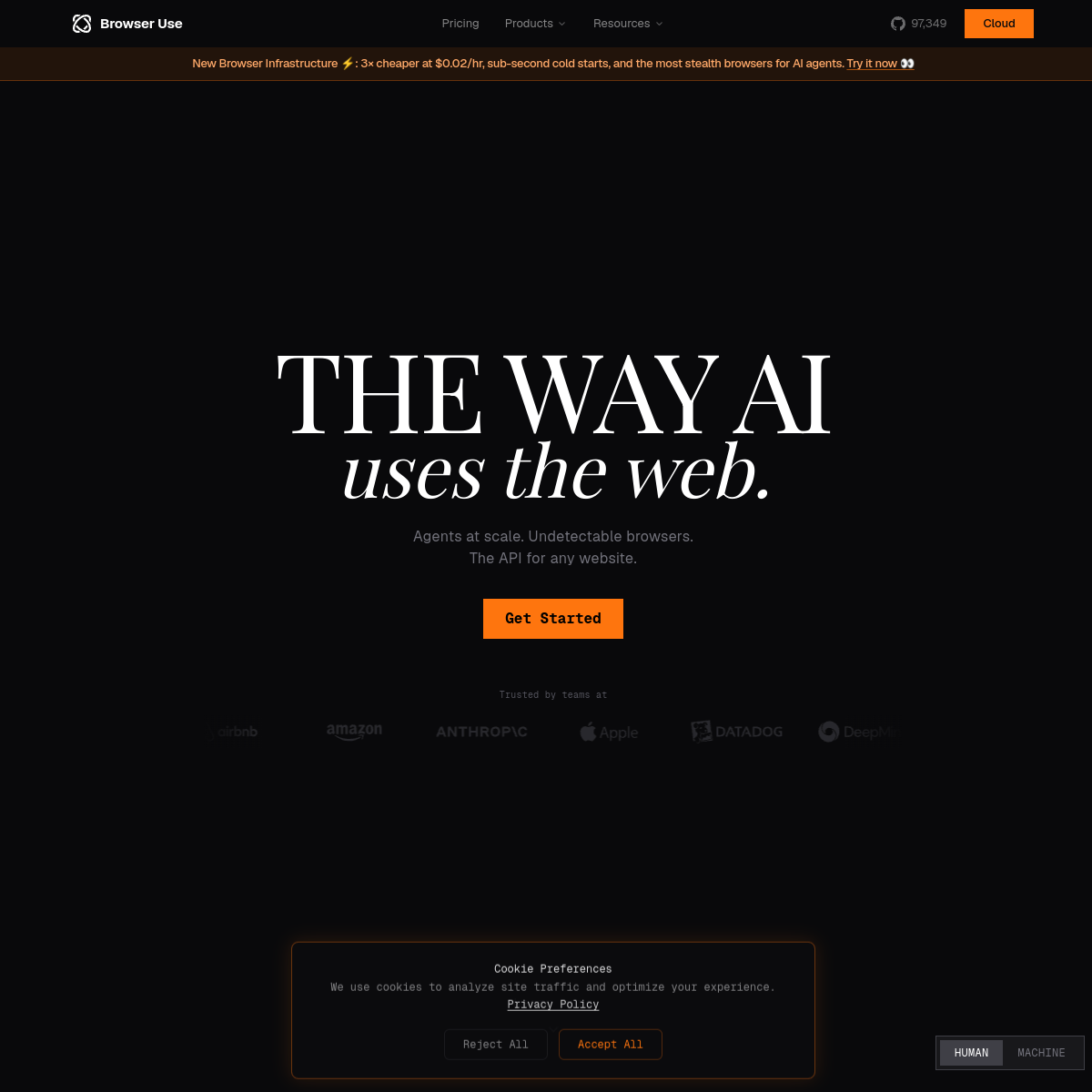
browser-use is a browser automation platform for AI agents. The official website emphasizes "The way AI uses the internet". The GitHub warehouse is positioned to make websites accessible to AI agents and perform online tasks.
browser-use
Core parameters and statistics
browser-use is an open source browser automation platform for AI Agents. The official website advocates "The way AI uses the internet". The GitHub warehouse is positioned to make websites accessible to AI agents and enable models to stably access, understand and operate real web pages.
| Projects | Public Information |
|---|---|
| Official positioning | The way AI uses the internet |
| Core Capabilities | Make websites accessible to AI agents and automate online tasks |
| Open source license | GitHub public repository, MIT license |
| Community size | About 97,588 stars, 10,910 forks |
| Latest version | 0.12.9 (2026-05-26, GitHub Releases) |
| Commercial Tier | Open Source, Free, Pro, Enterprise, Credits |
| Support Platform | Web, API |
Capability positioning: browser-use solves the "last mile of the model" - allowing AI to change from "knowing the content of the web page" to "being able to click, enter, jump and submit on the web page".
Community Endorsement: The official website description gives "78,000+ GitHub stars. Trusted by Fortune 500.", and the GitHub API has shown about 97,588 stars at the current point in time, indicating that it has entered the stage of high-profile infrastructure from a niche library.
Iteration rhythm: Three versions of 0.12.7, 0.12.8, and 0.12.9 will be released consecutively in late May 2026. The last two versions are only three days apart, and the iterations are quite compact.
User and market recognition
At the market level, browser-use is already one of the most watched open source projects in the field of browser automation, but its corporate revenue and specific customer list have not been officially disclosed.
Community Popularity: About 97,588 stars and 10,910 forks on GitHub. An active community usually means richer real-life cases and faster problem convergence.
Positioning difference: It is not an independent demonstration Agent, but a browser automation base, suitable for tasks that require real web page interaction, such as web page crawling, form operations, background navigation or third-party SaaS drivers.
Approval Boundary: High star does not mean enterprise-level controllability. Login state management, permission isolation and failure retry still need to be independently verified in your own environment.
Cost advantage
- C-side/Individual: Usually a free version is provided to experience the core functions, and high-frequency use requires a paid package subscription.
- API/Developer: Billed by call volume, suitable for development teams that can be flexibly integrated into their own systems.
- Enterprise/Privatized: Contact the business owner for customized quotation and deployment plan. The specific price is subject to the official real-time pricing page.
Main functions
The value of browser-use focuses on allowing AI to evolve from "reading web pages" to "acting in web pages". The core functions include:
- Web page access and element understanding: Analyze the page structure and let the model identify interactive elements.
- Page Navigation and Jump: Maintain context in multi-page processes and complete continuous operations.
- Form and input operations: Automatic filling and submission, covering common interactions in the backend system.
- Online task automation: Encapsulate web page operations into reusable Agent execution steps.
- Unified Execution Interface: Provides a consistent web control layer for upper-layer Agents.
It is recommended to focus on three points for function acceptance: whether it can stably handle dynamic websites, whether it can recover the context after a failure, and whether it can output key operation logs to the upper-layer system.
Model and version evolution
Continuous iterative updates, the latest version introduces performance optimization and new features. Historical version information can be viewed on the official release page. There is no complete public version evolution timeline yet. It is recommended to pay attention to the official announcement to understand the rhythm of feature updates.
Technical advantages
The technical advantage of browser-use is not in its universal model capabilities, but in its ability to adapt to the context of web pages, which can be broken down into three points:
Webpage Adaptation: The focus of the project is to connect the webpage structure, browser behavior and Agent tasks to reduce the repetitive work of writing separate scripts for each website.
Interface reuse: Let the upper-layer Agent reuse a unified web page execution interface instead of implementing browser control individually.
Coverage Advantage: Preserve higher coverage than API-only automation when real web page login, redirect and submission processes are required.
Its limitations are also clear: maintenance costs will increase when the web interface changes frequently, so it is more suitable for high-value, standardizable web tasks.
How to use
- Web client: You can use it by visiting the official website and registering an account. Most functions do not require installation.
- API access: Provides RESTful API, developers can obtain the API Key and integrate it into their own applications.
Product Pricing
The pricing model is subject to the official real-time page. Usually a freemium or subscription system is used, and basic functions can be used for free. Advanced functions or high-frequency use require paid subscriptions, and users are advised to evaluate the optimal solution based on actual usage.
Application scenarios
The implementation scenarios of browser-use focus on execution tasks that require real web page interaction:
- Web page execution agent: automatically log in to the backend, query data, fill in forms, and navigate across pages.
- SaaS driven tasks: CRM background entry, order management, internal management desk query, need to pay attention to login and permission stability.
- Agent orchestration execution layer: As the web page execution base under the higher-level workflow, it allows the model to complete the final step.
Applicable people
browser-use is suitable for three types of roles:
- Agent Platform R&D Team: Build the execution layer and focus on unified web control interface.
- Operation Automation Team: Need to automate repetitive web page operations.
- Entrepreneurial Team: Use open source components to quickly build web Agent prototypes.
Situations that are not suitable are: the business mainly relies on API rather than web page interaction, the team does not have the ability to maintain web page changes, or compliance does not allow browser execution to be connected to production. In these scenarios, its coverage capabilities will become additional governance burdens.
Summary and Outlook
The value of browser-use is to complement the execution layer between the AI Agent and the real Internet, so that the model can not only read web pages, but also complete actions on web pages. This makes it more like a web automation infrastructure than a simple chat product; a community of nearly 100,000 stars and a tight iteration rhythm also support its continuous evolution in this positioning.
If you want to implement it, it is recommended to use the open source version to do PoC on 1 to 2 web page tasks first, giving priority to verifying the login status, dynamic DOM and failure recovery, and then deciding whether to introduce Pro quota or enterprise support; before scaling up, you still need to confirm the Credits billing method, complex website compatibility, and the team's ability to maintain web page changes in the long term.
Related tools:  CrewAI,
  LangChain
Version evolution of browser-use
browser-use has a faster public release pace, with multiple stable versions released in late May 2026.
Recent main line
- 0.12.9 (2026-05-26): The latest version is currently publicly available and is the benchmark for capability evaluation.
- 0.12.8 (2026-05-23): Only three days apart from the latest version, indicating that recent iterations are compact.
- 0.12.7 (2026-05-19): Pre-order version of the same month, which can be used to observe whether the upgrade rhythm is too fast.
Due to the high frequency of releases, it is more appropriate to fix a version to verify the success rate of core tasks before entering production, and then select a pre-order stable version for regression comparison.
Version Info
- browser-use 0.12.9 :The latest version released by GitHub Releases continues the core thread of browser automation and AI Agent access to the Internet.
- browser-use 0.12.8 :A stable iterative version close to the current mainline, suitable for comparing the pace and compatibility changes of the last three updates.
- browser-use 0.12.7 :The last batch of stable nodes in the public release rhythm can be used to determine the upgrade frequency and regression window.
User Reviews