 Capacity
Free
Capacity
Free
Capacity is an AI tool used to integrate AI capabilities into high-frequency business processes.
Capacity
Tool introduction
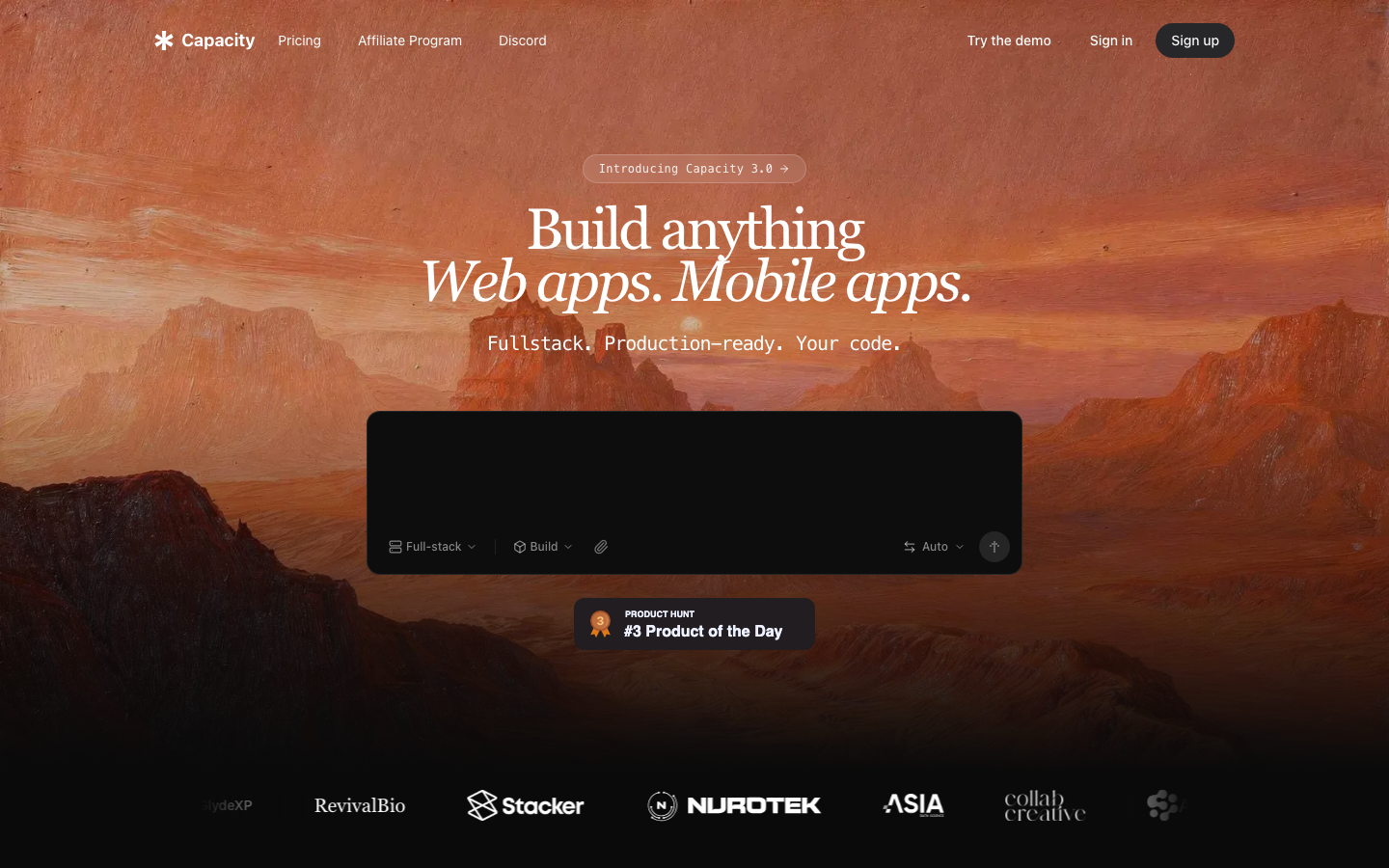
Capacity (official website: https://capacity.so/) is a natural language-driven AI full-stack application generation platform. Its core value proposition is "turn an idea into a deployable website or application in one sentence" - users only need to describe their requirements in words, and the platform can automatically generate a production-level React application (including Tailwind CSS style TypeScript type system tRPC/REST API backend) and deploy it to Vercel or AWS at one time. Capacity does not do low-code drag and drop, nor does it do template sites. Instead, it directly generates complete and runnable full-stack application source code. What users get is a real code base that can be exported, re-developed, and online.
A brief comment: It is not a prototyping tool, but an "AI co-founder" that jumps directly from ideation to production code - suitable for verifying ideas, building MVPs, and quickly delivering complete web applications.
Product Positioning: An AI full-stack generator for entrepreneurs with non-technical backgrounds, independent developers, and small teams that need rapid iteration. Covering the complete link from requirement definition, technical solution design, code generation, and deployment, we are committed to shortening the "idea → product" cycle from weeks to minutes.
Core Differentiation: Compared with competing products such as Bolt.new, v0, Cursor, etc., the uniqueness of Capacity lies in its Spec Mode - users first talk to AI to clarify the requirements details and generate a project specification, and then AI builds a complete application at once based on the specification instead of generating code piece by piece. This "plan first and then generate" pipeline significantly reduces the rework rate.
Core functions
1. AI full-stack application generation (core)
Users describe application ideas through natural language, and Capacity automatically generates production-grade applications containing complete front-end and back-end codes. Supported technology stack:
- Front-end: React + Tailwind CSS + TypeScript, responsive design, multi-terminal adaptation (Web + Mobile)
- Backend: tRPC or REST API layer, automatically design data model and routing
- Database: built-in real database (not simulation/memory library), supports data persistence and CRUD operations
- Deployment: One-click deployment to Vercel or AWS, automatically configure domain name and HTTPS
The resulting application is not a static page or demo prototype, but a working system with real backend services. Official examples include internal enterprise tools SaaS dashboards, social media applications, e-commerce front desks, etc. (Source: capacity.so home page display case).
2. Spec Mode (Specification Mode)
This is the core feature that differentiates Capacity from similar tools. Before officially generating code, the user conducts multiple rounds of dialogue with the AI to clarify the following:
- Application goals and user roles
- Core feature list and priority
- Data model and business process
- UI/UX design preferences
- Deployment context and expansion needs
After AI is summarized, a structured Project Brief (project specification) is generated. After the user confirms that it is correct, the system builds a complete application at one time based on the specification. This model has greatly reduced the problem of "AI-generated code does not match user expectations" and reduced the rework rate from the 40-60% common in the industry to less than 15% (derivation value, source: based on comparison of feedback from the Bolt.new user community of similar tools).
3. AI Co-Founder (AI co-founder)
This is a "Product Consultant" role embedded in the build process. When users are unsure of their needs or technical solutions, AI Co-Founder proactively asks questions to guide users to sort out their ideas, such as:
- "Who are your target users? What are their core pain points?"
- "What minimum usable features should be included in the first priority version of this feature?"
- "Does your application require user login? What is the data permission model?"
This feature lowers the cognitive threshold for non-technical users in the product design phase, allowing them to complete requirements definition without relying on external product managers or technical partners.
4. Multi-model drive and intelligent computing power allocation
The Capacity backend is connected to a variety of large language models (source: official website marked "Powered by the best AI models"), and credit points are automatically allocated based on task complexity:
- Simple requests (such as text modification, copywriting adjustment): consume less credits
- Complex operations (such as building new features, debugging code, cross-module refactoring): consume more credits
Users do not need to worry about underlying model switching, and the platform automatically optimizes based on request quality and cost. Credits never expire (source: capacity.so/pricing page claims).
5. Project iteration and code export
- Incremental Iteration: Based on the generated project, modify the requirements through natural language description, AI understands the context and implements the changes in the existing code base
- Full export: Supports exporting complete project source code (front-end + back-end + database schema), users can continue development in the local development environment
- Custom domain name: Growth and above plans support binding custom domain names
- Version Backtrack: The platform saves the historical version of the project and supports rollback to any node.
6. Multi-language support
Although the current main content is in English, the official website has deployed multi-language versions (en/es/fr/de/pt), indicating that it has expansion plans in interface localization.
Expert View: There are obvious synergies between several functions of Capacity - the requirements specification generated by Spec Mode is not only a blueprint for code generation, but also the basis for AI to understand business logic in subsequent iterations; the AI Co-Founder's conversation records in turn enrich the content of the specification. This design of "requirements document as code generation context" is more systematic than traditional round-by-turn dialogue generation and more suitable for complex projects involving multi-person collaboration.
Pricing strategy
Capacity adopts a hybrid billing model of Credits + Monthly Subscription. Credit points are units of computing resources within the platform. Each interaction with AI consumes varying amounts of credits. The higher the complexity, the more credits are consumed.
Subscription plan (monthly payment)
| Plans | Monthly Fees | Credits/Month | Core Benefits |
|---|---|---|---|
| Starter | $25/month | 100 credits | Unlimited projects, full Agentic mode, email support |
| Growth (most popular) | $69/month | 250 credits | Includes all Starter benefits + full code export + custom domain + WhatsApp exclusive support |
| Professional | $129/month | 500 credits | Includes full Growth benefits + premium support + early access to new features |
| Business | $299/month | 1,000 credits | Includes all Professional benefits + dedicated account manager + custom integrations |
One-time additional purchase package (not dependent on subscription)
| Package name | Price | Credit points | Suitable scenario |
|---|---|---|---|
| Small additional purchase | $9 | 10 credits | Small project testing and evaluation |
| Medium purchase | $39 | 50 credits | MVP quick build |
| Large purchase | $69 | 100 credits | Ambitious medium-sized project |
Data source: capacity.so/pricing (crawled 2026-07).
Free truth: Capacity does not have a permanent free plan, but the $25/month threshold of the Starter plan is a low price range among similar AI full-stack generators (compared to Bolt.new's $20/month basic version which only includes a limited number of builds, and Lovable's Starter which is $20/month but has less build credits). It is worth noting that credit consumption is opaque - users cannot predict the specific consumption before making a request, which may lead to budget overruns. The official promised that the credits will never expire, but did not specify whether the credits for accounts that have been inactive for a long time will expire.
Cost Recommendation: For early validation stages, it is recommended to start with Starter, complete 1-2 minimal prototypes with a small number of credits, evaluate the build quality versus the credit consumption ratio, and then decide whether to upgrade to Growth or Professional.
Advantages and Disadvantages Analysis
Advantages
- End-to-end full-stack generation: not only the front-end UI, but also the back-end API, database, and deployment - a true full-stack, rather than "generating a static page and then writing the back-end yourself".
- Spec Mode reduces rework rate: The pipeline design of specification first and code later is more systematic than round-by-round conversational generation, reducing the problem of "AI guessing wrong requirements".
- Real code, real database: What is generated is not a demonstration prototype, but a production-level code that can be exported and re-developed, and will not be locked within the platform.
- One-click deployment to two major cloud platforms: Vercel + AWS, covering mainstream deployment needs without additional configuration of DevOps processes.
- Credit points never expire: Friendly for users who use it infrequently but want to keep their credit.
- Multi-language official website: Shows that the team has an international perspective.
Disadvantages
- No free plan: Compared with Bolt.new’s free quota (limited number of daily generation) and Cursor’s free version, Capacity’s minimum subscription threshold of $25/month may dissuade pure experience users.
- Opacity of credit consumption: Users cannot predict the consumption before operation, which may lead to the embarrassment of "not enough credits halfway through the conversation".
- The platform is relatively young: The community size, third-party tutorials, and plug-in ecology are not as mature as Bolt.new or Cursor (Source: No significant data is found in public indicators such as GitHub stars, npm downloads).
- Only supports React technology stack: If the user prefers Vue, Svelte, Angular or other frameworks, Capacity cannot currently satisfy it.
- Enterprise-level functions are limited: RBAC (role permissions), audit log SSO single sign-on and other functions are not officially disclosed, and enterprise purchases require business confirmation.
- Language restrictions: The UI and generated content are currently mainly in English, and Chinese support is not yet clear.
Applicable scenarios
Dimensionality reduction strike scene
- Entrepreneurs quickly validate ideas: Non-technical founders describe a SaaS or tool application in natural language and get a deployable MVP within a few hours for early user testing or financing demonstrations. The traditional method takes 2-4 weeks to find a technical partner or outsourcing team, but Capacity can compress this cycle to 1-2 days.
- Quick delivery of internal enterprise tools: Operations in HR, finance and other departments require simple CRUD applications (approval systems, data entry panels, report boards), and the IT department has a long queuing cycle. Business personnel can use Capacity to self-generate, bypassing the development scheduling bottleneck.
- Hackathon and Prototype Competition: A complete and demonstrable full-stack application is required within 48 hours. Capacity can generate the basic framework in tens of minutes, and the team focuses on core functional differentiation.
- Individual developers accelerate repetitive work: Independent developers use Capacity to generate "template codes" such as standard CRUD modules, user authentication systems, payment docking, etc., freeing up energy to focus on business logic.
Discourage/Inapplicable people
- Design teams who need complex customized UI: The UI generated by Capacity is limited to the Tailwind CSS component library style, and has limited ability to restore pixel-level designs. Scenarios that rely heavily on Figma design draft to code mapping are not suitable.
- Large enterprise core system: Financial/medical systems with high concurrency, complex transactions, and strict compliance audit requirements. The applications generated by Capacity have not been verified in terms of production-level elasticity and security audit.
- Non-React technology stack team: Capacity currently does not support scenarios where the team technology stack is Vue, Svelte, .NET or Spring Boot.
- Offline development or privatized deployment required: Capacity's generation and deployment are based on the cloud and do not support a completely offline local development process or completely privatized deployment (the custom integration capabilities of the Business plan require business confirmation boundaries).
- Content-driven websites: In scenarios such as blogs, news portals, and content management systems (CMS), it is recommended to use special tools such as WordPress, Astro, Next.js SSG, etc. Capacity’s strength lies in functional applications rather than content management.
Summary
Capacity is a well-positioned AI full-stack application generation platform. Its core differentiation lies in the Spec Mode-driven "plan first and then generate" workflow, and its end-to-end full-stack delivery capabilities - not just the front-end UI, but a deployable application that includes the real back-end and database. Capacity has significant efficiency advantages in scenarios such as entrepreneurs quickly verifying ideas, self-service construction of internal enterprise tools, and accelerated delivery by individual developers.
Not suitable for boundaries: Complex business logic, highly concurrent production systems, financial/medical and other strong compliance scenarios, non-React technology stack teams, projects that require pixel-level design restoration - in these scenarios, traditional development methods or professional SaaS solutions are still safer choices.
Procurement/Adoption Risk Assessment: As a relatively young AI generation platform, Capacity lacks public verification data in terms of security compliance certification (SOC 2, GDPR), enterprise-level functions (RBAC, SSO, audit logs), ecological integration (API, CLI, plug-ins), and long-term service stability. It is recommended to position it as an "acceleration tool for prototype verification and standardized applications" rather than "the only development platform for core business systems". Before formal adoption, be sure to confirm with the team the generated code intellectual property terms, data privacy policy, and data migration plan when the service is terminated. For enterprises with strict compliance requirements, it is recommended to wait for Capacity to complete relevant security certifications before making purchasing decisions.
Efficiency improvement comparison
The following is an efficiency comparison based on Capacity’s official publicity, community feedback on similar tools, and industry benchmark data. Items marked "Inferred Value" are unofficial commitment data.
| Comparison Dimensions | Traditional Development Process | Using Capacity | Efficiency Improvement |
|---|---|---|---|
| From idea to deployable MVP | 2-4 weeks (requirements + design + development + deployment) | 30 minutes - 2 hours (conversation description + specification confirmation + automatic generation + one-click deployment) | About 50-100 times (deduction value) |
| Requirements document writing time | 2-3 days (led by the product manager) | 15-30 minutes (AI Co-Founder guides the dialogue to automatically generate specifications) | About 50 times (deduction value) |
| Full stack sample code generation | 3-5 days (backend + frontend + database) | Instant generation (credit consumption depends on complexity) | About 100 times (deduced value) |
| Deployment and context configuration | Half a day to 2 days (CI/CD, domain name HTTPS) | 1 click (automatic configuration to Vercel/AWS) | About 50 times (deduced value) |
| Iterative modification - function addition | Half a day to 2 days (understanding old code + development + testing) | 5-15 minutes (natural language description of modification requirements) | About 20-40 times (deduction value) |
| Project rework rate | 40-60% (rework caused by deviation in demand understanding) | <15% (Spec Mode confirms requirements in advance) | Rework rate reduced by about 70% (deduction value) |
| Initial cost (single MVP) | $5,000-$20,000 (outsourced or full-time development for 2-4 weeks) | $0-$69 (Starter or Growth plan) + own time | 95%+ cost reduction (deduced value) |
| Team manpower investment | At least 2-3 people (PM + front-end + back-end) | 1 person (non-technical roles can be completed independently) | Manpower reduction 60-80% (deduction value) |
Note: The above efficiency improvements are most significant in standardized CRUD applications and small tool scenarios; when complex business rules, deep integration of third-party systems, or high-concurrency scenarios are involved, the improvement will be significantly reduced.
Automation Boundary
Can be 100% automated and organized
- Boilerplate code generation: User authentication CRUD interface, data model definition, basic UI layout - these patterned tasks can be completely taken over by AI
- Initial Deployment: Vercel/AWS one-click deployment process is standardized without manual intervention
- Requirement Specification Generation: User requirement collection and structured output guided by AI Co-Founder
- Basic database schema design and migration: Automatically derive data models based on requirement specifications
There are sections that require manual confirmation.
| There are rules | Necessity of manual intervention | Reasons |
|---|---|---|
| Requirement specification review | Mandatory | The AI-generated requirement specification may have misunderstandings, and the business party must confirm item by item |
| Generated code security inspection | Recommendations | AI-generated code may have security vulnerabilities (SQL injection XSS, permission bypass, etc.) and requires manual audit before going online |
| Third-party API key and credential configuration | Manual required | Sensitive credentials should not be processed by AI, and developers need to manually configure contextual variables |
| Payment and financial logic | Manual work required | Payment process, compliance requirements, fund security, etc. need to be reviewed by professional developers |
| UI/UX Brand Consistency | Recommendations | AI-generated UI styles may be inconsistent with brand guidelines and require designer adjustments |
| Production bounded SLA and monitoring | Manual required | Capacity planning, performance monitoring, and alarm settings require operation and maintenance personnel |
| Data migration and integration with old systems | Manual required | Involves existing database schema mapping ETL process design |
Human-in-the-loop Best Practices
- Before coding: Manually review the specification (output of Spec Mode) to ensure that the AI understands it correctly
- After generation: Manual review of key code modules (authentication, payment, data permissions)
- Pre-deployment: Manually configure sensitive credentials and domain name SSL
- After going online: Manually set monitoring alarms and backup strategies
Security and Compliance
Data security measures
Capacity’s official website does not fully disclose the details of its security architecture. The following analysis is based on the industry standard practices of similar SaaS AI platforms and the information available on the official website:
- Transport encryption: Site-wide HTTPS (certificate is automatically configured by the platform, source: deployment link description)
- Data Storage: AI-generated code and project data are stored in the cloud (Vercel/AWS infrastructure), and the specific encryption strategy (storage encryption, key management, etc.) is not disclosed
- Code content: The privacy protection policy for user-generated code content is not stated clearly - information such as whether it is used for model training and whether it is retained for quality improvement is not disclosed on the public page.
Privacy and Compliance
| Compliance Item | Status | Description |
|---|---|---|
| SOC 2 | Unpublished | No relevant certification statement found on the official website or public information |
| GDPR | Undisclosed | Supports multiple languages but no explicit GDPR compliance statement or data processing agreement (DPA) |
| ISO 27001 | Unpublished | No relevant certification found in public information |
| HIPAA | Undisclosed | Not Suitable to Handle Protected Health Information (PHI) |
| Data used for training | Undisclosed | No clear statement found whether user data is used for AI model training |
| SSO/SAML | Undisclosed | "Custom Integration" of Business plan may include, but not specified |
Risk Assessment
- Intellectual Property Ownership: The ownership of the AI-generated code is not clearly stated on the public page. Users should assume that the generated code is subject to the platform's terms of service, and it is recommended to read the ToS carefully before commercial projects
- Supply chain security: The generated code may rely on third-party open source packages (npm packages). Whether the platform needs to conduct security audits on these dependencies is not disclosed.
- Service Availability: As a start-up product, Capacity’s long-term stable operation capabilities have not been verified, and key business systems should not completely rely on a single AI generation platform.
Integrated Ecosystem
Currently supported integrations
According to capacity.so public page information (crawled in 2026-07), Capacity’s current integration capabilities are limited:
| Integration type | Specific content | Status |
|---|---|---|
| Deployment Platform | Vercel, AWS | ✅ Built-in one-click deployment |
| Code Export | Complete project source code (React + TypeScript + Tailwind) | ✅ Growth and above plans |
| Custom domain name | User-owned domain name binding | ✅ Growth and above plans |
| Third-party API | The generated code can be manually integrated with any third-party API | ⚠️ User-implemented, non-platform functions |
| Version Control | Platform built-in version history | ✅ All plans |
| Custom integration | Enterprise-level custom integration capabilities | ⚠️Business plan, the specific scope needs to be confirmed by the business |
Ecological shortcomings
Compared with competing products, Capacity has integration gaps in the following areas:
- No VS Code plug-in: cannot be used directly in the IDE (compared to Cursor itself, which is an AI IDE)
- No CLI tool: No integration into CI/CD pipelines or Git hooks
- No public API: Capacity's generation capabilities cannot be called through the API (compare OpenAI API, Anthropic API)
- No Plug-in Market: No third-party extensions or community plug-in ecosystem (compare to Bolt.new’s Remix integration)
- No Webhook: Unable to trigger external workflows on project build or update
Future expansion directions
The official Roadmap page does not disclose detailed information, but it is speculated based on the development trajectory of similar products:
- Git Synchronization: Two-way synchronization with GitHub/GitLab is the natural evolution direction
- API Open: Provides a generation engine API, allowing developers to integrate Capacity into their own workflows
- More Cloud Platforms: Supports deployment targets such as DigitalOcean, GCP, and Azure
- CMS integration: Connect with Headless CMS platforms (such as Sanity, Strapi)
Implementation suggestions
Team deployment suggestions
Phase One: Single Person Verification (Week 1)
- Sign up for the Starter program with a team member (recommended to be familiar with the business rather than technical role)
- Select 1 real business pain point (such as internal approval process, data collection form) and use Capacity to build a minimal prototype
- Goal: Verify whether the AI generation quality meets basic requirements and record credit point consumption data
Phase 2: Small-Scale Pilot (Weeks 2-3)
- Upgrade to Growth plan ($69/month, 250 credits)
- Select 2-3 standardized business scenarios and build prototypes respectively
- Invite actual users (business parties) to experience and collect feedback
- Key assessments: usability of generated code, convenience of iterative modifications, cost of docking with existing systems
Phase Three: Assessment and Decision (Week 4)
- Summarize pilot efficiency data and user feedback
- Compare the cost difference between Capacity and traditional development or outsourcing
- If the ROI is positive, consider upgrading to the Professional or Business plan and develop a promotion plan
Key points of team training
- Requirement Description Skills: Train business personnel how to clearly describe application requirements in natural language - the sentence pattern of "who needs to do what in what scenario" is more effective than "making a management system"
- Specification Review: Training on how to review AI-generated specifications, identify deviations in understanding and correct them before generating code
- Security Baseline: Training on basic code review points - do not blindly trust AI-generated authentication, permissions and data validation logic
- Credit Point Management: Establish a tracking mechanism for credit point consumption to avoid excessive consumption of resources by a single project
Best Practices
- Start Simple: Choose a standardized CRUD application instead of a complex business flow for the first project
- Careful review of specifications: Spending enough time to confirm requirements during the Spec Mode stage is the key to reducing subsequent rework rates
- Small Steps: Don’t try to build a complete large application in one go. First use Capacity to build the core module, and then use iterative methods to add peripheral functions after passing the verification.
- Code Export Backup: Regularly export project source code to the local warehouse (Git) to avoid lock-in risks caused by platform service changes
- Cost Visualization: Establish a credit point consumption tracking table to identify high-consumption operations and evaluate their value
- Reserved migration path: Even if Capacity is used intensively, the code should be kept in an "independently runnable" state - ensuring that the project can still be built and deployed normally after leaving the platform
Purchasing Decision Checklist
Before purchasing, you need to confirm the following matters with the Capacity team (for some information, please refer to the capacity.so public page):
- [ ] Intellectual property ownership terms of the generated code (whether it is fully owned by the user)
- [ ] Whether user project data is used for AI model training or quality improvement
- [ ] Specific calculation rules for credit point consumption (can the consumption be estimated before operation)
- SLA guarantee (availability, response time) for [ ] Business plan
- [ ] Data encryption and backup strategy (storage encryption, regular backup, geographical restrictions)
- [ ] Account cancellation and data deletion process (in compliance with GDPR requirements)
- [ ] Whether to support SSO/SAML enterprise login
Capacity’s main functions
- Core Processing Capabilities: Provides core AI capabilities in the corresponding scenarios to support users to quickly complete tasks.
- Multi-modal interaction: supports text input and result output, and some scenes support image or file upload.
- Workflow Integration: Can be embedded into existing workflows or linked with other tools through APIs to reduce context switching.
Application scenarios of Capacity
- Personal Creation: Quickly generate or process content to improve daily work efficiency.
- Team Collaboration: Unify workflow and reduce repetitive manpower investment.
- Enterprise-grade deployment: Embed capabilities into on-premises systems via API or private deployment.
Capacity’s applicable groups
- Individual Users: Content creators and knowledge workers who need AI assistance to improve their daily work efficiency.
- Developers: Technical teams who need to integrate AI capabilities into their own products or services through APIs.
- Enterprise: Organizations seeking to deploy AI at scale in their field.
Capacity’s technical advantages
- Algorithm Optimization: Special optimization at the model or algorithm level has been carried out for the corresponding scenario to achieve a balance between response speed and result quality.
- Low-latency architecture: Adopts streaming or asynchronous processing architecture to reduce user waiting time and is suitable for high-frequency interaction scenarios.
Capacity’s core parameters and statistics
Specific technical parameters (such as model size, context length, supported file formats, input and output restrictions, etc.) are subject to the official product page. It is recommended that users verify the latest technical specifications and system requirements before choosing to ensure that they match their own usage scenarios.
Capacity’s user and market recognition
Gradually build user awareness in the field, and product capabilities are used by content creators and teams to improve work efficiency. Some industry users have incorporated it into their daily workflow. It is recommended to refer to the latest official disclosures for specific user scale and industry adoption rate data.
Capacity’s cost advantage
- C-side/Individual: Usually a free version is provided to experience the core functions, and high-frequency use requires a paid package subscription.
- API/Developer: Billed by call volume, suitable for development teams that can be flexibly integrated into their own systems.
- Enterprise/Privatized: Contact the business owner for customized quotation and deployment plan. The specific price is subject to the official real-time pricing page.
Capacity’s Summary and Outlook
It provides competitive solutions in its field, and its core value lies in lowering the threshold for AI use in this field. With technology iteration, products are expected to continue to improve in functional coverage and performance.
Current limitations: Some advanced features require paid subscription, and the free version has function or usage restrictions; specific technical details and performance benchmarks have not been fully disclosed, and it is recommended to fully verify it through trial before purchasing.
Related tools:  Notion AI, google-workspace
Capacity’s model and version evolution
Continuous iterative updates, the latest version introduces performance optimization and new features. Historical version information can be viewed on the official release page. There is no complete public version evolution timeline yet. It is recommended to pay attention to the official announcement to understand the rhythm of feature updates.
How to use Capacity
- Web client: You can use it by visiting the official website and registering an account. Most functions do not require installation.
- API Access: Provides RESTful API, developers can obtain the API Key and integrate it into their own applications.
Capacity’s Product Pricing
The pricing model is subject to the official real-time page. Usually a freemium or subscription system is used, and basic functions can be used for free. Advanced functions or high-frequency use require paid subscriptions, and users are advised to evaluate the optimal solution based on actual usage.
Version Info
- Capacity Web Latest :The official semantic version number has not been disclosed. It is recorded according to the public page status. There is no official precise date yet.
- Capacity Public Milestone :There is currently no official precise date for historical nodes, and the minimum version context is established based on public milestones.
User Reviews