 Chatfuel
Free
Chatfuel
Free
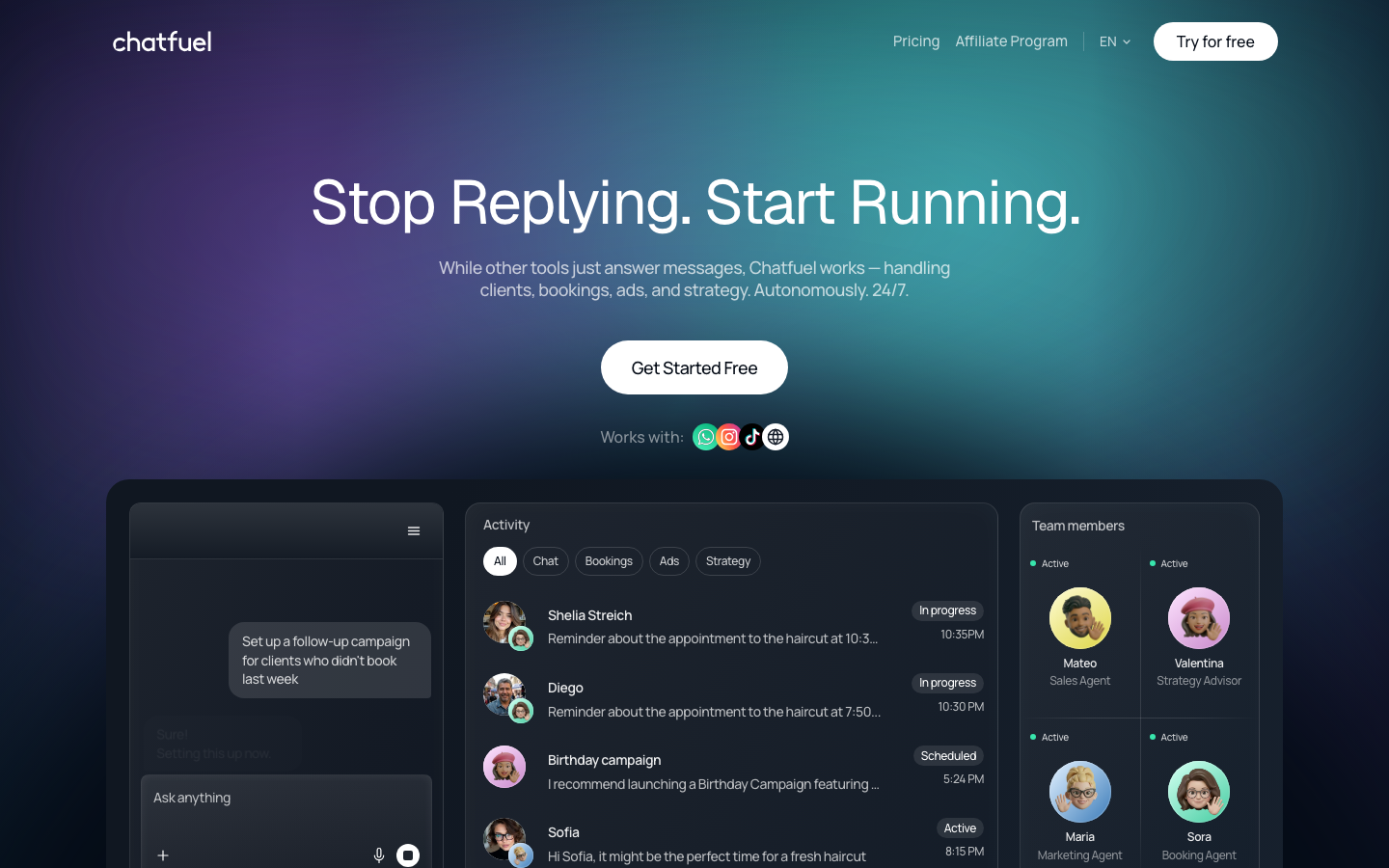
Chatfuel is an AI tool product for business and content teams, suitable for quickly verifying generation capabilities and collaboration efficiency in real tasks.
Chatfuel
Chatfuel’s core parameters and statistics
Chatfuel is a code-free conversation automation platform for marketing and customer service scenarios. It was incubated by Y Combinator in 2015. It originally started as a Facebook Messenger chatbot and has now expanded to multiple channels such as Instagram, WhatsApp, website chat, and TikTok. Its core positioning is to allow non-technical teams to build automated dialogue processes using drag-and-drop methods, covering the complete customer life cycle from potential customer acquisition, pre-sales consultation to after-sales support.
| Projects | Public Information |
|---|---|
| Official Positioning | Conversational Marketing and Customer Service Automation Platform |
| Product form | Web online service (SaaS), with mobile application (Android/iOS) |
| Core Channels | Facebook Messenger, Instagram, WhatsApp, Website, TikTok |
| Deployment Path | Cloud-hosted SaaS, no self-hosted/private options |
| Business Model | Freemium + Monthly Subscription |
| User scale | A total of 7 million+ merchants have used it since 2015, and there are about 150,000+ active merchants |
| Message magnitude | Officially claims to process over 1 billion messages per month |
| Rating | 4.6+/5 stars (G2, Capterra, Software Advice) |
| Latest version | Web Rolling Release (~2026-Q2) |
| Supported platforms | Web, Android, iOS, API |
Parameter Interpretation: Chatfuel is a typical product that is not driven by version numbers and evolves by continuous online delivery. The volume of 150,000+ active merchants and an average of 1 billion+ messages per month proves that it has a solid foundation for adoption among small and medium-sized merchants. However, it should be noted that these figures come from the official promotional page, and the specific statistical caliber has not been disclosed. The cross-platform score consistency of 4.6+/5 is relatively high, indicating that the core experience is highly satisfactory among the target user group. As a cloud SaaS, Chatfuel does not offer self-hosting or private deployment, and organizations with strong compliance requirements for data sovereignty need to confirm data processing boundaries in advance.
Chatfuel’s users and market recognition
Market signals: Chatfuel's market recognition mainly comes from three levels - Y Combinator endorsement, merchant adoption base and third-party evaluation reputation.
Y Combinator and investment background: Chatfuel’s founding team was accepted by Y Combinator in 2015 and has received investment from top institutions such as Greylock. This level of endorsement helped it quickly build merchant trust in the early stages, especially for SaaS products aimed at small and medium-sized merchants. The YC label is an important credit lever.
Merchant Adoption Scale: The official page publicly displays "7M+ businesses have chosen Chatfuel since 2015" and "150,000+ businesses" (active). In the Facebook Messenger bot category, this is one of the few platforms to reach millions of cumulative users. Well-known brand cases include Adidas, Levi's and many beauty, medical, and e-commerce merchants.
Third-party review ratings: Chatfuel maintains a 4.6+/5-star rating on the three major review platforms: G2, Capterra, and Software Advice. Keywords frequently mentioned in user reviews include: ease of use (no coding / drag-and-drop), rapid deployment (minutes to launch), and customer service response speed ("the fastest customer support"). This is a typical product-driven growth (PLG) signal - low threshold + good reputation drives natural spread.
Ecological extension: Chatfuel is an officially certified technology partner of Meta (Meta-approved tech provider) and integrates the latest version of WhatsApp Business API. This qualification is a guarantee of platform compliance and long-term availability for merchants who rely on the Instagram/Facebook channel.
Undisclosed information: The official has not disclosed operational indicators such as ARR, paid user conversion rate NPS, and specific regional distribution. There are few enterprise-level customer cases, mainly concentrated in small and micro businesses and growing merchants.
Chatfuel’s Cost Advantages
Chatfuel's cost structure is clear and layered: the free version lowers the experience threshold, the AI PRO version provides core revenue, and the WhatsApp Enterprise version covers high-demand merchants.
| Plan | Monthly fee | Applicable channels | Core capacity | Applicable objects |
|---|---|---|---|---|
| Chatfuel Light (Free) | $0 | Instagram, Facebook, WhatsApp | Basic auto-reply Shared Inbox, contact management, pre-made templates | Personal business, start-up verification |
| AI PRO | $49/month (annual payment is about -29%) | Same as above + Website | Includes all Light features + AI Sales Manager, AI Knowledge Base, AI automation, broadcast, lead funnel, advanced contact tools | Growing merchants, need AI assistance |
| WhatsApp Business | Starting from $69/month | WhatsApp exclusive | WhatsApp Business API, basic automation | Merchants using WhatsApp as the main channel |
| WhatsApp Enterprise | Starting from $400/month | WhatsApp Exclusive | Customized plans, priority support, dedicated Bot Builder experts | Enterprises with high message volume and need customization |
C-side/Individual: Chatfuel Light’s free plan is friendly enough for individual creators and small and micro businesses - you can get started without a credit card, and the core auto-responders, process editor and contact management can be used without paying. The real cost is the usage fee after the message volume exceeds the free quota, as well as the AI node and broadcast functions that will be unlocked after upgrading AI PRO.
API/Developer: Chatfuel does not charge per token or API call like pure API platforms. It offers a SaaS service, and developers extend functionality through built-in integrations (Zapier, Shopify, Google Sheets, etc.) or the WhatsApp Business API. For developers, the hidden cost is that when integrating unofficially supported third-party systems, they need to develop their own middle layers.
Enterprise/Private: Chatfuel currently has no self-hosted or private deployment options. WhatsApp Enterprise plan ($400+/month) includes dedicated support and customization, but is still cloud-hosted. Enterprises need to focus on evaluating: data storage location (subject to official GDPR/Privacy Policy), how long message history is retained, and overage rates after exceeding package limits. These details are not fully disclosed on the public page and need to be confirmed with a business contract before purchasing.
Hidden costs and pitfall avoidance tips
- Channel Platform Policy Risk: Chatfuel’s capabilities are highly dependent on Meta (Facebook/Instagram/WhatsApp) platform policies. Meta’s adjustments to message marketing template approval, frequency limits, user privacy policies, etc. will directly affect Chatfuel robot availability. The multiple mentions of "Facebook guidelines affecting bots" in the comment area are a true reflection of this type of risk.
- The Boundary of AI Capabilities: The "AI Sales Manager" and "AI Knowledge Base" in the AI PRO plan are essentially dialogue enhancement modules based on LLM, but the underlying model, the upper limit of the knowledge base capacity, and the review mechanism of AI replies have not been officially disclosed. In customer service scenarios with high accuracy requirements (such as medical consultation, financial compliance), the misjudgment rate of AI responses requires manual sampling verification.
- Message volume overage billing: The AI PRO plan description page is marked "Usage limits apply", but the specific overage rate needs to be referred to the limits.chatfuel.com page. It is recommended that merchants take the initiative to review limits before peak seasons (such as Black Friday and Double Eleven) to avoid service interruptions.
Chatfuel’s main features
Chatfuel's capabilities revolve around the two main lines of "code-free conversation automation + AI enhancement". Here is the core feature set cross-checked from the official website, help center, and pricing page:
-
Visual Process Editor (Flow Builder): Drag-and-drop to build a dialogue tree, supporting conditional branching, variable storage, delayed triggering, and multi-round context. Acceptance concerns: For complex processes with more than 50 nodes, whether the loading and rendering performance of the editor is acceptable; whether version history and rollback mechanisms exist.
-
Multi-channel unified inbox (Shared Inbox): Aggregates customer messages from multiple channels such as Facebook, Instagram, WhatsApp, and websites into the same interface, supporting manual takeover and annotation. Acceptance concerns: The message locking mechanism when multiple agents operate simultaneously, and the configurability of session allocation rules.
-
AI Sales Manager: Exclusive to the AI PRO plan, it can identify purchase intentions, recommend products, and automatically follow up during conversations. Acceptance concerns: AI’s ability to maintain context across multiple rounds of conversations, and the frequency with which high intentions are misidentified as customers, or real purchase signals are ignored.
-
AI Knowledge Base: Supports uploading FAQs, documents, etc., and the robot will automatically answer repetitive questions accordingly. Acceptance concerns: The effective delay time after the knowledge base update; the retrieval accuracy of multi-lingual mixed content; and whether it supports marking the confidence level at the end of the AI reply for manual review.
-
Broadcasts & Re-engagement: Send targeted messages to the accumulated contact list (promotions, replenishment reminders, event notifications), and support audience segmentation based on behavior and attributes. Acceptance concerns: The impact of the Messaging frequency control limit of the Meta platform on the broadcast delivery rate; the integrity of the unsubscription and complaint management links.
-
Lead Funnels & Contact Management (Funnels & CRM): Automatically annotate customer choices and tags in conversations, and build exportable customer portraits and groups. Acceptance concerns: Whether the export format (CSV/API) meets the docking requirements of the upstream CRM system; the flexibility of field customization.
-
Pre-made template library (Templates): Covers dialogue templates for e-commerce, education, medical, beauty and other industries, which can be deployed and fine-tuned with one click. Acceptance concerns: Whether the localization degree of the template (language, cultural customs, compliance terms) needs to be significantly modified.
-
Integrations: Native integration with Shopify, Google Sheets, Zapier, as well as Meta tools such as WhatsApp Business API and Facebook Comments Plugin. Acceptance concerns: The docking path to non-native systems (Webhook/API), and the stability of each integration under the pressure of message volume.
Expert View: The real value of Chatfuel is not a single function, but the three-layered design of "multi-channel aggregation + AI automatic reply + manual intervention" - customers ask questions from Instagram comments, the robot automatically replies to the FAQ, and automatically transfers to manual Shared Inbox when the problem cannot be solved. After the problem is solved, it is automatically tagged into the CRM group, and subsequent broadcast repurchases can be made for this group. This kind of "automatic bottom-up, manual filling, and data return" link is the core difference between it and other single-channel chatbot tools.
Chatfuel’s model and version evolution
Since Chatfuel was launched in 2015, its product evolution has gone through four identifiable stages:
2015-2018: Facebook Messenger native bot era
- Use Facebook Messenger as the first and only channel.
- Core capabilities: keyword automatic reply, menu navigation, broadcast sending.
- Business model: Freemium, pay to unlock more contacts and broadcast credits.
2019-2021: Multi-channel expansion period
- Added Instagram auto-reply (comment + private message) and website chat plugin.
- Introduced Flow Builder visual editor to replace the early simple rule configuration.
- Launched a mobile app to support merchants to manage robots and view messages on mobile phones.
2022-2024: AI capability embedding period
- Launched the Fuely AI sub-brand (now renamed AI PRO plan), including AI Knowledge Base, AI Sales Manager, and AI automation nodes.
- Become Meta's official certified technology provider and deeply integrate WhatsApp Business API.
- Added TikTok channel automation.
- Contact and CRM modules have been upgraded to support more fine-grained audience segmentation.
2025-2026: AI-first thinking becomes the main line
- AI PRO is upgraded from an additional function to an independent plan, forming a dual-plan structure with Chatfuel Light (free).
- The pricing page clearly shows that AI Sales Manager, AI knowledge base, etc. are exclusive capabilities of AI PRO.
- Continue to iterate frequently, but update in a continuous delivery manner (Web Rolling Release) without traditional semantic version numbers.
Version summary:
| Phase | Timeframe | Core Changes | Version Tags |
|---|---|---|---|
| Origin period | 2015 | YC incubation, Facebook Messenger bot launched | public-launch |
| Multi-channel period | 2019~2021 | Added Instagram, Website, Mobile App | multi-channel |
| AI embedding period | 2022~2024 | Fuely AI releases WhatsApp API, TikTok | ai-integration |
| AI-first issue | 2025~present | AI PRO solution independent, conversational AI enhancement | web-rolling-2026q2 |
Since Chatfuel adopts the SaaS continuous delivery model, the official semantic version number has not been released. Evaluation Suggestions: Merchants can track service status through status.chatfuel.com, and understand the rhythm of feature updates through changelog instead of relying on version numbers to judge evolution.
Chatfuel’s technical advantages
Architecture form: Chatfuel adopts a fully managed SaaS architecture. Merchants configure the bot through the web panel or mobile app, and the Chatfuel backend is responsible for interacting with the APIs of platforms such as Meta, Instagram, and WhatsApp at runtime. Merchants do not need to manage server SSL certificates or message queues.
Channel abstraction layer: The core technical value lies in the abstraction of "a process editor → multi-channel release". The conversation tree configured by the merchant in Flow Builder is automatically mapped by the Chatfuel adaptation layer to the interface formats of different channels such as Facebook Messenger API, Instagram Graph API, WhatsApp Business API, Website Widget SDK, etc. This means that business terminology only needs to be maintained once to maintain consistency across multiple channels.
AI Enhancement Mechanism: The AI Knowledge Base and AI Sales Manager in AI PRO are implemented based on LLM, but Chatfuel has implemented domain constraints - the scope of AI answers is limited to the knowledge base and preset processes uploaded by the merchant, rather than open domain conversations. This approach strikes a balance between controllability and intelligence: Merchants don’t have to worry about customers asking sensitive topics that cross the line, but the price is that the flexibility of AI is limited, and questions beyond the scope of the knowledge base are directly transferred to humans.
Effects and Limitations:
- Advantage Scenarios: High-frequency, standardized, and predictable dialogue scenarios (FAQ, order inquiries, reservations, promotion push). In this scenario, Chatfuel can reduce the manual processing rate from 100% to 10%~30% (officially claimed that 98% of requests can be automatically processed by robots).
- Limited Scenarios: Conversation scenarios that are highly personalized, highly creative, and require in-depth industry knowledge (such as personalized lesson plan design, legal consultation, medical diagnosis). In this case, the coverage and accuracy of the AI knowledge base cannot meet user expectations, and human agents must be relied upon.
Engineering Pitfall Guide (for technical evaluators):
- Message delivery delay: Messages sent through WhatsApp/Instagram API are subject to platform-side review and frequency control, and there may be minute-level delays during the promotion period. It is recommended to prepare A/B channels in advance for time-sensitive messages.
- AI Reply Consistency: The non-deterministic characteristics of responses generated by LLM may lead to different answers to the same question at different times. In high-frequency scenarios, it is recommended to use template constraints or manual pre-review of AI responses.
- Webhook integration with third-party systems: Chatfuel’s Webhook capabilities and API documentation are limited in depth, and complex integration scenarios (such as self-built CRM two-way synchronization) may require middleware layer assistance.
How to use Chatfuel
Chatfuel provides a unified configuration entrance for multiple channels. The core operation path is as follows:
Access methods of each channel
| Channel | Access method | Time-consuming | Prerequisites |
|---|---|---|---|
| Facebook Messenger | Authorize Facebook Page | ~5 minutes | Own Facebook Page |
| Bind Instagram business account | ~5 minutes | Instagram business account + Facebook Page association | |
| Connect WhatsApp Business API number | ~15 minutes | Requires Meta Business verification + phone number | |
| Website | Embed JS Widget snippet | ~10 minutes | Webmaster permissions |
| TikTok | Authorize TikTok business account | ~10 minutes | TikTok business account |
Standard implementation process
- Step 1: Select a channel and complete authorization. Select the target channel from the Chatfuel panel (it is recommended to start with Facebook Messenger or Instagram because the authorization link is the shortest), and follow the guidance to complete Meta account authorization and Page/account binding.
- Step 2: Start from a template or build the process from scratch. For first-time users, it is recommended to select a template from the pre-made template library that is closest to the business (such as "FAQ automatic reply", "lead collection", "appointment confirmation"), and replace the words and conditional branches based on the template. Non-R&D roles can typically have their first robot online within 30 minutes.
- Step 3: Configure AI knowledge base (optional). AI PRO users can upload FAQs, product manuals, price lists and other documents to AI Knowledge Base, and the robot will answer customer questions accordingly. After uploading, it is recommended to do a round of coverage testing to check the AI’s recall accuracy for high-frequency issues.
- Step 4: Set up manual takeover rules. Configure manual transfer rules in Shared Inbox (for example: the customer enters "human customer service", the same question is repeated three times, the AI confidence is lower than the threshold, etc.). Make sure there is a team rotation or notification mechanism to avoid long waiting times for customers.
- Step 5: Publish and monitor data. After releasing the robot, monitor through Chatfuel's built-in analysis panel: core indicators such as message volume, automatic reply rate, manual conversion rate, and number of lead conversions. It is recommended to use a seven-day evaluation cycle to continuously optimize process nodes and AI knowledge base content.
Quantitative deduction of cost reduction and efficiency improvement (taking AI PRO $49/month as an example)
The following is an unofficial commitment based on public functions and industry averages:
| Job role | Typical tasks | Working hours before the exercise | Working hours after the exercise | Decrease |
|---|---|---|---|---|
| Customer service specialist (e-commerce) | Repetitive FAQ reply | 4 hours/day | 0.5 hours/day (manual review of AI reply) | ~87% |
| Social media operation | Comment interaction + DM reply | 2 hours/day | 0.5 hours/day (only handles requests that AI cannot answer) | ~75% |
| Sales Assistant | Lead screening and follow-up | 3 hours/day | 1 hour/day (AI automatic screening + manual confirmation of high intent) | ~67% |
| Marketing activities | Event notification broadcast + registration confirmation | 8 hours/time | 1 hour/time (templated + automated triggering) | ~87% |
Human-machine collaboration boundary:
- 100% automated and organized: standard FAQ reply, order status query, appointment reminder, event notification broadcast, automatic reply to comments.
- Manual confirmation is required: refund/complaint handling, first contact with high-value customers, responses involving compliance/legal statements, scenarios where customers explicitly request manual transfer, cross-system data correction.
- It is recommended that human-machine collaboration be regulated: Confirmation of clues after initial screening by AI (AI marks "high intention" and then manually confirms again and then forwards to sales), AI-generated personalized discount plan (send after manual approval).
Product Pricing for Chatfuel
Chatfuel's pricing system is fully displayed on the public page of the official website. It adopts the standardized SaaS model of "free trial + monthly/annual subscription", without complicated Token metering or API call billing.
Comparison of core solutions
| Projects | Chatfuel Light (Free) | AI PRO ($49/month) | WhatsApp Business ($69/month) | WhatsApp Enterprise ($400+/month) |
|---|---|---|---|---|
| Channel Coverage | Facebook, Instagram, WhatsApp | Same as above + Website | WhatsApp Exclusive | WhatsApp Exclusive |
| Process Editor | ✅ | ✅ | ✅ | ✅ |
| Shared Inbox | ✅ | ✅ | ✅ | ✅ |
| Contact Management | ✅ | ✅ | ✅ | ✅ |
| Pre-Made Templates | ✅ | ✅ | ✅ | ✅ |
| AI Knowledge Base | ❌ | ✅ | ❌ | Customization |
| AI Sales Manager | ❌ | ✅ | ❌ | Customized |
| Broadcasts & Funnels | ❌ | ✅ | ❌ | Customization |
| Advanced Contact Tools | ❌ | ✅ | ❌ | Customization |
| Dedicated Support | ❌ | ❌ | ❌ | ✅ |
| Bot Builder Expert | ❌ | ❌ | ❌ | ✅ |
| Annual payment discount | — | ~29% off | Undisclosed | By contract |
Additional Note:
- All plans require no credit card to get started (free version and AI PRO trial).
- WhatsApp Enterprise pricing starts at $400/month. The actual cost may increase depending on message volume, customization requirements, and SLA levels, and needs to be confirmed by the business.
- The usage limits of the free version and AI PRO are as marked on limits.chatfuel.com. The excess amount will incur additional charges, but the official unit price for the excess amount has not been disclosed.
- For merchants with high demand for API or customized integration, Chatfuel has not disclosed a pure API access solution and currently needs to operate through the SaaS panel.
Negotiation space: AI PRO annual payment is about 29% discount compared to monthly payment (equivalent to monthly fee of about $34.8). For merchants who plan to use it for a long time, annual payment is a more economical option. There is room for negotiation on WhatsApp Enterprise plans, depending on message volume and scope of feature customization.
Chatfuel application scenarios
Chatfuel's core implementation scenarios focus on "high-frequency, standardized, multi-channel" customer interaction scenarios. The following are three typical scenarios that have been verified:
Scenario 1: E-commerce pre-sales and after-sales automation
Task Type: Product consultation (size, inventory, price) → automatic reply; order status query → API synchronization real-time status; return/exchange → AI preliminary screening guidance + manual confirmation. Actual benefits: Merchant cases show that after connecting to Chatfuel, a beauty brand’s monthly revenue increased by about 40% ($250,000), the cost of a single conversion dropped from $8.30 to $4.06, and the return on advertising spend reached 10 times. Another horoscope/astrology brand uses Messenger bots to qualify leads, reducing operating costs by $25,000/month and reducing the team from 55 to 25 people. Key points of verification: The accuracy of AI in "judgment of reasons for returns", and whether customer satisfaction has declined after manual intervention.
Scenario 2: Local service industry reservations and reminders
Task type: Online appointment for clinic/beauty salon/consultation room → conversational booking; appointment confirmation and approaching reminder → automatic message; feedback collection after arrival → conversational questionnaire. Actual benefits: Compared with traditional forms, the conversational experience of scheduled appointments can significantly reduce the abandonment rate (from 20%~30% to 5%~10%), and automatic reminders can reduce the no-show rate (No-show) by 30%~50%. Key points to verify: Whether the two-way synchronization of the calendar system (Chatfuel ↔ Google Calendar / Calendly) is real-time and accurate; whether the cancellation/rescheduling process is transparent to customers and can be operated independently.
Scenario 3: Social media marketing lead generation and cultivation
Task type: Instagram/Facebook ads → Automatically reply to comment messages → Conversational lead collection → AI scoring → Automatically push product catalog → No tracking. Actual benefits: Advertising traffic no longer stops at the landing page, but directly enters the conversation process, and the lead collection rate can be increased by 3 to 5 times (due to the immediacy and low resistance of conversation interactions). Key points to verify: Configurability of lead scoring rules; whether AI scoring supports custom rules (such as "Customers who select service A -> high intent"); completeness of field mapping exported to CRM (such as HubSpot, Salesforce).
Not applicable scenarios
- Deeply customized original design: Chatfuel’s templates and Flow Builder are suitable for standardized processes, but they cannot replace manual customized visual or verbal creation.
- Strong compliance industries: In highly regulated fields such as medical diagnosis, legal consulting, and financial transactions, Chatfuel's AI replies lack industry certification and audit traceability capabilities, and are not suitable for direct use on clients.
- Pure internal communication/collaboration tool: Chatfuel is designed for external interaction scenarios of merchants → customers, and is not suitable for internal employee communication or project management.
Who is Chatfuel suitable for?
Chatfuel's core audience is "small, medium and micro businesses who want to use automation to improve customer service and marketing efficiency, but do not have a technical team." In terms of pricing and capability boundaries, it covers the span from individual creators to medium-sized enterprises.
- Individual entrepreneurs and individual merchants: The free version is sufficient for individual merchants with a monthly message volume of less than 1,000 - starting from pre-made templates, replying to FAQs, and collecting clues, one person can complete the configuration and operation. Threshold: You need to have the most basic dialogue process design ability (can be understood as "drawing a dialogue flow chart"), no code is required.
- E-commerce and retail team (3~20 people): The value of the AI PRO solution is most obvious in this group - the AI knowledge base takes on 80% of repetitive customer service work, and the team can focus its manpower on high-value customers and promotional strategies. Threshold: At least one person is required to be responsible for the maintenance and quality inspection of the AI knowledge base (to ensure that AI responses do not cause brand image or compliance issues).
- Social Media and Content Operations Team: Need to uniformly manage customer interactions across multiple channels such as Instagram, Facebook, and WhatsApp, and provide rapid response and lead recovery during the advertising period. Threshold: Need to coordinate with the advertising team to connect Chatfuel's lead capture process with the advertising campaign (through Click-to-Messenger advertising).
- WhatsApp-first merchants: In markets with high WhatsApp penetration such as Latin America, Southeast Asia, and Europe, Chatfuel’s WhatsApp Business API integration is a core selling point. Threshold: The Meta Business verification process (enterprise qualification review) needs to be completed, which may take 1~2 weeks.
Not suitable for the crowd:
- Large Enterprises and Strong Compliance Organizations: Chatfuel has no private deployments, no public information on security certifications such as SOC2, and no enterprise-grade SSO/AD/LDAP integration. For businesses with >500 employees or that are subject to strict HIPAA/GDPR regulations, Chatfuel's current product form may not pass procurement compliance reviews.
- Teams that require deeply customized dialogue experiences: The boundary of Flow Builder's capabilities is visual branch logic, which cannot achieve completely free natural language dialogue, nor can it be connected to self-developed NLP models or external LLM services (closed ecosystem).
- Pure developer team: The core value of Chatfuel is "lowering the threshold" rather than "opening capabilities". If the team has the ability to maintain the bot infrastructure themselves, it may be more cost-effective and flexible to use the Meta/WhatsApp API directly or the open source Rasa/Botpress.
Summary and Outlook of Chatfuel
Chatfuel has spent 10 years evolving from a single Facebook Messenger bot to a multi-channel conversation automation platform. Its core competitiveness can be summed up in three points: The ease of use of the code-free process editor (non-technical teams can launch the robot within 30 minutes), The aggregation capabilities of multiple message channels (a set of processes is published on Facebook/Instagram/WhatsApp/website), and AI-enhanced automation closure (AI knowledge base + AI sales manager + manual back-up). Among small and medium-sized merchants, these three points combine to form a clear path for cost reduction and efficiency improvement.
Current Limitations and Uncertainties:
- Platform dependency risk: Chatfuel’s capabilities are deeply bound to the Meta ecosystem (Facebook, Instagram, WhatsApp). Any adjustments Meta makes to message frequency control, template approval, and data access policies will be directly transmitted to Chatfuel’s feature availability and cost structure.
- The transparency of AI capabilities is too low: The underlying model of the AI PRO solution, the auditability of the upper limit of knowledge base capacity, and the auditability of AI responses are not disclosed on the public page. This poses a substantial obstacle for scenarios that require interpretability and compliance verification of AI responses.
- Gaps in enterprise-level capabilities: Enterprise necessities such as SSO, RBAC, audit logs, privatized deployment, etc. are missing from Chatfuel’s current product line. This is the main bottleneck in its leap from medium-sized merchants to large enterprise markets.
- Price Transparency: The actual starting price of the WhatsApp Enterprise plan with excess usage rates, the lock-in terms of long-term contracts, etc., all require one-to-one business communication to obtain, which affects the efficiency of price comparison and budget preparation.
Purchasing and Adoption Recommendations: It is recommended to start with a small-scale pilot—select 1 to 2 highly repetitive, low-risk customer interaction processes (such as FAQ automatic reply + appointment confirmation), and use the free version or the AI PRO monthly payment plan to complete the 14-day trial run. Focus on three data points: AI automated response rate (target > 70%), average resolution time after switching to manual, and changes in customer satisfaction before and after automation. If the trial run data meets business expectations, the discount will be locked in by annual payment and channels and processes will be gradually expanded. For merchants with WhatsApp needs, they can directly activate the WhatsApp Business plan in the trial stage, because Chatfuel’s status as Meta’s official certified technology provider in this channel is a rare differentiation advantage among competing products. Before making a formal purchase, enterprise-level buyers must confirm the data storage location, overage billing tiers, and transitional clauses when platform policies change with the business contract.
Positioning comparison between Chatfuel and mainstream competing products
| Comparison Dimensions | Chatfuel | ManyChat | Tidio | Intercom |
|---|---|---|---|---|
| Core positioning | Multi-channel dialogue automation + AI | Messenger/Instagram bot | Website chat + email marketing | Customer communication platform (pre-sales ~ after-sales) |
| Main Channels | Facebook, Instagram, WhatsApp, Website, TikTok | Messenger, Instagram, SMS, Email | Website Chat, Email, Messenger | Website, Email, Messenger, WhatsApp |
| No code editor | ✅ Flow Builder drag and drop | ✅ Visual process | ✅ Visual process | ✅ Partial automation rules |
| AI Knowledge Base | ✅ AI PRO Solution | ❌ (requires third-party integration) | ✅ AI Assist (paid) | ✅ Fin AI Agent (additional) |
| WhatsApp Business API | ✅ Meta Official Certification | ✅ | ❌ (Basic only) | ✅ |
| Free Plan | ✅ Chatfuel Light | ✅ Limited Free | ✅ Limited Free | ❌ Paid Trial Only |
| Starting monthly fee (paid version) | $49 | ~$15 | ~$29 | ~$74 |
| Enterprise-level capabilities | Weak (no SSO/privatized) | Average | Average | Strong (SSO, RBAC, auditing) |
| Optimal size | Small micro ~ medium | Small micro ~ medium | Small e-commerce/SaaS | Medium ~ large enterprise |
Chatfuel has advantages in cost performance and multi-channel coverage in the optimal scale segment (small and micro to medium-sized merchants), but will encounter functional shortcomings when entering the enterprise market. There is no need to pursue "the strongest" when choosing, but to see whether your team size, compliance requirements, and channel distribution are aligned with Chatfuel's capability boundaries.
Related tools:  CrewAI,
  LangChain
Version Info
- Chatfuel Web Rolling Release :Officially, the online service is updated through continuous delivery. There is no official precise semantic version number and release date yet.
- Chatfuel Public Launch :There is no official precise date yet, but historical milestones are recorded according to the publicly accessible stage.
User Reviews