 CodeGPT
Free
CodeGPT
Free
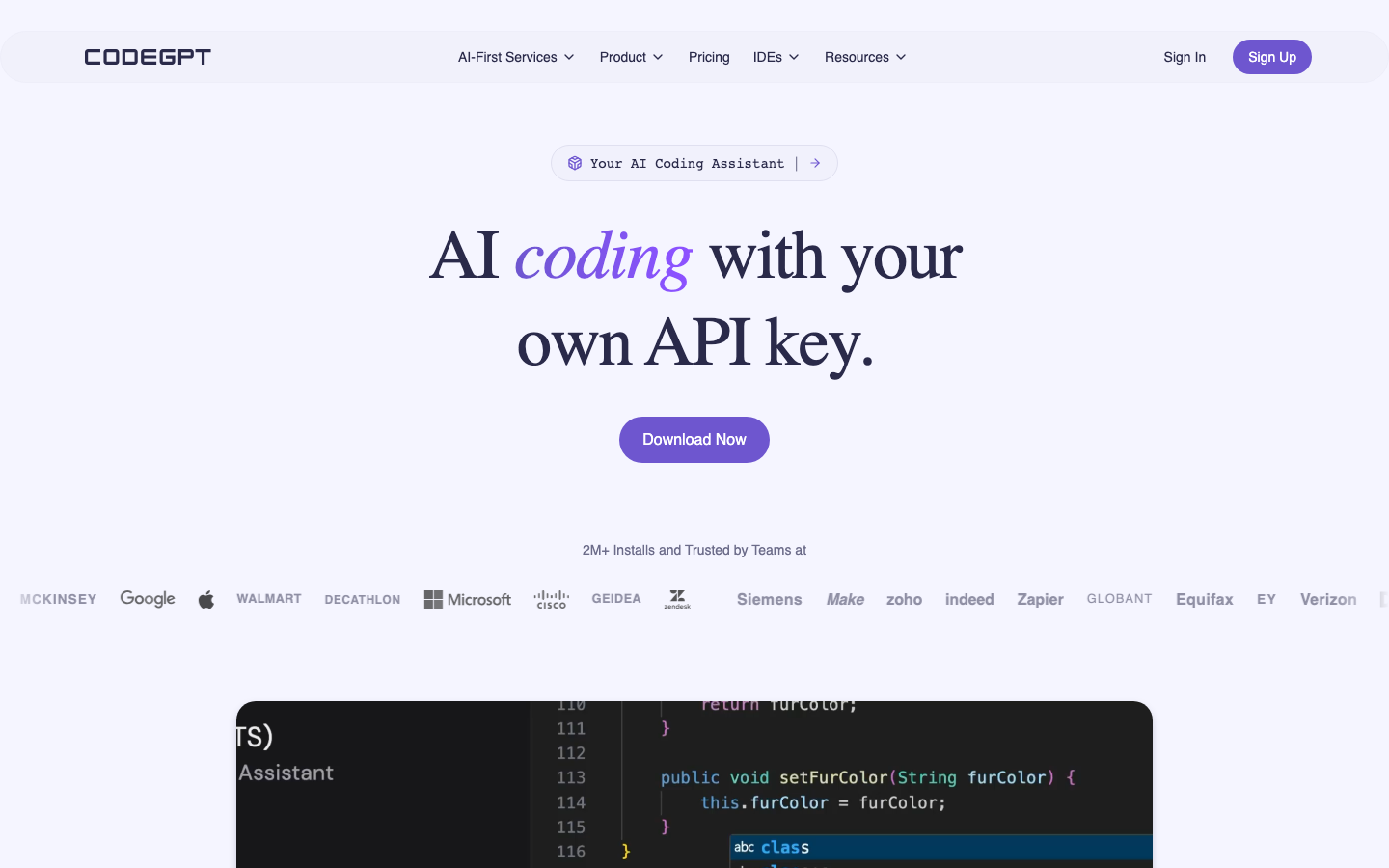
CodeGPT is an AI code assistant tool that supports access to a variety of large models (GPT-4, Claude, local models, etc.), provides code completion, conversational programming, code review and document generation capabilities, covering VS Code extensions and independent desktop clients.
CodeGPT
Core parameters and statistics of CodeGPT
CodeGPT's positioning can be summarized as a "model-hub AI coding co-pilot" - it is not tied to a single model supplier, but allows developers to freely switch between 20+ back-end models (including local models) within a set of IDE plug-ins, and provides advanced capabilities such as Agent mode, smart Diff, and MCP connection. The official self-description is "The AI coding assistant that connects to any model and understands your entire codebase", which is essentially an AI programming middle layer in the form of BYOK (Bring Your Own Key).
| Projects | Public Information |
|---|---|
| Official positioning | AI coding assistant with multi-model / BYOK support |
| Core capabilities | Agent mode, intelligent Diff, conversational programming, code completion MCP connection Rules rule engine |
| Integration method | VS Code extends JetBrains, extends Cursor, independent desktop client API |
| Deployment method | SaaS (CodeGPT Plus) + BYOK (direct connection to third-party API) + local model |
| Supported platforms | VS Code, JetBrains IDEs, Cursor, Desktop, API |
| VS Code installations | About 2.45 million times (as of 2026-07-18) |
| VS Code Rating | 3.4 / 5.0 |
| Target customer groups | Individual developers, development teams, enterprise IT |
| Place of Attribution | US (Judini Inc.) |
| Latest extended version | 3.24.15 (updated on 2026-07-18) |
DIFFERENCE IN BYOK FORM: Unlike GitHub Copilot or Amazon Q, CodeGPT does not provide hosting model quota by default, but allows users to access APIs such as OpenAI, Anthropic, and Google. This means that users have full control over data flow and token costs, but they also need to manage multiple API accounts and keys by themselves.
Horizontal coverage of the portal: Supports the three mainstream IDE ecosystems of VS Code, JetBrains, and Cursor, and cooperates with independent desktop clients and APIs to cover the entire link from personal coding to team CI/CD integration.
Users and market recognition of CodeGPT
CodeGPT's market signals mainly come from IDE market public data and customer logo walls, rather than public revenue or financing figures (the latter is not officially disclosed).
VS Code Marketplace: The extension page shows approximately 2.45 million installs and a rating of 3.4/5.0. The installation volume is at an upper-middle level among AI programming extensions, but the score is low, reflecting the gap between users' expectations for experience and actual delivery (common feedback focuses on response speed and model switching stability).
Enterprise Customer Wall: The official website lists the logos of well-known companies such as Salesforce, Google, Apple, Microsoft, Cisco, NVIDIA, Figma, Zendesk, Equifax, and Deloitte. However, this list does not distinguish between "paid customers" and "trial/test teams" and needs to be used as a market signal rather than a contractual basis.
Community activity: Discord community GitHub Issues (16 Open Issues), Product Hunt page and other channels are kept updated. The GitHub document repository (JudiniLabs/code-gpt-docs) has about 16 stars, indicating that the community contribution layer is still thin and the main maintenance is completed by the official team.
Financing and Team: Parent company Judini Inc. has limited public financing information and has not entered the first-tier financing disclosure sequence of mainstream AI programming tools. Business sustainability needs to be continuously observed.
Cost Advantages of CodeGPT
CodeGPT's cost advantage does not come from "absolutely low price", but from the model selection and usage control brought by the BYOK architecture.
C-side / personal
- Free Plan: $0/month, users bring their own API Key and get 30 free interactive experience credits. You can continue to use BYOK mode after exceeding it (pay according to actual API consumption).
- BYOK Pro: $8/month, removes the limit on the number of interactions and provides advanced auto-completion. Users still pay for API calls.
- CodeGPT Plus (Credit Mode): No API Key is required, and officially hosted models (Claude, GPT, Gemini, etc.) are consumed according to credits. It is suitable for users who do not want to manage API accounts by themselves. The unit price of credit points is subject to the official real-time page.
Developer / API
CodeGPT provides an API entrance (developers.codegpt.co) to support embedding AI coding capabilities into CI/CD or internal tool chains. The billing logic depends on the API pricing of the selected model provider, and CodeGPT itself does not charge additional middle-tier fees (BYOK model), which is the core cost difference with fully managed solutions such as Copilot.
Enterprise / Privatization
The Enterprise solution (AI-First Services) covers privatized deployment, model customization SLA and security audit, and pricing is subject to business confirmation. No public price list.
Cost comparison of competing products
| Plan | Monthly fee model | Model flexibility | Data control | Hidden costs |
|---|---|---|---|---|
| CodeGPT Free (BYOK) | $0 + user pays API | High (20+ models) | High (direct API connection) | Need to manage multiple API Keys by yourself |
| CodeGPT BYOK Pro | $8/month + user pays API | High (20+ models) | High (direct API) | Same as above |
| GitHub Copilot | $10-19/month (fully managed) | Low (OpenAI only) | Low (code uploaded to GitHub) | No additional API fees |
| Amazon Q Developer | $0-19/month | Low (Bedrock only) | Medium (within the AWS ecosystem) | AWS Infrastructure Bundling |
| Cursor Pro | $20/month (Fully Hosted + BYOK Hybrid) | Medium (Limited Model Selection) | Medium | Fully Hosted Credits Mode |
Core Difference: CodeGPT’s BYOK model is lower than Copilot and Cursor in terms of monthly subscription fee, but the actual total cost to the user = subscription fee + selected model API call fee. For high-frequency users, the API fee may far exceed the monthly subscription fee. Therefore, CodeGPT is more suitable for teams that already have API quotas or need to control costs with a fixed model.
Main functions of CodeGPT
CodeGPT's functional system is designed around the three main lines of "model neutrality + agent-driven + developer controllable", which can be summarized into six types of core capabilities:
- Agent Mode (Core Differentiation): Not just dialogue completion, Agent can create files, apply edits, read the code base and perform multi-step tasks (such as code migration, batch refactoring). The tools exposed by the model in Agent mode include
read_file,edit_file,create_file,delete_file,list_dir,search_files, etc., forming the relationship of "LLM → Tool call → File change → Diff preview → User confirmation". Unlike the browser control of Playwright MCP or browser-use, CodeGPT Agent controls the local file system and IDE workspace. - Smart Diff (Change Review): Every code modification generated by the Agent or conversation is presented in the form of a real-time Diff, and developers can accept, reject, or edit it piece by piece. This mechanism solves the most critical "trust verification" problem in AI programming - not allowing the AI to write to the disk directly, but keeping the human in the loop.
- Conversational Programming (Chat): Converse with AI in the IDE sidebar or independent window, supporting slash commands such as
/Fix,/Explain,/Refactor,/Document,/Unit Testing, and#file-namesyntax to add context to the specified file. Conversations can be traced, traced back, and project documents referenced. - Autocomplete: Provides real-time code completion based on the selected model, supporting context awareness. Unlike Copilot's built-in models, CodeGPT's completion is done through the user-selected model API, and the quality of completion directly depends on the selected model capabilities.
- MCP connection: CodeGPT links to external APIs, documents and databases, encapsulating external system capabilities into Agent callable tools. This enables the Agent to no longer be limited to file operations, but can also query databases, call REST APIs, and access internal knowledge bases.
- Rules and context management: Users can set coding rules (such as coding style, naming conventions), and the Agent automatically abides by them when generating code; the context panel displays Token consumption in real time, with no hidden limits.
Model Classification: CodeGPT belongs to Productivity/Business Application (Type D). The main delivery form is IDE extension + desktop client, which is aimed at improving developers' daily coding efficiency. At the same time, because of its Agent mode and MCP connection capabilities, it has the sub-type characteristics of Agent / MCP Automation Tool (Type A) - Agent exposes a clear Tool list to complete the complete process from understanding requirements to modifying files.
CodeGPT model and version evolution
CodeGPT's product iteration is based on the VS Code extended version, accompanied by parallel updates of JetBrains plug-ins and desktop clients.
VS Code extended version context
| Version Node | Date | Major Changes |
|---|---|---|
| 3.24.15 (currently the latest) | 2026-07-18 | Continuous feature iteration and bug fixes (subject to the VS Code Marketplace update log) |
| Early 3.x | 2025-2026 | Agent mode introduced MCP connection launched BYOK Pro subscription launched |
| 2.x | 2024-2025 | Multi-model switching support and code completion are launched on JetBrains extension release |
| 1.x | 2023-2024 | Initial version online, basic conversation programming functions |
Version Note: The version number of CodeGPT follows the VS Code extended calendar version (year.month.patch) and does not mark major version milestones in the sense of a feature line. The official does not provide traditional semantic version numbers (such as v1.0, v2.0), so the version description is subject to the Marketplace update log.
Product form evolution
From a single conversation tool (2023) → multi-model code assistant (2024) → agent-driven coding assistant (2025-2026), the evolution direction of CodeGPT is "from chat box to autonomous agent." The Agent mode MCP connection and Rules system introduced between 2025 and 2026 mark its shift from passive question and answer to active code operation.
Technical advantages of CodeGPT
CodeGPT's technical advantages do not come from the performance leadership of self-developed models, but from the model abstraction and developer control design at the architecture layer.
BYOK Architecture (Mechanism → Effect): CodeGPT does not hold the model inference layer, but acts as an intermediary proxy for model calls. After the user configures the API Key in VS Code, all requests are directly connected to the third-party API, and CodeGPT itself does not record the code content. This has three direct effects: ① The data does not go through a third-party intermediate server (privacy compliance advantage); ② Users can accurately trace the Token cost generated by each line of code (cost control advantage); ③ Switching models does not require migrating data or relearning operations (flexible migration advantage).
Agent tool-based design (mechanism → effect): Agent mode encapsulates each encoding operation into an independent Tool (create_file, edit_file, read_file, search_files, etc.), and LLM orchestrates the execution steps through Tool Calling. Compared with directly generating complete code blocks, the tool-based design allows Agent to perform a multi-step process of "first reading the project structure → understanding the context → modifying in batches → waiting for user confirmation". This design is especially valuable for complex refactoring tasks - the agent can explore the code base before taking action, just like a human developer.
Local model priority (mechanism → effect): Support local running models through frameworks such as Ollama, LM Studio, Docker, etc., and the inference is completely completed on the developer's machine, with zero data off-machine. This is a key entry point for data-sensitive industries such as finance, healthcare, defense, etc. – there is no need to upload code to any external server for AI coding assistance.
MCP integration architecture: CodeGPT uses the MCP protocol as the external capability extension layer of the Agent. The Agent can call external APIs, databases and document systems through the MCP Server. The architecture link is LLM → CodeGPT Agent → MCP Server → External System, and the data return direction is External System → MCP Server → CodeGPT Agent → IDE Diff Panel → User Confirmation.
Guide to engineering pitfalls:
- Dead-end loop and Token inflation control: Agent mode may fall into a loop of "modify → check → modify again" in a multi-step task. It is recommended to set
max_stepsand timeout threshold in Rules, and observe the Agent's step log in the Diff panel to terminate in time when repeated actions are found. - Multi-model configuration complexity: When accessing the three APIs of OpenAI + Anthropic + Google at the same time, it is necessary to maintain the quota Key and model name mapping of the three accounts respectively. The risk of API Key leakage increases linearly with the number of access models - contextual variables or key management services should be used instead of written in the VS Code configuration file.
- Context window management: When there are many project files, the Agent may read a large number of files at once, causing context overflow. It is recommended to use the
#file-namesyntax to precisely control the set of files sent to the context, rather than letting the Agent automatically scan the entire workspace.
How to use CodeGPT
CodeGPT provides multiple access paths, covering different development situations and usage habits.
| Access method | Installation entrance | Applicable scenarios |
|---|---|---|
| VS Code extension | marketplace.visualstudio.com — DanielSanMedium.dscodegpt | Mainstream choice, the most complete functions |
| JetBrains plugins | plugins.jetbrains.com — CodeGPT Chat & AI Agents | IntelliJ, PyCharm, etc. JetBrains IDE users |
| Cursor Extensions | Cursor Marketplace | Users Already Using Cursor Editor |
| Independent desktop client | codegpt.co download | Independent programming context that does not rely on IDE |
| API | developers.codegpt.co | CI/CD integration or custom toolchain |
Typical Getting Started Steps:
- Install the extension in the VS Code Marketplace.
- Select the connection mode: ① Configure your own API Key (BYOK mode, supports 20+ vendors such as OpenAI/Anthropic/Google); ② Purchase CodeGPT Plus credits (no API Key required, directly use the officially hosted model).
- Open CodeGPT Chat in the command palette (Ctrl+Shift+P) to start a conversation, or enable auto-completion.
- If you need Agent mode, enter the coding task in the dialog, and the Agent will automatically read the project file, generate a modification plan, and display a Diff preview.
Product Pricing for CodeGPT
CodeGPT's pricing structure is divided into four tiers: "Free + BYOK Subscription + Credit Points + Enterprise Services", covering the complete link from personal trial to enterprise-level deployment.
| Plan | Monthly fee | Core benefits | Applicable objects |
|---|---|---|---|
| Free (BYOK) | $0 | 30 free interactions + unlimited use with your own API Key + basic Agent mode | Personal developer experience |
| BYOK Pro | $8 | Free benefits + unlimited interaction + advanced auto-completion + priority support | Daily high-frequency developers |
| CodeGPT Plus | Credit billing | No API Key required, use official hosting models such as Claude/GPT/Gemini | Users who don’t want to manage API Keys |
| Enterprise | Business Pricing | Private Deployment + Model Customization + SLA + Security Audit | Medium and Large Enterprise Teams |
C client/individual: Actual usage cost of Free + BYOK mode = API call fee of the selected model. For light users (average <50 completions per day), the API fee is usually $5-15/month; for heavy users, it may exceed $50/month.
Developer/API: The API model is billed based on the amount of calls, CodeGPT only serves as the proxy layer, and the price is based on the official pricing of each model supplier. Ideal for teams embedding AI coding into CI/CD pipelines or internal code review tools.
Enterprise/Private: The Enterprise solution (AI-First Services) covers customized needs, including private model deployment, data isolation SSO integration, and dedicated SLA. Pricing is not public, you need to obtain a quote through the official website business form or contact sales.
Competitive product price benchmark: GitHub Copilot Individual $10/month (fully managed), Cursor Pro $20/month (fully managed + partial BYOK). CodeGPT BYOK Pro's $8/month subscription fee is the lowest in absolute terms, but after adding API fees, the actual total cost depends on the frequency of calls and the model chosen.
Application scenarios of CodeGPT
The value of CodeGPT is most prominent in three typical scenarios:
- Daily coding acceleration (personal efficiency scenario): Developers use auto-completion and conversational programming in VS Code to handle daily CRUD, interface joint debugging and unit test writing. Verification focus: Whether the completion accuracy significantly shortens the single encoding decision time (from 2-5 minutes for document review to 10-30 seconds for AI generation); whether the consistency of multiple file modifications in Agent mode is reliable.
- Legacy code understanding and migration (team maintenance scenario): When taking over old projects or migrating across languages, use Agent mode to scan the code base, generate architecture descriptions, and refactor in batches. Quantification of cost reduction and efficiency improvement (deduction): The code migration of a medium-complexity module (about 5,000 lines) takes a senior engineer 3-5 days in traditional methods. Using Agent assistance can compress the understanding phase to less than 1 day, but the final code review and boundary case processing still need to be completed manually. Human-machine collaboration boundary: Design review of refactoring plans, risk assessment of destructive changes, and production-bound deployment decisions—these three steps must be confirmed by the developer and cannot be delegated to the Agent.
- Code Review and Quality Gating (Team Process Scenario): Integrate CodeGPT into the PR review process and use the
/Reviewor/Fixcommands to automatically detect potential defects, security vulnerabilities, and anti-patterns. Verification focus: The false positive rate and false negative rate of AI review - the team needs to run AI review and manual review in parallel within a certain period (such as 2-4 weeks) to calibrate the trust threshold. - Personalized Coding Rules Implementation (Team Governance Scenario): Use the Rules system to encode the team's coding style, naming conventions, and security baselines into an Agent-executable rule set. When a new member joins the team, the Agent can automatically check whether the submitted code complies with team specifications, reducing the burden of low-level issues in manual review.
Unfit Boundary: CodeGPT is not suitable for scenarios that require deep domain modeling (such as high-frequency trading algorithms, code generation for autonomous driving perception modules) - in these scenarios, the model lacks sufficient training data, and the risk of the Agent's "confidence but error" is much higher than the benefit. It is also not suitable for non-technical users with zero coding experience - it assumes that users can correctly evaluate the quality of AI output and make modification decisions.
Applicable groups of CodeGPT
CodeGPT's multi-model and BYOK design enables it to serve multiple types of developer roles, but each type of role sees different values and thresholds:
- Independent Developers/Freelancers: Benefit from the low-cost entry-level BYOK model ($0 subscription + self-paid API), and can freely switch between different models to adapt to different projects. However, you need to manage API quota Key security and multi-model tuning strategies by yourself.
- Enterprise Development Team: Suitable for medium and large teams that already have multi-cloud model API contracts. Model switching can be achieved through a unified plug-in interface without changing the workflow. However, before implementation, the team needs to solve the problems of API Key sharing and management, usage auditing, and differences in output styles caused by inconsistent models selected by different members.
- Technical Leader/Architect: Agent mode can be used for code base audit, architecture compliance check and batch migration. However, the Agent's architectural analysis conclusions need to be manually verified - the Agent may miss cross-module indirect dependencies or uncaught runtime exceptions.
- DevOps/Platform Engineer: Embed AI coding capabilities into CI/CD tool chains, internal developer platforms, or code review pipelines through the CodeGPT API. The premise is that the team already has a mature CI/CD infrastructure and API governance process.
- Inapplicable people: ① Enterprises that require highly customized prompt word engineering and fine-tuning models (CodeGPT does not provide model fine-tuning services); ② Financial institutions that have strict compliance requirements for code assets and have not completed third-party AI service risk assessments; ③ Users who expect "zero configuration out-of-the-box" (BYOK mode requires self-registration and management of API Key).
Summary and Outlook of CodeGPT
CodeGPT's core competitiveness lies in the trinity of "model neutrality + BYOK data control + agent tooling". It does not rely on the performance leadership of self-developed models like Copilot or Cursor. Instead, it has taken a differentiated path in the AI programming tool market through model abstraction and developer control design at the architecture layer. For teams that already hold multiple model API contracts or have clear requirements for data sovereignty, CodeGPT is currently one of the options that best meets their needs.
Current limitations: The score of VS Code extension 3.4/5.0 indicates that the user experience still has room for improvement (mainly focusing on response consistency and model switching stability); the success rate of Agent mode in multi-step complex tasks has not yet reached a level that can be fully trusted; the maturity of enterprise-level functions (SSO, audit logs, role permissions) has not been publicly verified.
Procurement/Adoption Risk Assessment: CodeGPT’s BYOK architecture is a double-edged sword – it gives users maximum freedom of model choice, but also transfers the responsibility for token cost control and API availability to users. Before adoption by a large-scale team, it is recommended to run the Free + BYOK model in 1-2 projects for 2-4 weeks to measure the code quality, response time and API cost of different models, and then decide whether to upgrade to BYOK Pro or Enterprise. Before purchasing, enterprises need to confirm: ① Whether the SLA terms of the Enterprise plan cover high availability and failure response; ② Whether the data privacy policy clearly states that the code content will not be used for model training; ③ If using CodeGPT Plus (credit mode), whether the training data policy of the hosted model is consistent with the organization's compliance requirements.
Related tools:  Cursor
Version Info
- CodeGPT :There is no official precise date yet, the SaaS version is under continuous iteration.
- CodeGPT :There is no official precise date yet, and an early version of the product will be online.
User Reviews