 CodiumAI
Free
CodiumAI
Free
CodiumAI is an AI tool used to embed AI capabilities into actual business tasks and improve delivery efficiency.
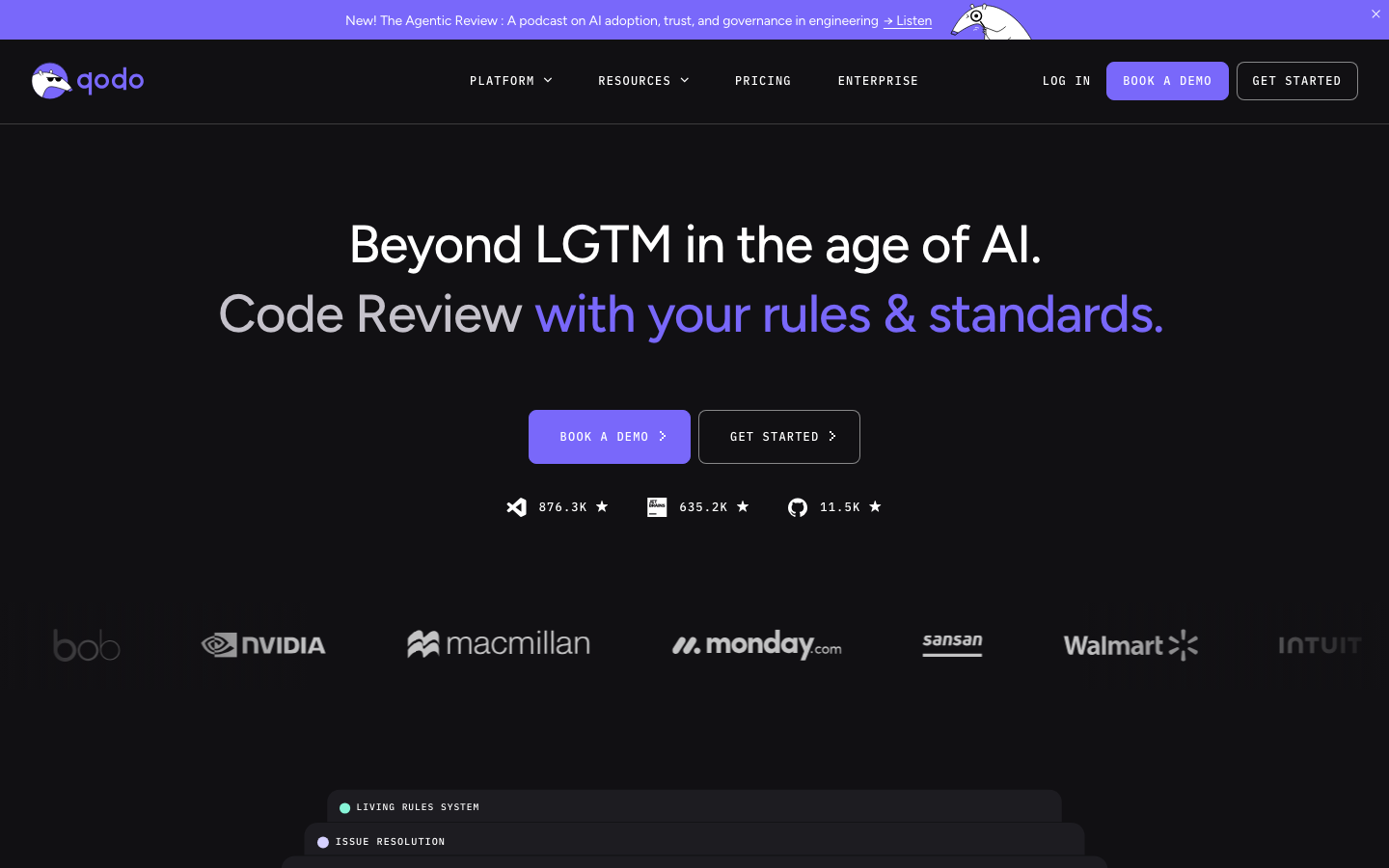
CodiumAI (Qodo)
CodiumAI’s core parameters and statistics
CodiumAI (now branded as Qodo) is an AI code review and governance platform for engineering teams, officially positioned as "The AI Code Review and Governance Platform". Its core delivery form has evolved from an early code test generation tool to a full-link platform covering PR review, standards governance, cross-warehouse context analysis and IDE inline review. The current verifiable information is distributed on the official homepage, pricing page, GitHub organization, and customer cases.
| Projects | Public Information |
|---|---|
| Product name | CodiumAI (brand name Qodo) |
| Official entrance | https://www.qodo.ai/ |
| Product Positioning | AI Code Review and Governance Platform |
| Deployment path | Cloud SaaS, single-tenant SaaS, On-premises |
| Supported Platforms | Web, Desktop (VS Code, JetBrains), Git, CLI |
| Supported languages | en-US |
| Supported programming languages | Python, TypeScript, JavaScript, Java, Kotlin, Go, PHP, C++, Swift, C# |
| Security Certification | SOC 2 Type II |
| Data strategy | Zero data retention, discard immediately after code analysis |
| Open source projects | qodo-cover (5.6k stars), open-aware (500 stars) |
| Enterprise customers | NVIDIA, HiBob, Pax8, Slickdeals, etc. (official public citation) |
| Version visibility | The product is mainly based on SaaS continuous delivery, and there is no unified semantic version number |
Positioning boundaries: The core value of Qodo is to solve the governance gap caused by "AI writing code faster than human review ability". It is not suitable for personal projects that do not require a code review process, nor is it suitable for very small teams that rely entirely on manual review (for open source or personal projects with less than 2-3 people, the benefits of introducing AI review may be lower than the configuration cost).
Users and market recognition of CodiumAI
Qodo's market recognition is mainly reflected in the public citations of enterprise-level customers and the attention of the open source community. Its growth model shows the dual-track characteristics of "enterprise word-of-mouth driven + developer community recognition".
Enterprise customer signal: NVIDIA publicly cited how Qodo's contextual engine provides deep code search and retrieval capabilities in its official developer blog; engineering VPs/CTOs from online travel platforms, cloud service providers Pax8, price comparison platform Slickdeals and other companies have provided usability endorsements on the Qodo homepage, covering multiple roles from technical decision-makers to engineering leaders. The official homepage directly quotes the evaluations of 8 executives from different companies, which is a relatively high-density coverage of customer testimonials among similar tools.
Open Source Ecosystem: There are 12 public warehouses under the GitHub organization qodo-ai, of which qodo-cover (automated test generation and code coverage improvement tool) has received 5.6k stars and 545 forks, and open-aware (in-depth code research agent) has received 500 stars. These open source projects are not only engineering verification of product capabilities, but also constitute Qodo's technical brand assets - developers can experience some of Qodo's core capabilities with zero threshold through open source projects.
Industry positioning: In the AI code review track, Qodo's differentiated advantage lies in the depth of the "governance layer" - it is not a lightweight tool that only does PR comments, but integrates standard definition, rule execution, cross-warehouse dependency analysis and compliance auditing into one package. Comparable products include CodeRabbit, SonarQube’s AI review capabilities, and GitHub Copilot Code Review. Qodo has clear differences in the customizability of the rule system and cross-repository context understanding, but it is not as convenient as CodeRabbit's out-of-the-box experience in the developer's personal free experience.
CodiumAI’s cost advantage
Qodo's cost structure is centered around "credit point" subscriptions, graded by team size and usage, and does not adopt an API-based token billing model. The three-tier cost framework is as follows:
C-side/Personal Developer: Qodo does not provide a permanently free personal plan. New users can enjoy a 14-day free trial (unlimited credits) and need to upgrade to a paid plan after the trial is over. For individual developers who only do occasional PR reviews, the cost of a single trial period is close to zero, but the minimum monthly fee for long-term use depends on the credit package. Compared with the fixed subscription model of GitHub Copilot Personal Edition ($10/month), Qodo's pay-as-you-go billing is more friendly to low-frequency users, but the cost may be higher for high-frequency users.
Team/Pro Team: Billed by credits, $0.012/credit, credits are shared within the team. Monthly plans range from approximately 18 reviews/month (2,500 credits) to approximately 144 reviews/month (20,000 credits), with no annual commitment and the ability to switch plans at any time. Compared with fixed-seat subscriptions, the flexibility of the credit point mechanism is that teams with large fluctuations in review volume do not have to pay for idle seats and only consume credits based on the actual review volume. However, you need to pay attention to the risk of review interruption after the credits are exhausted - if the team suddenly has a sudden surge in review volume in a certain month, the review will automatically stop after the credits are used up, and additional points packages will need to be purchased.
Enterprise/Private: For teams of more than 30 people, pricing requires business communication. Enterprise Edition includes SSO/SAML, audit logs, governance analytics dashboard, advanced self-learning rule BYOK (bring your own LLM key), single-tenant SaaS or On-premises deployment, priority support and a dedicated customer success manager. Hidden costs include: GPU/server infrastructure fees for self-hosted deployments (if On-premises is selected), engineering effort for initial configuration of the rules system, and learning costs for migrating from existing review processes. SOC 2 Type II certification and a zero-data retention policy lower the implicit barrier to compliance review.
Main functions of CodiumAI
Qodo's functional system revolves around the three capability lines of "review accuracy × governance depth × ecological coverage". It is not a simple AI PR comment robot, but integrates code review, standard governance and full life cycle quality control into one platform.
-
Agentic PR Code Review: Runs a dedicated review agent on every Pull Request to identify real bugs, rule violations, and missing requirements based on full codebase context. Different from simple difference review, Qodo's Agent can understand the impact of changes across files - when the signature of an API interface changes, it can automatically detect whether all callers need to be updated synchronously. Acceptance Concern: The false positive rate of the Agent directly affects developers' trust in the review tool. It is recommended that the proportion of the three types of suggestions "accepted/rejected/ignored" be counted during the pilot phase.
-
Rule System (Living Rules System): Convert organizational knowledge into machine-executable standard rules. Rules can be "self-learned" from the code base and PR history, eliminating the need to manually write rule files. Rule effectiveness is continuously monitored, and conflicts and decay can be discovered before they affect code quality. Synergy: The rule system is connected to the PR review - violations discovered during the review can be converted into new rules with one click, and the new rules will automatically take effect in subsequent PRs, solving the common team problem of "the same code problem recurring".
-
Cross-warehouse context analysis: Understand the dependencies and change impact chains between multiple warehouses. When the underlying library is modified, all upstream services that depend on the library are automatically marked and the breaking scope of the change is assessed. For teams with a microservice architecture, this is the most differentiated capability - a single warehouse review tool cannot detect the cross-service-level impact of "modifying the interface signature of a shared library".
-
IDE Inline Review Workflow: Get code review feedback directly in VS Code and JetBrains, so developers can find and fix issues during the coding phase without switching to the PR page. Synergy: IDE review + PR review + CLI review (Qodo Merge) covers the entire link from coding to integration, ensuring that problems are caught at the earliest stage instead of being exposed until code review.
-
Governance Analysis Dashboard: Provides cross-warehouse and cross-team risk visualization - review discovery trends, resolution rates, risk concentration, rule execution health and other indicators are presented on the same interface. For engineering managers, this is a key shift from "judging code quality by feeling" to "data-driven quality governance".
-
Shift-left Review Skills: Review skills that can be run inside the developer's AI Agent to proactively discover rule violations and potential problems during the coding phase, further shortening the feedback cycle from problem discovery to repair.
CodiumAI’s model and version evolution
Qodo follows the SaaS continuous delivery model and does not have a semantic version number system in the traditional sense. The evolution of its capabilities is marked by product feature iterations and major version releases (such as Qodo 2.4). The following is the version context based on official public information:
Qodo 2.x Series: From Code Review to Governance Platform (2025-2026)
- Qodo 2.0 (~2025-Q1): The brand is upgraded from CodiumAI to Qodo, and the product positioning is expanded from "AI code test generation" to "AI code review and governance platform". Introducing Agentic PR Review and base rules system.
- Qodo 2.1 (~2025-Q2): Introduces cross-warehouse context analysis capabilities and supports automatic detection of multi-warehouse dependencies.
- Qodo 2.2 (~2025-Q3): Launched Living Rules System (self-learning rules), rule validity monitoring and conflict detection online.
- Qodo 2.3 (~2025-Q4): Added governance analysis dashboard, enterprise version supports SSO/SAML and audit logs.
- Qodo 2.4 (~2026-Q2): Introducing Cross-repo review, Mined Rules and Skill Governance. This is the latest major feature release as of July 2026.
Open source project context
Qodo's product capabilities are technically verified and community diffused through multiple open source projects:
- qodo-cover: automated test generation and code coverage enhancement tool. GitHub 5.6k stars, AGPL-3.0 license. Supports automatically generating unit tests for existing code to fill coverage gaps.
- open-aware: In-depth code research Agent, positioned as "your Agentic chief engineer". MIT License, 500 stars. Ability to understand complex codebase context across repositories and documentation.
- agents: Qodo Commands Playbooks for customizing Qodo Command for specific use cases. JavaScript implementation, 122 stars.
- command: Qodo Gen CLI, allowing interaction with the Qodo platform from the terminal, supporting automation, advanced AI workflows and CI/CD integration. 88 stars.
- qodo-skills: Review skill template library, 42 stars.
- pr-compliance-templates: A library of PR compliance checklist templates for automating and standardizing the code review process.
Version management suggestions
Since Qodo adopts the SaaS model, users do not need to worry about version upgrades. However, when enterprise users deploy privatized/single-tenant deployments, they should specify the version update strategy in the contract—including the delivery cycle for feature updates, backward compatibility guarantees, and migration windows for major architectural changes. It is recommended that "version freezing period" and "mandatory upgrade window" be considered as must-negotiate terms in procurement negotiations.
CodiumAI’s technical advantages
Qodo's technical competitiveness does not lie in the parameter scale of the underlying model, but in its "Context Engineering" capabilities for code review scenarios—how to allow AI to accurately understand the intent, scope of impact, and compliance requirements of code changes.
Context Engine: Qodo’s self-developed context engine is the core of its technology. It builds a foundation for understanding code changes in four dimensions: codebase structure (deep modeling from repository structure to dependencies), PR history (indexing historical PRs for differences, comments, discussions, and fixed issues), business requirements (extracting project goals from tickets and specs), and rule base (automatically discovered and enforced coding standards). Mechanism: The engine compresses multi-dimensional context into structured review input and passes it to a specialized review agent, which then outputs high-precision review opinions based on this. Effectiveness: According to a quote from NVIDIA's official developer blog, the engine "provides engineering teams with deep Agentic code search and retrieval capabilities." Adaptation Scenario: Suitable for engineering organizations with large code bases (more than 500,000 lines of code in 10+ warehouses) and more than 20 team members. The cost of building the context can be diluted by the amount of large-scale review.
Specialized design of review agents: Qodo does not use a single model for all review tasks. Instead, it designs multiple specialized review agents, each of which is responsible for a specific review dimension (such as security, performance, standard compliance API compatibility). Causal explanation: The advantage of this "Agent federation" architecture compared to single-model full review is that the context window of each Agent can focus on its professional field, avoiding the common model being distracted by code style issues during security review, thereby improving the detection accuracy of key issues.
Self-learning rule system (Mined Rules): The rule system can automatically extract coding patterns and quality standards from the existing code base and PR review history, without the need to manually write regular or AST rules. Mechanism: By analyzing the code patterns required to be modified in historical PRs and the approved code styles, the system automatically summarizes the team's implicit coding standards. Effectiveness: This is especially critical for new member onboarding and cross-team collaboration - new developers don't need to read dozens of pages of coding standards documents, and the rules system will automatically make implicit standards explicit during PR review. Adaptation Scenario: Suitable for teams that already have a stable code base and a certain PR history. It is not suitable for scenarios in new projects where there is no "historical practice" to learn.
Zero data retention architecture: Qodo's technical design in terms of security is to "discard code immediately after analysis, without storing, recording, or using it for model training." This is a key compliance differentiator in enterprise-level code review scenarios - most AI coding assistants retain code snippets in the cloud for model improvement, while Qodo's zero data retention strategy allows it to pass SOC 2 Type II audits and has obvious procurement advantages in financial and government industries where data sovereignty is sensitive.
Technical comparison with competing products:
| Dimensions | Qodo | CodeRabbit | SonarQube AI | GitHub Copilot Review |
|---|---|---|---|---|
| Context scope | Cross-warehouse dependency analysis | Single-warehouse diff | Single-warehouse static analysis | Single-warehouse diff |
| Rule engine | Self-learning rules + manual rules | Preset rule templates | Manual configuration rules | No independent rule system |
| Deployment Options | SaaS / Single Tenant / On-prem | SaaS only | SaaS / Self-hosted | SaaS only |
| Security Certification | SOC 2 Type II | Unpublished | SOC 2 Type II | SOC 2 Type II |
| Data retention policy | Zero retention | Reserve for improvement | Configurable | Reserve for improvement |
| IDE Integration | VS Code + JetBrains | VS Code | No Native IDE Review | VS Code Deep Integration |
| Governance Dashboard | Yes | Basic | Yes | No |
How to use CodiumAI
Qodo provides multiple entrances and integration methods to adapt to different usage scenarios from individual developers to large engineering teams.
| How to use | Suitable for the crowd | Features | Startup path |
|---|---|---|---|
| Web App (Dashboard) | Engineering Managers, Team Leaders | Review Overview, Rule Management, Governance Dashboard | Visit app.qodo.ai to register |
| VS Code extension | Personal developer | IDE inline review, coding is review | VS Code extension market search for "Qodo" |
| JetBrains plug-in | Personal developer | Same as VS Code extension capabilities | JetBrains plug-in market search for "CodiumAI" |
| Git integration (GitHub/GitLab) | Team | PR automatic review, ready to configure | GitHub Marketplace installation Qodo Merge |
| CLI (Qodo Gen) | DevOps/Automation | CI/CD process integration, automated workflows | Install qodo-command via npm or GitHub |
| On-premises/single tenant | Enterprise compliance requirements | Completely private deployment, data does not leave the country | Contact the business team |
Quick Start Steps:
- 14-day free trial: Visit app.qodo.ai to register an account and get unlimited credits without a credit card.
- Configure Git integration: Connect to the code repository in the Qodo dashboard, install Qodo Merge GitHub App or configure GitLab Webhook.
- Define initial rules: Start with preset rule templates (such as security specifications, code style API design specifications), or enable the "rule mining" function to automatically learn team standards from historical PRs.
- First PR review verification: Submit a new PR and observe the quality of Qodo’s review comments. It is recommended to count the ratio of "effectively found problems vs. false positives" during the 1-2 week pilot period to evaluate whether the review accuracy reaches an acceptable level for the team.
- Adjust rule thresholds: Adjust rule sensitivity based on pilot feedback - downgrade rules with high false positive rates to "recommendations" instead of "must be repaired", and add custom rules for areas with high false negative rates.
- Gradual promotion: Promote from 1-2 core warehouses to the entire team, and incorporate the governance dashboard into weekly engineering meetings as a reference for quality indicators.
CI/CD integration example: Integrating Qodo Merge in GitHub Actions:
name: Qodo Code Review
on: [pull_request]
jobs:
  qodo-review:
    runs-on: ubuntu-latest
    steps:
      - name: Qodo Merge Review
        uses: qodo-ai/qodo-merge@latest
        with:
          github_token: ${{ secrets.GITHUB_TOKEN }}
          config: >
            {
              "review_mode": "thorough",
              "rule_packs": ["security", "performance"]
            }
Notes on configuration verification: The review_mode parameter affects review depth and credit point consumption - thorough mode has a higher detection rate but consumes more points, lite mode is fast but may miss edge issues. It is recommended to use thorough in the PR preview stage of CI and lite in the development branch to balance cost and speed.
Product Pricing for CodiumAI
Qodo adopts a three-tier pricing structure of "free trial → Pro Team pay-as-you-go → Enterprise business customization" to form differentiated competition with GitHub Copilot's fixed monthly fee model.
| Plan | Price | Core Competencies | Suitable for Team Size |
|---|---|---|---|
| Free trial | $0 (14 days, unlimited credits) | All Pro Team features | Evaluation phase |
| Pro Team (2,500 credits) | ~$30/month | ~18 reviews/month, Agentic PR Review, rule system, Git+IDE integration, dashboard | Small team of 1-5 people |
| Pro Team (5,000 credits) | ~$60/month | ~36 reviews/month | Teams of 3-10 people |
| Pro Team (20,000 credits) | ~$240/month | ~144 reviews/month | 10-25 person team |
| Enterprise (30+ users) | Business Pricing | All Pro + SSO/SAML, Audit Logs, Governance Analytics BYOK, Single Tenant/On-prem, Priority Support | Medium to Large Enterprises |
Credit consumption logic: The credits consumed for each PR review depend on the code difference size, repository size and review mode. The precise consumption formula is not officially disclosed, but it can be deduced from the "~18 reviews/2,500 credits" on the pricing page: a typical PR review consumes approximately 140 credits. Reviews that have multiple custom rules configured or enable cross-warehouse context analysis are more expensive.
Hidden Costs and Pitfall Guidelines:
- Risk of running out of credit points: Credit points are reset monthly, and unused points will not be rolled over. Teams may consume a large amount of credits at one time during large-scale mergers (such as quarterly branch merges). It is recommended to upgrade the package or purchase additional credit packages before high review volume months.
- Self-Hosted Infrastructure Cost: Enterprises that choose On-premises deployment are responsible for their own GPU servers (such as instances equipped with NVIDIA A100 or H100), storage, network, and operations manpower. For teams with less than 50 reviews per day, the total cost of ownership for SaaS options is typically lower than self-hosted.
- Trial to paid conversion path: After the 14-day trial period, if the package is not upgraded in time, the review function will automatically stop. It is recommended to complete purchase approval around the 10th day of the trial period to avoid service interruption.
CodiumAI application scenarios
Qodo’s AI code review and governance capabilities have been verified at scale in the following four scenarios:
-
Cross-warehouse change management for microservice architecture teams: When the team maintains 10+ microservice warehouses, modifying the interface signature of the shared library may affect 5-8 downstream services. Traditional single-repository audit tools cannot detect this cross-service impact. Qodo's cross-repository contextual analysis is of greatest value in this scenario - automatically marking affected services, assessing changes for breakage, and displaying dependency graphs in PRs. Implementation Tips: When configuring for the first time, you need to register all associated warehouses in Qodo and establish a dependency mapping table. The initial setup may require 2-3 hours of engineering investment.
-
Enterprise-level coding standards governance and compliance: Industries such as finance, healthcare, and government often have hundreds of pages of coding specifications and compliance requirements (e.g., PCI-DSS, HIPAA). Qodo's rules system can convert these compliance requirements into machine-executable review rules and automatically verify them in every PR. Combined with SOC 2 Type II certification and a zero-data retention policy, Qodo has stronger purchasing power than general-purpose AI review tools in compliance-sensitive industries. Implementation Tips: The conversion of rules from manual specification to automated execution requires domain experts to participate in the initial configuration. It is recommended to arrange for 1-2 senior engineers to interface with the Qodo rule system. It is expected to complete the establishment of the core rule library in 1-2 weeks.
-
New member onboarding and code quality standardization: When new developers join the team, it usually takes 2-4 weeks to adapt to the coding conventions, architectural conventions, and community norms of the code base. Qodo's self-learning rule system can automatically remind new members in their PRs that "this approach does not conform to our coding style" or "existing tool functions should be used here", making implicit knowledge explicit. Quantitative deduction: Assuming that new members receive an average of 15 review comments per PR in the first three weeks, 60% of which are coding convention issues (can be automated through the rule system). The introduction of Qodo is expected to reduce the number of comments from manual reviewers by 40%-60% and accelerate the integration of new members by about 30%.
-
PR review enhancements for large-scale open source projects: For open source projects with hundreds of contributors, the maintainer's review bandwidth is often the bottleneck. Qodo's Agentic PR review can pre-review all incoming PRs, filter out submissions with obvious quality problems (such as missing tests, misuse of security vulnerability mode APIs), and reduce the review burden on maintainers. The qodo-cover open source project (5.6k stars) itself is an engineering model of Qodo's capabilities. Implementation Tips: When using Qodo for open source projects, you need to pay attention to the cost of credits - for large community projects, it is recommended to contact the Qodo business team to apply for the open source sponsorship plan.
Not suitable for scenarios: For personal projects with extremely small code bases (single warehouse, <10 files), the benefits of introducing AI review are lower than the configuration costs; for teams with extremely high requirements for rule customization, initial rule configuration requires more than 2 weeks of input from domain experts; for teams that do not use Git workflow or PR process at all (such as submitting directly to the trunk), Qodo cannot exert its core value.
Applicable groups of CodiumAI
Qodo's product design targets a full spectrum of users, from individual developers to large engineering organizations, but the focus of benefits and value perceptions of different roles are obviously different:
-
Individual Developers & Independent Contributors: Get inline code review feedback with the VS Code/JetBrains extension to uncover logic holes, security risks, and code smells during the coding phase. The free trial period is sufficient to evaluate the value for personal use scenarios. Misfit Boundaries: If a personal project is primarily scripts, configuration files, and one-off analysis code, AI reviews have limited value. It is recommended to use it in projects that have been developed for at least 3 months so that the rule system has enough learning data.
-
Engineering Team Manager (Tech Lead/EM): Qodo’s core beneficiary. The governance dashboard provides a quantitative view of code quality trends - no longer "I feel like code quality has declined" but "Security rule violations are up 20% this month, concentrated in three new repositories." The rule system changes the maintenance of team coding standards from "rule of man" to "rule of law". Purchase Prerequisite: The team should have a mature CI/CD process and PR workflow, otherwise integrating Qodo requires completing the process infrastructure first.
-
Compliance and Security Engineer: Teams responsible for code security audits and compliance verification can use Qodo's rule system and zero-data retention architecture to establish automated compliance review pipelines. Misfit Boundary: For special scenarios that require deep static analysis (such as symbolic execution, formal verification), Qodo's rule system may not be as accurate as specialized tools (such as Coverity, Infer).
-
DevOps and Platform Engineering Team: Embed AI code review into the CI/CD pipeline through Qodo Merge (GitHub Action) and Qodo Gen CLI to achieve "review-as-deployment access". Implementation Tips: It is recommended to set "review passing" as the precondition for merging (merge gate) in CI, but a bypass mechanism needs to be set up (for example, emergency repair can skip the review).
-
CTO and VP Engineering: Focus on the macro trends of engineering efficiency and code quality. Qodo's governance analytics dashboard provides quality comparison data across teams and warehouses, helping to make engineering standards and tool selection decisions. Purchasing Prerequisites: Before promotion, confirm that the team size is greater than 30 people or the annual PR volume is greater than 1,000 times, otherwise the value of Qodo's governance layer will not be fully reflected.
Summary and Outlook of CodiumAI
Qodo (CodiumAI) has established a differentiated competitive position in the AI code review track through the technical combination of "context engine + specialized review agent + self-learning rule system" - it is not just a PR comment robot, but a governance, auditable, and customizable code quality control platform.
Current core advantages: The cross-warehouse context analysis capability is unique in the same category; the self-learning ability of the rule system reduces standard maintenance costs; zero data retention + SOC 2 Type II certification form the security compliance basis for enterprise-level procurement; multi-entry coverage (IDE + Git + CLI + Web) ensures that developers with different roles can use it naturally in their own workflows.
Current major limitations: The credit point billing model has high requirements for the ability to predict review volume, and teams with large review volume may face the problem of depleting or wasting points; the free trial is only 14 days, and there is no permanent free plan after the trial, which is less friendly to individual developers than some competing products; the initial configuration of the rule system requires the participation of domain experts, and for teams with unclear standards, the configuration cost may exceed short-term benefits; the infrastructure cost of self-hosted deployment is not as economical as SaaS in low review volume scenarios.
Follow-up observation points: Whether Qodo will introduce a permanent free quota in the Pro Team layer to expand the developer personal market; whether the depth of cross-warehouse context analysis can continue to expand - currently it mainly supports warehouse-level dependency analysis, and whether it will in-depth function-level call chain tracking in the future; whether the rule system supports direct mapping with third-party compliance frameworks (such as SOC 2 control item PCI-DSS clauses) to further reduce the configuration complexity of compliance review; Qodo and mainstream AI coding assistants (GitHub Will the complementary integration of Copilot, Cursor, Windsurf) form a deeper ecological binding?
Procurement and Adoption Risk Assessment: For engineering teams with more than 20 people, especially enterprises that maintain multi-warehouse microservice architectures, have code compliance audit needs, or want to establish a quantitative code quality governance system, Qodo is worthy of being included in a formal evaluation as a core code review tool. It is recommended to complete the integration verification with the existing CI/CD pipeline through a 14-day trial period. For individual developers and small teams (<10 people), it is recommended to use the free trial period to evaluate the actual value before deciding whether to bear the cost of credits - if the team's monthly review volume is less than 20 times, the $30 per month Pro Team entry package may be more cost-effective than competing products (such as CodeRabbit's fixed monthly fee model). During procurement contract negotiations, enterprise customers should focus on: the transparency of the credit calculation formula, the processing strategy for unused credits (some suppliers support point pool rolling), the version update strategy and SLA guarantee for On-premises deployment, and data export/migration clauses - ensuring that historical review records and rule configurations can be fully exported when a supplier needs to be changed.
Related tools:  Cursor
Version Info
- CodiumAI Web Latest :The official page does not disclose the semantic version number. It is recorded in the current public form and there is no official precise date yet.
- CodiumAI Public Milestone :The official has not disclosed the precise historical release date, and established a minimum version context based on public product milestones.
User Reviews