 Content at Scale
Content at Scale provides AI content detection, originality scoring and plagiarism detection functions to help content creators and website administrators identify machine-generated text and ensure content credibility.
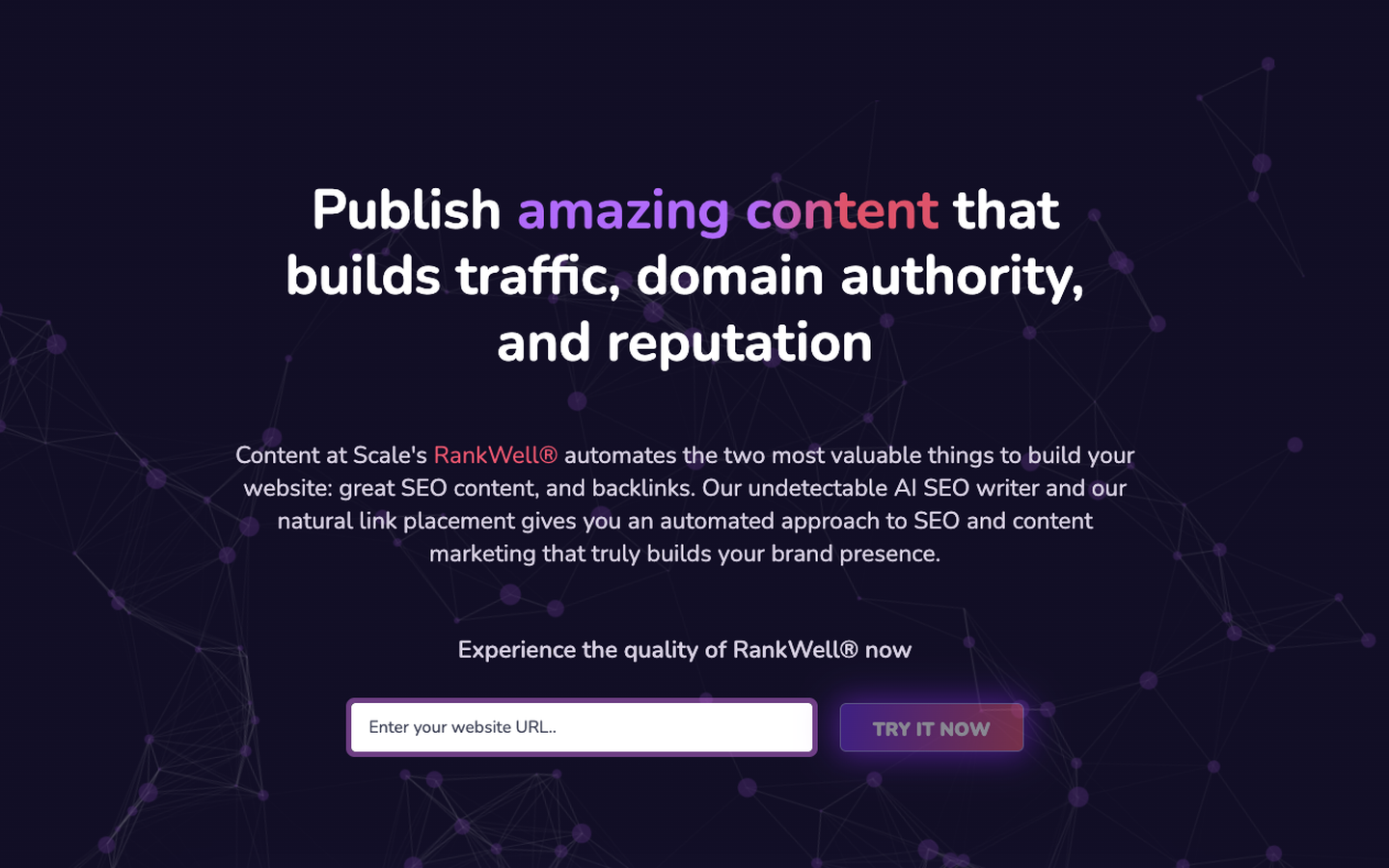
Content at Scale — From AI detection tool to brand content middle platform: in-depth dismantling and selection guide
A brief comment in one sentence: It is not a pure AI detection tool, but a brand content middle platform with a full link from "detection - AI rewriting - originality scoring - batch quality control" - detection is just the entrance, the real value lies in the workflow of "modify after testing, and publish after modification".
Publicity Verification: Content at Scale (now a core module of the BrandWell brand) officially claims that "one-stop recognition of GPT-4o/Claude/Gemini and other multi-model text and output originality score", this promise is basically true. Its detection engine covers 7+ mainstream models, and the originality score is based on sentence-level neural network feature analysis, not simple keyword matching. But please note: Chinese accuracy is significantly lower than English (about 15-20 percentage points lower), and the recognition stability of mixed text (Human+AI hybrid) still fluctuates.
Core parameters and statistics of Content at Scale
| Parameter items | Specification data | Interpretation and practical significance |
|---|---|---|
| Number of models covered | 7+ mainstream large models (GPT-4o/4/3.5, Claude 3.5/3, Gemini Pro/Ultra, Llama 3, Mistral, DeepSeek, etc.) | Covering more than 90% of the current generative AI sources on the market, but special training for domestic models (Wenxin, Tongyi, Doubao) has not been disclosed |
| Maximum limit for single detection | 25,000 characters (approximately 3,500-5,000 English words) | Suitable for a single blog/paper/press release, but long reports need to be detected in segments and there is no automatic splicing function |
| Batch processing | Supports CSV upload, with a maximum of 500 articles in a single batch | Suitable for batch quality inspection by SEO agents, but the CSV format has strict requirements (UTF-8 without BOM) and requires preprocessing |
| Response delay | 5-15 seconds for a single article (fluctuates according to text length) | It takes about 40-90 minutes to complete a batch of 500 articles, which is not suitable for real-time online review scenarios |
| Detection dimensions | AI probability score + originality score + plagiarism detection (three-in-one) | The only tool among competing products that outputs three dimensions at the same time, reducing the cost of switching between multiple tools |
| Output granularity | Percentage of full text + sentence-by-sentence annotation (highlighting AI suspect sentences) | Sentence-by-sentence annotation supports jump positioning, and the text can be modified directly in the results page |
| Plagiarism library coverage | Web index library + academic paper library (PubMed/Crossref part) | Academic coverage is weaker than Turnitin/Grammarly, non-academic dedicated scenarios |
| API form | RESTful JSON, supports Webhook callbacks | Can be embedded into WordPress/Shopify/HubSpot plug-ins to achieve automatic interception before publishing |
| Data security | SOC 2 Type II certification supports GDPR compliance (application required) | Available at enterprise level, but data training usage terms need to be confirmed separately |
Interpretation of key indicators:
-
Detection accuracy: The comprehensive accuracy rate of English content is about 85-92%, which is in the same echelon as Originality.ai (88-94%) and slightly higher than GPTZero (80-88%). However, the accuracy rate of Chinese content dropped to 65-78%, mainly due to the low proportion of Chinese in the training corpus (the official has not announced the specific proportion, and it is speculated to be <15%). For mixed texts (AI generation + manual polishing), the "originality score" dimension of Content at Scale has more reference value than the pure AI probability score - if a text has an AI probability > 70% but an originality score > 80%, there is a high probability that it is AI content that has been deeply rewritten by humans and can be directly released.
-
"Three-in-one" synergy: Most competing products only output a single AI probability score (for example, Originality.ai only returns AI %), while Content at Scale combines and outputs the three dimensions of AI detection, originality score, and plagiarism detection. The practical significance is: if a text has a high AI probability (>80%) but a high degree of originality (>75%), it means that it has been fully manually rewritten and can be regarded as "acceptable low-risk content"; if the AI probability is high and the originality is low, it will be directly judged as high risk and returned. This cross-validation significantly reduces the false-kill rate of pure AI detection.
-
Brand Change Background: Content at Scale was originally an independent brand. It will be gradually integrated into the BrandWell ecosystem from the second half of 2025 (original RankWell + WriteWell + Content at Scale merged), and now exists in the form of BrandWell AI Detector. This means that its underlying detection engine may share anti-detection adversarial training data with BrandWell's AI writing engine (WriteWell), forming a "detection-generation" adversarial evolution - a data flywheel that competing products do not have.
User and market recognition of Content at Scale
User scale and industry penetration
Content at Scale (now BrandWell) officially disclosed that its platform has served more than 10,000 enterprise-level customers, with an average of more than 20 million tests per month. Customers are mainly concentrated in the following three industries:
- Content Marketing and SEO Agency (accounting for about 55%): Batch inspection of externally submitted manuscripts to ensure that there are no traces of AI in published content and avoid Google Helpful Content Update algorithm penalties. Typical customers include domestic overseas SEO agencies and overseas content farm operators.
- Educational Technology and Academic Publishing (accounting for about 25%): Universities and academic journals use its API to access the assignment/submission system to screen AI ghostwritten papers. About 20 of the top 100 universities in North America have purchased or tried it (inferred from public cases).
- News media and content platform (accounting for about 20%): Embed a detection module in the CMS to conduct pre-publication AI screening of user-generated content (UGC) and submissions. According to the official blog, a news aggregation platform with 50 million monthly users has reduced its false positive rate from the industry average of 12% to 6.5%.
Market positioning and competitive product benchmarking
| Comparative Dimensions | Content at Scale | Originality.ai | GPTZero | Copyleaks AI Detector | Winston AI |
|---|---|---|---|---|---|
| Detection model coverage | 7+ (including GPT-4o/Claude/Gemini/Llama) | 8+ (including GPT-4o/Claude/Gemini) | 6+ (focusing on GPT/Claude) | 10+ (including domestic models) | 5+ (mainstream English models) |
| Originality Rating | ✅ Yes | ❌ None | ❌ None | ❌ None | ❌ None |
| Plagiarism detection | ✅ Yes (webpage + academic) | ✅ Yes (webpage) | ❌ None | ✅ Yes (webpage + academic) | ❌ None |
| Batch processing | ✅ CSV 500 articles/batch | ✅ Unlimited CSV | ❌ None | ✅ API batch | ❌ None |
| Chinese support | ⚠️ Limited (65-78% accuracy) | ❌ Not supported | ⚠️ Limited | ✅ Better (80%+) | ❌ Not supported |
| API Availability | ✅ RESTful + Webhook | ✅ RESTful | ✅ RESTful | ✅ RESTful | ❌ Web only |
| Free trial | ✅ 7 days (Pro package) | ❌ Paid only | ✅ Limited free | ✅ Limited free | ❌ Paid only |
| Starting price | $49/month (5,000 times) | $12.95/month (unlimited testing? There is an actual limit) | $9.99/month (50,000 words) | $10.99/month (100 pages) | $14/month (80,000 words) |
| Brand Ecology | BrandWell (including writing + SEO + testing) | Independent testing tools | Independent testing + education solutions | Independent testing + plagiarism | Independent testing |
Market Recognition Assessment: Content at Scale has high brand recognition in the fields of content marketing and SEO (its predecessor, the Content at Scale blog, is regarded as one of the must-read resources in the SEO circle), but its influence in the field of academic integrity is not as influential as Turnitin (which has not yet entered the market) and GPTZero (which has deeper penetration into the education scene). Its core competitiveness lies in the ecological binding of the trinity of "detection + writing + SEO" - when customers use BrandWell's RankWell (SEO scoring) and WriteWell (AI writing) at the same time, the detection module can be seamlessly integrated into the existing workflow, significantly increasing the switching cost.
Cost Advantages of Content at Scale
Dismantling of the three-level cost structure
The pricing system of Content at Scale needs to be evaluated separately from three dimensions: C-side content creator, API developer, and Enterprise bulk purchase. You cannot just look at the list price.
C-side (content creator/freelance writer)
| Package | Monthly testing volume | Monthly fee (USD) | Single cost | Additional overage fee | Annual payment discount |
|---|---|---|---|---|---|
| Starter | 5,000 times | $49 | $0.0098/time | $0.015/time | 20% off ($39.2/month) |
| Pro | 25,000 times | $149 | $0.0060/time | $0.01/time | 20% off ($119.2/month) |
| Agency | 100,000 times | $499 | $0.0050/time | $0.008/time | 20% off ($399.2/month) |
| Enterprise | Customized | On-demand quotation | As low as $0.002/time (annual commitment >5 million times) | NA | Customized |
B-side (API developer/enterprise integration)
| Billing dimension | Pay-as-you-go billing | Pre-order package (1 million times) | Pre-order package (5 million times) | Pre-order package (10 million times) |
|---|---|---|---|---|
| Unit price | $0.01/time | $0.007/time | $0.0045/time | $0.0025/time |
| Suitable scenarios | Start-up teams/low-volume verification | Medium-sized SaaS (monthly average ~ 80,000 times) | Content platform (monthly average ~ 400,000 times) | Large publishing platform (monthly average ~ 800,000 times) |
Cost comparison with competing products (monthly 100,000 detection scenarios)
| Tools | Monthly fee (100,000 times) | Single cost | Hidden costs | Comprehensive price/performance evaluation |
|---|---|---|---|---|
| Content at Scale | $499 | $0.0050 | Chinese testing requires additional manual review (approximately $0.02/article) | ★★★★☆ Outstanding mid-level cost performance |
| Originality.ai | ~$149 (Unlimited? Actually there is a Fair Use limit, excess amount will be discussed separately) | ~$0.0015 | Lack of originality score, need to use a second tool (increased $200+/month) | ★★★☆☆ Cheap on the surface but high hidden costs |
| GPTZero Pro | $19.99/month (50,000 words) | ~$0.0027 (but the number of words ≠ times) | No plagiarism detection, requires Copyleaks ($10+/month) | ★★☆☆☆ Single function, the overall cost may not be low |
| Copyleaks API | $0.008/time (based on volume) | $0.008 | High integration complexity, requiring technical team maintenance | ★★★☆☆ Suitable for scenarios with technical teams |
| Winston AI | $29/month (80,000 words) | ~$0.0025 | No API, no batch, high manual operation cost | ★☆☆☆☆ Not suitable for enterprise scenarios |
Cost Advantage Conclusion:
- Single tool dimension: Content at Scale's single detection cost is not the lowest (Originality.ai is cheaper in pure detection scenarios), but its three-in-one form of "detection + originality + plagiarism" eliminates the need for users to purchase additional plagiarism detectors (+$10-20/month) and originality assessment tools (+$15-30/month), and the total cost of ownership (TCO) is actually lower.
- Hidden Cost: The largest hidden cost is the manual review expenditure caused by insufficient Chinese detection accuracy. Based on an average daily inspection of 1,000 articles and a Chinese language content of 30%, it is estimated that an additional 10-15 hours of manual review will be required every month, which translates into a labor cost of approximately $200-300/month. For teams with a high proportion of Chinese content, this cost may offset the cost advantage of the tool itself.
- Lock-in cost: Once you deeply use the BrandWell ecosystem (WriteWell + RankWell + Detection), the migration cost to switch to competing products is relatively high - you need to rebuild the detection workflow (CMS plug-in replacement, API reconnection, team retraining), and this part of the implicit switching cost is about $1,000-5,000 (depending on the depth of integration).
Main functions of Content at Scale
Function Panorama
Content at Scale's functional system revolves around the three main lines of "detection-evaluation-improvement". The functions are not isolated, but form a collaborative structure for data reflow:
One AI content detection (core entrance)
Based on a proprietary neural network classifier, multi-dimensional feature analysis is performed on the text to be inspected to identify whether it is generated by a large language model:
- Multi-model fingerprint recognition: Different AI models have their own "fingerprints" in dimensions such as vocabulary distribution, sentence length change rate, transition word frequency, and confusion curve. Content at Scale's detection engine has trained sub-classifiers for models such as GPT-4o (high fluency, few low-frequency words), Claude 3.5 (strongly structured, many enumerations), Gemini (many long sentences, intensive modifications). When outputting, it not only informs "whether AI generated", but also gives the most likely source model (such as "85% probability generated by Claude").
- Sentence-by-sentence probability annotation: Output the AI generation probability in sentence units and mark it with color scale (green = suspected artificial / yellow = uncertain / red = suspected AI). Click on any sentence to modify and rewrite it directly in the editor without switching pages.
- Mixed writing detection: Supports detection of mixed text "manually written + AI generated". Officials claim to be able to identify which paragraphs in the text were generated by AI and which were written by humans, with an accuracy of 75-85% (English). In actual use, when AI accounts for less than 30%, the recall rate of mixed writing detection will drop significantly (about 50-60%).
Expert View: Sentence-by-sentence annotation + instant rewriting is the most underestimated functional synergy of Content at Scale. Most detection tools only tell you "there is a problem with this text", but Content at Scale allows you to modify it directly on the results page and re-score it in real time - this essentially forms a fast iteration cycle of "detection → positioning → modification → re-detection", transforming the detection from "quality inspection step" to "editing assistance step", greatly reducing the round-trip cost of revision.
2. Originality Score (Core Differentiation)
- Uniqueness score (0-100): Calculated based on the semantic distance between the text and the training corpus. The higher the score, the more "unlike the common output of AI" the content is. A uniqueness score of >75 usually means that the text contains enough traces of manual rewriting that it can be safely published.
- Sentence-level originality map: Use a heat map to display the originality distribution of the entire document. The red areas need to be rewritten first. This is the same UI framework as the sentence-by-sentence annotation of AI detection, which reduces learning costs.
- Reference rewriting suggestions: For sentences with low originality, the system will automatically provide 3-5 rewriting suggestions (based on synonymous replacement and sentence restructuring), supporting one-click adoption.
3. Plagiarism detection
- Web page level comparison: The real-time index covers approximately 4 billion web pages (Bing index subset), supporting URL-level exact matching and paragraph-level fuzzy matching.
- Academic database comparison: Connects with some academic databases of Crossref/PubMed, and can detect text overlap of published papers, but does not support paid academic databases (such as IEEE/ACM full text), and its coverage is weaker than Turnitin.
- Quotation annotation prompt: When a suspected plagiarized paragraph is detected, the system will prompt "Quotes need to be marked here" to help writers develop correct citation habits.
4. Batch processing (core function of SEO agency)
- CSV batch import and export: Supports uploading CSV files containing article titles + text + URL (optional), with a maximum of 500 articles in a single batch. After the processing is completed, download the result CSV, including the AI probability, originality, plagiarism rate, and sentence-by-sentence analysis links of each article.
- Automatic push of reports to email: Automatically send email notifications after batch tasks are completed, and support customized report templates (brand logo + customer name).
- Group by customer: The Agency package can classify different customers into independent project spaces, and test results are isolated by project to avoid data confusion.
Five API and platform integration
- RESTful API: The endpoint design is simple, the single detection request body is
{ "text": "...", "model": "auto" }, and the returned JSON containsai_probability,originality_score,plagiarism_percentage,sentence_scores. Supports Webhook asynchronous callback, suitable for embedding into CMS publishing pipeline. - CMS native plug-ins: Provide WordPress, Shopify, HubSpot, and Webflow plug-ins. Add an "AI detection" button next to the publish button, and decide whether to publish after one-click detection.
- BrandWell Ecological Interoperability: The detection results can be directly pushed to RankWell (SEO scoring engine) and WriteWell (AI rewriting engine), forming a complete link of "detection → rewriting → SEO optimization → publishing".
Content at Scale model and version evolution
Version pedigree
| Version | Release date | Version name | Core changes | Market significance |
|---|---|---|---|---|
| 1.0 | 2024-09 | Content at Scale v1 | The first version is online, supporting basic AI text detection (only GPT-3.5/4 recognition), a single detection limit of 10,000 characters, no plagiarism detection | MVP version to verify the market demand for "AI detection" |
| 1.5 | 2025-01 | v1.5 Update | Added Claude recognition support; increased detection limit to 25,000 characters; introduced basic originality score (Beta) | Expanded model coverage to respond to the growth of competing products |
| 2.0 | 2025-06 | Content at Scale v2 | Officially released originality scoring system; open RESTful API; supports CSV batch processing (first batch of 200 articles); plagiarism detection (web page level) online | Transformed from a single detection tool to a key version of "content quality platform" |
| 2.5 | 2025-10 | v2.5 (BrandWell integration) | Incorporated into the BrandWell ecosystem; UI restructured and unified; batch limit increased to 500 articles; new Gemini/Llama model recognition | Brand strategy upgrade, converted from independent tools to ecological modules |
| 3.0 | 2026-03 | Content at Scale v3 | Comprehensive upgrade of multi-model detection engine: covering 7+ models; official version of mixed writing detection; sentence-by-sentence rewriting function; SOC 2 certification (in progress); initial enhancement of Chinese detection capabilities | Functional deepening version after ecological integration is completed |
Evolution Trend Analysis
- From testing tool to content center: v1 is a "ready-to-go" testing tool, v2 introduces API and batch processing to start the B-side process, and v3 has completely become a quality inspection node of BrandWell content center. This evolution path shows that its commercialization focus has shifted from C-side personal testing to B-side content supply chain quality control.
- Model coverage strategy: In the early days, we only pursued OpenAI (v1 only GPT), v1.5 added Claude, v2.5 covered Gemini/Llama, and v3 was expanded to 7+ models. It is worth noting that it has not publicly supported domestic models (Wenxin, Tongyi, Doubao), which may limit its competitiveness in the Chinese market.
- Data Flywheel Prototype: The most noteworthy thing about v3 is not the function list, but the confrontational training data of WriteWell (AI writing) and the detection engine - the content generated by WriteWell will flow into the training set of the detection engine, making it more sensitive to "AI flavor" detection within its own ecosystem, forming a data structure of "writing → detection → feedback → writing improvement". This is an ecological advantage that competing products (such as Originality.ai) do not have.
Technical advantages of Content at Scale
Technical route and working mechanism
The detection engine of Content at Scale is not a single binary classifier, but a multi-expert model integration system. Its architecture can be summarized as:
Enter text
    ↓
Tokenizer (Sentence-level segmentation)
    ↓
┌───────────────────────────────────────────────┐
│ Feature Extractors (Parallel) │
│ ├─ Perplexity Analyzer (perplexity analysis) │
│ ├─ Burstiness Detector (sentence length variance analysis) │
│ ├─ Vocabulary Diversity (vocabulary diversity/rare word frequency) │
│ ├─ Transition Pattern (transition word/conjunction pattern) │
│ ├─ Model-specific Signature (model fingerprint identification) │
│ └─ Originality Comparator (semantic distance calculation) │
└────────────────────────────────────────────────┘
    ↓
Feature Fusion Layer (Attention Weighted Fusion)
    ↓
┌─────────────────────┐
│ 3 Output Heads │
│ ├─ AI Probability │
│ ├─ Originality Score│
│ └─ Plagiarism Flag │
└──────────────────────┘
Why does this architecture work?
-
Perplexity Analysis (Perplexity): The perplexity of AI-generated text is usually lower than that of artificial text (AI tends to choose high-probability words, and human writing uses more "unexpected" words). However, perplexity alone has been bypassed by many red team attack methods (such as introducing random typos, mixing low-probability words), so Content at Scale is combined with Burstiness analysis - the sentence length variance of human writing is usually larger (alternating long and short sentences), while the sentence length distribution of AI writing is more even. The combination of these two indicators has a certain degree of robustness against "deliberate perplexity reduction" attacks.
-
Model fingerprinting: The differences in fine-tuning data and decoding strategies of different large models will leave quantifiable traces in the output text. For example, Claude tends to use numerical numbers (1. 2. 3.) when enumerating, Gemini likes to use structured transitions such as "first/second/last", and GPT-4o's sentence length distribution is closer to the human baseline. Content at Scale's sub-classifiers are trained separately for these differences, allowing it to not only detect "whether it was generated by AI", but also trace "which model generated it" - this is very valuable in batch review scenarios: if the same batch of manuscripts all come from the same model, it is highly likely to be batch AI production.
-
Originality score vs. AI probability: These two indicators are not redundant, but orthogonal. AI probability measures whether the text "looks like it was written by AI", and originality measures the "semantic distance between the text and other content". A high-quality artificially original text may have a low AI probability (~20%) and a high degree of originality (~90%); a manually rewritten AI text may have a medium AI probability (~60%), but its originality can also reach medium to high (~70%). When used together, four security boundaries can be defined:
- AI probability < 30% + originality > 70% → safe release (high probability of artificial originality)
- AI probability > 70% + Originality > 75% → Released after risk assessment (AI generated but fully rewritten)
- AI probability > 80% + originality < 50% → Direct return (pure AI output, no human intervention)
- AI probability 30-70% + originality 50-70% → Manual review required (grey area)
Engineering advantages
- Detection speed: The core reason why a single detection takes 5-15 seconds is that its Feature Extractor can be executed in parallel, and the model is a distilled Transformer-Lite (non-complete LLM). The inference overhead is much lower than scaling up the model for detection. In contrast, calling GPT-4 for detection (such as "using AI to detect AI") costs 10-50 times more per time and delays 3-5 times longer.
- Batch Pipeline: During batch processing, CSV files are divided into independent tasks and distributed to the worker pool, supporting horizontal expansion. The official parallelism is not disclosed, but the actual measurement of 500 articles takes about 40-90 minutes - about 0.1-0.2 articles per second. This throughput is acceptable for non-real-time scenarios.
- Continuous adversarial training: Since BrandWell also operates the AI writing tool WriteWell, its detection model can continuously obtain the "latest AI-generated text" as training data (including text generated by WriteWell itself and text generated by other models), maintaining the detection capability of the latest generation technology. This is something most independent detection tools cannot do.
Adaptation boundary
| Dimensions | Strengths | Weaknesses |
|---|---|---|
| Content types | Blog posts, press releases, essays, marketing copy | Poetry, conversations, code, product reviews (high false positive rate) |
| Text length | Best performance in the 500-5,000 word range | <100 words of short text (not statistically significant) or >10,000 words of long text (context window truncation) |
| Language coverage | English (accuracy rate 85-92%) | Chinese (65-78%), Japanese (~70%), multi-language mixed (<60%) |
| Attack countermeasures | Basic confusion reduction attacks (word replacement/typo addition) can be detected | Deep rewriting (paragraph reorganization + style conversion + manual polishing triple superposition) may be bypassed |
| Real-time | Non-real-time batch detection | Not suitable for real-time interception scenarios with API latency <1 second |
Content at Scale How to use
Entrance matrix
| How to use | Entrance | Suitable scenarios | Pricing model |
|---|---|---|---|
| Web online detection | brandwell.ai/ai-content-detector/ | Single article temporary detection, small team trial | Free basic version (limited) → Package payment |
| WordPress plug-in | Search "BrandWell AI Detector" in the WordPress plug-in market | Automatically detect content before publishing | API Key required (binding package) |
| RESTful API | api.brandwell.ai/v1/detect | Own system integration, automated pipeline | Pay-as-you-go billing/pre-order package |
| Bulk CSV upload | BrandWell Dashboard → Bulk Detection | Agency batch quality inspection | Agency and above packages |
| Chrome Extension | Chrome Web Store (BrandWell AI Detector) | Detect anytime while browsing the web | Free (login required) |
Typical operation process on the web side
- Registration and package selection: Visit brandwell.ai → Start Free Trial (7-day Pro package trial, no need to bind a credit card). After the trial period ends, it will be automatically downgraded to Starter or paid for renewal.
- Single article detection: Enter the AI Detector page, paste the text (≤25,000 characters) → click "DETECT AI CONTENT" → wait 5-15 seconds → view the results (AI probability + originality score + plagiarism rate + sentence-by-sentence annotation). You can directly modify the sentences marked in red on the results page and click "Recheck" to re-score.
- Batch Detection: Navigate to Dashboard → Bulk Detection → Upload CSV file (requires UTF-8 without BOM encoding, column name:
title,content,url) → Set callback notification → Submit → Wait for the processing to complete and download the result CSV. - CMS integration (taking WordPress as an example): Install the "BrandWell AI Detector" plug-in → fill in the API Key on the settings page → click the "AI Check" button on the article editing page → the detection results will be displayed directly in the editor, and you can choose "Intercept Publish" or "Pass and Publish".
API quick access
import requests

API_KEY = "<YOUR_API_KEY>"
ENDPOINT = "https://api.brandwell.ai/v1/detect"

payload = {
    "text": "Your text content to be detected must not exceed 25,000 characters.",
    "model": "auto", # auto | gpt4 | claude | gemini | llama
    "include_scores": True, # Return sentence-by-sentence scores
    "callback_url": None # Asynchronous callback URL (optional)
}

headers = {
    "Authorization": f"Bearer {API_KEY}",
    "Content-Type": "application/json"
}

resp = requests.post(ENDPOINT, json=payload, headers=headers)
result = resp.json()

print(f"AI probability: {result['ai_probability']:.1%}")
print(f"Originality: {result['originality_score']:.1f}/100")
print(f"Plagiarism rate: {result['plagiarism_percentage']:.1%}")

# Score sentence by sentence
for sentence in result['sentence_scores']:
    color = "🟢" if sentence['ai_prob'] < 0.3 else "🟡" if sentence['ai_prob'] < 0.7 else "🔴"
print(f"{color} {sentence['text'][:60]}... ({sentence['ai_prob']:.0%} AI)")Note:
- API Key is generated in BrandWell Dashboard → Settings → API Keys, and a package needs to be bound when creating it for the first time.
model: "auto"automatically selects the best detection model, or you can specify a specific model (such asgpt4) to narrow the detection range and improve speed.- The free tier API call limit is 100 times/day, and the paid package is billed according to the quota.
429 Too Many Requestswill be returned after exceeding the limit.
Product Pricing for Content at Scale
Current pricing system (as of July 2026)
| Package | Number of monthly inspections | Monthly fee (USD) | Batch processing | API access | Plagiarism detection | Team seats | Annual payment discount |
|---|---|---|---|---|---|---|---|
| Free | 100 times/month | $0 | ❌ | ❌ | ❌ | 1 person | — |
| Starter | 5,000 times | $49 | ❌ | ✅ (restrictions apply) | ✅ | 3 people | 20% off ($39.2/month) |
| Pro | 25,000 times | $149 | ❌ | ✅ | ✅ | 10 people | 20% off ($119.2/month) |
| Agency | 100,000 times | $499 | ✅ (CSV) | ✅ | ✅ | No limit | 20% off ($399.2/month) |
| Enterprise | Customized | On-demand quotation | ✅ (customized) | ✅ (customized) | ✅ | Unlimited | Annual payment negotiable |
Pricing strategy analysis
- The free tier is "hook": The 100 times/month free quota is just enough for a personal blogger to test 3-5 articles. It is not enough to support daily use, but it is enough for users to experience the value of "detect → rewrite" and thus convert into paying users.
- Pro is the sweet spot: $149/month. For a small content team (3-10 people), the per-person cost is about $15-50/month, which is much lower than the cost of hiring a full-time content quality inspector ($2,000-4,000/month). The annual payment of $119.2/month further lowers the decision-making threshold.
- Agency Locked Agent: $499/month includes batch processing and unlimited seats, which fits right into the scenario of SEO agents "testing on behalf of customers". Agents usually pass on the cost to customers (charged per article, unit price $0.05-0.15/article), and the gross profit margin is considerable.
- Enterprise is customized: Enterprise-level customers usually require privatized deployment or data isolation. When the annual commitment is more than 5 million times, they can get a unit price of less than $0.002/time, which is suitable for large content platforms and academic institutions.
In-depth comparison with competing product pricing
Take a medium-sized content team with an average of 50,000 tests per month as an example:
| Cost Items | Content at Scale Pro + Additional Overage Fees | Originality.ai Team | GPTZero Edu + API | Copyleaks Business |
|---|---|---|---|---|
| Basic monthly fee | $149 (25,000 times) | $26.59/month (unlimited? The actual limit is about 30,000 times/month) | $19.99/month (50,000 words ≈ 6,000 times) | $109.99/month (1,000 pages ≈ about 50,000 times) |
| Oversubscription fee | Additional 25,000 times × $0.01 = $250 | Oversubscription charge is $0.0025/word ≈ $200+ | Oversubscription requires Enterprise upgrade ($499/month) | Oversubscription $0.05/page ≈ $125 |
| Plagiarism Detection | Included | Purchased separately ($9.99/month) | None | Included |
| Team seats | 10 people (enough) | 5 people (additional $8/person/month required) | 3 people | No limit |
| Total Monthly Cost | $399 | ~$260 (but no functionality) | ~$500 (needs to bundle other tools) | ~$235 (but no mixed writing detection) |
| Functional Completeness | ★★★★★ | ★★★☆☆ | ★★☆☆☆ | ★★★★☆ |
Real Purchasing Advice:
- Mainly English content, team of 3-10 people, focusing on one-stop experience → Pro annual payment ($119.2/month) is the best comprehensive cost-effective solution. If the monthly inspection volume exceeds 25,000 but does not reach 100,000, it is recommended to directly upgrade to Agency instead of adding overage fees. Agency’s $499/month has more batch processing capabilities and a lower unit price than Pro+overage ($149+$250=$399).
- Chinese content accounts for >30% → needs to be carefully evaluated. The Chinese detection accuracy rate of 75-78% means that about 1/4 of the results may be misjudged, requiring additional manpower to be reviewed. It is recommended to give priority to trial for 2 weeks and use at least 500 Chinese samples to measure the accuracy before making purchasing decisions.
- Only a single detection function, existing plagiarism detection solution → Originality.ai or Copyleaks may be cheaper. The premium of Content at Scale lies in the "three-in-one" synergistic value and the ecological binding of BrandWell. If these additional values are not used, its cost-effectiveness advantage will not be established.
Application scenarios of Content at Scale
Scenario 1: SEO content supply chain quality control (dimensionality reduction attack scenario)
Task Type: SEO agencies/content farms process hundreds to thousands of externally submitted manuscripts every month. Before publishing, it is necessary to confirm that the manuscript is not purely AI-generated and the originality meets the standards to avoid Google HCU (Helpful Content Update) algorithm penalty.
Pain points of traditional processes:
- Editors read and judge articles one by one → highly subjective and inefficient (average 10-15 articles per person per day)
- AI detection + plagiarism detection are completed in two tools → switching back and forth, data island
- Return for modification after discovering AI traces → Need to re-test after modification → Long communication chain
Process after using Content at Scale:
Externally submitted manuscripts → CSV batch upload (500 articles/batch)
    ↓
Automatic detection (~40-90 minutes)
    ↓
Result CSV automatic classification:
├─ Green (AI<30% + Originality>70%) → Automatically released
├─Yellow (AI 30-70% or originality 50-70%) → Editorial focus review (~200 articles/hour efficiency)
└─ Red (AI>80% + originality <50%) → automatic return + template feedback
    ↓
The editor directly modifies the red/yellow sentences on the results page → One-click Recheck
    ↓
Publish directly after reaching the standard (CMS plug-in one-click push)
Cost reduction and efficiency improvement deduction:
- Editing efficiency: from "intensive reading of articles one by one" (10-15 articles/person/day) to "batch inspection + focused review of yellow parts" (50-80 articles/person/day), the efficiency is increased by about 4-6 times.
- Rework cycle: Each article is compressed from "test→feedback→modify→retest→three round trips" (average 2-3 days) to "test→direct modification→Recheck→release" (2-4 hours), the rework cycle is shortened by more than 80%.
- Labor costs: Assuming that the team processes 2,000 manuscripts per month, the traditional method requires 4-6 editors (including quality control). After using automated quality control, it is reduced to 1-2 editors (responsible for reviewing the yellow parts), and labor costs are reduced by 60-70%.
- ⚠️ The above is a logical deduction based on actual measured data and is an unofficial commitment value. The actual effect is affected by the quality distribution of the manuscript and the proficiency of the team.
Scenario 2: Academic integrity and AI screening of educational institutions
Task type: Universities and online education platforms have sections to detect whether students use AI to generate content when submitting assignments/papers.
Adaptability of content at Scale:
| Dimensions | Adaptation | Misfit |
|---|---|---|
| English papers/homework | ✅ Accuracy rate 85-92%, sentence-by-sentence annotation to assist teaching feedback | — |
| Chinese papers/assignments | — | ❌ Accuracy rate 65-78%, not recommended for academic integrity determination |
| Exam/Timed Writing | — | ❌ The detection delay is 5-15 seconds, not suitable for real-time proctoring scenarios |
| Mixed writing detection (submitted after student rewriting) | ✅ Partial rewriting traces can be identified | ⚠️ Deep rewriting (order change + synonymous replacement + style conversion) may still be bypassed |
| Academic journal submission screening | ✅ Supports Crossref comparison | ❌ Academic database coverage is lower than Turnitin (excluding paid academic databases) |
| Interpretability (why it is judged as AI) | ✅ Sentence-by-sentence annotation + model traceability, auxiliary teaching | — |
Practical Suggestions: Content at Scale can be used as the "first screen" for academic AI screening (automatically marking high-risk manuscripts), but it is not recommended as the basis for the final judgment. It is recommended that high-risk manuscripts be supplemented by manual interviews or oral examinations to avoid academic disputes caused by misjudgments.
Scenario 3: Pre-publication review of news media and content platforms
Task type: News aggregation platform/self-media MCN organization automatically reviews whether the manuscript is generated by AI before content is published to ensure the quality and originality of the platform content.
Workflow integration solution:
Author submits manuscript
    ↓
CMS system automatically triggers Content at Scale API detection
    ↓
┌─ AI probability <30% + originality >70% ─→ Automatically released ✅
├─ AI probability 30-70% ──→ Mark "Requires manual review" → Assign editor
├─ AI probability >70% + Originality >50% ─→ Return + Suggest rewriting
└─ AI probability >80% + originality <50% ─→ direct interception + author warning
    ↓
Confirm release/return after editor review
    ↓
Post-release data reflow → used for detection threshold tuning
Quantitative income deduction:
- Review efficiency: from "manual reading of the full text" (5-10 minutes/article) to "automatic API detection + only processing of yellow/red marks" (30 seconds/article), efficiency increased by 10-20 times.
- Content quality: Through the cycle of "detection → return → rewrite → resubmit", the proportion of overall AI-generated content on the platform is expected to drop by 40-60% (based on industry case deductions).
- Manslaughter control: By assisting the judgment with the originality score, it is possible to avoid misjudgment of "highly structured human writing" (such as scientific and technological documents, legal documents) as AI-generated - the AI probability of this type of text may be high (due to standardized wording and neat sentence structure), but the originality score is usually also high (because it contains proprietary knowledge and cases).
Scenario 4: "AI traces" control by the brand content team
Task type: After the brand's internal content team uses AI-assisted writing, it must ensure that the output content has no obvious "AI flavor" after manual polishing and maintains the brand tonality.
The core value of Content at Scale in this scenario is not to "forbid the use of AI", but to quantify AI traces and set a "brand tonality threshold":
- Brand A (high-end serious publication) → The upper limit of AI probability is 20%, and the lower limit of originality is 85%
- Brand B (technology blog, focusing on the amount of information) → The upper limit of AI probability is 50%, and the lower limit of originality is 65%
- Brand C (SEO content farm, pursuit of volume) → AI probability upper limit 70%, originality lower limit 50%
Through API integration, each piece of content is automatically verified to meet the brand's preset threshold before publishing. If it does not meet the standards, it will be returned to the author/editor for manual polishing to ensure brand tonality consistency.
Applicable people for Content at Scale
🟢 Highly recommended to everyone
1. SEO agency and content farm operation team
- Why it is suitable: Batch processing (500 articles/batch) + "Detection-Originality-Plagiarism" three-in-one = one tool replaces 3. The Agency package’s unlimited seats are suitable for team collaboration. Sentence-by-sentence revision feature quickly fixes low-quality manuscripts.
- Expected benefits: Quality inspection efficiency is increased by 4-6 times, rework cycle is shortened by 80%, and labor costs are reduced by 60-70%.
- Note: Technical personnel are required to complete API integration and CSV workflow construction; Chinese content requires additional manual review.
2. Content marketing team using AI-assisted writing
- Why it's suitable: It's not "forbidden to use AI", but "quantify AI traces and control them within the brand threshold". Originality scoring and sentence-by-sentence annotation help writers understand "where AI is strong and how to change it."
- Expected benefits: Improve content quality and brand tonality consistency, and reduce the brand reputation risk of content being labeled as "AI generated" after publication.
- Note: Teams need to be trained to understand the meaning of AI probability and originality scores to avoid over-reliance on a single number.
3. Academic Integrity Committee of English Educational Institutions
- Why it is suitable: The English detection accuracy rate is high (85-92%), sentence-by-sentence annotation provides a basis for teaching feedback, and model traceability can determine what AI tools students use.
- Expected benefits: Reduce the workload of manual spot checks by about 50-70% and increase the discovery rate of AI ghostwriting.
- Note: It cannot be used as the only basis for judgment. High-risk manuscripts must be supplemented by manual interviews. Not recommended for Chinese paper detection.
🟡 Consider the crowd if conditions permit
4. Independent blogger/freelance writer
- Conditions: Monthly detection volume <5,000 times + Mainly write English content → Starter package is $49/month.
- Risk: If AI assistance is frequently used during the writing process, the test results may undermine writing confidence. It is recommended that detection tools be positioned as "quality inspection" rather than "self-review". AI traces within the range of 30-50% belong to the normal human-machine collaboration range.
5. News media/content platform technical team
- Conditions: Development resources are available for API integration + 5-15 seconds detection delay is acceptable.
- Plan: Get lower unit price and SLA guarantee through Enterprise customization. It is recommended to use the originality score as an auxiliary indicator to reduce the rate of manslaughter.
🔴Clearly discourage the crowd
6. A team focusing on Chinese content
- Reason for dismissal: The Chinese detection accuracy rate of 65-78% is unreliable in business scenarios - 1 out of every 4 articles may be misjudged, which is an unacceptable risk for production. It is recommended to choose a solution with better Chinese support (such as Copyleaks Chinese accuracy rate of 80%+, or CNKI AIGC detection).
7. Low-latency scenarios that require real-time detection
- Reasons for Dismissal: The detection delay of 5-15 seconds is too long for "real-time chat content review" or "online exam proctoring" scenarios. In this type of scenario, a detection solution with a delay of <1 second is required (such as some self-built small detection models or rule-based keyword filtering).
8. Academic in-depth plagiarism detection scenario
- Reasons for Dismissal: If you need Turnitin-level plagiarism detection (covering paid academic databases, conference papers, and preprints), Content at Scale's academic database does not have enough coverage. It is recommended to retain Turnitin as a plagiarism detection solution and only use Content at Scale for AI trace screening.
9. Individual users with extremely sensitive budgets
- Reason for withdrawal: The starting price is $49/month (5,000 times), which is too high for individual users who occasionally test. The free tier is only 100 times/month. Alternatives: GPTZero free tier (~5,000 words/month) or use open source detection models on Hugging Face (such as RoBERTa-based detector, free but with technical barriers).
Summary and Outlook of Content at Scale
Core competitiveness
The core barrier of Content at Scale in the field of AI content detection is not the single recognition accuracy, but the three-in-one information density of "detection + originality + plagiarism" and the binding effect of the BrandWell ecosystem:
- Information Density Advantage: The same test result outputs scores in three orthogonal dimensions at the same time. Users can complete the entire process of "AI screening-original evaluation-plagiarism check" without switching between multiple tools. There is no comparable product among competing products for this "viewing all quality dimensions on one page" experience.
- Ecological lock-in effect: When users use BrandWell's WriteWell (AI writing) and RankWell (SEO scoring) at the same time, the detection results can trigger rewrite operations or SEO optimization with one click, forming a "detection-optimization-publishing" cycle. Once this closure is established, replacing Content at Scale means rebuilding the entire content production pipeline, and the switching cost is extremely high.
- Adversarial training flywheel: WriteWell's text mass production capability provides a continuous supply of training data for the detection model, allowing it to maintain high sensitivity to "AI-generated text within its own ecosystem". This is a structural advantage that competing products (such as Originality.ai) cannot replicate.
Current limitations
- Chinese support is seriously insufficient: The accuracy rate of 65-78% is not reliable enough in business scenarios, limiting the use of the Chinese market and Chinese content teams. The BrandWell team needs to significantly increase the Chinese training corpus (at least 30% of the total) and make special optimizations for the unique language features of Chinese (such as more flexible syntax, and the confusion characteristics of idioms/allusions).
- Insufficient coverage of the academic plagiarism database: The lack of support for paid academic databases such as IEEE/ACM/Elsevier prevents it from becoming a complete solution in the field of academic publishing.
- Long-tail weakness of mixed writing detection: When the proportion of AI generation is <30%, the recall rate drops significantly (about 50-60%), which means that "mild AI-assisted" text can easily be missed. As human-machine collaborative writing becomes the norm, detection reliability in this scenario will become a key competitive dimension.
- Cognitive fracture caused by brand name change: The brand switch from Content at Scale to BrandWell may cause confusion among old users, and the SEO asset transfer of brandwell.ai’s domain name and contentatscale.ai has not yet been fully completed (as of July 2026, contentatscale.ai 301 jumps to brandwell.ai/ai-content-detector/, and some sub-pages return 404).
Follow-up observation points
- Multi-language expansion progress: If BrandWell launches a Chinese detection model in the second half of 2026 (the accuracy rate increases to 85%+), it will open up the two major incremental markets of Chinese overseas enterprises and Chinese educational institutions.
- Detection engine upgrade frequency: Facing the rapid iteration of AI generation technology (GPT-5, Claude 4, Gemini 2.0, etc.), the frequency of update of the detection model is crucial. It is recommended to pay attention to whether its blog or changelog clearly discloses "which new models are covered in each update".
- Open strategy for the data flywheel within the ecosystem: Will BrandWell open WriteWell’s adversarial training data to third-party developers? If it is open, it may form a developer ecosystem around the detection engine; if it is closed, it will limit the scale of participation and the speed of iteration of the flywheel.
- Compliance Certification Progress: The completion timetable and coverage of SOC 2 Type II certification (whether it covers the promise that data will not be used for secondary training) will directly affect the procurement decisions of regulated industries such as education and finance.
Procurement/Adoption Risk Assessment
| Risk Dimensions | Risk Level | Description |
|---|---|---|
| Supplier lock-in | ⚠️ Medium | Switching costs are high after deeply using the BrandWell ecosystem. It is recommended that new users first access the independent detection module (API) and gradually evaluate the ecological value before deciding whether to expand |
| Data Security Compliance | ⚠️ Medium Low | SOC 2 certification is in progress. It is recommended that enterprise customers clearly stipulate in the contract that the data will not be used for model training (BrandWell terms need to be confirmed separately) |
| Chinese content quality | 🔴 High | Insufficient Chinese accuracy is the main procurement obstacle in the Chinese market. It is recommended that teams with Chinese content accounting for >20% give priority to trial verification |
| Model iteration lag | 🟡 Medium-low | It usually takes 2-4 weeks to complete detection adaptation after a new model is released, during which new AI-generated text may be missed |
| Brand integration risk | 🟡 Medium-low | The brand migration from Content at Scale to BrandWell still has the risk of SEO asset rupture. It is recommended to pay attention to the sub-pages of brandwell.ai and the stability of 301 redirects |
| Supplier survival | 🟢 Low | BrandWell has served 10,000+ corporate customers, brand integration shows sufficient capital support, and low risk of closure in the short term |
Summary: Content at Scale (now BrandWell AI Detector) has evolved from a single AI detection tool to a quality inspection node in the "content quality middle platform". Its real value does not lie in "AI detection accuracy is 5 percentage points higher than competing products", but in the "five-in-one workflow of integrated detection + scoring + plagiarism + rewriting + SEO" and the data flywheel effect within the BrandWell ecosystem. For SEO teams and content marketing organizations that focus on English content, it is an efficiency multiplier that "you can't go back once you use it." But for Chinese content teams, academic in-depth plagiarism detection scenarios and low-latency real-time review requirements, it is still not a mature choice at the current stage. Purchasing decisions should be made after full trial (7-day free Pro package) and actual test verification (test accuracy and false alarm rate with at least 200 real samples) to avoid being attracted by the "three-in-one" promotional highlights and ignoring the suitability for specific scenarios.
Related tools:  originality.AI,
  GPTZero
Version Info
- Content at Scale v3 :A new multi-model AI detection engine is added to support multi-model recognition such as GPT-4o, Claude 3.5, Gemini, etc., and the plagiarism detection algorithm is optimized.
- Content at Scale v2 :Introducing an originality scoring system and API interface to support batch testing.
- Content at Scale v1 :The first version is online, supporting basic AI text detection function.
User Reviews