 GPTZero
GPTZero is the world's earliest widely adopted AI content detection tool, founded in January 2023 by Princeton University student Edward Tian. Based on the dual-dimensional algorithm of perplexity and burstiness, it can accurately identify text generated by mainstream large models such as GPT-4, Claude, Gemini, and Llama, and is widely used in education, publishing, and content review scenarios.
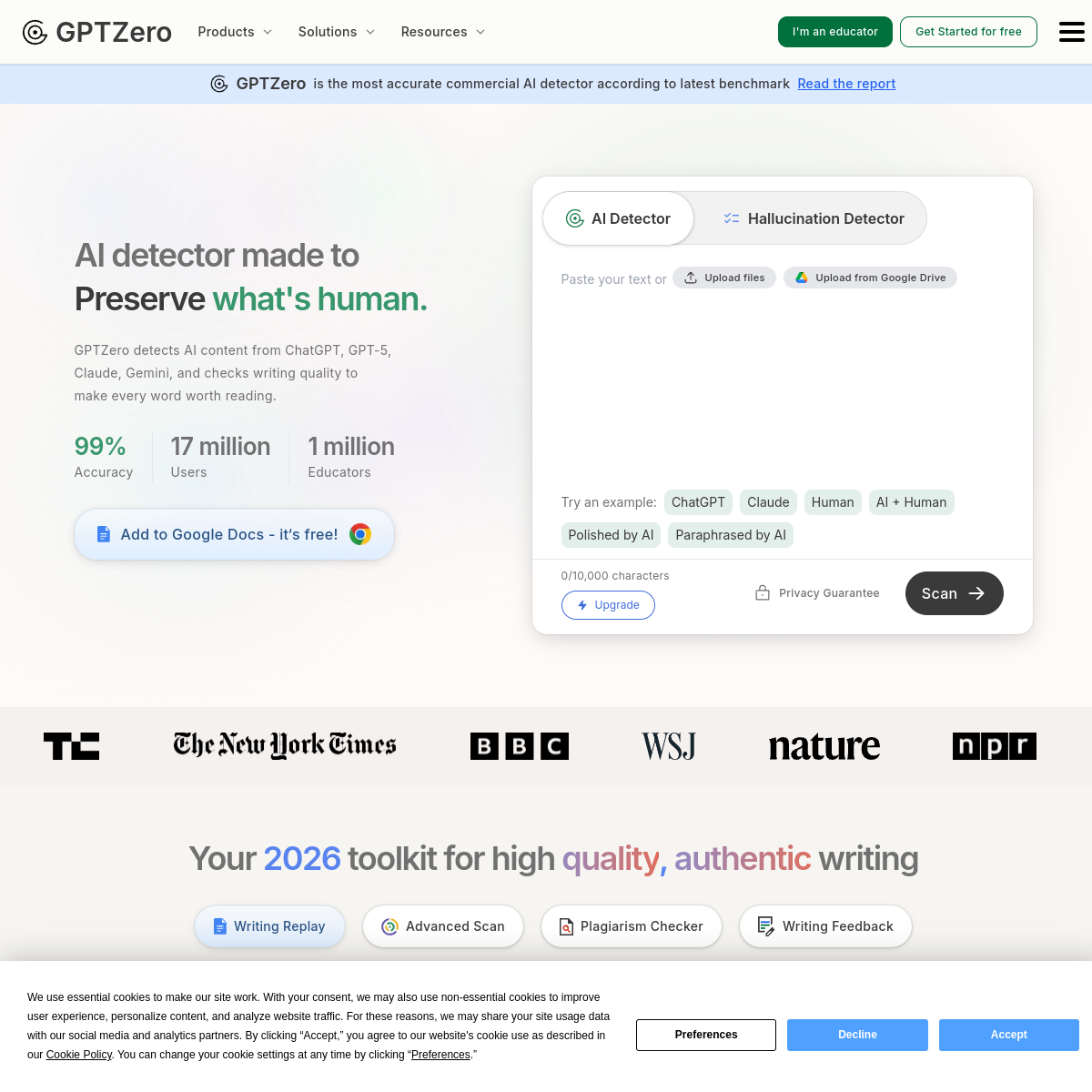
GPTZero — The world’s leading AI text detection tool
Core parameters and statistics
| Parameters | Details |
|---|---|
| Founded | January 2023 |
| Founder | Edward Tian (Student at Princeton University) |
| Number of registered users | 4 million+ |
| Detection model coverage | GPT-4/4o, Claude 3, Gemini 1.5, Llama 3 and other mainstream large models |
| Core algorithm | Perplexity + Burstiness two-dimensional analysis |
| Supported file formats | PDF, Word, plain text |
| Support Platform | Web Interface API |
| Free version | Yes (basic testing, limited times per month) |
| Paid version starts | Educator $10/month; Pro $16/month |
| Application fields | Educational academic integrity, content publishing review, corporate content quality control |
GPTZero is a pioneer product in the AI text detection track. With its unique dual-dimensional algorithm of perplexity and burstiness, it took the lead in establishing reliable detection capabilities in the early days of the outbreak of AI-generated content (AIGC). The core insight is that human writing naturally exhibits a high degree of variation in sentence complexity, while AI-generated text tends to maintain a more uniform level of perplexity—a statistical characteristic that becomes an effective signal for identifying AIGC.
User and market recognition
GPTZero received more than 30,000 user registrations within 48 hours of its release in January 2023, setting one of the cold launch speed records for AI tools. As of the end of 2024, the number of registered users on the platform has exceeded 4 million, covering more than 100 countries around the world, and has been adopted by thousands of schools and universities as an academic integrity tool.
The product has gained high recognition in the education market. Many well-known universities in the United States have listed GPTZero as an officially recommended AI content detection tool. Teachers and professors have reported that GPTZero’s sentence-level highlighting function (marking paragraphs most likely to be generated by AI) has significantly improved the efficiency of homework review. The API version is integrated by content platforms, publishers and enterprise content teams to automate the content quality review process.
Cost advantage
| Plan | Price | Key Benefits |
|---|---|---|
| Free version | $0 | Basic AI text detection, limited number of times per month, web interface use |
| Educator version | $10/month | Unlimited testing times, batch document upload, class management function |
| Pro version | $16/mo | Full features + API access, Humanize accessibility, advanced report export |
| API (pay-as-you-go) | Billed per 1000 characters | Developer and enterprise integration, supports batch processing |
Compared with other AI detection tools, GPTZero's Educator version is priced very competitively and has class management and batch submission functions specially optimized for educational scenarios. It is one of the most cost-effective choices for teachers in primary, secondary and university schools. The free version allows students and individual users to experience core detection capabilities at a low threshold.
Main functions
- Multi-model AI detection: Covers the output recognition of current mainstream large language models such as GPT-4/4o, Claude 3, Gemini 1.5, Llama 3, etc., and continuously updates the detection feature library as new models are released.
- Dual-dimensional analysis of perplexity and burstiness: The core algorithm builds a probabilistic model of human writing and AI writing by measuring the statistical perplexity (the difficulty of the model predicting the next word) and burstiness (the change in complexity between sentences) of the text.
- Sentence-level highlighting: Not only gives the overall AI probability score, but also accurately marks the specific sentences in the document that are most likely to be generated by AI, helping users quickly locate suspicious paragraphs.
- Batch document upload: Supports uploading multiple PDF, Word or plain text documents for testing at the same time, suitable for teachers to review student assignments in batches.
- API interface: Provides a complete REST API, supports the integration of third-party platforms and enterprise systems, and can be embedded in content management systems (CMS), learning management systems (LMS) or customized workflows.
- Humanize Accessibility: Analyzes the source of AI features of text, provides rewriting suggestions, and helps content creators understand how to make AI-assisted writing more like human writing.
- Teacher Class Management: The Educator version supports creating classes, batch importing students, unified viewing of submission records and test reports, and seamless integration with classroom workflow.
- Detailed Detection Report: Generate an exportable PDF report, including overall AI probability, paragraph analysis, and confidence description, suitable for document archiving needs of academic integrity investigations.
Model and version evolution
| Milestone | Time | Description |
|---|---|---|
| Public release | 2023-01 | Twitter debuts, 30,000 users in 48 hours, confusion + burst algorithm debut |
| Detection engine v2 | 2023-06 | Reduce false alarm rate, open API, launch Educator business plan |
| GPT-4 detection support | 2023-04 | Follow up the release of GPT-4 and quickly update the detection model coverage |
| Claude/Gemini support | 2023-2024 | Expand detection range to Anthropic Claude, Google Gemini series |
| Multi-model + Humanize | ~2024-09 | Added Humanize function, covering the latest models such as GPT-4o and Llama 3 |
Technical advantages
Core algorithm based on statistical linguistics: GPTZero's detection logic does not rely on "style features" in the training data, but uses the predicted entropy (perplexity) of the language model itself to evaluate the text. For a given text, the computational language model predicts the average uncertainty of each token - AI-generated texts often choose high-probability words, resulting in low overall confusion and small fluctuations; while human writing will show higher sudden changes due to emotion, creativity and non-linear thinking. This method is model-independent and suitable for detection of output from a variety of AI systems.
Continuously updated model coverage: With the release of new models such as GPT-4o, Claude 3 Opus, Gemini 1.5 Pro, Llama 3, etc., the GPTZero team continues to update the detection feature library to maintain the ability to identify the latest AI output and avoid the trap of "detection tools lagging behind AI evolution".
False Positive Rate Control: Compared with earlier versions, the v2 engine has significantly reduced the false positive rate for real human writing while maintaining a high detection rate, especially optimizing the scenario for non-native English writers (such as ESL students) - this type of text is easily misjudged as AI-generated due to relatively simple vocabulary selection by early tools.
How to use
| Entrance | Description |
|---|---|
| Web interface | Visit https://gptzero.me, paste text directly or upload a document to detect |
| Browser extension | Install the GPTZero Origin Chrome plug-in to highlight detection results directly on the web page |
| API | Obtain API Key after registration and call REST API to integrate into your own system |
| Educational Institution Integration | Contact the team for LMS (such as Canvas, Blackboard) integration solutions |
Typical steps (teachers review student work):
- Visit https://gptzero.me to register an Educator account ($10/month, supports class management).
- Create a class and invite students to join via email or link.
- After students submit their assignments, the teacher uploads PDF or Word files in batches on the console.
- The system automatically generates AI probability scoring and sentence-level highlighting reports for each document.
- The teacher checks the report and manually reviews the documents whose AI probability exceeds the set threshold.
- Export PDF report archive for document support for academic integrity investigations.
Product Pricing
GPTZero adopts the pricing strategy of "free basic version + tiered subscription by role":
- Free version: Limited number of tests per month, suitable for individual users who occasionally need to test. The web interface can be used directly without registering for advanced features.
- Educator Edition ($10/month): Designed specifically for teachers, with unlimited testing, batch uploading, and class management, it is the most cost-effective solution for educational scenarios.
- Pro Edition ($16/mo): For content creators and professional users, includes API access to Humanize features and advanced report exports.
- API pay-as-you-go: For developers and enterprises, billing is based on the number of characters processed. It is suitable for scenarios where detection capabilities need to be integrated into their own systems.
- Enterprise/Institution Customization: Large educational institutions or enterprises can contact sales to obtain batch seats and exclusive integration support solutions.
Application scenarios
1. Academic integrity review of college assignments After receiving student papers or assignments, teachers can quickly identify the entire AI-generated or partial AI-assisted writing submissions through GPTZero Educator version batch upload testing, providing objective evidence for academic integrity investigations and maintaining fair academic evaluation.
2. Content publishing platform quality control Blog platforms, news media or freelance writer platforms integrate GPTZero API into the content review process, automatically run AI detection on submitted content, filter out low-quality AI batch-generated content, and ensure the originality and credibility of published content.
3. Enterprise content team brand consistency management The brand content team uses GPTZero to review outsourced marketing copy, white papers, and technology blogs to ensure that the authenticity of externally published content is consistent with the brand’s voice and to avoid damaging the brand’s professional image due to a large amount of AI-generated content.
4. Verification of authenticity of resume and cover letter in recruitment scenarios HR teams or recruitment platforms use GPTZero to detect personal statements, resume summaries or technical articles submitted by candidates, assess the candidates' actual writing ability and AI-assisted degree, and assist in recruitment decisions.
5. Pre-review of academic journal submissions The editorial department of academic journals runs AI detection during the preliminary review stage of papers to identify all or large sections of AI-generated manuscripts to improve peer review efficiency and maintain the seriousness of academic publishing.
Applicable people
- College and middle school teachers: the core user group, the Educator version is specially designed for classroom assignment review scenarios. Class management and batch inspection functions can significantly reduce the workload of academic integrity review.
- Education Institution Manager: Hope to establish AI content usage regulations at the school-wide level, and need reliable detection tools to support policy implementation.
- Content Editors and Publishers: To manage a large number of foreign manuscript submissions, it is necessary to systematically filter AI-generated content to ensure the quality of publishing.
- Corporate Content and Brand Team: Review the quality of outsourced content to ensure that brand content for external communication reflects the true value of human creation.
- Unsuitable Scenarios: Legal or judicial scenarios that require 100% deterministic judgment (AI detection tools are essentially probabilistic judgments and cannot be used as a basis for conviction); pure code content detection (GPTZero mainly targets natural language text); non-English language detection (detection accuracy for languages other than English is relatively low).
Summary and Outlook
With the first-mover advantage of being "the first AI text detection tool to be adopted on a large scale", GPTZero quickly established brand awareness and user base in the early stages of the AIGC wave. Its moat is 4 million registered users, partnerships with educational institutions around the world, and high visibility in mainstream media.
Current main challenges: The quality of AI-generated text continues to improve, and the "AI flavor" is getting weaker and weaker, creating continued pressure on detection tools; the emergence of "Humanize" tools makes it easier to avoid detection, and the confrontation between detection tools and anti-detection tools has escalated; the problem of false positives (especially for non-native writers) is still a pain point for users, which may lead to unfair judgments in education scenarios.
Follow-up focus: expansion of multi-modal content detection capabilities (pictures, videos); deep integration with LMS platforms; promoting educational institutions at the regulatory level to establish disclosure standards for AI use rather than relying solely on detection; and in the context of increasingly common collaborative writing between AI and humans, how to transform from "detecting AI" to a more refined tool for "assessing the extent of AI usage".
Related tools:  originality.AI, GPTZero
Version Info
- detection engine v2 :An upgraded version of the detection engine has been launched to significantly reduce the false alarm rate. A new Educator Plan has been added to support batch uploading of PDF/Word documents. API interfaces have been opened for third-party platform integration, and commercial operations have been officially launched.
- Public beta :Edward Tian released the first version of GPTZero on Twitter and received more than 30,000 user registrations within 48 hours, becoming the first widely spread AI text detection tool. The core algorithm is based on the two-dimensional analysis of perplexity and burstiness.
- Multi-model detection + Humanize functional version :Added the Humanize (humanized rewriting) auxiliary function, and simultaneously upgraded the multi-model detection engine to cover the latest large model output such as GPT-4o, Claude 3, Gemini 1.5 and Llama 3; the API supports batch document detection, and the detection accuracy exceeds 99% in benchmark tests.
User Reviews