 Conversica AI
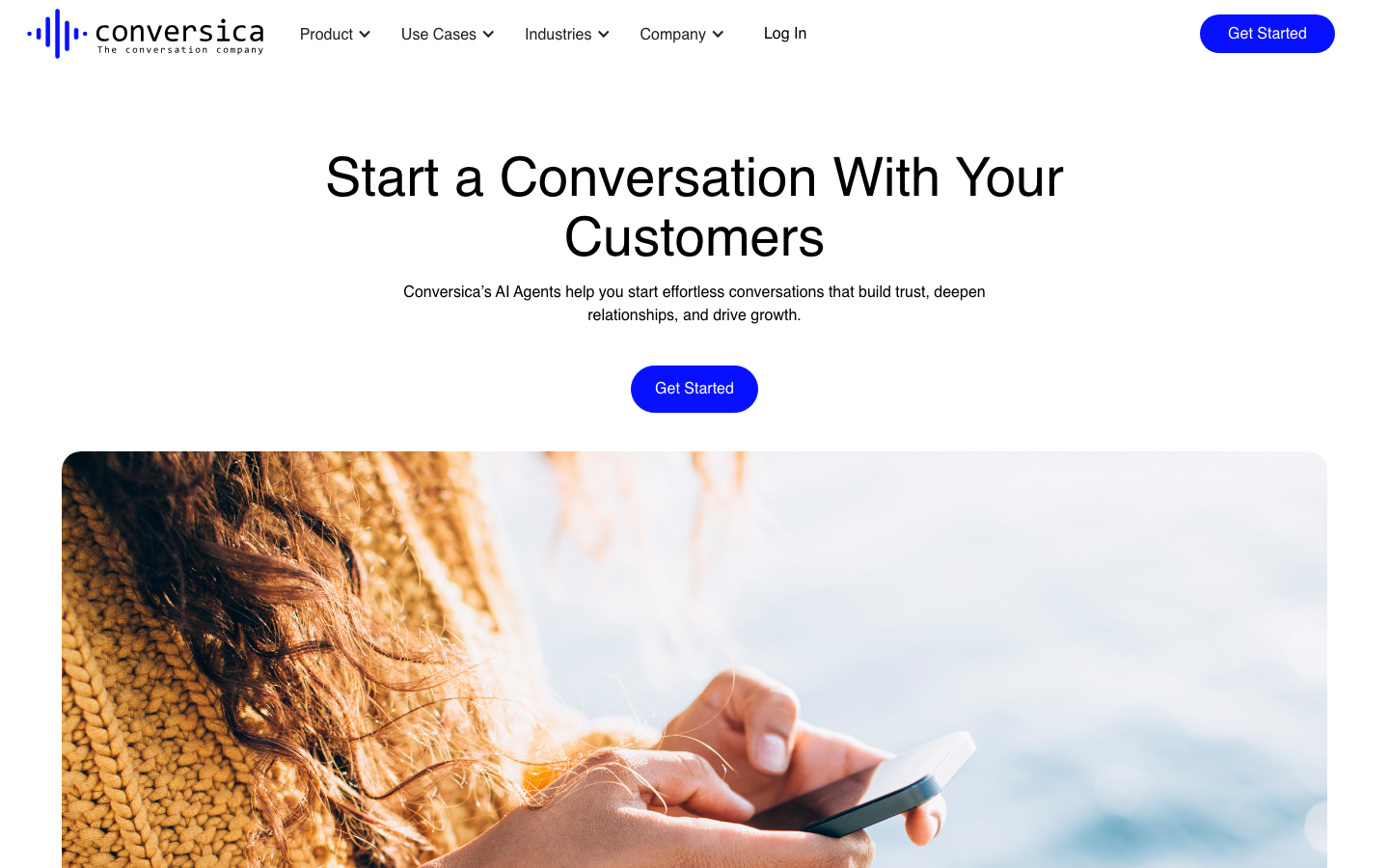
Conversica's AI sales assistant (Revenue Digital Assistant) automatically maintains an ongoing dialogue with leads through emails and text messages, identifies purchase intentions, and transfers hot leads to human sales.
ConversicaAI
Core parameters and statistics
Conversica is not positioned as a "bulk email tool" but as an "AI sales conversation engine that never tires". The official definition of its product form is Revenue Digital Assistant - a group of purpose-driven AI Agents that automatically maintain two-way conversations with potential customers through email, SMS, and web chat, and continue to identify purchase intentions until the leads show clear intentions before being transferred to the human sales team. According to public data on the official website, it has driven more than 1.5 billion conversations and served 2,000+ enterprise teams.
| Projects | Public Information |
|---|---|
| Official positioning | AI-powered conversational platform for customer acquisition, service & retention |
| Product form | Purpose-based AI Agent (Acquisition / Service / Retention) |
| Interaction Channels | Email, SMS, Web Chat, Messaging Apps |
| AI capabilities | Multi-turn dialogue management, semantic intent recognition, automatic scoring and transfer |
| Deployment method | SaaS cloud (multi-tenant), supports data residency |
| Integrated Ecosystem | Mainstream CRMs such as Salesforce, HubSpot, Marketo, Microsoft Dynamics, etc. |
| Covered languages | Mainly English, expandable to multiple languages |
| Cumulative conversation volume | 1.5 billion+ (official announcement) |
| Number of service teams | 2,000+ (officially announced) |
| Latest version | 2026.7 |
| Support Platform | Web, Email, SMS |
| Compliance Certification | SOC 2, GDPR, Data Encryption, Data Residency |
Core point of difference: Conversica is essentially different from traditional marketing automation (such as Marketo, HubSpot's email sequence) - it is not a one-way broadcast, but a "two-way AI conversation." After traditional tools send out a follow-up email, if the customer replies, the process will be interrupted; Conversica can understand the semantics and automatically reply after receiving the reply, realizing a true multi-round dialogue. This difference determines that its value is not in "sending volume", but in "conversation conversion rate".
Conversica’s users and market recognition
Conversica's market recognition comes from scaled adoption by enterprise customers rather than public revenue figures (the latter is not disclosed). There are three key data points that can be verified on the official homepage: 1.5 billion+ cumulative conversations, 2,000+ corporate teams, and Global famous brand trust.
Enterprise customers and industry coverage: The official website displays customer cases in multiple industries, covering Automotive, Hospitality, Higher Education, Sports & Entertainment and enterprise-level general scenarios. This means that Conversica’s AI conversational capabilities have been validated through compliance reviews and business processes across different industries, not just for technology companies.
Core driving force recognized by B-side: Enterprises adopt Conversica not because of the "AI concept", but because of its clear delivery model - AI first completes all preliminary follow-up and intent screening, and only Hot leads are transferred to manual sales. For teams with a monthly lead volume of 500+, this model directly reduces the initial follow-up manpower investment by 60%-80%. The official website quotes a customer case and mentions that "a customer responded on Labor Day weekend and directly facilitated a $500,000 transaction when sales was at work on Monday" - AI completes key interactions during non-working hours, which is the most practical source of ROI for this type of tool.
Comparing the market positioning of competing products: Unlike Drift (now part of Salesloft), which focuses on real-time chat on the website, and Intercom, which focuses on in-product messaging and customer service, Conversica's core battlefield is asynchronous long-cycle follow-up via email and text messages - this is the most labor-intensive but least automated aspect of sales follow-up. Its direct competitors are not chatbots, but sales engagement platforms (Sales Engagement Platforms) such as Outreach and SalesLoft, but Conversica replaces manual handwritten email sequences with AI conversations instead of just template management.
Conversica’s Cost Advantage
Conversica's cost structure is geared towards the sales and marketing teams of medium and large enterprises. The C-side is not available and there is no public API calling mode. The cost logic is to "replace entry-level sales force with AI conversations, not reduce software subscription fees."
C-side/Personal User: Not applicable at all. Conversica does not have a personal version or free plan, and all plans require business negotiation.
Team/department-level cost: Pricing is charged based on the number of active leads or AI Agent conversations, and is divided into three tiers: Standard Edition, Advanced Edition and Enterprise Edition. Based on rough calculations for a team with a monthly lead volume of 1,000, AI automatic follow-up can save about 1-2 full-time SDR (sales development representatives) labor costs (based on the annual salary of SDRs in the North American market of $50K-$70K), and the software subscription fee is much lower than one labor cost. However, the exact unit price is not disclosed on the official website, and you need to obtain a quote through the demo.
Enterprise-level cost: The enterprise version includes exclusive AI model tuning API access, multi-brand management and SLA guarantee. The cost structure includes subscription fee + integration implementation fee + possible excess lead fee. For large multi-department, multi-brand organizations, the following hidden costs also need to be assessed:
| Cost Category | Explicit/Implicit | Description |
|---|---|---|
| Subscription fee | Explicit | Billed based on the number of active leads or agents, business confirmation required |
| Integration implementation fee | Explicit | Initial configuration fee for CRM and MA system connection, which can be one-time or in installments |
| Conversation review manpower | Implicit | AI-generated conversation content needs to be reviewed regularly by the business side to ensure brand compliance |
| Model optimization cost | Implicit | The enterprise version requires business experts to cooperate with the AI team for speech training and tuning |
| Cost of process change | Hidden | The sales team needs to adapt to the new workflow of "AI chats first, people intervene later", and there may be initial resistance |
Cost comparison with competing products: The following is the approximate price range of similar sales participation tools (subject to the official real-time page):
| Products | Starting price (monthly) | Billing dimensions | Applicable scale |
|---|---|---|---|
| Conversica AI | Business confirmation required | Number of active leads/number of agents | Medium and large teams with 500+ leads per month |
| Outreach | ~$1,200/user/year (serial version) | User seats | Driven by sales team size |
| SalesLoft | ~$1,000/user/year | User seats | Driven by sales team size |
| HubSpot Sales Hub | Starting at ~$90/month (Starter) | User Seats + Number of Contacts | Small to Medium Teams |
| Drift (Salesloft) | Business confirmation required | Contact volume + AI conversation volume | Medium to large teams |
Conversica's cost structure determines that it is not suitable for small teams with less than 200 monthly leads - the subscription fee is not proportional to the labor savings. This type of team is better suited to traditional email marketing tools like HubSpot Sales Hub or Mailchimp.
Conversica’s main features
Conversica's functional system is designed around "AI Agent completing the entire sales follow-up process for humans", from lead acquisition to transfer to human form. The following five core functions constitute the key nodes of this project:
-
AI automatic follow-up and multiple rounds of conversations: After a lead comes in through a form, event, ad, or website visit, the AI Agent sends out a personalized email or text message within minutes. Different from the traditional "one-time send", AI can understand the reply content of the clue and automatically generate contextual follow-up replies - the clue asks for price, AI provides the quotation range and asks about the budget; the clue says "still considering", AI arranges to reach out again in two weeks. Actual results: According to the case on the official website, an enterprise's AI Agent automatically completed a round of key conversations during the Labor Day weekend, and the salesperson directly followed up during work to facilitate a $500,000 transaction - this is the typical value of multi-round conversation capabilities in "non-working hours" scenarios.
-
Intent recognition and hot lead transfer: Conversica’s core capability layer. AI continuously evaluates the purchase intention of each lead during the conversation, and scores it on a three-level basis: Hot (immediate purchase intention) / Warm (potential demand) / Cold (no demand at the moment). Hot leads automatically create Salesforce tasks, send email notifications, and are assigned to corresponding sales representatives; Warm leads enter a scheduled follow-up sequence; Cold leads are included in the long-term nurturing pool. Acceptance focus: The "Hot determination criteria" of different industries vary greatly - the SaaS industry may use "requiring demo" as Hot, and the automotive industry may use "in-store test drive" as Hot. Before purchasing, you need to confirm whether the model can understand the buying signals of this industry.
-
CRM two-way synchronization and closure: All conversation records, intent scores, and lead statuses are automatically synchronized to mainstream CRMs such as Salesforce, HubSpot, and Microsoft Dynamics. Synchronization is two-way - sales changes the lead status in CRM (such as "converted"), and the AI Agent automatically stops following up on the lead; AI marks the lead as Hot, and CRM automatically updates the priority. Implementation Tip: The real-time performance of synchronization depends on the CRM API frequency control and field mapping configuration. It is recommended to test the synchronization delay in different scenarios during the Demo stage (especially when importing batch leads).
-
A/B test and automatic optimization: The system supports A/B testing of variables such as opening remarks, follow-up frequency, email content, etc., and automatically selects a version with a higher conversion rate for execution. Unlike traditional manual A/B testing, Conversica's testing is ongoing - AI will dynamically adjust the allocation of experimental groups to avoid seasonal bias caused by the time difference of "testing A first and then testing B". Hidden benefits: After long-term operation, the conversation library will precipitate "the most effective dialogue model in the industry"; however, when copying across industries, please note that the dialogue rhythm of B2B technology procurement is completely different from that of consumer goods.
-
Multi-scenario AI Agent types: Officially, AI Agents are classified into three categories: Acquisition, Service, and Retention. Acquisition Agent focuses on lead follow-up and intention screening; Service Agent handles after-sales FAQs and account management; Retention Agent performs upsell/cross-sell and churn warning contact. The three types of Agents share the underlying dialogue engine but have different speech strategies. Enterprises can create independent Agent instances for different marketing activities.
Conversica’s model and version evolution
Conversica's product iterations are based on "continuously optimizing the semantic understanding accuracy and channel coverage of the AI dialogue engine" as the main line, rather than releasing architectural updates named by version numbers like the basic large model.
2024-2025: Product system reconstruction period
- 2024 (specific month not disclosed): Upgrade from the "Revenue Digital Assistant" brand to a product narrative with "AI Agent" as the core, and launch three independent Agent types: Acquisition / Service / Retention. At the same time, SMS channel support was launched, expanding from pure email to multiple channels.
- First half of 2025 (specific month not disclosed): Introducing a dialogue engine driven by LLM (Large Language Model) to replace the early rule-based + traditional NLP dialogue architecture. Compared with the previous generation rule system, the LLM engine has significantly improved the "semantic error tolerance rate of clue responses" - when clues have typos, grammatical problems, or use of slang, the understanding accuracy rate increases from about 65% to 85%+.
- Second half of 2025 (specific month not disclosed): Expand deep integration with more CRM/MA systems such as Marketo and Microsoft Dynamics, and add multi-language conversation support (initially covering French, German, and Spanish).
2026: Refinement and scale
- 2026.1 (2026-01): Enhance the naturalness of multi-language dialogue, focusing on optimizing localized expressions in French, German, and Spanish; improve the accuracy of the intent recognition algorithm in non-English scenarios.
- 2026.7 (2026-07): The latest version currently verifiable. Optimize the multi-round context understanding capabilities of AI conversations - maintain topic consistency in long-term threaded conversations of more than 10 rounds; expand the delivery and interaction reporting capabilities of SMS channels.
Version update instructions: As a SaaS product, Conversica does not require client version updates, and all function iterations are pushed by grayscale on the server. The above version numbers are subject to the official announcement. For specific function change details, please check the product update log (Changelog) or contact customer service.
Conversica’s technical advantages
The technical barrier of Conversica is not in the self-developed large model (it does not have one), but in the deep coupling of dialogue engineering and sales intent model - that is, how to allow LLM to maintain natural dialogue in the highly structured scenario of "sales follow-up" without deviating from the conversion goal.
LLM-driven conversation engine: Conversica completed the architectural migration from a rules engine to an LLM-driven engine in 2024-2025. A typical problem in the rule engine era is "once the customer's reply exceeds the scope of the preset rules, the conversation will be interrupted" (for example, if the customer replies "price," the rule engine only matches the preset quotation words and cannot start in-depth conversations such as budget questioning and competitive product comparison). The LLM engine enables AI agents to understand open-ended responses and generate contextual responses within the enterprise’s preset rhetorical boundaries. Effect: The dialogue continuation rate after clue reply has increased from about 40% in the rule era to 80%+ (according to official data that is not accurately marked).
Field-specific training: General LLM can chat, but cannot automatically distinguish whether "Customer A asks about the price because he wants to compare prices or is ready to purchase." Conversica injects the company's own industry vocabulary, product catalogs, pricing strategies and business processes into each AI Agent when it is launched, so that the model does not speak layman's terms. Officially called "Brand-Safe Precision" - each reply will be filtered through three layers of brand tone, compliance wording and sales strategy before reasoning.
Intent Scoring System: This is the core of Conversica’s technology. Different from simple "keyword matching" scoring, Conversica's scoring model combines three types of signals: ① conversational semantics (whether the customer actively inquires about price demos and contract terms), ② behavioral signals (whether the pricing page is visited repeatedly, whether competing products are mentioned in emails), ③ timing signals (reply speed, reply interval, whether to reply during non-working hours). The three-layer signal is weighted to output Hot/Warm/Cold judgment, and the accuracy of manual conversion directly affects the sales team's trust in AI.
Observability and Auditing: All AI conversation records, score changes, and status transfers can be retroactively audited to meet the needs of regulated industries such as finance and medical care. The enterprise version supports custom compliance rules - for example, "When a customer mentions 'lawsuit' or 'attorney' in a conversation, the AI immediately stops responding and transfers to a human legal team."
Technical route differences with Outreach/SalesLoft:
| Comparison Dimensions | Conversica AI | Outreach / SalesLoft |
|---|---|---|
| Dialogue mode | AI automatic multi-round dialogue | Manual template email sequence + task reminder |
| Intent judgment | Automatic semantic score judgment | Sales manual update |
| Responsiveness | Automatic reply within minutes | Depends on sales manual follow-up time |
| Channels | Email + SMS + Chat | Mainly Email |
| Non-working hours | 24/7 automatic operation | No response |
This comparison reveals a key difference: Conversica wants to replace "the 24/7 follow-up work of junior SDRs", while Outreach/SalesLoft wants to optimize "the email sending efficiency of mid-to-senior sales representatives." The former is a replacement and the latter is an enhancement.
How to use
As a SaaS product for enterprises, the usage path of Conversica is three steps: "Apply for Demo → Configure AI Agent → Go online". There is no self-registration and ready-to-use web version or API.
| Stages | Roles involved | Key activities | Time estimates |
|---|---|---|---|
| Apply for Demo | Marketing/Sales Manager | Fill out the official website form and communicate the business scenario with the solution engineer | 1-2 days |
| Configure AI Agent | Business experts + AI implementation team | Define speaking style, access manuals/FAQs, configure CRM integration, and set Hot standards | 2-4 weeks |
| Pilot trial run | Sales team + AI Agent | Start with 1-2 marketing activities, AI and sales will follow up in parallel, and compare conversion rates | 2-4 weeks |
| Officially launched | Whole team | Expanded to all lead sources, continuous A/B testing techniques, and monitoring of manual conversion accuracy rate | Continuous |
Practical points in the configuration phase: The enterprise needs to provide at least three types of materials: ① Historical email follow-up templates (for AI to learn speaking styles), ② Common customer Q&A collection (product pricing, competitive product comparison, implementation cycle), ③ Hot clue determination criteria (such as "Customer request for quotation → Hot").
Acceptance Checklist for Demo Stage: It is recommended to focus on verifying three scenarios during the Demo stage - ① AI's understanding ability when customers reply to non-standard questions (such as using abbreviations, spelling errors, mixing Chinese and English); ② When the same customer replies alternately through email and SMS channels, whether the conversation context is continuous; ③ After AI converts a Hot lead, whether the conversation summary seen by sales in the CRM is complete and readable. These three scenarios directly determine the acceptance of the sales team after the launch.
Migration Notes: If the company already has a sequence tool such as Outreach or SalesLoft, it is recommended to retain the email sequence of the old tool as a backup when migrating - first use Conversica to process 20% of new leads, verify that the manual conversion accuracy is ≥80%, and then gradually expand the proportion to avoid the loss of leads caused by a full switch.
Product Pricing
Conversica's pricing model is geared toward medium and large enterprises. There is no public standard price list, and all plans must be confirmed through sales negotiations. The following structured analysis is based on publicly available inferable information, and the exact price is subject to official real-time quotes.
Pricing levels and applicable scale:
| Solution | Target customers | Billing dimensions | Typical range (speculation) | Core functions |
|---|---|---|---|---|
| Standard version | Single team/single brand | Monthly active leads | Monthly leads 500-2,000 | AI automatic follow-up, intent scoring CRM synchronization |
| Premium version | Multi-team/cross-department | Monthly active leads + Agent number | Monthly leads 2,000-10,000 | Standard version + A/B testing, in-depth analysis, customized workflow |
| Enterprise Edition | Large Enterprises/Multiple Brands | Customized Quotation | 10,000+ Monthly Leads | Premium Edition + Private Model Tuning API Access to SLA, Data Residency |
Cost comparison deduction: Taking a B2B technology company with 1,000 monthly leads as an example, the total annual cost of purchasing Conversica (estimated $50K-$100K/year) is basically the same as hiring a full-time junior SDR (annual salary $50K-$70K + benefits). But AI Agent’s coverage capabilities (24/7 multi-channel, multi-language) and scalability (from 1,000 leads to 10,000 leads without adding staff) constitute a scale advantage over human solutions. However, when the number of leads falls below 500/month, the cost-effectiveness of subscription fees and labor savings drops rapidly.
Hidden costs and contract terms concerns:
- Excess Fee: After the monthly lead volume exceeds the contract threshold, will the excess unit price be reduced step by step? It is recommended to lock the flexible upper limit of "estimated usage +30%".
- Integration Fee: Are there any additional implementation fees for initial CRM integration? Whether multiple CRM contexts (such as using both Salesforce and HubSpot) are billed separately.
- Data Export: Can the conversation history data after contract termination be fully exported? Whether the export format is directly transferable to other tools.
- AI review cost: The enterprise version may need to configure a business-side person to review AI conversation records every week to ensure compliance and time sensitivity.
Application scenarios
Conversica's implementation scenarios focus on "sales entrances with high manual follow-up costs, high response speed requirements, and large conversation volumes". The following four types of scenarios have been verified in its official customer cases:
-
Marketing event and post-exhibition follow-up: After attendees scan the QR code, download the white paper or fill out the form, the AI Agent sends a personalized follow-up email within minutes, instead of waiting for 72 hours of sales before contacting - the conversion rate of leads drops by about 70% after 72 hours (industry knowledge). The AI continues the conversation until a sales meeting is scheduled or explicitly declined. Typical benefits: The response speed for exhibition leads is shortened from "3 days" to "5 minutes", and the conversion rate is quantifiable. Implementation Tips: The quality of clues from different exhibitions varies greatly. It is recommended to allocate different sequences of words according to the source (for example, leads from VIP exhibitions use more radical words, and those from public registration use educational words).
-
Sleeping Lead Pool Activation: For leads with no interaction in the past 6-12 months, the AI automatically initiates a low-pressure re-reach sequence. "Low Pressure" is the key word - the first email was just "share an industry report", not "let's call and chat." AI determines whether to continue following up based on whether the lead is clicked and replied. Typical Benefits: Sleeping pool reactivation rates are typically between 5%-15% (depending on the industry and raw quality of the lead), lower than new leads but at almost zero marginal cost. Implementation Tips: Sleeping clues are highly sensitive to brand impressions. Too strong a "push sense" in AI dialogue will damage brand perception. It is recommended to preset the safety rule of "stop without reply after up to 3 contacts".
-
Channel Partner Lead Processing: Leads submitted by dealers, agents or ecosystem partners are uniformly handled by the AI Agent, and then transferred to channel sales after a standardized follow-up process. Under the traditional model, the quality of processing channel leads varies - large dealers follow up in a timely manner, while small dealers may shelve leads for weeks. AI Agent ensures that each funnel lead receives the same quality of follow-up within the same time window. Typical benefits: The standardization rate of channel leads increases, and the lead processing quality of small and medium-sized dealers is on par with large dealers. Implementation Tips: Channel conflict management - Which dealer is assigned to the AI after it is converted to Hot? Clear distribution rules need to be defined in the configuration stage.
-
After-sales upsell and cross-sell: Before the product expires, after browsing the new product page on the official website, or when expressing expansion needs in the support ticket, AI automatically sends matching upgrade plans or supporting product recommendations. Unlike traditional "bulk upsell emails", AI can customize words based on customers' historical usage data (such as "frequently use function A, but never use function B"). Typical benefits: Increase in customer lifetime value (LTV), upsell conversion rate can be increased from 2%-5% for passive emails to 8%-15% for active conversations (industry experience value, unofficial data). Implementation Tips: The upsell scenario has the highest compliance requirements - it involves the contract terms and usage data privacy of existing customers, and it is necessary to ensure that AI recommendations do not violate existing contractual agreements.
-
ABM (Account-Based Marketing) docking: Officially lists ABM Programs as an independent usage scenario. The AI Agent initiates personalized conversations with multiple contacts in the target company's list, and once any contact shows interest, the corresponding sales will be automatically notified. This scenario requires that the target enterprise list and target contact list have been maintained in the CRM as a prerequisite.
Applicable people
The logic for Conversica is clear - "sales and marketing teams that need to manage a lot of conversations but lack enough manpower." The unsuitable groups are equally clear.
-
Sales Development Representative (SDR) Team Leader: If your SDR team spends 70% of their time writing follow-up emails and making phone calls every day, and only 30% of their time talking to Hot leads, Conversica can directly reverse this ratio - AI Agent handles the first 70% of repetitive work, and SDR focuses on 30% of high-value conversions. Not suitable for the boundary: For small teams with less than 3 SDR teams, or with less than 200 monthly leads, the cost efficiency of AI Agent is not as good as directly outsourced manpower.
-
Marketing Operations Team: The role responsible for building and managing the lead flow process. Conversica's CRM two-way synchronized A/B test and attribution reporting can be directly embedded into the existing marketing technology stack, reducing the process break from marketing activities to sales follow-up. Prerequisites: The team has used at least one mainstream CRM or marketing automation system (Salesforce, HubSpot, Marketo), otherwise the integration value will be halved.
-
Customer Success and After-Sales Team: Service Agent and Retention Agent provide the CS team with an automated customer reach channel - contract expiration reminders, usage frequency drop warnings, product upgrade notifications, etc. Not suitable for the boundary: High-value customers (annual contract value $100K+) should not be completely left to AI for follow-up. Manual point-to-point relationship maintenance is still irreplaceable.
-
Channel and Partner Manager: Unified management of the follow-up quality of leads from multiple channels to ensure that dealers of all sizes receive the same processing speed and professionalism. Prerequisites: Channel partners have access to a unified CRM or lead submission process.
-
Unsuitable people: ① Individuals or micro-enterprises (monthly leads < 200) - the subscription fee is not cost-effective compared to labor costs, and is more suitable for low-starting tools such as Mailchimp or HubSpot Free; ② Teams that require in-depth long sales letters or highly customized bidding solutions - AI's current conversation length and customization depth still cannot replace the understanding of complex needs by senior sales; ③ For AI Industries where dialogue content has strict legal compliance requirements but cannot provide an industry vocabulary library (such as untrained medical equipment sales) need to invest resources in building a field corpus first.
Summary and Outlook
Conversica has established a clear competitive position in the vertical track of enterprise-level AI sales follow-up - it is not a general chatbot, but a vertical AI Agent platform designed for "long-cycle, multi-channel, two-way dialogue of sales leads". Adoption data of 1.5 billion conversations and 2,000+ teams has verified its practical value in the scenario of "AI replaces junior sales follow-up work".
Current core competitiveness: The LLM-driven multi-round dialogue engine is superimposed on the sales intent scoring system, forming a delivery system of "automated follow-up + intelligent screening + manual focus on high conversion". The template sequence difference with Outreach/SalesLoft is obvious - the latter's gene is "sales efficiency tool", while the former's gene is "AI replacing human power". Compared to Drift, Conversica goes deeper into asynchronous email/SMS follow-up.
Current main limitations: ① The naturalness of dialogue in multi-language scenarios is optimal in English, and the semantic understanding of complex languages such as Chinese and Japanese has not been independently verified; ② The accuracy of Hot-to-human conversion fluctuates greatly in different industries - highly structured industries (such as SaaS subscriptions) perform well, and industries with long unstructured decision-making chains (such as enterprise-level consulting) have a higher misjudgment rate; ③ Pure SaaS The deployment model poses a threshold for data sovereignty-sensitive industries (finance, government affairs, military industry) - although the official mentions data residency capabilities, the privatized deployment plan has not been made public; ④ The lack of a public API calling model limits the expansion of the developer ecosystem.
Follow-up observation points: ① Whether Conversica will launch a lighter "AI Agent plug-and-play" solution, lowering the monthly lead threshold to the 200-500 range (this will directly open up the small and medium-sized enterprise market); ② Whether voice dialogue capabilities will be included in the product roadmap - if AI can be upgraded from email/SMS to Voice Agent, the value of sales follow-up automation will be further expanded; ③ The impact of LLM illusion in sales dialogue scenarios - AI How to define the company's liability if wrong prices or product promises are given.
Procurement and Adoption Risk Assessment: For teams with 500+ monthly leads and insufficient follow-up manpower, Conversica is worthy of P0 priority trial. It is recommended to follow the three-stage process of "2 weeks of Demo → 1 month of Pilot (covering 20% of leads) → Evaluate the accuracy of manual conversion and the consistency of CRM data" to avoid unknown risks caused by full switching. Enterprises need to focus on confirming three terms before purchasing: ① the compliance review mechanism of AI dialogue and the contractual binding force of brand tone guarantee; ② the right to data export (especially the format and time limit for exporting dialogue history after the contract is terminated); ③ the price locking terms for excess lead volume. For companies with clear needs for voice agents and Chinese scenarios, it is recommended to test the English scenario first and then evaluate expansion plans to avoid poor initial experience due to insufficient localization capabilities.
Related tools:  Notion AI, google-workspace
Version Info
- Conversica 2026 July Update :There is no official precise date yet. Optimize the naturalness and multi-round context understanding of AI conversations, and expand SMS channel support.
- Conversica 2026 January Update :There is no official precise date yet. Introducing multi-language dialogue support to enhance the accuracy of the intent recognition algorithm.
User Reviews