 Copymatic
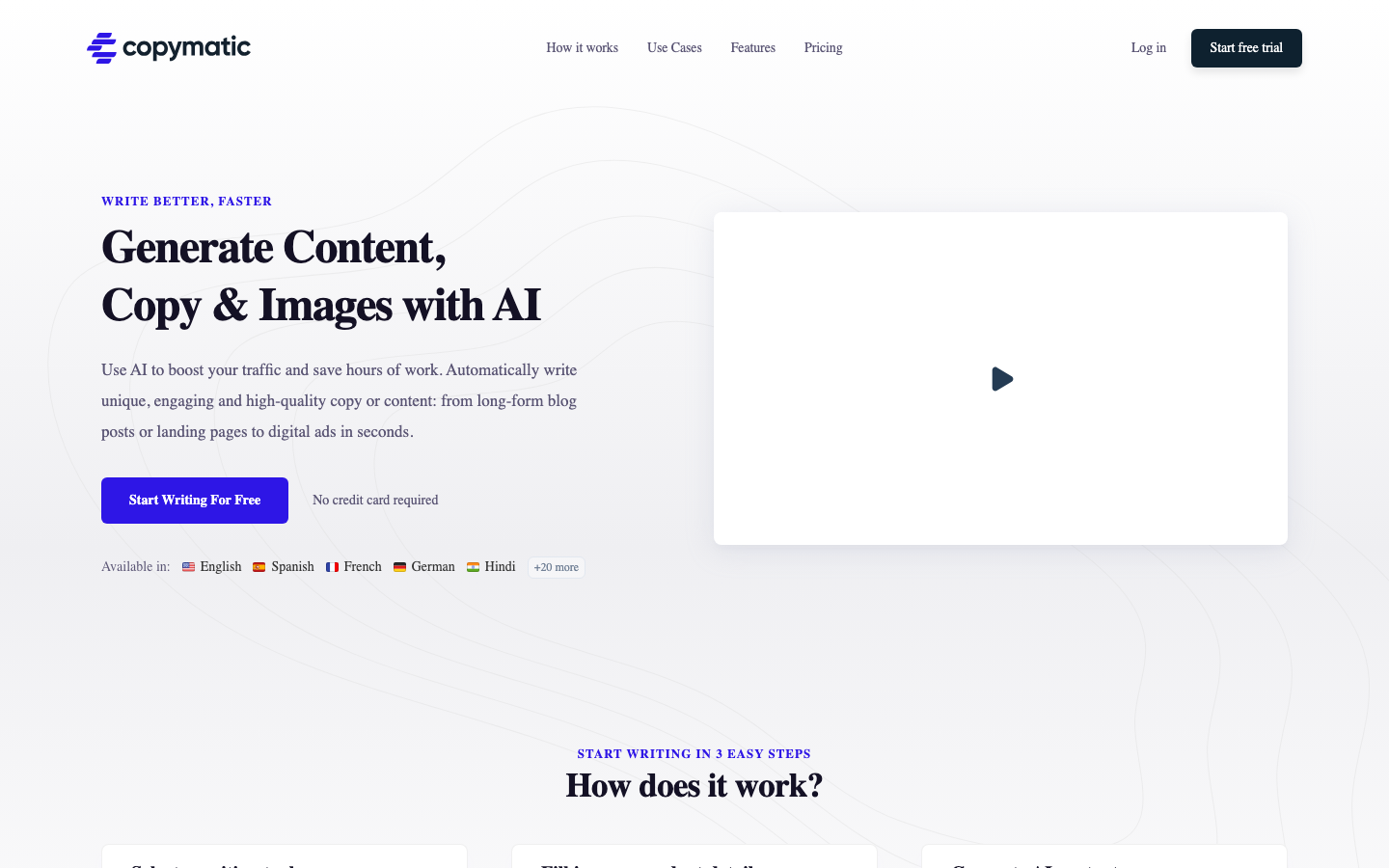
Copymatic provides 80+ copywriting templates to support rapid generation of blog posts, advertising copy, social media content, etc.
Copymatic
Copymatic’s core parameters and statistics
Copymatic is positioned as a "full-scenario AI copywriting workstation", covering complete writing needs from short copywriting (advertisements, social media posts) to long content (blogs, e-books), while providing conversational AI assistance and AI image generation capabilities through CopyChat.
| Projects | Public Information |
|---|---|
| Official positioning | AI copywriting and content generation platform |
| Number of copywriting templates | 80+ scene templates |
| Content type | Blog, advertising, email, social media, landing page, e-commerce |
| Supported languages | 30+ languages (English, Spanish, French, German, Hindi, etc.) |
| AI engine | GPT-3 basics + self-training marketing optimization model |
| Deployment Method | SaaS Web + Chrome Extension |
| Additional capabilities | CopyChat dialogue AI, AI image generation, duplication detection, grammar checking |
| Latest version | 2026 Release |
| Free trial | Support (no credit card required) |
| Paid starting point | $19/month (annually paid Pro version) |
| Company Location | United States |
| Online time | 2021 |
Core Difference: The difference of Copymatic lies in "template breadth + full-link automation" - not only copywriting generation, but also providing blog outline generation, title variations, content rewriting, SEO keyword integration, scheduled publishing, ranking tracking and other auxiliary functions, forming a complete process from topic selection to publishing. Compared with competing products such as Jasper and Writesonic, Copymatic provides more automated operation functions (automatic publishing, ranking tracking, keyword research) at the same price, and is closer to the positioning of a "content operation center" rather than a single "writing assistant".
Users and market recognition of Copymatic
Copymatic does not disclose specific user numbers, customer lists or financing information. The following are verifiable external market signals:
- Chrome extension continues to operate: It has been on the Chrome Web Store for many years and supports calling CopyChat and all 80+ writing templates on any web page. The installation volume data is based on the real-time data of the Chrome Web Store.
- Blog and content accumulation: The official blog has been continuously updated since 2021. The articles cover AI writing skills, tool comparison and industry trends, indicating that the product is in stable operation, and it uses AI to generate blog content as a demonstration of product capabilities.
- Social media and alliance ecology: Twitter account
@CopymaticAikeeps product updates and releases; operates an alliance recommendation program through thegetrewardful.complatform, indicating the existence of a certain scale of word-of-mouth communication network. - Product iteration rhythm: Since its launch in 2021, it has experienced multiple key upgrades from 50+ templates to 80+ templates, from pure copywriting generation to the launch of CopyChat conversational AI, and from single language to 30+ language coverage, reflecting continued product investment.
Market competition landscape: Copymatic is in the mid-range market of AI writing tools, covering the needs of individual creators to small and medium-sized enterprises with pricing of $19-$66/month. Direct competitors include Jasper (starting at $39/month), Writesonic (starting at $20/month), Copy.ai (starting at $36/month) and Rytr (starting at $9/month). Compared with competing products, Copymatic's "unlimited word count + Autopilot automation" combination is clearly differentiated in the same price range, but its brand awareness and financing background are weaker than Jasper (valued at US$1.5 billion) and Copy.ai.
Cost Advantages of Copymatic
Copymatic's cost structure is broken down into three layers: C-side, developer/API, and enterprise/team:
C-side/individual user
- Free Trial: No credit card is required to register for the experience. It includes a limited number of copywriting quotas, suitable for evaluating whether the quality of the tool meets your own writing scenarios. The specific free quota (such as the number of times of generation or the upper limit of word count) is subject to the real-time display on the official registration page.
- Pro version ($19/month, paid annually): Unlimited word count, all 80+ tools and templates 1 Autopilot project, automatic keyword research, content scheduling and publishing, ranking tracking AI SEO suggestions. The monthly payment price is subject to the official page.
- Cost deduction: Based on the calculation that an individual blogger produces 20 blogs per month, each with 1,500 words, the cost of a single piece of content using the Pro annual paid version ($228/year) is approximately $0.95. Compared with the market price of $50-$200 per article for outsourced writers, the cost savings are about 95%-99%. Even compared to low-end outsourcing ($10/article), the savings are still about 90%.
Developer / API User
- API is available but the information is opaque: The FAQ confirms that "API is provided", but the specific endpoints, billing model (per Token/per request/monthly), rate limit, document entry, etc. are not disclosed. If developers want to integrate, they need to contact the sales team to confirm the technical details and contract terms.
- Comparison with competing products: Jasper's API is billed at $0.02/thousand words, and Writesonic's API is billed according to word count tiers. Copymatic API's pricing competitiveness cannot be evaluated until specific quotes are obtained.
Enterprise/Team
- Team version ($32/month, paid annually): 15% external link discount for 3 Autopilot projects, suitable for small marketing teams of 2-5 people. Compared with the Pro version, the cost per user is lower ($32/month vs 3×$19/month=$57/month), and the number of Autopilot projects has increased from 1 to 3.
- Enterprise version ($66/month, paid annually): 20% external link discount for 10 Autopilot projects, suitable for teams or multi-site operation scenarios with large content needs.
- Hidden Costs: Functions such as Brand Voice Customization (Brand Voice), Team Authority Management (RBAC), and Dedicated Customer Success Manager (CSM) are not clearly listed in the self-service package. Before enterprise-level purchasing, you need to communicate with sales to confirm whether there are additional charges. The status of data compliance certification (SOC2, GDPR) is not disclosed, and compliance-sensitive industries need to verify it first.
- Horizontal comparison: Jasper Business package starts at $69/month (charged by word count), and Writesonic Business starts at $49/month. Copymatic Enterprise ($66/mo) has a clear lead in the number of concurrent Autopilot projects (10) and is suitable for teams running multi-brand or multi-lingual sites.
Cost Advantage Summary: Copymatic's core pricing competitiveness lies in the strategy of "unified monthly fee + unlimited number of words + full functionality". Most competing products charge based on the number of words or the number of generations (for example, Jasper's Creator package is limited to 20,000 words/month), while Copymatic's Pro version provides unlimited generation at a fixed $19/month, with a marginal cost of close to zero for high-volume users.
Main functions of Copymatic
- Long blog post generation: Enter a topic or a short description, and AI will automatically generate a complete blog post of 1,000+ words. It supports step-by-step generation of titles, introductions, outlines, paragraphs, and conclusions. Users can control the length and tone of the article (formal, humorous, empathetic, professional, etc.). Synergy effect: The generated articles can be directly entered into the Autopilot scheduling queue without manual copying to the publishing tool, which reduces the intermediate steps of "write → save → publish".
- 80+ scenario-based copywriting templates: Covering 80+ templates such as Facebook/Google/LinkedIn ad YouTube title and description, landing page Hero block, email subject line, e-commerce product description About Us page, etc. Each template is pre-trained with output format and wording preferences for specific platforms and conversion goals. Synergy: Shared brand information (such as company name, product keywords) between templates can be consistent in different templates without repeated input.
- CopyChat Conversational AI Assistant: Built-in ChatGPT-like conversational interface, supporting real-time Q&A, brainstorming, content generation and AI image generation. Its differentiation lies in three points: access to the latest search results to provide more timely answers (rather than relying solely on model training data), a built-in plagiarism detector to directly verify the originality of content in chat, and support for image generation (schematics, infographics, illustrations). Synergy: CopyChat shares the same context with front-end writing templates. Users can produce content paragraphs in conversations and apply them to the document being edited with one click.
- AI content rewriting and grammar checking: Rewrite, expand, shorten or correct the grammar of existing copy to maintain the core meaning but change the way of expression. It supports sentence-level rewriting and paragraph-level rewriting, which is especially suitable for A/B testing multiple versions of advertising copy or optimizing old blog content. Grammar checker identifies spelling errors, punctuation issues
Question and sentence ambiguity.
- SEO full-link integration: Target keywords can be set from the content generation stage, and AI will automatically integrate it into the text and mark the keyword density. Supporting functions include: Automatic Keyword Research (automatically extracts relevant high search volume keywords from topics), internal/external link suggestions, Rank Tracking (Rank Tracking, monitors the position changes of target keywords in search engines), and AI SEO optimization suggestions. This is the key that distinguishes Copymatic from a pure "writing tool" - it embeds SEO analysis into the writing process from an independent point of view, avoiding the back and forth switching of "after writing, go to Surfer SEO to run scores and then come back to make changes".
- Autopilot automated content operation: After setting the theme, keywords and publishing schedule, AI automatically generates articles as planned and pushes them to CMS such as WordPress. Users can manage multiple Autopilot projects (Pro is limited to 1 Team, Enterprise is limited to 10), and each project can be configured with different subject areas, target audiences, and release frequencies. Suitable for "set it and forget it" large-scale content production model.
- AI Image Generation: Through CopyChat's built-in image generation capability, users can directly generate diagrams, charts or illustrations that match text content in the conversation without switching to Midjourney or DALL·E. The generated images can be combined with the article text to provide a quick solution for blog illustrations.
- Chrome extension instant call: After installing the Chrome extension, users can select text in any web page to invoke the Copymatic tool - rewrite the selected paragraph, generate extended content, or talk to CopyChat without having to switch back and forth between the editor and the browser.
Copymatic model and version evolution
Copymatic has not disclosed the official version number system. The following milestones are based on the official blog, feature release records and package changes:
Key Milestones
- Mid-2021 (initial release): Copymatic is officially launched, providing the first batch of 50+ AI writing tools, based on the GPT-3 model. At the same time, AI Article Writer and AI Text Completer were launched, targeting individual bloggers and marketers.
- 2022 (template expansion period): The number of templates increases from 50+ to 80+, and new functions such as content rewriter (AI Rewriter), grammar check (Grammar Check), and Sentence Rewriter are added. Launched Chrome extension to extend product entry from web editor to browser plug-in scenario. During the same period, "SEO optimization" began to be emphasized as the core selling point of generating capabilities.
- February 2023 (CopyChat released): CopyChat is launched - a conversational AI assistant that benchmarks ChatGPT. The core differences include: providing answers based on real-time search results (solve the GPT data cutoff problem), built-in duplication detection, and supporting AI image generation. At the same time, the Autopilot automated content operation function was launched, marking the upgrade of product positioning from "writing tool" to "content operation platform".
- Mid-2023 (Multi-Language Expansion): Introducing multi-language support, expanding from just English to 30+ languages, including Spanish, French, German, Portuguese, Italian, Dutch, Hindi, and more. This capability allows Copymatic to enter the international content market and cross-border e-commerce scenarios.
- 2025 (2025.2 version): Further optimize the quality of long article generation, improve the SEO recommendation algorithm, and improve the Autopilot scheduling logic. Multi-language generation quality has been improved in a targeted manner.
- 2026 (2026.1 version): The latest version, optimized blog long article generation and new templates. The specific changes will be subject to official real-time information.
Version evolution features
Copymatic's version route presents a clear "from point to surface" expansion path: writing tools → template matrix → conversational AI → automated operations → multi-language globalization. Unlike Jasper, which focuses on "brand voice", and Writesonic, which focuses on "AI customer service", Copymatic takes the "full-link content center" route - functional iterations always focus on shortening the total time "from topic selection to release".
Technical advantages of Copymatic
Copymatic's technology stack uses GPT-3 as the basic layer, superimposed with a self-trained marketing optimization layer, forming a hybrid architecture of "universal language capabilities + vertical scene fine-tuning".
- Underlying Engine: Based on the OpenAI GPT-3 large model. The official page is clearly marked "Powered by the GPT-3 AI language model", indicating that the basic generation capabilities rely on the industry's mature general-purpose large model rather than a self-developed base. This means that Copymatic has a GPT-3 level baseline in general language understanding and generation, but it is also limited by the capabilities of the model.
- Marketing scenario vertical optimization: Copymatic claims that its AI has been trained by the knowledge of "content writers and conversion experts", with additional supervisory fine-tuning or prompt engineering optimization at the copywriting level (CTA wording, emotional rhythm, conversion funnel language). Its implementation is more likely to be a carefully designed Prompt template combination + output post-processing rules, rather than in-depth fine-tuning of the GPT-3 model - because the service layer based on the GPT-3 API does not support own data training of the base model. This means that the technical barriers to Copymatic lie in template engineering and Prompt orchestration capabilities, rather than underlying model differences.
- Creativity Level and Tone of Voice Control Mechanism: Provides adjustable Creativity Level (creativity) and Tone of Voice (tone) parameters. The implementation mechanism is to dynamically adjust the
temperatureandtop_pparameters of the GPT-3 API and cooperate with the system-level Prompt command to constrain the output style. The parameter range covers a continuous spectrum from "conservative and precise" to "divergent creativity", adapting to the needs of different scenarios. - SEO integration implementation path: The core mechanism of keyword density detection and automatic integration is to inject target keywords as context through pre-made SEO Prompt templates in the generation stage, and to count the frequency and distribution position of keywords in the post-processing stage. It is not a simple text replacement (replacement insertion) after generation, but guides the model to use keywords naturally during the generation process.
- CopyChat real-time search architecture: The core difference between CopyChat and the standard GPT Chatbot is "answering questions based on the latest search results." The implementation link is: User question → Search API (presumably SerpAPI or Google Custom
Search) to obtain real-time results → Result summary is injected as Prompt context → GPT-3 comprehensively generates answers containing time-sensitive information. This architecture effectively alleviates the GPT-3 data cutoff problem, but also introduces accuracy and latency dependencies in search results.
- Duplicate Checking and Content Security: Built-in plagiarism checker (Plagiarism Checker), which performs similarity comparison on content after generation. The implementation may be to integrate third-party duplication checking APIs (such as Copyscape or Turnitin-like services) rather than model layer capabilities. Users should note: The scanning range and database coverage of the duplication checking tool directly affect the detection effect. For scenarios with high originality requirements, it is recommended to use professional duplication checking services for secondary verification.
- Chrome extension architecture: The browser extension serves as the function entrance, realizes text selection interaction within the page through Content Script injection, and calls the Copymatic API through the background Service Worker to complete the generation request. This architecture expands Copymatic's usage scenarios from web editors to any browsing page, lowering the threshold for use.
Technical limitations: Due to its reliance on the GPT-3 base rather than the more advanced GPT-4 or self-developed models, Copymatic's capability ceiling in terms of ultra-long context consistency (10,000+ words), complex instruction following, and professional domain knowledge (medical, legal, financial) is lower than competing products based on newer models. There is no official disclosure on whether there are plans to migrate to GPT-4 or an alternative model.
How to use Copymatic
Copymatic provides a variety of usage entrances to cover the access needs of different scenarios:
| Entrance | Applicable scenarios | How to obtain | Function coverage |
|---|---|---|---|
| Web Editor | In-depth writing: long blog posts, landing pages, e-commerce descriptions | Official website registration (free trial, no credit card required) | All 80+ templates Autopilot, ranking tracking |
| Chrome extension | Lightweight call: quickly generate/rewrite copy on any web page | Chrome Web Store installation | CopyChat, some writing templates |
| CopyChat conversation | Q&A, brainstorming, image generation | Launch within web editor or Chrome extension | Conversational AI, AI image generation, plagiarism checking |
| API | Developer integration, automated workflow | Contact sales to obtain keys and documentation | Undisclosed specific endpoint range |
| WordPress plug-in | WP background direct writing and publishing | FAQ confirms existence, the specific path is subject to the official website | Article generation, automatic publishing |
Typical usage steps (Web editor)
- Registration and Trial: Visit
copymatic.aiand click "Start Writing For Free". Registration only requires an email address and password, and no credit card is required. After registration, you will enter the free trial status by default. - Choose a template: Select the tool that matches the scenario (such as AI Article Writer, Facebook Ad Generator, eCommerce Description Generator) from the Dashboard’s 80+ template list. The Dashboard is classified and filtered by content type (Blog, Ads, Email, Social).
- Fill in the input: Provide context such as topic description, target keywords, brand name, target audience, etc. according to the template requirements. The more detailed the input (such as providing a list of product selling points, references to competing products, and tone preferences), the higher the quality of the generation. The input fields for each template vary depending on the scenario, and typically include 3-8 required or optional fields.
- Adjust generation parameters: Set Creativity Level (1-10 levels, 5-7 is recommended as the default range) and Tone of Voice (Formal / Humorous / Empathetic / Professional / Witty and other options) before generation. The higher the creativity, the more diverse the output but the greater the probability of deviating from the topic; tone options affect wording style and sentence structure.
- Generate and Iterate: Click the Generate button and the AI returns multiple output variants (usually 3-5) within 5-15 seconds. Users can use the results directly, use them after editing, regenerate them, or use rewriting tools (Sentence Rewriter/Paragraph Rewriter) to adjust partial text. It is recommended to do at least one round of manual editing after each generation to ensure accuracy and brand consistency.
- Set up Autopilot (optional): For projects that require regular output (such as 3 blogs per week), create an Autopilot project and configure primary keywords, auxiliary keywords, publishing frequency and target CMS. The system automatically generates the first draft of content as planned and pushes it to the publishing queue. Users can set two modes: "manual confirmation before publishing after generation" or "automatic publishing".
- Tracking effect: Use built-in Rank Tracking to monitor the ranking changes of target keywords in search engines, and the data
The data can be used as a basis for content strategy adjustments.
Chrome extension usage process
- Install the "Copymatic - AI Content Writer" extension from the Chrome Web Store.
- After installation, the Copymatic icon will appear in the browser toolbar. Click it to call up CopyChat or the template selection panel.
- Select text on any web page (such as Google Docs, WordPress editor, social media publishing box), right-click and select "Rewrite with Copymatic" to rewrite, expand or translate the selected content.
- The copy generated by the extension can be pasted directly to the current page without switching tabs.
Product Pricing for Copymatic
Copymatic adopts a package-based subscription system, priced in two cycles: annual payment/monthly payment. The following prices are derived from the official website pricing page (annual payment is marked as the actual monthly fee), and the details are subject to official real-time display.
| Package | Annual price | Monthly price | Number of Autopilot projects | Word limit | Tool permissions | External link discount | Applicable scale |
|---|---|---|---|---|---|---|---|
| Pro | $19/month | Subject to official page | 1 | Unlimited | All 80+ tools | 10% off | Personal creator |
| Team | $32/month | Subject to official page | 3 | Unlimited | All 80+ tools | 15% off | Small team (2-5 people) |
| Enterprise | $66/month | Subject to official page | 10 | Unlimited | All 80+ tools | 20% off | Medium to large teams (5-20 people) |
Free trial mechanism:
- All plans come with a free trial period, no credit card required.
- The function permissions during the trial period are the same as those of the paid version (no function emasculation), and there are only hard limits on the number of times of generation or word count.
- After the trial period, it will automatically downgrade to the free version (limited times), and users can choose to upgrade to the paid package.
Annual payment discount mechanism:
- Annually paying users enjoy a discount equivalent to approximately "4 months free" (i.e. total annual payment = 8 months × monthly payment price).
- Taking the Pro version as an example: the annual payment is $19/month × 12 = $228/year, while the monthly payment is $32/month. It is estimated that the annual payment saves about 40% compared to the monthly payment. The specific monthly payment amount is subject to the official page.
External link discount description:
- All three packages include different proportions of backlinks discounts (Pro 10%, Team 15%, Enterprise 20%). The "backlinks" here may point to the third-party external link building services that Copymatic cooperates with or the external link purchase discounts within the platform. The specific list of available service providers and the applicable scope of the discount need to be confirmed after the package is activated.
Price comparison with competing products:
| Dimensions | Copymatic Pro | Jasper Creator | Writesonic Pro | Copy.ai Pro |
|---|---|---|---|---|
| Monthly payment price | Subject to official | $39/month | $20/month | $36/month |
| Yearly Price | $19/month | $29/month | $13/month | $25/month |
| Word limit | Unlimited | 20,000 words/month | 60,000 words/month | Unlimited |
| Number of templates | 80+ | 50+ | 70+ | 90+ |
| Autopilot/Automation | ✅ (1 item) | ❌ | ❌ | ❌ |
| SEO Ranking Tracking | ✅ | ❌ | ❌ | ❌ |
| Multi-language support | 30+ | 30+ | 25+ | 25+ |
| AI Image Generation | ✅ (CopyChat) | ❌ | ✅ | ❌ |
As can be seen from the table above: Copymatic Pro is close to Writesonic Pro ($13/month) in terms of annual payment price ($19/month), but it provides two differentiated functions: Autopilot and ranking tracking. Although Jasper Creator has a higher brand awareness, its annual payment price of $29/month and a limit of 20,000 words/month makes it less cost-effective than Copymatic for high-volume users.
API Pricing: Undisclosed. You need to contact sales to confirm the billing model (per token/per request/per word), rate limit, data disposal terms and SLA.
Copymatic application scenarios
- Weekly output of the content marketing team: The team needs to produce 5-10 blogs and corresponding social media promotion copy every week. After using the Autopilot function to set up the theme library and keyword pool, AI will automatically generate the first draft according to the schedule, and manual editors only need to review and fine-tune it. Cost reduction and efficiency improvement: In the traditional workflow, a 1,500-word blog takes about 3-4 hours from topic selection, outline, writing to scheduling and publishing (intermediate writers). After using Copymatic, it takes 10 minutes for AI to generate the first draft and 30-60 minutes for manual editing. The total time is reduced to 40-70 minutes, a reduction of about 70%-80%. Boundary of Human-Computer Collaboration: The first draft generated by Autopilot must be manually reviewed before being published - brand tone, data accuracy, and contextual coherence still require human judgment. Autopilot can be set to a semi-automatic mode of "generate → notify manual review → publish after manual confirmation".
- Batch distribution for e-commerce sales: An e-commerce team operating 500+ SKUs needs to batch generate product descriptions, advertising copy, and email marketing content before a major sale. Use Copymatic's e-commerce template, enter the product name and selling point keywords, and then AI will output multiple versions of the description in batches (applicable to different platforms: Amazon, eBay, Shopify). Cost reduction and efficiency improvement deduction: Under the traditional method, the writing of 500 product descriptions takes about 100-150 man-days (including editing and modification). After using Copymatic, it takes about 2-3 hours to input structured product data (CSV/table), AI batch generation of the first draft, and about 3-5 man-days for manual quality inspection and fine-tuning. The total time is compressed to about 1 week. Human-machine collaboration boundary: Compliance terms in product descriptions (such as safety warnings, import regulations) must be checked manually, and AI-generated content cannot be directly used in categories with strict compliance requirements (such as food, medical, and children's products).
- Multi-client writing for freelancers: Freelancers who serve multiple clients at the same time need to handle blogs, landing pages, ad copy, emails every week
various content types such as file sequences. The 80+ template library covers mainstream needs, eliminating the need to familiarize yourself with separate tools for each content type. Cost reduction and efficiency improvement: Under the traditional plan, Freelancer spends about 20-25 hours/week (8-10 tasks) per week on "understanding customer needs → conceiving the structure → writing the first draft". After using Copymatic, template selection + input filling + AI generation takes about 5-8 hours, and manual editing and adjustment takes about 10-12 hours. The total time is compressed to 15-20 hours, and the efficiency is improved by about 25%-40%. Boundary of human-machine collaboration: The unique tonality of the customer's brand language, the accurate use of industry terminology, and the information logic chain of long texts still require Freelancer's in-depth control. AI is suitable for handling first draft generation and repetitive copywriting variations.
- International operation of multilingual content: SaaS or e-commerce companies facing overseas markets need to translate/localize marketing content into 5-10 languages. Copymatic supports direct content generation (rather than simple translation) in 30+ languages, and is better than pure machine translation in retaining local context and expression habits. Note: For small languages (such as Arabic, Thai, Vietnamese), the generation quality needs to be manually verified - the training data of the model in these languages is more sparse and may produce unnatural expressions. It is recommended to generate the core content in English first, and then use Copymatic's multi-language templates to compare and adjust it on a language-by-language basis.
- Scale operation of SEO content factory: SEO teams that operate multiple blogs or website groups need to continuously produce a large amount of keyword-oriented content. Copymatic integrates keyword research, content generation, and ranking tracking into a unified platform, reducing the friction of switching between tools. Applicable Prerequisites: A clear SEO strategy and keyword prioritization are required, otherwise the generic content generated by Autopilot may lack deep competitiveness. Human-machine collaboration boundary: in the YMYL field (medical advice, financial investment, legal consulting)
Content may not be automatically generated and published using AI and must be reviewed by licensed professionals. Autopilot is only useful in this type of scenario during the inspiration phase from generating assistance to manual drafting.
Copymatic Applicable Groups
- Individual bloggers and independent creators: Individual creators who independently operate blog newsletters or social media accounts usually require 10-30 articles per month. The Pro version ($19/month, paid annually) provides unlimited word count and full feature access for a fixed low monthly fee, with high budget certainty. Prerequisites: Basic content selection skills and editorial judgment are required. AI-generated content cannot replace manual opinion refining and fact-checking. Not suitable for the boundary: If the creative content is mainly based on in-depth narratives, personal opinions or original research (such as investigative reports, personal essays), the significance of AI generation is limited, and the value is mainly in the inspiration of the first draft rather than written replacement.
- Small and medium-sized marketing teams (2-10 people): Teams that need to manage content for multiple brands or multiple channels. The Team version ($32/month) supports 3 Autopilot projects and is suitable for scenarios where the main website blog + sub-site + social media content can be operated at the same time. Autopilot assigns different projects to different members for management to achieve "asynchronous collaboration" in content production. Not suitable for the boundary: For teams that have extremely high requirements for brand tone consistency (such as luxury brands, boutique consulting, high-end services), it is difficult for AI-generated copywriting to accurately reproduce the brand tone, and a lot of fine-tuning is still required after each generation, which may offset some of the efficiency gains.
- E-commerce operators (100-1,000+ SKUs): E-commerce operators who manage a large number of SKUs, and batch product description generation is a rigid requirement. Using e-commerce templates and batch generation functions can increase daily distribution efficiency by 5-10 times. Not suitable for boundaries: For high-priced products that emphasize original design and brand stories (such as independent designer brands, handicrafts), AI-generated homogeneous descriptions may damage brand uniqueness. It is recommended that the core product pages be written manually, and AI assists in processing long-tail SKU and variant content.
- SEO Professionals and Content Strategists: Required for multi-site, multi-level
Professionals who generate high-volume SEO content based on keywords. Copymatic’s three-piece combination of Autopilot + Rank Tracking + Keyword Research reduces the frequency of cross-tool operations from Ahrefs to Google Search Console to WordPress. Not suitable for boundaries: Copymatic's ranking tracking accuracy is still far behind professional SEO tools (Ahrefs, Semrush, Moz), and is suitable for directional tracking rather than refined competitive product analysis.
- Not applicable to people:
- Serious writers and literary creators: AI’s long-form coherence, thematic depth, and narrative rhythm still cannot meet the requirements of novels, documentary literature, or in-depth investigative reporting.
- Brand teams that require highly customized visual design: CopyChat supports AI image generation, but the output quality, resolution and controllability are far less than professional AI visual tools (Midjourney, DALL·E 3, Stable Diffusion).
- Enterprises with strict compliance requirements for data privacy: Copymatic has not disclosed SOC2, GDPR, HIPAA and other compliance certifications. Industries involving sensitive data (such as medical records, financial accounts, minors’ information) need to request a data processing agreement and security white paper from Copymatic before use.
- Users who only need general conversational AI: If the core requirement is general Q&A rather than content creation, professional conversational AI such as ChatGPT, Claude, and Gemini are superior in depth of interaction and breadth of knowledge. Copymatic's writing template capability is a redundant function for such users.
Summary and Outlook
With "template breadth + full-link automation" as its core selling point, Copymatic has gained differentiated positioning in the red ocean market of AI writing tools by integrating writing SEO, publishing, and tracking into a unified platform. Its Autopilot function has almost no direct competition at the price of $19/month. It is a cost-effective "content operation center" choice for small and medium-sized teams where "content is the product".
Current limitations and uncertainties
- The underlying model is generationally backward: The official still refers to GPT-3 and has not confirmed whether it has been migrated to GPT-4 or a newer base model. In terms of long text consistency (10,000+ words), instruction following accuracy, and complex reasoning capabilities, GPT-3-based services may lag behind competing products based on GPT-4/Claude 3. Users need to take this gap into quality expectations when making choices.
- API ecosystem is not open enough: Although the FAQ confirms the existence of API, technical details such as documentation, endpoints, pricing, rate limits, etc. are not disclosed, and there is a lack of technical window for developers/enterprises who need customized integration or large-scale automated workflows to evaluate.
- Low transparency of enterprise-level capabilities: Brand tone customization, team authority management (RBAC), SSO, audit logs, data compliance certification (SOC2/GDPR) and other information are missing. Before purchasing, enterprises need to confirm each item with the Copymatic sales team and write down the contract terms.
- Industry competition intensifies: Competing products with highly overlapping functions such as Jasper, Writesonic, and Copy.ai are also rapidly iterating - Jasper launches brand voice customization Writesonic strengthens AI customer service capabilities, and Copy.ai expands workflow automation. Copymatic's "unlimited word count + Autopilot" differentiation advantage may be gradually followed and surpassed by competing products.
- Content homogeneity risk: The widespread use of AI writing tools is reducing the differentiated value of content. Sites that rely on AI-generated content may be at risk of algorithmic suppression of "low-quality AI content" by search engines. If Copymatic's Autopilot function is used improperly (no human editing, no unique point of view, keyword stuffing), it may cause the content to be demoted by search engines.
Procurement/Adoption Risk Assessment
Copymatic is suitable for small and medium-sized teams to use as an "accelerator" for daily content production. The recommended adoption path is:
- Evaluation period (1-2 weeks): Use a free trial account, select 2-3 most commonly used writing scenarios (such as blog posts, advertising copy, product descriptions), generate 10 samples each, and compare the quality gap between manual and AI. Key evaluation: Editability ratio of generated content (requires major modifications vs. minor tweaks vs. usable out of the box).
- Pilot period (1 month): Purchase Pro monthly payment and officially use it in a specific project (such as weekly blog updates). Set quantitative indicators: single article generation time, editing time, reading volume/conversion rate change after publication.
- Expansion period (after ROI is confirmed): If the pilot period proves that Copymatic’s content quality reaches an acceptable baseline (editing and rewriting ratio < 30%), it can be upgraded to Team or Enterprise at an annual locked unit price, and the scope of use can be expanded to more content types and team collaboration scenarios.
- Enterprise procurement needs to verify terms: Before signing the annual contract, request and confirm from Copymatic sales: data processing location and deletion policy, actual effect of brand tone training (you can ask to do a test project first), SLA guarantee (availability 99.5%+?), technical support response time, data export format after the contract is terminated.
Follow-up directions
- Base Model Upgrade: Does Copymatic plan to migrate to GPT-4 or develop a self-developed model? This will directly impact the generational gap in content quality.
- API Openness: The disclosure of API documentation, pricing and rate limits will determine whether Copymatic can enter the developer and enterprise automation market.
- Differentiation Maintenance: Will Autopilot and ranking tracking become industry standards? Copymatic needs to continue to innovate to maintain its competitive advantage over Jasper and Writesonic.
- AI Content Policy Changes: Policy changes on AI-generated content by search engines and content platforms (Google, Medium, LinkedIn) may impact the sustainability of Copymatic's user base.
Related tools:  Notion AI,
  Jasper
Version Info
- Copymatic 2026 Release :There is no official precise date yet. Optimize the quality of blog long article generation and add more template types.
- Copymatic 2025 Update :There is no official precise date yet. Introducing multi-language support, expanding to 30+ languages.
User Reviews