 Copyscape
Copyscape is the world's leading online plagiarism detection service, helping content creators and website owners protect original content through Internet-level text comparison.
Copyscape
Copyscape’s core parameters and statistics
Copyscape is a "reverse search engine" that verifies the originality of content, detecting at an Internet level whether text has been copied or scraped. It does not determine whether text was written by AI, but rather compares the degree of textual overlap between submissions and indexed web pages—a core difference that differentiates it from AI-generated detection tools.
| Projects | Public Information |
|---|---|
| Official positioning | The world's leading online plagiarism detection and originality verification platform |
| Detection scope | Web-level text comparison of all Internet search engine indexes |
| Detection methods | URL plagiarism check, text pasting plagiarism check, file upload (PDF/Word), batch scanning |
| Input method | URL, paste text, file upload API |
| Processing speed | Seconds to minutes (depending on initial check or full comparison mode) |
| Deployment path | SaaS Web, API, Enterprise private deployment |
| Support Platform | Web, API |
| Company | Indigo Stream Technologies (Private Company) |
| Founder | Gideon Greenspan |
| Founded | 2004 |
| Latest service version | Copyscape Premium (pay-as-you-go)/Copysentry (subscription-based) |
Core Competencies: The core mechanism of Copyscape is "submit content → search engine index matching → return overlapping page list". It does not scan PDF databases or paper libraries, but directly queries the Google index (officially confirmed to use Google as the search provider), and then performs post-processing on the results. This means that it can cover the entire public Internet, but it also relies on the search engine's crawling time and indexing breadth. The advantage of this architecture is "large coverage" - any web page indexed by search engines may be detected. The disadvantage is "limited depth" - closed content that cannot be indexed by search engines (pages behind paywalls, requiring login, and dynamic loading) cannot be inspected.
Product Matrix: Copyscape actually includes four product lines - free duplication check (basic URL search), Copyscape Premium (paid enhanced version, including batch scanning API, private index), Copysentry (automated monitoring subscription service) and Copyscape Enterprise (localization/private cloud deployment). Different product lines cover multi-level needs from individual webmasters to large enterprises. It is worth noting that these four product lines are not completely independent from each other - Premium users can choose to stack Copysentry subscriptions, or they can try Premium within the enterprise before evaluating whether to upgrade to Enterprise. This progressive structure of "free traffic → pay-as-you-go → subscription value-added → privatized deployment" is a relatively mature commercialization path in the field of content duplication checking.
Copyscape’s users and market recognition
Copyscape is one of the most well-known brands in the field of Internet content plagiarism checking. Its market recognition is mainly reflected in three dimensions: media endorsement, enterprise adoption and ecological integration:
Media Approval: Copyscape’s official website cites positive reviews from mainstream media such as Forbes, Wired, BusinessWeek, The Guardian, The Independent, Time, NBC News, CBS News, BBC, etc. Time magazine described it as a "Productivity tool nobody can live without". These citations span multiple years, indicating the continued impact of the brand. It is worth noting that the cited media cover multiple fields such as technology (Wired), business (Forbes, BusinessWeek), news (BBC, Guardian) and popular culture (Time), indicating that the value recognition of Copyscape is not limited to the technical circle, but is recognized by the wider business and journalistic circles.
Enterprise Customers: The official website clearly lists the following enterprise-level user cases - Jasper (AI writing platform, integrating Copyscape as a plagiarism checker), TopContent (content delivery platform, automatically checking plagiarism before delivery through API), ContentWriters (content writing platform, requiring writers to use Copyscape for double checking). These cases illustrate that Copyscape is embedded as a "quality gate" in the content supply chain.
Third Party Reviews: The official website claims that Copyscape is rated #1 by independent testing (HTW Berlin 2008). This review is more than 15 years old, but its status as an industry benchmark continues to be cited. More recent horizontal comparison data are not disclosed on the official website.
Community size: As Copyscape is a SaaS service rather than an open source project, it does not have quantitative indicators such as GitHub stars. The official website's statement "trusted by millions of website owners" indicates that its user base is huge, but the precise number of active users and paying customers has not been disclosed.
Ecological integration: Copyscape provides WordPress plug-ins (available for download from the WordPress.org official directory) and has a stable number of installations in the WordPress ecosystem. The API is integrated by content platforms such as Jasper and TopContent to form a standardized link of "content production → automatic duplication checking".
Cost Advantages of Copyscape
Copyscape's cost structure needs to be evaluated separately at three levels: C-side individuals, developers/APIs, and enterprise/privatization. Its pricing logic is significantly different from mainstream SaaS duplication checking tools.
C-side/individual
Free tier: Copyscape provides free basic duplication checking service - enter the URL on the homepage to check the matching status of the content of the page in the entire network, free of charge. The main limitation of the free version is that it only returns a small number of results at a time and does not have advanced features such as batch scanning and private index API. For individual bloggers who occasionally check one or two articles, the free version is basically enough.
Copysentry Subscription: Copysentry offers automated content monitoring starting at $4.95/month. The service scans the entire network on a periodic basis (daily or weekly) and alerts you via email when new copied content is found. The price level is linked to the number of monitored pages (the specific level is not disclosed). For ongoing original content sites, Copysentry's monthly payout is equivalent to the price of a cup of coffee in exchange for the convenience of passive monitoring rather than active discovery.
Copyscape Premium pay as you go: Premium adopts a pre-recharge model, with a minimum recharge of $10. The logic of pay-per-view is as follows:
- Each plagiarism check costs 3¢ (first 200 words) + 1¢/each additional 100 words (or part thereof)
- Taking a typical blog post of 1,000 words as an example, the cost of a single plagiarism check is about 3¢ + 8¢ = 11¢ ($0.11)
- The price per page of Batch Search is lower, and there are discounts after exceeding 100 pages.
For individual users, the average monthly investment for checking dozens of articles for plagiarism is about $5-$20, which is within an acceptable range. However, there is no monthly payment subscription option, which means that users need to prepay funds, and there will be no refunds if the balance is not used up, so there is a cost of occupancy of funds.
Developer/API
Copyscape Premium API adopts the same pay-as-you-go billing rules as the web version, with no additional price increase. This means that developers do not need to pay a separate subscription fee for the API, but only bear the cost of the queries generated by the calls.
API Cost Example:
- A plagiarism check task called 100 times a day with 1,000 words each time, the daily expenditure is about $11, and the monthly expenditure is about $330
- Each API call can choose between Initial Check (fast, only returns fragments) or Full Comparison (complete comparison, same cost but longer)
- API supports three response formats: JSON/XML/HTML, as well as the original POST method at the cURL level
Hidden Cost: The biggest hidden cost of API integration is not query fees, but development and maintenance man-hours. Scripts need to be written to handle URL encoding, response parsing, error retries (such as query insufficient balance, service unavailability), and result persistence. Officially provides sample code in PHP, Python, Ruby, Java, Perl, C# and other languages, which can lower the integration threshold.
Enterprise/Privatization
Copyscape Enterprise is designed for large organizations with stringent requirements for data sovereignty and compliance, and can be deployed on-premises or in a private cloud. The official description is "on-premises or in your private cloud", which keeps content data from leaving the corporate network.
Cost Characteristics:
- There is no price listed on the public page. You need to contact sales to get a quote.
- The charging model is speculated to be an annual enterprise contract, including deployment, maintenance and technical support.
- The core difference from the SaaS version is the data plane control: sensitive content (such as unpublished AI-generated text, legal documents) is not transmitted outside the network
- Private deployment still requires sending selected phrases to the search engine to complete the match, but the data and indexing logic are on the enterprise side
Cost comparison: Compared with the SaaS model, Enterprise has higher explicit expenses (including infrastructure license, operation and maintenance manpower), but eliminates the risk of data leakage and hidden costs of compliance. For content factories with extremely large daily processing volumes, privatized deployment may also be advantageous in terms of long-term marginal costs.
| Cost Dimensions | Free Edition | Premium (On Demand) | Copysentry (Subscription) | Enterprise |
|---|---|---|---|---|
| Initial investment | $0 | Starting from $10 | Starting from $4.95/month | Business communication required |
| Cost per duplicate check | Free (limited results) | 3¢+1¢/100 words | Included in subscription | By contract |
| Applicable scenarios | Occasional plagiarism checks | Medium and high-frequency plagiarism checks | Continuous passive monitoring | High compliance requirements |
| Data Sovereignty | Cloud | Cloud | Cloud | Local/Private Cloud |
| Operational burden | None | None | None | Requires enterprise IT |
Main functions of Copyscape
Copyscape's functional system revolves around the core task of "discovering whether content has been copied on the Internet" and can be summarized into the following six capability modules:
-
URL Plagiarism Check (Free): Enter the target URL on the Copyscape homepage to get a list of matching results for the page content in the entire network, including the title URL and text fragment of the matching page. The free version does not provide an exact word count, but it is enough to determine whether the content has been captured. This feature requires no registration or payment and is the most widely known entry point to Copyscape. Its design philosophy embodies Copyscape's "zero friction" philosophy - users do not need to create an account, log in, or learn how to use it, they can just enter the URL and see the results. This low barrier to entry makes Copyscape a "first aid tool" for many content creators.
-
Text Paste/File Upload Duplication Checking (Premium): Supports directly pasting text or uploading PDF/Word documents for duplication checking. This means that not only can published web content be checked, but drafts can be preflighted before publishing - a critical "pre-publish quality gate" for content creators. The document upload function also expands the usage boundaries of Copyscape to offline creation scenarios.
-
Snippet Comparison Tool (Copyscape Compare, free): Enter two URLs or two pieces of text, and Copyscape compares them word-for-word for similarity, highlighting exact matches and overwritten content. This tool embodies Copyscape's "micro comparison" capability - instead of searching the entire web, it accurately compares the similarities and differences between two pieces of content. Suitable for verifying "whether article B was edited from article A", or confirming whether there are internal duplications between your new article and old content.
-
Batch Search (Premium): Check up to 10,000 pages in a single operation. SEO agencies or site group managers can submit sitemaps to Copyscape to automatically scan the entire site for content collection. The results of batch scanning are presented in the form of a report, including the number of matches for each page and the corresponding origin site.
-
Copysentry Automated Monitoring (Subscription): Copysentry is the "passive defense" module in the Copyscape ecosystem - after setting up the monitoring page, the system automatically scans the entire network on a daily or weekly basis, and alerts via email when new copied content is discovered. Unlike the "active attack" of manual duplication checking, Copysentry implements "7×24 duty". Key synergy: Manual Search + Copysentry form a complete "active duplication checking + passive monitoring" solution, covering the two stages of content pre-release verification and post-release tracking.
-
API and WordPress plug-in (Premium): API allows developers to embed duplication checking capabilities into their own systems (CMS, editor, content production pipeline), while WP plug-in allows one-click integration of WordPress sites. Expert’s point of view: The real value of API does not lie in "the ability to check for plagiarism", but in turning duplication checking into an automatic checkpoint in the content production process - articles automatically trigger API duplication checking before publishing, and automatically intercept and notify the reviewer when the hit rate exceeds the standard, without manual intervention in the whole process. This "pipelining" eliminates inspection blind spots in content operations.
-
Private Index (Premium): Allows users to build their own exclusive content library, add their own sites or documents to the index, and then perform internal duplication checks within this scope. For large sites with a large amount of historical content, private indexing solves the problem of "whether new content is duplicated with old content" - this is something that ordinary network-wide duplication checking cannot cover.
-
AI Detector, Premium API: A new capability added in 2025-2026. After submitting text through the API, an AI generation probability score (0.01-0.99) is returned. This feature does not judge "whether it is a duplicate of a web page", but evaluates "whether it is written by AI". Hidden linkage: Copyscape's AI Detector and Plagiarism Search complement each other - a piece of content may pass both AI Detector (determined to be generated by AI) and Plagiarism Search (found to be duplicated with a certain page). Only by using the two together can the intellectual property risk of the content be fully determined.
Copyscape’s model and version evolution
Copyscape is a SaaS service rather than a stand-alone software, and its concept of "versions" is different from that of regular software. The publicly traceable information is mainly service milestones and server updates, rather than client version numbers.
2004-2010: Creation and basic capability building
- 2004: Gideon Greenspan founded Copyscape, operated by Indigo Stream Technologies. Initially only a free URL plagiarism check service was provided - entering a URL returned a list of other websites that imitated/copied the page. This stage established Copyscape’s first-mover advantage in the field of Internet plagiarism checking.
- 2008: HTW Berlin independent testing ranks Copyscape as the #1 plagiarism detection tool, becoming an important third-party verification node in its early days.
2011-2019: Commercialization and product matrix formation
- Copyscape Premium is online: Based on the free version, a paid enhanced version is launched, adding functions such as text pasting and duplication checking, batch scanning API interface, etc. Pricing was initially $0.05/search, later adjusted to per word (3¢/200 words + 1¢/100 words).
- Copysentry launched: The automated monitoring service is launched, filling the "passive defense" product gap and forming a product matrix of active duplication detection (Premium) + passive monitoring (Copysentry).
- WordPress plug-in release: Publish the Copyscape Premium plug-in in the official WordPress.org directory to lower the technical threshold and expand ecological coverage.
- 2018: The pricing structure is adjusted from a fixed-price "per search" model to a per-word billing model to match the cost differences of duplication checking for content of different lengths. The official release stated that this adjustment makes short text duplication checking cheaper and long text duplication checking more cost-effective.
2020-2024: Adaptation to the AI era and new scenarios
- Copyscape Enterprise launched: Provides on-premises deployment and private cloud solutions for enterprise customers, responding to the needs of high-compliance industries such as finance, law, and government.
- An explosion in demand for AI-generated content detection: With the popularity of generative AI tools such as ChatGPT, Copyscape began to face the new demand of "how to distinguish AI writing from human writing." This prompted the team to invest in research and development of AI detection capabilities.
2025-2026: AI detection integration and continuous optimization
- ~2025-06 (2025.2 Update): Improve the search engine crawling algorithm and improve duplication detection coverage. The version description does not disclose precise details of the changes.
- ~2026-02 (2026.1 Update): Enhance the duplication checking and identification capabilities of AI-generated content. "Duplicate detection and identification" here refers to two aspects - determining whether the text is generated by AI through the new AI Detector function of the API, and optimizing the detection accuracy of AI-generated text that may directly copy Internet content in the existing duplication detection engine.
Version evolution rules: Copyscape's update direction reflects two main lines - one is to continuously optimize the quality and coverage of search engine index matching (this is its core infrastructure), and the other is to gradually embed AI content detection capabilities to adapt to market changes. Due to its SaaS nature, users can obtain the latest capabilities without manual upgrades, but interface changes on the API side require client adaptation.
Technical advantages of Copyscape
Copyscape's technical advantage lies not in its use of cutting-edge deep learning models, but in its engineering system built around "search engine result post-processing" - it cleverly solves the engineering problem of "how to find accurate text overlap in massive Internet content."
Search engine post-processing mechanism: The technical foundation of Copyscape is built on Google search (officially confirmed to use Google as the search provider). After a user submits content, Copyscape converts the content snippets into a search query, obtains a list of matching pages from Google, and then performs multiple layers of post-processing on the results—including extracting matching text snippets, calculating overlap ratios, filtering false positives (such as internal citations from the user's own site), and sorting by relevance. Effect: This architecture allows Copyscape to inherit Google's breadth of Internet coverage, while improving matching accuracy through its own algorithm. From an engineering perspective, the three key challenges of this mechanism are: first, query disassembly - how to decompose long text into appropriate search query fragments to maximize recall; second, result deduplication - how to merge and display the same content when copied by multiple sites; third, match calculation - how to distinguish between "reasonable citation" (with quotation marks and source annotation) and "malicious plagiarism" (full text copy without annotation). Copyscape's engineering accumulation in these three areas is the core of its technical moat.
Two-level comparison architecture: Copyscape API provides two modes: Initial Check and Full Comparison. The initial check quickly returns the matching fragment (snippet) and the approximate number of matching words (minwordsmatched), which is suitable for scenarios with high speed requirements; the complete comparison actually captures the full text of the matching page for word-by-word comparison, and returns the exact number of matching words and matching text. Applicable scenarios: Initial Check is used for rapid initial screening (such as batch pre-inspection before release), and Full Comparison is used for forensic-level confirmation (such as evidence fixation before preparing a DMCA complaint).
Private index technology: Private index allows users to build exclusive content libraries. When users add their own pages or texts to the private index, subsequent duplication checks can be performed within the scope of this index. Mechanism → Effect: The private index solves two key problems - one is to deduplicate the internal content of large sites (whether there are duplications between different sub-sites), and the other is to prevent false positives on own sites (excluding overlapping content of one's own sites). This feature is especially valuable for content matrix sites.
AI Detection Technology: Copyscape AI Detector uses a scoring model that is independent of the duplication checking engine, outputs an AI-generated probability score of 0.01-0.99 for the submitted text, and returns a segmented score for each sentence. The official statement states that "the accuracy of segmented scoring is lower than global scoring," indicating that the model is more suitable for overall judgment rather than sentence-by-sentence annotation. Boundary: AI Detector and Plagiarism Search are two independent technical paths - the former determines "whether it is written by AI", and the latter determines "whether it is duplicated with the Internet" - users need to choose or combine them according to specific scenarios.
Limitations and Engineering Challenges:
- Search engine dependence: The quality of Copyscape's duplication checking directly depends on Google's index scope and update timeliness. Newly released content may not be indexed within a few hours; content on closed platforms (WeChat public accounts, Xiaohongshu, forums that require login) is basically not covered.
- Non-HTML format limitation: Full Comparison may fail because the target page is inaccessible or uses a non-HTML format. The API documentation clearly states this limitation.
- Content length threshold: The duplication check results for texts that are too short (such as titles with dozens of words) lack statistical significance, and Copyscape has limited matching accuracy when processing short texts.
How to use Copyscape
Copyscape's product line covers the entire spectrum from "zero registration and free duplication checking" to "enterprise privatization deployment", and different user groups can start using it through the most suitable entrance. The core basis for selecting an entrance is the frequency of use and data sensitivity: for occasional use, choose the free version, for medium and high-frequency duplication checking, choose Premium, for continuous monitoring and superimposition of Copysentry, and for data compliance, Enterprise is preferred.
| How to use | Suitable for people | Features | Cost |
|---|---|---|---|
| Free URL plagiarism check (homepage) | Personal bloggers, occasional users | Just enter the URL, no registration required | Free |
| Copyscape Premium | Medium and high-frequency plagiarism checking user SEO agency | Text/file plagiarism checking, batch scanning API | Pay-as-you-go billing, starting from $10 |
| Copysentry | Webmasters with continuous monitoring needs | Automatic scanning + email alerts | Starting from $4.95/month |
| Copyscape Enterprise | Enterprises/Organizations with high compliance requirements | Local deployment, data not transmitted | Business communication required |
| WordPress plug-in | WordPress site | One-click plagiarism check in the editor | Premium account required |
Quick steps to get started
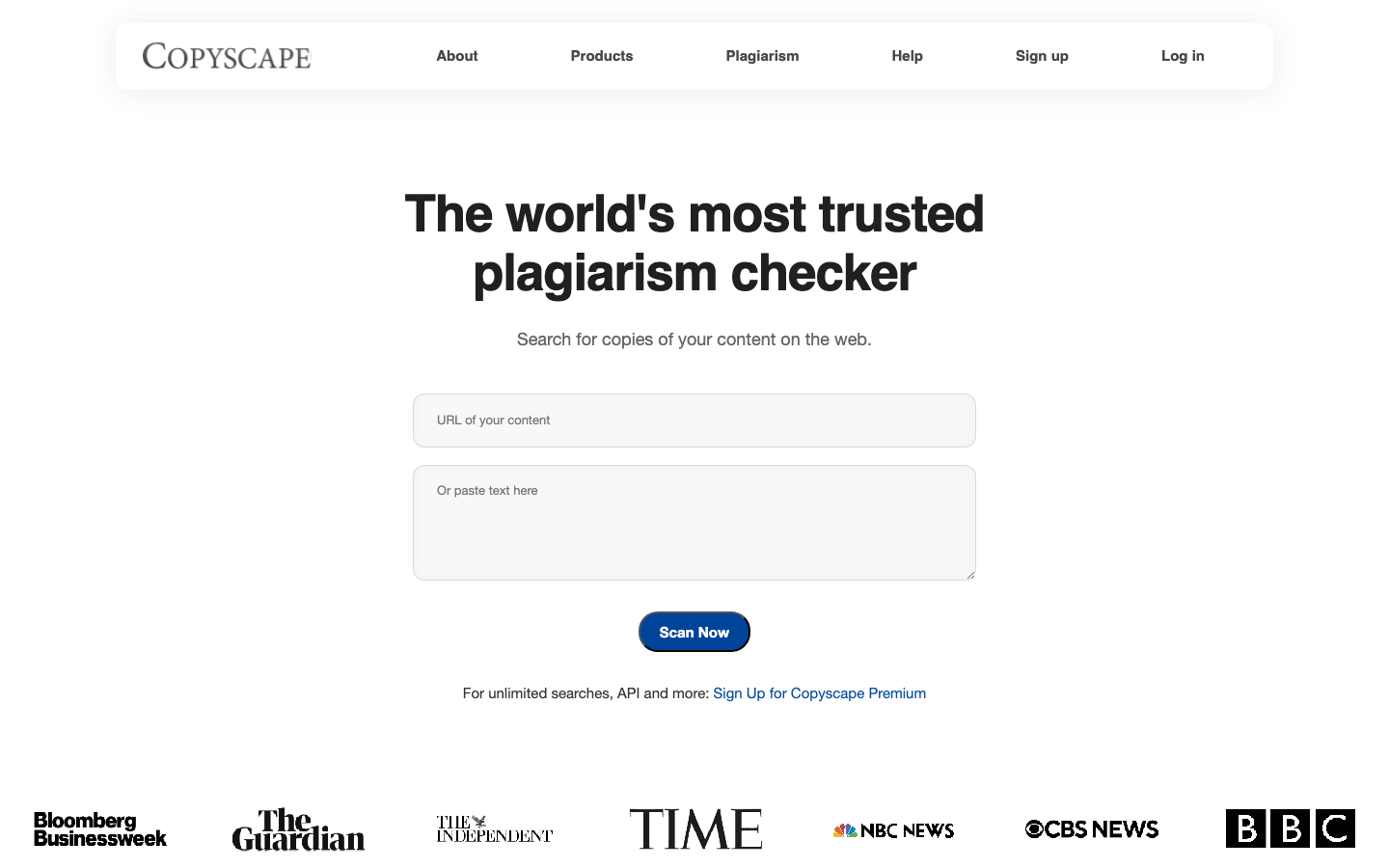
Free plagiarism check: Open copyscape.com → Paste your article URL in the input box on the homepage → Click "Scan Now" → View the list of matching results. No registration required, zero configuration.
Premium Plagiarism Check (Web): Register a Copyscape Premium account → Pre-charge (minimum $10) → Paste text or upload files in the Premium panel after logging in → Get matching results and overlap ratio.
API integration (using Python as an example): Get the API Key (generated in Premium account settings) → Send a request using the following pattern:
import urllib.request, urllib.parse

url = "https://www.copyscape.com/api/"
params = urllib.parse.urlencode({
    "u": "YOUR_USERNAME", # Replace with actual username
    "k": "YOUR_API_KEY", # Replace with actual API Key
    "o": "csearch", # Public Internet search
    "q": "https://example.com/article", # URL to check
    "c": "3", # Do a complete comparison of the first 3 results
    "f": "json" # Return JSON format
})
req = urllib.request.Request(url + ", " + params)
response = urllib.request.urlopen(req).read()
Copysentry settings: Register a Copysentry account → Select a monitoring plan (daily scan/weekly scan) → Add the page URL to be monitored (can be added in batches) → Set an alarm email → Start monitoring. Whenever the system finds new copied content, you will receive an alert email containing the URL and text fragment of the matching page.
Batch Search: Find the Batch Search entrance in the Premium panel → Upload a file containing a URL list or submit a site map → Select the scan depth → Start the batch task. After the scan is completed, you can export the report, which lists all matching results by page.
Product Pricing for Copyscape
Copyscape's pricing system consists of three independent payment lines, corresponding to different usage scenarios:
Copyscape Premium (pay as you go)
- Billing Unit: Billed by word count. 3¢ per search (first 200 words) + 1¢/each additional 100 words.
- Pre-recharge: The minimum recharge is $10. After the account balance is recharged, the amount will be deducted according to the amount of calls.
- Batch Scanning: Lower page price when scanning more than 100 pages (exact discount ratio not disclosed).
- API call: Same price as the web version, no price increase.
- Balance Query: The API provides the Check Balance interface, which can query the balance and the remaining number of queries on the day in real time.
Copysentry (subscription only)
- Starting Price: $4.95/month.
- Billing logic: Monthly subscription, the price is related to the number of monitored pages (the specific ladder is not disclosed).
- Free Trial: The first month is free for new users (the official website mentions "limited introductory special – first month free").
- Applicable scenarios: Continuously monitor whether site content is collected, suitable for websites with stable content output.
Copyscape Enterprise (negotiation system)
- Pricing Model: No public price, please contact sales for a customized quote.
- Content included: Local deployment or private cloud deployment web interface + API, technical support.
- Applicable scenarios: Financial, legal, and government agencies that have rigid requirements for data sovereignty, as well as content factories with average daily check weights.
Price comparison with competing products
| Dimensions | Copyscape | Grammarly Plagiarism | Turnitin | Originality.ai |
|---|---|---|---|---|
| Pricing model | Pay-as-you-go pre-recharge/subscription | Subscription-based (included in Grammarly Premium) | Institutional subscription | Pay-as-you-go/subscription |
| Personal monthly fee reference | $0-$20 (based on actual usage) | $12-30/month (Grammarly Premium) | Not for individuals | $15-30/month |
| Enterprise Plan | Enterprise (Negotiation) | Grammarly Business | Institutional Contract | Enterprise Negotiation |
| Scope of duplication checking | Internet public web pages | Web pages + academic database | Academic paper database | Internet + AI detection |
| AI Detection | Yes (API) | No | No | Yes (Core Function) |
Core Difference: Copyscape is the only duplication checking platform among the above products that does not rely on a subscription system and is fully billed based on usage. This is more fair to users whose frequency of duplication checks fluctuates greatly - pay for what you use and don't waste it in the off-season. However, you need to pay attention to the management of pre-recharge balance to avoid idle funds.
Copyscape application scenarios
The core scenario of Copyscape revolves around "discovering content duplication on the Internet", covering everything from personal content protection to enterprise-level compliance review:
-
Originality verification before content publishing: This is the most typical usage scenario of Copyscape. Content creators or editors use Premium's text paste or file upload features to check drafts for overlap with Internet content before publishing them. If it is AI-assisted writing, superimpose the AI Detector to check the AI generation probability. Cost reduction and efficiency improvement: Traditional manual cross-duplication checking requires editing and copying paragraph by paragraph to search engines. A 2000-word article takes about 30-60 minutes; after using Copyscape, it is shortened to 1-3 minutes, and the duplication checking efficiency is increased by more than 90%. For the content team, this means that the workload that would otherwise require an editor to check for plagiarism can be reduced to an automated step in the publishing process. Boundary of Human-Machine Collaboration: The result of duplication check requires manual judgment - the matching content may be a reasonable quote (needs to be retained and the source marked), may be an unintentional collision (needs to be rewritten), or may be a serious infringement (needs to be deleted or replaced). Copyscape provides matching evidence, but the decision-making rests with humans. A common practical suggestion is to set the rule of "match rate > 20% automatic rejection + manual review", which can prevent fish from slipping through the net and will not slow down the release pace due to excessive review.
-
Tracking and evidence collection of website content being collected: It is a norm on the Internet that the webmaster’s original content is transferred in batches by collection sites. Copyscape provides two paths - the passive path: Copysentry continuously monitors the entire network and alerts when new copies are found; the active path: uses Premium's URL duplication check or batch scanning to confirm which content has been copied. Cost reduction and efficiency improvement: Assume that a medium-sized content site (1,000 articles) needs to manually check whether 50 pieces of content have been collected every week. Manual search for each article takes 10 minutes, totaling about 8 hours/week; after using Copysentry, the workload is reduced to 0 (automatic system alarm), and only 30 minutes per week are spent processing the alarm results. Boundary of human-machine collaboration: Infringement processing (DMCA complaints, contacting the other host provider, court evidence preparation) requires manual intervention, and Copyscape's Full Comparison results can be used as evidence material.
-
SEO Audit and Batch Content Management: SEO agencies or site group managers use the batch scanning function to conduct large-scale duplication checks on customers' entire sites or their own site groups. This includes three subtasks: first, off-site duplication check (whether the content has been copied by other sites), second, on-site duplication check (whether there is duplication of content between different sub-sites or different language versions), and third, AI content prevalence check (the proportion of AI-generated content on the site). Cost reduction and efficiency improvement: Manually checking whether a 500-page site has been captured is almost impossible; use Batch Search to complete the scan and generate a structured report in a few hours. However, post-report processing (confirming matching pages one by one, deciding whether to take action) still requires manual labor.
-
Compliance review of AI-generated content: After enterprises deploy AI writing tools (such as Jasper, ContentWriters), they need to conduct compliance checks on AI output. Copyscape plays the role of a "quality gate" in this scenario - the AI-generated text is automatically sent to Copyscape through the API for double checking before publishing: Plagiarism Search (to confirm that it does not duplicate existing Internet content) + AI Detector (to confirm that the AI generation probability is within an acceptable range). Cost reduction and efficiency improvement: For a content factory with a daily output of 500 pieces of AI-assisted content, the cost of manual duplication checking and verification per article is extremely high (assuming that each article takes 3 minutes, approximately 25 working hours/day); after automation through the API, the time for duplication checking is reduced to 0, and only abnormal content with a hit rate exceeding the threshold needs to be processed (usually 5-10%).
-
Compliance management of content supply chain: When brands outsource content production (such as hiring writers, purchasing AI writing services), Copyscape serves as a third-party independent plagiarism check tool to verify the originality of the delivered content. The cases of TopContent and ContentWriters show that Copyscape acts as a "trust intermediary" in this scenario - buyers do not trust the seller's promise of originality, and the seller needs verifiable evidence that the content is not plagiarized.
Who is Copyscape suitable for?
Copyscape's product line and pricing model determine that it is not suitable for all users. The following analyzes the adaptation boundaries by role:
-
Individual bloggers and content creators: Copyscape's free URL plagiarism check and Copyscape Compare snippet comparison are completely sufficient for individual creators. If you only occasionally check whether your articles have been collected, the free version is fine. When there is a need to "verify the originality of a draft before publishing", it is recommended to upgrade to Premium's text paste checking. Not suitable for boundaries: If you are concerned about "whether the article is fluent/has grammatical errors" rather than "whether it is duplicated with Internet content", you should choose Grammarly instead of Copyscape.
-
SEO Agencies and Site Group Operators: Copyscape Premium’s batch scanning function is almost essential for SEO agencies – it can check 500-10,000 pages in batches and provide structured reports. It is difficult to find equivalently priced alternatives among competing products. It is recommended that institutions incorporate Copyscape into daily service SOPs and conduct originality audits before customer delivery. Not suitable for boundaries: If you manage a very large number of sites (hundreds of thousands of pages), the cost of batch scanning will rise quickly (pay-as-you-go billing, no enterprise subscription package), and you need to evaluate whether to enable the Enterprise plan.
-
Enterprise Content Team and Compliance Department: For companies with stable content output (media, e-commerce, marketing technology companies), the value of Copyscape lies in embedding duplication checking into the content production pipeline. Through API integration, automatic duplication checking and interception before release is realized. Prerequisite: Enterprises need to have basic technical integration capabilities (at least the ability to call REST API), and have established clear content compliance thresholds (such as "match rate > 15% automatic rejection"). Does not fit the boundary: If the enterprise only needs occasional duplication checking and does not need to be streamlined, using the Premium web interface will be enough. The maintenance cost of API integration may exceed the benefits.
-
Content platform and technology provider: Platforms such as Jasper and TopContent integrate Copyscape as a built-in function into their products, providing end users with a "one-click duplication check" experience. The core needs of this type of user are API stability, call latency, and billing predictability. Recommendation: Before integrating, fully test through the API's sample test function (x=1 parameter), and set a reasonable spend limit to prevent abnormal traffic from causing budget overruns.
-
Not applicable to people:
- Academic Researchers: Copyscape's plagiarism checking scope is the public Internet, not academic paper databases (such as journals/conference papers covered by Turnitin). If you need to detect duplication of a paper with existing academic literature, you should choose Turnitin or iThenticate, not Copyscape.
- Users who need in-depth AI detection: Although Copyscape provides AI Detector, its core is duplication checking, and AI detection is a subsequent supplementary function. If the main requirement is "accurately determine whether the text is AI-generated", specialized tools such as Originality.ai or GPTZero may be more suitable.
- Closed Ecosystem Content Supervisor: Copyscape cannot detect the logged-in content of WeChat public accounts, Knowledge Planet SaaS applications, and content behind paywalls. If the detection target is mainly in these closed ecosystems, Copyscape cannot provide effective help.
Summary and Outlook of Copyscape
Copyscape is a benchmark product that has survived for more than 20 years in the field of Internet content duplication checking. Its core competitiveness lies in "focus" - it only does one thing (finding duplication of content on the Internet) and does it to the extreme. It does not try to be a general "content quality platform", but is embedded in the larger content ecosystem as a duplication checking engine (API is integrated into the WP plug-in service WordPress ecosystem by mainstream platforms).
Current Core Limitations:
- Search Engine Dependence: The quality of duplication checking is limited by Google’s indexing timeliness and scope. New content may go undetected for hours, and closed platform content is completely invisible. This is an architectural limitation that will be difficult to break through in the short term. This also means that the quality of Copyscape will be compromised in non-English Internet areas (for example, the index coverage of Chinese Internet content is not as complete as English). Chinese content creators should use the free version to test its duplication checking effect on Chinese sites before choosing.
- The auxiliary status of AI detection: AI Detector is a new feature in 2025-2026, and its accuracy and segmentation capabilities (such as segmentation scoring) are still far behind those of specialized AI detection tools. The official documentation clearly states that segmented scoring is “less accurate than global scoring” and also acknowledges this capability boundary. For scenarios that require high-intensity AI detection (such as academic misconduct review, content review in high-compliance industries), Copyscape's AI Detector is more suitable as a preliminary screening tool rather than a final judgment basis.
- No subscription option: The Prepaid model is not friendly enough to individual users with weak budget management capabilities, and balance accumulation issues may cause friction in use. In contrast, many competing products (such as Grammarly, Originality.ai) offer monthly/annual subscriptions, and users can use them as needed without depositing large amounts of money in advance.
Follow-up observation points:
- Closed ecological coverage capability: Whether Copyscape will expand the detection of content on closed platforms through browser plug-ins, partner APIs, or other means is the key to determining whether it can adapt to the mobile Internet era. Currently, a large amount of original content is produced on content platforms such as WeChat, Xiaohongshu, and Douyin. Content search engines on these platforms cannot or can only partially index the content. Copyscape has obvious detection blind spots in this scenario.
- Deep iteration of AI detection: whether AI Detector will be promoted to the same product status as the plagiarism checking engine, and whether the integrated API interface of "AI writing + plagiarism checking" will be opened. If Copyscape can integrate "duplication checking + AI detection + batch auditing" into a unified API, it will significantly enhance its competitiveness in the content compliance market.
- Pricing model evolution: Whether a subscription option will be introduced on a pay-as-you-go basis to lower the decision-making threshold for individual users. If Copyscape launches a $9.99/month subscription plan, it may attract a large number of individual users who were previously hesitant due to the pre-recharge threshold.
- The trend of being integrated by AI writing tools: The integration of platforms such as Jasper has verified the feasible path of "duplication checking as a service". Will Copyscape launch a dedicated API or package for AI writing platforms to seize this growth opportunity. With the popularity of AI writing tools, "duplication checking" is changing from "checking after writing" to "automatic checkpoints in the generation process". This market change is both an opportunity and a challenge for Copyscape - the opportunity lies in the expansion of demand, and the challenge is that competing products are also rapidly following up.
Procurement/Adoption Risk Assessment: Copyscape is a "safe purchase" for teams that need Internet-level plagiarism checking - the brand is old enough, there are enough customer cases, and the pricing is transparent and predictable. However, before actual adoption, it is recommended to first verify whether its index coverage meets your needs through free URL duplication checking (especially the coverage of language content in specific regions), and then decide whether to recharge. Before purchasing, enterprises need to focus on verifying the SLA of the Enterprise plan, the data anonymization strategy (whether full text or fragments are sent to search engines), and the service termination clause in the contract (how the prepaid balance will be handled when the service is terminated). If the team's primary need is AI-generated detection rather than Internet plagiarism checking, Copyscape may not be the best choice.
Related tools:  originality.AI,
  GPTZero
Version Info
- Copyscape 2026 Update :There is no official precise date yet. Enhance the duplication checking and identification capabilities of AI-generated content.
- Copyscape 2025 Update :There is no official precise date yet. Improve search engine crawling algorithms and increase duplication detection coverage.
User Reviews