 Copysmith
Free
Copysmith
Free
Copysmith is an AI copywriting generation platform for e-commerce and marketing teams. It supports batch generation of product descriptions, advertising copy, emails and social media content, and provides direct integration with e-commerce platforms.
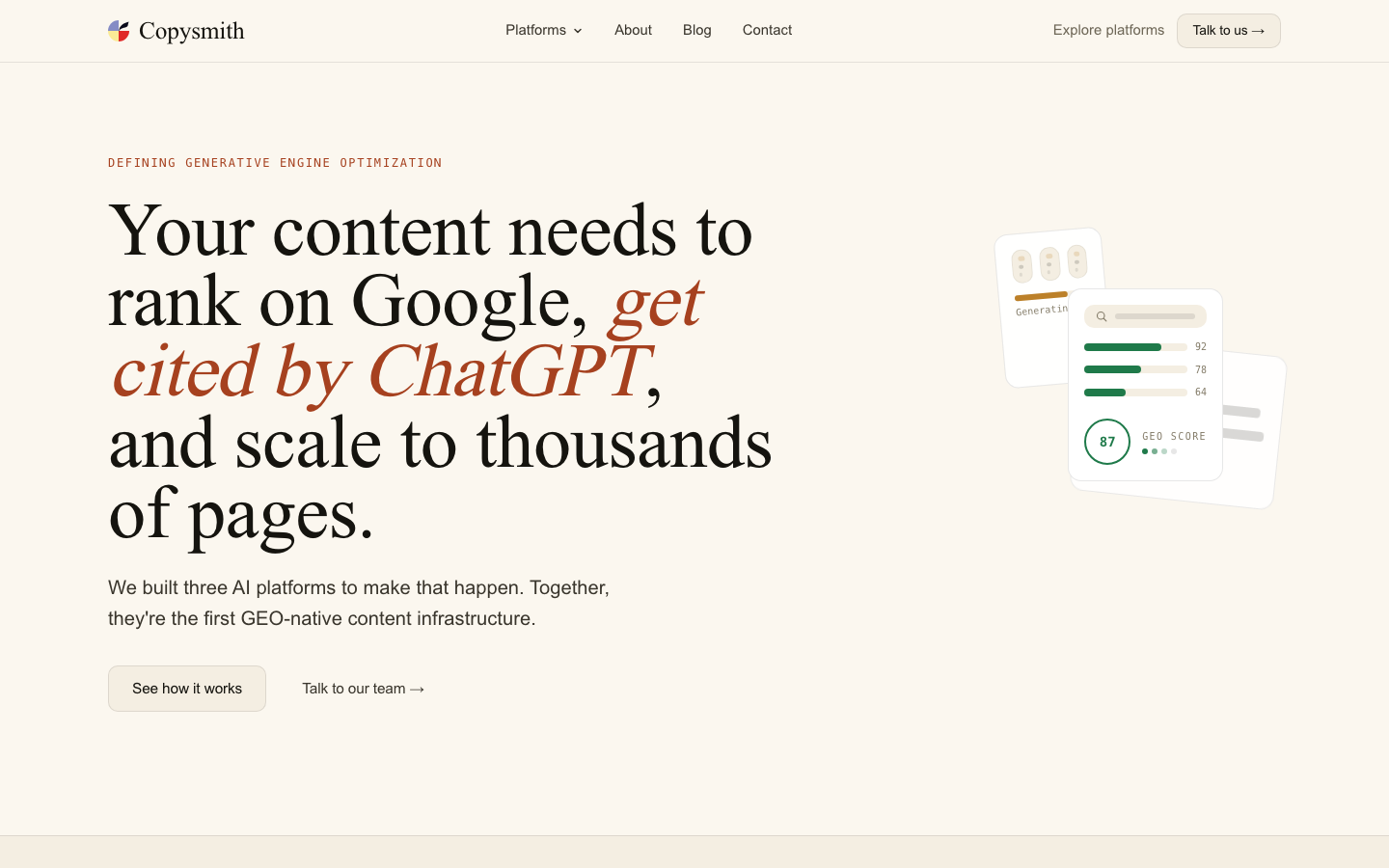
Copysmith
Copysmith’s core parameters and statistics
Copysmith is an AI copywriting generation platform for e-commerce and marketing teams. Its core value lies in transforming structured business writing tasks such as product descriptions, advertising copywriting, and email content from "manual writing one by one" to a workflow of "batch AI generation + manual review". Its product positioning directly addresses the pain points in e-commerce scenarios such as the large number of SKUs, high copywriting duplication, and complex channel distribution.
| Projects | Public Information |
|---|---|
| Official positioning | AI-powered content creation for ecommerce |
| Core Competencies | Batch product descriptions, advertising copywriting, emails, and social media content generation |
| Delivery form | SaaS cloud (Web + API) |
| Place of origin | US (mainly English market) |
| Support Platform | Web, API |
| Target customer group | E-commerce operations, marketing team, advertising agency |
| Company background | Copysmith Inc., founded in 2020, later transformed into an AI performance company (including three platforms: Frase, Describely, and Rytr) |
| Compliance certification | SOC 2 Type II, GDPR Compliant (specific coverage needs to be confirmed through the official Trust Center) |
| Latest version | Unpublished (continuous SaaS iteration, no semantic version number) |
Positioning Interpretation: Copysmith's product development has experienced a clear trajectory - from 2020 to 2023, it competed with Jasper and Copy.ai as an independent AI writing tool. From 2023 to 2024, it completed the transformation from "single tool" to "content operating system holder" through the acquisition of Frase (SEO/GEO platform) and Rytr (personalized writing assistant) and internal incubation of Describely (e-commerce content platform). This article focuses on the core scenario of Copysmith as an e-commerce copywriting generation tool, rather than its three platforms at the group company level.
Adaptation logic for e-commerce scenarios: Copysmith's core capabilities are based on the workflow of "structured input → templated generation → multi-channel distribution". The more complete the structured data such as product names, specifications, features, keywords, etc., the higher the quality and consistency of the AI output. The biggest difference between this and general-purpose AI writing tools (such as ChatGPT) is that Copysmith treats batch processing, brand rules, and channel adaptation as first-class citizens, rather than as additional features for manual prompts one by one.
Copysmith’s users and market recognition
The market signals of Copysmith as an independent tool need to be understood through two dimensions: one is the user base it accumulated as an early AI writing tool, and the other is the customer scale endorsement it obtained through the acquisition of Frase and Rytr.
Frase’s market position: The official page of Frase (acquired by Copysmith in 2023) shows that it serves 30,000+ content teams, has a G2 rating of 4.8/5, and customers include well-known companies such as Microsoft, Oracle, Target, GitLab, Coursera, etc. Frase's core capabilities cover traditional SEO and the emerging GEO (Generative Engine Optimization), which optimizes the citation probability of content in AI searches such as ChatGPT, Perplexity, and Google AI Overviews. While Frase is a standalone brand within the Copysmith Group, its customer base and G2 rating are a direct reflection of Copysmith Group's overall recognition in the enterprise content market.
Rytr’s user scale: Rytr (acquired by Copysmith in 2024) officially claims 8,000,000+ global users and a G2 rating of 4.7+. Rytr targets individuals and freelancers as its main customer base, and its Chrome extension and MyVoice personalized writing technology are core points of differentiation. The large-scale C-end user base provides Copysmith Group with an upward channel for brand voice and cross-sales.
Describely’s vertical case: Describely (internally incubated by Copysmith) focuses on batch generation of e-commerce product content. Customer cases include Target Australia (1,000+ product descriptions per week, 98% accuracy, 60x acceleration). The quantitative data (accuracy rate, acceleration factor) of this case provides the e-commerce team with a reference ROI benchmark.
Market signals for Copysmith’s native products: Copysmith’s clear market data (number of independent users, number of enterprise customers, revenue scale) as an independent AI writing tool has not been officially disclosed. Its existing market recognition mainly comes from the public data of the group's Frase and Rytr, rather than third-party certification of the Copysmith brand itself. This means that purchasing decision makers need to distinguish between "Copysmith brand recognition" and "specific competency verification of each platform under the Copysmith Group".
Copysmith’s Cost Advantages
The cost structure varies depending on the usage method: C-side users can usually experience core functions through the free version, and high-frequency usage requires subscribing to paid packages; developers/API users are billed based on the number of calls; enterprise-level users need to contact the business to obtain customized quotations. The specific price is subject to the official real-time pricing page.
Copysmith’s main features
As an e-commerce copywriting generation tool, Copysmith's feature set is designed around the workflow of "structured input → batch generation → multi-channel adaptation → review and release". The following core functions are based on the capabilities of Copysmith’s native products and the group’s Describely platform:
Generate batch product descriptions
- Core capabilities: Enter product attributes (name, features, specifications, keywords), and AI will generate unique product descriptions in batches for hundreds to thousands of SKUs. Supports CSV batch import and direct connection to e-commerce platforms (PIM systems such as Shopify, WooCommerce, Akeneo, etc.).
- Synergy: Batch generation is not only about "writing more", but also about "maintaining consistency" - all products follow a unified brand tone, keyword strategy and SEO metadata specifications. In the case of Target Australia, Describely achieved a 60x acceleration in producing 1,000+ product descriptions per week with 98% accuracy.
- Acceptance concerns: The uniqueness of batch-generated content - search engines may determine highly similar batch content as duplicate content, affecting SEO rankings. It is recommended to randomly check the sentence structure and keyword distribution diversity of the content after generation, and introduce random variants through the brand rules engine if necessary.
Multi-version generation of advertising copy
- Core capabilities: For Google Shopping, Facebook, Instagram, LinkedIn and other delivery channels, automatically generate multiple versions of advertising titles and descriptions from the same product information source, adapting to the character restrictions, format requirements and audience preferences of each platform.
- Expert View: The value of multi-version generation lies not only in "saving time", but also in "testing efficiency" - A/B testing requires at least 3-5 copywriting variations to obtain statistically significant results. Manually writing 3-5 variations takes approximately 60-90 minutes; Copysmith can generate 10+ variations in 1-2 minutes, allowing advertising teams to iterate on creative direction faster. But please note: AI-generated variants are often weaker than those manually written by senior copywriters in terms of emotional resonance and brand storytelling. It is recommended to use the AI version for "frame testing" (testing different selling point rankings and call-to-action expressions), and use manual adjustments for "emotional polishing".
Email marketing content creation
- Core capabilities: Generate complete drafts of common email marketing scenarios such as promotional emails, welcome sequences, shopping cart abandonment recovery emails, and customer return emails. Supports personalized variable insertion (customer name, purchase history, recommended products, etc.).
- Cost reduction and efficiency improvement: For a standard automated email sequence (welcome email + 3 cultivation emails + 1 conversion email), traditional writing takes about 4-8 hours (including strategy alignment and brand tonality control); Copysmith can compress the first draft generation to 15-30 minutes, but subsequent strategy calibration and personalized logic debugging still require 2-4 hours.
- Human-computer collaboration boundary: It is recommended to retain manual optimization for parts of email copywriting such as Call-to-Action, sense of urgency creation, and brand emotional connection that require a deep understanding of user psychology; factual content such as product function descriptions, preferential terms, and delivery information can be fully automatically generated.
Content rewriting and expansion
- Core Competencies: Adjust the tone (formal/casual/friendly/professional), shorten the length or expand the content of existing product descriptions, advertising copy or social media posts to adapt to the requirements of different distribution channels. For example: expanding a concise description on product packaging into long copy on an e-commerce detail page, or rewriting a blog article summary into a social media post.
- Expert View: The actual value of rewriting and amplification lies in "create once, distribute multiple times" - the brand's core selling points and product information only need to be written once, and the format and tone of different channels can be adapted to the format and tone of different channels through Copysmith's rewriting engine. This ability is particularly critical in big promotion scenarios such as "Double 11/Black Friday": the same promotional information needs to be presented in different lengths and styles on multiple touch points such as homepage banner, product details page, SMS push, and official account articles.
SEO Content Optimization
- Core Capabilities: Automatically integrate keyword strategies into the copywriting generation process, including keyword deployment in title tags, meta descriptions, and H1-H3 title structures. Supports integration with Google Search Console data to optimize the SEO performance of existing product pages.
- Synergy: SEO optimization and batch generation have a natural "linkage" relationship - keywords are implanted during generation, avoiding the rework of subsequent manual optimization one by one. But the premise of this linkage is that the team has a clear keyword strategy and content architecture plan. Copysmith is an execution tool rather than a strategy maker.
Hidden linkage: synergy between functions
The value of Copysmith's features is not the sum in isolation, but the "multiplier effect" between features:
- Batch Generation × Rewriting and Adaptation: Batch-generated product descriptions can be directly adapted to different channels (detail pages, advertisements, emails) through the rewriting engine to avoid repeated generation in each channel - this is a typical model of "generate once and reuse in multiple channels".
- SEO Optimization × Advertising Copywriting: SEO keyword strategy can be directly mapped to the keyword selection of advertising copywriting, ensuring consistency of keyword coverage for search advertising and natural search, and reducing communication costs between the advertising team and the SEO team.
- Email Marketing × Product Description: The product recommendation paragraph in the promotional email can directly reference the existing product description, without the need for the email team to write it separately - this is particularly efficient in scenarios such as "shopping cart abandonment recovery emails" that need to reference specific products.
Copysmith’s model and version evolution
The evolution of Copysmith's version reflects the trend of the AI content industry from "universal writing assistance" to "vertical scene specialization". The following is a milestone sequence based on public information:
Phase 1: Start of AI writing tools (2020-2023)
| Time node | Event | Impact |
|---|---|---|
| 2020 | Founded by Copysmith | Positioned as an AI marketing copywriting generation tool, competing with Jasper and Copy.ai at the same time |
| 2021-2022 | Continuous product iteration | Provide product descriptions and advertising copy generation based on the GPT model, and accumulate e-commerce scenario capabilities |
| 2023 | Acquisition of Frase (SEO platform) | Upgrade from "writing tool" to "content optimization platform" to acquire SEO technology stack and enterprise customer base |
Phase 2: M&A, expansion and rebranding (2024)
| Time node | Event | Impact |
|---|---|---|
| Early 2024 | Acquisition of Rytr (8M+ users) | Acquisition of personal writing assistant product line and MyVoice personalization technology |
| Mid-2024 | Internal incubation Describely | Focus on vertical scenarios of e-commerce product content, forming a dual engine of SEO + content generation with Frase |
| End of 2024 | Brand upgraded to "AI performance company" | Proposed GEO (Generative Engine Optimization) concept; completed SOC 2 Type II certification |
The third phase: GEO ecological construction (2025-2026)
| Time node | Event | Impact |
|---|---|---|
| 2025 | Frase releases Agentic SEO and GEO scores | Differentiated function construction, covering AI search engine citation tracking |
| 2025 | Rytr launches MyVoice technology | Personalized generation based on user writing samples to improve output consistency |
| 2026 (current) | Describely’s rich connectors and brand rules engine | E-commerce vertical capabilities continue to deepen; the three platforms operate independently but share brand narratives |
Version Management Instructions: Copysmith’s native products and the three platforms of Frase, Describely, and Rytr all adopt the SaaS continuous delivery model and do not have a unified semantic version number. Version updates for each platform are released through their respective Changelog and status pages. For enterprise users, it is recommended to follow Frase’s Release Notes (app.frase.io/changelog) and Rytr’s change log simultaneously.
Model dependency description: The underlying LLM (GPT series Claude or other third-party models) that Copysmith relies on for each platform has not been publicly disclosed. This means that iteration or switching of the underlying model may affect output quality and stylistic consistency. It is recommended to pay attention to the "model change notification clause" in the purchase agreement - when the underlying model is switched or upgraded, whether the platform party is obligated to notify in advance and allow customers to accept changes in output quality.
Copysmith’s technical advantages
The technical value of Copysmith does not lie in the advancement of its self-developed basic model, but in its engineering integration capabilities in the vertical scenario of "e-commerce content generation".
Structured data-driven batch generation pipeline: Copysmith’s core technical barrier lies not in AI generation itself, but in its ability to clean, complete, and structure e-commerce non-standard data. E-commerce product data usually exists in CSV/Excel format. Missing fields, inconsistent units, and mixed classification systems are the norm. Copysmith’s batch generation engine needs to complete data preprocessing—identifying and completing missing fields, unifying measurement units, and mapping classification systems—before it can inject structured data into the generation template. Mechanism → Effect: In the conversion process from "raw product data" to "batch product description", data preprocessing accounts for 40-60% of the workload, the AI generation itself only accounts for 10-20%, and quality review and release account for 20-30%. This means that Copysmith’s technical competitiveness depends more on the robustness of the data pipeline than on the number of parameters of the generated model.
Rule Drift Control for Brand Rules Engine: Copysmith’s Brand Rules Engine allows teams to preset tone (formal/casual/friendly), banned words, required attributes, and style preferences to be automatically applied on each build. Engineering value: In batch generation across 10 to 10,000 products, the rules engine ensures output consistency - in theory, 10,000 product descriptions should all follow the same brand tone, and there is no risk of content homogeneity caused by "the same team using the same template". But be careful: The initial configuration of the rules engine is a key bottleneck. The more precisely the rules are defined, the higher the quality of the output; however, rules that are too rigid (such as forcing a specific sentence pattern to be used at the beginning of each paragraph) may lead to uniformity in the generated content, weakening the uniqueness and readability of product descriptions. It is recommended to add a "randomized relaxation strategy" when configuring the rules - within the same brand tone framework, certain random changes in sentence structure, paragraph structure and keyword deployment are allowed to avoid batch content being judged as machine-generated by search engines.
Template architecture of multi-channel adaptation engine: Copysmith's channel adaptation is not a simple "long text shortening" or "short text lengthening", but an independent template designed based on the content best practices of each channel (such as Facebook ads' character limits and emotion-driven structure, Google Shopping's keyword density requirements, and personalized variable positions in emails). Effect: The same product description can automatically output 5-8 channel versions through the channel adaptation engine, and each version conforms to the format specifications and best practices of the channel. The maintenance cost of this templated architecture is not obvious when the number of channels is small (such as only Shopee + official website), but in large-scale e-commerce operations covering 8+ channels (Shopee, Lazada, Amazon, Shopify, Facebook, Instagram, Google Shopping, Line), template update and maintenance will become a continuous workload investment.
Uniqueness guarantee mechanism for batch generation: The core technical challenge faced by batch generation is "how to make 1,000 product descriptions different without deviating from brand specifications." Copysmith's output engine achieves differentiation through three strategies: first, field-level random combination based on product attributes (name, specifications, features); second, introducing rotation of sentence templates while maintaining the brand tone framework; third, synonym replacement and position randomization in SEO keyword deployment. Verification Perspective: It is recommended to extract 10-20% of samples for text similarity analysis (using cosine similarity or BERTScore) after batch generation to ensure that the description similarity within the same batch is less than 65% to avoid duplicate content penalties from search engines.
How to use Copysmith
The path to Copysmith usage has changed following the 2024 brand transition. The original Copysmith writing tool is no longer directly displayed as an independent product on the copysmith.ai homepage, and is replaced by three independent brands: Frase, Describely, and Rytr. The following entry paths are organized according to usage scenarios:
Batch generation path of e-commerce product content (recommended: Describely)
| Method | Entrance | Suitable for the scene | Cost |
|---|---|---|---|
| Web application | app.describely.io registration | Batch generation of e-commerce product content | The first 5 products are free, then $0.75/product |
| Integrated docking | Shopify, WooCommerce, Akeneo connectors | Direct synchronization of product catalogs | Included in pay-as-you-go billing |
| Enterprise customization | Contact sales | Customized brand rules SSO, SLA | Customized pricing |
Typical process:
- Connect to the e-commerce platform or upload a CSV file (including product name, specifications, keywords and other fields)
- Configure brand rules (tone selection, banned words, required attributes, SEO keywords)
- Select the target SKU to be generated (full or batch selection is supported)
- Trigger batch generation (generation time for 1,000 SKUs is usually 5-15 minutes)
- Review and edit (item-by-item or batch review, supports direct modification and export)
- Import back to the e-commerce platform (supports direct push to Shopify/WooCommerce product list)
First time use recommendation: First use 10-20 SKUs for small batch verification to evaluate the accuracy and output quality of the brand rule configuration. Adjust the rules based on the verification results and then expand them to the entire catalog to avoid thousands of SKUs needing to be reworked due to improper rule configuration.
Advertising and social media copywriting generation path (recommended: Rytr)
| Method | Entrance | Suitable for the scene | Cost |
|---|---|---|---|
| Web App | app.rytr.me Registration | Advertising Copy, Social Media Posts, Emails | Free/Unlimited/Premium |
| Chrome extension | Chrome Web Store installation | Use directly in Gmail, GDocs, LinkedIn | Bind to account plan |
| API | Developer Document Application | Custom Integration | Subject to the official real-time page |
Typical process:
- Select usage scenarios (40+ templates such as advertising, emails, blogs, social media, etc.)
- Enter a short tip (product name, target audience, core selling points)
- Choose tone (formal/casual/friendly/professional/bold) and creativity
- Generate multiple versions (usually 3-5, can be regenerated)
- Manually edit and polish, and copy to the target platform
MyVoice Personalized Configuration (exclusive to Rytr):
- Prepare 50 personal writing samples (200-500 words each, approximately 10,000-25,000 words in total)
- Upload the sample in Rytr settings and start training (training time is about minutes to hours, depending on sample size)
- After the training is completed, the subsequent generated content will automatically match your personal writing style.
- The generated text is closer to real people in terms of sentence rhythm and word usage, but enterprise-level applications still need to be reviewed.
SEO content optimization path (recommended: Frase)
| Method | Entrance | Suitable for the scene | Cost |
|---|---|---|---|
| Web App | app.frase.io Sign Up | Complete SEO/GEO Workflow | 7-day free trial, then $39-$299/month |
| Browser usage | FraseCMS publishing | Content published directly to WordPress/Webflow | Included in subscription |
Typical process:
- Connect Google Search Console and CMS (WordPress, Webflow, etc.)
- Select target topics or keywords, or use Site Auditor to scan existing content
- AI agent drafts content (research → writing → optimization → preview)
- View GEO scores and AI search citation tracking
- Publish to CMS with one click after optimization
- Content Guard continuously monitors ranking changes
Cross-platform usage recommendations
For teams that use multiple platforms at the same time, it is recommended to advance according to the "pilot → expansion" path: in the first stage, select a single platform to verify the value (Frase for content teams, Describely for e-commerce operations, and Rytr for personal writing); in the second stage, expand to other platforms based on actual results. Currently, Copysmith Group lacks a unified cross-platform console, and multi-platform users need to manually switch between platforms and export and import data.
Product Pricing for Copysmith
Copysmith's pricing system has undergone fundamental changes after the brand transformation in 2024 - the original Copysmith independent pricing page is no longer maintained, and has been replaced by the pricing plans of three independent platforms: Frase, Describely, and Rytr. The following is a compilation of pricing information based on the core scenario (Describely) generated by e-commerce copywriting and the auxiliary scenario (Rytr) as a supplement.
Describely: Pay-as-you-go (core e-commerce scenario)
| Billing items | Price | Description |
|---|---|---|
| Product description generation | $0.75/product | First 5 free, then pay as you go |
| Data Enrichment | $0.55/point | Automatically infer missing attributes and metadata |
| Image processing | $0.05/point | Image optimization and cropping |
| High Volume (500+ SKUs) | Custom Pricing | Contact Sales for Volume Discounts |
- Cost Accounting Example: For a medium-sized store managing 500 SKUs, the one-time fee for batch-generating product descriptions is approximately $375 (500 × $0.75), plus on-demand data completion. Compared with the thousands of dollars in labor costs of manual writing, the explicit expenses are significantly reduced.
- Hidden costs: Time-consuming for CSV/PIM docking, brand rule configuration, review and modification of generated content - these modest costs are not directly reflected in Describely bills, but constitute an important part of the total implementation cost.
Rytr: Freemium (auxiliary writing scenario)
| Plans | Monthly Fees | Suggested Scenarios |
|---|---|---|
| Free | $0 | Personal trial, evaluation of build quality |
| Unlimited | About $9/month (based on the official page) | Daily writing for personal bloggers and freelancers |
| Premium | About $29/month (subject to the official page) | Multi-speech matching, multi-language, high-frequency writing |
- Free plan boundaries: 10,000 characters/month is approximately 5-10 standard blog posts or 20-30 pieces of ad copy, suitable for a short trial but not sufficient to support ongoing content production.
- Cost-effectiveness of paid plans: The Unlimited plan is about $9/month and has significant cost-effectiveness for individual creators, but please note that it has a limit on the number of voice matches (1) - if shared by multiple people in a team, each person needs an independent voice profile.
Frase: monthly subscription (SEO optimization scenario)
| Plans | Monthly Fees (Pay Annually) | Core Limits |
|---|---|---|
| Starter | $39/month | 1 seat 1 site 10 articles/month |
| Professional | $103/month | 3 seats 5 sites 40 articles/month |
| Scale | $239/month | 5 seats 10 sites 100 articles/month |
| Enterprise | Custom | SSO, SLA, white label reporting, custom domain names |
Pricing Summary: Copysmith Group’s pricing strategy covers the complete spectrum from zero-cost trials to enterprise-level contracts, but the three platform fees are independent. If an enterprise needs to use e-commerce content generation (Describely), SEO optimization (Frase) and writing assistance (Rytr) at the same time, the total cost is the accumulation of the three platform fees, and there is currently no official cross-platform packaging discount.
Copysmith application scenarios
Copysmith's core values are most prominent in the "structured, scaled, channelized" business writing scenario. The following are typical proven scenarios:
Scaled output of e-commerce store product descriptions
- Task Description: The e-commerce operations team manages 500-5,000 SKUs and needs to write unique product descriptions, specifications, and SEO metadata for each item. The traditional approach requires 1-3 copywriters working full-time for 4-12 weeks.
- The value of Copysmith: Through CSV batch import or PIM docking, AI completes the first draft generation of all SKUs in hours, and the team only needs to review and fine-tune.
- Key points of verification:
- Uniqueness of batch-generated content - extract 10% samples for text similarity analysis to ensure that the description similarity within the same batch is less than 65% to avoid SEO duplicate content penalties.
- Keyword coverage - Confirm that the core keywords of each product are naturally deployed in the title, description and metadata, rather than being rigidly stacked.
- Brand tone consistency - Take 5-10 items from each category (e.g. electronics vs home furnishings) to verify whether the tone of voice is consistent.
Explosive content demand during e-commerce promotions
- Task Description: During major promotions such as Double 11, Black Friday, and New Year's Day, the e-commerce team needs to update promotional labels, limited-time copywriting, and advertising materials for tens of thousands of products within 1-2 weeks. This is the ultimate stress test for the content team in traditional mode.
- The value of Copysmith: Centralized generation before a big sale compresses promotional copy preparation to 1-2 days. The same batch of product information can simultaneously generate home page banner copy, detail page promotion labels, advertising copy and SMS push copy - achieving "one generation, four terminals synchronization".
- Human-machine collaboration boundary: Factual fields such as price information, coupon rules, and inventory status in promotional copy can be fully automated; however, psychologically driven copy such as "scarcity creation" and "urgency expression" are recommended to be retained for manual review. Key points of verification: In the promotional copy generated by AI, whether the price effective date and preferential conditions are accurate to avoid legal risks caused by misalignment of field variables.
Copywriting adaptation for multi-channel content distribution
- Task Description: Brand operations need to distribute the same product information to multiple channels such as Shopify official website, Amazon detail page, Facebook Shop, Instagram shopping, Google Shopping, etc. Each channel has different requirements for copy length, format, and keyword density.
- The value of Copysmith: The rewriting engine automatically adapts the same product description to versions for each channel (Amazon focuses on A+ content structure, Shopify focuses on brand story, Google Shopping focuses on keyword coverage), reducing the time of one-by-one adaptation.
- Quantitative deduction of cost reduction and efficiency improvement: For brands covering 5 channels, copywriting adaptation for a single product traditionally takes about 30-45 minutes (including format adjustment and keyword calibration for each channel); after using Copysmith, the adaptation time can be compressed to 2-5 minutes per product, improving efficiency by about 10-15 times. But please note: the content policies of each channel (such as Amazon’s A+ content requiring a mix of images and text) and platform policies (such as the strictness of title character restrictions) recommend manual acceptance to ensure compliance.
Content filling for email marketing automation
- Task Description: The marketing team builds an automated email process (welcome email, cultivation sequence, promotion notification, shopping cart recovery), and each node requires differentiated copywriting content. A 6-email welcome sequence takes about 6-12 hours to write traditionally (including strategic alignment and brand tonality control).
- The value of Copysmith: Email draft generation is compressed to 30-60 minutes, supports automatic insertion of personalization variables (customer name, purchase history, recommended products). Shopping cart abandonment recovery emails can directly reference the product descriptions in the customer's shopping cart, eliminating the need to manually paste them.
- Key points to verify: Whether the personalized variable rendering of the email copy is displayed normally in all email clients (Outlook, Gmail, Apple Mail); whether the reading experience on the mobile terminal (the attractiveness of the first 10 words and the overall length) is in line with best practices.
Rapid iteration of copywriting materials for advertising A/B testing
- Task Description: The advertising team needs to prepare 3-5 copy variations for each ad group for A/B testing. Traditionally, a senior copywriter would produce 3-5 variations per hour, and it would take about 6-10 hours to cover 10 ad groups.
- The value of Copysmith: Automatically generate 10+ copy variations from the same product listing, allowing advertising teams to spend more time testing strategies and data analysis instead of writing copy.
- Expert View: AI-generated variants provide diverse framework choices in "selling point sorting" and "Call-to-Action expression", but are weaker than senior human copywriters in "emotional resonance" and "brand storytelling". Recommended strategy: AI-generated variants are used for "structural testing" (testing the difference in effectiveness of selling point A vs. selling point B), and manual optimization is used for "emotional polishing" (raising the emotional appeal of the winning variant to brand standards).
Who is Copysmith suitable for?
The applicable groups of Copysmith (and the group's platforms) need to be stratified according to usage scenarios, because different business roles require different capability modules.
E-commerce operations and product content team
- Adaptation Value: Copysmith (via Describely) directly solves the pain points of large number of SKUs and high content duplication. It is suitable for e-commerce operation teams that manage an average of 200+ SKUs per month and need to update product descriptions in batches. For large e-commerce companies with 2,000+ SKUs, the efficiency improvement brought by batch generation is most obvious.
- Prerequisite: The team should have standardized product data (CSV/PIM) and clear brand tone guidelines. If the product data itself is confusing (missing fields, inconsistent size units, mixed classification systems), Copysmith's data completion capabilities can alleviate the problem, but pre-data cleaning still requires 1-2 days of investment.
- Does not fit boundaries:
- For categories where product descriptions are mainly based on pictures and videos with minimal text (such as some home decorations and artworks), Copysmith's text generation has limited value.
- For boutique brands that require customized storytelling and unique brand narratives for each product, automatically generated content can lead to homogeneity and weaken brand differentiation.
Advertising and Marketing Operations Team
- Adaptation value: Advertising teams need to quickly generate and iterate copywriting versions for different platforms and different audience groups. Copysmith’s multi-version generation capability increases material preparation efficiency by 5-10 times for A/B testing.
- Applicable Prerequisites: The team has a clear advertising strategy and target audience definition. Copysmith is an execution-level tool and cannot replace early audience insights and delivery strategy development.
- Does not fit boundaries:
- Copysmith's pure text generation capability is not suitable for advertising creatives that require a high degree of visualization and mixed graphics and text (such as brand video scripts and interactive ads).
- In industries with strict compliance review requirements for advertising copy (such as medical, financial, and legal), AI-generated copy must be reviewed item by item by a professional compliance team.
Individual creators and freelancers
- Adaptation value: Through Rytr's free or low-price plans, individual bloggers, self-media, and freelance writers can quickly generate daily content (social media posts, email newsletters, blog articles). MyVoice personalization technology makes output more personal.
- Applicable prerequisites: Creators need to have basic topic selection and content planning capabilities. Rytr is an accelerator rather than a source of ideas.
- Does not fit boundaries:
- Rytr’s free plan for freelancers (10,000 characters/month) is clearly not enough for high-production writers.
- For scenarios where the writing style is extremely personalized (such as novel writing, column comments) or requires strict fact checking (such as industry analysis, technical tutorials), AI-generated text still requires a lot of manual editing and fact verification.
Enterprise Content Strategy and Growth Team
- Adaptation value: Copysmith Group's three-platform combination (Frase + Describely + Rytr) provides a theoretically complete "content generation → SEO optimization → AI search tracking" solution. Ideal for businesses with a dedicated content operations team (3+ people) and established content review processes and brand guidelines.
- Purchase Prerequisite: The enterprise should already have a basic SEO awareness and content strategy framework, and Copysmith is the amplifier and execution tool. It is recommended to verify the value in a single scenario first (for example, first use Describely to solve the batch generation of product descriptions), form ROI data, and then expand to other scenarios.
- Does not fit boundaries:
- For the Chinese market team that mainly targets Chinese search engines such as Baidu and Sogou, Frase's GEO scores and AI search tracking are mainly targeted at English AI search engines (ChatGPT, Perplexity, Gemini), and the coverage and data accuracy of Chinese scenes need to be verified separately.
- The three platforms operate independently and lack a unified data panel and management backend. If an enterprise needs unified content governance and permission management, it can currently only be managed separately through independent consoles of each platform, which increases the complexity of operation and maintenance.
Summary and Outlook
Copysmith started as an AI writing tool in 2020 and transformed into an "AI performance company" through the acquisition of Frase and Rytr and the incubation of Describely in 2024. Its product evolution reflects a core trend in the AI content industry: general AI writing is being replaced by a competitive model of "vertical scenario + platform matrix". It is difficult for a single AI writing tool to establish lasting differentiation between ChatGPT's general capabilities and vertical tools such as Jasper and Copy.ai - Copysmith's choice is to "not make a tool, but make a matrix of content tools."
Current Core Advantages:
- The batch generation capability in e-commerce scenarios has been verified by large retailers such as Target Australia, and the quantitative data of 60 times acceleration and 98% accuracy has industry reference value.
- The brand rules engine and data completion capabilities reduce the manual bottleneck of e-commerce content scale and have significant efficiency advantages for teams with a large number of SKUs.
- SOC 2 Type II and GDPR compliance certifications provide the necessary backing of trust for enterprise-level procurement.
- The product matrix (Frase + Describely + Rytr) covers a wide range of scenarios from writing efficiency to search optimization to e-commerce verticals, with wide horizontal coverage.
Main Current Limitations:
- Platform collaboration is opaque: "GEO Flywheel" is conceptually attractive as a brand narrative, but the data integration and unified workbench of the three platforms have not yet been implemented, and users still need to manually operate across platforms.
- Blank coverage in the Chinese market: The three platforms are mainly in the English market, have no Chinese interface, and have limited GEO coverage of Chinese AI search engines such as Baidu/Byte. Chinese e-commerce teams need to independently evaluate language suitability and platform usability before use.
- Underlying model dependencies are not disclosed: The LLM that each Copysmith platform relies on is not publicly disclosed. Switching of the underlying model may affect the stability of output quality, and enterprise users lack a transparent prior notification mechanism.
- Pricing Independence: The three platform fees are independent. Customers purchasing multiple platforms at the same time face limited negotiation space on a single "Copysmith total bill". The cross-platform discount plan is not disclosed.
- Original Copysmith tool positioning is ambiguous: After the brand transformation in 2024, the entrance and pricing of Copysmith as an independent writing tool will no longer be maintained, causing confusion to new users' perception - "Is Copysmith one tool or three tools?"
Follow-up observation points:
- Will Copysmith Group build a unified data layer and user management on the three platforms to solve the user experience problem of "three sets of accounts and three bills".
- Whether the GEO score will evolve from Frase’s unique metric to an industry standard, or be opened up as a third-party audit tool – this will have a direct impact on its credibility as the basis for procurement decisions.
- Whether the penetration rate of AI search engines (ChatGPT, Perplexity, Google AI Overviews) is sufficient to support Copysmith’s strategic positioning as a “GEO category definer”.
- Describely faces competitive differences from PIM players such as Akeneo and Salsify in the e-commerce vertical scenario - currently its advantage lies in the "AI generation" layer, but the data governance capabilities in the PIM field (inventory synchronization, multi-level category management, channel mapping) are deep barriers for traditional PIM vendors.
Procurement and Adoption Risk Assessment:
- Pilot entry path: It is recommended that the e-commerce team start the pilot with Describely's pay-as-you-go billing model - select 50-100 SKUs to verify the brand rule effect and content quality, set a 2-week evaluation period (first week rule configuration + batch generation, second week content review + online observation), and calculate the actual labor cost saving ratio and content modification rate.
- Technical Terms Verification: During the business negotiation stage, focus on confirming the following terms - the copyright ownership of the generated content (whether it belongs to the purchaser), the notification obligations of underlying model changes and the data retention and deletion policy of the acceptance rights API, and the current method of obtaining SOC 2 Type II reports.
- Combined Procurement Assessment: If an enterprise needs to use Frase's SEO capabilities and Describely's e-commerce content capabilities at the same time, it is recommended to plan the budget according to the "core platform as the main platform and auxiliary platforms as the supplement" method. First, clarify which scenario is the real pain point, and then evaluate whether the supplementary capabilities of the second platform are needed to avoid the waste of resources in purchasing three platforms at once.
- Competitive product comparison: In the e-commerce copywriting scene, Copysmith's direct competitors are Jasper (more mature brand control) and Copy.ai (more complete workflow collaboration). The core difference between the three is "vertical depth vs general breadth" - Copysmith (Describely) is deeper in e-commerce data docking and batch processing, but Jasper is more mature in brand tone control and template design. It is recommended to try the free versions of two competing products at the same time before purchasing, do a comparative test on your own product data (about 50 SKUs), and make decisions based on the generated availability rate, editing modification rate, and compliance pass rate.
Related tools:  Notion AI,
  Jasper
How to use Copysmith
- Web client: You can use it by visiting the official website and registering an account. Most functions do not require installation.
- API access: Provides RESTful API, developers can obtain the API Key and integrate it into their own applications.
Version Info
- Copysmith :There is no official precise date yet, the SaaS version is under continuous iteration.
- Copysmith :There is no official precise date yet, and an early version of the product will be online.
User Reviews