 Lightning theory (original body)
Free
Lightning theory (original body)
Free
Lightning Talk (original version) is a cross-application communication agent upgraded from the voice input method. It can not only convert speech to text, but also automatically organize text, generate replies based on screen context, execute code, and call tools - covering any input scenarios such as chat, documents, and programming.
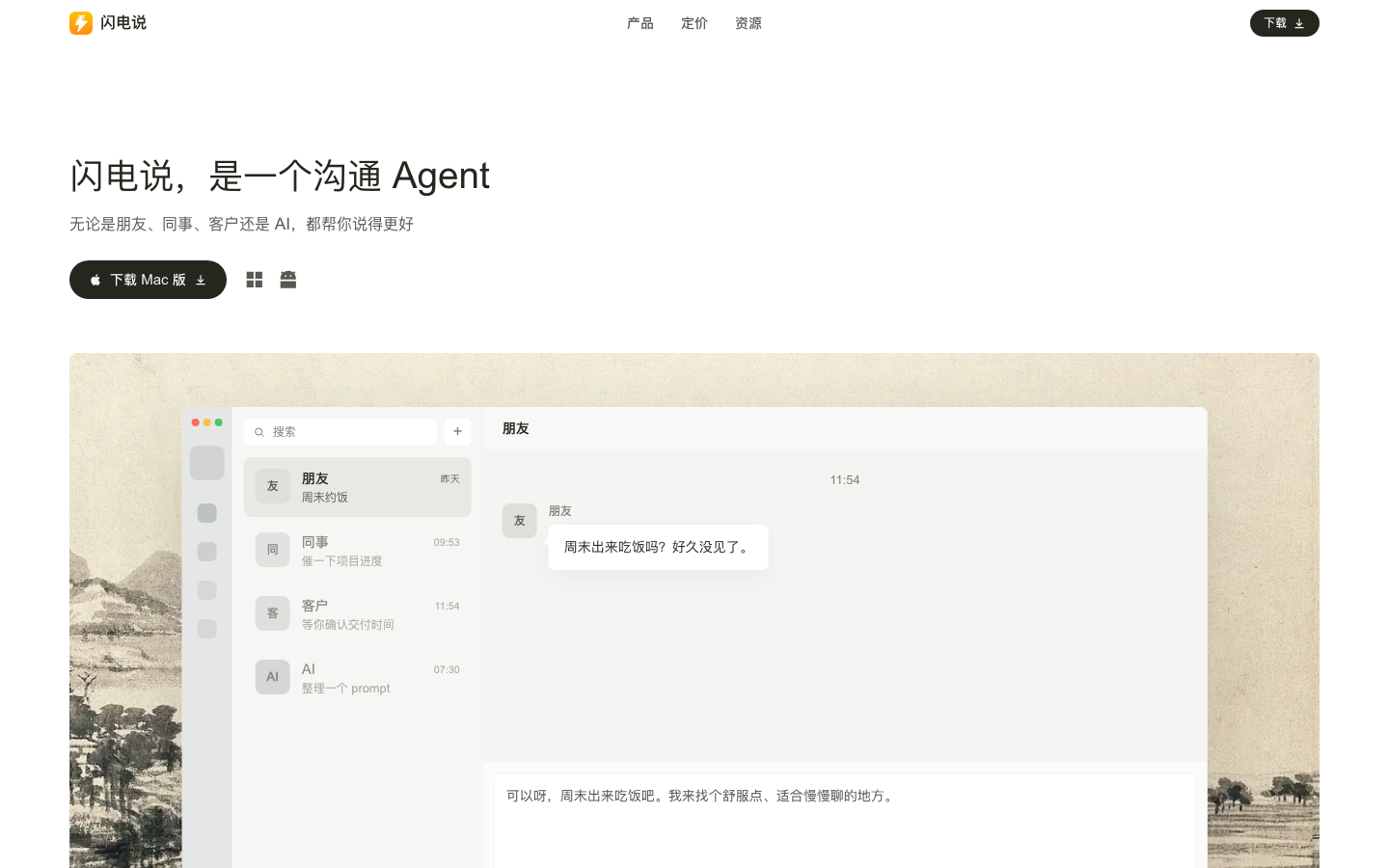
Complete review of Lightning Theory (original body)
Core parameters and statistics
| Project | Specifications |
|---|---|
| Product positioning | Cross-application communication Agent (original voice input method) |
| Developer | Tanwei (Wuhan) Technology Co., Ltd. |
| Core Technology | Local Speech Recognition (FunASR) + LLM Context Understanding |
| Supported Platforms | macOS, Windows (Android in beta, iOS/Linux to be released) |
| Core Competencies | Voice→Text→Organization→Reply→Execution |
| Pricing model | Free basic version + Pro subscription + Volume pack |
| Local processing | Speech recognition runs locally, data privacy protection |
User and market recognition
Lightning Talk started as a local voice input method (agent) and gradually evolved into a "communication agent" - it no longer just converts speech into text, but understands what you say, combines it with the screen context, and generates more appropriate replies. This product path is very interesting: it did not choose to be a general AI assistant, but used voice as the entry point to solve the high-frequency pain points of "typing too slowly and replying messages with difficulty".
Promotion verification: "Local speech recognition" means that basic speech-to-text is completed locally, but "Agent context understanding" and "skill execution" require cloud LLM support and are not completely local. The scope of "privacy protection" is limited to speech recognition, and subsequent text processing and Agent execution still involve data migration to the cloud.
Cost advantage
| Billing dimensions | Price |
|---|---|
| Basic (free) | 0 yuan (basic voice input function) |
| Pro monthly payment | 29 yuan/month |
| Pro annual payment | 238.8 yuan/year (≈ 19.9 yuan/month) |
| Voice Plus Package | 10 hours/20 yuan |
| Agent recharge package | 1000 points/20 yuan |
The free truth: The free version meets basic voice input needs, and the Pro provides 10 hours/month of voice + 1000 Agent points/month. For heavy voice users, the Pro annual payment is more cost-effective. Hidden Cost: Agent points (1000/month) may not be enough in complex mission scenarios. An Agent call that requires querying data, calling tools, and organizing responses may consume dozens of points, and the monthly quota may not last until the end of the month under heavy use.
Main functions
- Voice input: Use voice to replace keyboard input in any input box such as chat, documents, programming, etc. Based on the Tongyi FunASR local model, speech recognition is completed locally without the need for networking, and the data does not leave the device.
- Automatic text sorting: remove colloquial repetitions, correct errors, and add punctuation marks. Say "Please help me arrange the meeting at three o'clock tomorrow afternoon" → Output "Help me arrange the meeting at three o'clock tomorrow afternoon".
- Style and Dictionary Memory: Remember commonly used reply styles and professional terms, no need to repeat settings every time. Suitable for customer service, sales and other positions with fixed speaking skills.
- Screen context generation: Generate more appropriate responses based on the current screen content. The other party sends a message, you say a response to the screen, and the AI will organize the language with reference to the message content and context.
- Skill Execution: You can request data, execute code, call external tools and then organize a reply, upgrading from "input efficiency tool" to "execution efficiency tool".
Model and version evolution
Mainline release
- ~2026-03: The brand is upgraded to "Lightning Talk", which is expanded from voice input method to communication agent, adding context understanding and skill execution capabilities.
- ~2025-06: The first release of "Agent", a local voice input tool based on Tongyi FunASR.
Technical advantages
- Algorithm Optimization: Special optimization at the model or algorithm level has been carried out for the corresponding scenario to achieve a balance between response speed and result quality.
- Low-latency architecture: Adopts streaming or asynchronous processing architecture to reduce user waiting time and is suitable for high-frequency interaction scenarios.
How to use
- Download the client for the corresponding platform from https://shandianshuo.cn/
- After installation, set the shortcut key to activate voice input.
- Use the shortcut keys in any input box to call out, and the text will be automatically converted to text after speaking.
- If you need context generation, call Agent mode in the communication scenario
- Configure commonly used styles, dictionaries and skills to improve efficiency
Product Pricing
| Plan | Price |
|---|---|
| Basic (free) | 0 yuan |
| Pro monthly payment | 29 yuan/month |
| Pro annual payment | 238.8 yuan/year (≈ 19.9 yuan/month) |
| Voice Plus Pack | 10 hours/20 yuan |
| Agent refill pack | 1000 points/20 yuan |
Persuasion Scenario: If your work environment has strict regulations on data security (such as confidential units, financial institutions), even if the speech recognition is running locally, the Agent's cloud LLM call still involves data outgoing, and compliance needs to be confirmed.
Human-machine collaboration boundary: 100% automation: basic speech-to-text, text organization, dictionary and style matching. Manual intervention is required: content confirmation of important replies, pre-send review of automatic replies by Agent, and judgment of sensitive topics.
Application scenarios
- High-frequency instant communication: In work communication scenarios such as WeChat, Feishu, and Qiwei, voice is used instead of typing, and context generation is used to make responses more accurate. It is suitable for positions such as sales, customer service, and operations that require a large number of responses to messages. The typing speed is increased from 60 words/minute to 200+ words/minute for voice.
- Email and document writing: dictate the email content or document paragraphs, and AI will automatically organize them into formal written language. Suitable for managers and business people who need to write a large number of emails but don't want to sit and type word for word.
- Programming auxiliary input: Use voice input to comment, variable name description or natural language description in the IDE, suitable for programmers who need to quickly memorize ideas.
Applicable people
- High-frequency communication positions: For users in sales, customer service, operations, etc. who need to reply to a large number of messages every day, voice input + automatic sorting can significantly improve efficiency.
- Workplace office crowd: Professionals who need to quickly write emails, documents, and reports to reduce the time cost of keyboard input.
- Privacy-conscious users: Speech recognition runs locally, and data is not uploaded to the cloud. It is suitable for users who have requirements for data privacy.
Summary and Outlook
Lingshui's product path is very clear: from the local voice input method of "Dai Ti" to the cross-application communication Agent of "Lingshui". Its core differentiation lies in local-first privacy protection (speech recognition runs locally) and capability upgrade from input to execution (not only can it convert text, but it can also understand context and call tools). The current product form has clear practical value in communication efficiency scenarios, but the usage scenarios of the Agent function still require access to more ecological tools to unleash the potential.
Current limitations: Currently only supports macOS and Windows, Android is in internal testing, iOS and Linux are to be released - high-frequency communication scenarios on the mobile terminal are not fully covered; the actual experience of the Agent function is limited by the capabilities of the upstream LLM model; the team size and company background information are limited, and the long-term stability of the service needs to be observed.
Related tools:  Notion AI, google-workspace
Business process integration and ROI analysis
Lightning Theory (original version) As a productivity tool for enterprises or professional positions, its true value depends on the depth of integration with existing workflows and the quantifiable efficiency improvement effect. The following is a systematic analysis from three core dimensions.
System integration and data interoperability The ability to interoperate with existing business systems is a key prerequisite for productivity tools to be integrated into workflows. It is recommended to focus on evaluating the following integration dimensions: the openness and documentation quality of the RESTful/GraphQL API (whether a complete API reference and SDK examples are provided), the support scope of Webhook event notifications (which business event types are supported for automatic push), the number and depth of pre-built integrations with common collaboration SaaS tools (WeChat Enterprise, DingTalk, Feishu, Slack, Notion, Jira, etc.), and enterprise-level identity authentication support (SSO/SAML/OAuth and LDAP/AD directory integration). Products that lack integration capabilities are easily isolated into information islands, which in turn increases the cognitive cost and operational friction for teams to switch between different tools.
Efficiency Quantification and ROI Estimation Methodology Before purchasing decisions, it is recommended to quantify the input-output ratio through a structured method: Step 1, choose 3-5 Standardized tasks that are frequently repeated and time-consuming in each team are used as test samples; in the second step, the average time consumption of a single task before and after tool intervention, first-time pass rate or error rate, and the number of links requiring manual intervention are recorded under controlled conditions; in the third step, the saved manpower time is converted according to the comprehensive cost of the position (salary, benefits, management sharing), and soft benefits (increased employee satisfaction, standardization of work quality, and improvement in response speed to core business) are superimposed to obtain a comprehensive ROI estimate. It is recommended to continue tracking ROI trends on a monthly basis, as the value of a tool usually increases over time as team proficiency increases and workflows are optimized.
Phase-based implementation strategy and risk control It is recommended to adopt a three-stage implementation path of "pilot verification-gradual promotion-continuous optimization". In the pilot stage (1-2 weeks), a single team or a single business scenario is selected for small-scale verification. The core goal is to verify technical feasibility and user acceptance, and establish preliminary usage specifications and success standards; in the promotion stage (2-4 weeks), after the pilot verification is passed, the coverage is gradually expanded, and standardized activation processes and training materials are developed; in the optimization stage (continuous), the workflow configuration is continuously adjusted based on actual usage data and user feedback, and more high-value application scenarios are explored. Clear quantitative key result indicators should be set at each stage to avoid blindly expanding the scope of use without data support.
Version Info
- Lightning said :The brand was upgraded to Lightning Talk, which expanded from voice input method to communication agent, adding contextual understanding and skill execution capabilities.
- body :A local voice input tool based on Tongyi FunASR that supports basic speech-to-text conversion.
User Reviews