 DALL·E 3
DALL·E 3 is the third-generation Vincent graph model launched by OpenAI. It is better at understanding the details and semantics of complex and long prompt words than the previous generation. It is natively integrated into  ChatGPT and Microsoft Copilot, allowing users to gradually generate and modify images through dialogue.
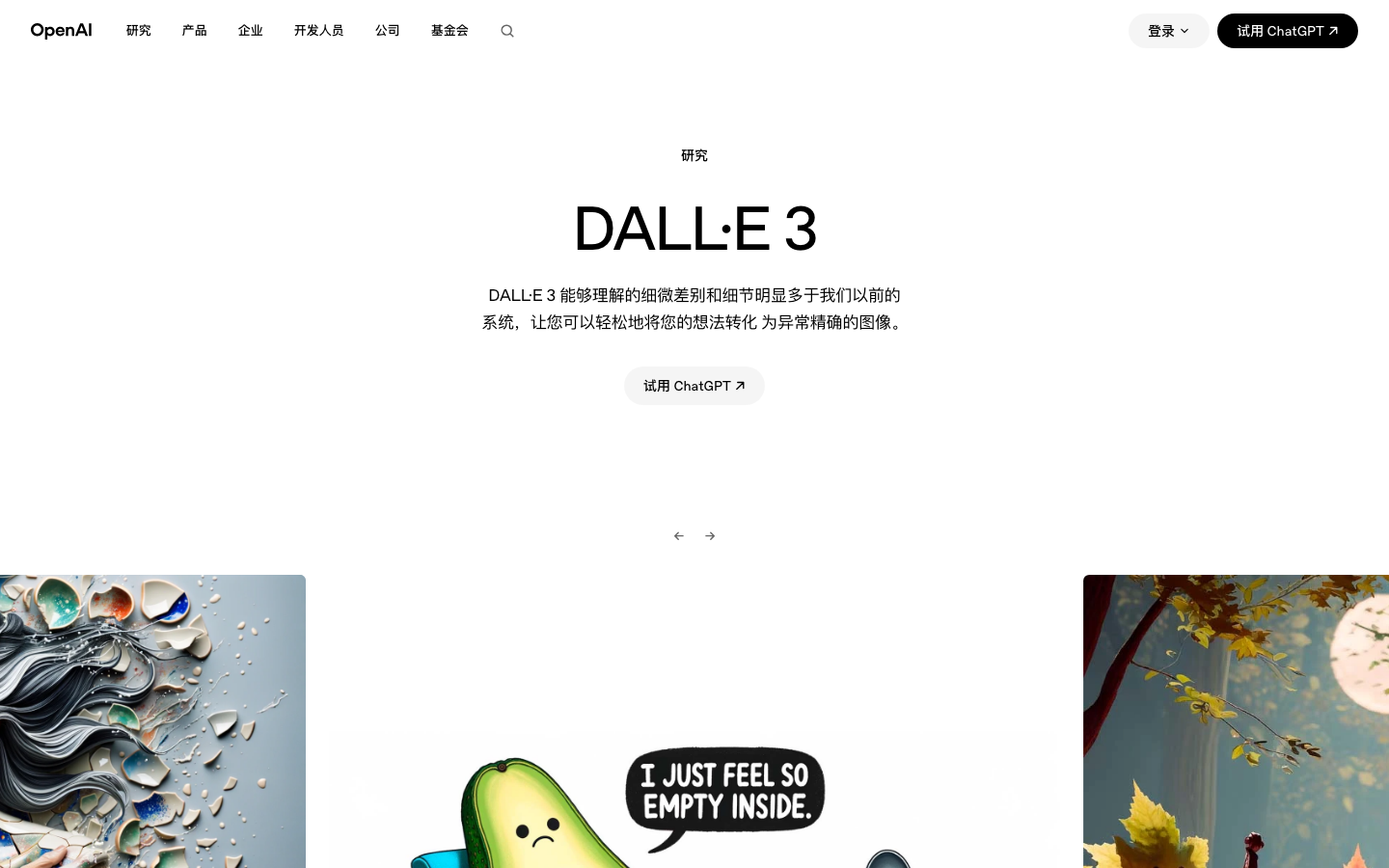
DALL·E 3
Core parameters and statistics
DALL·E 3 is OpenAI's third-generation text-to-image model. The biggest product feature is not "the ability to draw pictures", but that it directly embeds image generation into ChatGPT's dialogue process: users describe their needs in natural language, ChatGPT helps expand and optimize prompt words, and then hand it over to DALL·E 3 to produce pictures, thus lowering the threshold for "writing a precise English prompt word".
| Projects | Public Information |
|---|---|
| Model type | Text-to-image generation model (text-to-image) |
| Developer | OpenAI |
| Integration portal | ChatGPT (Plus/Team/Enterprise), Microsoft Copilot, API |
| Core improvements | Stronger semantic understanding of long prompt words, more accurate text rendering |
| Officially open | 2023-10 (ChatGPT and API) |
| Security policy | Restrict living imitations of artist styles and provide creators with an exit mechanism |
| Support Platform | Web, API |
Integration first: The core value of DALL·E 3 is "dialogue is the picture". It hands over prompt word engineering to ChatGPT. Users only need to describe their intentions, and the model will convert fuzzy requirements into executable details. This is a significant experience improvement for ordinary users who are not familiar with painting prompt words.
Semantic Restoration: Compared with DALL·E 2, DALL·E 3 is better able to follow multiple constraints (number, position, text, style) in a paragraph, reducing the deviation of "the prompt words are written but not reflected in the picture".
Version relationship: After 2025, OpenAI will gradually take over image capabilities with GPT-4o native image generation (gpt-image-1) in ChatGPT. DALL·E 3 can still be called through API. The two belong to the evolution of the same image capability route.
User and market recognition
DALL·E 3's market recognition mainly comes from its distribution channels rather than independent user volume disclosure. OpenAI has not separately disclosed the active user data of DALL·E 3, but it relies on the two major entrances of ChatGPT and Microsoft Copilot/Bing Image Creator, and its reach is considerable.
Channel Advantages: Through ChatGPT’s hundreds of millions of user base and Copilot’s distribution in Windows, Edge, and Office, DALL·E 3 has become the first high-quality text drawing tool that many ordinary users have come into contact with.
Word-of-mouth focus: Industry discussions generally recognize its progress in "long sentence understanding" and "text rendering in pictures". These two points happen to be the most commonly criticized shortcomings of the early Vincentian graph model.
Prerequisites for implementation: To stably produce commercial-grade images, users still need to master the basic description structure and multiple rounds of modification habits; DALL·E 3 lowers the threshold, but it does not mean that the draft is completed in one go.
Cost advantage
DALL·E 3 does not have an independent consumption subscription. Its cost structure is bound to ChatGPT subscription and API billing. Therefore, "whether it is cost-effective" depends on the user's existing subscription status.
- C side: Image generation can be used through the ChatGPT payment plan (such as Plus), which is equivalent to obtaining the text drawing capability within the existing conversation subscription, without the need to purchase additional painting tools.
- Developer/API: DALL·E 3 is billed on a per-image basis through the OpenAI image API. The price changes with the resolution and quality level. Please refer to the official API pricing page for details.
- Enterprise: Can be accessed through the Team/Enterprise solution or Azure OpenAI, combined with data and compliance terms, subject to business confirmation.
True Cost: For individual users, the biggest hidden cost is "multiple rounds of modifications" - complex requirements often require multiple generations to meet the standards; for developers, they should pay attention to the accumulated API costs caused by high-frequency drawings.
Main functions
DALL·E 3’s capabilities are designed around “converting fuzzy language into controllable images”:
- Conversational generation: Directly describe the requirements in ChatGPT, and the model will assist in expanding the prompt words and producing pictures, supporting multiple rounds of iterative modifications.
- Long Prompt Word Understanding: Can parse complex descriptions containing multiple objects, spatial relationships, and text content.
- In-picture text rendering: Compared with the previous generation, it can correctly render specified text in scenes such as posters and signboards.
- Style and composition control: Supports various style instructions such as illustration, realism, graphic design, etc.
- Safety Guardrail: Refuse to generate high-risk content such as styles specified by living artists, public figures, etc., and provide a mechanism for creators to withdraw from image training.
The actual effect of these functions depends on the clarity of description: the more clearly you write "what you want, what you don't want, text content, and format", the more controllable the drawing will be.
Model and version evolution
DALL·E 3 is the third generation node of OpenAI’s Wensheng diagram route, and the entire clue is clear:
Backbone evolution
- DALL·E (2021-01): Demonstrated for the first time the feasibility of generating images with natural language.
- DALL·E 2 (2022-04): The resolution and realism have been greatly improved, making it more widely used.
- DALL·E 3 (2023-10): Enhanced semantic understanding and text rendering, and natively integrated into ChatGPT.
Follow-up undertaking
- Starting from 2025, image generation in ChatGPT will gradually be taken over by GPT-4o native image capability (gpt-image-1), and DALL·E 3 will still be retained as an API model. This means that the evaluation should distinguish between "the latest graphics experience in ChatGPT" and "the DALL·E 3 model called through the API".
Technical advantages
The technical advantages of DALL·E 3 focus on “understanding” rather than simply “image quality”:
Prompt word alignment: The model strengthens the consistency of images and texts during training, making it more faithful to the detailed constraints in long descriptions and reducing repeated trial and error by users.
ChatGPT Collaboration: Handing over prompt word optimization to the language model is equivalent to adding a layer of "demand clarification" before drawing. This is an experience advantage that a simple image model does not have.
Security Engineering: Built-in content review and style restrictions reduce compliance risks for use in enterprise and public products.
The price is: subject to security policies, some stylized or celebrity-related requirements will be rejected; and as a closed-source hosting model, users cannot self-host or deeply customize the underlying weights.
How to use
DALL·E 3 has two main usage paths:
| How to use | Suitable for the crowd | Features | Cost |
|---|---|---|---|
| Generated within ChatGPT | Ordinary users, content creators | Conversational picture rendering, automatic optimization of prompt words | Included in ChatGPT paid plan |
| Microsoft Copilot | Light users who don’t want to pay | Free trial through Bing/Copilot | Free quota, subject to platform policies |
| OpenAI / Azure API | Developers and Enterprises | Programmatic batch rendering of images, which can be integrated into products | Billing by image |
Suggestions for practical use: first describe the core picture in one sentence, and then gradually add "text content, color matching, layout, and exclusions" in subsequent conversations, and approach the goal through multiple rounds of modifications, rather than expecting the first picture to be completely up to standard.
Product Pricing
DALL·E 3 itself is not sold separately, and its cost is integrated into OpenAI’s subscription and API system:
- C Client/Individual: Used through the ChatGPT paid plan, image generation is an incidental capability, the free tier and quota are subject to the official website.
- Developers: Billing is based on the number and quality of images generated through the OpenAI image API. The specific unit price is subject to the official API pricing page.
- Enterprise: Can be accessed via Team/Enterprise or Azure OpenAI. Price, data isolation and compliance terms are subject to business confirmation.
Since pricing is adjusted with official policies, the actual quota and unit price are subject to the real-time page of the OpenAI official website.
Application scenarios
DALL·E 3 is suitable for scenarios where you need to “quickly visualize ideas”:
- Content and Social Media Illustrations: Quick illustrations and covers for blogs, public accounts, and posters, with the benefit of eliminating the need for external material procurement and scheduling.
- Creative Sketches and Concept Drafts: Early visual exploration of product, advertising, and brand direction to align ideas before committing design resources.
- Education and presentation materials: schematic diagrams and scene illustrations in courseware and presentations.
Not suitable for: final deliverables that require pixel-perfect consistency, rigorous restoration of specific brand IP, or are highly constrained by copyright and compliance.
Applicable people
- Content Creators and Operators: Need high-frequency, low-cost graphics, and do not want to learn complex painting tools.
- Developer: Hope to embed Vincent Diagram capabilities into your own products or workflows.
- Ordinary users: Use natural language to quickly turn the pictures in your mind into images.
Not suitable for those who need deeply customized models, self-hosted deployment, or professional visual creators who pursue high originality and clear commercial authorization - such needs are more suitable for professional tools with stronger control or clearer authorization.
Summary and Outlook
The core value of DALL·E 3 is to combine "high-quality Vincentian drawings" with "conversational prompt word optimization", so that ordinary users can produce pictures stably without being proficient in prompt word engineering. It's not the most adjustable drawing tool, but with distribution of ChatGPT and Copilot, it is one of the most comprehensive Vincent drawing capabilities.
As the ChatGPT image experience is gradually taken over by the native capabilities of GPT-4o, DALL·E 3 is more likely to exist in the form of an API model for a long time. If it is to be implemented, individual users can directly try it out within existing ChatGPT subscriptions. Developers recommend using small batches of API calls to verify the stability of the image output and the cost of a single image before deciding whether to scale it up; enterprises need to confirm data usage, commercial authorization and compliance terms before purchasing.
Related tools:  Midjourney, stable-diffusion
Version Info
- DALL·E 3 official version :DALL·E 3 is officially open to ChatGPT Plus and Enterprise users, and provides image generation capabilities through API and Microsoft Copilot/Bing, significantly improving the restoration of details of long prompt words.
- DALL·E 3 Research Preview :OpenAI announced DALL·E 3, demonstrating its improvements in semantic understanding and text rendering compared to DALL·E 2, and announced that it will be open to ChatGPT users first.
- DALL·E 2 :The second-generation Vincentian model has greatly improved resolution and realism compared to the first generation, and is the basis of DALL·E 3's capabilities.
User Reviews