 DealHub
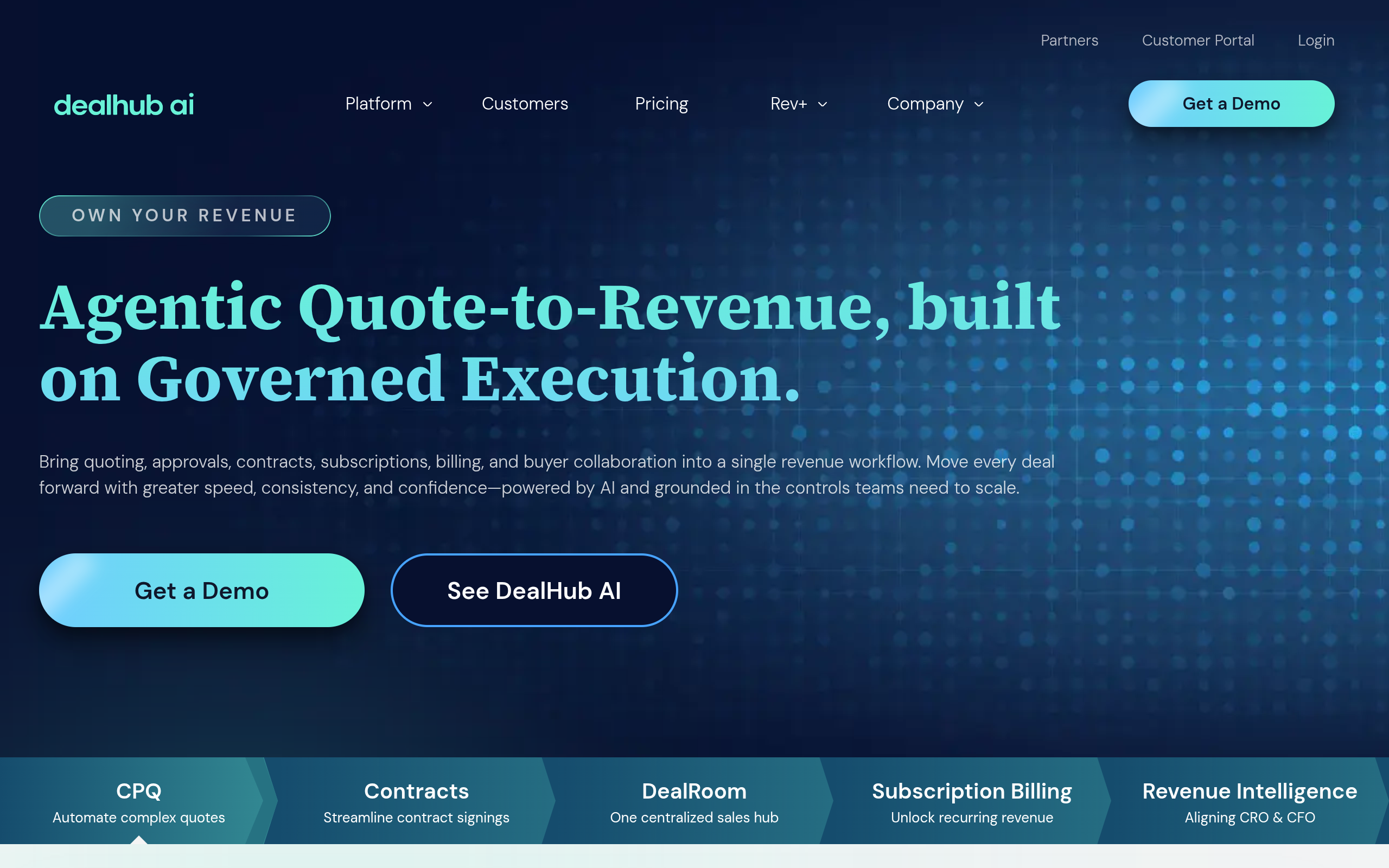
DealHub is a CPQ (Configuration-Pricing-Quotation) and subscription management platform for B2B SaaS companies. It uses AI to optimize quotation strategies, shorten the contract period, and reduce contract discount losses.
DealHub
A brief comment: It is not a general CRM plug-in, but an Agentic revenue execution platform that packages CPQ, subscription billing and revenue intelligence into a unified governance layer - equivalent to installing a set of "quote-signing-billing" highway with an AI brain for Salesforce.
DealHub’s core parameters and statistics
| Parameter item | Value |
|---|---|
| Product Positioning | Agentic Quote-to-Revenue Platform (CPQ + Subscription Management + Revenue Intelligence) |
| Deployment method | SaaS cloud |
| Core modules | CPQ, DealRoom, CLM, Subscription Billing, Revenue Intelligence |
| AI capabilities | Conversational Quoting, Pricing Optimization, Revenue Analytics, DealAgent |
| Integration Ecosystem | Salesforce, HubSpot, MS Dynamics 365, NetSuite, Slack, Gong, DocuSign, Stripe, Avalara |
| Compliance Certification | ISO 27001, ISO 27701, ISO 22301, ISO 42001, SOC 1 Type II, SOC 2 Type II, GDPR, CCPA |
| Open interface | REST API, native MCP (Model Context Protocol), Prismatic integration platform |
| Target customers | B2B SaaS and subscription service companies with annual revenue of $10M–$500M |
| Headquarters/Regionation | Israel (IL) |
| Supported languages | en-US |
| Support Platform | Web, API |
DealHub's core battlefield is in the blank space between Salesforce CPQ and Zuora - it neither wants to be a giant platform like Salesforce, nor does it want to focus only on billing like Zuora. The underlying logic of its product design is: Quotation is a contract, contract is a subscription, and subscription is revenue. A unified "governance layer" is used to connect all revenue streams, rather than using a series of independent tools to splice the process together. Three key differentiating features: first, AI is not a plug-in module but a native capability embedded in the execution engine; second, the "Governed Execution" concept - all pricing, discounts, and approval rules are modeled into executable policy layers, rather than buried in CRM configuration items; third, the introduction of the MCP protocol allows the platform to be called as a Tool Provider for large models, which is the first of its kind in CPQ products.
From the perspective of tool type classification, DealHub's main delivery form is [Productivity/Business-side Application] (Rule D), because it uses the end-to-end CPQ-subscription-revenue management business process as its deliverable, and AI and MCP are its capability enhancements rather than independent products. However, its Agentic architecture and MCP protocol support also have the sub-type characteristics of [Agent/MCP/Automation Tool] (Rule A), so this analysis superimposes two types of deepening rules at the same time.
DealHub’s users and market recognition
Enterprise customer group: Customers listed on DealHub’s official website include Intuit, HP, Braze, Tipalti, Zapier, Camunda, Fleet Complete, Tripleseat, Playmetrics, PlexTrac, Adecco Group, etc., covering everything from SaaS unicorns to world-renowned technology companies. The specific roles mentioned in customer cases include VP of Revenue Operations, Head of Deal Desk, Global CPQ Administrator, CFO, etc., indicating that the product has decision-making influence on both RevOps and finance. The customer industry distribution is dominated by SaaS and technology services, but the existence of non-pure SaaS companies such as HP, Intuit, and Adecco shows that its product boundaries have extended to hybrid companies.
G2 Rating: In the Salesforce CPQ alternatives comparison page, DealHub shows G2 data with a "Meets Requirements" rating of 9.1/10 (449 reviews), compared to Agentforce Revenue Management's 8.0/10 (87 reviews). This data is publicly available on the official page and is a relatively reliable third-party satisfaction reference. Dimensions such as "Ease of Use" and "Ease of Setup" are also leading, which is consistent with the product's "lightweight and flexible" positioning.
Quantified results from customer testimonials: Fleet Complete says sales reps spent more than 70% less time quoting; Tripleseat reports a 99.3% win rate for opportunities with signed DealHub quotes; Intuit’s Deal Desk leader says approval cycles have been reduced from days to 8 hours; Zapier’s RevOps manager mentions migrating from a self-built 100-node Zapier approval flow to DealHub To gain scalability; Trintech’s head of business applications reports time-to-quote ratio speeds of 50%–90%; Playmetrics’ COO/CFO cited a 45% reduction in invoice volume. These numbers form the main quantitative basis for DealHub’s ROI argument.
Market Share Note: DealHub does not disclose revenue ARR or financing data. Judging from the number of customer cases and industry distribution, its market penetration is mainly focused on medium-sized B2B SaaS companies, and it often appears as an alternative or supplementary solution to Salesforce CPQ in large enterprise scenarios. Compared with Salesforce CPQ, Zuora, and Oracle CPQ, there is still a significant gap in brand awareness and ecological coverage.
DealHub’s Cost Advantage
The cost analysis needs to be broken down into a three-tier structure because DealHub's pricing model and purchasing methods vary greatly among customers of different sizes.
C-side/personal level: DealHub does not provide a personal or free version, and all functions are only sold to corporate teams. There is no public entrance to the free trial, only Demo reservations are available. Not available for independent use by individuals or small teams at a low price. This means it's not suitable for freelancers, minimally invasive teams, or individual developers.
API/Developer Level: DealHub provides REST API and Prismatic integration platform, as well as native MCP protocol support. API access is included with Enterprise subscriptions, there is no separate pay-as-you-go API pricing. MCP capabilities are provided as platform function packages, and developers cannot purchase the API layer separately without purchasing a CPQ license. This means that there is no "pay-as-you-go" model at the developer level, and enterprises must bear the full subscription cost to gain access to API integration capabilities. This cost structure may be on the high side for technology teams that only require API integration and do not require a full CPQ workflow.
Enterprise/privatization level: DealHub’s pricing is completely non-public and requires business confirmation, and the pricing dimensions are complex:
| Cost Dimension | Description |
|---|---|
| Basic License | Pricing based on module usage (CPQ / CLM / Subscription Billing / Revenue Intelligence) combination |
| Number of users | Billed according to the number of seats, usually divided into Admin and Standard User |
| Number of integrations | CRM integration (Salesforce/HubSpot/Dynamics) may be included in the base package, ERP integration may be quoted separately |
| Implementation and Services | Initial deployment charges are additional, and Change Management Services, Training & Onboarding and Support SLA are officially provided |
| Annual payment vs. monthly payment | Annual payment is the default contract mode and can lock in the annual unit price |
Quantitative deduction of hidden costs and ROI:
- Implementation Cycle: Customer testimonials show typical go-live cycles of 6 weeks (versus 6–12 months for Salesforce CPQ), which means implementation costs and business waiting periods are significantly reduced. Based on the internal IT resource consumption of a typical medium-to-large SaaS enterprise, each one-month shortening of the implementation cycle is equivalent to saving about 8–15% of the total project cost.
- Rework Reduced: Multiple customers mentioned "no more cross-department tickets" - automated subscription changes and billing updates eliminate manual reconciliation time between finance and RevOps. Playmetrics’ 45% reduction in invoice volume is a quantifiable metric to look at.
- Discount Loss Control: The Discount Governance module can directly reduce profit losses caused by excessive discounts through the preset discount threshold approval chain. Fleet Complete's "70% reduction in quote time" and Trintech's "50%–90% increase in time-to-quote ratio" can be used as starting points for ROI calculations.
- Risk Point: DealHub does not support permanent buyout or privatized deployment, and all customers use SaaS subscriptions. Customers who are sensitive to data sovereignty (e.g., financial, government) may need to additionally assess compliance risks. Downtime SLA violations, data migration costs, etc. are not detailed on the public page.
DealHub’s main features
DealHub's functional system can be divided into five capability layers, and there is a clear data flow relationship between each layer: CPQ generates quotes → DealRoom collaborative negotiation → CLM locks the contract → Subscription Billing performs billing → Revenue Intelligence analysis feedback. This transaction means that once a "signing" is completed in DealHub, subsequent contract management, subscription billing and revenue recognition do not require manual intervention.
-
AI Conversational Quoting: The sales representative describes the customer's needs in natural language (for example, "A three-year contract for a 500-user Enterprise version with a 20% discount"), and AI automatically generates compliant quotes in the background based on pricing strategies and discount rules. Expert view: This is not a simple "speech to text + search", but AI automatically executes a complete chain of CPQ rules after understanding the semantics - product configuration verification, price calculation, discount threshold determination, approval routing determination - and finally outputs a quotation. One step replaces the 5–8 manual steps in traditional CPQ.
-
AI Pricing Optimization: Based on historical transaction data, customer portraits and current business opportunity stages, automatically recommend the optimal quotation structure - product portfolio suggestions, discount range, and contract period selection. Expert View: Different from the regular "static discount table", this function makes real-time pricing decision suggestions when the quotation is generated, which is equivalent to assigning a "pricing analyst" to each AE. However, the data granularity and training frequency based on the model have not been disclosed, and the actual effect needs to be verified in the POC by comparing it with its own historical data.
-
Configuration-Pricing-Quotation (CPQ): Supports complex product configuration rules (pricing based on number of users, functional modules, usage), built-in Adaptive Pricebook, covering new purchases, renewals, expansion Co-terming, Amendment and other sales scenarios. The Headless API Quoting model can embed CPQ capabilities into e-commerce or PLG self-service purchasing processes. Approval Workflows supports parallel approvals and real-time visibility. Implementation Tips: The POC stage should focus on testing the rule engine's ability to bear the complexity of its own product - especially the concurrent scenario of mixed pricing (fixed + volume + tiered discount) and multi-layer approval chain.
-
DealRoom (Deal Collaboration Space): Each business opportunity has an independent digital space where buyers and sellers can view quotation progress, approval status, contract draft and communication records. Customers can self-approval without repeated email reminders. Expert view: DealRoom is essentially a "lightweight CRM" collaboration interface - it unifies transaction information originally scattered in emails and electronically signed CRM notes into one context, reducing information asymmetry between buyers and sellers. For AE, it reduces the blind spot of "not knowing whether the other party has read the quotation after sending it out"; for customers, there is no need to search for quotation attachments in the mail pile.
-
Subscription Lifecycle Management: Automatically create subscription records after quotation signing, and track start and end dates, usage and renewal status. Supports automated mid-term changes (upgrade and downgrade Co-terming, Proration), and the billing plan is automatically updated after the change, without waiting for manual RevOps operations. Entitlement & Provisioning Automation can pass subscription events to downstream product systems to automatically activate permissions. Quantitative Reference: Playmetrics achieved a 45% reduction in invoice volume on this module, primarily through automated in-cycle change merging and billing consolidation.
-
Contract Lifecycle Management (CLM): Generate contract draft from quotation with one click, integrate DocuSign electronic signature, and centrally manage contract clause library, version control and approval records. Expert View: The depth of the CLM module may not be as good as that of Icertis or Conga at the contract terms negotiation level, but it is more efficient in the automatic mapping of "quotation terms → contract terms" - because the data model is unified and there is no need to map fields across systems.
-
Revenue Intelligence: Automatically calculate ARR/MRR and waterfall changes NRR/GRR/Churn, supporting revenue iteration analysis and segmentation by product/customer. The Revenue Recognition module is compliant with ASC 606 and IFRS 15, and recognition plans automatically update with contract changes, reducing reconciliation efforts at the end of the financial period. Implementation Tip: The value of this module is highly dependent on the integrity of the upstream CPQ and subscription data - if quotes and contracts are not closed within DealHub, Revenue Intelligence's data base will be skewed. The most ideal scenario is that all quotation, contract and subscription changes are completed within DealHub, which will produce the effect of "no reconciliation required".
-
Discount Governance: Set discount rules and approval thresholds - exceeding a certain discount range will automatically trigger an approval chain (can be set to multiple levels and in parallel), and all approvals will have complete audit logs. Expert View: This is DealHub’s most compelling feature for CFOs – it transforms “discount depletion” from an ex-post financial reporting issue into an ex-ante process control issue. Used in conjunction with pricing optimization, the discount range can be constrained without sacrificing transaction rates. For the CFO, this amounts to embedding financial control points early in the sales funnel.
DealHub’s model and version evolution
DealHub is a subscription-based SaaS product and does not release "model versions" in the traditional sense (such as large model version numbers). Its functional iterations are promoted at the pace of annual main version + quarterly minor version. The following is a verifiable version history based on public information:
2025 Fall Release (~2025-09)
- Introducing intelligent discount suggestions (Discount Intelligence) - recommending discount ranges based on historical quotation data to help AE make a trade-off between profit margin and transaction rate.
- The contract lifecycle management (CLM) module is online, supporting the process from quotation to electronic signature.
- DocuSign native integration, contract signing status is visible in DealRoom in real time.
- This is a key version of DealHub's transformation from "pure CPQ" to a "full-process revenue platform". Prior to this, DealHub was essentially a "quotation tool". After this version, it has contract management and signing capabilities, and the process has been initially formed.
2026 Spring Release (~2026-03)
- The AI Pricing Optimization engine was officially released, replacing the previous rule-based discount recommendations to model-driven pricing recommendations.
- Subscription management enhancements - Renewal Prediction function is launched. The system predicts renewal probability based on usage, customer interaction and contract history.
- Deeper Salesforce integration - two-way data synchronization, custom object mapping, trigger-level linkage.
- MCP protocol supports starting beta, allowing DealHub to be called as the Tool Provider of AI Agent.
- This version marks DealHub's evolution from "automation tool" to "Agentic platform". The introduction of MCP is of strategic significance - it makes DealHub no longer just a "system for humans", but also a "system for AI Agents".
Mid-2026 to present (unofficially named version)
- Launch of DealAgent concept - an AI Agent that can autonomously perform tasks within DealRoom (such as automatically following up on approvals, generating quotation revisions, and reminding contract renewal negotiation nodes).
- The Revenue Intelligence module is officially launched to connect data with the CPQ/subscription module.
- Native MCP moved from Beta to GA, becoming the first revenue management platform in the industry to support the MCP protocol.
- The "AI Conversational Quotation" function is publicly launched and is open to all Enterprise customers.
Version evolution summary: DealHub's iteration route clearly reflects the three-step jump from "configuration automation" to "decision intelligence" to "Agentic execution". The function density of the current version is significantly higher than that of 2025, especially the layout of AI and MCP, which makes it differentiated and competitive among similar products. However, it should be noted that the actual stability and adaptability of these new functions to enterprise-level scenarios still need time to be verified - especially the dependence of AI pricing optimization on the amount of training data and the reliability of the MCP interface under large-scale concurrency. There is a lack of public API changelogs or backward compatibility statements between versions, which can be an upgrade risk for deeply integrated enterprises.
DealHub’s technical advantages
1. Unified Revenue Data Model
DealHub's core technical decision is to use the same data model across quotations, contracts, subscriptions, billing and revenue recognition. In the traditional architecture, these gaps are usually maintained by different systems each maintaining a set of data (CPQ uses one set of Billing and another set of ERP), causing reconciliation and adjustment to become a daily routine for the finance team. DealHub removes this layer of friction through a shared data model – changes to a field in a quote’s row are automatically mapped to contract terms, subscription records and billing plans, with no ETL or middleware transformation required. Mechanism → Effect: Data model unification → Elimination of cross-system reconciliation → Financial period closing shortened from 3–5 days to less than 1 day.
2. Governance Execution Layer
The platform introduces the concept of "policy as code" - pricing rules, discount thresholds, approval links, and product configuration logic are all defined and executed in a unified governance layer, rather than scattered in CRM configuration items or hard-coded scripts. This model has two meanings: first, rule changes can be completed independently by RevOps (not relying on IT scheduling); second, all quotations and pricing recommendations generated by AI operate within the constraints of the governance layer, and there will be no "black box decision-making." Mechanism → Effect: Strategy centralization → RevOps self-service changes (in minutes, not weeks) → Increased market response time.
3. AI’s execution boundary (AI as a Governed Executor)
Unlike most "AI attached to the UI" solutions, DealHub AI is designed as a decision-making unit embedded inside the execution engine. AI does not directly output quotations - after it generates suggestions, it still needs to be verified by the rules of the governance layer (pricing compliance, discount authorization, product availability, etc.). Only after passing the verification can it enter the execution pipeline. This dual-layer architecture of "AI proposal + rule arbitration" improves efficiency while retaining the bottom line of compliance, which is particularly critical for enterprise-level deployment. Applicable scenarios: Suitable for mature SaaS companies that pursue both "Quotation Automation Speed" and "Zero Tolerance for Financial Compliance".
4. Native MCP protocol support
DealHub is the first known revenue management platform to support Model Context Protocol (MCP). MCP enables large language models to call DealHub's Tool through standardized interfaces: query quotation status, initiate approval, generate price simulations, etc. This has potential value in Agentic CRM and AI-driven sales automation scenarios - for example an Opportunity Agent could automatically initiate a price adjustment simulation in DealHub upon detecting a change in a customer's budget. However, the actual adoption rate and ecological scalability of the MCP interface are still in the early stages.
5. Breadth and depth of integrated ecology
DealHub's pre-built integrations cover CRM (Salesforce, HubSpot, Dynamics 365), ERP (NetSuite, Sage Intacct, QuickBooks, Xero), Finance (Stripe, Avalara), eSignature (DocuSign), Communications (Slack, Gong), and Identity Authentication (SSO/MFA). Integration is managed through the Prismatic embedded integration platform, which supports custom connector development.
Comparison of core capabilities of each program:
| Dimensions | DealHub AI | Salesforce CPQ | Zuora | Agentforce Revenue Management |
|---|---|---|---|---|
| Deployment Modes | SaaS Native | Runs within the Salesforce Platform | SaaS | Runs within the Salesforce Platform |
| Depth of AI capabilities | Embedded execution engine, rule constraints | Limited, relying on external Agentforce | Limited, rule-based | Assisted AI, no rule constraints |
| Unified data model | CPQ → Subscription → Billing → Revenue | Data spread across multiple Salesforce objects | Billing-centric | Based on Salesforce data model |
| MCP support | Native support (GA) | Not supported | Not supported | Not supported |
| Implementation Cycle | Customer Statement 6 weeks | Typical 6–12 months | 3–6 months | Depends on Salesforce foundation |
| Introductory price | Undisclosed, subject to business confirmation | Per Salesforce license + CPQ surcharge | By transaction volume or subscription fee | Per Salesforce platform add-on license |
| Applicable scale | $10M–$500M B2B SaaS | Full scale, larger enterprises | Medium and large subscription enterprises | Existing Salesforce customers |
How to use DealHub
The usage entrance and integration methods of DealHub are divided into the following types, adapting to different team sizes and starting points:
SaaS Web Application (Main Entrance): All functions are accessed through the browser, login address login.dealhub.io. The recommended configuration is desktop 1440x900 resolution for the best experience. First-time use must be invited by the enterprise administrator, and there is no self-service registration channel.
CRM Embedded Mode: DealHub is embedded as a Native component into the pages of Salesforce, HubSpot or Dynamics 365. Sales representatives can complete quotation, approval and contract operations within the CRM interface without switching to a separate system. This mode works best for teams that are deeply integrated into Salesforce.
API integration mode: DealHub provides REST API and Prismatic embedded integration platform, supporting Headless API Quoting - embedding quotation and pricing capabilities into e-commerce PLG self-service purchasing or custom portals. API Key management is done in the DealHub Admin Console.
MCP access mode: Supports Model Context Protocol, allowing large language models (LLM) to directly call DealHub's function Tool. Developers can configure DealHub as an MCP Server, and the Agent can perform operations such as quotation query, price simulation, and approval status tracking through Tool calls. The typical mounting configuration of MCP Server is as follows (subject to the latest official documents):
{
  "mcpServers": {
    "dealhub": {
      "command": "npx",
      "args": ["@dealhub/mcp-server"],
      "env": {
        "DEALHUB_API_KEY": "<YOUR_API_KEY>",
        "DEALHUB_BASE_URL": "https://api.dealhub.io"
      }
    }
  }
}
Typical usage steps (taking AE to generate quotations as an example):
- Open an opportunity record in CRM or create a new DealRoom in DealHub.
- Select a product configuration template, and the system displays optional modules and pricing according to preset rules.
- AI automatically recommends the optimal quotation structure (product mix, discount range, contract period), which AE can accept or adjust on its own.
- The system determines whether approval is required based on the discount governance rules - if the discount is within the threshold, the quotation PDF will be automatically generated; if it exceeds the standard, the approval process will be automatically initiated.
- The customer views the quotation through DealRoom and provides online feedback; after reaching an agreement, an electronic signature is initiated.
- After signing, the system automatically creates a subscription record and triggers billing, and the Entitlement information is synchronized to the downstream product system.
Human-machine collaboration boundary (Rule D mandatory): In DealHub's workflow, the following sections can be 100% automated: standard quote generation, automatic approval within discount thresholds, billing updates for subscription changes, renewal plan generation, and revenue recognition plan updates. Manual confirmation points must be set for the following sections: approval of discounts exceeding the threshold, changes in contract terms (involving non-standard terms), permission audit after entitlement changes, and financial review before batch generation of invoices. DealHub's governance layer architecture itself provides the ability to configure these manual confirmation points - defining which sections require manual intervention through the approval process.
DealHub Product Pricing
DealHub does not disclose pricing, and all prices are subject to commercial confirmation with the sales team. The following module structure based on the official page information can be used as a reference frame:
| Product Line | Main Functions | Pricing Method (Inference) |
|---|---|---|
| CPQ | Guided quotation configuration Adaptive Pricebook, approval workflow DealRoom | By Seat + By Module |
| Subscription Billing | Subscription lifecycle management, billing automation, usage billing, invoice generation | Included on top of CPQ or separate subscription |
| CLM | Contract generation, clause library, version management DocuSign integration | Usually as a CPQ add-on module |
| Revenue Intelligence | ARR/MRR report NRR/GRR analysis, revenue recognition ASC 606 | Advanced module, separate pricing |
| AI capabilities | Conversational quoting, pricing optimization DealAgent | Included in Professional/Enterprise tier |
Key points for pricing decisions:
- Annual payment is the default contract form, and the annual payment price is usually discounted from monthly payment (the discount rate is not disclosed).
- Implementation and Change Management services are typically quoted separately and are not included in the subscription fee.
- Multiple customer stories mention quantifiable ROI after migrating from Salesforce CPQ, but DealHub has not published an official TCO comparison white paper.
- Compared with Salesforce CPQ, the implicit advantage of DealHub is that each month shortened in the implementation cycle is equivalent to saving about 8–15% of the total project cost (based on the resource consumption of a typical enterprise SaaS implementation).
- Before purchasing, you need to focus on confirming the following terms: API call frequency limit, MCP interface concurrency quota, data retention policy, SLA availability guarantee and downtime compensation, as well as the data export format and cycle when the contract is terminated.
DealHub application scenarios
Scenario 1: B2B SaaS standardized quotation process (core scenario of cost reduction and efficiency improvement)
AE selects product module combinations based on customer needs, the system automatically calculates prices and verifies discount rules, and generates professional quotations with one click. Comes with a DealRoom link for real-time customer review and feedback. Quantitative deduction: In the traditional process, AE needs to go through 3-5 rounds of back-and-forth across CRM + spreadsheet + email to complete a quotation, which takes an average of 4-8 hours; DealHub compresses this to 10-30 minutes. Fleet Complete customer testimonials attest to "70% reduction in quote time." Quantified cost reduction and efficiency increase (Rule D mandatory): Based on an AE generating 5 quotes per week, the traditional process takes 20-40 hours per week, which is reduced to 1-2.5 hours in DealHub mode, freeing up approximately 19-38 hours of business opportunity follow-up time for each AE per week. Acceptance concerns: The accuracy of the rules engine when it comes to bound sales, volume-based pricing, and multi-currency mixed quotations.
Scenario 2: Subscription renewal management and expansion and purchase (high-frequency scenario for CS team)
The customer success team views the list of expiring subscriptions through the dashboard, and the system automatically recommends the optimal renewal strategy based on usage and interaction data—price adjustment range, discount suggestions, and identification of expansion opportunities. Renewal plans can generate quotes with one click and send them to customers. Quantitative deduction: 50–70% of the time in traditional contract renewal negotiations is consumed in internal communication and price confirmation; DealHub compresses the renewal preparation time from 1–2 weeks to real-time. A CS team that manages 200 renewal customers would need to invest 60–80 person hours per month in the preparation of renewal plans under the traditional model; DealHub can reduce this to 8–12 person hours. Boundary note: The accuracy of renewal forecasts is highly dependent on the integrity of customer interaction data in the CRM - if the sales process is not documented formally in the system, the credibility of AI recommendations will decrease.
Scenario Three: Corporate Quotation Compliance Audit and Discount Governance (Finance/CFO Scenario)
The CFO and Deal Desk team view discount distribution across all offers, over-threshold approval records and discount trends by team/product/geo via the discount analytics dashboard. Dynamic discount strategies can be set up to automatically adjust the discount range when quarterly sales targets change. Quantitative deduction: A customer case mentioned that the approval cycle was shortened from "several days" to "8 hours". The travel line can be estimated as the indirect time cost of the sales team waiting for approval. Taking a 50-person sales team as an example, each person waits for approval at least three times a week for 30 minutes each time. The waiting time when losing 75 people per week under the traditional model; DealHub reduces this to close to zero. Acceptance focus: Whether the audit log covers the complete quotation-approval-signing link, and whether there are version records for discount policy changes.
Scenario 4: Unified management of cross-channel revenue (multi-channel sales scenario)
For enterprises that operate multiple sales channels including Direct Sales, Channel/Partner, PLG, and E-commerce, DealHub extends unified price logic and data models to each channel through Headless API Quoting. Partners configure their own quotes through the Channel Quoting portal, automatically following the brand’s pricing rules and discount restrictions. Value Point: Eliminate channel conflicts and revenue recognition confusion caused by differences in quotation rules between different channels.
Scenario 5: Financial period closing and revenue recognition automated work orders (financial team scenario)
The Revenue Recognition module automatically generates revenue recognition schedules from subscription and billing data, compliant with ASC 606 and IFRS 15. The system provides a two-stage period closing process - freezing first and then final review to avoid manual errors. Revenue recognition data can be synced directly to ERP (NetSuite, Sage Intacct, etc.) as structured journal entries. Quantitative deduction: The monthly settlement process of a typical medium-to-large SaaS enterprise usually requires the financial team to invest 3–5 working days for data verification and entry adjustments; DealHub can compress this to 1 day. Based on a senior financial analyst's hourly salary of $50–$80, this can save $1,200–$3,200 per month in direct labor costs.
Who is eligible for DealHub?
-
Sales Representative (AE): Benefit from guided quotes and AI pricing recommendations, reducing quote generation time from hours to minutes. DealRoom allows customers to check the quotation/approval status by themselves, reducing the back-and-forth communication of "quote reminders". Unsuitable Boundary: For large customer scenarios that require highly customized terms (non-standard product configurations, complex legal review), AI recommendations have limited effect, and sales representatives still need to return to manual negotiation.
-
RevOps / Deal Desk Team: Discount Governance and automated approval flows significantly reduce the administrative overhead of "repeatedly pulling group confirmations for discount levels". Governance shifts maintenance of pricing policies from IT to RevOps, so changes don’t need to be scheduled. Prerequisite: The team needs to have the ability to model pricing strategies - the perfection of the rules engine directly determines the efficiency of automation. If the rules are not clearly defined, "automation" will turn into "making mistakes quickly".
-
Finance/CFO and Accounting Team: The Revenue Intelligence module provides ARR/MRR report NRR/GRR analysis and automatic revenue recognition, freeing finance from the tedious work of month-end reconciliation. Unfit Boundary: If the enterprise uses non-standard revenue recognition methods (such as special industries that are not recognized by ASC 606/IFRS 15), the suitability of the Revenue Recognition module needs to be verified in detail.
-
Customer Success Team (CS): Renewal prediction and expansion recommendation capabilities enable the CS team to more proactively identify additional purchase opportunities and renewal risks throughout the customer lifecycle. Prerequisite: The renewal prediction model requires a certain amount of historical data accumulation - the prediction output of new online customers may not be stable enough in the first 3–6 months.
-
IT/System Administrators: DealHub’s No-Code configuration philosophy reduces the ongoing maintenance costs of the system. The CRM integration deployment is a collaborative effort between RevOps and DealHub's Change Management team, leaving IT only to manage the API Key and SSO configuration. Boundary Note: Deep customization requirements (such as integration with non-standard ERP, complex identity federation authentication) still require IT intervention.
-
Not applicable to the group: Seed/Series A SaaS companies with an annual revenue of less than $10M (the investment return period of CPQ is too long); companies with extremely complex product lines (hardware + software + service mixed delivery, project-based customized pricing) (the modeling capabilities of the CPQ rule engine may not be enough); large companies that have deeply invested in the Salesforce ecosystem and are basically satisfied with the existing CPQ configuration (migration costs may exceed the benefits).
Summary and Outlook
Core Competencies: DealHub's core competitive barrier does not lie in a single CPQ function, but in three points - the unified data model eliminates the reconciliation friction between quotation-contract-billing; the Governed Execution Layer allows AI to execute autonomously within the constraints of rules; and the industry's first native MCP support opens up the imagination of Agentic Revenue Execution. For B2B SaaS companies with annual revenue of $10M–$500M, if using Salesforce CPQ feels too heavy and Zuora is too biased towards the billing side, DealHub is an option worth spending time on doing a POC.
Current limitations and uncertainties: The brand recognition is much lower than that of Salesforce CPQ, and the long-term stability may be questioned by compliance and procurement teams in the procurement lists of large enterprises; the model accuracy of AI pricing optimization and renewal prediction lacks independent third-party evaluation, and the actual effect depends on the customer's own data quality; MCP interface is currently a small ecosystem as a differentiated function, and how much value it can exert depends on the enterprise's own agent strategy; opaque pricing makes TCO estimation before procurement require more consultation time; DealHub Privatized deployment is not supported, and data sovereignty-sensitive industries require additional evaluation; the product currently only has an English interface, and the adoption threshold for non-English speaking teams is high.
Future observation points: The third-party adoption of the MCP interface and the speed of ecological expansion are key indicators to measure the success or failure of DealHub Agentic's strategy; whether AI pricing optimization will open up custom model training in subsequent versions (that is, allowing customers to fine-tune the pricing model with their own historical data), which determines its applicable boundary in very large enterprises; whether DealHub will launch a lightweight version or entry-level pricing for early-stage SaaS companies with annual revenue of $5M–$10M to expand market coverage.
Procurement/Adoption Risk Assessment: Recommended as a first choice for B2B SaaS businesses with annual revenue of $30M–$200M. The POC phase focuses on verifying the following key points: (1) The CPQ rule engine's ability to handle the complexity of its own products - especially hybrid pricing and multi-approval chain concurrency; (2) The real-time nature of the CRM integration - the time delay between quotation submission and synchronization to the CRM; (3) The data accuracy of the Revenue Intelligence module - the test phase is cross-validated with existing financial reporting results; (4) Whether the frequency control limits of API and MCP match the throughput requirements of its own Agentization roadmap. It is recommended to sign an annual payment contract and retain the flexibility to evaluate renewals on a quarterly basis to avoid being locked into a 2–3 year long contract.
Procurement/Adoption Risk Assessment: Recommended as a first choice for B2B SaaS businesses with annual revenue of $30M–$200M. The POC phase focuses on verifying the following key points: (1) The CPQ rule engine's ability to handle the complexity of its own products - especially hybrid pricing and multi-approval chain concurrency; (2) The real-time nature of the CRM integration - the time delay between quotation submission and synchronization to the CRM; (3) The data accuracy of the Revenue Intelligence module - the test phase is cross-validated with existing financial reporting results; (4) Whether the frequency control limits of API and MCP match the throughput requirements of its own Agentization roadmap. It is recommended to sign an annual payment contract and retain the flexibility to evaluate renewals on a quarterly basis to avoid being locked into a 2–3 year long contract.
Related tools:  Notion AI, google-workspace
Version Info
- DealHub 2026 Spring Release :Added AI quote optimization engine, enhanced subscription management and renewal forecasting, and deeper Salesforce integration.
- DealHub 2025 Fall Release :Introducing smart discount suggestions, contract lifecycle management and native integration of e-signatures.
User Reviews