 DeepSeek API
DeepSeek API is a model calling platform launched by DeepSeek, providing HTTP API interfaces for DeepSeek-V3, DeepSeek-R1, and DeepSeek-V4 series models. Compatible with the OpenAI protocol format, it supports streaming output, function calling, JSON structured output, context caching and three-level reasoning modes (Non-think/Think High/Think Max). The API price is 10-100 times lower than that of GPT-5.5 Pro, and the input cache hit is as low as 0.02 yuan/million tokens. It is one of the most cost-effective solutions for developers and enterprises to access LLM capabilities.
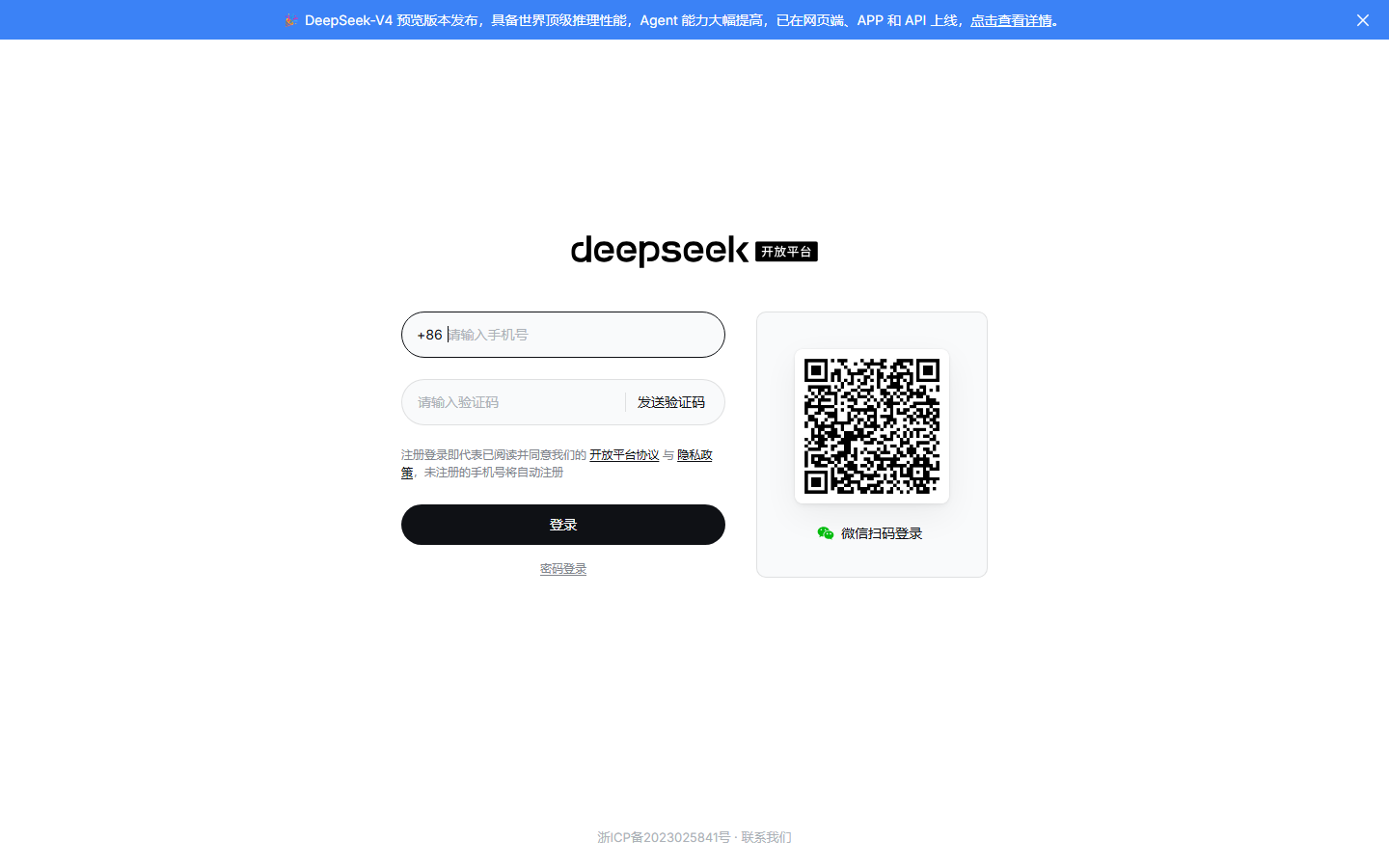
DeepSeekAPI
Core parameters and statistics
DeepSeek API is not an independent model, but a calling platform that DeepSeek encapsulates its V3/R1/V4 series models into a standardized HTTP interface. It shares the underlying model with the DeepSeek web version and App, but there are essential differences in capability exposure, calling methods, billing logic and usage constraints - the API is oriented to "programmed call" scenarios rather than "human-computer dialogue" scenarios.
| Parameter dimensions | DeepSeek API specifications |
|---|---|
| Protocol compatibility | OpenAI API protocol compatibility (can directly replace base_url) |
| Support models | deepseek-chat (non-thinking mode, currently pointing to V4-Flash), deepseek-reasoner (thinking mode, currently pointing to V4-Flash) |
| Context window | Maximum 1M tokens (V4 series), 128K (V3/R1 series) |
| Maximum output | Up to 384K tokens (V4 series), 8K-32K (V3/R1 series) |
| Streaming output | Support (stream: true) |
| Function Calling | Support (tool calling and multi-step task orchestration) |
| JSON structured output | Support (response_format: {"type": "json_object"}) |
| Context caching | Supported (server automatically caches duplicate prefixes, cache hit price is as low as 0.02 yuan/million tokens) |
| Reasoning mode | Non-think (straight out) / Think High (conventional thinking) / Think Max (maximum depth of thinking) three levels available |
| Internet search | Supported (search parameters need to be explicitly enabled in the request) |
| Multi-modal | Image understanding (based on visual language model, non-native multi-modal model) |
| API endpoint | https://api.deepseek.com |
| Free quota | Register and receive 10 million input tokens (approximately 100,000 free calls) |
Performance and Throughput Reference: DeepSeek officials have not continued to disclose precise TTFT (first word delay) and TPM/RPM frequency control values. According to sampling data from third-party evaluation communities (such as Artificial Analysis), the TTFT of V4-Flash under medium concurrency is about 200-400ms, and V4-Pro is about 400-800ms. In terms of frequency control, the API default can refer to the baseline of 60 requests per minute (RPM) and 50 million tokens per day. For high-frequency scenarios (>100 RPM), please contact the business expansion quota. It should be noted that TTFT is affected by three factors: context length, inference mode selection, and concurrency. In the Think Max scenario of 1M context, the first word delay may reach 3-5 seconds. This is the physical cost of an ultra-long context scenario and is not a service exception.
User and market recognition
There is a clear differentiation between the market perception of DeepSeek API and the DeepSeek web version: the former is a "cost depression" for developers and enterprises, while the latter is a "free dialogue window" for C-end users.
Developer Community Penetration: On GitHub, integration projects around DeepSeek API (including third-party client MCP server LangChain/LlamaIndex integration One API transfer, etc.) have accumulated more than 5,000 stars. The API's OpenAI compatible protocol greatly reduces migration costs - developers only need to change base_url from https://api.openai.com to https://api.deepseek.com to complete the switch without modifying the code logic. This is the core driving force behind the rapid penetration of DeepSeek API in the developer community.
Adoption by B-side enterprises: According to public information, more than 30,000 enterprises have accessed the DeepSeek model through API, covering 12 industries including finance, medical care, industry, and government affairs. State-owned enterprises such as China UnionPay and National Pipeline Network Group have embedded API calls into core business processes such as marketing copy generation, intelligent control, and pipeline safety audits. The core logic adopted by the company is not to lead the model performance alone, but the economic account of "with the same capabilities, the API cost is only 1/10-1/100 of the international competitive products".
Third-party evaluation positioning: On third-party platforms such as Artificial Analysis, OpenRouter, and LMSYS Chatbot Arena, the V4 series models provided by DeepSeek API have reached the best level of open source models in terms of reasoning and agent capabilities, and are comparable to top closed-source models in mathematical STEM and competitive coding tasks. However, it is still slightly inferior to Gemini-3.1-Pro and Claude Opus 4.6 in terms of world knowledge coverage and the "naturalness" of creative writing, indicating that the model behind the API has room for continued optimization in terms of long-tail fact injection and style diversity.
Cost advantage
The cost structure of DeepSeek API is not a periodic promotion, but a systematic low pricing achieved through MoE architectural innovation, hybrid attention mechanism and engineering optimization. Its price system has a "dimensionality reduction blow" effect on Chinese developers - pushing the cost of calling large model APIs from "cents/million tokens" to the order of "cents/million tokens".
| Service type | Component | DeepSeek-V4-Flash | DeepSeek-V4-Pro (25% off) | Competitor reference (GPT-5.5 Pro) | Competitor reference (Claude Opus 4.6) |
|---|---|---|---|---|---|
| Input | Cache hit | 0.02 yuan/million tokens | 0.025 yuan/million tokens | ~3.4 yuan/million tokens | Undisclosed |
| Cache miss | 1 yuan/million tokens | 3 yuan/million tokens | About $30/million tokens | About $15/million tokens | |
| Output | 2 yuan/million tokens | 6 yuan/million tokens | About 180 US dollars/million tokens | About 75 US dollars/million tokens |
Real Benefits of Cache Hits: Context Caching is the most underestimated cost-cutting mechanism of the DeepSeek API. For production scenarios with fixed system prompt words and stable dialogue prefixes (such as customer service robots and code review assistants), the cache hit rate can reach 60%-80%, which means that the actual effective price may be as low as 0.4 yuan/million tokens (V4-Flash output). However, for use cases where dynamic content changes frequently (such as entering a completely different question each time), the cache hit rate approaches zero. At this time, you should refer to the "cache miss" price for budgeting.
Free quota strategy: 10 million input tokens (about 5 million output tokens) will be given as a gift upon registration, which is enough for a lightweight application (average daily input of 100,000 tokens) to run for about 100 days. Compared with OpenAI’s $5 free credit (approximately 36 yuan), the actual credit available to domestic developers is nearly 30 times higher. But please note: the free quota has a validity limit (usually 3 months), and the unused portion will be cleared automatically.
API Cost Comparison Deduction: Taking a medium-scale application that processes 2 million tokens per day and inputs 1 million tokens as an example, the monthly cost of using V4-Flash is approximately (1×60 + 2×30) = RMB 120; the monthly cost of using V4-Pro with a 25% discount is approximately (3×60 + 6×30) = RMB 360. The monthly cost of GPT-5.5 Pro under the same load is approximately (30×7.2×60 + 180×7.2×30) ÷ 100 ≈ US$518 (about 3,700 yuan), a difference of 10-30 times.
Cost Tradeoffs for Enterprise/Private Deployments: The choice between open source model API calls vs. self-hosted deployments is not a pure price comparison. The API mode does not require GPU hardware investment and operation and maintenance teams, and is suitable for teams with large fluctuations in model call volume, or teams that want to quickly verify product concepts. Although the marginal cost of a single call is lower for privatized deployment (especially in high-concurrency scenarios), it does need to bear fixed costs such as GPU server purchase/lease (monthly rent for 8×A100-80G is about 50,000-80,000 yuan), operation and maintenance manpower, and network bandwidth. The total cost of the enterprise should be comprehensively evaluated by "annual API fee vs three-year TCO of private deployment" and consider the update cost caused by model version iteration.
Main functions
The functional design of DeepSeek API focuses on the three main lines of "lowering the integration threshold, expanding calling flexibility, and controlling usage costs". It is not simply a matter of moving the model chat box to the HTTP interface.
-
OpenAI protocol compatibility: This is the most pragmatic decision for the DeepSeek API. Using the exact same request/response format, developers don't need to learn a new SDK, just modify
base_urlandapi_key. Existing OpenAI SDK-based code, tool chains (LangChain, LlamaIndex, AutoGPT, etc.) and monitoring middleware (Helicone, Portkey, etc.) can be directly reused. Migration cost is almost zero - Switching a medium-sized project from OpenAI to the DeepSeek API typically only takes 10 minutes to modify the configuration and requires no code refactoring. -
Function Calling: Supports defining custom tools through the
toolsparameter, allowing the model to independently decide which external functions to call during the inference process. Suitable for building Agent applications - the model can complete the complete package of "understanding the user's intention → deciding to call the function → parsing the returned results → generating the final answer" in one interaction. The agent capabilities of the V4 series reach SOTA in the open source model, and the accuracy of Function Calling is better than the Llama 4 and Qwen3 series with the same parameter quantity. -
Three levels of reasoning mode: Non-think (straight out mode), Think High (regular in-depth thinking) and Think Max (maximum in-depth thinking) three levels adjustable. Non-think is suitable for delay-sensitive tasks such as translation, summarization, and information extraction. TTFT is usually within 200ms. Think High is suitable for daily question and answer and medium-complexity reasoning, and the output token is about 1.5-3 times that of Non-think. Think Max is suitable for mathematical proofs, competition programming, and counterfactual analysis, and the output token can reach 3-8 times that of Non-think. Selection Principle: Do not use Think High for tasks that can be solved with Non-think, and do not use Think Max for tasks that can be solved with Think High - the deeper the reasoning depth, the token consumption and delay of a single call will increase non-linearly.
-
Context Caching: The server automatically caches the system prompt words and previous conversation history in the request, and directly reuses the cached results when the prefix content of subsequent requests matches. For scenarios such as customer service robots (fixed system prompts + user problem changes), code assistants (fixed context + different code segment reviews), the cache hit rate can reach 60%-80%, and the effective cost can be reduced to 2%-5% of the miss price. The cache is automatically managed and does not require manual operation by the developer, but it is important to note: the cache has a TTL (usually 5-10 minutes), and high-frequency repeated requests can be fully utilized.
-
JSON structured output: Pass
response_format: {"type": "json_object"}to force the model to output legal JSON. This is crucial for scenarios where AI output needs to be directly connected to downstream automation pipelines (such as data cleaning, automatic form filling, API parameter generation). When using it, the expected JSON schema must be clearly stated in the system prompt. The model performs well in following the schema, but the stability of complex nested structures and the consistency of field hits still need to be tested and verified. -
Internet Search: Search parameters can be enabled in API requests, allowing the model to retrieve Internet information in real time during inference to break through the knowledge cutoff of the training data. Search results are injected into the model for inference as context, rather than returning search summaries independently. The accuracy of search result citations in the V4 series is improved compared to V3, but it is still recommended to set manual review points in key fact scenarios.
Model and version evolution
The model version evolution of DeepSeek API is synchronized with DeepSeek's overall model iteration, but API endpoint management has its own life cycle - the old model will not be taken offline immediately, but the outage time will be notified in advance, leaving a migration window for developers.
API endpoint mapping relationship
| Time node | deepseek-chat (not thinking) |
deepseek-reasoner (thinking) |
Key changes |
|---|---|---|---|
| 2024-12-26 | DeepSeek-V3 | — | The first API version, basic conversation capabilities |
| 2025-01-20 | DeepSeek-V3 | DeepSeek-R1 | Thinking mode API is online, reasoning specialization |
| 2025-05-28 | DeepSeek-V3-0324 | DeepSeek-R1-0528 | Significantly enhanced reasoning capabilities and mathematical benchmarks |
| 2025-08-21 | DeepSeek-V3.1 | DeepSeek-V3.1 (thinking mode) | Hybrid inference architecture, 128K context |
| 2025-09-22 | DeepSeek-V3.1-Terminus | DeepSeek-V3.1-Terminus | Language consistency and Agent capability optimization |
| 2025-09-29 | DeepSeek-V3.2-Exp | DeepSeek-V3.2-Exp | Sparse attention experimental version |
| 2025-12-01 | DeepSeek-V3.2 | DeepSeek-V3.2 | General capabilities further improved |
| 2026-04-24 | Point to V4-Flash non-thinking | Point to V4-Flash thinking | The V4 era has begun, and the old endpoint name is planned to be retired on 2026-07-24 |
Endpoint management strategy: DeepSeek API adopts the strategy of "fixed endpoint names and rotation of backend models". The two endpoints deepseek-chat and deepseek-reasoner have pointed to the V4-Flash model after the release of V4. Older models (V3, V3.1, V3.2) can be called by specifying the model parameter as the specific model name in the request. Officials have announced plans to deactivate the V3 series mapping of the old endpoint names on 2026-07-24. Developers should complete the performance verification of migration to the new model before stopping the service.
Relationship between API version and model version: The "version" of the API is not an independent software version number, but a mapping layer of the back-end model version. Every time DeepSeek releases a new model, the API team will conduct compatibility testing, performance stress testing, and stability verification. Only after passing the verification will the new model be deployed to the API endpoint. Therefore, API launch usually lags model release by 3-14 days. The existence of this lag period means that developers pursuing the latest model capabilities need to pay attention to official API announcements rather than model release announcements.
Technical advantages
The technical competitiveness of DeepSeek API does not come from the parameter scale of a single model, but from the system engineering ability of "achieving equal or better inference quality with less computing power cost".
Low activation cost of MoE architecture: V4-Pro only activates about 49B parameters per token (accounting for 3% of the total parameters 1.6T), and V4-Flash activates about 13B parameters (accounting for 4.6% of 284B). The extremely low activation rate means that the amount of GPU computing consumed per API call is much lower than that of a model with the same total parameter amount. This is the core technical reason why DeepSeek API can be sold at 1/30 the price of GPT-5.5 Pro - not because DeepSeek is subsidizing at a loss, but because the MoE architecture itself has lower computational requirements for unit inference.
Context cost revolution of hybrid attention mechanism: The hybrid attention architecture (CSA + HCA) of the V4 series reduces the calculation amount and memory usage in 1M ultra-long context scenarios to 10%-27% of the traditional full attention method. The direct significance of this mechanism to API callers is that ultra-long document analysis tasks that previously required separately purchasing higher-spec GPU instances can now be completed with standard configurations without calling failures due to OOM. KV cache occupancy is reduced to 7%-10% of traditional methods, which means that more concurrent requests can be supported under the same hardware conditions.
Inference bonus of FP8 mixed precision training: DeepSeek fully adopts FP8 mixed precision in the training phase, and the trained model weights naturally support FP8 inference. Compared with FP16 inference, FP8 inference can reduce graphics memory usage by about 50% and computing latency by about 30%. This means that API service providers can host more concurrent inference requests on the same GPU cluster, and the cost advantage is ultimately passed on to API pricing.
Compliance Value of Domestic Computing Power Adaptation: DeepSeek has achieved in-depth collaboration with Huawei’s Ascend NPU, and API services can complete full-process reasoning on the Ascend platform. This capability has "irreplaceable license value" for industries such as government affairs, finance, and energy that have localized substitution needs. Under the requirements of Xinchuang policy, if the underlying computing power of API calls is completely dependent on NVIDIA GPU, it may face compliance risks. But please note: the inference throughput and stability on the Ascend platform are still weaker than those of NVIDIA GPUs of the same generation, and the latency difference in high-frequency scenarios may reach 20%-50%.
How to use
The usage path of DeepSeek API is divided into three steps: "Account preparation → API Key acquisition → Interface call". The overall process is highly consistent with the OpenAI API.
Usage comparison:
| Usage form | Suitable scenario | Entrance | Cost model |
|---|---|---|---|
| HTTP API direct call | Backend service integration, automated workflow | https://api.deepseek.com |
Pay by token volume |
| OpenAI SDK (Python/Node) | Rapid migration, prototype development | Modify base_url and api_key |
Same as above |
| LangChain / LlamaIndex integration | Complex Agent / RAG application | Configuration ChatOpenAI(model="deepseek-chat", openai_api_base="https://api.deepseek.com") |
Same as above |
| One API / New API transfer | Multi-model aggregation management | Self-built transfer service | Transfer service fee + API fee |
| MCP Server access | MCP clients such as Claude Desktop | Configure mcpServers |
Same as above |
Python calling example (including key parameters):
from openai import OpenAI

client = OpenAI(
    api_key="<YOUR_API_KEY>",
    base_url="https://api.deepseek.com"
)

response = client.chat.completions.create(
    model="deepseek-chat", # currently points to V4-Flash non-thinking mode
    messages=[
        {"role": "system", "content": "You are a professional Python code review assistant. Please output the review comments in JSON format."},
        {"role": "user", "content": "Review the following code:\ndef fib(n):\n if n <= 1: return n\n return fib(n-1) + fib(n-2)"}
    ],
    temperature=0.3, # Low temperature is recommended for code review scenarios
    max_tokens=4096, # Control the upper limit of output length
    stream=True, # Enable streaming output to reduce first word delay
    response_format={"type": "json_object"}, # Force JSON output
    # tools=[...], # Function Calling definition (optional)
    # enable_search=True # Internet search (optional, parameter name needs to be confirmed)
)

for chunk in response:
    if chunk.choices[0].delta.content:
        print(chunk.choices[0].delta.content, end="")
Key parameter tuning suggestions:
temperature: 0.1-0.3 is recommended for code/mathematical scenarios, 0.7-0.9 is recommended for creative writing, and 0.0-0.2 is recommended for information extraction. Excessive temperature can cause unstable inference task output.max_tokens: The V4 series supports up to 384K, but in actual use it is recommended to set a reasonable upper limit based on task needs - setting it too high will not only increase waiting time, but also cause billing waste due to unused tokens.stream: For production purposes, it is recommended to always enablestream=True, which can significantly reduce the user-perceived first word delay. The experience difference can reach several seconds in long output scenarios.response_format: In scenarios that require structured output, it is recommended to enable JSON mode, but the JSON schema of the model output must be clearly informed in the system prompt. In JSON mode, the model will sacrifice part of the generation diversity to ensure format correctness, and it is not recommended to enable it for creative tasks.tools(Function Calling): Each tool definition needs to containname,descriptionandparameters(JSON Schema). Tool descriptions should be as detailed as possible - the more precise the description, the more accurate the model will be at selecting the correct tool.
How to call online search: When calling the API, you need to add search-related parameters in the request body (the specific field names are subject to the official API document). The search switch can be manually turned on in the input box on the web version and the App. It should be noted that network search will increase the inference delay (about 1-3 seconds) and is only enabled in scenarios where real-time information is required.
Product Pricing
The pricing system of DeepSeek API adopts a dual-track strategy of "C-end free web version + API volume-based extremely low price", and there is no "monthly subscription system" or "package package" model. The price has been detailed in the cost advantage chapter above. Here we focus on the actual cost deduction and billing considerations for different consumption levels.
Individual developers/small-scale use: The free registration limit is about 10 million input tokens. For an individual developer to run an automated script (such as an AI daily summary generator) with an average daily input of 100,000 tokens, the free quota can be used for approximately 100 days. After that, the cost of V4-Flash is about (1×3 + 2×1.5) = 6 yuan/month (estimated based on an average daily input of 100,000 and an output of 50,000), which is almost negligible.
Medium-scale application: For an application with an average daily input of 2 million tokens and an output of 1 million tokens, the monthly cost of using V4-Flash is about (1×60 + 2×30) = 120 yuan; the monthly cost of using V4-Pro with a 25% discount is about 360 yuan. This magnitude corresponds to about 100,000 conversations per month, and the average cost per call is about 0.0012-0.0036 yuan (0.12-0.36 cents), which is far lower than the average pricing of domestic mainstream cloud APIs.
High-frequency/large-scale production with context: average daily input of 20 million tokens and output of 10 million tokens, monthly cost is approximately (1×600 + 2×300) = 1,200 yuan (V4-Flash). At this level, it is recommended to contact the DeepSeek business team to obtain tiered pricing or reserved resource discounts. At the same time, evaluation is required - when the monthly API fee exceeds 5,000 yuan, private deployment may be a more economical option, especially if there are fixed GPU resources and a complete operation and maintenance team.
Billing Notes:
- Input tokens and output tokens are billed separately, and the output price is higher than the input (about 2 times).
- Input tokens for cache hits enjoy significant discounts (as low as 2% of the miss price).
- The system prompt words are included in the input token billing, and it is recommended to streamline them to reduce costs.
- Search result tokens for Internet searches are also included in input billing, and actual usage may exceed expectations.
- Failed requests (due to frequency control, timeout, parameter errors, etc.) do not incur charges, but it is recommended to set a reasonable retry strategy to avoid business gaps.
Application scenarios
The implementation scenarios of DeepSeek API have "batch processing, structured output, and automated integration" as common features, which forms a clear distinction with the "human-computer interaction" scenario for the web version.
-
Intelligent customer service and work order system: Embed deepseek-chat (Non-think mode) into the customer service system to handle FAQs, work order classification and standardized response generation. Function Calling can be used to query order status, inventory information or user history, forming a "understand → query → reply" concept. Implementation Tips: Customer service scenarios have high requirements on the consistency of response formats. It is recommended to use JSON mode to constrain the output structure, and prepare at least 500 test cases to cover high-frequency problem types before going online. Enterprise-level customer service recommends enabling context caching to reduce repeated billing of system prompt words.
-
Code review and automated testing: Connect deepseek-reasoner (Think High mode) to the CI/CD pipeline to conduct automated code review of Pull Requests, generate unit tests, and detect security vulnerabilities. The 1M context window of the V4 series can read the core source files of the entire code warehouse at one time for cross-file analysis. Implementation Tips: Typical token consumption in code review scenarios is relatively large (2K-10K tokens per file). It is recommended to reduce costs through incremental diff rather than full code submission. Models may miss best practices for specific language frameworks, and it is recommended to inject team coding conventions into the prompt.
-
Content mass production and structured extraction: Extract key fields from unstructured documents (PDF, Word, scanned documents) and output them in JSON format. It is suitable for data-intensive scenarios such as contract clause extraction, invoice information entry, and resume analysis. The V4 series has good performance in post-OCR text understanding, but it still has limitations in complex table structures and handwritten content. Implementation Tip: It is recommended to divide long documents into 8K-16K token paragraphs and process them separately instead of submitting the full text at once - this can not only control the token cost, but also reduce the retry cost when a single paragraph fails.
-
Generation engine in RAG application: Acts as the generative segmented component of the RAG pipeline, receives the retrieved context fragments and generates the final answer. The low price of the DeepSeek API makes it particularly suitable for knowledge base Q&A applications - such applications usually have long inputs (splicing of search results) and short outputs (answers of a few sentences), so the cost structure is naturally favorable. Implementation Tips: In RAG scenarios, Think High mode can usually generate more accurate answers than Non-think mode, but the output token consumption will increase by 50%-100%, which requires a specific test balance between accuracy and cost.
-
Agent Workflow and Automation: Connect LLM with external tools (database query API calls, file operations, web page access) through Function Calling to build multi-step task automation. The V4 series has the best Agent capability among open source models, and the success rate of single-step task planning is 5-10 percentage points higher than that of major competitors. Implementation Tips: The Agent scenario needs to implement an upper limit on the number of steps (recommended 10-20 steps) and timeout control to prevent the model from endless loops or token surges in complex task planning.
Not suitable for scenarios: DeepSeek API is not suitable for real-time applications that require millisecond response (such as online translation, real-time voice dialogue), because even Non-think mode has 200ms+ network latency and inference latency. It is also not suitable for brand copywriting scenarios that have extremely high originality requirements in output style - the DeepSeek model is still weaker than the Claude series in terms of creative diversity and style consistency. In addition, production scenarios that require high-frequency calls (>100 RPM) and cannot accept frequency control restrictions will have availability risks before contacting the business to obtain quota expansion.
Applicable people
The positioning of DeepSeek API determines that its core user group is "technical teams and individuals who have development capabilities, pursue cost-effectiveness, and need to embed AI capabilities into their own systems."
-
Individual developers and independent developers: Through API, LLM capabilities can be accessed in personal projects at a very low cost. Suitable for building automation scripts, personal knowledge base assistants, code assistance tools, etc. Not suitable for boundaries: If the requirements are just daily conversation Q&A rather than programmatic integration, you should give priority to using the DeepSeek free web version instead of the API - the API requires pay-as-you-go even after the free quota is used up. It is recommended to have basic Python/Node.js development capabilities and at least be able to understand HTTP requests and JSON format.
-
Start-up teams and small and medium-sized technology companies: The low price of API allows start-up teams to integrate AI functions in the early stages of the product at a monthly cost of tens to hundreds of yuan, without the need to invest in GPU hardware upfront. The single-card runnability of V4-Flash also lowers the hardware barrier to entry for self-hosted alternatives. Implementation Tips: It is recommended to verify the product concept and user acceptance in API mode first, and then decide whether to switch to self-hosted deployment based on the scaled-up cost model. Pay attention to the compatibility risks caused by API version switching in the contract - the deactivation of the old endpoint may cause service interruption.
-
Enterprise development team and system integrator: Embed LLM capabilities into internal systems (OA, CRM, ERP, customer service platform) through APIs to achieve process automation and decision-making assistance. Enterprise users should prioritize whether the API's frequency control limits meet business peak demand and whether the data privacy terms allow sensitive information to be transmitted through the API. Purchasing Prerequisites: Enterprises should clarify specific scenarios and quantifiable efficiency indicators for AI integration, rather than purchasing API quotas for the purpose of "getting to AI first". It is recommended to use free credits to complete technical verification during the PoC stage and then purchase in bulk.
-
AI Application Developers and Agent Builders: Use Function Calling and tool calling capabilities to build complex multi-step AI applications. This group is most sensitive to the model's Agent capability, Function Calling accuracy, and long context window. Unfit Boundary: If the application scenario involves multi-modal understanding of a large number of images/audio/videos, the visual model capabilities of DeepSeek API are limited, and Gemini API or GPT API should be given priority. If the application requires private deployment and strict data sovereignty requirements, the technical cost and operation and maintenance burden of the self-hosted solution need to be evaluated.
Summary and Outlook
The core competitiveness of DeepSeek API lies not in having the model with the largest number of parameters, but in the engineering ability of "providing good enough inference capabilities at the lowest cost". It turns large model APIs from "luxury goods" to "daily necessities" - allowing independent developers and small and medium-sized enterprises to integrate top-notch reasoning capabilities into their products at a cost of tens of yuan per month.
Current Core Advantage: The API price is 10-100 times lower than that of international competing products, and this price difference is based on architectural innovation rather than burning money through subsidies, and is sustainable. OpenAI protocol compatibility makes migration costs almost zero, which is a key factor for rapid adoption by developers. The V4 series has reached the best level of open source models in terms of reasoning, coding and agent capabilities, and is "good enough" for most production scenarios. Features such as context caching and JSON schema directly serve the implementation of the project, rather than being a marketing gimmick.
Current main limitations: Insufficient transparency of API frequency control and SLA - the official has not disclosed clear RPM/TPM ladder upper limit and availability SLA, posing potential risks to key business scenarios. The model's world knowledge coverage accuracy is still lower than the top closed-source model, and its performance is unstable in vertical scenarios that require precise fact recall (such as medical diagnosis support, legal precedent retrieval). The generation quality of creative writing and brand copywriting scenes is not as good as that of the Claude series, and is not suitable for applications that require extremely high output style. Inference latency in long context scenarios (>500K) is still high, and Think Max mode may reach a first-word latency of 5-10 seconds in extreme scenarios.
Follow-up observation points: After the official version of V4 is released, whether the API will introduce more detailed frequency control classification and regional acceleration nodes (currently only domestic nodes); whether the official will release the formal SLA commitment and compensation terms of the API; whether the world knowledge injection strategy of the DeepSeek model will continue to be optimized to narrow the gap with the closed source model; whether the open source community can form a mature solution around the ecological tools (monitoring, caching, load balancing) of the DeepSeek API.
Procurement and Adoption Risk Assessment: For individual developers and start-up teams, DeepSeek API is currently the most cost-effective LLM API choice - the free quota is enough to complete the proof of concept, the cost of pay-as-you-go is extremely low, and there is no long-term lock-in risk (you can switch back to OpenAI API or other compatible services at any time). For enterprise users, it is recommended to first verify model capabilities and API stability in non-critical processes (internal knowledge Q&A, report draft generation, code-assisted review), and then gradually expand to customer-facing production processes. In compliance-sensitive industries, you should focus on confirming the data privacy terms before using the API - ensuring that the text sent to the API will not be used for secondary training of the model and that it meets the data export compliance requirements. If the API call volume exceeds the monthly fee of 5,000 yuan, it is recommended to initiate a TCO assessment of privatized deployment and write the model version update terms (including the transition period for outage of old endpoints) into the procurement contract to avoid the risk of business interruption.
Related tools:  Hugging Face, replicate
Version Info
- DeepSeek-V4-Pro Preview (API) :The V4 preview flagship model is open through API, has 1.6T total parameters (approximately 49B activated), supports 1M context window, and the hybrid attention architecture significantly reduces the cost of long sequence reasoning.
- DeepSeek-V4-Flash Preview (API) :The cost-effective model of the V4 preview version is open through API, has 284B parameters (about 13B activated), can be run on a single card A100, and is an economical choice for high-frequency calls.
- DeepSeek-V3.2 (API) :V3.2 general model API is online, performance benchmarks against cutting-edge closed-source models, and the knowledge base is updated to May 2025.
- DeepSeek-V3.1 (API) :The hybrid reasoning architecture model API is online, supporting fast response and deep thinking mode switching, with a context of 128K.
- DeepSeek-R1-0528 (API) :R1 has a major upgraded API, with significantly improved reasoning capabilities and significantly enhanced mathematical benchmark performance.
- DeepSeek-R1 (API) :The reasoning-specific flagship model API is online, driven by reinforcement learning, and has outstanding mathematics, programming and logical reasoning capabilities.
- DeepSeek-V3 (API) :The 671B MoE base model API is online, laying the foundation for subsequent series.
User Reviews