 editGPT
Free
editGPT
Free
editGPT is an AI tool product for business and content teams, suitable for quickly verifying generation capabilities and collaboration efficiency in real tasks.
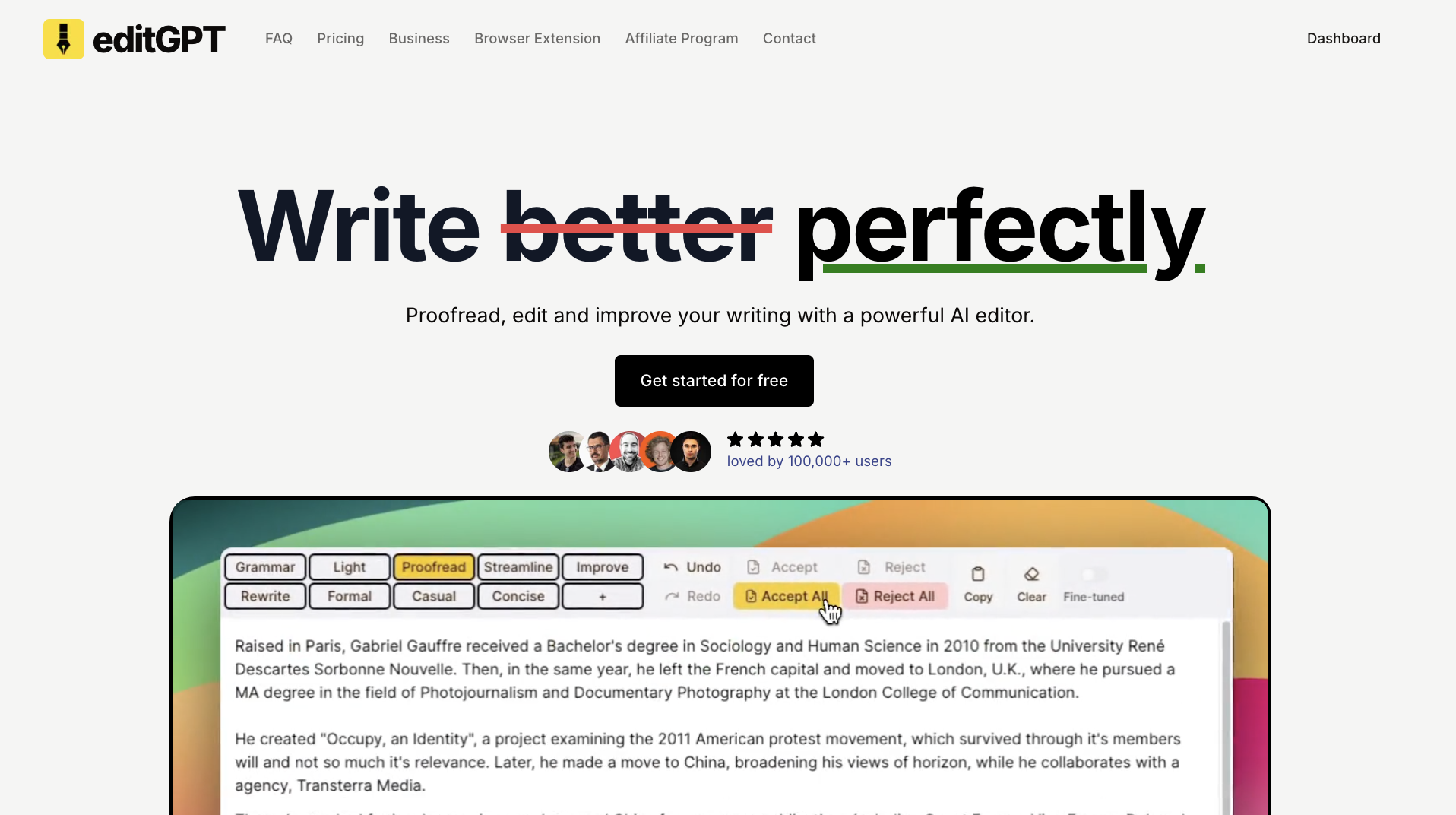
editGPT
core parameters and statistics of editGPT
Product form: editGPT is an AI-based online text editing and proofreading tool. It uses web applications as its main delivery form and also provides Chrome browser extensions. Its core positioning is to become an AI alternative to Grammarly, focusing on in-depth text rewriting, grammar proofreading, style optimization and multi-language editing scenarios. It does not do general writing "generated from scratch", but focuses on "optimization and polishing of existing text" - this boundary clearly distinguishes it from general conversation models such as ChatGPT.
Key statistics: Public data from the official website shows that editGPT has served more than 200,000 registered users, processed 15.4 million editing requests, and created more than 5,100 customized prompts. According to simple estimates, each user completes about 77 editing operations on average, indicating that the product has a high retention base in repeated use scenarios. These data have established a stable user base in the fields of academic writing, business communication and content creation.
Core Parameters:
| Projects | Public Information |
|---|---|
| Official entrance | https://www.editgpt.app/ |
| Product form | Web application + Chrome extension |
| Developer | Cluster Software Ptd Ltd |
| Founder | Sal Bajo |
| User scale | 200,000+ registered users |
| Cumulative number of edits | 15.4 million times |
| Supported languages | 80+ languages |
| Platform Support | Web, Chrome |
| Latest iteration | Web Rolling Release (~2026-Q2) |
Positioning boundaries: editGPT is suitable for modifying, polishing, and proofreading scenarios, rather than brainstorming or long-form original writing. It is oriented to the need of "existing text needs to be made better", rather than the need of "starting from a blank page". The editing depth is divided into 6 levels (Fix Grammar 5% → Rewrite 40%), covering the entire spectrum from light grammar correction to deep rewriting.
editGPT’s user and market recognition
User scale: 200,000 registered users and 15.4 million edits are the core indicators directly displayed on the official homepage. Many well-known KOLs have left recommendations on the official website, including Rowan Cheung (well-known AI newsletter author), Dr. Amina Yonis (academic writing blogger), Jeremy Nguyen PhD, etc. Many users clearly stated "Cancel Grammarly subscription and switch to editGPT", which directly points to their alternative relationship with Grammarly. Product mentions on the Reddit community r/editGPT and Twitter have created an ongoing ecosystem of word-of-mouth communication.
Market positioning: editGPT is in the "editing vertical track" of AI writing assistants. Direct competitors include Grammarly, ProWritingAid, Wordtune, Hemingway Editor, etc. Its differentiated selling points are reflected in three aspects: first, deep AI rewriting capabilities (based on semantic understanding of large language models, rather than shallow syntax rule matching); second, Word Track Changes mode compatibility (retaining traces of modifications and supporting item-by-item review); third, data privacy commitment (explicit commitment that user data will not be used for model training). Although no corporate customer list or financing information has been disclosed, the scale of 200,000 users shows that it has established a firm foothold in the C-side and academic markets.
Disclosure boundary: Officials have not disclosed refined operational indicators such as monthly active users, payment conversion rate, and number of corporate customers, nor have they disclosed financing history or team size. For corporate procurement that needs to evaluate the long-term vitality of products, it is recommended to supplement due diligence information through business docking. The official website provides a Custom Solution customization channel, implying that medium-sized enterprise customers are already negotiating or using it.
The cost advantage of editGPT: three-tier pricing locks in different usage levels
C client/individual users: editGPT adopts a free value-added model. Free users have access to basic proofreading and editing capabilities, but there is a monthly word limit and feature limitations. For light users (such as revising one or two short articles per week), the free tier can meet their needs. Payments start at $8/month ($96 annually) for the Pro plan, which is intended for individual users who require higher word counts and in-depth rewriting. The Elite plan is $15/month ($180 annually) for high-volume users, providing a processing capacity of 3 million words per month.
API/Developer: editGPT currently does not publicly provide an independent API interface. Its core capabilities are delivered through web applications and Chrome extensions, and its value to developers is mainly reflected in the custom prompt system and programmable workflows. If enterprise users have batch processing needs, the official website provides a Custom Solution customization channel, which supports private model deployment and system integration. However, the price requires business confirmation and is not priced on the public page.
Enterprise/Team Pricing:
| Package | Price (annual payment) | Monthly word count | Single document word limit | Team seats |
|---|---|---|---|---|
| Pro | $8/month ($96/year) | 500,000 | 200,000 | 1 person |
| Elite | $15/month ($180/year) | 3 million | 200,000 | 1 person |
| Business | $60/month ($720/year) | Unlimited | Unlimited | 4 seats or more |
Pricing Strategy Highlights: editGPT promises "Prices will never increase for existing customers" (Prices will never increase for existing customers), which is relatively rare in the SaaS industry. For individuals and teams who plan to use it for a long time, the earlier you subscribe, the lower the long-term holding cost will be. The annual payment plan can save about 40% compared to monthly payment, but users need to commit to the whole year at once. The Business package costs about $15/month per seat (for 4 seats), which is the same as the Elite single-person price, and is clearly attractive to team users.
Hidden Cost: The word limit and limited functionality of free users (such as no custom prompt words, no revision history, no Word import and export) may create bottlenecks during frequent use. If enterprise users rely on the Track Changes collaboration process but choose the free tier, the actual workflow will be severely restricted - it is recommended to compare the "must-have feature list" with the capabilities of each package one by one during evaluation.
Main functions of editGPT
-
Multi-level editing depth selection: Provides 6 levels of editing strength - Fix Grammar (about 5% text change), Proofread (about 10%), Natural (about 15%), Improve (about 30%), Rewrite (about 40%). Users can choose the appropriate strength according to the document type: Proofread for academic submissions, Natural for business emails, Improve for content marketing, and Rewrite for renovation of old documents. The actual range of changes between each gear is clearly marked to avoid the experience problem of "AI overshooting".
-
Word revision mode (Track Changes): The editing results are presented in Track Changes format, and the import and export of .docx files are supported. This feature is crucial for academic papers, business contracts, formal reports and other scenarios where traces of modifications need to be preserved - reviewers can review AI suggestions one by one instead of accepting them all. At the same time, the "Suggestions Panel" is supported to display the AI modification intention sentence by sentence, and the user can selectively accept or ignore it, achieving fine control of human-machine collaboration.
-
80+ multi-language support: Automatically detect the source language, covering major languages such as English, Chinese, Japanese, German, French, Spanish, and Arabic. Different from Grammarly, which mainly focuses on English, and ProWritingAid, which focuses on the limitations of English, editGPT's multi-lingual capabilities make it more attractive among non-native English writers. The system automatically detects languages with high accuracy, and supports manually specifying languages to avoid misjudgments.
-
Custom Prompts: Users can create and save their own editing instruction templates, such as "Convert this article to an academic paper style", "Optimize the tone for LinkedIn" or "Simplify expressions in a way that junior high school students can understand". The system has recorded more than 5,100 custom prompt words created by users, and the community ecosystem has begun to take shape. Pro plans and above fully support this feature.
-
AI Tool Matrix: In addition to the main editor, it independently provides special tools such as AI Proofreader (quick proofreading), AI Rewriter (full text rewriting), Text Splitter (long text segmentation), Text Improver (sentence-by-sentence improvement), AI Detector (detection of AI-generated content), Transcript SRT Proofreader (subtitle proofreading), covering everything from text splitting to AI content detection. Hidden linkage: The AI-generated text detected by AI Detector can be directly sent to the Rewriter module for humanized rewriting with one click. The results of Rewriter then enter Proofreader for final proofreading - this three-stage pipeline of "detection → rewriting → proofreading" is the core synergy advantage of editGPT that distinguishes it from a single grammar checking tool.
-
Revision History and Version Backtracking: All editing operations are automatically archived and support backtracking to any historical version. For long-term projects (such as book manuscript editing and multiple rounds of revision of papers), users can return to the editing state at any time at any time to avoid misoperation or unsatisfactory rewriting that cannot be recovered.
editGPT model and version evolution
Current Mainline: editGPT is continuously delivered in Web Rolling Release mode and does not use fixed semantic version numbers. The online service maintains a rhythm of updates multiple times a week, covering editing engine optimization, new tool launches and UI improvements. Its underlying AI model is updated with the upgrade of the upstream basic model, but the specific model version number is not publicly disclosed. For users who need to track changes in editing quality, it is recommended to follow the feature update log posted on their blog.
Key Milestones:
- ~2024-01: editGPT was first launched as a ChatGPT plug-in, focusing on paper polishing scenarios. Early users are mainly academic researchers, and they quickly accumulated initial reputation with the help of ChatGPT's ecological traffic.
- 2024-H2: Launch an independent web application and separate from the ChatGPT plug-in ecosystem. At the same time, a Chrome extension was launched to enable instant editing in the browser, and was upgraded from a "plug-in accessory tool" to an "independent AI editing platform".
- 2025-Q1: Released multi-level editing depth selection function, expanded from a single "Rewrite" option to 6 levels of intensity selection (Fix Grammar→Rewrite). The number of users exceeded 100,000.
- 2025-Q3: Launched the Track Changes function (suggestion panel + Word .docx two-way import and export), and upgraded the product positioning from "AI writing tool" to "AI proofreading editor". Feature parity with Grammarly has been greatly improved.
- 2026-Q1: The number of users exceeded 200,000, and the cumulative number of edits exceeded 15 million times. Special tools such as AI Detector and Transcript Proofreader have been added, evolving from a single editor to a matrix of editing tools.
- 2026-Q2: Launched the Docx Express function (Pro and above packages) to further simplify the import → edit → export process of Word documents. Pricing page updated for Business plans.
Implications of version governance: For enterprise users, since the product adopts a continuous delivery model and lacks public version numbers and release instructions, it is recommended to stipulate a function change notification mechanism and rollback guarantee in the procurement contract. During the pilot period, a regression acceptance list of key functions should be established to avoid upstream model upgrades causing mutations in editing styles that affect business continuity.
The technical advantages of editGPT
Mechanism→Effect→Cause and effect chain of scene:
AI editing engine vs. static rules: Traditional grammar checking tools (such as early Grammarly) rely on static rule libraries and pattern matching, and have limited ability to rewrite complex sentence patterns, contextual ambiguities, and creative language. editGPT is based on a large language model for semantic understanding and generation, and can understand the logical relationship at the paragraph level instead of just checking the grammar of a single sentence. Effectiveness: In long and difficult sentences, improper word choice, preposition matching and naturalness of expression can be corrected at the same time, instead of just marking spelling errors in red. Applicable scenarios: Complex sentence patterns in academic papers (such as "I created games replicating 'Whack-a-Mole'"→"I created games resembling 'Whack-a-Mole'"), logical reorganization of long paragraphs in business reports.
Track Changes native architecture: Map AI output directly to Word-compatible revision marks, instead of a simple two-column comparison of "original text → rewritten text". Effect: Reviewers can view AI's modification suggestions one by one in Word, accept, reject or adjust them, instead of facing the black box output of "whole paragraph replacement". Applicable scenarios: In scenarios that require collaborative review by multiple people (review of submitted papers, review of contract terms, final proofreading of team reports), this mechanism downgrades AI from a "replacer" to a "collaborator", significantly reducing the resistance to the introduction of editing tools.
Data Privacy Architecture: A clear commitment not to use user data for model training or share it with third parties. Server-side transmission is encrypted and user document content is not retained for a long time. Effectiveness: For users dealing with sensitive information (unpublished papers, business plans, legal documents), privacy commitment is a key decision-making factor in whether to adopt an AI editing tool. Applicable scenarios: Scientific research institutions, law firms, corporate legal departments and other vertical industries that are sensitive to data export compliance.
Multi-language understanding and format maintenance: Supports automatic detection of 80+ languages, while retaining rich text formats such as bold, italics, and title levels of the original text during the editing process. Effect: Users do not need to choose between "preserving format" and "getting AI editing suggestions" - language optimization and format maintenance can be completed in one edit. Applicable scenarios: Multilingual content teams, secondary polishing after localized translation, and scenarios with high cross-language format consistency requirements in multilingual academic writing.
How to use editGPT
Entry Matrix:
| Entrance | Applicable Scenarios | Core Competencies |
|---|---|---|
| Web Editor (main site) | In-depth editing, long documents, multiple rounds of revisions | Full-text Track Changes, 6 levels of depth, .docx import and export, revision history |
| Chrome extension | Instant proofreading in the browser, email/Gmail integration | Web page text selection → editing, lightweight quick proofreading |
| Special tool page | Quick processing of single tasks (Proofreader/Rewriter/Detector, etc.) | Ready to use, no need to enter the main editor |
Typical steps:
-
Text input: Paste text directly (Web editor), upload a .docx file (supports Track Changes retention), or select text to be edited in the web page through a Chrome extension. The system automatically detects the language or you can manually specify it from 80+ languages.
-
Select editing depth: Select the target rewrite intensity from 6 levels from Fix Grammar (5% change) to Rewrite (40% change). For first-time users, it is recommended to start with Proofread (10%) or Natural (15%) and gradually increase it to feel the actual changes in each gear. For non-native English users, the Improve (30%) level usually balances "degree of correction" and "preservation of original meaning".
-
Review and Adjustment: The editing results are presented in Track Changes format, and the modified content is highlighted sentence by sentence. Through the Suggestions Panel, you can view the detailed description of each modification, choose to accept/reject each item, or you can manually fine-tune the original text and resubmit it. Pro plans and above support saving custom prompt words to standardize subsequent edits.
-
Export and Archive: Copy and export the revised text, or download it directly as a .docx file (keeping the Track Changes tag). Pro and above packages support revision history review and can return to any historical version at any time.
Human-machine collaboration boundary: editGPT's Track Changes mechanism is essentially a "forced manual confirmation point" (Human-in-the-loop) - AI does not directly modify the original text, but presents modifications in the form of suggestions. The following scenarios particularly rely on this design:
- Academic Publishing: Before submission of the paper, traces of modifications must be retained for review by the supervisor or co-author. Journals usually require disclosure of the use of AI assistance.
- Legal Documents: Modifications to the wording of the contract must be confirmed item by item by legal personnel and cannot be directly rewritten by AI.
- Brand Copywriting: Adjustment of tone and style of externally released content requires final review by the marketing team, and AI recommends it as a first draft rather than a final draft.
- High-risk content: Text involving financial data, medical information, and legal statements, AI modifications must be reviewed manually.
In these scenarios, Track Changes mode is just right for compliance review requirements, while Rewrite mode's full-text replacement is suitable for internal drafts, low-risk content, or the brainstorming stage.
editGPT’s Product Pricing: The Long-Term Value of Locking in Rates
Pricing system: editGPT adopts a three-tier pricing structure, with annual payment saving about 40% compared to monthly payment. The price locking mechanism (existing users will never increase the price) is the core differentiated design. The following is a comparison of the complete functional differences of each package:
| Features | Free | Pro | Elite | Business |
|---|---|---|---|---|
| Monthly word count | Limited | 500,000 | 3 million | Unlimited |
| Maximum number of words in a single document | Limited | 200,000 | 200,000 | Unlimited |
| Docx Express | — | ✓ | ✓ | ✓ |
| Suggestions Panel | — | ✓ | ✓ | ✓ |
| Custom prompt words | — | ✓ | ✓ | ✓ |
| Word Import/Export | — | ✓ | ✓ | ✓ |
| Revision History | — | ✓ | ✓ | ✓ |
| Data privacy (not used for training) | ✓ | ✓ | ✓ | ✓ |
| Team Management Backend | — | — | — | ✓ |
Detailed explanation of price locking mechanism: editGPT clearly promises that "Prices will never increase for existing customers". This means that even if the product price increases in the future (for example, Pro goes from $8 to $12), early subscribers will still be renewed at the original price. From a long-term financial perspective, the holding cost of annual paying users after the second year will be lower than that of new users in the same period. This strategy is rare in the SaaS industry and is used to reduce churn concerns among early users and incentivize early conversion.
Free vs paid decision reference: The free tier is sufficient for light users (monthly editing volume < 5,000 words, basic grammar proofreading needs). Medium and high-frequency users (academic writing, business communication, monthly editing volume of 50,000+ words) are recommended to start with Pro. Elite or Business are more cost-effective for high-volume users (professional authors, translation reviewers, content marketing teams). Enterprise users need to additionally evaluate whether the team collaboration functions (team management background, unlimited word count) of the Business package meet their internal needs.
Hidden Cost Tip: The feature gap between the free and paid tiers isn’t just the word limit—custom prompt words, revision history, and Track Changes export are core capabilities of Deep Workflow. If a team relies on these features but chooses the free tier, the actual usage experience will be severely limited, and the resulting hidden rework costs may exceed the subscription fee itself. It is recommended to compare the "must-have features list" with the capabilities of each package one by one when evaluating. The price of the Business package of $720/year requires at least 3-4 active editing users to be cost-effective.
Application scenarios of editGPT
-
Academic paper polishing and submission preparation: Non-native English-speaking researchers need language polishing before submitting their papers. editGPT's Track Changes function allows tutors and co-authors to review AI's modification suggestions one by one instead of accepting black box output. Cost reduction and efficiency improvement: Traditional manual polishing takes 3-5 hours per paper and costs $200-500 (professional polishing service). editGPT can shorten the initial review polishing to 15-30 minutes, and the author spends another 30-60 minutes reviewing and confirming the AI suggestions. The total cycle is compressed from several days to less than 2 hours. Applicable Boundary: When a journal requires the disclosure of AI assistance, it must confirm whether the editing records of editGPT meet the disclosure requirements. Some journals explicitly prohibit AI from directly modifying the content of the manuscript. It is recommended to verify the policy of the target journal before submitting.
-
Business email and external communication optimization: Important emails to customers, partners or management can use editGPT to check the tone, grammar and clarity of expression. Cost reduction and efficiency improvement deduction: Middle managers process an average of 20-30 important emails every day, and the hidden time cost of proofreading each email is about 30-45 minutes/day. Using the Chrome extension to enable one-click proofreading in the browser can reduce proofreading time to 5-10 minutes/day and improve the consistency of overall output quality. Applicable Boundary: Emails that are extremely personalized or involve sensitive business policies should not be processed through online services. It is recommended to evaluate the applicability of the privacy policy.
-
Technical documentation and product copy localization review: In the secondary polishing scenario after translation of multi-language product documents, editGPT’s 80+ language support and format maintenance capabilities have obvious advantages in this scenario. Cost reduction and efficiency improvement: Traditional localization LQA (Language Quality Assurance) requires native language reviewers to check each item, which takes about 1-2 hours per 1,000 words. editGPT automates the initial language proofreading, and reviewers only need to focus on manual judgments such as terminology consistency and cultural suitability, improving efficiency by about 40-60%. Applicable Boundary: Highly professional technical documents (such as medical device instructions, financial compliance documents) still require manual final review by domain experts, and AI proofreading is only used as the first screening.
-
Editing workflow for book/long article authors: editGPT provides an AI Book Editor page to support chapter-by-chapter editing and revision management of long manuscripts. Cost reduction and efficiency improvement: The traditional editing cycle for a 100,000-word manuscript is about 2-4 weeks, and the cost is $2,000-5,000. Using editGPT assistance can compress AI proofreading to 2-3 days, shorten the manual review cycle to 1 week, and compress the total cycle by approximately 60%. Applicable Boundary: Creative language rewriting in literary creation requires the author's own judgment - AI tends to standardize expression and may weaken the unique style of the work.
-
Quality inspection of AI-generated content is related to humanized rewriting: Combine AI Detector and Rewriter to form a complete workflow - first use Detector to identify passages with heavy AI traces, then use the Rewriter module for humanized rewriting, and finally use Proofreader for final proofreading. Cost reduction and efficiency improvement: The content marketing team processes 10-20 AI-assisted generated manuscripts every day, and manually detects and rewrites each article for about 20-30 minutes. Using editGPT can reduce the processing time of a single article to 5-8 minutes, and increase the overall output efficiency of the team by about 60%. Applicable Boundary: The detection accuracy of Detector is affected by the length of the text and the degree of rewriting. Short text or highly humanized AI content may cause misjudgments. It is recommended to use it as a reference rather than an absolute basis for judgment.
Not suitable for scenarios: The use of editGPT is not recommended in the following scenarios - ① Original writing from scratch (editGPT is positioned for editing rather than creation, and general models such as ChatGPT/Claude are more suitable in blank page scenarios); ② Strong compliance audit industry (regulated industries such as finance and medicine require additional compliance approval, and editGPT lacks third-party certification public information such as SOC2/GDPR); ③ Offline/intranet privatized deployment (Pure Web services do not support offline, and are not applicable to organizations whose data cannot leave the intranet); ④ Ultra-large automated batch processing (Although the Business package supports an unlimited number of words, UI operations are still based on single documents, and batches of hundreds of documents need to be customized through Custom Solution).
EditGPT applicable groups
-
Non-native English-speaking academic researchers: PhD students, postdocs, and university professors are the core user groups of editGPT. They face the need for high-frequency polishing before submission, and the Track Changes function is a natural match for the academic review process. Prerequisite: Users need to have basic English writing skills - editGPT optimizes the quality of expression rather than replacing the user's ideological content. For users who rely entirely on AI writing, the value of editGPT will be significantly reduced. It is recommended to use it in conjunction with Grammarly’s academic vocabulary suggestions and Plagiarism detection to form a complete academic writing tool stack.
-
Content Marketing and Social Media Operations Team: Need to produce blog articles, social media posts, email newsletters and other external content frequently, and have requirements for tone consistency. The custom prompt word function allows preset editing templates for different channels (LinkedIn, professional style, Twitter, relaxed style, Newsletter, in-depth analysis style). Prerequisite: The team needs to invest 2-4 hours of initial configuration time to establish and maintain the prompt vocabulary library for each channel. The stability of editing quality depends on the quality of prompt word design, and it is recommended to A/B test the effect of different prompt words.
-
Business People and Managers: Daily need to write and respond to a large number of business emails, reports, proposals, etc., and are sensitive to language accuracy and professionalism. The lowest-cost Chrome extension lets you proofread without leaving your email client. Prerequisite: You need to accept the collaborative mode of AI-assisted writing - instead of letting AI write for you, let AI do the initial proofreading and then manually confirm. It is recommended to start with the Proofread (10%) setting and gradually adapt to it before trying a higher rewriting intensity setting.
-
Translation and localization practitioners: Translated target language texts often have "translation accents", and editGPT's multilingual Natural/Improve mode can effectively improve the authenticness of the translation. Precondition: Comparison is required to avoid AI rewriting from introducing modifications that deviate from the semantics of the original text. Professional fields (legal, medical, technical) are recommended to retain the final confirmation rights of domain experts during manual final review. In a multi-language scenario, the editing quality of different languages may vary. It is recommended to verify the effect of the target language with a small-scale sample before adopting it on a large scale.
-
Independent authors and self-media people: For individual creators who need self-editing but lack a professional editorial team. The revision history and Track Changes functions help authors track their revision trajectory and provide feedback on their writing growth. Prerequisite: The paid package is only cost-effective when the monthly output exceeds 10,000 words. Light authors can use the free tier for a long time. For novel authors who pursue a unique writing style, it is recommended to only use the Fix Grammar/Proofread mode to avoid using the Improve/Rewrite mode to introduce standardized expression and weaken the personality of the work.
Not suitable for boundaries: Organizations that have rigid requirements for strong privatization deployment, strong audit compliance, and strict offline border need to complete compliance and architecture assessments before considering procurement. Teams that rely on open APIs for workflow integration need to confirm whether editGPT's Custom Solution can meet the integration needs. For light users who only need basic spell checking and grammar correction, the free Grammarly Basic version may be a more lightweight option.
Summary and outlook of editGPT
Core value summary: editGPT has found a precise vertical cut in the AI writing tool track - not doing "generative writing" but "editing writing". Its Track Changes mechanism + multi-level rewriting depth + multi-language support form a foundation of capabilities that can replace Grammarly in academic writing and business communication scenarios. 200,000 users and 15.4 million edits are effective evidence of product-market fit (PMF), and the promise of "never raising prices" reflects the business philosophy of long-term user relationships. The evolution path of the product from the ChatGPT plug-in to an independent platform and then to the editing tool matrix shows a clear category expansion plan.
Current limitations and uncertainties: First, the specific version and update frequency of the underlying model are not disclosed, and users cannot evaluate the evolution trend of editing quality - an upstream model upgrade may lead to sudden changes in the rewriting style, posing potential risks to the stability of the production environment. Second, the lack of public information on third-party security certifications such as SOC2/GDPR poses an obstacle to compliance-sensitive corporate procurement. Third, there is no public API, which limits the potential for workflow integration and automation - for technical teams who want to embed editing capabilities into their own systems, they need to rely on Custom Solution customization channels, with high cost and time uncertainty. Fourth, the size and financial health of the business team are not transparent, and sustainability needs to be continuously observed.
Procurement/Adoption Risk Assessment: For individual users, editGPT’s free tier and low-priced Pro plan have almost no decision-making risk, and they can be quickly tried to verify the match. It is recommended that new users first use the free tier to complete the editing of 5-10 real documents, and evaluate the match between the editing quality and their own needs before deciding whether to upgrade. For team/enterprise procurement, it is recommended to advance in three phases: ① 2-4 weeks personal pilot: select 2-3 core users (such as academic writers, content editors, high-frequency business communication users) to verify in their respective scenarios whether Track Changes, multi-level editing and custom prompt words meet daily needs; ② Small team expansion (1-2 months): Use Business The package verification team manages the backend, collaboration process and the actual usage of unlimited words to confirm the function matching and hidden costs; ③ Scale Procurement: After confirming the function matching, confirm the data privacy terms, service level agreement (SLA), function change notification mechanism and invoice compliance requirements through the business channel ([email protected] or Custom Solution channel), and then enter the full-team large-scale deployment. There are risks of opaque version of the underlying model and uncontrollable changes. It is recommended to stipulate the functional change notification period and acceptance window in the contract.
Related tools:  Notion AI,
  Jasper
Version Info
- editGPT Web Rolling Release :The official update of online services is through continuous delivery. There is no official precise semantic version number and release date yet.
- editGPT Public Launch :There is no official precise date yet, but historical milestones are recorded according to the publicly accessible stage.
User Reviews