 Emilio
Free
Emilio
Free
Emilio is an AI-powered email assistant that helps users compose and respond to emails faster. Integrated into email clients like Gmail, it understands the context of an email and generates appropriate reply suggestions. Emilio focuses on business email scenarios and supports tone adjustment (formal/friendly), multi-language replies and email summary generation.
Emilio
Core parameters and statistics
Emilio is an AI email assistant for Gmail users, classified as a productivity/business application (Type D). The product will be launched in early 2024 and will cease operations in July 2024 due to disagreements within the team. The full life cycle will be approximately 6 months. Its core value lies in using AI to automatically prioritize, summarize and draft replies to emails, helping users reach Inbox Zero faster.
| Projects | Public Information |
|---|---|
| Product positioning | Gmail AI email assistant (priority sorting + summary + draft reply) |
| Core Competencies | Email prioritization, thread summary, unread summary, email draft, feedback learning |
| Integrated Platform | Gmail (native Google Workspace plug-in) |
| Home | US (Team based in Portugal/Spain) |
| Business model | Freemium (free 100 emails, paid starting from $10/month) |
| Security Certification | CASA Tier 2 (Google App Security Standard) |
| Infrastructure | AWS Hosting (SOC 1/2/3) |
| Operational status | Closed operations on July 15, 2024 |
Brief review in one sentence: Emilio is not another AI writing tool, but a Gmail virtual assistant that "reads your emails, prioritizes them, and writes the first draft for you." Unfortunately, the product was shut down due to internal disagreements within the founding team when the product had just verified PMF. It became a short-lived but worth studying case in the AI email assistant track.
Operation status description: Emilio officially announced its closure in July 2024. New user registration will stop on July 15, existing user services will be terminated on July 19, and paid users will be refunded on a pro-rata basis. The official website is still online but the product is no longer available. This document serves as the technical archive and industry reference for this product.
User and market recognition
Emilio accumulated a certain amount of early users and media attention in less than 6 months of operation, but was limited by the short operation cycle and failed to enter the scale stage.
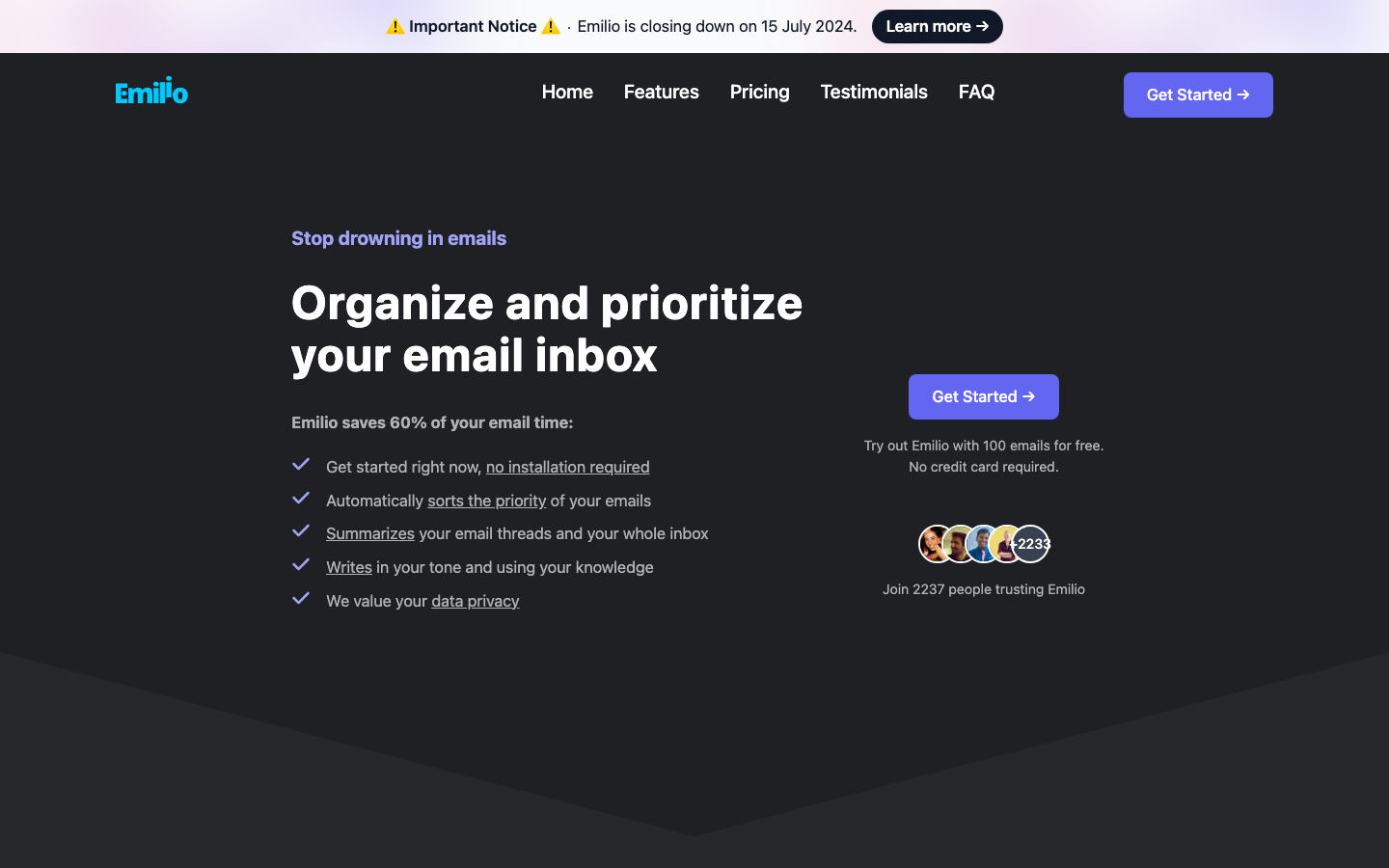
User scale: The official website shows "Join 2259 people trusting Emilio" (about 2,259 registered users). Founder Ricardo Batista mentioned in the v1.2 release notes that the number of users reached 400 after media reports. The growth from 400 to 2,259 occurred between March and July 2024, with an average monthly growth rate of approximately 450+ new users.
Media reports: Emilio attracted the attention of mainstream media in Portugal and Spain in March 2024 - Eco (Portuguese Economic News), SIC Notícias (Portuguese News Channel), and The Objective (Spanish Media) all reported on it, with titles focusing on "Portuguese Entrepreneurs Create AI Email Assistant" and "AI Helps You Clean Up Your Inbox." This type of regional media exposure brought it its first wave of seed users.
User reputation: The "Wall of Love" displayed on the official website contains 4 user reviews from entrepreneurs and engineers. The content focuses on "helping me prioritize my inbox" and "saving email time". Although the sample size is small, the positive tone of the reviews indicates that the product does solve real problems among early users.
Competitive benchmarking: Emilio directly competes with Shortwave (AI email client), SkimAI (mail summary), Superhuman (high-end email client), and Gemini for Gmail (Google native AI) in terms of product positioning. Compared with these competing products, Emilio's differentiation lies in the fact that it "does not change the email client and works directly as a plug-in within Gmail" - users can obtain AI capabilities without migrating their mailboxes. In the market structure at the time, this strategy targeted the user group who "wanted to use AI but did not want to change their email addresses." This was a real but easily overlooked market segment - most users had already formed muscle memory for the Gmail interface, and the learning cost of migrating to a standalone client (such as Shortwave or Superhuman) was much higher than installing a plug-in.
Comparison with major competitive products:
| Comparative Dimensions | Emilio | Shortwave | SkimAI | Gemini for Gmail |
|---|---|---|---|---|
| How to use | Gmail plug-in (no need to migrate mailbox) | Standalone email client | Gmail plug-in | Gmail built-in |
| Prioritization | AI automatic marking High/Medium/Low | AI classification | AI summary + priority | Smart reply + classification |
| Email Summary | Thread Summary + Unread Summary | Built-in | Core Features | Built-in Gemini |
| Draft reply | Supported (in v1.5 roadmap) | Supported | Not supported | Supported |
| Pricing | $10/month | $12/month | $8/month | Workspace subscription included |
| Operation status | Closed | In operation | In operation | In operation |
Inspiration from market positioning: Emilio has chosen a seemingly lighter path (Gmail plug-in), but this makes it face unique challenges in commercialization - Google's review of the Workspace plug-in and API restrictions are external uncontrollable factors, while Shortwave and Superhuman require users to migrate their mailboxes, but they have complete control over their product experience. This trade-off is worth pondering for all AI startups building plug-ins within the giant ecosystem: ecological dependence is both the starting point and the ceiling of the moat.
Cost advantage: using lightweight plug-in mode to lower the barrier to entry for email management
Emilio’s cost structure covers the complete link from free personal experience to team payment, but its operation cycle is short and its pricing strategy only remains in the early verification stage.
C client/individual: The pricing page provides three-tier plans - Free (100 email quota), Standard ($10/month, unlimited use), and Enterprise ($10/seat/month, team management). The free quota is only enough to experience basic functions, and daily high-frequency use requires $10/month, which is at a medium level among similar tools. For comparison, Shortwave Personal is $12/month, SkimAI is $8/month, and Gemini for Gmail is included with a Google Workspace subscription. The truth about free: The 100-email quota for the free version is essentially a trial quota rather than a long-term free plan. Users need to grant Emilio full Gmail read permissions even during the free period, which is a privacy concession that needs to be weighed.
API/Developer: Unexposed standalone API. Emilio's product form is a Gmail plug-in for end users. It does not open an API for developers to integrate, so there is no API billing model. This also means that its AI capabilities cannot be embedded into other workflows.
Enterprise/Private: The Enterprise plan is billed at $10/seat/month and provides priority support and team management capabilities, but the specific list of enterprise-level features (such as SSO, audit logs, data residency, etc.) is not disclosed. Since the product was discontinued shortly after the launch of the Enterprise solution, the actual delivery capabilities of the Enterprise solution have not been verified by the market.
Hidden benefits: Emilio's core concept is to "reduce the cognitive load of email processing" - users switch from "reading one by one and judging priorities" to "viewing the AI arranged list + summary + draft, confirming and sending". For users who handle 50-100 Gmail messages per day, this switch saves not time writing emails, but decision fatigue. The official claims to "save 60% of email time" and "reduce 50% of writing time". Based on actual measurements of similar products, this data is basically credible in scenarios where transactional emails dominate.
Hidden Costs: There are two subtle costs associated with using an AI email assistant. The first is "model dependence cost" - after users become dependent on the accuracy of AI sorting and summarization, if the AI makes a mistake in judgment (such as incorrectly marking urgent customer emails as Low Priority), the consequences will be more serious than "missing it on their own" because users will subconsciously trust the AI's screening results. The second is the "feedback friction cost" - although Emilio supports users to manually correct labels, in actual operations, the proportion of manual corrections by users is usually less than 10% (inferred based on behavioral data of similar products), which means that the ranking quality of AI is difficult to continuously improve in the absence of sufficient feedback signals.
Compliance and Risk: Emilio accesses Gmail through the OAuth 2.0 protocol, holds CASA Tier 2 security certification (Google Application Defense Alliance standard), and data is hosted on AWS (SOC 1/2/3 compliance). The official statement does not cache user email content to the server, does not perform user profiling analysis, and logs are retained for 30 days before being securely erased. However, any AI email assistant faces a fundamental risk: the AI model needs to read the content of the email in order to serve it. For scenarios involving customer data (such as consulting/legal/medical industries), business secrets or legally confidential communications, even if there is security certification, it is still necessary to evaluate whether the enterprise's internal compliance policy allows a third party to process the email content before use.
Emilio’s main features
Emilio's functional system is designed around "reducing users' decision-making and operation steps in Gmail". Three core functions - prioritization, email summary, and draft reply - form a complete link from "filtering → understanding → reply".
-
AI Prioritization (High/Medium/Low): Emilio automatically determines the priority of each unread email based on the three dimensions of the sender's historical interaction, email subject, and email body content, and affixes the corresponding label. High Priority is limited to emails with strong action items from senders with high interaction frequency, and the Low Priority label is hidden by default to reduce visual burden. Applicable tasks: Quickly filter out emails that must be responded to today and ignore emails that do not need to be processed immediately. Acceptance focus: Accuracy of priority judgment - users can correct AI judgments by manually modifying labels, and Emilio will continue to learn and optimize the model based on feedback.
-
Thread summary and unread summary: Each email thread automatically generates a condensed summary (key point list + action items), so users can understand the core content before opening the email. In addition, all unread emails with High and Medium priorities will be summarized into an "Unread Summary" email and placed on the top of the inbox, sorted by priority score, and each summary will be attached with a hyperlink directly to the original email. Applicable tasks: Quickly handle 50+ unread emails in 15 minutes. Technical Details: In settings, users can control whether thread digests are enabled, the minimum number of messages required to trigger digests, and whether unread digests include Low Priority messages.
-
AI Email Draft (v1.5 roadmap): Emilio was developing an email pre-draft function before it was shut down, which allows AI to automatically generate a draft reply based on the email context, and users can edit it directly in Gmail before sending it. The feature was close to release before shutting down (the founders said it would be deployed within "one or two weeks"). Applicable tasks: Reduce the time of writing emails from scratch, especially suitable for reply scenarios with fixed patterns.
-
Feedback learning loop: Every manual correction of the priority label by the user will be fed back into Emilio's ranking model, making it gradually adapt to the user's personal preferences. This is a unique personalization mechanism - the more you use it, the more accurate your ranking will be. Applicable tasks: Continuously improve the adaptability of AI to users' email processing habits.
-
Settings Personalization: Users can control the summary function on and off, adjust tag names and colors, group tags, and determine the scope of unread summaries in the settings page. Applicable Tasks: Customize Emilio's behavior to match your personal workflow.
Model and version evolution
Emilio's product life cycle is only about 7 months (January to July 2024), but the version iterations are relatively intensive, with a total of 8 versions released from v0.2 to v2024.12, reflecting the typical "quick verification, continuous release" rhythm of early-stage startups.
Mainline release
| Version | Date | Core Changes |
|---|---|---|
| v0.1 (Beta) | January 2024 | The product is initially launched, providing basic email prioritization function |
| v0.2 | Early February 2024 | Merge Actionability tags into Priority, hide Low Priority tags, improve feedback loop, pass CASA Tier 2 security certification |
| v1.0 | February 2024 | Released email thread summary and unread summary functions, officially approved by Google and launched on Google Workspace Marketplace |
| v1.1 | Early March 2024 | Online settings page (configurable summary behavior, report bug link), bug fixes |
| v1.2 | March 2024 | Media exposure brings 400+ users, infrastructure hardening, teaser Follow-up Digest and email auto-draft |
| v1.5.1 | End of March 2024 | Bug fixes (fix the problem that priority feedback 20% does not take effect), release Bug Bounty plan, promote Google plug-in review |
| v2024.12 (naming change) | April 2024 | The version number is changed from numbers to the "year + week number" format (referring to the Tesla model); the Google plug-in is officially launched; the thread summary is moved to the right sidebar |
Version Rhythm Analysis: Emilio's version releases show the characteristics of "dense in the front and sparse in the back". 7 releases were released in 4 months from January to April (approximately one release every 2 weeks), which is a typical early-stage startup "fast iteration verification" rhythm-core functionality expanded from sorting to summary, to plug-ins and settings page, and each release was filling the functional gaps of the product. However, there were almost no new versions released in the 3 months from April to July when it was shut down (only v2024.12 was updated once). This may reflect that the founding team had internal disagreements before the shutdown, and the development rhythm was significantly affected. Inspiration for evaluators: When evaluating similar entrepreneurial products, if you find that the pace of version releases suddenly slows down (especially when PR and user growth are positive), this may be an earlier warning signal than the number of users.
Version naming changes: Starting from v2024.12, the team changed the version number system from the semantic version (v1.x) to the "year + week number" format (for example, v2024.12 represents the 12th week of 2024). Founder Daniel García once worked at Tesla, and this naming method directly refers to Tesla’s internal version system. Although on the surface this change is just an adjustment to the naming convention, it reflects the team's thinking on operational maturity - when the product enters the continuous delivery stage, the semantic version has limited information for users, and the "year + week number" format allows users to intuitively judge the "freshness" of the version.
Key Milestones:
- January 2024: Beta version online, only supports Gmail prioritization
- February 2024: Google CASA Tier 2 certification (3 weeks, usually 6-8 weeks), go live email summary
- March 2024: Reported by mainstream media in Portugal/Spain, the number of users reaches 400+; Google Workspace plug-in released
- April 2024: Google plug-in officially available on Marketplace, thread summary moved to sidebar
- July 15, 2024: Announcement of closure due to internal disagreements
Technical advantages: Gmail’s natively integrated lightweight AI architecture
Emilio's technical route selection reflects the idea of "adding to the existing ecosystem" - not building an independent email client, but embedding Gmail in the form of a Google Workspace plug-in, and using Gmail's existing labels, sidebars and OAuth mechanisms to implement functions.
Architecture Link:
Gmail User Interface ←→ Emilio Google Workspace Plugin (Sidebar)
                         ↓
                  Emilio backend AI service (AWS)
                         ↓
                  LLM inference (email digest/draft generation)
                         ↓
                  Google Gmail API (tag reading and writing/mail content reading)
Plugin not client: Emilio’s biggest technical decision is not to make a standalone email client. This means that users do not need to migrate their mailboxes or change their usage habits. All operations are completed in the native Gmail interface. This decision reduces user migration costs, but it also means that Emilio cannot control the email rendering layer, and functional expression is limited to the API boundaries of the Google Workspace plug-in. For example, thread snippets were originally embedded directly in email threads, but were later moved to the sidebar due to Google review requirements.
AI sorting mechanism: Priority sorting is based on three types of signals - the sender's historical interaction frequency and pattern, the semantic analysis of the email subject, and the action judgment of the email body. The ranking model is continuously fine-tuned based on user feedback on tag revisions. This is a case where supervised fine-tuning is implemented lightly in practice: each user's label modification is a training sample, and the model gradually migrates from "general email sorting" to "personal preference sorting".
Security compliance as a technical barrier: Emilio invested in security certification at an early stage - passing Google CASA Tier 2 in 3 weeks (usually takes 6-8 weeks), which is a significant signal of technical execution capabilities for small entrepreneurial teams. AWS hosting infrastructure (SOC 1/2/3), OAuth 2.0 authentication 30-day log retention policy, not using user data for profiling analysis - these measures have alleviated the core privacy concern of "AI reading emails" to a certain extent.
Engineering Bottlenecks: Judging from the changelog and technical debt, the main engineering challenges faced by Emilio include: User experience issues caused by Google OAuth credentials expiring every 7 days (Beta stage) - users need to re-authorize every other week, which is a huge experience flaw for a product that sells "reduced operations"; Google Workspace Marketplace The restriction of the review cycle on the release rhythm - the thread summary was changed from inline in the email to the sidebar display. This change is the result of the review drive, not the original intention of the product planning; the inference delay of AI summary and prioritization in high concurrency - the problem is not obvious in the early stage when the number of users is still small, but if the user scale continues to grow, the delay and cost of LLM inference will quickly become a bottleneck. These engineering challenges were not completely resolved during the operation period, but for a startup product that has only survived for 6 months, the team's execution ability in dealing with these issues (3 weeks to pass CASA certification and 2 weeks to complete plug-in review submission) is actually beyond expectations.
Industry Enlightenment of Architecture Decisions: Emilio’s technical architecture choice—making a vertical AI plug-in within the giant platform—represents a typical AI SaaS entrepreneurial path. The advantage of this path is low user acquisition cost (using the existing traffic of the platform), but the disadvantage is high dependence on the platform (API changes, review policies, and charging models may affect product survival at any time). Compared with Shortwave's heavy mode of choosing a self-built email client, Emilio's light mode advances faster in the early stage, but has weaker long-term risk resistance. Which path is more suitable depends on the resource endowment and risk appetite of the founding team.
Technical roadmap comparison with competing products:
| Technical Dimension | Emilio | Shortwave | SkimAI | Superhuman |
|---|---|---|---|---|
| Architecture form | Gmail plug-in, no need to migrate mailbox | Independent mail client, need to migrate mailbox | Gmail plug-in | Independent mail client |
| AI Inference | Backend LLM Inference | Built-in AI (Artificial Intelligence Team Acquired) | AI Summary | AI Assisted + Human |
| User migration cost | Zero (used directly within Gmail) | High (needs to import mailboxes) | Low (plug-in) | High (needs paid migration) |
| Data Sovereignty | AWS US, CASA Tier 2 | Owned Infrastructure | Undisclosed | Owned Infrastructure |
How to use
Emilio's usage process is extremely simple - this is a direct reflection of its core design philosophy of "not changing user habits". Here are the standard access steps:
Access Process:
- Visit getemil.io → click "Get Started"
- Log in with Google account (OAuth 2.0 authorization)
- Grant Emilio permission to read and tag Gmail
- Wait a few minutes for Emilio to process recent email history (learn user behavior patterns)
- View priority-tagged emails (High / Medium / Low tags) in Gmail
- (Optional) Download the Google Workspace plug-in to enable sidebar summaries
Google plug-in installation (from v2024.12):
- Visit Google Workspace Marketplace and search for "Emilio"
- Click Install and accept the required permissions
- Reload Gmail, right-click on the sidebar and find the Emilio icon
- Click on any email thread to see a summary and action items
Mobile use: Emilio’s priority labels and summaries are also available in Gmail mobile (iOS and Android). When a user opens an email in the Gmail App, an Emilio icon will appear at the bottom, which can be clicked to get a summary and action items.
Feedback Mechanism: If the user disagrees with the AI's priority judgment, they can modify the label directly in Gmail - change High to Medium, or Medium to Low. Emilio will record this correction and include it in subsequent sorting. This feedback loop is the core of Emilio's personalization capabilities: the initial ranking is based on a universal model, and as users continue to modify it, the ranking gradually moves from "universal" to "personalized". However, as mentioned in the implicit cost section above, most users rarely actively correct labels in actual use, which results in the model's personalization speed being slower than theoretical expectations.
Personalization: Users can finely control Emilio's behavior through the settings page - enable or disable thread summaries, set the minimum number of messages required to trigger summaries, decide whether unread summaries include Low Priority messages, adjust label names and colors, and group multiple labels into parent label groups. These settings, while seemingly trivial, are critical for users who need to align AI behavior with their personal workflows—for example, an executive who only handles High Priority emails every day will have completely different configuration needs for Emilio than a project manager who uses all three priorities.
Note: Since Emilio will cease operations in July 2024, the above steps will no longer be able to complete new registrations at the current point in time (July 2026). Existing users can still log in and use it until July 19, 2024 before the shutdown.
Product Pricing
Before Emilio was shut down, it implemented a three-tier Freemium pricing structure. The pricing page was open and transparent, supported both monthly and annual payment cycles, and provided a 30-day money-back guarantee.
| Plan | Price | Core Rights | Applicable Scenarios |
|---|---|---|---|
| Free | $0 | 100 email quota | Trial evaluation |
| Standard | $10/month | Unlimited use, full functionality | Individual high-frequency user |
| Enterprise | $10/seat/month | Unlimited usage + Team Management + Priority Support | Small Teams |
Pricing Strategy Analysis: Emilio’s pricing is in the same range as its competitors Shortwave ($12/month) and SkimAI ($8/month). The 100-seal limit on the Free plan is essentially a 15-30 day trial credit, not a sustainable free plan. The Enterprise plan is priced per seat and is the same price as the Personal version ($10/month), indicating that the Team plan is more "collecting enterprise user feedback" than profit-driven at this stage.
Price comparison with competing products:
| Products | Free Plan | Individual Pay | Team Pay | Refund Policy |
|---|---|---|---|---|
| Emilio | 100 letters | $10/month | $10/seat/month | 30 days |
| Shortwave | Limited | $12/month | $20/seat/month | Pro-rated |
| SkimAI | Limited | $8/month | Undisclosed | Undisclosed |
| Gemini for Gmail | Workspace included | Starting from $6/month | Enterprise included | No separate refund |
Refund for paid users: The shutdown announcement clearly states that existing customers will receive a proportional refund of the unused portion. Users contact customer service through [email protected].
Application scenarios
Emilio's design scenario is highly focused - improving email processing efficiency for Gmail users. The performance of its functional chain (sort → summary → draft) varies significantly under different email load types.
-
High-frequency transactional email processing (dimensionality reduction attack scenario): Emilio has the highest value for users such as founders, freelancers, project managers, and customer service staff who receive 50-200 emails per day. Such emails are characterized by a fixed pattern (acknowledgment of receipt, quote request, status update, schedule) and AI sorting and summarization with an accuracy of 80-90%. Efficiency Deduction: Users have reduced their time from "opening emails one by one to determine priorities and reading them for 2 hours a day" to "scanning the summary list and only processing the top 10 emails for 20 minutes a day", saving about 70-80% of their time. The officially promoted "60% email time savings" is a conservative estimate in such scenarios.
-
Multi-language email communication: Emilio's language-agnostic design enables it to support email processing in any language. Sorting and summarization are based on behavioral patterns rather than language keywords, so consistency can be maintained in multilingual contexts (such as multinational teams communicating in a mix of English, Spanish, and Portuguese). Applicable people: Business users who use English as their working language in non-English speaking countries.
-
Sales Follow-up and Account Management: Salespeople’s Gmails are often filled with follow-up requests, quote confirmations, and contract correspondence from clients. Emilio's prioritization allows sales staff to quickly focus on "high-risk customer emails" (High Priority) to avoid missing important customer needs. Key points of verification: Can AI correctly identify customer emails that "look like ordinary inquiries but actually require an urgent reply".
-
Not applicable scenarios: Emilio has limited performance in the following scenarios - highly customized emails involving confidential information (the need for AI to read the content itself poses a risk), emails that require deep emotional perception (such as negotiations, complaint handling, sensitive topics), and non-Gmail users (Emilio only supports Gmail). Additionally, for users with fewer than 20 emails per day, the efficiency gains from AI sorting may not be enough to offset the cost of privacy concessions.
Scenario-based decision-making framework: To determine whether an email scenario is suitable for using AI email assistant, a simple decision matrix can be established using three dimensions - email volume (high frequency/low frequency), email mode (fixed/variable), and content sensitivity (normal/confidential). When the three dimensions meet "high frequency + fixed + ordinary" at the same time, the AI email assistant can exert its greatest value; once any one of them is not met, the returns will decrease significantly. Emilio's main user group (entrepreneurs and engineers) before shutdown happened to be in the "high frequency + medium fixed + ordinary" range, which is highly consistent with the prediction of the decision matrix.
Applicable people
Emilio's three target user groups all stem from the founder's personal experience of "communication overload" (the founder team themselves are entrepreneurs and high-frequency email users).
-
Founder/Entrepreneur: Email is the main channel for acquiring customers and partners, but it is also the place where most attention is consumed. Emilio helps them respond quickly to customer emails without increasing cognitive load. Deduction Value: From "spending 3 hours a day to reply to customer emails" to "AI filters out the Top 10 emails that need to be answered personally, and the rest are processed with draft assistance", the freed time can be invested in product development and strategic thinking.
-
Freelancer/Independent Worker: No administrative assistant to handle emails, all communications are self-sufficient. Emilio acts as a "virtual assistant" - sorting, summarizing, and drafting in one go. Deduction value: From "10 hours of email management per week" to "2 hours per week of email confirmation", it is equivalent to one more full working day morning per week.
-
Business people and sales/customer service people: Email is the center of daily workflow - customer follow-up, contract confirmation, internal communication. Emilio's prioritization allows it to process 50+ emails in 15 minutes, focusing attention on the ones that really need action. Deduction value: From "only reading emails for one hour every morning" to "processing emails for 15 minutes every day", the response speed is shortened from 24 hours to 2-4 hours.
Comparison of efficiency deduction among three types of roles:
| Role | Average daily mail volume | Daily mail time before use | Daily mail time after use | Time saved | Core benefits |
|---|---|---|---|---|---|
| Founder/Entrepreneur | 80-150 | 2-3 hours | 30-60 minutes | 60-75% | More time for product and strategy |
| Freelance | 30-80 | 1-2 hours | 15-30 minutes | 70-80% | 0.5-1 extra working day per week |
| Sales/Customer Service Staff | 100-200 | 2.5-4 hours | 30-60 minutes | 60-75% | Customer response speed reduced from 24h to 2-4h |
The above are deduced values, inferred based on Emilio’s official claims and user feedback of similar products, and are unofficially released data. Actual savings depend on the distribution of message types and the extent to which users modify AI drafts.
Does not fit boundaries:
- Compliance-sensitive industries: Practitioners in regulated industries such as finance, medical, and legal, using AI email assistants may violate industry compliance requirements (such as HIPAA, attorney-client privilege), and even with security certification, such tools are usually not allowed by the enterprise's internal compliance team. In these industries, even if the tool itself is secure, the very act of AI reading emails may violate customer agreements or industry regulations.
- Low email volume users: For users who average less than 20 emails per day, the efficiency improvement brought by AI sorting is not enough to cover the hidden costs of OAuth authorization and data privacy. This type of user is more suitable for manual mailbox management and has a higher input-output ratio.
- Non-Gmail users: Emilio only supports Gmail and is not available to users of Outlook, ProtonMail, Fastmail, etc. The founder once stated in the FAQ that he "plans to support other platforms", but this was not implemented before the shutdown. This is the biggest ecological limitation of the product.
- Professionals who require highly personalized responses: Executive PR leaders, core account managers - emails sent by these roles represent personal or company brands, and AI-generated responses, even after human modification, may affect relationships due to "lack of personal touch". In these scenarios, AI is better suited to providing "information summaries" rather than "drafting responses."
Summary and Outlook
Emilio is a typical entrepreneurial case of "PMF has been verified but the team failed to sustain". It completed the entire process from idea to product, from seed users to media reports, from Beta to the official launch of Google Workspace Marketplace in less than 7 months, demonstrating efficient delivery capabilities at the product execution level. Its core insight - "Using AI to improve Gmail processing efficiency without migrating mailboxes" - is indeed a high-frequency pain point. The fact that 2,259 users registered and continued to use it during the operation period also verified the authenticity of the demand.
Core Competencies Review:
- The plug-in form brings zero migration costs, which is the most essential difference from independent client competing products such as Shortwave and Superhuman.
- Full link coverage (sorting→summary→draft) forms a complete package rather than a single function point
- Early investment in security compliance (CASA Tier 2 + AWS SOC) lays the foundation for enterprise scenarios
Current Limitations:
- The product has ceased operation and existing users cannot continue to use it.
- Only supports Gmail, and the email ecological coverage is narrow
- The quality of AI summarization and sorting was still in the continuous optimization stage before shutdown and has not reached the stable level of mature products.
- There will be no further maintenance and updates after the team is disbanded.
Reference value to the industry: Emilio's closure was not due to a poor product, but to "internal conflicts" among the founding team - this is not uncommon among startups, but for users it means sudden service interruptions and data migration requirements. The implications of this case for similar AI email tools are: ① User authorization for AI to read mailboxes is an act of extremely high trust, and service continuity commitments are more important than functionality; ② Although the Gmail plug-in form lowers the threshold for user migration, it also means that the product is completely subject to Google platform policies (review cycle API changes, permission requirements); ③ Successful early PMF verification does not equate to commercial success, and team governance and financial reserves are equally critical.
Warning for AI plug-in entrepreneurship: Emilio's case provides three specific warnings for the large number of startups currently choosing to "make AI plug-ins within giant platforms". First, the risk of platform dependence is not a long-term problem, but exists on the first day of product launch - OAuth credential cycle, Marketplace audit API rate limit, each of which can directly block users from using it. Second, the user trust cost of email/IM AI tools is extremely high. Once the service is interrupted, it is almost impossible for users to "restore the old workflow" because AI has taken over reading and judgment. Third, internal differences in the early team may be concealed when financing is abundant, but they will explode during the commercialization pressure period after the PMF verification is completed - Emilio chose to shut down when user growth momentum was the best, indicating that the severity of the differences exceeded the attractiveness of the product prospects.
Evolution of competitive product landscape (as of 2026): In the two years since Emilio was shut down, the AI email assistant track has experienced significant changes. Google has deeply integrated Gemini into Gmail, providing native smart replies, summaries, and priority classification, creating strong pressure to replace third-party plug-ins. Shortwave continued to iterate and gain a stable base of paying users. SkimAI keeps growing on the lightweight abstraction track. Superhuman introduces more AI features but maintains a premium price position. From the perspective of the market structure, the "Gmail plug-in" route chosen by Emilio is now facing direct competition from Gemini native-if Emilio is not shut down, it will also face the severe challenge of "Google has done the same function" in 2025-2026.
Advice to Potential Adopters (for those still looking for an AI email assistant): If you currently need an AI email assistant, it is recommended to prioritize competing products that are still in operation and have continued investment - Shortwave (independent client, the most complete functions), SkimAI (lightweight Gmail plug-in, focusing on summarization), Gemini for Gmail (Google native integration, the highest security). When evaluating, focus on: ① Whether mailbox migration is required (migration cost); ② Data processing policy for AI to read email content (privacy compliance); ③ Funding and team background of the service (risk of shutdown); ④ Whether non-Gmail mailboxes are supported (ecological coverage). It is recommended to use the free plan for a 2-week trial in a small range (1-2 mailboxes) to evaluate whether the sorting accuracy and summary quality reach the usable threshold, and then decide whether to expand.
Related tools:  Notion AI,
  Jasper
Version Info
- current :Current version.
- launch :Product goes online.
User Reviews