 Flowise
Free
Flowise
Free
Flowise is an open source AI Agent low-code builder that builds chatbots, RAG retrieval enhancements and Agent workflows through visual drag-and-drop nodes. It supports self-hosting and cloud deployment. GitHub 33K+ Stars.
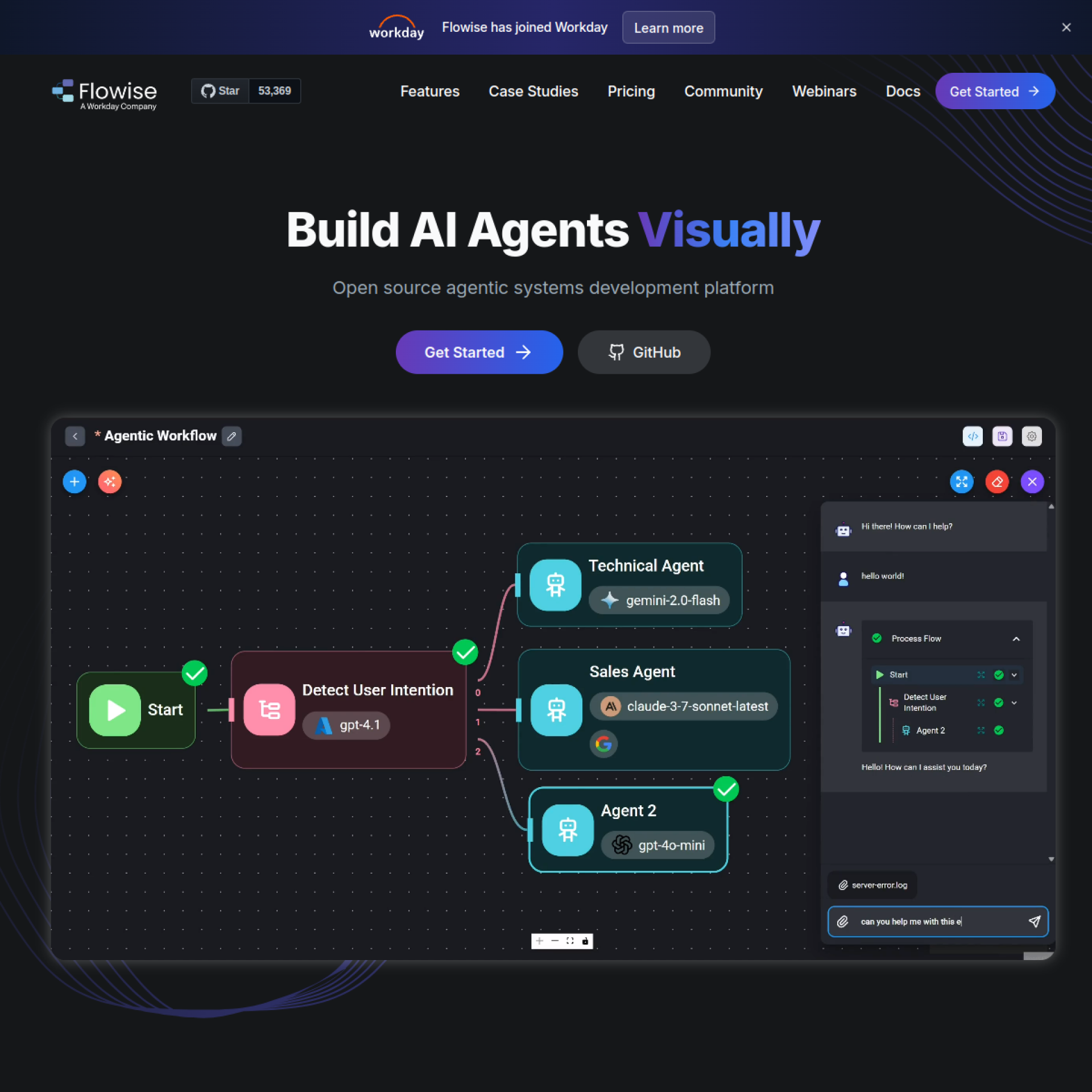
Flowwise
Flowise’s core parameters and statistics
Flowise uses visual nodes to reduce the coding process of LLM application building. It is currently one of the open source LLM application builders with the highest number of stars.
| Projects | Public Information |
|---|---|
| Product positioning | Open source low-code LLM application builder |
| Core capabilities | Visual orchestration, RAG, Agent, tool invocation, multi-Agent |
| Deployment method | Self-hosted (Docker/npm) + Flowise Cloud |
| Latest version | 2.2.6 (2026-07-15) |
| GitHub Stars | 33K+ |
| Integrated LLM | OpenAI, Anthropic, Google, Azure, Ollama and more |
| Integrated vector library | Pinecone, Weaviate, Chroma, Qdrant, etc. |
| License | Apache 2.0 |
Positioning boundaries: Flowise allows developers without deep learning background to build LLM applications, but the output is an "orchestrated workflow" rather than a customized model training platform.
Flowise’s user and market recognition
Open Source Community: 33K+ Stars on GitHub, one of the most popular open source projects in the LLM app builder category. Community contributions are active, and Issues and PRs are responded to in a timely manner.
Enterprise Adoption: Flowise Cloud provides hosting services, indicating that there are already a certain number of enterprise users willing to pay for hosting.
Competitive product comparison: Similar products include LangFlow, Dify, and FastGPT. The advantages of Flowise are a more pure visual drag-and-drop experience and wider model/vector library integration.
Flowise’s cost advantage
| Cost Hierarchy | Description |
|---|---|
| C-side/Developer | The open source version is self-hosted for free and only needs to bear the infrastructure cost |
| Team | Flowise Cloud is billed based on usage/seat, please refer to the official pricing page for details |
| Enterprise | Can be self-hosted, data is completely controllable, and needs to be maintained and operated by itself |
Cost comparison: Compared with developing an LLM orchestration system from scratch (requiring 2-3 man-months of back-end work), Flowise can compress the construction time to days, and the cost of iterative maintenance is lower. In self-hosting mode, data does not leave the corporate network, meeting compliance requirements.
Main functions of Flowise
- Visual drag-and-drop orchestration: Build LLM application links by dragging nodes, and you can complete LLM calls, prompt assembly, logical branches, etc. without writing code. Applicable value: Lower the threshold for LLM application development.
- RAG search enhancement: Access the vector library to implement knowledge base Q&A, supporting multiple blocking strategies and retrieval methods. Value for use: Let LLM answer questions based on private enterprise data.
- Agent and tool calling: Create an AI Agent that can call external tools (search, API, database, etc.) to complete complex multi-step tasks. Applicable value: automatic execution capabilities beyond a single round of question and answer.
- Multi-Agent Orchestration (AgentFlow): Orchestrate multiple Agents to collaborate to complete complex workflows, and context and results can be transferred between Agents. Applicable value: Handling complex tasks that require "division of labor and collaboration".
- API Exposure: Publish the orchestrated process as a REST API or embedded Chat Widget. Applicable value: Integration into existing products requires no additional development.
Flowise’s model and version evolution
This product provides services in an online Web form, and no standardized version log is disclosed through public channels. The following are recorded in public milestones:
| Version | Time | Change Points |
|---|---|---|
| Early included version | ~2026-07 | Using the public page capability as the included baseline, there is no official precise date yet |
| Current public version | ~2026-07 | Continuous iteration and optimization of product capabilities, specific changes are subject to the official update log |
Version Note: The official unified version number and precise release date have not been disclosed. The above milestones are based on external collection information. It is recommended to pay attention to official channels to get the latest version updates.
Flowise’s technical advantages
Mechanism: Flowise adopts the abstraction method of "node as component". Each Flowise node encapsulates a specific capability (LLM call, vector retrieval, Prompt template, etc.), and the nodes are connected through a directed graph to form an execution DAG.
Effect: Visual orchestration eliminates the trouble of handwriting Python glue code, allowing non-technical roles such as product managers and operations to participate in LLM application building.
Engineering Advantages: Supports Docker one-click deployment, npm global installation, and can be used out of the box. The front-end is implemented based on React Flow and the back-end is Node.js. The cost of extending new node types is low.
How to use Flowise
| Entrance | Method | Suitable objects |
|---|---|---|
| Self-hosted | npx flowise start or Docker deployment |
Developer/Team |
| Flowise Cloud | Hosted version, ready to use | Teams who don’t want to maintain infrastructure |
| API Integration | Publishing Flow as a REST API | Developers who need to embed into existing systems |
Typical usage steps:
- Installation (Docker or
npx flowise start) - Open the Flowise editor in your browser
- Drag and drop LLM nodes, Prompt nodes, and vector library nodes to form a workflow
- Connect each node to form an execution link
- Click Test to verify the output results
- Publish as API or Chat Widget
Flowise’s Product Pricing
| Plan | Price | Core Benefits |
|---|---|---|
| Open Source Edition | Free | Self-hosted, fully functional, Apache 2.0 licensed |
| Flowise Cloud | By usage/seat | Hosted operation, automatic upgrade, team collaboration |
The specific Cloud pricing is subject to the official page. The self-hosted version has no feature limitations.
Application scenarios of Flowise
- Enterprise Knowledge Base Q&A: Import enterprise documents into the vector library and build a RAG-based knowledge base Q&A robot. The preferred solution for new employee training documents, product manuals, internal FAQs and other scenarios.
- Intelligent customer service robot: Arrange customer service processes through Flowise, access FAQ data sources + LLM dynamic replies, automatically handle common customer issues, and transfer complex issues manually.
- Automated Agent Workflow: Orchestrate multiple Agents to complete tasks that require multi-step, multi-tool collaboration, such as data analysis report generation and competitive product information collection.
Flowise’s applicable groups
- Backend/Full Stack Developer: Quickly build an LLM application prototype and verify the product concept before deciding whether to rewrite it.
- Product Manager/Operations: Complete simple LLM workflow independently through visual orchestration, reducing dependence on the development team.
- Enterprise AI Team: Self-hosted Flowise serves as an internal LLM orchestration platform to uniformly manage enterprise AI applications.
Not suitable for the crowd: Scenarios that require highly customized model training or fine-tuning (the Fine-tuning platform should be selected); low-latency scenarios that have extreme requirements for orchestration performance (may be different from self-developed solutions).
Flowise’s Summary and Outlook
Flowise is known for its open source low-code and self-hosting capabilities and is a benchmark project in the LLM application builder category. The Apache 2.0 license is commercial-friendly.
Current limitations: Performance decreases when the number of nodes increases in complex orchestration scenarios; Flowise Cloud pricing transparency is insufficient; quality control of community plug-ins relies on community feedback.
Procurement/Adoption Risk Assessment: The open source version is a zero-cost entry, suitable for verification as the "preferred solution" for building LLM applications. It is recommended to pilot in non-core scenarios first, evaluate node performance and operation and maintenance costs, and then expand to the production environment. Enterprise self-hosting needs to pay attention to forward compatibility when upgrading versions.
Related tools:  CrewAI,
  LangChain
Version Info
- Flowise 2.2.6 :Enhanced Agent tool calling capabilities, fixed multiple bugs, and optimized the stability of RAG links.
- Flowise 2.2.0 :Introduce multi-Agent orchestration and improved dialogue management, and expand tool calling capabilities.
- Flowise 2.0 :Major architecture upgrade, introducing AgentFlow multi-Agent orchestration capabilities, and reconstructing the front-end interface.
User Reviews