 Forefront
Free
Forefront
Free
Forefront is an AI tool product for business and content teams, suitable for quickly verifying production capabilities and collaboration efficiency in real tasks.
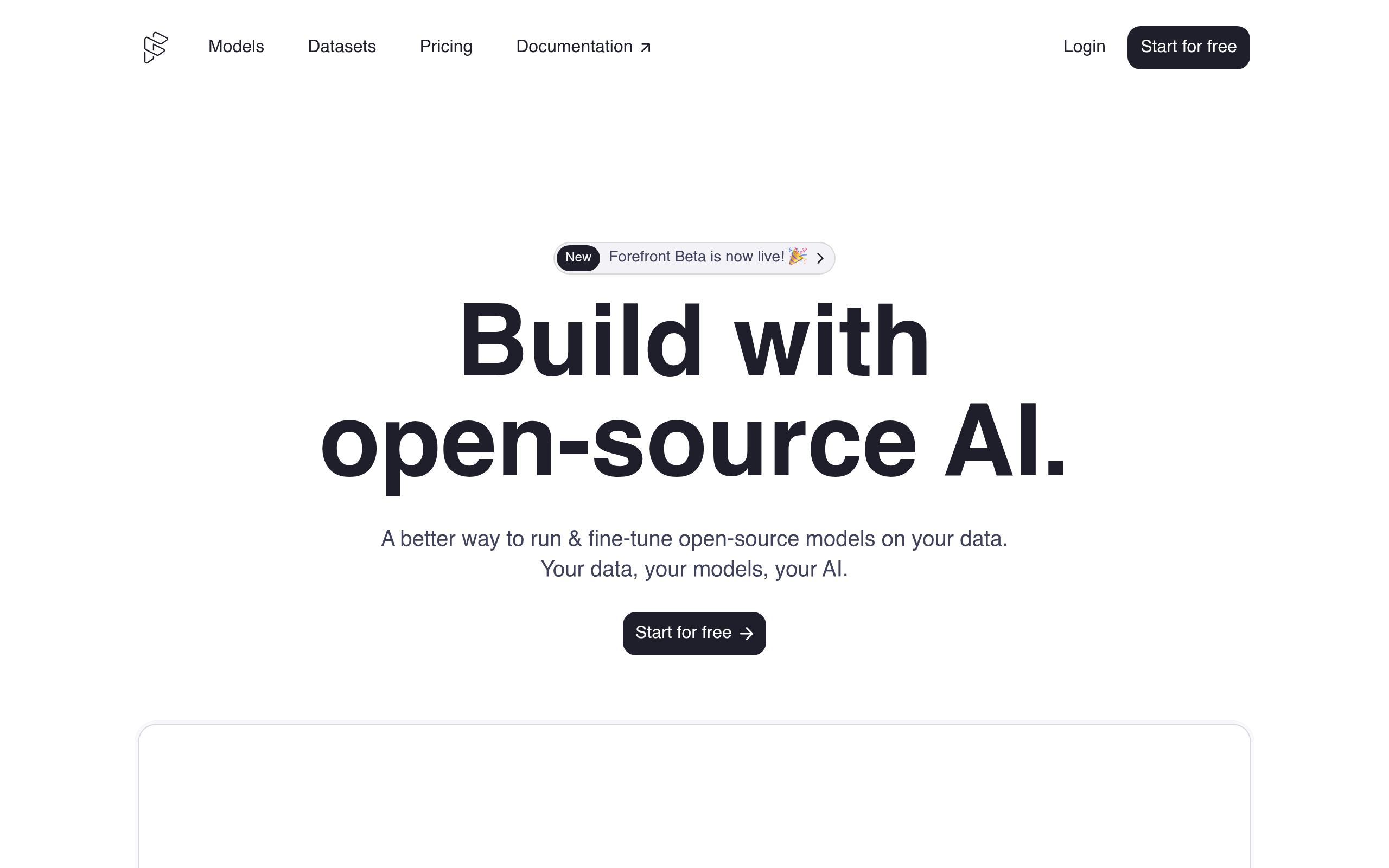
Forefront
Core parameters and statistics
Forefront is an open source large model fine-tuning and inference platform for developers. The core delivery form is OpenAI-compatible API service + Web management console. The biggest difference between it and mainstream "AI chat applications" is that users do not directly consume the model output, but inject their own data into the open source base model through fine-tuning, and then provide external services through API or self-hosting after obtaining the exclusive model.
| Projects | Public Information |
|---|---|
| Product Form | SaaS Platform (Web Console + API) |
| Product positioning | Open source model fine-tuning and inference service platform |
| Supported base models | Phi-2 (3B), Mistral-7B (7B), Mixtral-7Bx8 (46.7B, coming soon) |
| API compatibility | OpenAI compatible interface (chat/completions + completions) |
| SDK Languages | Python, Node.js/TypeScript |
| Billing model | Pay by token (Serverless serverless inference) |
| Data governance | Requests are not logged, not used for model training, and users retain model ownership |
| Platform Support | Web |
| Current Stage | Beta Public Testing |
Forefront: Forefront is not a general AI chat tool, nor a model training platform (it does not provide pre-training capabilities from scratch), but a full-stack hosting service of "fine-tuning + inference". Its core value lies in reducing the migration cost from "closed source API dependence" to "open source model independent control". It is suitable for development teams that already have data accumulation and want to get rid of single supplier lock-in.
User and market recognition
Forefront's market positioning is in the "developer infrastructure" rather than the mass consumer products track. Its popularity is reflected in the reputation of the technical community and developers, rather than the number of C-end users.
Developer Community Feedback: Forefront has received some attention in the Hacker News and GitHub communities. The core discussion point focuses on the combined value of "OpenAI compatible API + open source model fine-tuning" - developers can switch from GPT-4 to a self-tuning open source model with almost zero code changes. The product is currently in the Beta stage, and the number of registered users and active API calls has not yet been announced.
Competitive Product Landscape: Forefront’s direct competitors include Anyscale Endpoints, Together AI, Fireworks AI, Replicate and other platforms that also provide open source model inference as a service. The differentiation lies in three points: first, the built-in Pipelines data pipeline (complete control of converting production data into fine-tuned data sets); second, emphasis on model ownership and exportability (the fine-tuned model weights can be downloaded and self-hosted, not locked in the platform); third, product pricing is transparent and open (the unit price per thousand tokens is listed directly on the homepage).
Disclosure boundary: Officials have not uniformly disclosed the number of paying customers, revenue data and financing information. The company was founded in 2021 and has been backed by Y Combinator. Its team members are mainly located in North America. Enterprise-level adoption cases are subject to official real-time disclosure.
Cost advantage
Forefront's cost structure revolves around the core proposition of "replacing closed source APIs with open source models". Its pricing logic is not "cheap", but "predictable + controllable".
C-side/individual developers: Free registration and playground trial quota are provided, but the specific quota of the free tier (token upper limit, number of fine-tuning) is not clearly announced on the official website. Individual developers can complete Proof of Concept at zero cost, but before entering the production stage, they need to switch to paid API calls.
Developer/API call: Billed by token, the price difference between models is determined by the parameter magnitude.
| Model | Price (per thousand tokens) | Amount of parameters | Applicable scenarios |
|---|---|---|---|
| Phi-2 | $0.0006 | 3B | Simple text classification, summary, data cleaning |
| Mistral-7B | $0.001 | 7B | General dialogue, customer service, medium complexity reasoning |
| Mixtral-7Bx8 | $0.004 | 46.7B (MoE) | Complex reasoning, code generation, high-precision requirements |
Taking an average daily load of 1 million tokens (about 400 pages of English text) as an example, the daily cost of using Mistral-7B is about $1 (1000 × $0.001), and the monthly cost is about $30—far lower than the cost of GPT-4o calls with the same throughput (the latter is priced at about $2.5–$10/million token input in 2024, and the output is more expensive). Hidden Cost: The token consumption and training time of the fine-tuning itself need to be included in the additional calculation - the computing power cost of a medium-scale fine-tuning (100,000 samples × 512 tokens) ranges from tens to hundreds of dollars, which is subject to the official real-time pricing.
Enterprise/Private: Forefront supports exporting fine-tuned model weights, and users can deploy them to their own GPU clusters or third-party clouds. This means that enterprises can migrate the final model to private contextual inference after the platform completes data preparation and fine-tuning iterations, avoiding long-term API call fees. Enterprise-level deployment terms (SLA, data residency, compliance certification) need to be confirmed through business communication, and the official pricing page does not disclose the details of the enterprise package.
TCO comparison with closed source API: Assuming a medium-sized SaaS product calls 5 million tokens every day, the monthly cost of using GPT-4o (~$5/million token input + ~$15/million token output) is about $3000–$10000+; the monthly cost of using Forefront fine-tuned Mistral-7B ($1/million token) under the same load is about $150–$500, the difference expands exponentially as the call volume increases. However, it needs to be offset by the labor cost of the initial investment in fine-tuning (data preparation, experimental parameter adjustment, evaluation and verification).
Main functions
Forefront's functional design revolves around the complete concept of "data → fine-tuning → evaluation → reasoning → iteration". It is not an independent API agent, but a model life cycle management platform that can precipitate data assets.
-
Fine-tuning: This is the core capability of Forefront. Users upload a data set in JSONL format (Chat ML and Prompt-Completion formats are supported), select a base model (Foundation Model, Community Model or existing fine-tuning model), configure the number of training rounds (Epochs) and validation set, and start the fine-tuning task with one click. After fine-tuning is completed, the model is automatically deployed to the Serverless endpoint. Functional value: Lower the fine-tuning threshold from "requiring ML engineering team to maintain GPU cluster" to "upload data + click button", allowing the product team rather than the algorithm team to lead model customization.
-
Inference API: Provides OpenAI compatible Chat Completions and Completions endpoints. This means that existing OpenAI SDK calling code only needs to modify
base_urlandapi_keyto switch seamlessly. Supports standard parameters such as streaming output (streaming), pause sequence (stop), temperature, max_tokens, etc. Functional value: Eliminate the engineering transformation cost of "switching model suppliers", and developers do not need to rewrite the calling logic. -
Pipelines data pipeline: This is the key design that distinguishes Forefront from pure inference platforms. Pipelines allows users to automatically store production-bound LLM call logs as structured JSONL data sets, forming a forward cycle of "use the best model to generate data → use data to fine-tune smaller models → use smaller models to reduce inference costs". Functional value: Solve the cold start problem of "where does the data come from" in fine-tuning scenarios, allowing data assets to accumulate naturally with use.
-
Evals & Validation: Automatically run Loss Chart, validation set inference and standard evaluation benchmarks (MMLU, TruthfulQA, MT-Bench, ARC, HumanEval, AGIEval) after fine-tuning is completed. Users can talk to the fine-tuned model in real time in the playground and compare the performance of different versions. Functional value: Provide quantitative basis to judge "whether fine-tuning is effective" to avoid iteration based on feelings.
-
Model Import/Export (Import & Export): Supports direct import of models from HuggingFace (paste the model string to infer), and also supports exporting fine-tuned model weights to a standard format for self-hosting. Functional Value: Avoid platform lock-in - users can migrate models to their own infrastructure at any time without worrying about switching costs.
-
Playground experiment: The interactive debugging platform on the web page supports switching models, adjusting parameters, and comparing outputs in the UI, which is suitable for rapid prototype verification.
Model and version evolution
Forefront's product iteration has undergone a significant transformation from "universal AI chat interface" to "developer infrastructure". Understanding this evolution can help assess the maturity and future direction of current products.
Early Stage: Forefront Chat (2021–2023)
Forefront initially entered the market in the form of an "AI chat client" with a positioning similar to Poe.com - aggregating multiple models such as GPT-4, Claude, and LLaMA in one interface, providing enhanced functions such as dialogue management and role setting, and its target users are knowledge workers and individual creators. Products during this period gained initial user attention, but faced gross profit pressure due to insufficient differentiation and reliance on third-party model APIs.
Transformation Phase: Fine-tuning and Inference Platform (2023–2024)
With the maturity of the open source model ecosystem (the explosion of Mistral, Phi, LLaMA and other series), Forefront has shifted its strategic focus from "aggregation chat" to "open source model fine-tuning and inference services". Direct signals of this transformation include:
- End of 2023 – Early 2024: Launch of Fine-tuning API and Pipelines data pipeline to support users to fine-tune open source models with their own data.
- 2024: OpenAI compatible inference endpoint Playground, Evals evaluation system, and model import/export capabilities will be launched. The homepage of the official website has been completely changed from the slogan "Aggregation Chat" to "Build with open-source AI".
Current version (2024–2026, Beta)
The current product is in the Beta stage and is driven by "fine-tuning + serverless inference" dual engines. The official does not use semantic version numbers, but updates platform capabilities through continuous delivery. The Beta label indicates that the product is still rapidly iterating in terms of functional completeness and service stability, and has not yet reached the maturity of official release (GA).
Historical nodes
| Time | Milestone | Description |
|---|---|---|
| ~2021 | Company established | Supported by Y Combinator, initially entering the market with AI chat aggregation tool |
| ~2023-Q4 | Fine-tuning function goes online | Strategy shifts to open source model fine-tuning, supporting base models such as Mistral-7B |
| ~2024-Q1 | Pipelines + API release | Launch of data pipelines and OpenAI compatible inference endpoints to form a complete product system |
| ~2024-Q2 | Beta public testing | The official website has been revised to position developers, and Playground, Evals, and model import and export have been launched |
The official has not disclosed the precise release date. The above time nodes are calculated based on public pages and document history, and are subject to official real-time announcements.
Technical advantages
The technical value of Forefront is reflected in "reducing system friction in migrating from closed source to open source", rather than benchmarking against basic model manufacturers in terms of model inference speed or accuracy.
Design trade-offs for OpenAI compatible APIs: By implementing the /v1/chat/completions and /v1/completions interface signatures consistent with OpenAI, Forefront allows developers to switch underlying models without modifying the application code. This design eliminates the sunk cost of "changing model suppliers" at the engineering level - for existing projects that are already connected to OpenAI, migrating to Forefront only requires changing two lines of configuration (API Key + Base URL). The trade-off is that the product is limited to a subset of the capabilities of the OpenAI API and cannot expose the unique features native to the open source model (such as the fine-grained control of HuggingFace Transformers).
Serverless serverless architecture: The inference endpoint adopts a serverless architecture that automatically scales according to the number of calls. Users do not need to pre-purchase GPU instances or manage inference queues. There is no charge when the load is low, and the capacity is automatically expanded when the load is high. For development teams with large call volume fluctuations (such as customer service robots with high concurrency during the day and internal tools with almost no traffic at night), this architecture is more economical than building a self-built GPU cluster.
Product-based encapsulation of the fine-tuning process: Forefront simplifies the complex parameters in fine-tuning (learning rate, batch size, optimizer selection, gradient accumulation, etc.) into three steps: "select the model + transfer the data set + select the number of rounds". The bottom layer automatically handles training resource scheduling, Checkpoint storage, model weight merging and deployment. For non-ML professional back-end development teams, this is a design that significantly reduces the cost of fine-tuning and debugging.
Data sovereignty and model ownership: The official statement clearly states that it will not record the content of API requests and will not use user data for secondary training. Users can export the fine-tuned model weights at any time, which means that even if the Forefront platform stops serving, the user’s trained model assets will not be lost. This strategy has hidden advantages in industries with strict data compliance requirements (finance, medical, legal).
Technical comparison with competing products:
| Dimensions | Forefront | Together AI / Fireworks | Replicate | Self-built (HuggingFace TGI + GPU) |
|---|---|---|---|---|
| API compatibility | OpenAI compatible | OpenAI compatible | Custom interface | Need to package by yourself |
| Fine-tuning process | Productization (UI + API) | Productization (UI + API) | API only | Fully self-controlled |
| Model export | ✅ Support download weights | ❌ Lock within the platform | ❌ Lock within the platform | — |
| Data pipeline | ✅ Pipelines | ❌ None | ❌ None | Need to build by yourself |
| No operation and maintenance | ✅ Serverless | ✅ Serverless | ✅ Serverless | ❌ Operation and maintenance required |
| Entry barrier | Lowest (two lines of code switching) | Lower | Low | High |
How to use
Forefront's usage paths cover different depths from "two lines of code access reasoning" to "complete fine-tuning process". Developers can choose the entry point according to their own needs.
Quick Access to Inference API: For projects that already have OpenAI SDK integration, switching to Forefront only requires two changes:
from openai import OpenAI

# Just modify base_url and api_key
client = OpenAI(
    api_key="<YOUR_FOREFRONT_API_KEY>", # Generated in forefront.ai Playground
    base_url="https://api.forefront.ai/v1"
)

response = client.chat.completions.create(
    model="mistralai/Mistral-7B-v0.1", # Use the model ID hosted by Forefront
    messages=[
        {"role": "system", "content": "You are a helpful assistant."},
        {"role": "user", "content": "Explain what fine-tuning is."}
    ],
    temperature=0.7,
    max_tokens=512,
    stream=True
)

for chunk in response:
    if chunk.choices[0].delta.content:
        print(chunk.choices[0].delta.content, end="")
The model ID format is {creator}/{model_name} (such as microsoft/Phi-2, mistralai/Mistral-7B-v0.1), and the fine-tuned model ID is {team_name}/{fine_tuned_model_name}. The complete model list is subject to official documentation.
Basic steps to complete a fine-tuning:
- Prepare the data set: Collect input-output pairs and format them into JSONL (Chat ML format or Prompt-Completion format). Each sample represents a complete conversation or a single round of question and answer.
- Upload data: Upload the JSONL file on the Datasets page of the Forefront Web console, or write directly through the API.
- Create fine-tuning task: Select the base model (Foundation/Community/Existing fine-tuning model), select training and validation data sets, configure the number of Epochs (it is recommended to start with 2–4 rounds), and click Fine-tune to start.
- Evaluation results: After fine-tuning is completed, check the Loss Chart and validation set output; if the performance is insufficient, collect more high-quality data or adjust Epochs and then fine-tune again.
- Putting into production: The fine-tuned model is automatically registered as an inference endpoint and used through API call
{team_name}/{model_name}; the weights can also be exported and self-hosted.
Use Pipelines to continuously accumulate data: Introduce the forefront.ff SDK into the production code, and automatically write the LLM request/response pairs generated when the application is running into the Forefront data set, forming a continuous data reflow. This is especially efficient in the scenario of migrating from GPT-4 to a self-tuned model - first let GPT-4 handle production traffic, precipitate high-quality examples through Pipelines, then use these data to fine-tune Mistral-7B, and finally switch to a self-developed model.
| How to use | Time to get started | Suitable scenarios |
|---|---|---|
| Inference API (direct call) | 5 minutes | Quick switching of projects that have been integrated with OpenAI |
| Playground interactive debugging | Real-time | Model selection and Prompt engineering experiments |
| One fine-tuning (with data set) | 30 minutes | Model optimization for customized scenarios |
| Pipelines fully closed | 1–2 days integration | Long-term continuous optimization of model quality |
Product Pricing
Forefront adopts a serverless model that is billed by token, and is only billed when inference occurs, with no pre-purchased instance fees. Its pricing is more transparent than most similar platforms - core model prices are listed directly on the homepage.
| Model | Price per thousand tokens | Description |
|---|---|---|
| Phi-2 (3B) | $0.0006 | Suitable for simple classification, summary, and data cleaning |
| Mistral-7B (7B) | $0.001 | General reasoning, the most cost-effective |
| Mixtral-7Bx8 (46.7B) | $0.004 | Coming soon, suitable for complex tasks |
Fine-tuning fee: Fine-tuning training itself consumes computing resources and is billed based on token processing volume. The specific rates are not clearly announced on the official website. You need to check the real-time estimate when creating the fine-tuning task. Fine-tuning the inference verification step also incurs inference token fees.
Pipelines storage fees: Production data stored through Pipelines occupies persistent storage. Whether storage fees are incurred is subject to the official real-time pricing page.
Free Trial: Provides free registration and limited trial quota, but the specific token quota and functional limitations of the free tier are not clearly stated on the official website. There may be adjustments during the beta period.
Enterprise Pricing: Enterprise-level volume discounts, privatized deployment support SLA guarantee, etc. Please contact the business team for a quote. The official pricing page does not disclose details of the enterprise package.
Reference for price comparison with competing products (units per million tokens, approximate value):
| Services | Mistral-7B Inference | Fine-tuning Costs | Remarks |
|---|---|---|---|
| Forefront | ~$1 | Undisclosed | Support model export |
| Together AI | ~$0.6–$1 | Billed by training volume | Does not support model export |
| Replicate | ~$0.65–$1 | Billed by training time | Does not support model export |
| Build yourself (A100 on demand) | ~$3–$8 (including GPU amortization) | Depends on GPU usage | Fully controllable but requires operation and maintenance |
Forefront's cost is controllable in the "medium-scale inference + fine-tuning" scenario, but for ultra-large-scale inference (average daily hundreds of millions of tokens), the marginal cost of self-built GPU clusters may be lower.
Application scenarios
Forefront covers four types of proven scenarios in the two directions of "migration from closed source to open source" and "low-cost model customization":
-
Migrate from GPT-4 to self-controlled model: This is the core scenario at the beginning of Forefront's design. The team first used GPT-4 to process production traffic, automatically collecting request-response data through Pipelines, then used this data to fine-tune small open source models such as Mistral-7B, and finally switched to self-tuning models to obtain lower latency, lower costs, and fully controllable model behavior. Applicable signals: Mature products whose monthly API fees have significantly affected profit margins; businesses that have compliance requirements for model behavior consistency (closed source models may be updated at any time, causing output changes).
-
Vertical field customer service robot: Use the company's historical customer service conversation records to fine-tune the base model so that the model understands the specific product knowledge base and response style. Fine-tuned Mistral-7B generally outperforms non-fine-tuned GPT-4 in vertical domains because the general model lacks deep understanding of product terminology and business processes. Implementation Tips: Customer service scenarios are sensitive to latency. After fine-tuning, the inference latency of Mistral-7B is much lower than that of GPT-4, and it can run on low-end GPUs. It is recommended to reserve 1000–5000 high-quality conversation records as the initial training set.
-
Content production and document processing automation: Organize brand writing specifications, historical manuscripts and editorial feedback into fine-tuned data sets to train exclusive writing models. It is suitable for scenarios such as news summary generation, batch rewriting of product descriptions, and marketing email personalization. Implementation Tips: The output quality standards of content production scenarios need to be quantitatively verified by Evals (such as BLEU, ROUGE and other indicators) to avoid misjudgment of fine-tuning effects caused by subjective judgment.
-
"Rehearsal" before privatized model deployment: Enterprises (finance, medical, government affairs) that have strict requirements for data sovereignty first use Forefront's fine-tuning and evaluation capabilities to complete model selection and iteration, and then export the final model to a private cloud or local GPU server after confirming that the effect is up to standard. Business value: Avoid the upfront investment of a large number of trial and error experiments on self-built GPU clusters, and control the sunk cost of "selection + fine-tuning" within the scope of pay-as-you-go.
Not suitable for scenarios: Forefront is not suitable for research teams that train large models from scratch (the platform does not provide pre-training capabilities); it is not suitable for real-time online services that require extreme inference throughput (the Serverless architecture has a cold start delay under large concurrency); it is not suitable for individual users who only need simple conversations (there are more mature free chat tools available).
Applicable people
-
Independent developers and start-up teams: Get exclusive fine-tuned models with the lowest cost and engineering investment. Forefront's OpenAI-compatible API and Pipelines data pipeline allow a single developer to complete the entire process from data collection to model deployment. Prerequisites: Have basic data cleaning and Prompt engineering experience; have a quantitative awareness of model evaluation (rather than judging quality based on feelings). Unfit Boundary: If the product is still in the PMF verification stage and the call volume is extremely low, it may be more efficient to directly use ready-made APIs such as GPT-4o-mini than self-tuning - the initial investment in fine-tuning requires sufficient call volume to be diluted.
-
Backend & ML Engineer: Need to integrate AI capabilities into existing products, but want to avoid the burden of GPU operations and model deployment. Forefront's Serverless inference + model export capabilities provide the flexibility of "on-demand use in the early stage and migration and self-hosting in the later stage". Implementation Tips: It is recommended to adapt Pipelines SDK in the API calling code, accumulate production data from the first day, and reserve ammunition for subsequent fine-tuning.
-
Product Manager and AI Application Leader: Decision makers responsible for evaluating "whether it is necessary to develop a self-developed model." Forefront provides a low-risk trial and error path - first use the platform to complete proof of concept and effectiveness evaluation, and then decide whether to invest in self-built infrastructure. Pre-purchase verification: It is necessary to confirm the service stability of the platform in the beta stage (whether there is an SLA commitment, historical failure records), the data isolation plan (whether the training data is strictly isolated in a multi-tenant environment), and the possibility of pricing changes in the future official version.
-
Enterprise teams with requirements for data sovereignty: AI project teams in highly regulated industries such as finance, medical, and legal. Forefront’s data does not document policy and the ability for models to be exported makes it a candidate for compliance scenarios. Not suitable for boundaries: If an enterprise requires that all data must be kept in a specific cloud area within the country (such as a financial cloud exclusive area), it needs to confirm with Forefront Business in advance whether the infrastructure deployment region meets compliance requirements.
Summary and Outlook
The unique value of Forefront is that it provides a "risk-controlled closed source alternative path" - it is not the strongest large model, nor the cheapest API, but one of the few platforms on the market that integrates "fine-tuning + Serverless inference + data asset management + model export" into a single closed product.
Core Advantages: OpenAI-compatible API reduces migration costs to the lowest code change level; Pipelines data pipeline solves the most critical "where does the data come from" problem in fine-tuning scenarios; model export mechanism eliminates the risk of platform lock-in; pricing is transparent and pay-as-you-go, avoiding the idle waste of GPU reserved instances.
Current Limitations and Uncertainties: The product is in beta, and enterprise-grade SLAs, data residency zones, and multi-tenant isolation strategies are not yet fully disclosed; a limited number of base models are supported (Phi-2, Mistral-7B, Mixtral-7Bx8 only), covering parameter magnitudes from 3B to 46.7B, missing 70B+ level options, insufficient coverage for scenarios that require high-precision reasoning; fine-tuning fees and storage fees are not fully transparent, and budget planning needs to be based on the official real-time page; team size and historical financing information are limited, and long-term sustainability of suppliers requires continued attention.
Ecological niche judgment: The most likely direction for Forefront to form barriers is not model inference itself (this area has been fully competed by Together AI, Fireworks, Replicate, etc.), but the fully closed workflow of "data pipeline + fine-tuning + inference" - if Pipelines can continue to prove the efficiency advantage of "converting production data into better models", it will occupy an irreplaceable position in the market segment that migrates from GPT-4 to open source models.
Procurement and Adoption Risk Assessment: For individual developers and lightweight applications, the zero-cost registration trial + pay-as-you-go model has no real risks, and it is worth including Forefront on the shortlist as an "OpenAI cost reduction alternative". For enterprise teams with clear fine-tuning needs, it is recommended to advance in three phases: Phase 1 (1–2 weeks)—Complete data format verification and small sample fine-tuning experiments in the Playground to confirm that the basic capabilities of the platform meet the needs; Phase 2 (2–4 weeks)—Use Pipelines to run through the complete link from data collection to model evaluation in a non-production environment, and record fine-tuning quality and cost data; Phase 3 (Signing decision) - After confirming that the fine-tuning effect and cost model are acceptable, communicate with the business about enterprise-level SLA, data residency and long-term pricing terms, and clarify in the contract the rights to model export and the asset migration guarantee if the platform terminates service.
Related tools:  DeepSeek,
  ChatGPT
Version Info
- Forefront Web Rolling Release :The official update of online services is through continuous delivery. There is no official precise semantic version number and release date yet.
- Forefront Public Launch :There is no official precise date yet, but historical milestones are recorded according to the publicly accessible stage.
User Reviews