 GPT-4
GPT-4
GPT-4 is a series of multi-modal large language models launched by OpenAI. As the underlying model of AI Chat Assistant, it supports ChatGPT and a large number of enterprise applications, and is open to developers through API; its family includes versions such as GPT-4, GPT-4 Turbo, GPT-4o and GPT-4.5.
GPT-4
Core parameters and statistics
GPT-4 is OpenAI's multi-modal large language model series. As one of the underlying models of ChatGPT, it is also open to global developers through API. Its significance is more than "a chat model", but one of the core engines of the wave of generative AI applications in the past few years - a large number of writing, programming, customer service, and retrieval products are built on the GPT-4 family.
| Projects | Public Information |
|---|---|
| Provided by | OpenAI |
| Model type | Multi-modal large language model (text, some versions include image/audio) |
| First release time | 2023-03-14 (GPT-4) |
| Context Window | 8K / 32K (GPT-4), 128K (GPT-4 Turbo / GPT-4o) |
| Family members | GPT-4, GPT-4 Turbo, GPT-4o, GPT-4o mini, GPT-4.5 |
| Access method | ChatGPT (Web/App), OpenAI API |
| Latest research preview | GPT-4.5 (2025-02-27) |
| Support Platform | Web, API |
Family rather than a single model: GPT-4 is not a fixed model, but an evolving series from GPT-4 to GPT-4 Turbo, GPT-4o, and GPT-4.5. Different versions have obvious differences in context length, multi-modal capabilities, speed, and price. You need to specify the specific version when selecting.
Multi-modal capability layering: GPT-4 introduces image + text input, and GPT-4o further realizes native unified processing of text, audio, and images, so that "viewing pictures, listening to sounds, and talking" can be completed within the same model.
Verifiable items: Version release time, context window, and multi-modal capabilities can all be confirmed on the OpenAI official release page; OpenAI has not fully disclosed the specific parameter scale, training data details, etc., and this article does not make inferences.
User and market recognition
GPT-4 is currently one of the most widely adopted commercial large models, and its recognition is reflected in the ecological scale rather than a single indicator.
Consumer side: As the core model of ChatGPT, the GPT-4 family serves hundreds of millions of users around the world and is an iconic product that brought generative AI into public awareness.
Development and enterprise side: Through OpenAI API and Azure OpenAI service, GPT-4 has been widely integrated into various enterprise applications such as writing, programming, customer service, knowledge base Q&A, etc., and has spawned a large number of start-up products based on its capabilities.
Benchmarks and Evaluation: GPT-4’s performance on multiple professional examinations and academic benchmarks was an important selling point when it was released; at the same time, the industry generally uses the GPT-4 series as a benchmark baseline to evaluate other large models. It should be noted that there are differences in capabilities between different versions and at different time points. When comparing across products, specific versions and evaluation conditions should be clarified.
Cost advantage
The cost logic of the GPT-4 family is to "use different versions to cover different cost-effectiveness needs" rather than a single price.
C-side/Individual: ChatGPT provides a free tier (which can use some capabilities of models such as GPT-4o) and ChatGPT Plus subscription. Individual users can choose according to their needs; the specific subscription price and rights of each level are subject to the official OpenAI page.
Developer/API: The GPT-4 family is billed by token, and input and output are priced separately. The price difference between different versions is significant - GPT-4 Turbo and GPT-4o have significantly reduced prices compared to the first generation GPT-4, and GPT-4o mini further reduces the cost of small tasks. Developers should choose versions based on task complexity, leaving high-cost models for those who really need strong reasoning.
Enterprise / Privatization: Enterprises can access through ChatGPT Enterprise, OpenAI Enterprise Solution or Azure OpenAI to obtain higher quotas, data control and compliance guarantees; specific quotations are in the business category and need to be confirmed with the official or cloud vendor.
True cost structure: For the application side, what really affects the total cost is often not the unit price, but the token usage (long context, long output), call frequency and retry strategy. Controlling prompt length, caching results, and selecting models by task level are more effective ways to reduce costs than "selecting the cheapest model".
Main functions
The capabilities of the GPT-4 family revolve around "universal language understanding and generation + multi-modality". The public core capabilities include:
- Natural Language Understanding and Generation: Covering general text tasks such as writing, rewriting, summarizing, translation, and question answering, it is its most extensive use.
- Code generation and debugging: Understand and generate codes in multiple programming languages, supporting programming assistant products.
- Multi-modal input: GPT-4 supports image + text input, and GPT-4o further unifies audio and image processing.
- Long context processing: GPT-4 Turbo/GPT-4o provides 128K context, suitable for long document analysis and complex conversations.
- API and function calling: Provide function calling/tool calling capabilities through API to facilitate the integration of models into business systems and external tools.
The actual effect of these capabilities depends on three key points: the match between the selected version and the task, cost control of context and output length, and the fact-checking mechanism for the output results.
Model and version evolution
The current public version information has been covered in the previous article. If the official does not fully disclose the historical version milestones and precise dates, it is recommended to refer to the official real-time page and complete the version nodes in subsequent iterations.
Technical advantages
The technical value of GPT-4 can be understood by "mechanism → effect → applicable scenarios":
Mechanism: Large-scale pre-training + alignment + multi-modal fusion. GPT-4 is pre-trained on large-scale data and aligned with human feedback. GPT-4o further integrates text, audio and image processing in a single model, reducing the delay and information loss caused by multi-model splicing.
Effect: Balance of versatility and stability. Compared with earlier models, the GPT-4 family is more stable in complex reasoning, long context and instruction following, allowing it to be widely integrated as a "reliable universal base".
Applicable scenarios: Production environments that require strong general capabilities. The value is greatest in scenarios that require stable general capabilities such as writing, programming, customer service, and knowledge Q&A; while for scenarios with extremely low latency, extremely low cost, or strong domain specialization, specific versions or dedicated models need to be weighed.
How to use
The GPT-4 family provides a variety of access portals to choose from according to user type:
- ChatGPT (Personal): Chat directly via the Web or App at chatgpt.com, different models available with Free tier and Plus subscription.
- OpenAI API (Developer): Obtain the API Key on the OpenAI platform, call model interfaces such as
gpt-4oandgpt-4-turbo, and use function calls to access business systems. - Azure OpenAI (Enterprise): Connect to the GPT-4 family through Azure and get enterprise-grade compliance, network and quota management.
- Typical steps: Register an account → Select the access method → Obtain the Key (API) and specify the model version → Call based on token billing.
The specific model version (such as GPT-4o vs GPT-4.5) should be specified when selecting a model, because the version directly determines capability, speed and price.
Product Pricing
The pricing of the GPT-4 family is subject to the official real-time page of OpenAI. This article only describes the structure:
- ChatGPT Subscription: Provides free tier and paid subscriptions such as ChatGPT Plus. The specific price and benefits of each level are subject to the official page.
- API pay-per-volume: Billed separately according to input/output tokens. The price difference between different versions is significant (GPT-4o and GPT-4o mini are significantly lower than the original GPT-4). Please refer to the official pricing page.
- Enterprise Solution: ChatGPT Enterprise and Enterprise API/Azure solutions are designed for scale and compliance needs. The quotation is in the commercial category and needs to be confirmed by contacting the official or cloud vendor.
Application scenarios
- Content Creation and Office: Text tasks such as writing, rewriting, summarizing, and translating. The focus of verification is factual accuracy and style consistency.
- Software R&D Assistance: Code generation, interpretation and debugging. The focus of verification is the correctness and safety of the generated code, which requires manual review before integration.
- Enterprise knowledge Q&A and customer service: Combining retrieval (RAG) to build knowledge base Q&A and intelligent customer service. The focus of verification is whether the answer is bound to a trusted source and whether the cost of long context is controllable.
Applicable people
- Individual users and knowledge workers: Complete daily tasks such as writing, learning, and answering questions through ChatGPT, with the lowest threshold.
- Developers and product teams: Embedding GPT-4 capabilities into your own products through APIs requires version selection and cost control.
- Enterprises and Institutions: Focus on compliance, data control, and stability at scale through enterprise solutions or Azure access.
- Unsuitable Boundary: For high-frequency simple tasks that are extremely sensitive to delay and cost, scenarios that require strong domain expertise or can be completely offline and privately deployed, lighter or dedicated alternatives should be evaluated; manual review must be retained when high-risk output such as medical and legal is involved.
Summary and Outlook
The core competitiveness of GPT-4 is to "provide a stable, versatile, multi-modal language intelligence base in a layered version." From the original GPT-4 to GPT-4 Turbo, GPT-4o and GPT-4.5, it continues to expand the choice space between capabilities, speed and cost, becoming one of the most mainstream engines for generative AI applications.
Current major limitations and uncertainties include: the model may still produce factual errors (illusions), requiring manual review in high-risk areas; OpenAI does not fully disclose parameter scale and training details; version iterations are frequent, capabilities and prices change over time, and cross-product comparisons require clear specific versions and time points.
For application parties, it is recommended to use APIs to conduct small-scale verification on real tasks to clarify the "appropriate version" and "acceptable token cost" before expanding to production; for enterprise procurement, it is recommended to fully confirm with the official or cloud vendors on terms such as compliance, data residency, quota, and availability.
Related tools:  DeepSeek,
  ChatGPT
Version evolution of GPT-4
The GPT-4 family has intensive iterations and clear key nodes:
GPT-4 (2023-03-14)
The first version introduces image + text multi-modal input, provides 8K and 32K context variants, and is significantly improved compared to GPT-3.5 on multiple professional and academic benchmarks.
GPT-4 Turbo (2023-11-06)
Launched on DevDay, it provides 128K context, updated knowledge deadlines, and significantly reduces API prices, pushing GPT-4 towards large-scale application.
GPT-4o (2024-05-13)
The native multi-modal model handles text, audio and images in a unified manner, with faster response and lower cost, and opens some capabilities to free users; the subsequently launched GPT-4o mini further covers low-cost small tasks.
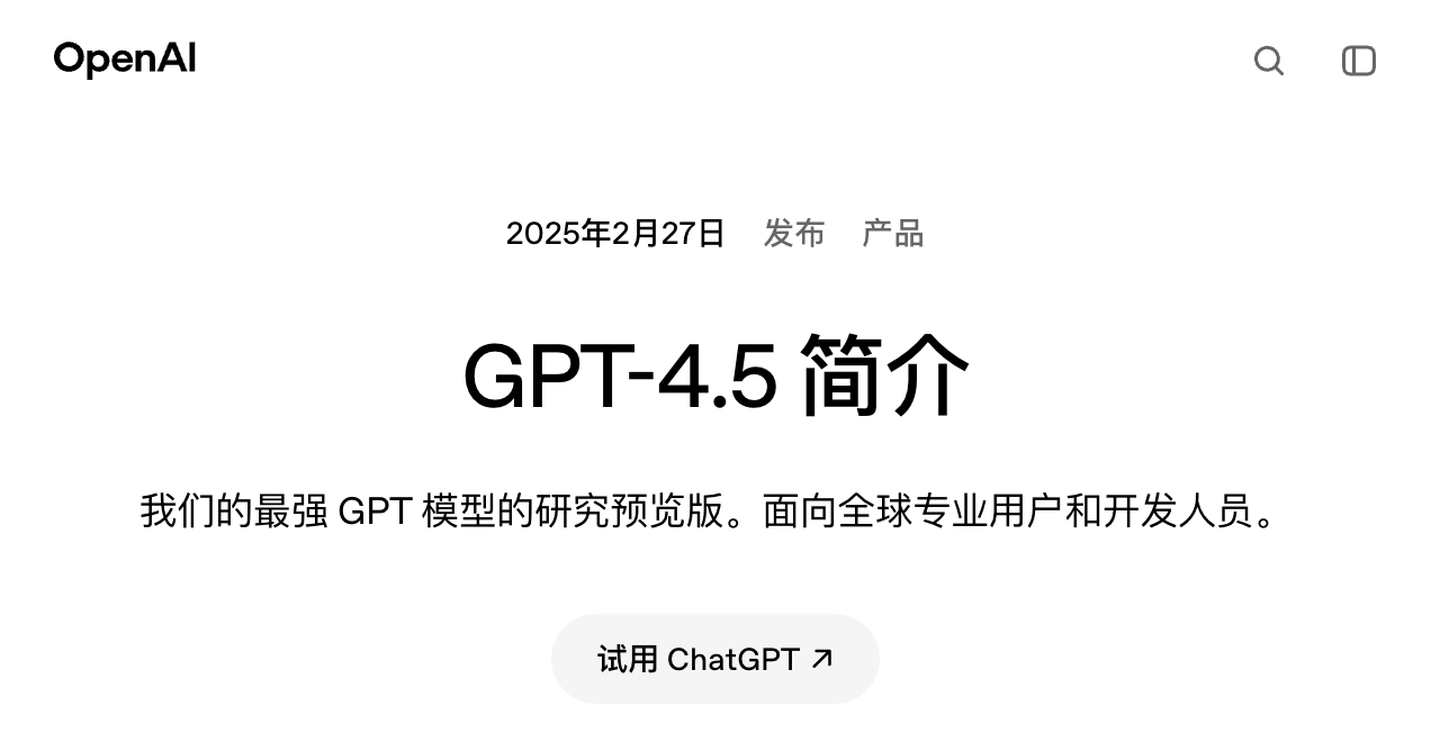
GPT-4.5 (2025-02-27)
The research preview version released by OpenAI, officially called the "strongest GPT model to date" research preview, emphasizes more natural interaction and wider knowledge coverage, and is aimed at professional users and developers.
Comparison of competing products
| Comparison dimensions | GPT-4 | Competitor A | Competitor B |
|---|---|---|---|
| Core Differences | — | — | — |
| Price | — | — | — |
| Target Users | — | — | — |
Note: The above comparison is based on product public information, and actual differences are based on user experience.
Version Info
- GPT-4.5 (research preview) :The GPT-4 family research preview version released by OpenAI, officially called the "strongest GPT model to date" research preview, is aimed at professional users and developers, emphasizing more natural interaction and wider knowledge coverage.
- GPT-4o(omni) :The native multi-modal model handles text, audio and images in a unified manner, with faster response and lower cost, and opens some capabilities to free users, becoming one of the main models of ChatGPT.
- GPT-4 Turbo :Launched on DevDay, it provides 128K context windows, updates knowledge deadlines, and significantly reduces API prices. It is a key version for GPT-4 to move towards large-scale application.
- GPT-4 :The first version of GPT-4 introduces image + text multi-modal input, provides 8K and 32K context variants, and is significantly improved compared to GPT-3.5 on multiple professional and academic benchmarks.
User Reviews