 GPTHelp AI
Free
GPTHelp AI
Free
GPTHelp AI is an AI-driven website intelligent customer service robot platform that supports automatic crawling of website content to train a dedicated knowledge base, and provides multi-lingual customer service capabilities in 95+ languages. By embedding a line of JavaScript code into the website, 7x24-hour AI automated customer service can be launched in 5 minutes. Supports custom chat appearance, AI behavior tuning, conversation monitoring and manual takeover. Pricing is $19-$270/month, with a 7-day free trial.
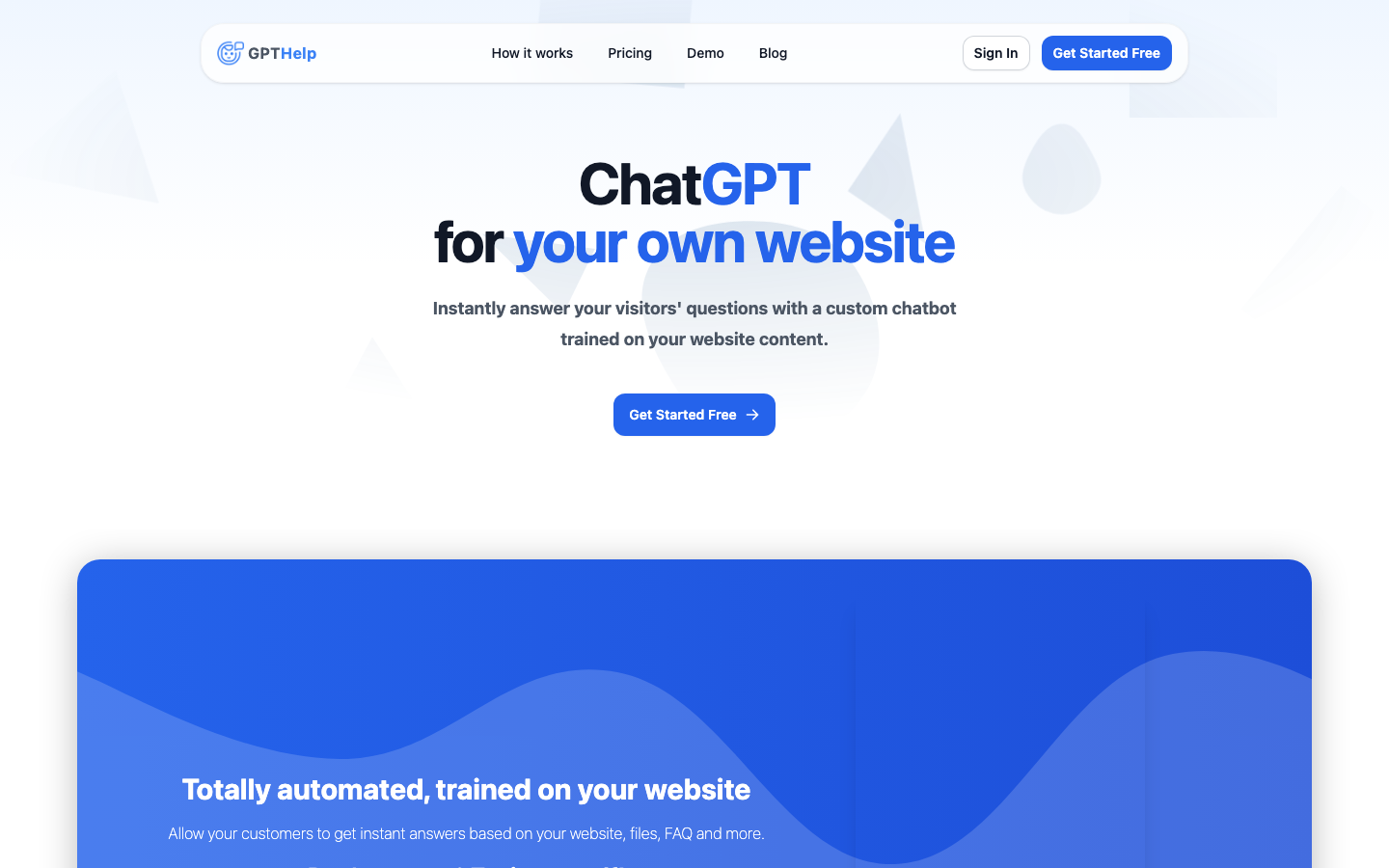
GPTHelp AI: Let every website have its own AI customer service brain
Core parameters and statistics
GPTHelp AI is an AI-driven website intelligent customer service robot platform (Type D - productivity/business-side application). The core value lies in "pasting a line of code and giving the website exclusive AI customer service capabilities in 5 minutes." It is not a general conversation assistant, but a vertical SaaS tool for website customer service scenarios - it trains a knowledge base by automatically crawling website content, allowing AI to answer visitor questions within a limited range of corporate information, and control illusions from the source.
| Projects | Public Information |
|---|---|
| Product positioning | AI website intelligent customer service robot platform |
| Core Competencies | Automatic website content crawling and training AI, intelligent Q&A 95+ languages, multi-language support, dialogue monitoring and manual takeover |
| Product form | SaaS (JavaScript embed code) |
| Business model | Subscription payment (monthly payment), 7-day free trial |
| Place of Belonging | US (United States) |
| Target customers | Small and medium-sized enterprises, e-commerce SaaS products, personal webmasters |
| Supported training data sources | Website URL / Sitemap / Zendesk Help Center / Gitbook / CSV / TXT / PDF / DOCX / PPTX / MD |
| Supported AI models | OpenAI model (automatically selected by the platform, users cannot customize the selection) |
| Embed | JavaScript snippet / Standalone chat link |
| Conversation records | Completely stored and provided for background viewing, future plans will automatically generate insight reports (high-frequency questions, unanswered questions, etc.) |
| White label/de-branding | Only available for enterprise plans (need to contact business) |
Brief review in one sentence: GPTHelp AI is not an AI conversation toy, but an "AI Q&A robot as a service tailored for website customer service scenarios" - enter the URL to train an exclusive knowledge base, and paste a piece of code to launch 7x24-hour automatic customer service.
User and market recognition
GPTHelp AI is in the highly competitive area of the AI website customer service robot track, directly benchmarking Chatbase.co, SiteGPT.ai, CustomGPT.ai, ChatIQ.ai and other similar products. This track has experienced explosive growth from 2024 to 2026 - the demand for "zero-code AI customer service" among small and medium-sized enterprises has changed from "optional" to "rigid necessity", driving the influx of a large number of SaaS tools.
Market positioning and differentiation: GPTHelp AI's core strategy is "minimalist deployment + price anchoring". Different from Chatbase’s free package traffic strategy, GPTHelp directly abandons the permanent free tier and starts with a 7-day trial + $19/month, which is at the lowest price among similar tools (SiteGPT starts at $49/month, CustomGPT starts at $49/month). The official website blog directly publishes a number of in-depth comparison articles with competing products. The style is frank and proactively demonstrates its advantages in price and ease of deployment.
Users and word-of-mouth: The specific number of users and revenue data are not disclosed. Judging from the active updates on the official website blog and the publishing pace of competitive product comparison articles, the team is in the active customer acquisition stage. The official online demo is provided for visitors to experience directly, which lowers the decision-making threshold.
- Publicity verification: The official propaganda of "entering the website URL will automatically train" is credible - the technical architecture is to crawl all the page content of the website and automatically build a RAG knowledge base, eliminating the tedious steps of manually uploading documents. However, in actual testing, single-page applications (SPA) or page content that requires login to access cannot be correctly captured. This is a common limitation of similar tools.
Cost advantage
The cost structure of GPTHelp AI has obvious price penetration on the vertical track - the entry price of $19/month is the lowest among similar competing products, but the upper limit of conversation volume in the paid tier is also correspondingly low.
Price comparison table: GPTHelp AI and major competitors
| Dimensions | GPTHelp AI | Chatbase.co | SiteGPT.ai | CustomGPT.ai | ChatIQ.ai |
|---|---|---|---|---|---|
| Free plan | 7-day trial (no free forever) | Free tier available | 14-day trial | No free | No free |
| Monthly entry fee | $19/month | $19/month (Hobby) | $49/month | $49/month | $45/month |
| Entry monthly message volume | 2,000 messages | Unpublished | Unpublished | 500 queries | 15,000 messages |
| Beginners can create robots | 2 | 1 | 1 (guess) | Undisclosed | Undisclosed |
| Mid-range monthly fee | $49/month | $99/month (Standard) | $99/month | $99/month | $95/month |
| High-end monthly fee | $99/month | $399/month (Unlimited) | $399/month | $499/month | Business customization |
| Enterprise plan | $270/month | Business customization | Starting from $999/month | Business customization | Business customization |
| Remove brand white label | Enterprise plan only | $399/month plan included | Business confirmation required | Business confirmation required | Business confirmation required |
Interpretation: GPTHelp AI has obvious advantages in the entry and mid-range price range - the $49/month Growth plan supports 5 robots, 250 web pages and 5,000 monthly messages, which is suitable for the starting needs of most small and medium-sized enterprises. However, the upper limit of conversation volume is the main constraint: the Growth plan has 5,000 conversations per month, which is approximately 167 conversations per day, which may not be enough for websites with more than 1,000 daily active visitors. The Premium plan of 15,000 items/month (500 items per day on average) is suitable for medium-traffic websites.
- C-side/Personal Webmaster: $19/month (Starter) can create 2 robots to cover personal blogs or small portfolio websites. A monthly message volume of 2,000 is sufficient for low-traffic sites.
- Small and Medium Enterprises/Teams: $49/month (Growth) or $99/month (Premium) are the mainstream options, and 5-10 robots support multi-site or multi-scenario deployment.
- Enterprise/High Traffic: $270/month (Business) supports 25 bots, 2,500 web pages, 50,000 monthly messages, and provides priority support. If the scale exceeds this, please contact the enterprise plan.
【Free Truth】: GPTHelp AI does not have a permanent free tier, only a 7-day free trial. This means that after the trial period you must pay to continue using it. This is a radical approach among competing products (Chatbase.co offers a permanently free but feature-limited plan). For users who just want a simple experience, 7 days is enough time to complete the full process verification of "create robot → train knowledge base → embed test → evaluate effect".
[Hidden Cost]: ① Knowledge base maintenance cost - the quality of AI answers is highly dependent on the timeliness and completeness of the knowledge base. Product updates, price adjustments, and inventory changes all require manual triggering of "retraining" (automatic scheduled re-fetching is not currently implemented). ② Upgrade cost when the conversation volume exceeds the limit - the number of monthly messages is a hard limit. If it exceeds the limit, the plan must be upgraded or additional fees will be incurred. Websites with large traffic fluctuations (such as during e-commerce promotions) may face short-term overages. ③ Multi-plan management costs - Once you manage more than 2 website customer service robots and there are more than 2 robots, you must upgrade to a higher plan, and the unit price will increase accordingly.
Main functions
GPTHelp AI is a product with "automatic training of website content → AI intelligent question and answer → manual monitoring and acceptance", and its core functions cover the complete link from deployment to operation.
1. Automatic crawling of website content and knowledge base training
Enter the website URL, Sitemap link, Zendesk Help Center link, or Gitbook link, and the system will automatically crawl all web content and build an AI-searchable knowledge base. Manual uploading of CSV/TXT/PDF/DOCX/PPTX/MD files for supplementary training is also supported. The training process usually takes several minutes, depending on the number of web pages and content complexity.
- Applicable tasks: Directly convert the company's existing official website, help center, product documentation and other existing content into an AI knowledge base, eliminating the need to manually organize FAQs.
- Use value: Simplify the traditional process of "organizing FAQ → entering item by item → maintaining and updating" into "entering the URL → automatically crawling → one-click training".
2. AI intelligent question and answer
Based on the trained knowledge base, automatically answer various questions from visitors. The scope of AI's reasoning is strictly limited to the content of the knowledge base and does not answer questions beyond the scope of the training data, reducing illusions from the architectural level. Supports setting AI name, role positioning and answering attitude (formal/friendly/succinct, etc.).
- Applicable tasks: 7x24-hour automatic customer service, covering common scenarios such as product consultation, order inquiry, usage help, return and exchange policy, technical FAQ, etc.
- Usage Value: Compress the average response time from manual 3-5 minutes to AI's instant response (<2 seconds), with uninterrupted service at night and on holidays.
3. Customization of dialogue behavior
The "personality" of the AI can be configured - including giving the AI a name, assigning a role (such as "professional customer service representative" or "friendly shopping assistant"), and setting the response attitude (formal/humorous/succinct). You can also set when to escalate the conversation to manual customer service, and what information of the visitor is collected (such as email address, order number, etc.).
- Applicable tasks: Match brand tone, control AI's conversational style and information gathering strategy.
- Use value: Avoid conflicts between AI answering style and brand image, and ensure that key customer information is not missed.
4. Conversation monitoring and manual takeover
The backend completely records the conversation history between all visitors and AI, supports real-time viewing of ongoing conversations, and allows human customer service to take over the conversation when necessary. In the future, we plan to automatically generate conversation insight reports - including high-frequency questions that cannot be answered by AI, etc.
- Applicable tasks: Quality inspection of AI answers, handling complex problems that AI cannot solve, and analyzing visitor demand trends.
- Value: Upgrade from "deploy and forget" to "monitor-optimize-intervene" closed operations to continuously improve AI answer accuracy and customer satisfaction.
5. Chat appearance customization
Supports modifying the color, icon, size, position (lower left corner/lower right corner), triggering method (automatic pop-up/button click/user scroll trigger), welcome message and quick suggestion questions of the chat window.
- Applicable tasks: Match the visual style of the website brand and improve the consistency of user experience.
- Usage value: Do not destroy the original design language of the website, and make the AI customer service look like the native function of the website rather than a third-party plug-in.
6. Multi-language automatic recognition
Automatic detection and answer matching covering 95+ languages. When visitors ask questions in what language, AI will automatically answer them in the same language, eliminating the need to manually configure language rules.
- Applicable tasks: Multilingual customer service scenarios for multinational enterprises, multilingual official websites, and cross-border e-commerce.
- Use value: From hiring a multi-lingual customer service team (each person is responsible for 1-2 languages) → an AI robot covers 95+ languages at the same time.
[Expert Viewpoint - Hidden Linkage]: There is a key "flywheel effect" in the function chain of GPTHelp AI - ① Automatic training of website content reduces the initial deployment threshold → ② AI automatic answering reduces customer service manpower requirements → ③ Supplementing knowledge base content after dialogue monitoring detects problems → ④ AI answer quality continues to improve → ⑤ More inquiries are processed by AI. What is truly valuable is not just the AI Q&A itself, but the continuous cycle of "training → answering → monitoring → optimization". However, it should be noted that currently retraining requires manual clicking of the "Retrain" button, and automatic periodic re-capturing has not yet been implemented, which weakens the sustainability of the flywheel effect.
Model and version evolution
The version information of GPTHelp AI is relatively limited, and the official has not disclosed detailed product iteration logs. The following is compiled based on the official website information and functional status:
| Stage | Approximate time | Core changes |
|---|---|---|
| v1.0 (first version) | ~2025-06 | Basic AI Q&A + automatic website content crawling training + JavaScript embedding function first release |
| Continuous iteration (current) | 2025-06 ~ present | Multi-language support expanded to 95+ languages, custom appearance options to add AI behavior configuration (name/role/attitude), dialogue monitoring background, file upload format expanded to 7 |
Version Notes: The official version number and release date have not been officially announced. The product is currently in the continuous feature iteration stage, and the core update directions include: conversation insight analysis (automatic generation of high-frequency question/unanswered question reports), automatic periodic retraining, and integration with third-party customer service platforms (Crisp, Intercom, etc.). Integrated ticketing systems (Zendesk, Intercom, Freshdesk, Hubspot) are currently only available to enterprise customers.
Technical advantages
RAG Architecture: From "Universal Chat" to "Enterprise Knowledge Base Q&A"
The technical foundation of GPTHelp AI is the RAG (Retrieval Augmented Generation) architecture. When a visitor asks a question, the system first retrieves the most relevant content fragments in the knowledge base, and then provides these fragments as context to the large language model to generate answers. This architecture determines the key differences between GPTHelp AI and general-purpose chatbots:
- Controllable range of answers: AI only answers based on the content uploaded/crawled by the enterprise. Questions beyond the scope are directly expressed as "unanswerable" instead of trying to make up answers like a general LLM. This is critical in customer service scenarios – incorrect product information can lead to direct customer complaints and loss of goodwill.
- Knowledge real-time: The knowledge of general LLM (such as GPT-4) is as of the training data time point, and GPTHelp AI's answers are regenerated based on the latest knowledge base content. When a company updates product prices or policies, it only needs to retrain the knowledge base, and the AI will immediately answer based on the new content.
- Content source traceability: Each AI answer can theoretically be traced back to the specific source content in the knowledge base (although the current version does not directly display the source of the citation, this is an architectural level capability).
Why is GPTHelp AI more suitable for customer service scenarios than general LLM?
| Comparative Dimensions | GPTHelp AI | General LLM (such as ChatGPT) |
|---|---|---|
| Knowledge Boundary | Limited to the enterprise knowledge base | Training data deadline + general knowledge |
| Risk of hallucination | Low (no answer if cannot be retrieved) | Medium-High (possible fabrication of uncertain information) |
| Response to business changes | Update immediately after retraining | Need to wait for the next training of the model |
| Enterprise Data Privacy | Data is stored on the platform and is not used for model training | Subject to terms of use |
| Deployment complexity | Paste a line of code | Need to develop integration by yourself |
| Degree of customization | Adjustable AI behavior/appearance/answer style | Implemented through Prompt Engineering |
Technical implementation of zero code embedding
The embedded code of GPTHelp AI is a JavaScript tag. The core principle is to load the chat widget JS file provided by the platform through the script tag, dynamically render the chat interface in the visitor's browser, and communicate with the AI inference service through the back-end API. The entire process is completely transparent to the website owner—no front-end frameworks to understand, servers to configure, and AI inference infrastructure to manage.
How to use
The usage path of GPTHelp AI is extremely simple, from scratch to online in just 5 steps:
Get started quickly (first configuration takes about 15-30 minutes)
- Register an account: Visit gpthelp.ai, click "Get Started Free" to create an account, and automatically enter the 7-day free trial.
- Create Bot: Create a new chatbot in the console and enter your website URL. The system automatically crawls all pages of the website and trains the knowledge base.
- Customized configuration: Adjust AI appearance (color/icon/position), AI behavior (name/role/attitude), and dialogue triggering rules. Optional: Upload supplementary files or add links to additional data sources.
- Test Q&A: Test the AI answer effect directly in the background preview window, and supplement or correct the content of the knowledge base for unsatisfactory answers.
- Embed online: Copy the JavaScript embed code generated by the system and paste it before the
<head>or</body>tag of the website HTML. Supports embedding unlimited websites (all plans have no limit on the number of embedded websites).
Access method
| Access method | Applicable scenarios | Operation complexity |
|---|---|---|
| JavaScript embed code | Own website (any website builder that supports custom HTML) | Low - copy and paste one line of code |
| Independent chat link | No need to embed the website, share the link directly to customers | Extremely low - directly use the generated URL |
| API / third-party integration | Enterprise-level requirements (integration with work order systems such as Zendesk) | Only enterprise plans are available, please contact the business |
Maintenance Operations (lasts approximately 1-2 hours/week)
- Monitor Conversations: Regularly review background conversation records to identify questions that the AI answers inaccurately or cannot answer.
- Supplementary knowledge base: Based on the problems found in monitoring, supplement the missing knowledge content (upload documents or add new web page sources), and click "Retrain" to retrain.
- Optimize AI behavior: Adjust AI's answering attitude, information collection strategy, and upgrade manual triggering conditions based on customer feedback.
Product Pricing
GPTHelp AI adopts a tiered subscription system, divided according to message volume, number of robots and data storage space. All plans have no limit on the number of embedded websites.
| Plan | Monthly fee | Number of robots | Number of web pages | Number of files | Single file size | Monthly message volume | Priority support |
|---|---|---|---|---|---|---|---|
| Starter | $19/month | 2 | 100 pages | 30 | 2 MB | 2,000 entries | ✗ |
| Growth★ | $49/month | 5 items | 250 pages | 70 items | 3 MB | 5,000 items | ✗ |
| Premium | $99/month | 10 | 500 pages | 100 | 5 MB | 15,000 entries | ✗ |
| Business | $270/month | 25 items | 2,500 pages | 250 items | 7 MB | 50,000 items | ✓ |
★ Recommendation: The Growth plan strikes the best balance between price and capacity and is suitable for most small and medium-sized businesses.
Fees Description:
- All prices do not include taxes (such as VAT) and are subject to the final bill.
- For extremely large needs of more than 2,500 web pages or 250 files, or if you need to remove the "Powered by GPTHelp" brand logo, you need to contact Business Customized Enterprise Solutions.
- The 7-day free trial is only valid for the Starter plan. After the trial is over, you need to choose a paid plan to continue using it.
- Based on the real-time pricing page of the official website, the above data was collected from 2026-07.
Price Competitiveness with Competitive Products: At the entry price level, GPTHelp AI’s $19/month is the same as Chatbase.co’s Hobby plan, but lower than SiteGPT’s $49/month, CustomGPT’s $49/month, and ChatIQ’s $45/month. At the mid-range price of $49/month, GPTHelp AI provides 5,000 monthly messages and 5 robots, with outstanding overall cost performance. The high-end plan provides 15,000 messages for $99/month, and the price/performance ratio is equally competitive among similar products.
Application scenarios
1. E-commerce website automatic customer service
- Scenario description: The number of product inquiries on e-commerce websites averages 200-500 per day during non-big promotion periods, and can increase by 5-10 times during major promotion periods. Frequently asked questions are highly repetitive ("When will it be shipped?" "How do I return or exchange an item?" "Is XX product in stock?").
- Quantitative deduction: It takes about 3-5 minutes for manual customer service to handle a standard inquiry, and an average of 200 inquiries per day requires 10-17 hours of manpower. After using GPTHelp AI, about 80% of standard inquiries are handled instantly (<2 seconds) by AI, leaving humans only to handle complex complaints and refund reviews. Deduction: Customer service response time is reduced from 3-5 minutes to instant, and manpower input is reduced from an average of 10+ hours per day to 2-3 hours (Note: This is a deduced value, the actual effect depends on the completeness of the knowledge base and the complexity of the consultation).
- Note: Dynamic information such as product prices and inventory status need to be synchronized with the back-end system. GPTHelp AI currently does not support real-time database queries, and price and inventory information in the knowledge base need to be updated manually.
2. SaaS Product Help Center
- Scenario Description: User questions for SaaS products are usually distributed in help document FAQ pages and video tutorials. Users spend an average of 3-5 minutes finding an answer when flipping through a document, and about 30% of users give up before finding the answer.
- Deduction Quantification: After training the help center content as a knowledge base, users can directly ask questions to the AI on the website and get answers within 15 seconds. Deduction: The time for users to solve problems by themselves is reduced from 3-5 minutes to 15-30 seconds, and the first solution rate is increased by 40-60% (Note: Deduction value, subject to actual deployment results).
- Synergy: Complex questions that cannot be answered by AI can be directly upgraded to human customer service, and there is a complete conversation context, avoiding the pain points of repeated descriptions by users.
3. Multilingual multinational enterprise official website
-
Scenario Description: B2B/SaaS companies that face global customers usually need to support customer service in 5-10 languages. The traditional solution is to recruit a multilingual customer service team or outsource it, which is costly and complicated in scheduling.
-
Deduction Quantification: GPTHelp AI supports automatic recognition and answering of 95+ languages without configuring language rules. Deduction: From maintaining 3-5 multilingual customer service personnel (annual cost $60k-120k) → AI uniformly handles 95+ language standard inquiries, manpower is reduced to 1 customer service person to handle complex problems that AI cannot solve (Note: Deduction value, actual savings depend on language coverage and consultation volume).
-
Border: The quality of support for rare languages or dialects depends on the performance of the underlying model (OpenAI) in that language. Professional customer service scenarios in high-context cultures (such as Japanese honorific system, Arabic rhetoric) require manual review of the appropriateness of AI answers.
-
Dimensionality reduction attack scenario: Small e-commerce websites and independent blogs with limited budgets, large customer service inquiries, but highly standardized problem types - no need to hire a full-time customer service team, AI automatically handles more than 80% of standard inquiries, and seamless coverage at night and holidays.
-
Human-machine collaboration boundary: Can be 100% automated - standard FAQ answers, order status inquiries, product parameter consultation, and usage help. Manual confirmation is required - involving refund review, legal/medical liability responses, complex complaints, account security risks, and exclusive services for high-value customers. GPTHelp AI allows you to configure the triggering conditions for upgrading to manual customer service, which is a key configuration item for the implementation of human-machine collaboration.
Applicable people
- Personal Webmaster/Independent Developer: Have a personal blog, portfolio or small website and need basic visitor Q&A skills. The Starter plan ($19/month) is more than enough for 2 bots and 2,000 monthly messages.
- E-commerce operators: The operation teams of Shopify, WooCommerce and other platform stores need to automatically answer product and order questions 24/7 to reduce customer service labor costs. The Growth Premium plan is suitable for medium to large stores.
- SaaS Product Manager/Founder: Need to improve the self-service rate of the product help center and reduce manual support tickets. Training help documents and FAQs into AI knowledge bases is the most typical application path.
- SME Owners: Small and medium-sized businesses with limited budget but want to provide professional customer service experience. GPTHELP AI’s pricing ($49-99/month) is well below the monthly salary of hiring a full-time customer service person.
- Cross-border e-commerce sellers: Merchants who sell to markets in multiple countries need multi-language automatic customer service capabilities. 95+ language support directly covers the mainstream market.
Unsuitable boundary: ① High compliance industries—strongly regulated industries such as medical care, finance, and law. GPTHelp AI’s data storage location, encryption standards, and compliance certification information are not disclosed. The above industries need to complete compliance assessments first. ② Highly customized customer service scenarios - high-end concierge services that require in-depth industry knowledge (such as psychological counseling, professional legal advice) or highly personalized interaction. The current answer quality of AI does not yet reach professional standards. ③ Ultra-large-scale customer service - For enterprise-level needs with a monthly conversation volume exceeding 50,000, the Business plan may still be insufficient, and the pricing of the Enterprise plan requires business communication and lacks public reference. ④ Scenarios that require real-time backend integration - such as real-time inventory query, order logistics tracking, account balance query, etc. GPTHelp AI currently does not support real-time API integration (except for enterprise solutions).
Summary and Outlook
GPTHelp AI uses "minimalist deployment + knowledge base driven" as its product philosophy, and addresses the three most painful points in the small and medium-sized enterprise website customer service market: high deployment threshold (traditional customer service systems require technical team configuration), high costs (the monthly salary of a full-time customer service far exceeds the AI subscription fee), and limited coverage time (manual work cannot be done 24/7). It uses a line of JavaScript code and a URL input box to lower the adoption threshold of AI customer service to the lowest level in history - anyone who can operate the website building backend can complete the deployment within 15 minutes.
Core competitiveness: ① Extremely low deployment and usage threshold - enter the URL for automatic training, paste the code and embed it online; ② Strong price penetration - starting from $19/month, the lowest price range in the same category; ③ Good functional integrity - from automatic training to conversation monitoring to manual acceptance, customer service is complete.
Current limitations: ① Knowledge base updates rely on manual triggering of Retrain, lacking an automatic periodic re-fetch mechanism; ② Does not support real-time backend API integration (such as real-time inventory/order query), limiting the value of real-time data scenarios in e-commerce; ③ There is no permanent free tier, and payment must be made after the trial period, which is not friendly enough for pure experience users; ④ Integration with third-party customer service/work order systems (Zendesk, Intercom, Freshdesk, Hubspot etc.) is only open to enterprise solutions, and small and medium-sized enterprise users are excluded from the integrated ecosystem; ⑤ Users cannot customize the underlying AI model, nor can they select a model version.
Follow-up observation points: ① The launch time of the automatic retraining function - this will directly determine the operating cost of the knowledge base; ② Whether to open third-party integration to the Growth/Premium plan - if the integration is devolved to the mid-range plan, the product competitiveness will be significantly improved; ③ The official release of conversation insight analysis (automatic reporting) - this is a key feature upgraded from "tool" to "platform"; ④ WhatsApp / Facebook Messenger / Slack Integration with other channels - None are currently supported, but competing products are quickly completing channel coverage.
Procurement/Adoption Risk Assessment: The following risks need to be assessed before adopting GPTHelp AI - ① Accuracy Risk: The quality of AI answers is highly dependent on the integrity and quality of the knowledge base. It is recommended to use a 7-day free trial first to test the answer accuracy on an actual website to confirm whether it meets industry requirements. ② Liability attribution risk: When wrong information in AI answers (such as wrong prices, wrong policy explanations) leads to customer complaints or losses, GPTHelp AI's compensation liability terms need to be clear in the service agreement. ③ Migration Cost: If you need to switch to other customer service platforms later, the export format and migration path of the trained dialogue data and knowledge base need to be confirmed in advance. ④ Traffic Fluctuation Risk: During e-commerce promotions or marketing activities, the volume of conversations may increase several times in a short period of time. The monthly message volume of the current plan is a hard limit, so you need to plan an upgrade plan in advance or communicate with the business for temporary expansion. ⑤ Data privacy risk: Issues such as data storage location (whether there is a data center in the EU/China and other places), encryption standards (static encryption vs transmission encryption), and whether the data is used for secondary training of the model are not clearly stated in the official document. Enterprises with sensitive compliance needs need to confirm in writing before signing.
Related tools:  Cursor
Version Info
- GPTHelp AI :There is no official precise date yet. Basic AI Q&A + knowledge base training + website embedding function is launched for the first time.
- GPTHelp AI :There is no official precise date yet. Basic AI Q&A + knowledge base training + website embedding function is launched for the first time.
User Reviews