 Haystack
Free
Haystack
Free
Haystack is deepset's open source LLM application construction framework. It provides modular pipeline design and supports the development of production-level AI applications such as RAG, search-enhanced Q&A, and dialogue systems.
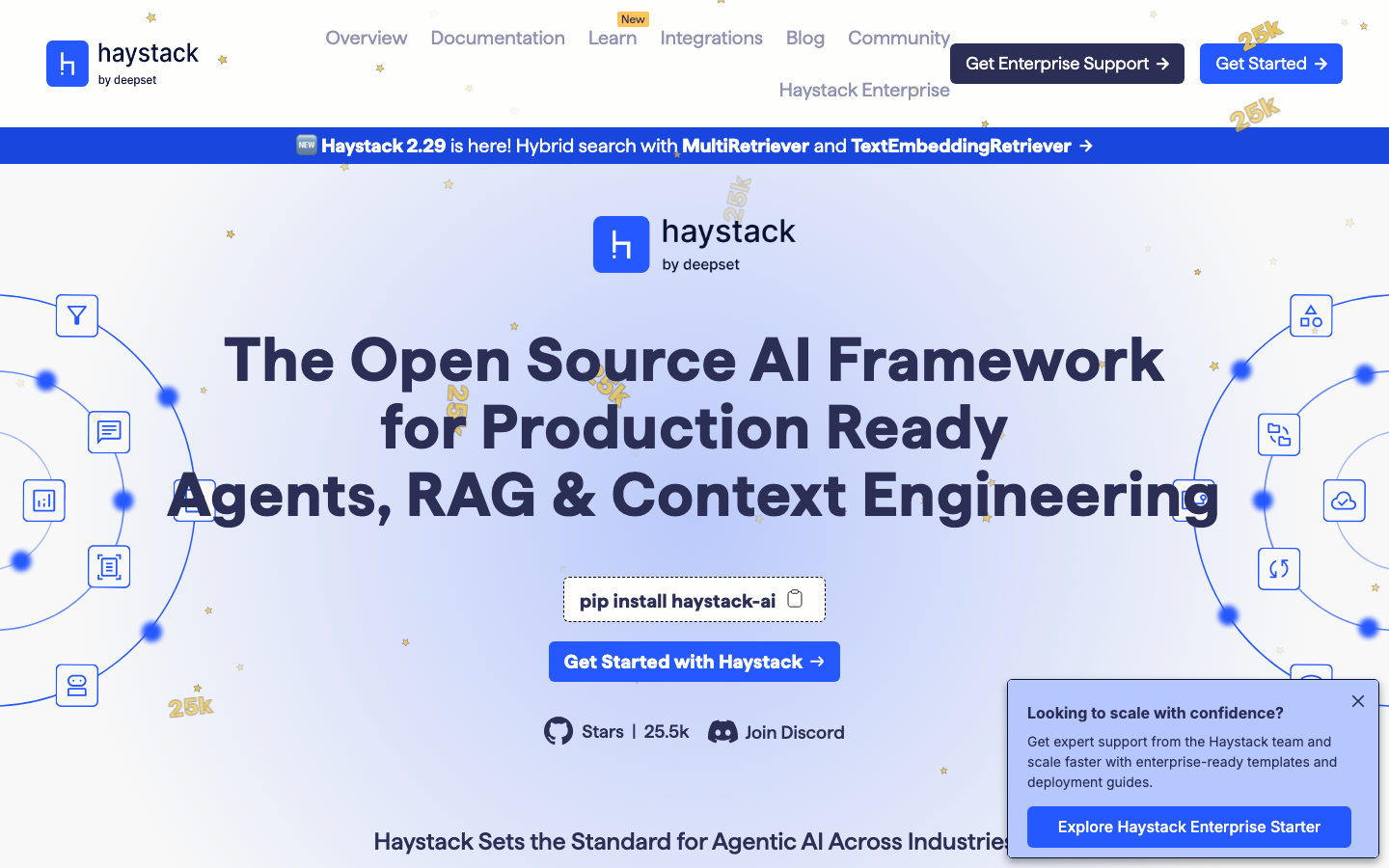
Haystack
Core parameters and statistics
| Parameters | Description |
|---|---|
| Open Source License | Apache 2.0 |
| GitHub Stars | 19,000+ (June 2026) |
| Supported languages | Python 3.9+ |
| Core Architecture | Declarative Pipeline + Componentized Nodes |
| Major Integrations | OpenAI, Anthropic, Cohere, HuggingFace, Elasticsearch, Weaviate, Pinecone, Chroma, Qdrant |
| Deployment method | Local / Cloud hosting / Containerized |
Haystack 2 upgrades pipeline definitions from configuration files to pure Python type annotation declarations, and automatically completes connection verification between components through the type system, greatly reducing the debugging threshold of complex RAG pipelines. Each component can be tested and replaced independently, making it friendly to engineering teams that need to iterate quickly.
User and market recognition
Haystack is currently one of the most widely used RAG and Q&A frameworks in the Python ecosystem. It has more than 19,000 stars on GitHub, and its weekly downloads on npm are stable at tens of thousands. Large companies such as Lufthansa, Accenture, NVIDIA, AWS, and Airbus all display cooperation or use cases on their official websites. deepset also provides an enterprise version of the cloud platform deepset Cloud, which has served many European financial and manufacturing customers.
In terms of community ecology, Haystack officially maintains more than 60 integrated components (Integrations), covering mainstream LLM providers, vector databases and document processing tools, and more than 150 third-party contributed plug-ins.
Cost advantage
C-side/individual developers: The Haystack framework itself is completely open source and free. Python pip install haystack-ai can be installed without license fees. The cost of calling LLM depends on the connected model provider (such as OpenAI, Anthropic), and there is no additional charge for the framework itself.
API / Self-Hosting: Supports local deployment of HuggingFace models or open source LLM (such as Llama 3, Mistral), and with local vector storage (Chroma, FAISS) can achieve a complete RAG link with zero external API fees, suitable for teams that are sensitive to data privacy.
Enterprise/deepset Cloud: deepset provides a hosted version of deepset Cloud, which includes a visual pipeline designer, team permission management, and enterprise-level SLA. Pricing is based on the official page. Please contact us for a business quote. Compared with self-hosting, infrastructure operation and maintenance costs can be saved.
Main functions
- Modular RAG Pipeline: Complete the "document splitting → vectorization → retrieval → rearrangement → generation" full link through declarative component combination, and each node can be replaced independently.
- Multi-vector storage support: Native integration of Elasticsearch, Weaviate, Qdrant, Pinecone, Chroma, FAISS, etc., without the need for additional adaptation layers.
- Multiple LLM providers: unified interface to connect to OpenAI, Anthropic Claude, Cohere, HuggingFace Inference, local vLLM, etc.
- Document processing tool chain: built-in PDF, Word, HTML, Markdown document parser, supports block strategy configuration (by sentence/paragraph/fixed number of tokens).
- Dialogue Agent: Supports Function Calling and Tool Use to build multi-round dialogue agents, which can be used in conjunction with RAG retrieval.
- Asynchronous Components: Haystack 2 natively supports async components, resulting in lower latency in high-concurrency reasoning scenarios.
- Visual debugging: The pipeline structure can be exported as a Mermaid diagram to facilitate troubleshooting node connection logic.
Model and version evolution
Haystack 1.x (2020-2024)
The first-generation architecture is built around four types of objects (Pipeline, DocumentStore, Retriever, and Reader) and is YAML configuration-driven. It is easy to get started but has limited scalability. Support Elasticsearch, FAISS as the main storage backend.
Haystack 2 (officially released in early 2024)
Comprehensive refactoring, migrating from YAML configuration to Python type annotation declarative API, is a major version upgrade that is not backwards compatible. Core changes:
- Components become first-class citizens and support custom input/output types
- Pipes can be serialized to JSON/YAML or defined in pure Python
- Asynchronous components are built-in, no additional packaging is required
- Multi-modal input (text + image) support
deepset Cloud (hosting platform)
An enterprise cloud service that is independent of the open source version and provides a visual pipeline designer and production deployment capabilities. Version iteration is independent of the open source backbone.
Technical advantages
Component-level type checking: Haystack 2 uses Python type annotations to perform static verification during pipeline connection. It can capture input and output type mismatches before running and reduce hidden errors in production environments - this is a capability that most YAML driver frameworks do not have.
Multiple retrieval strategies in parallel: Supports running dense retrieval (ANN) and sparse retrieval (BM25) simultaneously in the same pipeline, and merges the results through algorithms such as Reciprocal Rank Fusion. The recall rate is better than a single strategy, and is especially effective for long-tail knowledge queries.
Storage-independent abstraction layer: The DocumentStore abstraction layer enables the same set of RAG codes to be switched between Elasticsearch, Weaviate, Chroma, etc. without changing the upper-level business logic, reducing the risk of lock-in.
Community-driven integration ecology: Officially maintained Integrations Hub, a single integration package is released independently, and users only install the required dependencies to avoid dependency conflicts in the "big and comprehensive" framework.
How to use
Quick Installation (Python):
pip install haystack-aiBasic RAG Example:
from haystack import Pipeline
from haystack.components.retrievers import InMemoryBM25Retriever
from haystack.components.generators import OpenAIGenerator

pipeline = Pipeline()
pipeline.add_component("retriever", InMemoryBM25Retriever(document_store=...))
pipeline.add_component("llm", OpenAIGenerator(model="gpt-4o"))
pipeline.connect("retriever.documents", "llm.documents")
Entrance method:
- GitHub: https://github.com/deepset-ai/haystack — Open source code and issue tracking
- Official Documentation: https://docs.haystack.deepset.ai — API Reference and Tutorial
- deepset Cloud: https://www.deepset.ai/deepset-cloud — enterprise hosting platform, account registration is required
- Integrations Hub: https://haystack.deepset.ai/integrations — Third-party integration directory
Product Pricing
The Haystack open source framework itself is free (Apache 2.0) and has no usage restrictions. The enterprise version of deepset Cloud provides commercial support SLA guarantee and visualization tools. The pricing is not disclosed and is subject to the official real-time page or business inquiry.
Application scenarios
- Enterprise Knowledge Base Q&A: Vectorize the internal PDF manual Wiki and contract documents into the database, and achieve accurate natural language retrieval and answers through the RAG pipeline, which is suitable for legal, financial, and manufacturing knowledge management.
- Customer Service Robot: Combine conversational Agent and RAG retrieval to build a multi-round customer service robot that can quote product documents to reduce the hallucination rate.
- Academic Literature Retrieval: Batch process arXiv paper PDFs, build a semantic retrieval system, and support multi-dimensional queries "by subject/keyword/relevance".
- Code Documentation Assistant: Vectorize code warehouse documents and README to build a developer Q&A tool to accelerate new members' getting started.
- Multilingual Information Extraction: Combined with multilingual embedding models (such as multilingual-e5), cross-language question and answer is implemented on multilingual document sets.
Applicable people
- Python Developers: Developers who are familiar with Python can get started quickly through pip. There is no need to learn a new DSL. The component-based design reduces customization costs.
- AI Engineer: The first choice for teams that need to build production-level RAG systems and focus on retrieval accuracy, pipeline maintainability, and multi-storage support.
- Enterprise Data Team: Use deepset Cloud to get a visual designer and operational support, suitable for enterprises that are unwilling to build their own infrastructure.
- Not suitable for the boundary: Users who are not familiar with Python have a higher cost of getting started; teams that need low-code or no-code solutions should consider alternatives such as Dify and Flowise; Haystack 2 is not compatible with 1.x, and there is a certain cost to migrate existing 1.x projects.
Summary and Outlook
Haystack is a highly mature open source framework in the field of Python LLM application engineering. Especially in the dimension of "production-level RAG pipeline maintainability", it is better than most similar solutions - type checking, multi-storage abstraction, asynchronous support and a rich integration ecosystem make it suitable for enterprise projects that require long-term evolution.
Current limitations: Haystack 2 reconstruction has brought a better engineering foundation, but the document coverage and community Q&A density are still catching up with LangChain; for scenarios that pursue the simplest prototype, its componentized design will actually increase the amount of initial configuration.
Follow-up observation points: Multimodal component maturity (image and text hybrid RAG), deep integration with the Agent framework (such as OpenAI Assistants API compatibility layer), and progress in deepset Cloud pricing transparency.
Implementation Suggestions: Individual developers and small teams are recommended to start with the open source version and use Chroma or FAISS local storage for quick verification; enterprise teams need to evaluate the Haystack 2 migration cost (if upgrading from 1.x) before production deployment, and confirm the data residency terms and SLA level of deepset Cloud at the contract level.
Related tools:  CrewAI,
  LangChain
Comparison of competing products
| Comparison dimensions | Haystack | Competitor A | Competitor B |
|---|---|---|---|
| Core Differences | — | — | — |
| Price | — | — | — |
| Target Users | — | — | — |
Note: The above comparison is based on product public information, and actual differences are based on user experience.
Version Info
- Haystack 2 :Fully refactored Haystack 2, introducing a declarative pipeline DSL based on Python type annotations, natively supporting asynchronous components, multi-modal input and visual debugging; not backwards compatible with Haystack 1.x.
- Haystack 1 :The first official version is built around four components: Pipeline, DocumentStore, and Reader/Retriever. It supports mainstream vector storage backends such as Elasticsearch, FAISS, and Milvus, and is widely used in enterprise QA systems.
User Reviews