 Put pen to paper AI writing
Luobi AI Writing is an AI writing tool that focuses on the creation of online novels. It supports outlines, outlines, settings and character designs, and provides the ability to generate openings, opening imitations and multi-chapter continuations with one click, and is connected to many large models such as Gemini, ChatGPT, Claude, DeepSeek, Kimi, Doubao, etc.
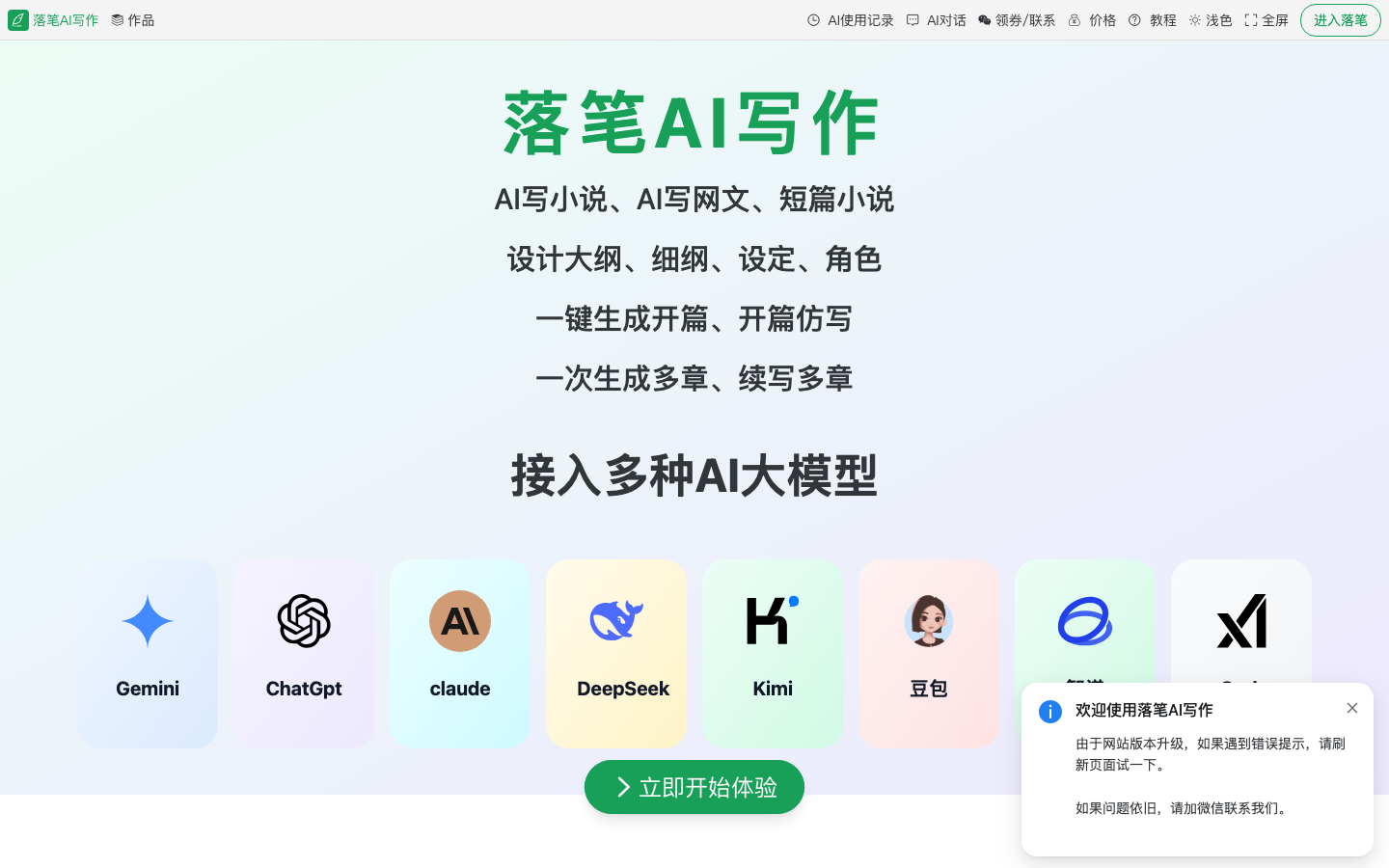
Put pen to paper AI writing
Tool type determination: productivity/business-side application (vertical AI writing tool for novel and online article authors). The following quantification of cost reduction and efficiency improvement and boundary analysis of human-machine collaboration are all based on this classification.
Core parameters and statistics
| Projects | Public Information |
|---|---|
| Official positioning | Novel web article AI writing tool |
| Creation link | Outline → Detailed outline → Setting → Character → Beginning → Continue |
| Opening generation | Generate openings and opening imitations with one click (supports importing existing opening imitations) |
| Multi-chapter capability | Generate the text of multiple chapters at once, continue writing multiple chapters, and generate detailed outlines of subsequent chapters at once |
| Short story capabilities | One-click generation of short stories, one-click imitation of short stories, and generation/imitation of blurbs |
| Script Capabilities | Script Writing Support |
| Auxiliary capabilities | AI-assisted book opening (.txt / .docx), text optimization suggestions and AI-generated inspiration |
| Outline editing | Table mode + list mode, scenes/characters/plots are visible on the same screen, free to drag and drop |
| Settings and roles | List mode + visual editing, supports importing external settings and setting associated roles |
| Chapter integration | The chapter page integrates all functions of outline, settings, and characters, and can extract chapter introductions and scenes |
| Automatic association | Automatic association of characters, settings, previous content introduction/scene/text |
| Prompt word template | Prompt word template memory function, shortcuts can be added |
| Access model | Gemini, ChatGPT, Claude, DeepSeek, Kimi, Doubao, Zhipu Grok |
| Delivery form | Web online tools |
| Place of Attribution | China (Shaoxing Shangyu Luobi Network Technology Studio) |
| Supported languages | Chinese |
| Platform Support | Web |
| User scale | Undisclosed |
| Privacy Policy Update | 2025-06-01 |
The parameter focus of Luobi AI writing is not on the model layer (it does not develop its own base model), but on the "coverage granularity of the creative process". Its core quantitative indicators should be "the number of steps required to generate the first chapter from zero" and "the degree of contextual coherence when continuing to write", rather than the scale of model parameters in the traditional sense.
Practical significance of multi-model access: Access 8 large models (Gemini, ChatGPT, Claude, DeepSeek, Kimi, Doubao, Zhipu Grok) at the same time, allowing the author to switch underlying models according to themes and styles in the same workbench. For example, using Claude for ancient themes may produce more detailed descriptions, and using DeepSeek or Doubao for refreshing rhythms may be more efficient. This "model is a plug-in" design avoids the style limitations of a single model in generating Chinese novels.
Integration of creative links: From filling in the basic information of the work, generating tags, and generating inspiration, to the general outline, volume outline, chapter outline, and detailed outline, to the opening text and multi-chapter continuation, the front-end planning and back-end output of online article creation are connected in the same interface. The chapter page integrates the functions of the outline, setting, and role pages, reducing the author's loss of repeatedly switching between multiple panels.
User and market recognition
Luobi AI Writing uses "focus on novels and online articles" as a vertical cut, and uses multi-model access to form differentiation. However, the official has not yet disclosed verifiable data such as the number of registered users, payment scale, retention rate or corporate cooperation cases.
User value of model selection: There has long been a pain point in the field of Chinese online literature of "one model for all themes" - fantasy, romance, and suspense have very different requirements for writing style, logic, and rhythm. Putting pen to paper and handing over the right to choose models to users is a direct response to the real needs of serious creators. The actual word-of-mouth and user scale must be based on the official real-time page and third-party reviews. This article does not make unfounded inferences.
Market space for vertical positioning: In the domestic AI writing tool track, most products (such as Wen Xin Yi Yan, Tong Yi Qian Wen) are mainly focused on general conversation or office writing, and tools specifically designed for online article serialization (outline → setting → opening → more chapters per day) to optimize the full set of processes are relatively scarce. The company has a clear positioning in this segment, but the market performance still needs to be corroborated by official data.
Competition Situated Reference: Similar tools include Chufei AI Writing, Xuanpai, etc., which focus on web text generation. The core difference lies in "multi-model optional" and "process-guided creation", rather than the comparison of the strength of single-point generation capabilities.
Cost advantage
The cost structure of AI writing needs to be analyzed from two levels: C-side individual author and B-side team/studio. The official website does not disclose complete membership levels and precise price details. The following analysis is based on publicly available information and common industry models.
| Cost Dimension | Description |
|---|---|
| C-side individual authors | The official website provides a free trial entrance; the official payment model (package level, generation quota, model call limit) is subject to the official real-time pricing page |
| B-side team/studio | Multi-account collaboration, batch management and enterprise-level capabilities are not explained in public channels |
| Hidden costs of model calls | Access to 8 large models. The API call costs of different models are different. Whether the written pricing strategy differentiates between model grades has not been disclosed |
| Hidden time cost | AI-generated content still requires manual review, plot consistency verification and compliance review. This part of the time cannot be ignored |
The truth about free: Free credits usually have limits on the number of daily builds, the maximum number of words per chapter, or the range of optional models. When it comes to long-form novel serialization (such as 5-10 chapters continued every day), the free slots are most likely not enough, and you need to upgrade and pay. The specific limit boundary should be based on the actual available quota after registration on the official website.
Hidden cost comparison with competing products:
| Comparison items | Start AI writing | General AI writing tools (such as Kimi/Tongyi Qianwen) |
|---|---|---|
| Web article process adaptation | Built-in outline→detailed outline→settings→continuation of full link | Prompt words need to be arranged manually, no structured support |
| Model switching | 8 models optional, one-click switching | Usually only a single model |
| Continue writing context | Automatically associate with previous introduction/scene/text/role/setting | Need to manually copy and paste context |
| Learning cost | There are 11 creative process guides, you can get started quickly | You need to design your own prompt word template |
| Single article time (deduction) | About 15-30 minutes from outline to first chapter | About 30-60 minutes (including manual arrangement and context maintenance) |
Quantitative deduction of cost reduction and efficiency improvement: Taking the online article author "updating 2 chapters a day (3,000 words per chapter)" as a typical scenario - before writing (purely manual or with the help of general tools), a single chapter takes about 2-3 hours from conceiving the outline, setting up settings, writing the text to reviewing and revising; after using writing, the outline and settings are generated with AI assistance (compressed to 30-60 minutes), and the text is continued by AI After generating the first draft, it was manually polished (a single chapter was compressed to 1-1.5 hours), and the overall daily editing time was reduced from 4-6 hours to 2-3 hours. This is a deduced estimate based on tool characteristics. The actual range depends on the match between the author's review standards and the quality of AI generation. It is an unofficial commitment.
Main functions
- Outline and detailed design: Supports two views: table mode and list mode. Table mode visualizes plot points, with scenes, characters, and plots visible at the same time and supports free drag and drop modification. You can generate detailed outlines of subsequent chapters with one click, automatically linking the introductions, scenes and character settings of previous chapters.
- Settings and Role Management: The list mode is simple and intuitive, and visual editing intuitively displays the setting content. Supports the generation of various types of worldview settings, can import external settings, and set content can be associated with characters. The character page is managed independently, and the chapter page integrates character functions.
- One-click generation of opening and opening copy: Supports generating opening text from scratch, and also supports importing existing openings for copying. When copying, you can specify the number of chapters and the number of words in each chapter to fit the target style.
- Short story and lead generation: An independent short story creation process that supports one-click generation of short stories, one-click imitation of short stories, generation of lead and imitation of lead, suitable for short stories and social media scenarios.
- Multi-chapter generation and continuation: Generate the text of the current chapter and multiple subsequent chapters at once, and automatically associate the introduction/scene/text of the previous chapters with the character settings. When writing multiple chapters, you can first generate inspiration for the subsequent plot, and then decide on the direction of the continuation.
- AI-assisted book opening: Supports uploading .txt and .docx files, automatically parses chapter structure, and can customize analysis requirements. The results of unpacking the book can be used to imitate the opening chapter and outline, helping new authors learn the rhythm and structure of popular works.
- Text Optimization and Suggestions: AI obtains optimization suggestions. You can choose whether to adopt the suggestions and optimize the text with one click based on the suggestions. Suitable for polishing and rhythm adjustment after the first draft is completed.
- Inspiration generation: AI generates story inspiration, with rich built-in inspiration word templates to help solve the starting point problem of "what to write".
- Prompt word template memory: commonly used
Prompt word templates are added to shortcuts to automatically select the last used prompt word to reduce repeated input.
- Chapter Page Integration: The chapter content page integrates all functions of the outline, settings, and character pages, allowing character association, settings viewing, subsequent outline generation, and chapter introduction/scene extraction to be completed on the same page.
Expert’s point of view: The real "hidden linkage" of writing is not in a single function, but in the complete link of "opening the book → imitating the outline → generating the opening chapter → continuing to write multiple chapters". New authors can use the open book to analyze the structure of popular works, and then imitate the beginning of a similar rhythm with one click, and then use the continuation function to continue production - this process converges "learning → imitation → originality" into the same tool, eliminating the cost of switching between multiple tools and manual connection. Another hidden linkage is the combination of "outline editor visible" and "automatic association": after you modify the plot points in the outline, the continuation content will automatically sense the new plot direction, preventing the outline from being disconnected from the main text.
Model and version evolution
Luobi AI Writing does not develop its own basic model. The core of its product evolution is "the continuous deepening of the creative link + the continuous expansion of the access model."
Product startup and link establishment (about August 2025)
The book was launched with novel online writing as its core capability, establishing a complete creative link of "outline-detailed outline-setting-character-beginning-continuation". In the early stage, it supports one-click generation of opening chapters and continuation of multiple chapters, with a clear positioning - not as a general writing assistant, but only as a vertical tool for web writing.
Multi-model ecological expansion (late 2025-2026)
The product continues to expand the access model lineup: from the initial Gemini, ChatGPT, Claude, DeepSeek, Kimi, and Doubao, to further additions to Wisdom Spectrum and Grok, forming an 8-model matrix. The key evolution direction at this stage is to give "model selection to the author" as a product differentiation point, and at the same time launch peripheral capabilities such as short story generation, script creation, and book analysis to expand the coverage of creative scenarios.
Current version and stability improvements (June 2026 to present)
The current online version (web-2026.06) has stabilized in terms of functional breadth, and the focus has turned to the improvement of the creative guidance process (11 types of creative process guidance), the accuracy optimization of automatic association, and the functional integration of chapter pages. The tutorial system on the official website has been improved simultaneously, and Bilibili’s video tutorials cover the entire process from the beginning, outline, to dismantling and copying the book.
| Version node | Time | Key changes |
|---|---|---|
| web-launch (first version) | ~2025-08 | Go online with the core ability of web article creation, establish outline/details/settings/opening/continuation links |
| web-2026.06 (current version) | ~2026-06 | The access model is expanded to 8 companies, the short story/script/open book function is added, and the creative process guidance is improved |
| Follow-up evolution direction | Undisclosed | Possible directions: Optimization of character/plot consistency, transparency of model call costs, team collaboration capabilities |
The above version date is an approximate estimate based on the public collection time and the official website page information. There is no official official version release record. Please refer to the official website update log for details.
Technical advantages
The technical value of AI writing is not in "how strong the model is", but in "the engineering encapsulation of the web article creation process".
- Multi-model abstraction layer: The upper layer encapsulates a unified "creation process layer", and the bottom layer connects to 8 large model APIs. The author only needs to choose "which model to write which part" and does not need to worry about API authentication, context window management token billing and other engineering details. The core value of this abstraction layer is to make the cost of model switching close to zero - the same outline, settings and character data can be transferred between different models to compare the production quality.
- Automatic Contextual Association Project: The biggest technical difficulty in continuing to write online articles is "long-term consistency" - the character relationships, foreshadowing trends, and worldview rules in the previous chapters cannot be contradicted in subsequent chapters. By automatically associating the introduction/scene/text of the previous chapters with the character/setting data, Luobi builds a structured context package before each generation, reducing the collapse of the character caused by the "forgetting" of the model. This is the key engineering capability that differentiates it from general-purpose AI chat tools.
- Structured Creation Data Model: Luobi internally disassembles the novel into a multi-layered data structure of "work → volume → chapter → scene → plot → character → setting" instead of a simple "title + text". This structured design allows outline editing, role management, and setting maintenance to directly affect the content direction of text generation, achieving "change an outline and the continued content will automatically adapt."
- Process Engine: 11 creative processes (from "start from the beginning" to "open book copy" to "import existing settings") are essentially preset workflow templates, each process corresponds to a different sequence of steps and context assembly strategies. For new writers who are not good at prompt word engineering, the process engine lowers the cognitive threshold for AI writing.
- Prompt word template memory system: allows users to save customized prompt word templates and set shortcuts, and the system will automatically remember the last used prompt word. this
The seemingly small function significantly reduces duplication of work in daily update scenarios - you don't need to reimagine how to describe the chapter style you want to the AI every day.
How to use
Luobi AI Writing can be used online on the web, no installation is required, just register and use it. The official website provides 11 creative process guides. The following are typical usage paths:
| Entrance | Applicable objects | How to use |
|---|---|---|
| Official website Web | Web author, short story author, script author | Visit https://luobi.net/ with your browser, register and log in and select the creative process |
Typical steps (take the "Start a novel from the beginning" process as an example):
- Visit the official website to register an account and enter the creative workbench.
- Select a creative process (e.g. "Start a novel by generating opening chapter content").
- Fill in the basic information of the work (name, tags, etc.), and you can choose AI to automatically generate tags and work information.
- Supplementary work information (optional): inspiration, cheats, world view settings, etc. can also be generated by AI.
- Select the underlying large model (Gemini/ChatGPT/Claude/DeepSeek/Kimi/Doubao/Zhipu/Grok).
- Generate the opening chapter content with one click (the number of chapters and the number of words per chapter can be specified).
- Enter the chapter page and use the resume function to continue the serialization.
- Add roles, settings, and adjust the outline at any time on the chapter page, and the modification results will automatically affect subsequent generation.
- Use the AI optimization suggestion function to polish and adjust the text.
Quick Notes on Other Processes:
- Start with an outline: First create an outline of the entire book (including a list of chapters), then refine the outline and details of each volume, and finally generate the main text. Suitable for authors who are accustomed to planning first and then writing.
- Start with imitation: Provide reference text (opening/outline), and AI imitate its structure and rhythm to generate new content. Suitable for newcomers who want to learn a specific style.
- Copy after opening the book: Upload a .txt or .docx file, AI will automatically analyze the chapter structure and content, and then copy the opening or outline based on the analysis results. Suitable for learning the structure of popular works.
- Import existing settings: If there are already externally organized role, setting and outline files, they can be imported directly to avoid repeated entry.
Detailed video tutorials can be obtained by searching "Luobi AI Writing" on Bilibili or visiting the official website help center (https://luobi.net/help).
Product Pricing
The complete pricing information of Luobi AI Writing has not been publicly disclosed on the official website. The following is an overview based on available information and common industry models:
- Free trial: The official website provides free registration and experience entrance. The specific quota (number of times of generation, upper limit of word count, optional model range) is subject to the actual display after registration.
- Payment model guess: The typical model for individual authors is monthly/quarterly/annual membership subscription, divided by the number of words generated or the number of calls. Due to access to 8 models, the difference in calling costs of different models may result in higher grades unlocking more model options.
- Team/Enterprise Plan: Not explained in public channels. If you have any needs, it is recommended to contact the official directly ([email protected]).
- Fee Transparency: The official website does not have an independent pricing page. It is recommended to use 1-2 short stories under the free quota to verify the production quality and continuity of writing before deciding to pay, and then upgrade after confirming that it meets your needs.
| Billing dimensions (speculated) | Description |
|---|---|
| Free quota | There is a certain daily generation limit or word limit, which will be determined after registration on the official website |
| Personal subscription | Presumably charged on a monthly/quarterly/annual basis, different levels correspond to different generation quotas and model access rights |
| Model Differentiation Pricing | High-end models (such as Claude, GPT-4, etc.) may only be available in high-end packages |
| Refund Policy | Undisclosed |
Important Tip: The above pricing information is a reasonable speculation based on industry models. Please be sure to refer to the real-time pricing page of the official website or the official customer service reply before making a formal purchase.
Application scenarios
- Daily update of web article serialization: This is the core scene where the writing was started. The author first builds the outline and settings of the book, uses the continuation function to generate the first draft of 2-3 chapters every day, and then publishes it after manual polishing. According to deduction, in a scenario where 2 chapters (3,000 words per chapter) are updated daily, writing can reduce the total time from 4-6 hours per day to 2-3 hours. The key is to automatically associate the previous context so that the character output by the AI is consistent with the plot direction.
- Short story and lead batch creation: The short story generation and copying functions are suitable for short video scripts, official account short stories, lead copywriting and other scenarios. Set the style and background at once, generate multiple short stories in batches, and fine-tune and publish them after manual screening. From "single article from scratch" to "AI generated first draft + manual screening and fine-tuning", the deduction can save about 50% of the production time.
- New author learning and imitation training: The book-splitting function allows newcomers to upload chapters of popular works. AI will automatically analyze the chapter structure, rhythm arrangement and plot advancement, and then imitate the opening or outline based on the analysis results. This is equivalent to an "AI writing coach" - from dismantling to imitation to originality, learning is completed within the same tool.
- Creative bottleneck breakthrough and inspiration: Use the inspiration generation function when you are stuck, and AI provides diverse plot development directions and creative tips. Combined with multi-model switching, the same outline can generate multiple versions of continuation directions under different models, helping authors to think outside the box.
- Setting and character system maintenance for long-form works: For million-word novels, character deviations and inconsistent settings are common pain points. The character management system and automatic association mechanism of Zhuobi will inject the current character status and setting rules into the context before each generation, reducing the engineering mistakes of "writing to the end and forgetting the beginning". From "relying on the brain to memorize" to
"System automatic maintenance" and deduction can reduce the set consistency rework rate by about 40%.
Applicable people
- Online article serial authors (core group): long-form authors who need to steadily update 2-5 chapters every day. The complete link to writing (outline → setting → opening → continuation) and the automatic association mechanism directly hit the two major pain points of "output efficiency" and "plot consistency" in the daily update scenario. It is recommended to use a short story to verify the generation quality and continuity of different models before deciding whether to use it for long-term serialization.
- Short story creators and self-media authors: Creators who need to mass-produce short stories, lead copy, or script fragments. The short story generation and imitation functions can quickly produce a first draft, which can be published after manual screening and fine-tuning.
- New Authors and Writing Enthusiasts: Newcomers who are interested in writing online articles but don’t know how to start. 11 creative process guides lower the starting threshold, the book-opening function helps you learn the structure and rhythm of popular works, and inspiration generation solves the problem of "what to write".
- Writing Teaching and Training Scenario: The book-breaking analysis function can be used in writing classes. Teachers can guide students to analyze the chapter structure of excellent works, and then conduct copying exercises based on the analysis.
- Not suitable for crowds and scenes:
- Non-fiction writing needs: If you only need to write official documents, press releases, product copywriting, or academic papers, the vertical functional links for writing web articles are too specialized and are not as flexible as general-purpose AI writing tools.
- Purely artificial creators with extremely high requirements for originality: No matter how good the content generated by AI is, it is essentially a probabilistic output based on existing data, and is not suitable for serious literary authors who insist on "word-for-word originality." Putting pen to paper is more suitable for the semi-collaborative mode of "AI generates first draft → manual in-depth rewriting".
- Lightweight users who do not need long-form structure management: For users who only write short content of less than 1,000 words, the outline, settings, and role management system may be too heavy. General AI writing tools are lighter
Convenience.
- Budget-sensitive low-frequency users: If you only write a novel occasionally, the free quota may be available; but if you are not sure about the payment price, it is recommended to confirm the package fee before deciding whether to use it in depth.
Human-computer collaboration boundary: In the workflow of writing, the following sections can be 100% automated - label generation, first draft of work information, inspiration generation, and book analysis. The following section recommends setting up manual confirmation points - outline structure and chapter planning (manual adjustments after AI generation), first draft of the text (manual polishing after AI generation, checking the continuity of character and plot), and final release content (manual review to ensure compliance and quality). To put it simply: AI is responsible for “quantity” (first draft generation, structural suggestions), and humans are responsible for “quality” (style control, logic verification, and final decision).
Summary and Outlook
The core competitiveness of Luobi AI writing is "web article vertical link + multi-model option" - it integrates outline, setting, role, opening, and continuation in the same workbench, and allows authors to switch on demand by accessing 8 large models, directly addressing the dual pain points of "output efficiency" and "uncontrollable production quality" in online article serialization.
Current Limitations:
- The complete pricing system is not disclosed, and purchasing decisions lack price anchors.
- The cost structure of multi-model calls and the quota allocation of each model are not transparent
- Market verification data such as user scale and retention rate are missing
- The consistency of the character design and plot of the million-word novel has not yet been publicly verified
- B-side capabilities such as team collaboration and multi-account management have not been disclosed.
Follow-up observation points:
- Length-length consistency test: Whether the automatic association mechanism of Zhu Bi can effectively maintain the character and plot direction in a novel of more than 500,000 words is a key watershed that determines whether it can become a "daily update artifact" or a "starting tool."
- Pricing Transparency: Whether a clear pricing page and model differentiated packages are launched will directly affect the willingness of medium to heavy authors to pay.
- Model update rhythm: When new connected models (such as DeepSeek-V4, GPT-5, etc.) are released, the adaptation speed and performance will be determined.
- Business side and ecology: Whether to open API, team collaboration, batch management and other functions to expand to studio and MCN scenarios.
Procurement/Adoption Risk Assessment:
- For individual authors: first use free credits to test the production quality and continuity of writing on 1-2 short stories. If the content output by AI needs to be significantly rewritten, it means that the tool has limited adaptability to your creative style. Do not subscribe to high-priced packages just because of the "multi-model" advantage.
- For authors who are preparing to integrate AI writing into the daily update process: Be sure to establish a quality control system of "AI generation → manual polishing → comparison and review" to avoid the homogeneity of AI-generated content leading to the loss of readers or violations of platform judgments.
- For teams/studios: Before the official release of multi-account collaboration and permission management capabilities, it is not recommended to fully host the core creative pipeline on this tool.
- Overall, Luobi AI Writing has made meaningful product exploration in the direction of "engineering the online article creation process", but potential adopters should follow the principle of "try before buying, small-scale verification" and make judgments based on their own creative style and quality requirements.
Related tools:  Notion AI,
  Jasper
Version Info
- Luobi AI writing online version :The current online version of the official website supports outlines, details, settings and character design, and provides the ability to generate an opening chapter with one click, imitate the opening chapter, generate multiple chapters at once, and continue writing multiple chapters. It is also connected to many large models such as Gemini, ChatGPT, Claude, DeepSeek, Kimi, Doubao, etc. There is no official precise release date yet.
- First edition of Luobi AI writing :It is launched with novel online writing as the core, establishing outline and detailed outline settings and the ability to start and continue writing with one click, and then access more mainstream large models for users to choose from. There is no official precise release date yet.
User Reviews