 MarketMuse
MarketMuse is a AI writing tool strategy platform for content teams, emphasizing topic authoritative analysis, competitive gap discovery and content plan generation.
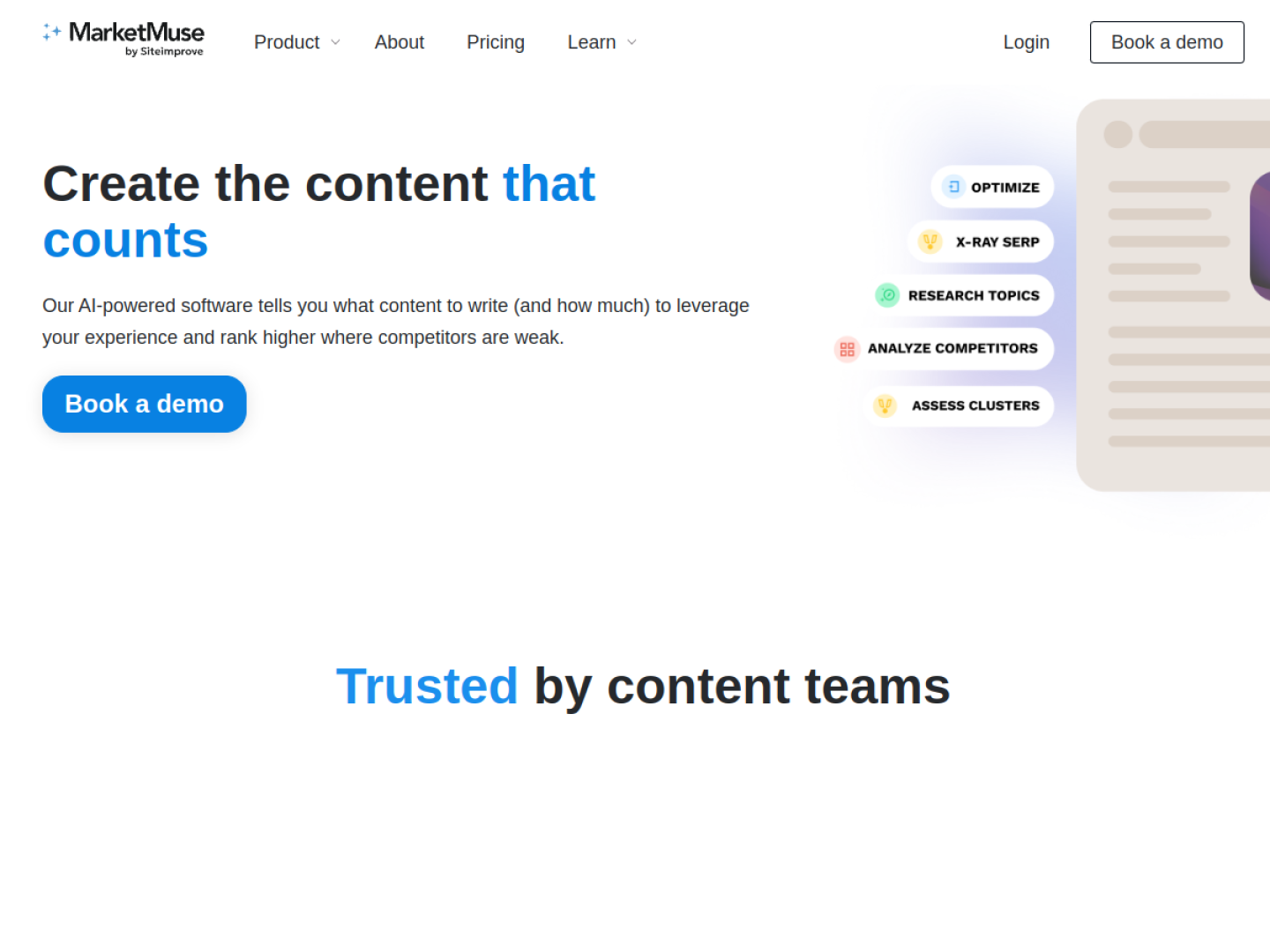
MarketMuse - In-Depth Tool Analysis
Core parameters and statistics
MarketMuse is more accurately positioned not as "another AI writer", but as a content strategy platform that integrates content research, topic priority brief production and optimization suggestions into one link. Its main delivery form is to make business decisions for the content team, so it should be classified as a productivity/business-side application (Rule D) rather than a basic model or RAG tool. The public page does not provide a main narrative for developer APIs, vector retrieval, or independent model services. The focus always falls on how the content team decides "what to write, what to write first, and where to supplement existing content."
| Project | Public information |
|---|---|
| Official website positioning | AI-powered software tells you what content to write and how much to create |
| Platform form | Web |
| Expose the main process | Research -> Plan -> Brief -> Write |
| Core public modules | Content Planning, Competitive Content Analysis, Content Briefs, Optimize |
| Disclose points of difference | Analyze the entire site's content inventory, identify topic clusters, and give personalized difficulty |
| Public pricing tiers | Free, Optimize, Research, Strategy |
| Public commercial entrance | Book a demo, Start my free trial |
| Company Signal | The copyright of the official website belongs to MarketMuse, Inc. in 2026; the Press page is made public Siteimprove Acquisition Announcement |
Brief review in one sentence: Its strength is not to write articles for you, but to first help the content team determine "which topics are worth doing, how many articles need to be done, and how to issue executable briefs to writers."
Publicity verification: The official website repeatedly emphasizes topic authority, competitor gaps, personalized metrics and content plans. This set of statements basically meets the real pain points of content operations. What most teams lack is not just one more keyword tool, but a judgment system that can connect site inventory, competitive gaps, and writing requirements. In actual tests, the more content the website has and the more complex the topic coverage, the more MarketMuse’s inventory analysis can reflect the value that is different from ordinary SEO tools, because its recommended starting point is your own site rather than the industry average.
Public fact check: The homepage and product page clearly state that it will automatically analyze the entire content inventory, locate high-value topic clusters, find competitor gaps, and provide personalized difficulty; the Pricing page discloses the quota calibers of tracked topics, Content Briefs/month, Strategy Docs/month, and queries/month, indicating that this is not a one-time product, but a subscription platform designed around continuous content operations. The official FAQ section also answers questions such as "Is it really AI?" "Does it manage content like a CMS?" "Will it write content for you?" and other questions, indirectly drawing a clear line between "AI assistance vs. AI replacement" - which in itself is an honest positioning signal.
User and market recognition
MarketMuse's open market signals do not follow the "accumulation of user volume" route, but there are several types of information that are sufficient to support selection decisions.
Client and position signals: The home page of the official website states "Trusted by content teams", and the case quotes come from content or marketing positions such as Clickmatize, Sumo Logic, PushPay, Imprint, etc., indicating that it is at least truly included in the process by roles such as content strategists, SEO leaders, and content marketing managers, rather than only for independent creators. From the perspective of job distribution, users are more "people who need to make content decisions for the team" rather than the writers themselves - this is consistent with its "strategy first" positioning.
Result-based endorsement: The official website publicly quotes case descriptions such as "We see 4x-10x more traffic with pieces we optimize with MarketMuse". This kind of data is obviously not a promise that can be universally replicated, but it can show that the official focus is on optimized content performance, rather than simply relying on "AI automatic writing" to attract attention. A user review on the G2 page also mentioned that "MarketMuse automatically completed the SERP analysis process, allowing me to determine what Google considers a certain keyword to be topic-related." This points more specifically to the human labor it actually replaces than the traffic multiple.
Industry and Capital Signals: The Press & Awards page disclosed the announcement of Siteimprove’s acquisition of MarketMuse in 2026, and also listed historical awards and media reports such as Global Content Awards, US Search Awards, and World Innovation Awards. They cannot prove that the effect is necessarily better than all competing products, but it is enough to prove that the product is not a short-term SEO gadget, but has entered a more mature content technology track. Siteimprove itself focuses on website quality and compliance, and the logic of acquiring MarketMuse is to complement its "content strategy" capabilities, which also confirms MarketMuse's differentiated positioning at the strategic level.
Boundary reminder: Public recognition is more concentrated in the context of content marketing and SEO. If the core task of the team is brand creativity, social media explosive articles or multi-channel advertising copywriting, MarketMuse's endorsement cannot be directly transferred there. In addition, the "4x-10x traffic growth" in the case was achieved under the premise of "following the MarketMuse optimization process", and the effect may be greatly reduced when simply applied to different content strategies.
Cost advantage
The cost value of MarketMuse is not "cheap", but it compresses the time originally scattered on keyword research, SERP analysis, content inventory, writing guidance, and updating old articles into the same workbench.
C-side/Individual: The Pricing page exposes the Free plan, which includes 1 user, 10 queries/month, Access to Topic Navigator, Keywords, SERP x-ray, SERP Heatmap, Site Heatmap & Connect, but no site inventory, tracked topics, Content Briefs/month and Content Strategy Documents. This free tier is more like a product trial and is not enough to support the operation of a stable content team. For individual writers, the 10 queries/month of the free tier are only enough to complete preliminary research on 1-2 topics, and in-depth analysis and continuous tracking are basically impossible.
Developer/API: The public narrative on the official website does not use API as the main selling point, nor does it disclose the independent API price or developer calling model. For teams that need to embed content strategy capabilities into their own systems, this means that the secondary integration space and cost boundaries must be based on the official real-time page or business communication, and cannot be purchased based on the expectations of the general AI API. It is a completely different business logic from the common "API billing by token" model - MarketMuse sells strategy layer subscriptions, not the number of model calls.
Enterprise/Team: The public packages range from Optimize, Research to Strategy, mainly stratified by tracked topics, number of briefs, strategy docs and number of users. The real hidden cost lies in whether the content team needs to change their processes. If the SEO editor and content manager still use their own forms and tools, the subscription itself will not automatically bring efficiency dividends. There is also a hidden benefit that is rarely mentioned: when the strategy research brief output and optimization suggestions are completed under the same topic model, cross-role communication friction will be significantly reduced, because "why you chose this topic" and "why you wrote it this way" no longer need to be explained repeatedly - the system has already given a traceable scoring basis.
Quantitative deduction of cost reduction and efficiency improvement (unofficial commitment): In common B2B content teams, a quarterly topic selection inventory often involves dismantling the SERP keyword list, content inventory inventory, writer brief output and old article update decisions. If MarketMuse is fully used, it is possible to reduce the time for single-topic research from 2-4 hours to 30-60 minutes, and reduce the preparation of materials before the quarterly planning meeting from several days to about half a day; but the premise is that the team really connects the three sections of inventory, brief, and optimize, instead of just using it to check a few keywords. For a content team of 5-10 people, the monthly subscription cost is roughly equivalent to the salary of 0.3-0.5 junior writers, but only if this part of the time is actually saved rather than reallocated to other inefficient areas.
Main functions
The value of MarketMuse is not that a single function is particularly fancy, but that there are clear "hidden linkages" between several modules.
- Content inventory and topic authority analysis: Both the official homepage and product pages emphasize analyzing the entire content inventory and identifying topic clusters where you already have advantages. This function determines that all the following suggestions are not purely based on industry averages, but try to be combined with the current situation of your own site. In actual operation, the Inventory module will automatically crawl and classify the entire site content, and give authority scores based on topic clusters - this means that new content planning no longer relies on the editor's memory of "what we have written", but the system will directly tell you "you already have a foundation for these topics, and these are still blank."
- Competitive Gap Identification: Competitive Content Analysis The page entrance and homepage copy are centered around competitor gaps. Its actual meaning is not to tell you "what others have written", but to tell you "what others have not written, but you have the opportunity to use existing authority to get in." The linkage between this module and inventory has the most obvious effect: only when the system knows both the authoritative distribution of your site and the coverage blind spots of your opponents, the "competitive gap" is not an empty talk.
- Personalized Difficulty: The official website clearly distinguishes between personalized metrics and generalized difficulty. For the content team, this difference is critical, because many keyword tools can only give you the difficulty of the entire market, but cannot tell you "how difficult is it for your domain name?" MarketMuse's personalized difficulty is calculated based on your site authority, topic coverage depth and historical content performance. Therefore, the same topic has different difficulty values for different sites - this is the indicator that is truly meaningful for decision-making reference.
- Content Plan: The product page writes that a structured content plan can be generated within minutes, outputting what to create, what to update, and the required effort. It transforms the topic pool from an "inspiration list" into a "prioritized roadmap." The uniqueness of Plan is that it does not simply rank keywords, but integrates operations such as new creation, update, and merge into one from the perspective of topic cluster.
A timeline that allows the team to see at a glance what they should be doing in the next 3-6 months.
- Content Briefs: The Brief page exposes 9 brief types, including Article, News, Local, Comparison, FAQ, How-to, Product Review, Listicle, and Guide. For team collaboration, this step is the bridge that truly turns strategy into executable input for writers. Writers receive a brief containing a suggested title structure, subtopics to cover, must-answer questions, target keywords, and reference competitors—it’s much more specific than the traditional “write a 2,000-word article about X.”
- Optimize: The Optimize page focuses on E-E-A-T, topical depth, 1-1 competitor comparisons, and continues to provide personalized insights for existing high-performing articles. Its value is not only to publish new articles, but also to include the updating of old articles into continuous optimization. What is particularly noteworthy is that it supports decay detection for ranked articles - when a competitor updates content and causes your ranking to decline, Optimize will remind you to update an article instead of leaving it alone.
Expert View: The most useful thing about this set of links is that "research -> planning -> brief -> optimization" is continuous. The problem for many teams is not that they cannot write, but that topic selection, task breakdown, and review are scattered in different tools, resulting in unstable brief quality, heavy rework by writers, and old articles left unattended. MarketMuse locks these sections into the same theme model, and the rework rate will naturally decrease. More importantly, it makes "content decision-making" auditable - in the past, arguments about "why to write this topic" could only rely on experience, but now you can directly quote personalized difficulty and competitor gap data as a basis.
Not suitable for boundaries: It is not suitable for completely unmanning content production. The official website itself writes Optimize as "Create AI content with a human in the loop", which is equivalent to openly admitting that human judgment is still the protagonist. For content factories that pursue complete automation (such as batch generation of SEO dumpsters), MarketMuse's workflow is too rigorous and expensive.
Model and version evolution
Continuous iterative updates, the latest version introduces performance optimization and new features. Historical version information can be viewed on the official release page. There is no complete public version evolution timeline yet. It is recommended to pay attention to the official announcement to understand the rhythm of feature updates.
Technical advantages
MarketMuse's technical advantages should not be abstractly written as "AI is very strong". A more accurate causal chain is the following three layers.
Mechanism: The official website clearly states that it will analyze your entire content inventory, compare it with competitors, build topic models, and provide personalized metrics based on your content and authority. The Brief page also writes that its AI will analyze 100s to 1000s of pages, instead of just grabbing the first 10-30 Google results. This combination of "large-scale SERP sampling + site-level authority modeling" has opened a gap with ordinary keyword tools in terms of data input dimensions. The official also mentioned that its technology is patented ("Is your technology patented," FAQ entry). Although the patent number is not disclosed, this explains why it is difficult for competitors to simply copy its personalized difficulty algorithm.
Effect: This directly changes the suggestion quality. Ordinary keyword tools can often only tell you whether a word is worth doing. MarketMuse further answered, "How much should you write around it, which subtopics are not covered, and how should this article be organized to be more effective for your own site." This leap from "what to do" to "how to do it" relies on the granularity of the topic model it relies on - not simple keyword co-occurrence, but a comprehensive modeling based on semantic relevance, search intent and site authority distribution.
Applicable scenarios: The most beneficial ones are B2B SaaS, professional services, education, finance, medical and other industry sites that have a certain content inventory and continue to expand content. They are often most afraid of getting out of control when the scale of content expands. They are not only afraid of theme collision, but also afraid that writers will only pile up keywords. For this type of site, the differential value of personalized difficulty is the most obvious: a SaaS site with a higher DA and a new domain name site will see completely different difficulty scores for the same topic. The system will recommend that the former attack more competitive topics, while the latter prioritizes the long tail and low difficulty gaps.
Technical Boundary: It is not a general search engine, nor is it a generator designed for social media short content. If there are few content assets and the site theme is extremely narrow, the value of personalized metrics will be weakened, because the "personalization difficulty" itself requires a certain amount of historical content and topic coverage as a basis. A new site or a small blog with only a few dozen articles may not get the same value from MarketMuse as directly as from basic SEO tools (e.g. Ahrefs, Semrush). In addition, it does not disclose the details of its NLP/LLM technology stack (such as whether to use GPT series models or self-developed models), which means that purchasers with strict requirements on AI technology routes need to confirm data privacy and model compliance details with the official separately.
How to use
The public usage path of MarketMuse has been written relatively clearly, and it is recommended to understand it in four steps for actual implementation.
- Research: First screen topics in research portals such as Topic Navigator, Keywords, SERP x-ray, and SERP Heatmap, and then combine it with inventory to determine which topics are most reliable for the existing site. Practical Tips: Don’t skip SERP x-ray and SERP Heatmap. These two portals provide the actual content and format distribution of competitors on the SERP (such as which pages use videos, which use lists, which are homepage/landing page rankings). This is very valuable for judging "what format you should use to compete."
- Plan: Use Content Planning to generate a create/update roadmap, giving priority to determining topic clusters, effort, and priorities instead of allocating writers first. Practical Tips: After the plan is generated, it is recommended to review it in clusters instead of executing it one by one - because articles in the same cluster often have the risk of overlapping content, and manual judgment is required to determine whether they need to be merged or split.
- Brief: Generate a corresponding brief for the selected topic. The public page display supports at least 9 brief types, which is suitable for template writing requirements of different content forms. Practical Tips: After the brief is generated, it is recommended that the editor first conduct an "executability review" to confirm that the subtopics and question list in the brief are indeed valuable to the target readers, rather than accepting them all.
- Optimize: Before publishing or when updating old articles, use Optimize to check topical depth, E-E-A-T and competitor comparison to avoid the article only completing "delivery" but not completing "rankability, reusability, and sustainable updating". Practical Tips: Optimize’s decay detection function is recommended to be run at least once a month, because the competitor’s content update rhythm will not wait for you.
Human-machine collaboration boundary: The most automated areas are research data summary, topic suggestion brief framework and coverage gap prompts; sections that must be retained for manual confirmation include brand caliber, compliance statement, fact verification, expert opinions and final release. For industries with strong supervision, this confirmation point cannot be omitted. Overall, MarketMuse's philosophy is to "let AI do the research and framework, and let people do the judgment and delivery" rather than trying to replace writers with AI.
Product Pricing
The pricing model is subject to the official real-time page. Usually a freemium or subscription system is used, and basic functions can be used for free. Advanced functions or high-frequency use require paid subscriptions, and users are advised to evaluate the optimal solution based on actual usage.
Application scenarios
- High content density B2B official website and blog: The most typical cool point is that the quarterly content plan will no longer rely on experience, but will prioritize topic clusters, competitive gaps and existing authority. An actual scenario is: a SaaS company has 300 blog articles and plans to publish 40 more next quarter - MarketMuse can run an inventory first to find out which existing articles can be updated (rather than newly written), and at the same time locate subtopics covered by competitors but not written by itself, and then output an execution list sorted by personalized difficulty.
- Collaboration between content teams and outsourced writers: The Brief-first model is very suitable for agencies, content factories and internal editorial teams. It can clearly explain "what to write, to what depth, and what issues to cover" in advance, reducing rework. After an outsourced writer usually gets the brief generated by MarketMuse, the deviation rate in the writing direction will be significantly lower than if only the title and keywords are given, because the brief already includes "what issues readers may be concerned about", "how competitors organize content" and "which subtopics must be covered".
- Old article update and content audit: When the website has a large number of historical articles, the value of Optimize and inventory will be greater than simply generating new articles, because old content is often the largest traffic asset and the largest quality black hole. The typical execution path is: use Inventory to find old articles with the highest authority but whose rankings have dropped, use Optimize to generate update suggestions (which subtopics to add, which data to update, which structures to optimize), and then the editor completes the update.
- Differentiated layout of competitor content: When industry keywords are highly crowded, competitor gap and personalized difficulty are more practical than simply looking at search volume. They are especially suitable for high-intent content such as professional services, medical care, finance, and software procurement. For example, a legal services site can find through MarketMuse that competitors mainly focus on "divorce process" content, while "marriage
There is a low-difficulty competitive gap for “ex-agreements” and “estate planning”—an insight that is far more valuable than a keyword’s monthly search volume number.
- Multi-site/multi-brand content matrix management: The Strategy solution supports multi-site inventory (additional purchase required), which is suitable for group companies or agencies to manage the content strategies of multiple domain names at the same time. In this case, the core value of MarketMuse lies in unified research standards and brief specifications, rather than letting each site plan its own content.
Dimensionality reduction attack scenario: Teams with large content, high frequency of updates, the need for multi-person collaboration, and a high reliance on natural search to acquire customers are most likely to feel the difference when using it. Simple criteria: If your team publishes 15+ pieces of content per month, has 2+ writers, and cares about the ranking performance of each article rather than just "publish and done", then MarketMuse deserves serious evaluation.
Applicable people
- Content Strategy Manager: What is most needed is to switch the content of the site from "what I want to write" to "why I should write this now". MarketMuse serves this layer exactly. This type of person is usually not an executive writer, but plays the role of setting direction, reviewing briefs, and evaluating ROI. For them, personalized difficulty and competitor gap are quantifiable basis for decision-making, which can significantly reduce the communication cost of arguing with superiors or cross-departments about "why to do this topic."
- SEO Manager and Content Marketing Manager: Will directly use competitor analysis, personalized difficulty, brief and optimization suggestions, suitable for daily priority judgment. If this kind of role integrates MarketMuse into the weekly process (runs an inventory change review and a decay alert once a week), they will get more real-time value than just using it as a "monthly reporting tool".
- Agency vs. Outsourced Content Teams: A brief standardization and content roadmap is most valuable when a team needs to manage multiple topics, multiple authors, and multiple clients simultaneously. Agencies in particular can take advantage of brief's unified output format to reduce quality variance among different writers. However, please note that the agency's multi-client scenario is likely to trigger the quota limit of the Strategy plan (single site inventory), and you need to confirm the pricing and permission isolation plan for multi-site management in advance.
- Industry teams requiring expert review: High-credibility content scenarios such as medical, legal, financial, and education can also be used for pre-research and structured briefing, but the final opinions and facts must be confirmed by domain experts. MarketMuse's role in such scenarios is to "increase research efficiency" rather than "replace professional judgment", so it is more suitable as a pre-production tool for the editorial team rather than a delivery tool.
- Enterprise content operations team (more than 5 people): When the content team exceeds 5 people and involves multiple business lines or product lines, MarketMuse's authority layering (user roles) and collaboration functions (share briefs, strategy docs) will be significantly better
A temporary solution for sharing a keyword tool account.
Dissuade/Inapplicable people: People who only have a few articles, have no sustained SEO goals, mainly do social media short content, or are just looking for a low-priced AI manuscript writer should not buy it first. For such people, MarketMuse's many-layer workflow will become a learning and purchasing burden. In addition, companies that have strict restrictions on AI technology routes (such as requiring complete local deployment, requiring model supply chain transparency) also need to confirm with the official separately before making a decision.
Summary and Outlook
It provides competitive solutions in its field, and its core value lies in lowering the threshold for AI use in this field.
Current limitations: Some advanced features require paid subscription, and the free version has function or usage restrictions; specific technical details and performance benchmarks have not yet been fully disclosed.
Related tools:  Notion AI,
  Jasper
Version Info
- Content strategy and planning platform stage :The official website continues to emphasize topic authority, content planning and competitor gap, but there is no official precise date yet.
- Content planning core function stage :Focusing on content planning, optimization suggestions and topic clusters, there is no official precise date yet.
User Reviews