 Moonbeam
Free
Moonbeam
Free
Moonbeam is an AI-driven long-form writing assistant focused on helping users write blog posts, in-depth content, and long-form articles. Unlike general-purpose AI writing tools, Moonbeam offers a structured writing workflow—from outline to research to draft to editing, with specialized AI assistance at every stage. It's aimed at writers who want high-quality, in-depth content.
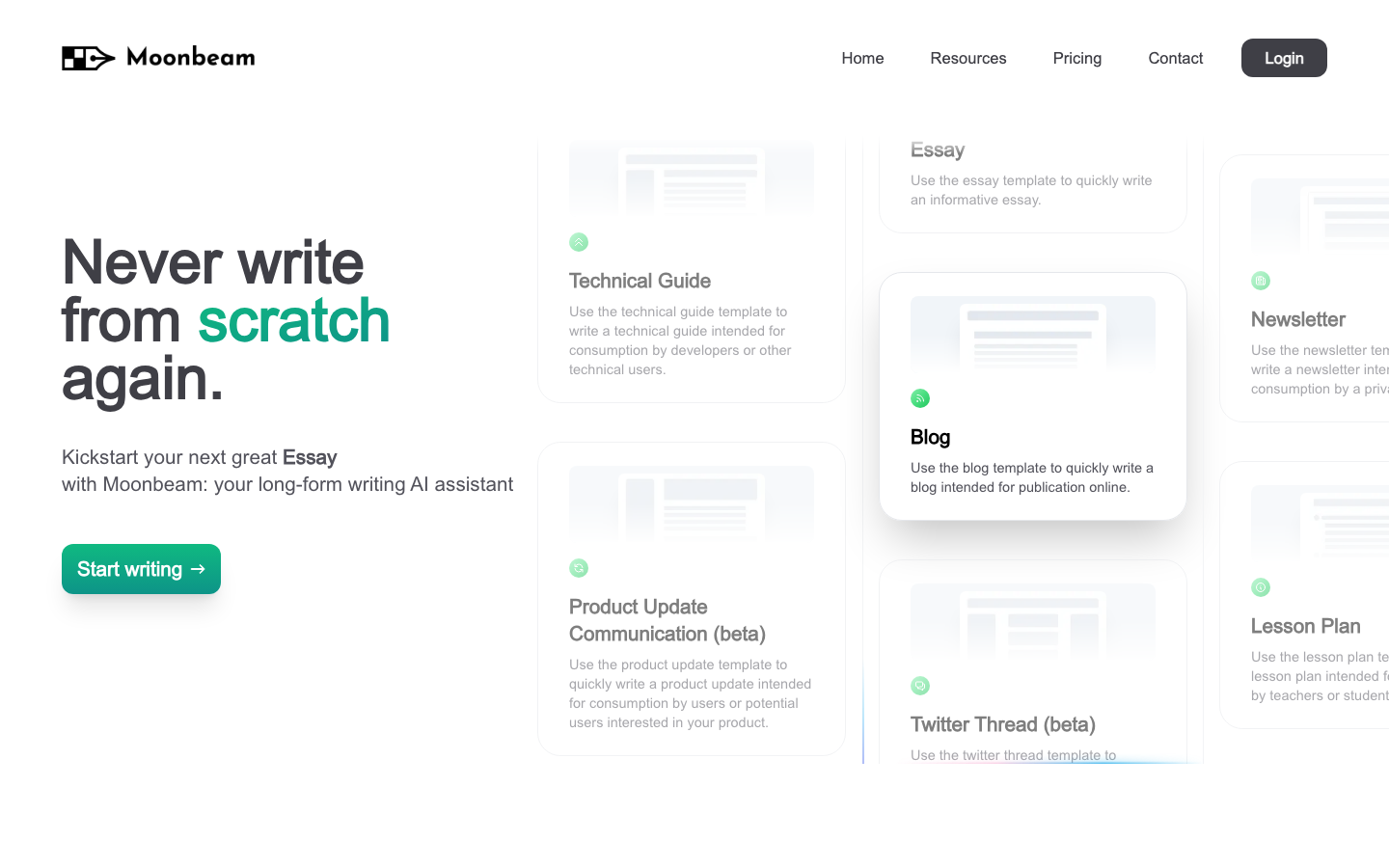
Core parameters and statistics of Moonbeam
Moonbeam is an AI writing assistant focused on long-form writing (main category: productivity/business applications, secondary category: AI writing tools), targeting bloggers, content marketers, academic writers and other user groups who need structured and in-depth content production. The core difference between it and general conversational AI (such as ChatGPT, Claude) is that Moonbeam does not "generate the full text at once", but breaks down writing into four progressive stages of outline, research, draft, and editing, with each stage equipped with exclusive AI assistance capabilities.
| Projects | Public Information |
|---|---|
| Product Positioning | AI Long-form Writing AI Assistant |
| Core Competencies | Structured four-stage writing (outline → research → draft → editing), Smart Chat, real-time editing, Content Cluster, batch content generation, Custom Style Generator |
| Underlying model | GPT-4 (official page annotation) |
| Supported Platforms | Web (with Chrome extension) |
| Home | US |
| Business Model | Freemium (Free Edition + Pro Subscription + Team Subscription) |
| Official entrance | https://www.gomoonbeam.com/ |
| Supported languages | en-US (interface and output are all in English) |
Brief review in one sentence: Moonbeam is not "another AI writing tool", but an "engineered workbench for long-form writing" - it uses AI to change writing from "the fear of a blank sheet of paper" to "fill-in-the-blank step-by-step advancement".
Parameter Interpretation: Moonbeam chooses GPT-4 as the underlying engine instead of a self-developed model, which means that the upper limit of its writing quality depends on the iteration of OpenAI's model capabilities. Its differentiation is not in the model itself, but in "using engineering processes to make up for the lack of long-text coherence of general models" - through the staged prompt chain and structured editor, the output of GPT-4 is more stable and more controllable than direct dialogue generation.
Moonbeam’s users and market recognition
Moonbeam is well-known in the English-language content creation community, especially among bloggers, freelance writers, academic writers, and content marketing teams. Its official website displays real reviews from Twitter users, business founders, college students, etc.:
- Kevin Newman (Founder of LegendCV): "I've turned in a lot of assignments using Moonbeam, all A's, no plagiarism issues. The AI's ability to generate real sentences, research key points, and tailor the content to the target audience is something no other product on the market can match."
- Brian Albrecht (Author of FinTech Training): "I just finished writing a chapter on FinTech Training using Moonbeam. I've used Jasper before, which was good, but Moonbeam works better with me."
- Ciara (college student): "Moonbeam helps me explore different content ideas. Highly recommend."
- Leo Mills (@Leonardo_Mills): "Research is more than just writing long essays. Moonbeam helps you outline your essay based on prompts. Give a few more prompts and bam, you have the beginning of your essay. Yes, your students will use this, but you can use it too!"
Market benchmarking: Moonbeam belongs to the same AI writing track as  Jasper,
  Lex, and Writer, but its differentiated positioning is "long text structured writing" rather than general copywriting generation or marketing copy writing. Compared with Jasper's "all-round marketing copywriting" positioning, Moonbeam focuses more on the scenario of "building an article skeleton from scratch."
Community and Ecology: Moonbeam provides a Chrome extension that supports activating writing assistance directly in the browser; it has an independent Help Center and Affiliate Program. No GitHub Stars, enterprise customer count, or funding information is currently disclosed.
Moonbeam’s cost advantage
Cost advantage: three-tier price structure, using a subscription system to cover individuals to teams
Moonbeam adopts Freemium + subscription system and does not provide a pay-as-you-go API model.
| Price Tiers | Monthly Fees | Core Benefits | Limitations |
|---|---|---|---|
| Free(Free version) | $0 | Basic AI writing function, limited word count | Word count is strictly limited, Boss Mode / Smart Chat / Customized style cannot be used |
| Pro (paid annually) | $49/month (paid annually) | Unlimited long article writing, unlimited social media posts, unlimited AI tools Boss Mode, Moonbeam Chat, Ask Luna, Moonbeam Wizard, custom style generator | 1 user, 30-day money back guarantee |
| Team | $99/month/seat | Includes all Pro features + collaborative real-time editing + tool integration + multi-user + priority support | Business confirmation required for multi-seat discount |
C client/individual users: The free version has a strict word limit and is only suitable for "trial experience"; heavy writers must upgrade to Pro ($49/monthly payment). Compared with similar tools: Jasper’s Creator plan starts at $49/month (annual payment is $39/month), and Writer’s Team plan starts at $18/month/seat. Moonbeam Pro’s annual payment of $49/month is close to Jasper Creator’s annual payment of $39/month, but Moonbeam focuses more on long-form writing scenarios.
API/Developer: Moonbeam does not expose an independent API and does not provide a token-based interface for developers. This means it can’t be integrated into one’s own workflows – if a team needs to programmatically invoke AI writing capabilities, Moonbeam isn’t the right choice.
Enterprise/Team: Team plan is $99/month/seat, including real-time collaborative editing and integration capabilities, but multi-seat discounts and customized SLA need to be confirmed by contacting the business. Compared with the combined solution of Google Docs + ChatGPT, Moonbeam's "AI native collaborative editor" solution is more integrated, but at the cost of an explicit cost of $99/seat/month.
The Free Truth: The free version has an extremely low word limit (approximately 2,000-5,000 characters/month in experience), which is not enough to complete a standard-length blog post (usually 1,500-2,500 English words ≈ 8,000-15,000 characters). The actual value of the free version lies in "testing whether the workflow suits you" rather than daily use.
Hidden Cost: Moonbeam relies on GPT-4 under the hood, so your writing quality and responsiveness are indirectly affected by the state of the OpenAI API - when GPT-4 is congested or down, Moonbeam's generation capabilities will also be limited. In addition, among the functions included in the $49/month Pro, the word "unlimited" is subject to the Fair Use Policy, and the official may limit the flow in case of extreme heavy use.
Moonbeam Key Features
The core of Moonbeam's product design is to break down "long article writing" into manageable engineering steps, each step corresponding to a set of AI capabilities:
- Moonbeam Wizard (Wizard Mode): Enter scattered notes or a topic description, and AI will automatically organize it into a structured outline and generate a complete paragraph one by one. This is Moonbeam's flagship feature and the key transition point from chaos to structure. Applicable tasks: First draft of blog articles, construction of academic paper framework, and launch of in-depth long articles.
- Smart Chat (intelligent conversation editing): Based on the GPT-4 editor, the editor has a built-in dialogue module. Users can talk to AI at any time during the writing process - asking for modification suggestions, requesting paragraph reconstruction, and generating new content fragments. It supports partial refinement (Precision Editing) after selecting the text, and directly converts the dialogue content into formal article paragraphs. Applicable tasks: Refinement in the editing stage, inspiration when writing blocks.
- Content Cluster: Enter a core keyword or prompt word, and Moonbeam can generate 10+ related content topics in seconds, and expand into article outlines and complete drafts with one click. Applicable tasks: Keyword development in SEO content strategy, topic planning for blog series.
- Custom Style Generator: Allows users to imitate the writing style of a specific author - from famous writers to comedians, from academic essays to social media. The system has a variety of built-in style presets, and also supports users to upload samples for AI to learn style characteristics. Applicable tasks: Unified tone of brand content, style experimentation in creative writing.
- Boss Mode: Completely restructure the entire article with one click - change the tone, adjust the structure, optimize readability or completely rewrite it. Applicable tasks: Rapid iteration when you are not satisfied with the quality of the first draft, multiple versions of the same topic.
- Ask Luna (AI assistant Luna): Give writing instructions to AI assistant Luna in natural language, and Luna will directly return a complete first draft
. Ideal for quickly launching content that doesn't require complex structure (e.g. newsletters, emails, social media posts).
- Collaboration Mode: A real-time collaboration experience similar to Google Docs, which supports multiple people to edit, comment and revise on AI-generated documents at the same time. Applicable tasks: Review and collaboration in the team's content production process.
[Expert View – Hidden Linkage]: The synergy between Moonbeam’s features is stronger than it appears. A typical "function chain" is: use Content Cluster to generate a topic list → use Wizard to generate an outline after selecting a topic → use AI to generate a first draft segment by segment → use Smart Chat to refine it paragraph by paragraph → use Boss Mode for final reading optimization. These five functions are connected in series to form a complete content production line. From "topic selection" to "final draft", it is all completed in one editor, avoiding the cross-software switching cost of "ChatGPT generation → Word editing → Grammarly proofreading" in the traditional process. In addition, the output of Custom Style Generator can be processed twice by Boss Mode to achieve a two-stage workflow of "imitation style first draft → own tone final draft".
Moonbeam’s model and version evolution
Moonbeam is a product with application layer capabilities as its core. Its version evolution is mainly based on UI/UX and functional iterations rather than underlying model version updates.
| Version | Time | Key Points |
|---|---|---|
| Launch (0.1) | ~2024-03 | Product launch, core functions: AI long article writing, outline generation |
| Smart Chat introduction | ~2024-09 | Integrate GPT-4 driven Smart Chat and support conversational editing |
| Content Cluster | ~2025-01 | Online content cluster generation function |
| Collaboration Mode | ~2025-06 | Launch of team collaboration editing mode |
| Current (1.0) | ~2025-06 to present | All current functions such as Custom Style Generator, Chrome extension Boss Mode, etc. |
Version Context Interpretation: Moonbeam's version evolution shows a clear path of "from a single-person tool to a collaborative platform" - in the early stage (0.1), it focused on the core experience of single-person long article writing; in the mid-term (second half of 2024), Smart Chat was introduced to evolve from "generative writing" to "conversational editing"; in the later stage (2025), Content Cluster (batch content production) and Collaboration were added Mode (team collaboration) expands the product positioning from "personal writing tool" to "productivity platform for content teams". The bottleneck of the current version is that it has not yet opened APIs and third-party integration capabilities, which limits its deep embedding in complex enterprise workflows.
Moonbeam’s technical advantages
The core of Moonbeam's technology is not a self-developed large model, but "AI engineering encapsulation of the writing process." Its underlying model uses GPT-4 (official page annotation), but has made multiple layers of optimization at the application layer:
Phaseline Prompt chain (Pipeline Prompting): Moonbeam breaks down long-form writing into four stages: "Outline → Research → Draft → Editing", each stage uses a different prompt strategy. For example, the "structured generation command" is used in the outline stage (requiring the output of hierarchical titles), and the "paragraph expansion command" is used in the draft stage (generated paragraph by paragraph, keeping the context window focused). The effect of this Pipeline Prompting mechanism is that even if the same GPT-4 model is used at the bottom layer, the consistency and structure of the output are significantly better than "write me a 2000-word article" at once.
Context window management: A major technical challenge in writing long articles is the limited model context window - although the context window of GPT-4 can reach 128K tokens, writing the entire article at once will cause early content to be "attention diluted" (Lost in the Middle). Moonbeam’s strategy is to generate in segments and maintain context in segments: the generation of each segment only loads the outline context and user input required for that segment, not the entire content of the entire article. This not only saves token consumption, but also improves the fit between each paragraph of output and the outline.
Smart Chat's "local injection" mechanism: Smart Chat is not just a chat window embedded with ChatGPT - it can inject the text fragment selected by the user as context into the conversation, allowing AI to give modification suggestions based on understanding the "specific questions of this paragraph" instead of giving generalized answers to the entire article. This ability to "select associative dialogue" is one of Moonbeam's engineering strengths in editing.
Custom Style Generator's Style Transfer: This function may use the technical route of few-shot learning (Few-shot Learning) or style vector embedding - by analyzing the style samples provided by the user or preset by the system, extract features such as intonation, vocabulary preference, sentence structure, etc., and apply them to subsequent generation. This is not a unique technology of Moonbeam (Jasper, Sudowrite, etc. also provide similar capabilities), but the engineering tuning on "long text consistency" is the point of difference.
[Guide to pitfalls in engineering]:
- Risk of "decision fatigue" in the staged process: Although Moonbeam's four-stage process has a clear structure, it requires users to make judgments at each stage (confirming outlines, editing paragraphs), which may cause "decision fatigue" for high-frequency content producers. It is recommended to set a fixed "writing template" in scenarios with large content to reduce the burden of decision-making from scratch every time.
- GPT-4 generation delay: Since the underlying layer relies on GPT-4, Moonbeam’s generation speed is affected by the OpenAI API response time. During peak hours, longer paragraphs may take 10-30 seconds to generate, which affects the "flow" of writing. It is recommended to use "paragraph-by-paragraph generation" instead of "full-text generation" when writing long articles to reduce the psychological cost of a single wait.
- Boundary of Style Consistency: Custom Style Generator has better style imitation effect on short texts, but in a complete article of 2000+ words, the style drift becomes more obvious as it goes on. It is recommended to use style generation in long articles in segments, rather than generating long articles all at once and expecting the style to be completely consistent.
How to use #Moonbeam
The entrance and usage path of Moonbeam are divided into two ways: Web side and Chrome extension:
| Entrance | Address/path | Applicable scenarios |
|---|---|---|
| Web Application | https://app.gomoonbeam.com/ | Complete writing experience, all features available |
| Chrome extension | https://www.gomoonbeam.com/extension | Call AI writing assistance anytime in your browser |
| Luna Quick Instructions | Click Ask Luna in the web app | Quickly generate short content (emails, social media posts) |
Typical steps:
- Registration and plan selection: Visit gomoonbeam.com → Register an account → Select the Free / Pro / Team plan.
- Start writing project: Click "New Document" in Dashboard → enter the article topic or paste notes.
- Generate Outline: Use Moonbeam Wizard or directly Ask Luna, AI will return a structured outline.
- Confirm and expand: Manually adjust the outline level → select a chapter → AI generates a draft of the chapter.
- Refining and Editing: Use Smart Chat to select a text fragment → make a modification request → AI returns an optimized version.
- Style adjustment (optional): Use the Custom Style Generator to adjust the tone style of the full text or chapter.
- Collaborative Review (Team): Invite team members to edit comments in real time in Collaboration Mode.
- Export and Publish: The completed draft can be copied to CMS or exported to other formats (subject to the current web editor support).
Chrome extension usage: After installing the extension, select text in any web page → right-click to call Moonbeam → select "Rewrite", "Extend", "Summary" and other operations. Suitable for using Moonbeam’s AI capabilities in third-party editors such as Notion, Google Docs, and WordPress.
Product pricing for # Moonbeam
Moonbeam uses a Freemium + fixed subscription system and does not provide pay-as-you-go or pay-as-you-go models.
| Plans | Monthly Fees | Payment Period | Core Limits | Who Is Suitable for |
|---|---|---|---|---|
| Free | $0 | — | Limited word count, basic AI functions, no Smart Chat/Boss Mode | Early adopter experience, very light user |
| Pro | $49/month | Annual payment only ($588/year) | Unlimited features, 1 user | Independent writer, freelance writer, blogger |
| Team | $99/month/seat | Monthly/annual payment available | Includes all Pro features + collaboration + integration + priority support | Content team, marketing team |
Pricing Strategy Analysis: Moonbeam's Pro price of $49/month (annual payment) is in the same range as the mainstream AI writing tools in the market - Jasper Creator annual payment is $39/month, Writesonic annual payment is $19/month (but the functions are quite different), and Lex ($19/month). Moonbeam's pricing is above average in its category, but its "long article focus" positioning avoids a head-on price war with general writing tools.
Refund Policy: Pro and Team plans offer a 30-day, no-questions-asked full refund, reducing trial risk.
Actual use of the free version: The free version is only suitable for "experience workflow" and is not enough to support daily content production. If you plan to incorporate Moonbeam into your daily writing tool chain, it is recommended to start the Pro annual paid trial directly. If you are not satisfied within 30 days, you can get a full refund.
Moonbeam application scenarios
- Blog post mass production (content marketing team): For content marketing teams that need to produce 3-5 blogs per week, Moonbeam's Content Cluster + Wizard process can compress the time of "topic selection → outline → first draft" from the traditional 4-6 hours to 1-2 hours. Quantitative deduction: After a content specialist uses Moonbeam, the weekly output can be increased from 3 to 6-8 articles, and the content production capacity is increased by 100%+ while the labor cost remains unchanged. However, it should be noted that the editing and fact-checking time after the first draft of AI cannot be omitted, and the actual efficiency improvement is about 50-60%.
- Academic Writing Assistance (Students/Researchers): Moonbeam’s outline generation and paragraph expansion capabilities are suitable for structured writing of essays, research reports, and literature reviews. Student user feedback (official website testimonials) shows that Moonbeam can help quickly build an argument framework. Boundary Tip: Moonbeam does not support automatic generation of literature citations, nor does it connect to academic databases - it provides "structural assistance" rather than "research assistance". Factual accuracy and reference standardization still require manual verification.
- SEO Content Strategy Execution: 10+ related content topics are derived from core keywords through Content Cluster, and then expanded into articles one by one - this is a tooled implementation of the "Topic Cluster" methodology in SEO content strategy. Comparison: The traditional method requires manual research of keywords → manual planning of the content matrix → writing one by one. Moonbeam automates the "planning" step by step, allowing the SEO team to respond more quickly to changes in search trends.
- Uniform tone of brand content: Custom Style Generator allows the content team to preset brand writing style templates (such as "professional and authoritative", "friendly and educational" and "technical depth") to ensure consistency of content tone across authors and channels. This is especially valuable for branded content projects where multiple writers are collaborating.
- Multi-channel content production for freelance writers: Freelancers can use Moonbeam to manage multiple channels simultaneously
Writing projects for each client—Each project can be set up with an independent style and theme, and Moonbeam’s in-editor folder organization makes multi-project management clearer.
Moonbeam is suitable for people
- Independent Blogger/Freelance Writer: Suitable for individual writers who need to regularly produce high-quality long articles but want to shorten the time for writing first drafts. Pro plan $49/month has a higher ROI for freelance writers making $2,000+ per month. Prerequisite: Must be able to write fluently in English (Moonbeam only supports en-US).
- Content Marketing Team (Enterprise Side): Suitable for managing a content team of 2-10 people and a marketing department that needs to produce blog posts and SEO content in batches. The cost structure of the Team plan is $99/seat/month, and the monthly fee is $297-$495 for a team of 3-5 people. It is necessary to ensure that the increase in content production capacity can cover this cost. Not a good fit: If your team primarily produces short copy, social media posts, or video scripts, Moonbeam’s long-form focus may not be the most efficient option.
- Academic Writers (College Students/Graduate Students): Suitable for students who need to write essays, research reports, and literature reviews. The free version can complete the outline and first draft of a single essay, but it is recommended to use the Pro version for a complete essay. Risk Warning: Please pay attention to the academic integrity policy - using AI to generate a complete paper may violate the school's academic ethics. Moonbeam is more suitable for use as a "writing assistant" rather than "essay ghostwriting".
- SEO Pros: For SEO professionals responsible for content strategy and keyword ranking, the Content Cluster feature is a useful tool for developing topic cluster strategies.
- Not applicable to people: ① Users who need Chinese writing support (Moonbeam does not support zh-CN); ② Social media operators who need short and quick copywriting (positioned as long articles, short content scenarios such as Twitter/Xiaohongshu are not as efficient as ChatGPT direct dialogue); ③ Developers who need API integration into their own systems (Moonbeam does not open API); ④ Serious writers who pursue the ultimate creative literature (AI There are always limits to the literary depth and personalization of generated content).
Summary and outlook of #Moonbeam
Moonbeam's core competitiveness lies in engineering the fuzzy requirement of "long article writing" into a "four-stage executable process" and using AI to provide targeted assistance at each stage. It is not the most technical writing tool (the bottom layer relies on GPT-4), nor is it the most comprehensive writing platform (lack of API, multi-language support, template library, etc.), but it has achieved a comprehensive experience in the vertical scenario of "structured long article writing" - from topic selection to final draft, users do not need to leave Moonbeam's editor.
Current limitations: ① Only supports English, limiting the global non-English user market; ② No public API, unable to be integrated into enterprise-level content pipelines; ③ Deeply dependent on GPT-4, model performance is affected by third parties; ④ The word limit of the free version is too strict, and the conversion path between "experience" and "payment" is not smooth enough; ⑤ It lacks Grammarly-style grammar checking and plagiarism detection, and writers need additional tools to supplement these restrictions.
Follow-up observation points: ① Whether Moonbeam will provide multi-model support on the underlying model (such as access to Claude, self-developed models) to reduce the risk of single dependence on GPT-4; ② Whether to launch APIs and more flexible enterprise solutions to expand the B-side market; ③ The timetable for multi-language support - if Moonbeam can cover more languages, its market space will be greatly expanded; ④ AI In the context of intensifying competition in the writing market (Lex, Jasper, Writer, Sudowrite, etc.), whether Moonbeam's "long article specialization" positioning can form a sufficient moat.
Procurement/Adoption Risk Assessment: It is recommended to verify the following terms before considering using Moonbeam: ① Actual ROI of content productivity improvement - it is recommended to use Pro monthly payment (30-day refund period) for a controlled test to quantify the time and cost of a single article before AI assistance vs after AI assistance; ② Integration compatibility with existing technology stacks - Moonbeam supports Chrome extensions embedded in third-party editors, but if the team uses specific CMS (such as WordPress, Contentful) in depth, Moonbeam needs to be confirmed Whether the output can flow seamlessly to the publishing process; ③ Content quality control process - manual editing after the AI draft cannot be omitted. It is recommended to preset the four-step quality control level of "AI first draft → manual fact check → brand style review → SEO optimization" in the team's workflow; ④ Procurement terms - Team plan's SLA, data storage location (Moonbeam It is a U.S. product, and the data may be stored in U.S. servers). Whether the data is used for model training (subject to the official privacy policy), companies need to confirm these terms with the Moonbeam team before purchasing.
Summary and Outlook
It provides competitive solutions in its field, and its core value lies in lowering the threshold for AI use in this field.
Current limitations: Some advanced features require paid subscription, and the free version has function or usage restrictions; specific technical details and performance benchmarks have not yet been fully disclosed.
Moonbeam’s main features
- Core Processing Capabilities: Provides core AI capabilities in the corresponding scenarios to support users to quickly complete tasks.
- Multi-modal interaction: supports text input and result output, and some scenes support image or file upload.
- Workflow Integration: Can be embedded into existing workflows or linked with other tools through APIs to reduce context switching.
Application scenarios of Moonbeam
- Personal Creation: Quickly generate or process content to improve daily work efficiency.
- Team collaboration: Unify workflow and reduce repetitive manpower investment.
- Enterprise-grade deployment: Embed capabilities into on-premises systems via API or private deployment.
Moonbeam’s applicable groups
- Individual Users: Content creators and knowledge workers who need AI assistance to improve their daily work efficiency.
- Developers: Technical teams who need to integrate AI capabilities into their own products or services through APIs.
- Enterprise: Organizations seeking to deploy AI at scale in their field.
Moonbeam’s technical advantages
- Algorithm Optimization: Special optimization at the model or algorithm level has been carried out for the corresponding scenario to achieve a balance between response speed and result quality.
- Low-latency architecture: Adopts streaming or asynchronous processing architecture to reduce user waiting time and is suitable for high-frequency interaction scenarios.
Moonbeam’s core parameters and statistics
Specific technical parameters (such as model size, context length, supported file formats, input and output restrictions, etc.) are subject to the official product page. It is recommended that users verify the latest technical specifications and system requirements before choosing to ensure that they match their own usage scenarios.
Moonbeam’s user and market recognition
Gradually build user awareness in the field, and product capabilities are used by content creators and teams to improve work efficiency. Some industry users have incorporated it into their daily workflow. It is recommended to refer to the latest official disclosures for specific user scale and industry adoption rate data.
Moonbeam’s cost advantage
- C-side/Individual: Usually a free version is provided to experience the core functions, and high-frequency use requires a paid package subscription.
- API/Developer: Billed by call volume, suitable for development teams that can be flexibly integrated into their own systems.
- Enterprise/Privatized: Contact the business owner for customized quotation and deployment plan. The specific price is subject to the official real-time pricing page.
Moonbeam’s model and version evolution
Continuous iterative updates, the latest version introduces performance optimization and new features. Historical version information can be viewed on the official release page. There is no complete public version evolution timeline yet. It is recommended to pay attention to the official announcement to understand the rhythm of feature updates.
How to use Moonbeam
- Web client: You can use it by visiting the official website and registering an account. Most functions do not require installation.
- API access: Provides RESTful API, developers can obtain the API Key and integrate it into their own applications.
Moonbeam’s Product Pricing
The pricing model is subject to the official real-time page. Usually a freemium or subscription system is used, and basic functions can be used for free. Advanced functions or high-frequency use require paid subscriptions, and users are advised to evaluate the optimal solution based on actual usage.
Version Info
- current :Current version.
- launch :Product goes online.
User Reviews